“Gender & Politics” Panel, Washington County, Oregon

Last week, I had the honor of moderating a panel discussion on “Gender & Politics” in Washington County, Oregon. The discussion was hosted by the local chapter of the American Association of University Women (AAUW) and was held at Taylor Auditorium at Pacific University.

The panel featured three women holding voter-elected offices in Washington County: See Eun Kim, a Hillsboro School Board member, Kate Grandusky of Gales Creek and the Forest Grove School Board, and Felicita Monteblanco and Chair of the Tualatin Hills Park and Recreation District Board of Directors.

Women’s involvement in government, and their overall civic engagement, is something I’m passionate about. I’ve participated in initiatives that support this abroad, including in Afghanistan, and it’s fascinating to participate in initiatives here in the USA – so many of the challenges are exactly the same. Since moving to Oregon in 2009, I made it a personal mission to encourage more civic engagement by everyone, including women, by posting on various social media channels every publicly-announced opportunity I could find for the public to hear from city council members and county officials where I live, local state representatives and senators and national officeholders, as well as those running for any elected office. I’ve also made it a goal to engage much more myself, such as serving on the Canby Bicycle and Pedestrian Committee, the Forest Grove Public Safety Advisory Commission and the Washington County Cultural Trust, as well as joining and volunteering with the League of Women Voters – Washington County Unit.

It was because of these activities that I was invited to be the moderator of this gender and politics panel here in the county where I live in Oregon. It was an opportunity to hear first hand from local women about their experiences in running for public office, the systemic changes needed they might think are needed for more women in office, and what we can do to encourage more women to run. And it was a terrific cross-section on the panel, in terms of ages and ethnic identities.

Before the discussion began, I noted a few things about women in politics in the USA and in Washington County, Oregon specifically:

  • Women make up at least half of the population here in the USA. Yet, as of now, women represent just over 20 percent of US Congress members – but that’s IS a record with just over 100 women serving. One of those members is the representative for our area here in Oregon, Suzanne Bonamichi (yeah!).
  • While it’s a record number of women overall in the US Congress, it’s the lowest number of Republican women in the House in a quarter-century (just 13).
  • Women have run for President and for Vice President in the USA, but have never held those offices. Meanwhile, many other countries, including the UK, Germany, New Zealand, and Pakistan are, or have been, lead by women.
  • In Washington County, of our 13 Oregon state representatives, 6 are women – that’s almost half.
  • There are five members of the Washington County Board of Commissioners, and two of them, including the chair, are women. The chair is Kathryn Harrington and member Pam Treece represents District 2.
  • In Forest Grove, where the panel was held, of the seven members of the city council, three are women: Councilor Elena Uhing and Malynda Wenzl, both elected, and the newest council member, recently appointed Councilor Mariana Valenzuela.

Some food for thought I offered as moderator to set the tone for the evening:

  • 2018 data from the Pew Research Center shows that Republican and Republican-leaning women are roughly twice as likely (44 percent) as Republican men (24 percent) to say that there are too few women in office, and are also significantly more likely to say that it’s easier for men to get into office.
  • Majorities of Republican women, Democratic women, and Democratic men say that women have to do more to prove themselves, compared to that 28 percent of GOP men. Likewise, while nearly half of GOP women and majorities of Democrats believe discrimination keeps women from office, compared to just 14 percent of GOP men.
  • Republican women are also significantly more likely than men in their party to say that sexual harassment, differences in party support, and voters “not being ready” to elect women keep women out of office.
  • Like Republican men, Democratic men are significantly less likely than their female counterparts to believe that Americans “aren’t ready to elect a woman to higher office.”
  • The poll also shows that Americans see women and men as having different abilities regarding both leadership and policy.

Some things I learned from the panelists’ comments:

  • None had run for office before and all said a version of, “I didn’t know how to run. I never did anything like this before!”
  • Two of the three were graduates of the Emerge program and said it was incredibly helpful in their campaigns. Those two also felt being mentored by women who had run for office was essential to their success and says there is a need for even more mentoring.
  • All three said personal connections with the community they wanted to represent and “social capital” were fundamental to their success as candidates and as officeholders. All of them knew a lot of people in their communities and were trusted by those people.
  • Two noted that women need to start asking, explicitly, for childcare to be provided at candidate forums, city council meetings, school board meetings, etc., if we truly want more women involved in politics.
  • One noted that, for many women, “We do not look in the mirror and see a candidate. But many men do look in the mirror and say, ‘I should run for office!” She also talked about imposter syndrome (something that I also suffer from!).
  • Two members of the panel noted that it was important to never be embarrassed to ask questions or to not know Roberts Rules of Order, that if someone says, “You are not following the rules!”, immediately ask for guidance and advice on how to do it.
  • One emphasized something I emphasize myself: go to the meetings of the government body you want to serve on. If you are going to run for school board, you need to be going to school board meetings. Become familiar, first hand, with how it works.

Here is the article in the Forest Grove News-Times newspaper about the event, and it does a good job of summarizing the candidates’ comments from the evening.

Questions I didn’t get to ask:

  • Do you feel like people have treated you differently as a candidate or serving in office because you are a woman and, if so, could you give an example of this?
  • How do you handle criticism?
  • How do you achieve work/life/office/family/volunteer balance?

An observation that I found startling as I listened to the panelists: they were focused on policies and actions regarding health, education, housing and the environment – and never once mentioned anything about how to help businesses. I don’t think any are anti-business, but I find it fascinating that talk of business-friendly policies that absolutely dominate political discussions with male candidates and officeholders wasn’t mentioned at all by these panelists.

As moderator, I tried to keep my statements at the event at a minimum – this was an event to hear from the panelists, not me. But what I would add to the advice about getting more women to serve in office:

  • Take your daughters, other female family members and friends to a city council meeting, to a school board meeting, to a candidate debate, or anything else that would expose them to how local government works.
  • Encourage your daughters, nieces, sisters, etc. to run for leadership roles at school or in any groups they are in. Celebrate them even if they don’t win the leadership position.
  • Discourage everyone in your life from disparaging a female candidate or an officeholder’s appearance – her hair, her makeup, her style of clothes, etc. – and her voice. Encourage discussion instead of a candidate’s opinions, positions and actions, including criticism. Watch carefully what you yourself say about any female officeholder, candidate or other leader (or aspiring leader).
  • Teach young women how to walk into a room for the express purpose of networking. Talk about how to approach a group, how to introduce yourself, how to shake hands, how to be culturally appropriate if you realize someone might not shake hands, etc.
  • If you have any doubts about your public speaking abilities, join your local chapter of Toastmasters.
  • Remember that you have EVERY right to take up space in any room, in any conversation. Take up that space and own it.

I could say so much more… I desperately want a diversity of more women on citizens’ advisory committees, including planning commissions, in addition to wanting a woman President and Vice-President. I want to support that happening anyway I can.

Also see these related blogs:

If you have benefited from this blog or other parts of my web site and would like to support the time that went into researching information, developing material, preparing articles, updating pages, etc. (I receive no funding for this work), here is how you can help

Are Accessible Web Sites Only For Companies That Can Afford Professional Web Designers?

A web site for any company based in the USA that is inaccessible to visitors with visual, auditory, or other disabilities may violate the Americans with Disabilities Act (ADA), according to a recent federal appeals court decision in Robles v. Domino’s Pizza. This decision includes nonprofits’ websites, according to “Ninth Circuit Ruling Bolsters ADA Website Accessibility Suits: Risks for Nonprofits,” by DC-based law firm Venable.

But just as important as the legal aspects, a web site that is not designed to be accessible for people with disabilities – people who use verbal screen readers, people who use screen magnifiers, people with mobility issues that use assistive tech and cannot use a mouse, etc. – locks out potential customers, clients, employees, volunteers, donors, and other supporters. People with disabilities in the USA comprise more than 19 percent of the people living in the country, an even larger percentage than Hispanics and Latinos, who are the largest ethnic, racial or cultural minority group in the USA, making up 15 percent of the population. Law or no law, can any nonprofit really afford to leave out so many, many people?

71% of people with disabilities leave a website immediately if it is not accessible, according to 2017 research conducted by the governance committee of Section508.gov in the USA, as quoted on this 3playmedia website.

The population that needs accessible web sites includes people who don’t identify as people with disabilities. People who wear glasses, for instance. I wear reading glasses and have started using the accessibility feature on my laptop and phone that automatically makes text large – but it doesn’t work with a web site that isn’t designed to be responsive to such settings.

You don’t have to be a professional web designer or developer to produce a basic, content-rich web site. You don’t have to be a professional web designer to produce a web site that’s easy to navigate. You don’t have to know most web design and development terms to produce a web site, like HTML, CSS, Java, ARIA, and on and on.

And that’s been wonderful for many nonprofits, NGOs, charities and other mission-based organizations, as well as small, independent artists like musicians, dancers, singers, poets, sculptors, theater troops, photographers and on and on, as most can never afford to pay a professional web designer or developer.

But you do have to involve a professional web designer or developer if you want a web site to have certain advanced features. And you do have to involve a professional web designer or developer if you want your web site to be fully accessible for all users and all devices (mobile phones, tablets, the voice reader in your car, etc.).

That means, for the vast majority of nonprofits, NGOs, charities and other mission-based organizations, as well as for the vast majority of artists, they cannot have fully accessible web sites for all users, because they will never be able to afford to pay a professional web designer or developer.

That means many people with disabilities who want to donate to, volunteer to, or just learn about a small vast majority of nonprofits, NGOs, charities and other mission-based organizations, can’t do any of these things via these programs’ inaccessible web sites. That means many people with disabilities that want to buy a ticket to an upcoming event, to find out where to purchase a CD or poster or book or whatever, to attend a conference about a cause they care about, can’t do any of those things.

A study from 2019 by the nonprofit RespectAbility found that most foundations and nonprofits aren’t doing enough – if anything – to enable people with disabilities to have the access and accommodations they need to fully participate in the work these organizations are doing – not as program participants, as volunteers, even as donors. The study included a review of nonprofits’ websites and online videos. “Philanthropy-serving organizations don’t know what they don’t know and often haven’t even thought about including people with disabilities,” said Jennifer Laszlo Mizrahi, president of RespectAbility. “Even among well-meaning groups who are engaged in a lot on racial and gender equity overall, disability is missing.”

What do we do about nonprofits not being able to afford fully accessible web sites? Anything?

The only program I know of that tries to address nonprofits that want accessible web sites, that tries to help small nonprofits, NGOs, charities and other mission-based organizations to have an accessible web site, as well as artists – just three to 25 organizations at a time – is the Accessibility Internet Rally, a virtual volunteering and web design/development training event by the nonprofit Knowbility. Otherwise… there’s nothing that I know of that is working to educate nonprofits, charities and other small mission-based organizations about digital accessibility – nor educating corporate donors and foundations about why they should fund such.

Are associations of nonprofit organizations going to explore how to address the inaccessibility of web sites for theater companies, dance troops, homeless shelters, nonprofits helping kids explore science, etc.? Are associations of museums, animal shelters, rural arts organizations, and other specific kinds of nonprofits going to at least discuss this?

Are companies that provide ready-to-use, customizable website templates and drag-and-drop web development platforms/web hosts like WordPress, Weebly, Wix, Square Space, Webflow and Jimdo going to address this, other than having a page on their sites that talk a bit about alt-text? (February 4 update: here is an excellent review of some of these sites regarding whether they are capable of creating accessible websites – spoiler alert: they aren’t).

Are companies and foundations that give money to nonprofits going to quit refusing to fund overhead – and, in fact, give special, additional gifts so that nonprofits can hire professional web site designers and developers to build accessible web sites?

Should associations like the International Association of Accessibility Professionals (IAAP), G3ict and/or the W3C Web Accessibility Initiative (WAI) try to address this – or at least discuss it?

Or do we keep telling people with disabilities that want to donate, volunteer and otherwise support or be involved with nonprofits and artists, “Tough luck, they can’t afford to be accessible to you”?

I have no answers to these questions… if you have ideas or comments, I’d love to hear them. I have asked this question on Quora and my own Facebook page and ended up mostly with recommendations for techniques about how to make a website more accessible, rather than answers to how we elevate this as a priority at mission-based organizations.

In the meantime, if you need to make the business case to your board of directors for fundraising so that you can afford to pay a web site designer with accessibility training to build and maintain your site, here are some resources that can help:

And if you want to encourage your web manager, whoever that person is, part-time, full-time, volunteer, whatever: the government of the State of Illinois provides Implementation Guidelines for Web-Based Information and Applications (formerly Illinois Web Accessibility Standards) and, as a non-web site designer, I find it easier to understand than most other guidelines out there. These guidelines are good to ask your web site designer and manager – no matter that person’s web design skill level, to follow. These guidelines from the state of Illinois also provide links to resources from other organizations:

Also, in researching for and writing this blog, I came up with a new resource on my web site: How Volunteers Can QUICKLY Help Your Program To Be More Accessible Online.

Note that these are questions I’ve been asking for a while on Quora:

How can accessible web design become a priority for nonprofits, NGOs & charities when most can’t afford to pay a web design pro-they rely on volunteers or staff with other roles (receptionist, marketing person, etc.) who don’t have these skills?
Asked Jan 2, 2020

Why has your nonprofit organization or school chosen not to have a fully accessible website for people with disabilities?
Asked Nov 19, 2019

Do you know of other web design accessibility hackathons like Knowbility’s OpenAIR, where designers volunteer to build accessible web sites for nonprofits, charities, and artists?
Asked Dec 19, 2017

How did you overcome resistance in your company or nonprofit organization to making your organization’s website fully accessible for people with disabilities?
Asked Nov 14, 2017

Knowbility has done a few webinars with TechSoup about accessibility for nonprofit organization’s websites and they are available free online on TechSoup. The most recent was this webinar with Knowbility Executive Director and myself in August 2017. This is a good video for anyone who manages your organization’s website, particularly the non-webmaster webmaster – the person who doesn’t have much training in web design but does have the responsibility to update the site.

It might be out of your nonprofit’s price range, but Knowbility also offers several online courses and onsite (Austin, Texas) training events that can raise the skill levels of your web site master regarding accessibility – they are worth looking into if you are looking for training for the person who manages your web site.

January 28, 2020 update: I encourage EVERY company, not just businesses but also nonprofits and NGOs, no matter your business or mission, to take the 2020 State of Digital Accessibility Survey from IAAP, G3ict and Level Access. For nonprofits and NGOs – choose “foundations & charities” as your org type. If you don’t have an accessibility program, don’t have an inclusion strategy, you should still take this survey – because we need to show that such strategies are NOT widespread (and that they should be!).

January 30, 2020 update: There are various web hosts that have ready-to-use templates that say things like “If your website is hosted with us or you are looking to switch to our nonprofit content management system (CMS), we can add an accessibility widget to make your website more accessible. Our widget will allow visitors to easily adjust settings on your website to meet their unique needs.” Among web accessibility experts, add-on accessibility toolbars are referred to as “toolbar overlays.” I asked a website accessibility expert about this and this was his response: “accessibility overlays are a scam and a lie and do not fix the actual problems” and then he linked to this article from Karl Groves and this website, overlaysdontwork.com. I also found this blog that begins: “Thinking about using one of those plugins or widgets that puts an accessibility toolbar on your website? This article will make you think again… What’s ironic is many of the toolbar companies tout the ‘We won’t touch your website code’ line as a selling point when, in fact, this is what buyers should want and expect.

If you have benefited from this blog or other parts of my web site and would like to support the time that went into researching information, developing material, preparing articles, updating pages, etc. (I receive no funding for this work), here is how you can help

Why qualified people get passed over for jobs

image of a panel discussion

It is the number one question or topic of discussion on any online discussion group about looking for a job in the humanitarian sector: I keep applying for jobs that I believe I am perfect for and I keep getting rejected. Why?

I’m sure it’s a frequent self-question for many people looking for a job in any sector.

I have been a part of many committees and panels to review résumés or interview candidates for a variety of jobs, including at the United Nations. I have also been told a few times why I got passed over for a job. And all of the reasons I’ve heard first hand about why someone, including myself, aren’t going to be interviewed run counter so many things we hear regularly about job hunting, like It’s easier to get a job when you already have one (this has never been my experience) or you have to know someone at the UN to get a job there (all three of my jobs at the UN came without already knowing anyone at any of the agencies where I was hired). Yes, luck and good connections can have a lot to do with finding a job, and knowing someone at a company you want to work for can absolutely help you get a job. But don’t assume that that’s why most people get hired.

In many cases, an applicant that doesn’t make the cut for an interview actually isn’t perfectly qualified for what they are applying for. When I get a stack of CVs for a job, I can eliminate half of them at first glance just by comparing what the résumés say versus what the job asks for. I can eliminate even more by looking at them in more detail and quickly discovering that some very specific things asked for in the job description not represented in the person’s profile.

So before you complain about being perfectly qualified for jobs you are being passed up for, make certain your profile represents the exact skills and experience asked for in the job description – if the job says applicants must speak Spanish, for instance, part of your cover letter needs to be in Spanish. Your résumé must explicitly list the skills and experience asked for in a job description – not just inferred. And if the job asks that you have a certain number of experience in a certain field, and you don’t have it, you go into the rejection pile, period.

With that stack of résumés from qualified people that I glean, I then put them in the order that I think represents the very best candidate on down. That might be just 10 résumés. That might be 30. I then look for jobs on the résumés that are similar to what we are asking for, I look at the type of education they have and I look at the kinds of work they have done that are most like what we’re asking for. Then I look at the top 3 or 5 or 10, whatever we’ve decided is the number we’re going to interview, and I ask myself, “Self, are these really the top folks you most want to interview?” Indeed, some of the people who don’t make the cut are qualified for the job – but they get beat out for an interview by people who match the profile even more.

When I interview candidates on a panel, we always have the same questions to ask applicants, and we assign a score to each answer. Afterward, we compare scores. Usually, we all have the same top candidate – our number twos and threes might be different. Sometimes, we don’t all have the same top candidate. It only gets dicey and uncomfortable when our scores vary wildly and we stanchly disagree on high and low scores – and in more than 20 years of being on hiring panels, this has happened just twice.

With all of that said, yes, I have heard arbitrary reasons for not considering a qualified candidate for a position. Not everyone chooses candidates to interview like I do and not everyone chooses the person to hire the way I do, and it’s when the arbitrary reasons for not choosing someone creep in that the process becomes unfair or impossible to navigate, that is absolutely true.

What are the reasons that don’t have to do with a lack of qualifications or lack of experience asked for that exclude a candidate? Here are reasons I’ve heard, blatantly or implied/inferred, as to why qualified people are not going to be interviewed or considered for a job:

  • This person already has a job. I’m suspicious of why they want to leave it.
  • They have a post-graduate degree, which is what we asked for, but this other person has a Master’s!
  • We asked for people who at least have a Bachelor’s – this person is overqualified because they have a Master’s.
  • They have applied for other jobs here. I’m suspicious of why they want to work here so much.
  • They might not stay long if they get this job. This person has never been at a job longer than four years.
  • They might want to stay in this job too long. This person has had only two jobs, both longer than 10 years.
  • They seem ambitious and will want a promotion quickly if they get this job.
  • They don’t seem very ambitious.
  • They seem overly-confident, maybe even arrogant.
  • They don’t seem confident enough.
  • This CV is too long. It has too much detail.
  • This résumé is too short. It doesn’t have enough detail.
  • Wow, this person has worked at insert name of very well known organization here. Why in the world have they left that company/that profession? Why do they want to work here instead? I’m not impressed – I’m suspicious.
  • Too old (50 or older)
  • Too young (26 – this was by someone at the UN who didn’t believe anyone in their 20s was capable of working abroad)
  • They don’t seem healthy (said about candidates over 50 or candidates who might have a perceivable disability).
  • They have a family. They might be too distracted for this work.
  • They don’t have a family. When they start one, they’ll need lots of leave time.
  • They don’t have a family. That means they have no ties to our community.

What has hearing these arbitrary and unfair reasons for not hiring someone taught me? For one thing, it’s taught me that it’s impossible to come up with that perfect résumé or cover letter – what one person will love another person will hate. It’s also taught me that it’s impossible to give a perfect interview for any situation – what one group likes, another group won’t. It’s also taught me that many career coaches and career consultants really don’t know what they are talking about – their ideas may or may not work, and there is absolutely no magical formula, no matter what they say.

Here’s my advice, in a nutshell, when applying for jobs,

  • Be accurate, be specific, be honest and spell correctly in your application
  • Make sure your résumé clearly shows why you are perfectly, exactly qualified for the job you are applying for, as described by the employer.
  • If you get the opportunity to ask someone why you weren’t chosen for a job or an interview, absolutely take that opportunity – but take the advice with a grain of salt. If someone says you seemed too confident, is that really something you want to change? Wouldn’t you prefer finding an employer who likes your confidence?
  • Apply for a job with absolute commitment and determination, as though it’s the only job you are applying for, and after you hit “send,” forget about it and move on to the next application.
  • Stay busy during your job search and, to anyone who is watching you, in person or online, stay positive.

Also see:

If you have benefited from this blog, my other blogs, or other parts of my web site and would like to support the time that went into researching information, developing material, preparing articles, updating pages, etc. (I receive no funding for this work), here is how you can help

Guidance on Virtual Volunteering – time tested!

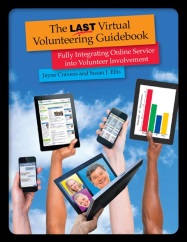
The Last Virtual Volunteering Guidebook: Fully Integrating Online Service Into Volunteer Involvement was published in early 2014. Now, six years later, is it still relevant? Oh, yes… I know because I’ve been testing all the principles offered in it over and over since it was published (as well as before it was published, when I was still writing it). My latest test: working with more than 150 online volunteers that participated in Knowbility’s 2019 Accessibility Internet Rally.

The book is the result of more than 20 years of research and practical experience by me, with heavy advice and observations by the book’s co-author, Susan Ellis. When we wrote the book, we wanted it to be timeless, like so many of Susan’s own books about various aspects of volunteer management. It’s not that I don’t still have things to learn about working with volunteers, online or off – I do! We all do. It’s that we believed strongly that certain principles would not change, and would be easily adapted no matter how the technology or even society evolved. These were principles that were explored in-depth at a variety of organizations when I managed the Virtual Volunteering Project at the University of Texas at Austin back in the 1990s, and they continue to be explored and tested – and proven.

For instance, I learned in the 1990s that the easier I made it for volunteers to sign up to volunteer, the larger the percentage of those volunteers that dropped out without even starting the assignment, let alone finishing it. But just putting in a simple second step that a candidate had to complete before they got to start on the assignment screened out the people who didn’t understand this was REAL volunteering and screened in the people who would take it seriously. It was true in 1998 and it’s true NOW, more than 20 years later.

I learned early on in studying virtual volunteering, a practice that’s been happening since the 1970s, and in working with online volunteers myself in the 1990s, that volunteers need to feel supported and valued or they won’t finish an assignment, or won’t finish it with the quality needed by an organization. In my role with Knowbility this time, I came on very late in the rally process, and because of that, trying to build trusting relationships with the volunteers that were already on board and get answers quickly to their questions proved quite difficult. The problems I have had with volunteers and that they had with their participation can almost all be traced back to that situation.

I learned early on, many years ago, that having expectations of volunteers in writing, online, both in role descriptions and in policies and procedures, was KEY to ensure both volunteers and managers are all on the same page as far as what’s happening and what’s needed, don’t get conflicting information, have a common place to look for guidance, etc. It greatly reduces conflict and misunderstandings, two factors which can lead to a lot of problems in volunteer engagement. Everyone isn’t going to read absolutely all of the support materials, but having it for referral is amazing in getting questions answered and conflicts resolved quickly. This lesson has been reinforced over and over over the years, including during this Knowbility event.

I’m thrilled to know my book is still relevant!

I have more than 100 hard copies of The Last Virtual Volunteering Guidebook in my possession and I would love for you to have one – or more! You can also order an electronic version. Yes, it’s available via Amazon, but let me be frank: I get far, far more money from the sale if you buy directly from me. Please consider doing so – buy one for yourself and for your favorite nonprofit!

Creating One-Time, Short-Term Group Volunteering Opportunities

I was shocked when I looked to see what page on my web site got the most visits in 2019. I knew that the most popular pages would be from the section of my web site for volunteers themselves, a section I started because I got tired of writing the same answers over and over to Frequently Asked Questions on YahooAnswers, Quora, Reddit, etc. I knew these pages would be the most popular because I post links to them constantly on those and other online communities. But tucked away in those web site visitor stats was this page, for programs that host volunteers, or want to:

Creating One-Time, Short-Term Volunteering Opportunities for Groups.

I haven’t done anything special to promote this web page. I post a link to it a few times a year on my various social media channels, I post a link to it if someone asks for advice on how to do it, but that’s it. And, yet, there it is, a hugely popular page on my web site in 2019.

So MANY different kinds of groups want a group volunteering experience where they feel like they show up, they volunteer, they have fun together, they make a difference, they get great photos, and then they leave. But he reality is that, for most nonprofits and community programs, these group volunteers aren’t worth the trouble to involve. Most nonprofits and community programs do NOT have volunteering tasks laying around that could be done by a large group of untrained, one-time volunteers – or even an untrained individual volunteer. Most organizations also do not have the money, staff, time and other resources to create two-hour, half-day or one-day, one-time group volunteering activities, especially for teens and children.

This is really hard for group representatives to hear, especially from corporations. The reaction is what?! you don’t have something for my group of 15 people from our marketing and sales departments to do this Friday from 10 to 12:30? No. No, we don’t. And you don’t have something in your marketing or sales department for a group of 15 temps to do from 10 to 12:30 either, so don’t act surprised.

My page has a list of possible activities for groups, but I also note that all of these activities, and any other group volunteering activities that aren’t listed, take many hours by the organization to prepare the site for the group of volunteers to show up, engage in the activity, and leave after two-to-seven hours – and to leave the site in such a way that the organization or program isn’t left with even more work for staff. That includes hackathons and program consultations. That’s why I believe your group should MAKE A FINANCIAL DONATION TO THE ORGANIZATION where you want to have your group volunteering experience. Yup: you need to pay money to the organization you expect to host your volunteering group, to cover at least some of the many costs they incur by creating this experience for your group.

My formula: donate $50 per hour your group will be there per staff member the nonprofit or other hosting agency will have to provide for preparation and supervision – regardless of whether or not that staff member is a volunteer or a paid person at the host organization. So, if your company or group wants a two-hour experience, and the volunteer hosting organization will need to have two people supervising and supporting your group, that’s $200. If your group wants a four-hour experience, and it will take just one nonprofit staff member, that’s also $200 your group is going to donate to the nonprofit. And, no, “in-kind” donations don’t count: it needs to be actual money.

I’m glad my page about volunteering activities for groups has proven so popular. I just hope it’s not just nonprofits and other volunteer hosting organizations that are reading it.

If you have benefited from this blog or other parts of my web site and would like to support the time that went into researching information, developing material, preparing articles, updating pages, etc. (I receive no funding for this work), here is how you can help

My top blogs for 2019

logo

It’s the time of year when I have a look at what people read most on my blogs. It helps me to know what resonates and what I might need to do a better job of promoting. Blogs that get a lot of traffic are the result of people who post about them on their own social media, or refer to them in a workshop they are doing, so if that’s you, THANK YOU.

I was quite pleased to see a lot of my blogs that have to do with communications, with community relations and with ethics end up in my list of most popular blogs this year – usually, the list is dominated by blogs related to volunteer engagement, which is fine, but I pour just as much energy into those blogs about outreach, so it’s nice to see that, this year, that reached a good number of folks.

In case you are wondering, I promote my blog through my Twitter account, my Facebook account, my LinkedIn account, some Subreddits, and some LinkedIn groups. I’m a one-person shop and create and promote these resources entirely on my own – and it’s getting harder and harder to get my voice out there in a sea of noise.

The visitor numbers are great – but the emails and comments on resources are what really keep me going, so please keep them coming!

What did I write that got people’s attention in 2019? Here’s the list:

Here’s to 2020!

If you have benefited from this blog, my other blogs, or other parts of my web site and would like to support the time that went into researching information, developing material, preparing articles, updating pages, etc. (I receive no funding for this work), here is how you can help

Before you recruit any volunteers

As the year comes to an end and things slow down at your organization for a week or two, this is a good time to think about reviewing some of the basics your organization should have in place to ensure you are getting the most out of your volunteer engagement and that volunteers are properly supported at your organization and feel like their donated time is being properly valued.

In fact, before your program recruits any volunteers – before you post anything to your web site or social media or a third-party site like VolunteerMatch, there are three things that I believe you absolutely should have in place first, and if you don’t have them already, this is a good time to get that taken care of. Having these three things in place will help:

  • ensure volunteers are engaged and supported appropriately – and that helps prevent volunteer turnover, misunderstandings, conflict, etc.
  • ensure volunteers are onboarded quickly – and that helps prevent volunteer turnover AND sets a tone with new volunteers that these are serious, real commitments.
  • inappropriate volunteers self-screen themselves OUT of your program – dropping out before they’ve gotten far along in your process and started an assignment. That means fewer people who drop out and leave you with unfinished activities and a scramble to get things done.

I get a lot of pushback when I try to implement these three things at any organization where I’m working – lots of complaints about bureaucracy and increased work, etc. But I regularly encounter a range of problems at programs where these three things are NOT in place, and I see just how much more work comes with NOT having these things in place. And, so, I’m going to keep saying it.

Here are the three things:

  • Have a mission statement for your volunteer engagement
    (Saying WHY your organization or department involves volunteers)

    This is at the heart of everything I say and recommend regarding volunteer engagement. This idea is what I would like to be identified with even more than virtual volunteering: that, in addition to carefully crafting the way you talk about the value of volunteers, your organization creates a mission statement for your organization’s volunteer engagement, to guide employees in how they think about volunteers, to guide current volunteers in thinking about their role and value at the organization, and to show potential volunteers the kind of culture they can expect at your organization regarding volunteers.
  • Required Volunteer Information on Your Web Site
    To not have this basic information about volunteer engagement on your web site says that your organization or department takes volunteers for granted, does not value volunteers beyond money saved in salaries, or is not really ready to involve volunteers.

If you have benefited from this blog or other parts of my web site and would like to support the time that went into researching information, developing material, preparing articles, updating pages, etc. (I receive no funding for this work), here is how you can help

United Nations site for people with disabilities is inaccessible

The United Nations Development Program (UNDP) created a web site for the United Nations Volunteers (UNV) initiative called the UNDP-UNV Talent Programme for Young Professionals with Disabilities. It’s a program to recruit people with disabilities to serve as UN Volunteers. Its web site opens with this: 

UNDP and UNV commit to leaving no one behind. As part of this commitment, the Talent Programme promotes the inclusion of persons with disabilities into our workplace. The Talent Programme also aims to build a talent pipeline of highly qualified professionals with disabilities who can contribute to the development sector, and to attaining the Sustainable Development Goals (SDGs) at national and global levels.

In addition to the grammar problem in the first sentence, the UNDP web site for this initiative leaves lots of people behind: the web site is not accessible for people with disabilities.
The web site does not meet even basic accessibility standards as outlined by numerous organizations, including the Web Content Accessibility Guidelines (WCAG). The UN General Assembly has designated the Department of Global Communications as the focal point for web accessibility in the United Nations, and this UN web site talks about the UN’s commitment to online accessibility – which, unfortunately, UNV and UNDP haven’t followed for their initiative specifically focused on people with disabilities.  How can an initiative that says it promotes the inclusion of persons with disabilities in the workplace exclude those same persons online? As someone who has worked for the UN, I know the answer to this question, but shall save that for another time…

Highly qualified professionals with disabilities absolutely can contribute to the development sector and to attaining the Sustainable Development Goals (SDGs) at national and international levels. In fact, they do already – if you don’t know that, you truly are not paying attention.

I have worked with highly-skilled people with a variety of disabilities – as employees, consultants and volunteers, online and face-to-face serving as web masters, editors, researchers, designers and more. It’s not unusual for me to find out someone I’ve been working with for weeks or months is, in fact, legally blind, or deaf, or is a person with limited mobility. We meet regarding what they CAN do, not what they cannot, and I’ve benefitted greatly, personally and professionally, from their expertise and talent.

I emailed representatives of UNV and UNDP in early December, saying pretty much the same thing I’ve just blogged, and I tweeted to UNDP and UNV as well. In my post, I also recommend to UNV and UNDP the nonprofit organization Knowbility to help their web designers and developers to fix this dire accessibility issue on the web site. 

I got a reply via email on December 11th from “Erik on behalf of the UNDP-UNV Talent Programme for Young Professionals with Disabilities”:

Thank you very much for your feedback. We are aware of the limitations of the websites and currently have teams working on projects that are focused on making them user-friendly and compliant with accessibility standards. Since we launched this initiative, we have been able to reach a wide range of persons with disabilities as evidenced by increased numbers of candidates registered and of applications. We also provide the option to reach out to us in person in case specific assistance or concerns are needed in the application process. As we are a continuously learning organization, our goal is to strive for a fully inclusive working environment and take every opportunity to improve. We appreciate your patience and understanding. Please let us know if we can further assist you in navigating the site.

So, in other words, they mean to say: the site is working just fine, people are applying for this program, people who can’t navigate our website can just email us and we’ll help them with the process, and being a “continuously learning organization”, we can’t be faulted for not having an accessible web site for people with disabilities for a program designed especially for people with disabilities at the get-go. Don’t bother us.

I really hope that UNV and UNDP will realize how bad this makes the agency and this program look, and choose to RAPIDLY remedy this situation regarding the accessibility of their web site for a program meant to increase inclusion of professionals with disabilities. They made a mistake – no excuses. Let’s hope UNV and UNDP not only fix this web site, but make a future commitment to digital inclusion in all of their web sites – especially those that are supposed to cater specifically to people with disabilities.

If you would like to let UNV and UNDP know what you think of the site and their response, I urge you to email these four addresses:

  • Talent Programme <talent.programme@unv.org>
  • Anant Sharma <anant.sharma@undp.org>
  • Anjali Kwatra <anjali.kwatra@undp.org>
  • UNV Media <unv.media@unv.org>

Also see:

What should be on a corporation’s website re: CSR

If your company has a corporate philanthropy program – it gives money to nonprofits, it supports nonprofit events by buying a table or other sponsorships, its employees volunteer as a part of a volunteer leave program or at events in partnership with the company – it should have at least a page on its website that offers an overview of these activities and your reasons for engaging in such.

Having corporate social responsibility information on a company’s web site not only helps communicate to people outside the company: it also helps a business’s employees to understand the company’s CSR activities and philosophy. Remember that ALL employees and consultants are potential messengers regarding a business’s CSR activities – they need to have a reliable reference point when friends, family and others ask them questions about their company. Having this information on the company web site ensures that there is a uniform message regarding CSR activities.

The link to a company’s CSR information can be on its home page, but most companies put the link on their “About Us” page. 

Here’s what absolutely needs to be on a company’s web site regarding its CSR activities:

  • A statement that provides an overview of the company’s CSR policy, especially with regards to its commitment to a particular cause or the community where employees work, send their children to school, etc.
  • An overview of what the company’s employees do as volunteers and how employee volunteering activities are structured (do they volunteer during company hours, as part of an official program or are employees encouraged to volunteer outside of work hours, but entirely independently? Is the company looking for volunteering opportunities that groups of employee volunteers can do together? Is the company looking for volunteering opportunities that groups of employee volunteers can do with their families?).
  • Information on how a nonprofit, non-governmental organization (NGO), school or other initiative can invite a company’s employees to volunteer with them.
  • An overview of how the company makes financial or in-kind donations, including sponsorships, and information on how a nonprofit, non-governmental organization (NGO), school or other initiative can apply for funds for financial and in-kind donations and sponsorships. If the company does not make financial or in-kind donations, nor purchase sponsorships, it should say so explicitly on its web site.
  • An overview of the financial contributions they company and employees make to the community – not just in donations, not just employee donation matching, but in tax payments to city, county, state and federal treasuries through tax payments.
  • Anything the company requires on the web sites of organizations it funds.

What can also be on a company’s web site regarding CSR activities:

  • An overview of what the company does to be a good to the environment. Does the company recycle materials that employees produce in the workplace? Does the company use recycled materials in its workplace? Does the company recycle all of its old computers, printers, smart phones and other electronics in an environmentally-appropriate way? Does the company have programs that encourage employees to carpool and use mass transit?
  • An overview of the company’s commitment to ethical business practices such as fair hiring, pay equality, safe working environments, adhering to fiduciary responsibilities, having an employee handbook with policies regarding harassment and discrimination, etc. If “corporations are people,” then this information is a must.
  • A statement of the company’s commitment to having an accessible web site, one that meets at least the basic guidelines for digital inclusion (videos are captions, people who have sight-impairments can navigate the web site because it’s been designed so that their assistive technology tools can navigate it, etc.).
  • Photos, videos and other updates about the company’s CSR activities.
  • Evaluations of the company’s CSR programs and their impact. What difference has employee volunteering made for nonprofits? Remember, that doesn’t mean a number of hours or a dollar value for those hours – it means how nonprofit clients or the community actually benefited from the time and talent.

It’s a good idea to invite representatives from nonprofits, charities and schools to provide feedback about a company’s online information about CSR activities. Can they find what they are looking for? Did they understand how to apply for funds – or understand that the company does not give financial donations? This can be done with a focus group or by simply offering a feedback form on the web site.

Look at the site’s web analytics regularly to make sure online CSR  information is being viewed and to see how web visitors are being directed to this information. Are they finding it using keywords in a search engine? From links from a certain page on the web site? Links from a nonprofit blog?

For more tips, see my list index of Corporate Social Responsibility (CSR) resources & advice for ethics, strategies & operations.

If you have benefited from this blog or other parts of my web site and would like to support the time that went into researching information, developing material, preparing articles, updating pages, etc. (I receive no funding for this work), here is how you can help

Call for papers on Marketing to Cultivate & Retain Donors, Members & Volunteers

Call for papers: special issue of International Review on Public and Nonprofit Marketing on marketing to cultivate and retain donors, members and volunteers. Submission deadline: June 15, 2020.

From the marketing blurb:

Charities and other nonprofit organizations rely upon marketing to cultivate and maintain relationships with supporters, without which most nonprofit organizations would not have resources to fulfill their missions.  Given the mission-critical need for effective marketing strategies and tactics in order to attract and retain supporters such as donors, members, and volunteers; this special issue is especially timely. 

Manuscripts that further our knowledge on cultivating and retaining support from donors, members, and volunteers are encouraged.  A wide variety of related topics are desired beginning with identifying prospects to deepening the commitment of supporters.  Theoretical, empirical, and literature review articles (including meta-analyses) are welcome.

Manuscripts should be prepared following the normal guidelines for the journal and should be submitted through the journal’s online system.  Please be sure to submit your manuscript for this special issue when submitting through the online system.

The guest editor is Professor Walter Wymer, University of Lethbridge, Canada and he can be reached at walter.wymer@uleth.ca – for more information, refer to the journal’s website at https://www.springer.com/journal/12208