Category Archives: Uncategorized

Forget pursuing a magical number of years of experience: here are things that will distinguish you when applying for humanitarian development jobs.

two shadows of humans talk together, with a globe behind them.

Most of the posts on subreddits like r/UNPath, r/InternationalDev (International Development) and r/Humanitarian are from people that want to know the magic number of working at a particular United Nations agency, or the magic number of internships, or the magic university degree that will land you a job at the UN or other big INGO.

Here are better ideas for distinguishing yourself when applying for these jobs:

  • Have experience doing locally what you want to do internationally. Want to work with refugees? Work, professionally or as a volunteer, with immigrants and refugees in your own geographic area/country – not just with food delivery, but with helping them enroll kids in school, helping a family member find a job, helping someone navigate enrollment in a government aid program, etc. Want to be focused on emergency housing? Work on initiatives in your own community that address emergency housing – not just after disasters, but also for people experiencing homelessness. Public health? same. And represent this work on your CV explicitly.
  • Have experience addressing community pushback or hostility or skepticism to ANYTHING. Could be a new housing development, the closing of a school, a proposal for a data center, the opening of a clinic providing abortion services, the opening of a mosque, the elimination of a program at the local school, changes in zoning laws, and on and on. Show that you have at least witnessed this kind of pushback / hostility for yourself and the efforts to address it – but having been a part of a committee dealing with such, or part of an advocacy group pushing for change, is even better.
  • Show experience where you have raised money, mobilized in-kind resources and/or saved money for a cause, a public school, a local nonprofit, etc. Even raising money for a for-profit endeavor is worth mentioning.
  • Show your experience to make and stay within a budget, stretch resources, etc. at a company or organization.
  • Show experience where you have worked with local elected officials, local unelected government officials, local business owners, etc. to change a rule, or introduce a rule or law, or to get them to collaborate on something.
  • Show experience working with programs that address the needs and challenges of a diversity of people and people who are particularly at-risk: people with disabilities, immigrants for whom your local language isn’t their native language, people leaving incarceration, people with HIV/AIDs, people who are in a religious minority in an area, seniors/the elderly, etc.
  • Survived a program or department or agency restructuring, downsizing or moving from one place to another? Or a radical rehaul of all software your agency used? Talk about it: were you involved in communicating layoffs? Organizing the packing up and moving of an office? Helping staff transition to the new system or new place?
  • Be able to work in at least one language other than English. Having proof, like passing the B2 DELE in Spanish, is really helpful. Being able to work in three languages is particularly attractive – even if you cannot communicate with a local population, being able to communicate with donors in their native language is very, very attractive.
  • Have designed and led a successful project: overseen the revamp of a web site so that it is mobile ready and fully accessible for people with disabilities, overseen and expanded a volunteer engagement program that supported literacy activities, expanded a children’s summer theater program, led a successful Women’s Build for your local Habitat for Humanity, researched and made recommendations regarding the walkability of a neighborhood or community, including with regard to people with mobility issues, helped lead a petition drive to change a local ordinance or law, led a successful voter registration drive, and on and on.

No one can have ALL of the aforementioned experience (and I laugh when someone tries to tell me that they have done ALL of the above). But any one of those things makes a person stand out when applying for jobs. Doing any of those things shows what you are capable of far better than a number of internships, or number of years in a role.

For those of you who have been on hiring committees, or reviewed applications for INGO jobs, what would you add?

And also remember: it is absolutely the worst time ever to pursue a career in international development. Foreign aid budgets have been slashed around the world. Many countries are impossibly behind in their United Nations dues. There is no amount of individual or corporate philanthropy that can make up that massive, devastating funding gap. You are competing for far, far few jobs than there were before 2022, and with far, far more people, many of them seasoned professionals. Have a backup plan.

If you have benefited from this blog or other parts of my web site and would like to support the time that went into researching information, developing material, preparing articles, updating pages, etc. (I receive no funding for this work), here is how you can help

America Gives, a nationwide initiative designed to make 2026 the largest year of volunteerism in U.S. history

America250, the official nonpartisan organization established by Congress to lead the USA’s 250th anniversary commemoration, launched America Gives, a nationwide initiative designed to make 2026 the largest year of volunteerism in U.S. history.

America Gives challenges businesses, nonprofits, schools, youth groups, faith-based networks, and organizations of all kinds to commit to increasing their volunteer efforts and measurable impact.

The initiative aims to build a movement of sustained impact — helping nonprofits expand their volunteer bases and inspiring individuals to continue giving back long after the fireworks fade.

America250’s National Co-Chairs are former Presidents Barack Obama and George W. Bush.

Americans can take the Year of Service pledge and log their volunteer hours at America250.org/America-Gives. A live national counter on the site will track participation in real time, showcasing the collective hours of service across all 50 states, 5 territories, and Washington, D.C.

Participants can easily record their hours by entering their volunteer activity details directly into the America Gives portal. They can also upload stories and photos to inspire others and explore opportunities to get involved.

Americans can also visit the America250 website at America250.org/America-Gives to find service opportunities near them and based on their interests. America250’s National Resource Partner, Points of Light, will help join interested volunteers with the right organization. 

For ideas for volunteering beyond volunteer matching databases, see this resource, which offers advice regarding volunteering with seniors, volunteering to support wildlife or natural spaces, how to create your own leadership volunteering activities and more.

2026 is also the 2026 the International Year of Volunteers for Sustainable Development. I’ve created a IYV2026 resource on my site that notes the origins of the year, highlights the accomplishments and resources of the first International Year of Volunteers in 2001, and links to the growing number of official resources. I hope it can be used both to help organizations prepare for IYV2026 and to compare resources now and then, to see how far we’ve come and how much more we need to do.

January 21, 2026 edit: turns out that there is ANOTHER initiative as well:  well-financed, privately funded initiative called the “Be The People” campaign. It’s funded by a mix of 50 philanthropic foundations and individual donors. According to this article on the PBS News site, “Be The People,” will not incorporate as a new nonprofit, but act more like a banner for groups to organize under and use to connect to resources.

How to Keep Immigrant Volunteers at Your Nonprofit or Community Program Safe From ICE

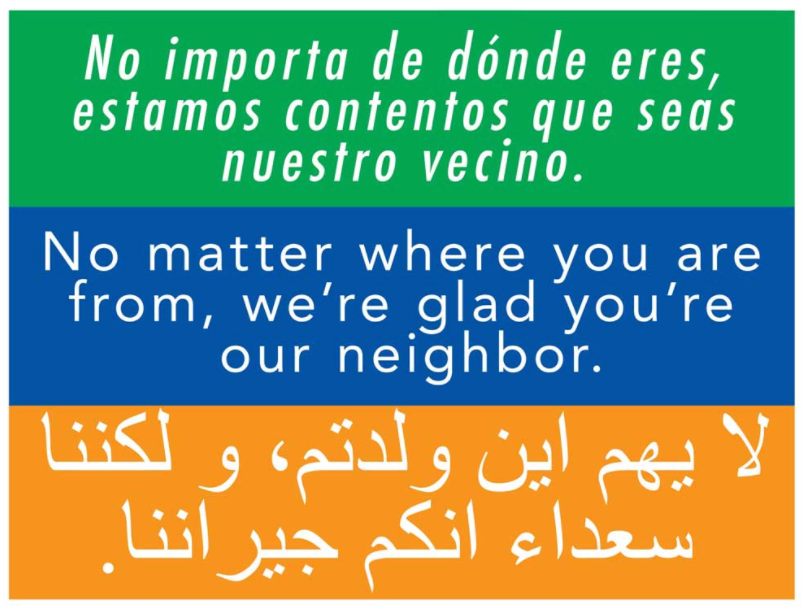
In three languages, the phrase "No matter where you are from, we're glad you're our neighbors."

Disclaimer: this is not legal advice. I am not a lawyer. Any activity incurs risk. The author (me) assumes no responsibility for the use of information contained within this document.

I don’t usually blog twice in a week, but this couldn’t wait:

In the USA, it is imperative that you keep immigrant volunteers, clients and employees safe from Immigration and Customs Enforcement (ICE), which has been documented frequently abducting people, many of whom have no criminal records and many of whom are in the USA legally.

Among the things you can do to help volunteers specifically:

(1) Be aware that volunteers who are immigrants may need to cancel their volunteering shift within minutes of it starting, in order to stay safe.

(2) Remove names and photos of volunteers who are immigrants from social media and your web site if you think there is any chance whatsoever of the information being used by ICE.

(3) Encourage volunteers who are immigrants to check in with their families frequently, such as every time they leave any location and when they arrive at any location.

(4) Have emergency contact information for all volunteers.

(5) Have sections of your work sites clearly marked as “Staff only” and “This area is closed to the public”, and make sure all staff know which areas these are and the different ways to access them quickly. Anyone – including ICE agents – can legally enter public areas of your business without permission, but not areas marked “private.”

(6) You may want to have a lookout specifically for ICE. For instance, perhaps you have volunteers building a house, or cleaning up a yard. Put up signs that say “Private property” on such outdoor sites and have someone, even two people, whose role is to watch out for ICE and to warn others if they suspect ICE agents approaching.

(7) Train all staff on how to quickly warn everyone on the premises that ICE may be entering the building or worksite (whistles are very effective) and how to direct people to private areas.

(8) Train your staff to NOT TALK to ICE agents. A worker can say, “I can’t give you permission to enter this private area. You must speak with my supervisor.” Practice – just like a fire drill.

(9) Immigration agents can enter a private area ONLY IF they have a judicial warrant. A judicial warrant must be signed by a judge and say “U.S. District Court” or a State Court at the top. Without a judicial warrant, ICE agents need YOUR permission to enter private areas of your business. If ICE agents try to enter a private area, you should say: “This is a private area. You cannot enter without a judicial warrant signed by a judge. Do you have a judicial warrant?” If ICE agents tell you that they have a judicial warrant, ask for a copy and read it. Sometimes, ICE agents try to use an administrative warrant to enter. But an administrative warrant does NOT allow agents to enter private areas without your permission. Administrative warrants are not from a court. They say “Department of Homeland Security” and are on Forms I-200 or I-205. (5) Connect with immigration response networks in your area. Look at their social media and web site and if they have a workshop on dealing with ICE, go to it.

Much of this advice was adapted from What to Do If Immigration Comes to Your Workplace from the National Immigration Law Center and the National Employment Law Project.  

Here are more of my resources on related topics:

The key to success in using online tools in nonprofit work is…

The reality is that nonprofits that did well pivoting to online meetings, online service delivery and virtual volunteering during the pandemic, and that continue to successfully leverage online tools, are those that already had excellent relationships with employees, volunteers and clients before the pandemic. They are those that already were well-managed and had excellent communication among teams and partners and the public, and that came from trust and a commitment to their staff and supporters, not from being techies. Their success was about the trust they had cultivated, not the technology they used.

No, I haven’t done academic research on this and I have only my own experiences and anectodal observations to back this up. But I have seen and experienced enough to know it’s true. You do too.

And these same successful organizations, most of them quite small, won’t stop using online meetings, online service delivery and virtual volunteering, even as they re-introduce onsite meetings back into their work. Because they know what works and they want to do the best they can to support staff and clients.

If your organization isn’t doing well adopting a new tech tool or using what it has or leveraging social media, the problem may not be your understanding of tech – it may be your lack of understanding of your own organization and its people.

cover of Virtual Volunteering book with hands raising up various Internet connected devices

For more advice on virtual volunteering, including how to cultivate trust among volunteers, employees and clients in such relationships, have a look at The Last Virtual Volunteering Guidebook. It’s the most ultimate guide to digital engagement and it’s available both as a traditional print publication and as a digital book. And if you buy it directly from me, the last two boxes in my closet will soon go away! And your copy will be signed with best wishes from me! I also get a bit more money than if you buy it from Amazon (and it’s slightly cheaper to buy from me as well). Note that if you buy two or more books, you get an additional book for free!

Also see:

If you have benefited from this blog, my other blogs, or other parts of my web site and would like to support the time that went into researching information, developing material, preparing articles, updating pages, etc. (I receive no funding for this work), here is how you can help