Category Archives: Career advice

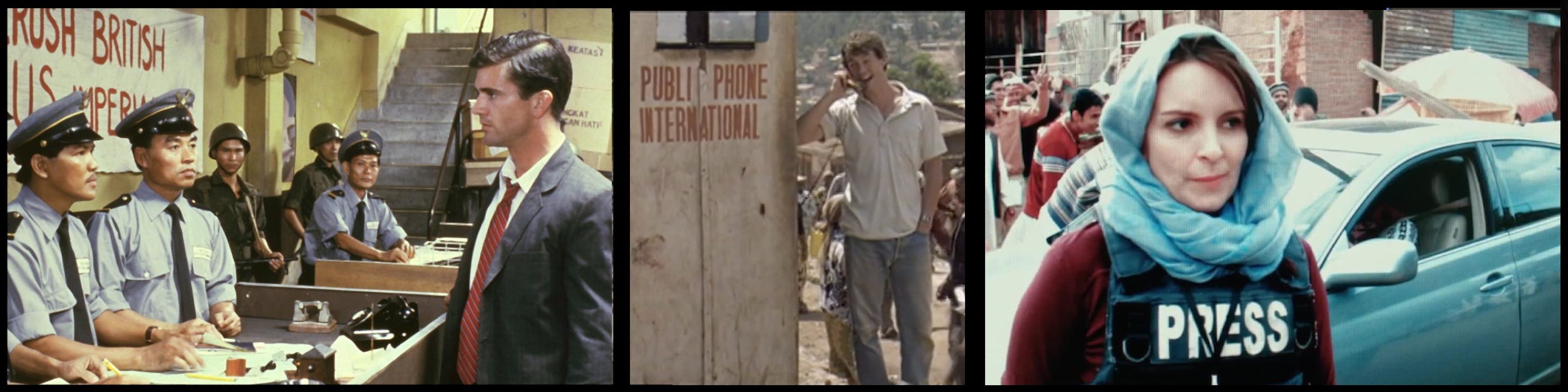
Movies I recommend if you want to do international aid work, foreign affairs or journalism abroad.

Three scenes from the movies listed. The first is a white man of European descent facing several angry Asian uniformed officials, the second is a white man using a phone in the middle of a chaotic African village, next to a wooden sign painted with the words "Public phone international", and the third is a woman in a head scarf and also wearing a vest that says PRESS, with shouting men and a car behind her.

For all of this month, each week, I’m publishing a blog focused on working in international humanitarian affairs and community development. This is part three of that series.

I know that, for many people, their career, or their career dreams, of working internationally in humanitarian development, or even as a journalist, are on hold. In fact, I’ve recommended that people who are pursuing a career in international development to rethink those plans. But the world cannot function without international aid workers and without international journalists. And maybe everyone needs to have a reality check on what the work REALLY looks like.

I’ve been thinking of this for a while: what movies would I recommend to someone who wants to work in international humanitarian development, in foreign affairs, or in journalism abroad, to give them an idea of what conditions and challenges are like? Or what movies do I think represent what it’s like to work “in the field” internationally, as we say?

Below is my list, in the order the movies were released. Most are not uplifting. Most are quite dark and even depressing. None are idealizations of aid workers or journalists: the people featured are flawed and white saviorism is on full display in many of them (and often not in a kind way). But, to me, what they collectively do is let you know that “doing good” and living abroad in country’s in post conflict situations and experiencing instability and poverty is not as easy as you might think, and not everything you see on the TV news is to be believed.

Black Narcissus (1947).

The Third Man (1949).

The Year of Living Dangerously (1982).

The Killing Fields (1984).

Volunteers (1985).

The Mission (1986).

The Constant Gardener (2005).

Shooting Dogs (2005).

The Whistleblower (2010).

A Perfect Day (2015).

Whiskey Tango Foxtrot (2016).

The Night Manager (2016 – mini series).

A good source for more movie ideas are these movie lists from the Council on Foreign Relations.

Which are my absolute favorites? What if I could recommend only two? The Year of Living Dangerously and Whiskey Tango Foxtrot.

What would be your recommendation for films that are good representations of working abroad in humanitarian affairs or as a journalist – or even if they aren’t accurate, you enjoy them?

All of my blogs with career-related advice are here. What I have written lately may be in conflict with some of the things I’ve advised over the years. But I never saw this coming… Here are some highlights:

If you have benefited from this blog or other parts of my web site and would like to support the time that went into researching information, developing material, preparing articles, updating pages, etc. (I receive no funding for this work), here is how you can help

Working abroad is not always looked on positively when looking for a local job

two shadows of humans talk together, with a globe behind them.

For all of this month, each week, I’m publishing a blog focused on working in international humanitarian affairs and community development. This is part two of that series.

Even in this climate of drastic cutbacks in foreign aid programs around the world, not only by the US government, many people want to work in humanitarian-related fields abroad. Many believe that such works means life-long employability, because they think international work is always perceived as a plus on a résumé.

I’m oh-so-proud of my work abroad, or my international work that I’ve been able to do while still in my home country, but my international work has not at all been the “wow” on my CV I thought it would be. In fact, sometimes, I think it has cost me some job interviews, and I am pretty sure it cost me at least two jobs I interviewed for. And the more I talk to others, the more I have realized that not all employers look favorably on work or volunteering abroad.

For years, I’ve gathered negative comments others have heard in job interviews with regard to their service abroad. Here’s a few that I think represent all that I’ve gathered. I’ve changed some comments slightly so that where they were said can’t be easily found with an online search.

I have been asked twice in interviews, almost with a scoff, “But why do you want to work HERE when you’ve done all this work abroad?” One of them followed up with, “Well, I just feel like if we hired you, you might run off at any moment to go back overseas.” Never mind that I had just bought a house – which I noted in both the interview and my cover letter.

I was giving a behavioral interview example using my time in the Peace Corps, and one of the panel interrupted me and told to instead pick an example from my “professional career”.

I had someone in an interview tell me it was a mistake to go off to Africa early in my career when I could be using my degree and learning the trade for the job I was interviewing for.

One interviewer just kept saying he feared I would be bored, because working at this local government agency would be COMPLETELY different than working abroad. I don’t think the interviewer had ever stepped out of his state, let alone the USA. And never mind that the work I would have been doing locally would have been almost identical to what I had done in other countries.

Two different interviewers implied I must not like the USA if I worked abroad. I wasn’t prepared to prove my patriotism in job interviews.

I have lots of advice for translating humanitarian work abroad such that it you present it in the same words as a federal, state, county or city job posting. But the reality is that, even if you were to follow that advice, you need to be prepared, if you are making the transition from international to local, that some folks don’t see how the work is oh-so-similar, and your work abroad may even make them suspicious of you, no matter how you phrase it. You may have to apply for far more jobs than you thought you would have to, to find hiring managers that see international work as an asset.

For sure, some regions are more friendly to international workers than others. In the USA, you are going to have a better reception from potential employers in the greater Washington DC and New York metropolitan areas, for instance, than you will in some other areas where there isn’t a large number of international agencies.

It’s such a shame that more local government agencies in particular don’t see international work as an asset among applicants. They are losing out on a tremendous amount of talent, ideas and experience.

All of my blogs with career-related advice are here. What I have written lately about working internationally may be in conflict with some of the things I’ve advised over the years. But I never saw this coming… Here are some highlights:

If you have benefited from this blog or other parts of my web site and would like to support the time that went into researching information, developing material, preparing articles, updating pages, etc. (I receive no funding for this work), here is how you can help

US Citizen? Planning a career in international humanitarian affairs? You might want to rethink it.

two shadows of humans talk together, with a globe behind them.

For all of this month, each week, I’m going to write a blog focused on working in international humanitarian affairs and community development. This is part one of that series.

If you’re a US citizen with the goal of working in international humanitarian affairs or community development, even disaster relief, in impoverished regions not in the USA, it’s time to pick a different career.

The US Presidential order withdrawing the USA from 66 international organizations, including many United Nations agencies, means US candidates won’t be considered for most international development jobs. When qualified applicants are identified for such jobs, hiring managers will then look at the nationalities of those applicants, per the funder’s preferences. And the USA isn’t funding.

I used to work for the United Nations, and I was on a fair share of hiring committees. In my department, I was often the person who went through the stack of applicants to pick only those who were absolutely qualified, because I was really good at it (I was amazed at how others couldn’t figure out how to rank people). But then someone else would go through that first round of finalists and remove a person or two specifically because of their nationality – a nationality that the government funding the position didn’t like. Or was at war with. And if there was a qualified applicant from the country funding the position, very often, that person got the job.

The current US Presidential administration has not only withdrawn financial support for international humanitarian work, the leader has said vile things about the people and leaders of dozens of other countries. This can result in targeted hostility toward someone from the USA even if they do not at ALL support the current administration – so many international organizations will just avoid any potential problems entirely and not consider job candidates from the USA.

Even if a new administration in 2029 starts reversing the disastrous policies of the current President and his staff, the damage that has been done now is long-term and will take MANY years to undo. Why should another country believe any plans of the USA? Better to partner with other countries. That means that, despite the fact that there will always be a need for international funding for community development, environmental protections, help for refugees, job development programs in underserved countries, etc., what jobs are available are, more often than not, closed to citizens of the USA, and I don’t see that changing for at least the next five years even if the current administration changes..

Studying international development is a wonderful experience, and I hate advising anyone to not do it. I have a Master’s Degree in international development management, and while it was difficult and stressful and consumed my life outside of work for three years, it also made me a much better professional in a thousand ways. It not only helped me in my work with international agencies, it also made me more effective in working for nonprofits in my own country, particularly small ones. It’s made me a better citizen of my local community as well as the global community – I really believe that. I applied for work with several government agencies here where I live in Oregon because I knew that my Master’s Degree, as well as my work experience in various development initiatives in various regions around the world, made me well-prepared for local government work – and, plus, I really wanted to do it. But I quickly found out that working abroad is not always looked on positively when looking for a local job – my next blog will be about that. So if you are thinking your international development degree will help you in other work – it might not (even though it should).

If you are in the USA< should you chance it and still pursue a career in international humanitarian development? Only if you have a very strong backup plan for if it doesn’t work out, and only if you are ready for the long haul in terms of actually getting into the field – like, 10 years from now.

All of my blogs with career-related advice are here. What I have written above may be in conflict with some of the things I’ve advised over the years. But I never saw this coming…

For people in the USA, if you can afford it, I hope you will consider pursuing a two-year gig in the PeaceCorps (which I hope will survive the current administration), or participating in a short-term program like Habitat for Humanity’s Global Village program; I have a list of international development volunteering programs here. Or, when you travel abroad, make a deliberate effort every day toward transire benefaciendo: to travel along while doing good. If you do any of these things, be a living testimony that contradicts the things said and done by the current administration, and showing that not all US citizens are anything like the current administration.

Also, if you have a UN Association in your area, or an affiliate of the World Affairs Councils of America, join it, and go to their meetings. Come together with others in your own community that think globally. At the very least, you will know you aren’t alone.

And, finally: I hope I’m wrong. I really do. But I’m trying to be realistic, no matter how much it hurts my heart.

What some nonprofits ask for in job candidates is ridiculous.

a simplistic drawing of a wizard

Within one week, I saw three different job announcements at three different mid-size or large nonprofits that, altogether, were what I did part-time at a small nonprofit for the last three years. And much of the activities in each of these roles are, altogether, what I have done at nonprofits for the last thirty years.

What each job listed for qualifications was so specific that the organizations are going to end up excluding MANY qualified people – and, probably, the best person for the job. Despite my extensive professional background, despite being expertly qualified for some positions, I don’t even bother applying because so many people don’t see a journalism degree as something desirable now.

When your small or medium-sized nonprofit is looking for someone to be a videographer or photographer, who you are going to pay a salary FAR below the market rate, what you need from job candidates is work portfolios, not a degree in videography or photography. Same for a web designer or a graphic designer or a communications manager and many other positions. And for education, what you may need most is graduation from a recent certificate program, not a full-fledged BA. You need people who can do the job, and since you cannot afford to pay people with the training and experience you are demanding, you need to adjust your expectations.

There’s a better way to attract and screen candidates for roles where the person will produce communications pieces – and will do the job you need done:

(1) Ask applicants to note in their résumés or applications where (in what professional and volunteer positions) they used the tools or produced the projects or demonstrated the skills you are asking for. If your job involves setting up press conferences, or designing web sites, or managing web sites, or designing brochures, or distributing brochures, etc., ask applicants to note in their résumés or applications where they have experience doing that.

(2) Note that you will be asking later for online portfolios from the top 10 candidates, what you will want in those portfolios, and approximately how many weeks you will contact the top 10 candidates to ask for those portfolios. Note how many people you will choose to interview from those top 10 candidates and approximately when those interviews will take place. If someone doesn’t already have the material for a portfolio, they aren’t going to apply – and if they do, they now know they need to make sure their portfolio is full of fantastic examples of their work.

And if you are going to demand that the person use certain specific software – Adobe Photoshop, Lightroom, Premiere Pro, After Effects, Illustrator, InDesign, Final Cut Pro, etc. – then you had better say what YOU are going to provide the selected candidate. What kind of laptop or desk top are you going to provide? Running what software? What kind of camera are you going to provide? Do you have a quiet room for creatives to create and edit? Are you committed to web accessibility and will give your web designer the tools needed to make that happen?

Be flexible in asking for a degree. I know amazing photographers with English degrees. I know very talented videographers with music degrees. I know kick-ass web designers with philosophy degrees.

And, finally: what you see as an entry-level job may be, particularly for seasoned professional in their 50s or 60s, a way to work for a few more years, work at a pace that is better suited to their life now than the senior and executive positions they held in the past, and apply a vast amount of skills and experience that your organization may be in much more need of than you might think. If you are thinking, “Oh, but what about health problems they might have?”, then also consider that it’s likely that candidates in their 50s or 60s aren’t starting families in the next few years, aren’t going to quit to pursue other, better job opportunities, and aren’t going to move across country to get married. And they are no more likely to have home-care obligations than a 30 something.

If you have benefited from this blog, my other blogs, or other parts of my web site and would like to support the time that went into researching information, developing material, preparing articles, updating pages, etc. (I receive no funding for this work), here is how you can help

Work & volunteering advice: don’t leave it all on the field every time

I attended a fantastic workshop on video editing several weeks ago. One of the things the instructor said has haunted me – and not just regarding video editing. He said that you need to NOT fall in love with whatever video you are making. Instead, you have to make the video, do work you can be proud of, post it, and then MOVE ON. But do NOT pour your heart into it and offer it up with the highest of hopes that all of your hard work and artistry is going to be popular or even acknowledged – because more than likely, you will get just a couple of “likes”, if you’re lucky. That’s it.

I pour my heart into my professional work. I do most projects as though I am doing them as a model for others. I relish in anyone acknowledging that they see my determination and skills in my work. In fact, I live for it. And my heart gets broken repeatedly.

Leaving it all on the field or court after every game is something that man fans and sports commentators admire, but it’s not a healthy approach to every day work and volunteering. I’m not sure I’ve experienced any benefits at all from just how much love and care I’ve poured into my work over the years – or even in the work I do now.

A few years ago, hungry to make some community connections and really missing any sorts of arts in my life outside of movies, I decided to apply for a citizens’ advisory group for a local government body regarding the arts. The role was simple: review applications from area arts organizations, very very small groups, entirely amateur, choose who gets what tiny sum of money, and attend a celebration at the end of the year where performing arts grants recipients perform. Perfect! I would get introduced to a big array of various dance, theater, music and fine arts groups and partake in their work. There would probably also be snacks.

I really enjoyed the first year, especially the grants celebration! Yes, there WERE snacks – and some beautiful performances.

I was shocked when one of the members asked me to be the chair for the next year. She said all the longer-term folks had done it already and I was “fresh” and I’d seen how it works, how much fun it was. So, yeah, okay! I said yes. COVID was in full swing, but we were having meetings online, and they were working WAY better than our face-to-face stuff, so I was quite happy to take on this volunteer leadership role.

At the very first meeting I ran came the bombshell, which the person who talked me into serving as chair swears she did NOT know was coming: our little advisory committee was losing its administrative support from the local government, and we had to form an independent 501 (c)(3) in 12 weeks if we were to continue.

I worked 20 hours a week for six months, identifying priorities, keeping track of who was doing what, scheduling meetings, opening a bank account, researching and drafting by-laws, drafting the web site content and then designing the simple site, working with our new fiscal agent, reading over the government requirements, researching grants management software, designing Google forms and spreadsheets for the data generated, and running meetings. I poured my heart into it.

One member of the committee didn’t like how I was doing things and would question every sentence, every detail, every suggestion, all of which came from hours and hours of research – but never offer to take over any task and work on it outside of meeting time. During one particularly horrible meeting, he insulted me during a long speech about how he didn’t like something I had drafted and, at last, I stopped him. I don’t want to get into details, but before the entire group, I calmly but FIRMLY told him he was going to stop that immediately, that his language and accusations were beyond inappropriate, and I wouldn’t continue for one more minute. He backed down. After that meeting, like so many other meetings, I sat at my computer and wept. Yes, I cried. At least two members wrote me to say they were so, so sorry at what I had just experienced. But they didn’t speak up at this or any other meeting.

The whole experience was grueling, degrading and soul-crusing. And I didn’t feel any sort of passion or love for this. Why did I stick with it? Because I have this ridiculous sense of duty and honor and pride when I take on a role: I’m going to see it to an appropriate conclusion and do my absolute best every moment and THEN walk away. Heaven forbid I inconvenience anyone, just because I’m being repeatedly insulted and overworked! At least I’ll have the knowledge that I did what I could and did my best!

Insert eyeroll here.

I wish I’d said, “F*ck ’em.” Because all but maybe one person on that committee, and no one in the government, saw the hours I was spending on what was supposed to be a simple community volunteering job, and that I was doing absolutely all that was necessary, in RECORD time, to see that this committee would get to continue its work and that small arts groups in my area would continue to receive a bit of funding each year.

I told the other members I would not be continuing on the committee once my term was up. I recruited six more board members, all under 45 – something the board said it wanted, since others were resigning at the end of the term as well and a need for younger minds was very much needed. I interviewed them and onboarded them, trying to give them as much support as I got when I first joined. I chaired my last meeting, introducing the new members, and then I walked away.

There was no real thank you and no acknowledgement that I’d undertaken a part-time job, for no pay, for much of the year to preserve funding for small nonprofits and to create a model that would allow the committee to get back to reviewing grant applications, awarding money and celebrating at the end of it all. In fact, what I felt mostly from the others was hostility at how demanding and pushy I’d been – something that was absolutely required to get all this done.

I kept all those emails and drafts and files from this experience. I went back and looked at them this week. The work takes up more storage on my computer than any one consulting job I’ve ever done.

I threw most of it away at last.

This is just one of MANY examples I could offer regarding having my heart broken because I wanted to do the BEST job possible. In fact, I’m doing this again now, professionally, for my one and only client, and I’m realizing that I need to stop. I need to scale back. I’ll always do work that I can be proud of and that a client and employer deserves. But do they deserve my absolute, tireless BEST, every time? Not for this pay.

I know that I am one of the best people out there for small nonprofits regarding leveraging social media, for crisis communications, for general public relations and marketing, and for donor cultivation, let alone volunteer engagement. But there comes a time when you have to say, “I’ll do just this much, and then stop. Because I’m not getting my heart broken at work anymore and the pay certainly is NOT worth it.”

Life’s too short. Time to play some piano.

Also see:

If you have benefited from this blog or other parts of my web site and would like to support the time that went into researching information, developing material, preparing articles, updating pages, etc. (I receive no funding for this work), here is how you can help

What’s the future of international humanitarian development & foreign relations careers?

two shadows of humans talk together, with a globe behind them.

The panic is real. Thousands and thousands of people are losing their jobs, entire agencies are shuttering and their property being sold off, contracts for funding are not being honored, and jobs in international humanitarian development and foreign relations are being eliminated.

In addition to the lives being upended and the financial hardships on both those working in the sectors and those served by such, there are many thousands of young people who are studying at the university level for careers in international humanitarian development and foreign relations – and they are panicked.

Here’s some advice for those affected by the cuts:

As I was in year three of my journalism degree back in the late 1980s, newspapers started being consolidated. There were far, far fewer jobs for journalists than there were when I started the degree. And “life time” jobs were ending: I’d never expected to have one job for life, or even one job for many years. But I started to panic about the changing job landscape. I wondered if I’d made a horrible mistake in my major.

I started exploring other careers, and realized, via an internship my senior year, that I really loved nonprofit marketing far more than journalism. So I stuck with the major, but in terms of my job search, I pivoted. I ended up in a much more satisfying career, one that VERY much appreciated my journalism degree, and one where I used what I learned in getting that degree over and over and over.

I still use that journalism degree in my work. I still leverage it.

The pundits were, indeed, correct in their predictions: newspapers are now few and far between. Sources for news, curated and written by professional reporters, are so, so fewer than even 10 years ago, let alone 40 years ago. And the pundits were right on another front: I have never had the same job for more than four years.

But there is a difference between newspapers and humanitarian development, as well as foreign relations: if there is a need for humanitarian assistance, then there will be jobs in humanitarian assistance. And if there is a need for foreign relations, there will be jobs in foreign relations. And I believe both of those needs will always exist. It’s going to take time, however: it’s going to take things to get really, really awful. There’s going to be a great deal of harm and death before people realize we either ALL sink or swim.

I have a Master’s in International Development. I worked for years in that field and loved it. But now I’m working for a small nonprofit in rural Oregon, and the things I learned in this degree, as well as what I learned on the job internationally, still deliver for me, hugely. Turns out rural Afghanistan and rural Oregon have a lot more in common than you might think.

Yes, right now, the humanitarian job sector is drastically shrinking. The foreign affairs job sector is also drastically shrinking. But the need is not. The need is, in fact, increasing. Eventually, the sectors will start expanding again, because people, even for-profit businesses, will start needing the services of such, and realize AI cannot do it: AI cannot convince rural farmers to stop growing poppies, or convince women to change a traditional but dangerous baby-rearing practice, or train government workers in how to build trust with their constituencies, or manage a refugee camp effectively. AI cannot humanely negotiate nor manage anything.

There are no guarantees for international development jobs with one particular degree. There are no guarantees for any jobs with any particular degree. So quit stressing over which degree to choose. My advice for the last few decades remains the same: study a subject because you love it and want to immerse yourself in it, because you want to be all but married to it. And then find a way to leverage that degree when you graduate.

The key to job success is flexibility and adaption. It’s been this way for the last few decades. And you may end up working in a field that, at least initially, doesn’t seem to have anything at all to do with the field you studied. But I have to say: I sure know a lot more successful, fully employed folks who majored in theater or music – even if they aren’t working in those fields – than I do people who majored in some aspect of computer science.

And as for AI, sure, learn to use it edit emails and reports – but then re-read that email and report carefully, because AI constantly, regularly messes things up. AI is, and will remain, lousy at compiling accurate information, because of the volumes of misinformation online. Being able to identify accurate remains a human strength, as does building trust with others and creating things that are unique and original.

If you have benefited from this blog or other parts of my web site and would like to support the time that went into researching information, developing material, preparing articles, updating pages, etc. (I receive no funding for this work), here is how you can help

Why Work for the United Nations? & What is Working the for UN really like?

Three years ago, someone on Reddit wrote on the subreddit UNPath, “Why Work for the UN?” Their post said:

What is the appeal? It seems very difficult to even get in at all, regardless of qualifications. So why try? I am studying a field that would probably be perfect for the UN but I’m not sure why it’s actually even appealing or worth trying to get in.

Here’s my reply from then, with some edits for clarity:

A lot of people want to work for the UN because they believe all sorts of myths – UN employees get to travel the world, you get paid a huge salary, you get a special passport, everyone is impressed that you worked at the UN and will want to hire you, etc. In fact, most UN employees don’t travel for work, don’t get a “huge” salary and don’t get that special passport. And some people, including employers back in your home country, view working at the UN as some weird thing – or will say to you, “But you worked at the UN, so why are you now applying for a boring normal job?”

Spoiler alert: a lot of UN work is really boring and normal.

I’m suspicious of anyone who says, “I want to work at the UN” on this subreddit or in a cover letter and leaves it at that. It’s like saying, “I want to work for a mega huge software company.” It doesn’t tell me anything about what work you actually want to do. It sounds like you just want a certain company on your CV. But what kind of WORK is it you want to do?

The nature and atmosphere of work for a UN employee in Bonn, Germany working on government policy recommendations for climate change is nothing like the nature and atmosphere of the head accountant that’s been brought in from abroad to work in the UNICEF office in Afghanistan. They might as well be working on different planets. Most UN jobs are administration – you’re sitting at a desk, not driving orphans to safety.

Why do I like working for the UN as a communication professional or project manager? Because the work feels very much like it matters and is making a difference on a scale far bigger than just in one community. Because I love reading country strategies and program strategies and interviewing a diversity of staff to try to represent their work. Because I love taking photos of the work my colleagues are doing and then sharing those photos in a variety of communications materials. Because I love helping people understand the benefits and impact of development projects, from earthen dams to repaired bridges to work training programs to HIV AIDS education programs to micro loans and on and on and on. Because I love working in multi-cultural environments or in an environment filled with local people staffing most of the posts in a developing country and getting to help build their capacities. And, indeed, the pay is competitive, far more than doing that exact same work for a nonprofit.

My UN job in Bonn, Germany was mostly at a desk. I met a ton of interesting people from all over the world, but I rarely traveled for work. Most of my colleagues didn’t travel for work. My jobs in Afghanistan and Ukraine were spent mostly at a desk, trying to rapidly prepare material for very demanding funders from various foreign governments – in one I had to be taken to work in an armored car and couldn’t leave the work campus except to leave for the day, nor leave my home except with approval. In the other, I could walk to work, go out with colleagues after work, go to street markets and live life like anywhere – except on the days when there were potentially violent protests. But even on “boring” days, the work always, always felt like it mattered. But note: a lot of colleagues, doing very similar work, didn’t feel energized by it – it was just a job.

As for it being difficult to get in – I have to say, most of the people I see here wanting a job in the UN don’t offer anything to show any qualifications at all for working at the UN. They seem to think there’s some sort of magical master’s degree or PhD that gets you “in”. Or some magical way to phrase things in a cover letter. And as a person that often was the person who went through a stack of CVs to pick who would get interviewed, it was soooo easy to disregard 80% of applicants, because they so clearly did NOT have anything in their CV that showed they had all – and I mean ALL – of the skills and experience asked for in the job description.

End of my reply on Reddit.

A lot of this could be said for why I prefer working for nonprofits or government agencies, rather than in the private sector: because it feels like the work matters, even if it’s at a desk most days. I like helping a specific community, including the one that’s all around me currently. And the differences between rural Oregon and rural anywhere else aren’t as great as you might think.

Also see:

If you have benefited from this blog or other parts of my web site and would like to support the time that went into researching information, developing material, preparing articles, updating pages, etc. (I receive no funding for this work), here is how you can help

Webinar: Careers in International Development

Images, in the style of petroglyphs, of people doing various activities, like writing or construction.

In late August, I had the honor of presenting a live webinar for the Beyond Africa Podcast. You can see a recording of the webinar on YouTube. You can also download the slides I used and see resources I used in the webinar and that I encouraged people to view after the webinar here on my web site.

The webinar opened with a question I have never been asked: why am I doing this? Why am I posting on r/UNPath and other online communities about how to work in international development? As briefly as possible, and among other reasons, because I don’t think there’s equity in who know about and has access to careers in international development, including at the United Nations. You can hear my full answer by listening to the webinar.

Please note that I did this pro bono for this group, but that I usually charge for my consulting, including delivering trainings.

Yes, you CAN get experience for entry level UN positions in your own community

A frequent lament of people on online groups who want to work for the United Nations is “It’s impossible because there’s no way for me to get the experience needed.”

Bollocks.

I’ve addressed this before in blogs such as

These aforementioned blogs are about how to get expertise that can be applied to UN positions, usually at the P level and above.

But a lot of people want to work at a headquarters or break into UN work at the administrative level. They claim the aforementioned doesn’t apply to them and then, again, say, “It’s impossible for me to get the experience necessary.”

I spent an hour going through G-level positions currently being recruited at some UN agencies. I then made a list of some commonalities in the positions, which I have listed below, stripping out UN-specific references. And as I read through these, it was obvious to me that:

  • If you have been a longish-term leadership volunteer in your community, managing other volunteers, in any project – Habitat for Humanity, Meals on Wheels, an NGO that helps refugees, a children’s theater camp, a hospice, a food bank, etc. – you have probably done most of these activities.
  • If you have been a successful Girl Scout leader for more than two years, and been on the board or core organizers of your service unit in that time, you have probably done most of these activities.
  • If you have been a leadership volunteer at a local farmer’s market or artists cooperative for an entire season, you have probably done most of these activities.
  • If you have been on the board of a nonprofit for at least a year, you have probably done most of these activities.

Often it’s how you frame and phrase your responsibilities on your CV and applications as to whether or not you look qualified for a position.

I was part of a hiring committee that hired a guy with extensive hotel management experience for a G level administrative support position: his procurement skills, his experience in dealing with conflict, his organizational skills, his multi-language skills, his client-focused mindset and his experience with international clients were all represented on his CV , explicitly. He was an incredible and perfect fit for the job (he did also have a Master’s degree – I think it was in business).

Job responsibilities that show up on a lot of G-level positions that you can learn through leadership volunteering and through most administrative jobs at nonprofits and local government agencies as well:

  • Schedule internal and external meetings and events, and communicate these dates, or possible dates, to the team/partners.
  • Assist in organizing events, workshops, webinars, launches of publications, seminars, conferences and campaigns.
  • Support the team with planning and implementing of operational activities.
  • Gather relevant and corresponding data (socio-economic, gender, etc.) needed for project development, proposals, reports, presentations, etc.
  • Support activities contributing to the regular communication with project partners to monitor deadlines, commitments made, actions taken, etc.
  • Support in mapping and identifying relevant stakeholders or desired audiences or potential partners.
  • Populate and maintain a database of potential partners, or area NGOs, or area small businesses, or some other needed data set for a project.
  • Review and proofread drafts of reports, drafts of online materials, etc.
  • Closely follow up with other staff, consultants, partner organizations, etc. regarding collaborative projects, data, etc.
  • Review reports developed by others and edit/contribute as needed.
  • Verify the accuracy and validity of research conducted or feedback provided by others.
  • Continuously monitor and collect all data indicators relevant to the project.
  • Provide support in the dissemination and sharing of relevant data and lessons learned.
  • Keep pulse on emerging best practices nationally, regionally, and internationally that relate to the work.
  • Regularly read knowledge networks and communities of practice related to the project/program area.
  • Support program-related knowledge building, management and sharing activities for both external and internal audiences.
  • Assist in preparation of official correspondence to all relevant project partners, HQ, etc.
  • Provide inputs in the development and producing knowledge products, i.e. case studies, success stories, lessons learnt reports, press releases and etc.
  • Contribute to the creation of content for specific stakeholders, including presentation decks, photos videos, programme briefs, webinar/event cards, literature.
  • Monitor online platforms including Facebook, Twitter, YouTube, LinkedIn, Reddit, etc. regarding mentions of the program and activities by partners/stakeholders.
  • Assist the Project Manager/other staff in preparation of the regular progress reports in line with reporting schedules, as well as any other reports requested by management, donor, government, press and/or other stakeholders/audiences.
  • Support other staff in implementing project M&E activities and providing on-going feedback and technical backstopping.
  • Make logistical arrangements for HQ staff visits and external visitors, preparing briefing kits and background materials.

Quit complaining that “the fix is in” and you can’t get a UN position unless you “know someone on the inside.” I’ve worked for the UN three times, at three different UNDP offices, in three different countries, and I knew NO ONE in those offices that hired me. I’ve been on several UN hiring committees and only one time in all those times was I pressured to hire someone who someone on the hiring committee knew – a practice common in the private sector! (I refused to change my score regarding her interview and qualifications, but she did still get hired somehow). Every other time, we hired the person obviously most qualified.

Get busy taking a hard look at all you have done to date and think about how to better frame it. And if you lack needed skills for the jobs you want, get busy with volunteering or working locally to get them!

Also see:

If you have benefited from this blog or other parts of my web site and would like to support the time that went into researching information, developing material, preparing articles, updating pages, etc. (I receive no funding for this work), here is how you can help

The truth about working from home

A truth bomb from a Facebook group I follow, for people that want to work from home:

I am amazed at the amount of people who believe that work from home means that they can: stay home with their kids, do things around the house, leave the house to run errands, go shopping, etc. 
My wfh job we got two 15 minutes breaks, no lunch, could only leave our desk around 2 feet - the length of my corded headset and my supervisor literally told us if we were taking more than a FIVE MINUTE bathroom break we were stealing from the company!!!
The ones that think they can get away with having their kids screaming in the background are sadly mistaken because customers will call in and complain about you!  And the calls are listened to by management at any given time!!

Most work-from-home jobs are customer service jobs, for insurance companies, airlines, subscription TV services, etc., and you don’t work when you want: you have a fixed, strict schedule. And these jobs don’t pay well. The trade-off is, of course, that you get to work from home, but if you think you are going to be doing child care at the same time, think again!

I work from home most of the time, and I don’t have a strict fixed schedule: I work in marketing and press relations for one nonprofit, I manage the online community for another, and I pick up marketing or volunteer management-related gigs here and there. I work from home 90% of the time, and I don’t have a strict schedule: I can walk my dog when I want, for the most part, I can take a break to watch a movie on TCM if I have time in the middle of the day, I can sleep late some days… but I have to work real hours most every day, and I can’t have distractions while I’m working. The deadlines are real. And I have to be available for phone calls and emails from clients. As flexible as my schedule is, there is NO room in it for child care.

The myths around working from home are important to me for three reasons:

There are so many work-from-home scams out there. I have a plate on my web site about What Work-At-Home / Remote Jobs Look Like and how to avoid scams because there are so many scams (and so many people falling for them).

There are so many desperate people in developing countries that believe the myths about working from home, that think it’s work you can do with just a smart phone and you can do whenever you might have some time, that you don’t need a computer or absolutely perfect and fast Internet access. They are among the prime targets for work-from-home scams.

The myths about working from home are similar to myths about virtual volunteering: that volunteering roles online don’t require a schedule (they do – extra time for online volunteering does not magically happen), that the deadlines aren’t strict (they are – if you don’t do an assignment, it often leaves the nonprofit scrambling to get something essential done that they were counting on you for), that you don’t need any skills (you do), etc. Here’s a list of myths about virtual volunteering, from the Virtual Volunteering Wiki.

cover of Virtual Volunteering book with hands raising up various Internet connected devices

There are a LOT of parallels between working online from home and volunteering online from home. My book The Last Virtual Volunteering Guidebook is focused primarily on people who want to engage online volunteers, and covers how to create online roles, and how to properly onboard and support online volunteers during their engagement. If you are a manager of online employees, you might find it helpful. It’s available both as a traditional print publication and as a digital book.

If you have benefited from any of my blogs or other parts of my web site and would like to support the time that went into researching information, developing material, preparing articles, updating pages, etc. (I receive no funding for this work), here is how you can help.