Commentary, resources & discussion re: nonprofits/ngos, communications, community engagement, volunteerism, effective humanitarian aid & development, ethics, women's empowerment & management ethics. Posts at least twice a month, usually on Tuesdays.
Mutual aid is a voluntary, peer-to-peer exchange of resources and services for mutual benefit for people in a particular neighborhood or region. It’s sometimes called neighbors-helping-neighbors. It’s usually informal: there’s often no government agency or nonprofit organization organizing it, though that does happen. And it’s usually not some huge, well-organized network: it’s usually something done spontaneously, without careful, long-term planning.
Mutual aid activities can be focused just on helping others to obtain food and medicine, but they can also be acts of resistance: they can be focused on helping people specifically who are being marginalized or oppressed by the government or by some or even a majority of people in an area.
This resource, Suggestions for mutual aid societies in Afghanistan: acts of survival as well as resistance, reviews many different examples of successful mutual aid networks, including those that were done in response to inequities and repression and those that were done in defiance of the government or societal norms. It offers several ideas for creating grassroots mutual aid networks as a way to build solidarity with other Afghans, to survive the evils of the Taliban, and to reduce the suffering of people.
The ICT4D subreddit (an online community on Reddit) was started in 2011 by someone – not me. But it was abandoned in 2017. Nothing has been submitted to this posting for posting since 2018 – until now. I stumbled upon it a while back and went through the official process to take it over as moderator.
The ICT4D subreddit is being restarted as of today, June 15, 2026. It’s new description is this:
ICT4D stands for Information & Communication Technologies (ICT) for Development. ICT4D refers to the application of ICT to economic development, humanitarian aid & development, & to causes that help empower a particular demographic or all people to address challenges, have greater access to education, protect their environment, etc. It is a term popularized by various United Nations initiatives.
Examples of ICT4D:
Activities to help build the digital literacy skills of an underserved group (seniors, women living in rural areas, etc.).
A computer lab open to the public at a public library.
An app to help refugees navigate various challenges.
Farmers working with drones and GIS to gather information that can help estimate crop yields with real-time satellite data.
An app that allows people to track and report on birds in people’s yards.
Producing IT materials in local languages.
Smart phones used to organize activists in real time.
Are you applying ICTs to economic development, humanitarian aid & development, &/or to causes that help empower a particular demographic or all people to address challenges, have greater access to education, protect their environment, etc.? This subreddit is a place to talk about that. Please write your testimonial yourself & remember that AI should assist your writing, but not author it here.
Up-to-date statistics about the digital divide and recent information about ICT4D-related initiatives are also welcomed.
If you have benefited from this blog or other parts of my web site and would like to support the time that went into researching information, developing material, preparing articles, updating pages, etc. (I receive no funding for this work), here is how you can help.
I’ve been reading through some of my first professional blogs, from back in 2009, on archive.org. Back then, my blog was hosted on another site and all the content went away when that site went under.
Some things have changed OH so much – and some things haven’t changed at all.
I found this blog from 19 October 2009 and thought it was worth re-sharing. The sadness as I read, of course, is profound, knowing the situation for women in Afghanistan now, versus when I was there in 2007. It’s also sad to read because, for thousands of people, a career in international humanitarian work has been put on hold – not just in the USA (foreign aid program funding has been slashed in countries all throughout the world). But I’m sharing it anyway, with the hope that someone out there might still find it helpful – and this is the last in my month-long series about working in interntional development:
While I was in Afghanistan, I was notorious for kicking-back field reports that stated “the community was consulted” about this or that project, but that never said if the decision-making included any women. Sadly, the report writers often came back to me with a scowl and lots of excuses about why women weren’t included when “the community was consulted.” Never mind that, even in Afghanistan, it IS possible.
When you work in humanitarian and development efforts, you must always be aware that talking to the official leadership of a community, a region, whatever, does not mean you are hearing about the needs of all citizens, such as minority populations or even majority populations — women. There are ways to seek out and include women in even socially-conservative areas so that they can be a part of decision-making.
A good example of this is an intervention in Egypt which used Egyptian women to reach other women regarding eye care, highlighted in a brief article by the Community Eye Health Journal. The successful strategy they employed was this:
The team undertaking the intervention held various meetings and presentations to establish a trusting relationship with local policy makers, local health authorities, local community leaders, local non-government organizations (NGOs), etc.
The team used this network to explain that women weren’t receiving eye care at the same rate as men, and that saving or restoring women’s sight benefits the whole family.
The team used this network to identify local women with previous experience in community development projects who could be trained to reach female community members in the intervention villages, as they would be able to enter homes and meet with women without coming into conflict with local cultural practices.
42 women were trained over three days, and 30 were selected. as “health visitors,”
The health visitors then visited 90 per cent of the population in the two intervention villages from March to December 2007.
During each visit, health visitors explained to women that saving or restoring their own sight would benefit the whole family. Each family received a variety of educational materials, including a calendar with illustrations relating to eye care and information on the importance of seeking eye care for the women in the household.
The result was a huge surge in the number of women receiving eye care as part of this intervention. And maybe something more: a change in the way the community viewed the value of its women? That wasn’t measured, unfortunately.
Ofcourse, Egypt isn’t Afghanistan. Every country presents special challenges when it comes to reaching women regarding development interventions. But there’s always a way! Regardless of your role in humanitarian or development efforts, always make reaching women a priority.
Postscript: even now, there are UN agencies working in Afghanistan and, even now, they are engaging with women. Look at their updates regarding their work there. I stand by the statement: there is ALWAYS a way.
If you have benefited from this blog or other parts of my web site and would like to support the time that went into researching information, developing material, preparing articles, updating pages, etc. (I receive no funding for this work), here is how you can help.
For all of this month, each week, I’m publishing a blog focused on working in international humanitarian affairs and community development. This is part three of that series.
I know that, for many people, their career, or their career dreams, of working internationally in humanitarian development, or even as a journalist, are on hold. In fact, I’ve recommended that people who are pursuing a career in international development to rethink those plans. But the world cannot function without international aid workers and without international journalists. And maybe everyone needs to have a reality check on what the work REALLY looks like.
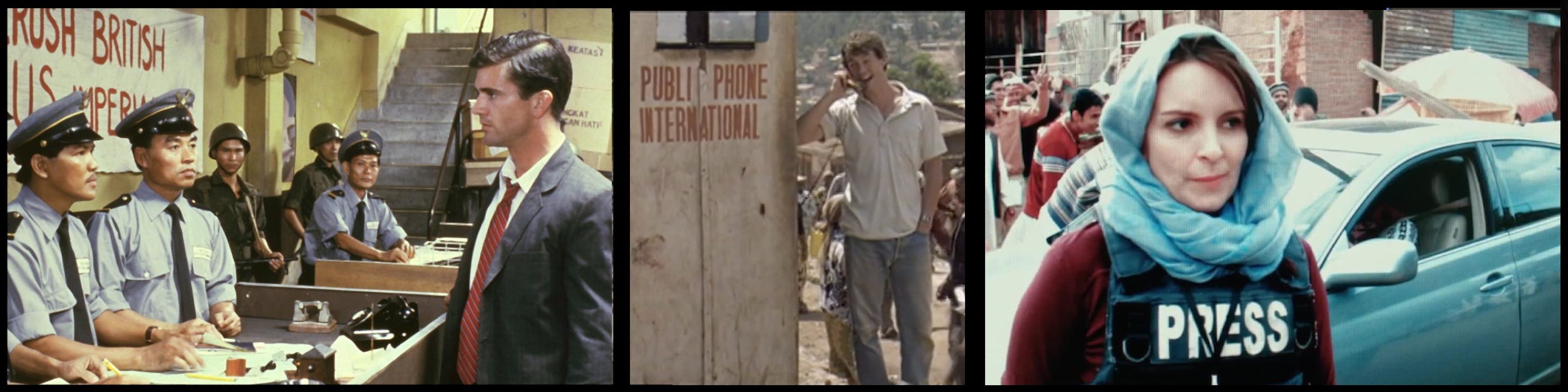
I’ve been thinking of this for a while: what movies would I recommend to someone who wants to work in international humanitarian development, in foreign affairs, or in journalism abroad, to give them an idea of what conditions and challenges are like? Or what movies do I think represent what it’s like to work “in the field” internationally, as we say?
Below is my list, in the order the movies were released. Most are not uplifting. Most are quite dark and even depressing. None are idealizations of aid workers or journalists: the people featured are flawed and white saviorism is on full display in many of them (and often not in a kind way). But, to me, what they collectively do is let you know that “doing good” and living abroad in country’s in post conflict situations and experiencing instability and poverty is not as easy as you might think, and not everything you see on the TV news is to be believed.
Which are my absolute favorites? What if I could recommend only two? The Year of Living Dangerously and Whiskey Tango Foxtrot.
What would be your recommendation for films that are good representations of working abroad in humanitarian affairs or as a journalist – or even if they aren’t accurate, you enjoy them?
All of my blogs with career-related advice are here. What I have written lately may be in conflict with some of the things I’ve advised over the years. But I never saw this coming… Here are some highlights:
What I did in Afghanistan for the Ministry of Rural Rehabilitation and Development, via the United Nations.
If you have benefited from this blog or other parts of my web site and would like to support the time that went into researching information, developing material, preparing articles, updating pages, etc. (I receive no funding for this work), here is how you can help.
For all of this month, each week, I’m publishing a blog focused on working in international humanitarian affairs and community development. This is part two of that series.
Even in this climate of drastic cutbacks in foreign aid programs around the world, not only by the US government, many people want to work in humanitarian-related fields abroad. Many believe that such works means life-long employability, because they think international work is always perceived as a plus on a résumé.
I’m oh-so-proud of my work abroad, or my international work that I’ve been able to do while still in my home country, but my international work has not at all been the “wow” on my CV I thought it would be. In fact, sometimes, I think it has cost me some job interviews, and I am pretty sure it cost me at least two jobs I interviewed for. And the more I talk to others, the more I have realized that not all employers look favorably on work or volunteering abroad.
For years, I’ve gathered negative comments others have heard in job interviews with regard to their service abroad. Here’s a few that I think represent all that I’ve gathered. I’ve changed some comments slightly so that where they were said can’t be easily found with an online search.
I have been asked twice in interviews, almost with a scoff, “But why do you want to work HERE when you’ve done all this work abroad?” One of them followed up with, “Well, I just feel like if we hired you, you might run off at any moment to go back overseas.” Never mind that I had just bought a house – which I noted in both the interview and my cover letter.
I was giving a behavioral interview example using my time in the Peace Corps, and one of the panel interrupted me and told to instead pick an example from my “professional career”.
I had someone in an interview tell me it was a mistake to go off to Africa early in my career when I could be using my degree and learning the trade for the job I was interviewing for.
One interviewer just kept saying he feared I would be bored, because working at this local government agency would be COMPLETELY different than working abroad. I don’t think the interviewer had ever stepped out of his state, let alone the USA. And never mind that the work I would have been doing locally would have been almost identical to what I had done in other countries.
Two different interviewers implied I must not like the USA if I worked abroad. I wasn’t prepared to prove my patriotism in job interviews.
I have lots of advice for translating humanitarian work abroad such that it you present it in the same words as a federal, state, county or city job posting. But the reality is that, even if you were to follow that advice, you need to be prepared, if you are making the transition from international to local, that some folks don’t see how the work is oh-so-similar, and your work abroad may even make them suspicious of you, no matter how you phrase it. You may have to apply for far more jobs than you thought you would have to, to find hiring managers that see international work as an asset.
For sure, some regions are more friendly to international workers than others. In the USA, you are going to have a better reception from potential employers in the greater Washington DC and New York metropolitan areas, for instance, than you will in some other areas where there isn’t a large number of international agencies.
It’s such a shame that more local government agencies in particular don’t see international work as an asset among applicants. They are losing out on a tremendous amount of talent, ideas and experience.
All of my blogs with career-related advice are here. What I have written lately about working internationally may be in conflict with some of the things I’ve advised over the years. But I never saw this coming… Here are some highlights:
What I did in Afghanistan for the Ministry of Rural Rehabilitation and Development, via the United Nations.
If you have benefited from this blog or other parts of my web site and would like to support the time that went into researching information, developing material, preparing articles, updating pages, etc. (I receive no funding for this work), here is how you can help.
For all of this month, each week, I’m going to write a blog focused on working in international humanitarian affairs and community development. This is part one of that series.
If you’re a US citizen with the goal of working in international humanitarian affairs or community development, even disaster relief, in impoverished regions not in the USA, it’s time to pick a different career.
The US Presidential order withdrawing the USA from 66 international organizations, including many United Nations agencies, means US candidates won’t be considered for most international development jobs. When qualified applicants are identified for such jobs, hiring managers will then look at the nationalities of those applicants, per the funder’s preferences. And the USA isn’t funding.
I used to work for the United Nations, and I was on a fair share of hiring committees. In my department, I was often the person who went through the stack of applicants to pick only those who were absolutely qualified, because I was really good at it (I was amazed at how others couldn’t figure out how to rank people). But then someone else would go through that first round of finalists and remove a person or two specifically because of their nationality – a nationality that the government funding the position didn’t like. Or was at war with. And if there was a qualified applicant from the country funding the position, very often, that person got the job.
The current US Presidential administration has not only withdrawn financial support for international humanitarian work, the leader has said vile things about the people and leaders of dozens of other countries. This can result in targeted hostility toward someone from the USA even if they do not at ALL support the current administration – so many international organizations will just avoid any potential problems entirely and not consider job candidates from the USA.
Even if a new administration in 2029 starts reversing the disastrous policies of the current President and his staff, the damage that has been done now is long-term and will take MANY years to undo. Why should another country believe any plans of the USA? Better to partner with other countries. That means that, despite the fact that there will always be a need for international funding for community development, environmental protections, help for refugees, job development programs in underserved countries, etc., what jobs are available are, more often than not, closed to citizens of the USA, and I don’t see that changing for at least the next five years even if the current administration changes..
Studying international development is a wonderful experience, and I hate advising anyone to not do it. I have a Master’s Degree in international development management, and while it was difficult and stressful and consumed my life outside of work for three years, it also made me a much better professional in a thousand ways. It not only helped me in my work with international agencies, it also made me more effective in working for nonprofits in my own country, particularly small ones. It’s made me a better citizen of my local community as well as the global community – I really believe that. I applied for work with several government agencies here where I live in Oregon because I knew that my Master’s Degree, as well as my work experience in various development initiatives in various regions around the world, made me well-prepared for local government work – and, plus, I really wanted to do it. But I quickly found out that working abroad is not always looked on positively when looking for a local job – my next blog will be about that. So if you are thinking your international development degree will help you in other work – it might not (even though it should).
If you are in the USA< should you chance it and still pursue a career in international humanitarian development? Only if you have a very strong backup plan for if it doesn’t work out, and only if you are ready for the long haul in terms of actually getting into the field – like, 10 years from now.
Also, if you have a UN Association in your area, or an affiliate of the World Affairs Councils of America, join it, and go to their meetings. Come together with others in your own community that think globally. At the very least, you will know you aren’t alone.
And, finally: I hope I’m wrong. I really do. But I’m trying to be realistic, no matter how much it hurts my heart.
I have a lot of friends and acquaintances who are refugees. They have fled dire situations in their home countries (countries that most of them did NOT want to leave) and they are now in a different country, either trying to figure out how to stay there or trying to get to somewhere else, often to join family or good friends. I can’t help them with much: I’m not a lawyer and have no legal training. But I can help with tracking down information they are looking for and debunking things they have heard (usually something about how easy it is to get into some South American country).
I have been pleasantly surprised and grateful regarding the web sites of a variety of countries for their clear information, in English, about exactly how someone can legally migrate to their country. Even tiny countries that aren’t at all wealthy often have very clear, up-to-date information on their web sites for anyone thinking of coming there under any circumstances. These web sites have been incredibly helpful in my efforts to help friends and acquaintances to get accurate information and to avoid scams.
The same CANNOT be said of the web sites of UNHCR , the United Nations agency that is supposed to be the leader in protecting refugees – people forced to flee conflict and persecution, as well as those denied a nationality. UNHCR web sites based in various countries all over the world are NOT focused on providing critically-needed, up-to-date information for refugees. And that is inexcusable.
UNHCR country web sites are often focused primarily on enticing donors rather than helping refugees access the critical information they need:
the information refugees would be looking for is either hard to find or not there at all,
many pages that are supposed to have information for refugees are horribly out-of-date,
the information for refugees that is there is usually is NOT the info refugees want most,
and the sites are so full of jargon I can’t understand the information and English is my first language!
An example of what I’m talking about: UNHCR Pakistan: this web site is NOT focused on refugees. I wish it was an exception, but it’s not. I have an Afghan colleague now in Pakistan trying to register as a refugee, but the UNHCR office is closed! There’s NOTHING on the web site saying it’s closed.
Each and every UNHCR web site in ANY country should have a link called “Help for Refugees” on the home page as prominent as any link to donate. That link should be on EVERY page and be as prominent as any link to donate.
And when someone clicks on that “help for refugees” link, they should be taken to a page that has this information (or links to such):
How and when to register with UNHCR in that country.
Notices about office closures.
UNHCR office hours.
Statement regarding who is considered a refugee.
Rights and obligations of asylum seekers in dealing with UNHCR.
A list of the first things someone should do upon arriving in that country as a refugee.
How to apply for refugee status in that country.
How to contact the UNHCR office in that country.
Where UNHCR offices are located in that country.
Where or how to find shelter in that country (if this information changes frequently, then tell refugees how to find the most up-to-date information themselves).
What NGOs are in the country that help refugees, or how to find them (NGOs that can help with education, legal matters, shelter, dealing with the police, etc.).
Information regarding working in that country.
How to avoid scams that target refugees.
Tips for staying safe (including for children, for women, how to avoid traffickers, etc.).
How to research rumors (and why it’s so important to do so).
Why requests for asylum take so long to process.
The dangers of lying or misrepresenting information to UNHCR or any immigration authorities.
A list of reliable news outlets.
UNHCR, you would reduce the amount of phone calls and visits to your offices if you made the aforementioned information available and kept it up to date on your individual country web sites. You would prevent at least some of the harm that refugees experience because they are targeted for crime and otherwise exploited. You would help stop harmful rumors before they get too widespread. And you would be fulfilling your mission!
Have you ever asked refugees themselves what information they need most?
Do better, UNHCR.
And for those who wonder why I have a lot of friends and acquaintances who are refugees, or who desperately want to be such: it’s because I have worked for the UN and talk about that work, as well as other humanitarian-focused work, online in various online communities and via my own social media channels, and because I frequently write about refugee-related efforts:
In a section titled “End-Of-Mission Highlights,” it says the Western-backed Afghan government sometimes didn’t even want projects that the United States proposed.
“For example, SIGAR found that most of the buildings at five Afghan Border Police facilities costing $26 million were either unoccupied or being used for unintended purposes, including one used as a chicken coop,” it says.
The report states that Western countries and global institutions flooded Afghanistan with money that fueled corruption, which US officials overlooked as they “prioritized security and political goals.”
But the final SIGAR report is not only a look back at the mission as a whole.
It also underlines the humanitarian impact of the Trump administration’s decisions to cut aid to Afghanistan and says the State Department did not explain why specific programs were being terminated.
SIGAR will cease operations in September.
Before then, it will produce one more report looking at how lessons learned in Afghanistan, Gaza, Syria, and elsewhere can be applied to future situations where aid missions face interference in undemocratic countries.
If you have benefited from this blog or other parts of my web site and would like to support the time that went into researching information, developing material, preparing articles, updating pages, etc. (I receive no funding for this work), here is how you can help.
Diego, our wonderful local liaison, Stephanie, our incredible group leader, and the Habitat Global Village volunteers in Paraguay in May 2025. We are filthy and it’s only the first day. I’m the fat girl on the viewer’s right.
I’m back from my week-long stint volunteering as a part of Habitat for Humanity’s Global Village program, where I helped build a foundation for a house for a family in a low-income community outside of Asunción, Paraguay.
I wrote about the trip for the local Habitat affiliate I work for, part-time, here in Oregon, focusing on what we did day-to-day, how we built the foundation, challenges we faced, what I packed, how I fundraised for the trip, etc., along with tips for anyone who might want to explore being a team leader for such a trip in the future. But I wanted to write about the trip from the perspective of me the volunteer management consultant and researcher, and me the skeptic regarding most volunTOURism trips.
What is volunTOURism? It’s where a person pays a lot of money to travel somewhere for a volunteering experience, coupled with at least some tourism/cultural exchange. Habitat for Humanity would REALLY like to move away from this label, and I respect that – however, by the definition I use, that’s still what this program is. And that’s NOT something to be ashamed of: what they are doing is ethical voluntourism.
I used to think all volunTOURism – all instances where someone pays to volunteer abroad – was bad, period. People in the United Nations and working for other international development agencies tend to look down on people paying to volunteer, mostly because it can often seem to be all about the volunteer and their feel-good, photo-friendly experience (“Vanity Volunteering”), not about actually engaging in sustainable development, in activities that empower local people, that aren’t just charity, and it often can reinforce the worst ideas of white saviorism and colonialism. Some volunteering programs can take away jobs from local people (an example is the backlash against volunteers coming into NOLA after Hurricane Katrina from carpenters, roofers and others who were desperate for work).
More dire horror stories about volunTOURism abound: so-called wildlife sanctuaries that care for orphan animals, but the animals are orphaned because their parents have been killed so that the sanctuary has baby animals for the foreign volunteers to care for. So-called orphanages where, in many cases, children have parents, but parents are paid for their children to live in these “orphanages”, and foreigners come for a few days or weeks to “care for” the “orphans.” And cases where volunteers harm people they are supposed to be caring for, including harming women and children in the worst ways imaginable.
I started to change my mind about all volunTOURism being all bad when I noticed a few programs that seemed to be designed by local people themselves, where there were written standards for both volunteers and for the kinds of work volunteers could, and shouldn’t, engage in, where there were strict rules regarding safety and safeguarding for both volunteers and those served, and where the work by the volunteers was needed and not being done by anyone else. Like Africa Fire Mission, a nonprofit that brings together experienced firefighters from developed countries to train firefighters in various African countries regarding effective emergency response and fire prevention and response services. Or HistoriCorps, a program in the USA where volunteers pay a fee and help restore a historic site on public lands, sometimes in very remote places.
The one volunTOURism program that stood out most was the Global Village program by Habitat for Humanity. Through this program, local Habitat programs in impoverished areas in South America, Central America and Asia receive much needed funding, in part per the fees paid by international volunteers, and an intense, hyper-productive week of labor: the volunteers get an incredible amount done in a week, working right along side local contractors (which the volunteers’ fees have helped fund). The additional goals of the program are that there is an increased understanding by the visiting volunteers of home ownership challenges globally and the role Habitat for Humanity plays in such, that volunteers become better advocates for Habitat’s vision where everyone has a decent place to live, and that people from different cultures get to come together and work side-by-side, leading to greater understanding and appreciation of each other – what Habitat calls God’s love into action, what I call humanism in action and necessary for our survival.
In all my years as a volunteer management consultant, long before I started working for a Habitat affiliate here in Oregon, I was a fan of Habitat for Humanity and its model for volunteer engagement locally. Habitat fully acknowledges that it is not going to solve the housing crisis anywhere by volunteers coming together when they have some time and building some houses here and there; the much needed resolution in the global housing crisis will come only through drastic and impactful policy changes and enforcement of those changes. But those changes will come only through the will of a mass of people, and one of the best ways to get people on your side, to turn people into advocates for your cause, is to get them involved as volunteers at your organization.
Habitat has strict guidelines for volunteer engagement on a local level, and when those principles are well applied, they are, IMO, the best in the “business” of volunteer engagement. Habitat’s engagement of groups of volunteers, when done in alignment with Habitat rules and policies, are models for other organizations. For the volunteer, the bar to participation should feel quick and easy, but behind the scenes, if done properly, a lot of thought, time and care goes into the volunteer feeling that way.
But what about Habitat’s volunteering-abroad program? How do I think it measures up in terms of ethics and impact? I’ll cut to the chase and it won’t be a surprise: this was a model group volunteering endeavor. This is the standard every short-term program should aspire to, whether it’s a local or international program:
Volunteers were provided all the materials beforehand, with all the information they needed to know exactly what they were getting into.
Volunteers were provided details on exactly what the money they had to raise, or pay, would pay for.
Volunteers knew exactly what to pack, what would be provided and what would not.
The group leader, also a volunteer, stayed in touch regularly, but not overwhelmingly, before departure. She sent regular reminders and had answers to all questions. And then after the trip, she sent an outstanding followup message that explained how we could continue to support Habitat and how we could get involved in advocacy efforts.
A WhatsApp group was set up for all volunteers just before we departed, so we would know who was arriving when, we could easily share links to photos, and we could further build community (and trust) with each other (that makes this a virtual volunteering effort, BTW!).
Volunteers always knew where to be and when to be there.
We were warmly welcomed at the work site.
The work was ready for the volunteers to do immediately, every day.
There were several people providing guidance whenever needed.
The safety and safeguarding briefing was clear and provided exactly the information needed, clearly and without any ambiguity.
Volunteers’ time was never, ever wasted.
Drinking water was provided (I can’t believe how many group endeavors don’t provide this).
A bathroom was provided (again, I can’t believe how many group endeavors don’t have this).
The volunteers worked like freakin’ machines. Unstoppable, ever-fueled machines. Get. Out. Of. Their. Way. The team leader definitely recruited exactly the right group for this gig (with one exception: me. I was no where near as productive as the other volunteers. But I had an excuse: I was so sick the week before that I almost had to cancel my trip, and the very strong antibiotics I was on those first days did NOT help).
In all fairness, I have to point out that this group of volunteers in Paraguay was full of ringers: there were 11 volunteers in all, and four were employees of Habitat for Humanity International, and all but two – and one of those two was me – were veterans of the Global Village program. So I was the only person starting from absolute zero. And given that I’m a rather seasoned international traveler, and a volunteer management consultant and trainer, I was a bit of a ringer myself.
But, of course, Habitat’s global volunteering program is more than a group volunteering gig abroad. It’s volunTOURism: volunteers are paying to go abroad and paying a fee to participate. How did THAT aspect measure up in terms of my oh-so-picky list of volunTOURism ethics?
Habitat’s Global Village program was put on hold during COVID so the program could be redesigned to be more locally-focused, more impactful for local communities, and less about tourism. I can’t compare my experience to before the pandemic. But here’s what I can say about my experience, in terms of the changes Habitat said they wanted to implement in the program:
In changing the program, Habitat said they wanted these volunteer activities to be focused on volunteers engaging in mutual learning and exchange with local people, rather than tourism activities. I think they nailed this. There were tourism activities, which took place on the day or two before work began, and in the evenings. But the focus of this trip was on the work itself, and the work took place right alongside the local contractors and local staff.
I was never so happy at my meager Spanish skills: I got to talk a lot with local staff, the local construction workers, the family we served and even some of the local kids gathered to watch. Each day when we arrived at the site, I would greet each member of the family that had come out to watch us work, holding hands, giving greetings and kissing each other on the cheek. One volunteer told me that, while I was feeling envious of the energy and strength of all the volunteers (I really was not nearly as productive as they were), she was envious of me having conversations with the Paraguayans. She said she felt like there was a wall between her and them, and she didn’t know how to bridge it, and she was envious every time I walked over and started chatting with local folks. I definitely got the “mutual learning and exchange with local people” aspect, but I’m not sure all the volunteers did (but those who didn’t were the ones why were hyper productive in building the foundation of this house, and that’s what they seemed to want to do most).
The redesigned program does not want international volunteers to enter a community with their own ideas of what needs to be done. The “agenda of change” needs to be defined by and led by the local people being served, not the outside volunteers coming into a community. I think this was adhered to, but not because volunteers were ever told this priority; the volunteers I was with in Paraguay were all veterans of these kinds of Habitat programs, save one person besides me, and they already knew better than to walk in to a work site and say things should be done differently.
Per the programs’ redesign, a promotion of safeguarding was supposed to be much more emphasized throughout the experience than before. I don’t know what it was like before, but I can say that what I experienced was a MODEL emphasis on and explanation of safeguarding and safety, one that the affiliate I work for still hasn’t mastered. Kudos.
Habitat Global Village projects are supposed to be designed by local communities and the focus should be on local ownership and local sustainability. They nailed this goal too. There was no doubt who was in charge – and it was NOT us, the volunteers – and whose project this was – NOT ours, but the local people themselves.
Also per the redesign of the program, from the beginning, volunteers were supposed to learn about the need for adequate housing around the world, so we can become advocates regarding the cause and champions for equitable housing long after their trip has ended. For me, this goal came up just a bit short. Why is there a shortage of housing in Paraguay? What policies and practices are keeping people from having housing in Paraguay? What’s the unemployment rate? How much would a family need to make to build their own house without NGO assistance? Are all kids in school? How does lack of housing affect education in Paraguay? Where is Paraguay in the UNDP Human Development Index? Where does it rank in Transparency International’s Corruption Perceptions Index? I don’t think it would have taken a huge amount of time to touch on answers to these questions, so we could get more context to why Habitat is needed in Paraguay (and other countries). But that said, the followup message from Habitat, after we returned, was spot on: it provided information on how we could be continued advocates for Habitat, how we could become involved with our local Habitat affiliates, etc. There’s an entire paragraph in my blog about the trip for the local Habitat affiliate I work for about advocacy and its importance, and it wouldn’t have been there had we not gotten this follow up email.
Personally, I felt uncomfortable at the stark contrast of our accommodations and our morning and evening meals to the lives of the people in the neighborhood where we worked in Paraguay. I’m a motorcycle traveler, including in developing countries, and I don’t stay in hotels as nice as what we experienced in Paraguay, and I don’t eat at restaurants nearly so nice when traveling. But from what I understand, our level of accommodations in Asunción were necessary because of the security situation in the region where we worked – we were very obviously a big group of relatively wealthy Americans, and we REALLY stood out in the countryside. As for the food at very nice restaurants, I think Habitat is dedicated to volunteers not getting sick, as they have just one week to work (and did I mention it is REAL WORK?). No one wants any volunteer to spend their week mostly in a hotel room bathroom. So, I get why our accommodations and food were as they were.
With all that said, let me be clear: this was an amazing experience. I cried when it was over. So. Much. Hugging. One of the local staff told me, “You were my favorite” and I nearly collapsed in weeping. This experience ticked all the boxes: international volunteers really were needed and really did make a difference, the effort was locally led, I know things about Paraguay I didn’t know before and I am in love with the country, I had an amazing experience, and I am even more committed to the mission of Habitat than I was before. I have a stronger connection to Habitat than ever before – and I intend to turn these feelings into more effective action at the affiliate where I work.
And a few days after I returned home, the homeowner that we had helped had “liked” my Facebook page, and written on one of the posts about Paraguay, “Gracias por todo Ojalá algún día vuelvan las puertas de mi casa siempre estará abiertas para todos ustedes Dios los bendiga.” (Thank you for everything I hope one day you come back the doors of my house will always be open to all of you God bless you.)
That comment, and so much of this experience, is what is too often missing almost entirely in professional international development work. I have worked for the United Nations three times. The first time was at a UN program HQ, and I rarely got this moving emotional experience there like I had in Paraguay, because I was so far removed from the people actually being served, and there were times that this kind of inspiration would have made me much more motivated – something very much needed amid the stress and bureaucracy of the UN work environment. When I worked in Afghanistan and Ukraine, I made a point to get beyond the office space, to get to know Afghans and Ukrainians, and as a result, I loved that field work so, so much more than HQ work. And I cried when I left those countries. And still cry for them.
When I worked at United Nations Volunteers HQ, part of UNDP, the head of UNV, Sharon Capeling-Alakija, said that the reason she was passionate about the UN’s Online Volunteering service, which I managed, was because it gave far more people a chance to be involved in the work of the UN. She felt it unfair that the ONLY way to be involved in the UN was to have a Master’s Degree, 10 years of experience and a job at a UN agency; she wanted a way for people with less experience, but with just as much interest and passion and good ideas, to get to be involved, to get an idea of what the UN does beyond what they read in the media, and maybe it could create a more caring world. Her words came back to me as I was a part of this Habitat experience. It’s still a rather exclusive experience: you have to pay all of your travel costs (or some angel in your life has to pay such for you) and you have to fundraise your program costs, or pay those yourself, and that means it’s not something just anyone can participate in. But it’s an avenue into working abroad with a much lower bar than getting a paid job and giving up your home and all your friends and family for a few years. And it really does have impact. It really does make a difference.
Any program that’s creating a greater feeling of solidarity and understanding among people, that cultivates empathy and caring and learning, is worth supporting, because oh how the world needs that right now.
Local volunteers in Paraguay will now begin to work on the site along those same wonderful contractors we worked with. The staff at Hábitat para la Humanidad Paraguay will update their Facebook and Instagram accounts about this family, so we – and YOU – will be able to see the progress and the finished product. They already have photos and videos there of our volunteer group in action.
And back here where I live in Oregon, I hope that we can incorporate the practices of Habitat Paraguay in making sure volunteers feel supported and prepared, that volunteers feel like they’ve made a real difference by the end of a day of work, and that they feel a part of Habitat for Humanity, so much so that they want to learn more about why there is a lack of affordable housing and why so many thousands and thousands of hard working people in our community cannot afford a house.
One more thing: there were a group of pre teens on bicycles, pretty rough, who came to watch us almost every day. They would call out words in English to see if we would respond. And one day, one of them yelled, “W.W.E!” That stands for World Wrestling Entertainment. One of the volunteers turned around and yelled back the name of a well-known wrestler. And BOOM, that volunteer was The Greatest American To Ever Visit This Village. The kids yelled wrestler names, the volunteer yelled back other wrestler names, imitating how the wrestlers get introduced in the ring. The kids could not get enough of him. At one point, I looked over and the volunteer was helping to repair one of the kid’s bicycles, with the kids all gathered around him. I bring this up because I have blogged about how much kids worldwide, from Kabul to Kansas, LOVE professional wrestling, and I cannot for the life of me understand why international development agencies and governments don’t leverage this. Yeah, People Magazine, I will never forgive you for all but mocking me when I dared to mention wrasslin’ in that project back we worked on in the 1990s…
Habitat is seeking people to become Global Village Team Leaders. Candidates need to be from organized groups, such as university classes or clubs, social clubs, communities of faith, volunteers or staff from local Habitat affiliates, employees from a company, etc. Candidates take the Global Village online trainings and then lead their organized group of co-workers, club members, students, congregation members or other association on a Global Village program trip abroad. Visit the Global Village team leader FAQ to find out if leading a team is right for you. The option for independent volunteers to join teams with whom they do not already have an association is not currently available, but you should sign up at the Habitat web site for updates in case this changes.
New Global Village build dates for 2026 will be released in July! Now is the perfect time to take the team leader trainings and to talk to your co-workers, fellow students, fellow members of your community of faith, other members of your civic club, or your local Habitat affiliate where you already volunteer about this program, to generate interest among your associates for possibly joining your team. That will help you to be ready to book early and secure your team’s spot in the Habitat program. Global Village groups usually consist of up to 16 individuals. Potential participants should understand that each Global Village volunteer raises funds among their associates or contributes a donation ranging from US$1,625-$2,700 that supports Habitat’s housing programs. Volunteers are responsible for paying for their own on-site accommodations (arranged by Habitat), meals, ground transportation and transportation to the country, as well as arranging for any necessary visas.
As this blog publishes, I should be in Paraguay, on my first international Habitat for Humanity build. In fact, it’s my first Habitat build, period – my work schedule or personal schedule kept me being involved in the builds here in Oregon, at the Habitat affiliate I work for, and then, when my schedule freed up, we took a break from construction.
I’ve been asked by a few people what I’m packing. I’m relying on both my experience working in Afghanistan and Ukraine and my motorcycle travels to come up with what I need. I’ll have two carry-ons, one to go under the seat in front of me, and everything has to fit into them.
It takes a full day of flights (three) to get to Paraguay, and then I’ll be there for eight days for building a house, then just a couple of days in Brazil as a tourist. What I take will be somewhat different from what I tell humanitarians to take on their first mission abroad. For instance, I’ll be taking work shoes that I intend to leave in the country when the work is done: they are terrific, tough trail running shoes, but the soles are worn and can’t be repaired. They are great for spilling paint on but not for trail running. In fact, or team leader says that we can leave any clothes we want to, that are still whole and in good condition – they will be used by locals. Added bonus: it will create room at the end of the trip for things I might want to bring back.
I’ll most definitely be taking a carbon monoxide detector. When I worked at UNDP/UN Volunteers, one of our volunteers died in the field because of carbon monoxide poisoning in his guest house, and I once read about almost everyone dying in a guest house in Spain from carbon monoxide poisoning. It’s a scary and very possible reality. I take one even for travel in the USA. But I will NOT be leaving the carbon monoxide detector behind… I need it!
And for sure I’ll take The Dress. You’ve probably seen it in a few of my photos. In fact, if you do a search for the word UNICEF in my photo account, most of my dress photos will come up. I get tired of wearing motorcycle clothes or even just shorts and t-shirts when I travel, especially if I’m going to have a day just walking on a beach or going out at night. I bought it from the UNICEF Market. I love UNICEF, the UNICEF Market has items procured directly from artisans in Asia, Africa and Latin America. By buying through the UNICEF Market, I support these local artists and small, fragile economies abroad, and also support UNICEF (which gets a portion of sales). This dress is multi-colored (easy to hide spills), comes almost to my knees (which it was a BIT longer), HAS POCKETS (oh, yes, you read that right) and dries quickly (terrific to wear over a swimsuit).
Follow me online to read more about this Paraguay adventure – and whatever else I might be doing!
If you have benefited from this blog or other parts of my web site and would like to support the time that went into researching information, developing material, preparing articles, updating pages, etc. (I receive no funding for this work), here is how you can help.