Tag Archives: Christian

Reaching women in socially-conservative areas, even in other countries

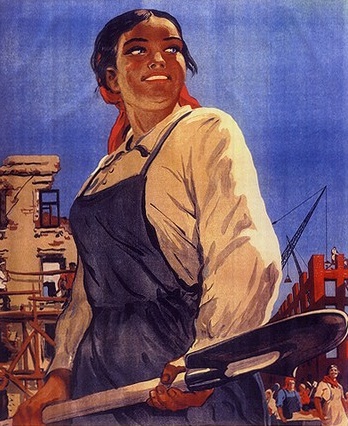
A Soviet-style drawing of a woman with a shovel

I’ve been reading through some of my first professional blogs, from back in 2009, on archive.org. Back then, my blog was hosted on another site and all the content went away when that site went under.

Some things have changed OH so much – and some things haven’t changed at all.

I found this blog from 19 October 2009 and thought it was worth re-sharing. The sadness as I read, of course, is profound, knowing the situation for women in Afghanistan now, versus when I was there in 2007. It’s also sad to read because, for thousands of people, a career in international humanitarian work has been put on hold – not just in the USA (foreign aid program funding has been slashed in countries all throughout the world). But I’m sharing it anyway, with the hope that someone out there might still find it helpful – and this is the last in my month-long series about working in interntional development:

While I was in Afghanistan, I was notorious for kicking-back field reports that stated “the community was consulted” about this or that project, but that never said if the decision-making included any women. Sadly, the report writers often came back to me with a scowl and lots of excuses about why women weren’t included when “the community was consulted.” Never mind that, even in Afghanistan, it IS possible.

When you work in humanitarian and development efforts, you must always be aware that talking to the official leadership of a community, a region, whatever, does not mean you are hearing about the needs of all citizens, such as minority populations or even majority populations — women. There are ways to seek out and include women in even socially-conservative areas so that they can be a part of decision-making.

A good example of this is an intervention in Egypt which used Egyptian women to reach other women regarding eye care, highlighted in a brief article by the Community Eye Health Journal. The successful strategy they employed was this:

  • The team undertaking the intervention held various meetings and presentations to establish a trusting relationship with local policy makers, local health authorities, local community leaders, local non-government organizations (NGOs), etc. 
  • The team used this network to explain that women weren’t receiving eye care at the same rate as men, and that saving or restoring women’s sight benefits the whole family.
  • The team used this network to identify local women with previous experience in community development projects who could be trained to reach female community members in the intervention villages, as they would be able to enter homes and meet with women without coming into conflict with local cultural practices.
  • 42 women were trained over three days, and 30 were selected. as “health visitors,”
  • The health visitors then visited 90 per cent of the population in the two intervention villages from March to December 2007.
  • During each visit, health visitors explained to women that saving or restoring their own sight would benefit the whole family. Each family received a variety of educational materials, including a calendar with illustrations relating to eye care and information on the importance of seeking eye care for the women in the household.

The result was a huge surge in the number of women receiving eye care as part of this intervention. And maybe something more: a change in the way the community viewed the value of its women? That wasn’t measured, unfortunately.

Ofcourse, Egypt isn’t Afghanistan. Every country presents special challenges when it comes to reaching women regarding development interventions. But there’s always a way! Regardless of your role in humanitarian or development efforts, always make reaching women a priority.

Postscript: even now, there are UN agencies working in Afghanistan and, even now, they are engaging with women. Look at their updates regarding their work there. I stand by the statement: there is ALWAYS a way.

If you have benefited from this blog or other parts of my web site and would like to support the time that went into researching information, developing material, preparing articles, updating pages, etc. (I receive no funding for this work), here is how you can help

Making certain volunteers feel unwelcomed because of your language

Many volunteers are motivated by religious reasons to donate their time and expertise, and enjoy religious messages in association with their service. But many of these volunteers don’t realize that their messages regarding their belief and volunteering, made to other volunteers, can make those that are not of the same religion, or not religious at all, quite uncomfortable – even unwelcomed.

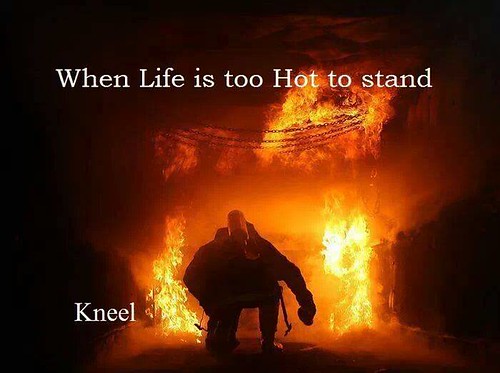
Take this message posted to the Volunteer Firefighters Facebook page, which assumes all volunteer firefighters are religious or, if they aren’t, they should be:

inappropriate

In case you don’t get it, the message literally means if a firefighter is faced with something challenging in his or her firefighting or in life in general, that person should pray to God (or Gods or Goddesses, perhaps?). The responses to the message are mostly “amens” — confirming the religious nature of the message.

Remember, this isn’t a Facebook group specifically for Christian firefighters or Muslim firefighters or Jewish firefighters or Hindu firefighters, etc. – the group is called Volunteer Firefighters. The assumption from the title is that it means ALL volunteer firefighters, not just religious ones.

What does this message say to non-relgious firefighters? It says: “You should believe in God. If you don’t, you should. Religion is how you can handle tough situations.” Imagine, for a moment, how that makes non-believing volunteer firefighters feel. If you can’t, then can you imagine if the administrators posted a message that assumed all volunteer firefighters are atheists and, if they aren’t, they should be? If a message was posted saying that the best way to handle challenging situations in life was to NOT believe in a god? Can you understand how that kind of message would be completely inappropriate for a group for all volunteer firefighters, not just religious ones?

As I noted in my earlier blog, Do you welcome people with your language?, inspired by a similar incident: most people who have been made uncomfortable by the mixing of religion and volunteering at an otherwise secular event or in an otherwise secular group are probably never going to say anything about their discomfort when the activity is infused with religion, particularly from the group’s organizers or administrators. No one wants to be seen as ruining an event or a feeling for others, even if the activity makes them feel less a member of the group – and they also don’t want to be singled out for “saving” later. Also, if you haven’t heard any complaints about these type of religious messages on your group, could it be because you’ve created an atmosphere where non-believers/other-believers don’t feel welcomed to be a part of your group – or to volunteer at all?

Sadly, this blog will be used to say I’m against religion and against religiously-motivated volunteers. I’m not, at all.

May 6, 2014 update: 

The administrator of the Volunteer Firefighters Facebook page didn’t notice the link to my blog post that I made on his group until just a few days ago, and decided to repost it to encourage people to comment. And comment they did – as you can see below. The comments started off overwhelmingly negative – just as I predicted, I was accused of being anti-Christian. Which is fascinating, as, today, I once again did a presentation for a Christian-based nonprofit regarding volunteer engagement, per their request. They do great work regarding social justice, human rights and poverty alleviation, in my opinion, and as their stated motivation is their religion, they do a lot of praying and references to their beliefs in their work with volunteers. And I have no problem with that at all – they are a religious organization and, as such, they know they are exclusionary, they are honest and upfront about that, and I respect it – and am still able to give them advice about how to improve their volunteer engagement. If I were anti-Christian, I’d refuse to work with them.

If the Volunteer Firefighters Facebook group isn’t going to focus on welcoming ALL volunteer firefighters, and is going to assume that, because most of their members are religious, then promoting religion is just dandy, then I hope they change the name of their group to Christian Volunteer Firefighters or the Religious Volunteer Firefighters. Why not be truthful and upfront about what you will – and won’t – include in your organization?

Big thanks to the Friendly Atheist for picking up the story, which resulted in the counter comments here and far more on his blog.

Also see:

Time Magazine asserts there are no organized Atheist volunteers

Do you welcome people with your language?

If you have benefited from this blog or other parts of my web site or my YouTube videos and would like to support the time that went into researching information, developing material, preparing articles, updating pages, etc. (I receive no funding for this work), here is how you can help.