Monthly Archives: April 2026

Movies I recommend if you want to do international aid work, foreign affairs or journalism abroad.

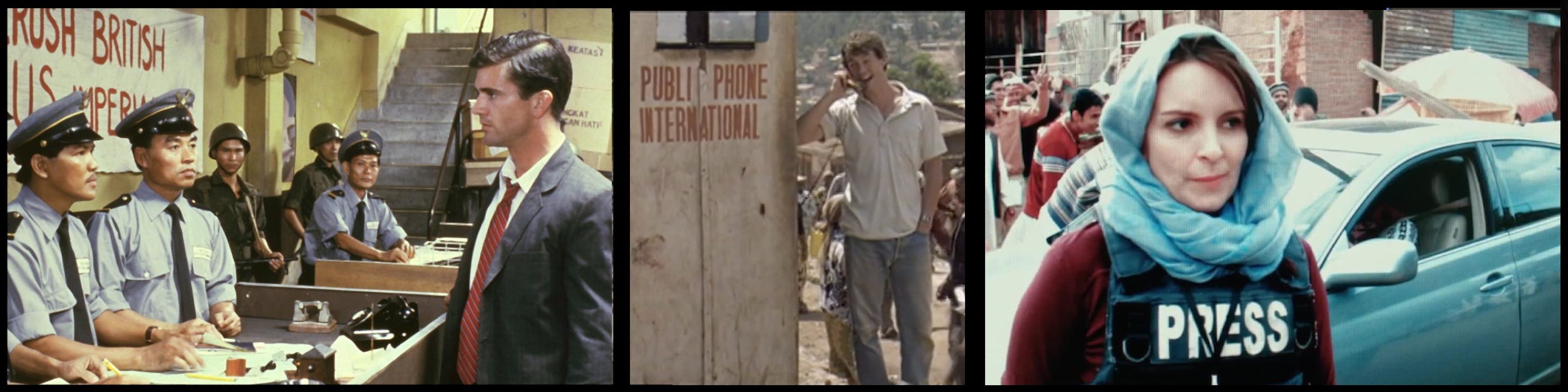
Three scenes from the movies listed. The first is a white man of European descent facing several angry Asian uniformed officials, the second is a white man using a phone in the middle of a chaotic African village, next to a wooden sign painted with the words "Public phone international", and the third is a woman in a head scarf and also wearing a vest that says PRESS, with shouting men and a car behind her.

For all of this month, each week, I’m publishing a blog focused on working in international humanitarian affairs and community development. This is part three of that series.

I know that, for many people, their career, or their career dreams, of working internationally in humanitarian development, or even as a journalist, are on hold. In fact, I’ve recommended that people who are pursuing a career in international development to rethink those plans. But the world cannot function without international aid workers and without international journalists. And maybe everyone needs to have a reality check on what the work REALLY looks like.

I’ve been thinking of this for a while: what movies would I recommend to someone who wants to work in international humanitarian development, in foreign affairs, or in journalism abroad, to give them an idea of what conditions and challenges are like? Or what movies do I think represent what it’s like to work “in the field” internationally, as we say?

Below is my list, in the order the movies were released. Most are not uplifting. Most are quite dark and even depressing. None are idealizations of aid workers or journalists: the people featured are flawed and white saviorism is on full display in many of them (and often not in a kind way). But, to me, what they collectively do is let you know that “doing good” and living abroad in country’s in post conflict situations and experiencing instability and poverty is not as easy as you might think, and not everything you see on the TV news is to be believed.

Black Narcissus (1947).

The Third Man (1949).

The Year of Living Dangerously (1982).

The Killing Fields (1984).

Volunteers (1985).

The Mission (1986).

The Constant Gardener (2005).

Shooting Dogs (2005).

The Whistleblower (2010).

A Perfect Day (2015).

Whiskey Tango Foxtrot (2016).

The Night Manager (2016 – mini series).

A good source for more movie ideas are these movie lists from the Council on Foreign Relations.

Which are my absolute favorites? What if I could recommend only two? The Year of Living Dangerously and Whiskey Tango Foxtrot.

What would be your recommendation for films that are good representations of working abroad in humanitarian affairs or as a journalist – or even if they aren’t accurate, you enjoy them?

All of my blogs with career-related advice are here. What I have written lately may be in conflict with some of the things I’ve advised over the years. But I never saw this coming… Here are some highlights:

If you have benefited from this blog or other parts of my web site and would like to support the time that went into researching information, developing material, preparing articles, updating pages, etc. (I receive no funding for this work), here is how you can help

Working abroad is not always looked on positively when looking for a local job

two shadows of humans talk together, with a globe behind them.

For all of this month, each week, I’m publishing a blog focused on working in international humanitarian affairs and community development. This is part two of that series.

Even in this climate of drastic cutbacks in foreign aid programs around the world, not only by the US government, many people want to work in humanitarian-related fields abroad. Many believe that such works means life-long employability, because they think international work is always perceived as a plus on a résumé.

I’m oh-so-proud of my work abroad, or my international work that I’ve been able to do while still in my home country, but my international work has not at all been the “wow” on my CV I thought it would be. In fact, sometimes, I think it has cost me some job interviews, and I am pretty sure it cost me at least two jobs I interviewed for. And the more I talk to others, the more I have realized that not all employers look favorably on work or volunteering abroad.

For years, I’ve gathered negative comments others have heard in job interviews with regard to their service abroad. Here’s a few that I think represent all that I’ve gathered. I’ve changed some comments slightly so that where they were said can’t be easily found with an online search.

I have been asked twice in interviews, almost with a scoff, “But why do you want to work HERE when you’ve done all this work abroad?” One of them followed up with, “Well, I just feel like if we hired you, you might run off at any moment to go back overseas.” Never mind that I had just bought a house – which I noted in both the interview and my cover letter.

I was giving a behavioral interview example using my time in the Peace Corps, and one of the panel interrupted me and told to instead pick an example from my “professional career”.

I had someone in an interview tell me it was a mistake to go off to Africa early in my career when I could be using my degree and learning the trade for the job I was interviewing for.

One interviewer just kept saying he feared I would be bored, because working at this local government agency would be COMPLETELY different than working abroad. I don’t think the interviewer had ever stepped out of his state, let alone the USA. And never mind that the work I would have been doing locally would have been almost identical to what I had done in other countries.

Two different interviewers implied I must not like the USA if I worked abroad. I wasn’t prepared to prove my patriotism in job interviews.

I have lots of advice for translating humanitarian work abroad such that it you present it in the same words as a federal, state, county or city job posting. But the reality is that, even if you were to follow that advice, you need to be prepared, if you are making the transition from international to local, that some folks don’t see how the work is oh-so-similar, and your work abroad may even make them suspicious of you, no matter how you phrase it. You may have to apply for far more jobs than you thought you would have to, to find hiring managers that see international work as an asset.

For sure, some regions are more friendly to international workers than others. In the USA, you are going to have a better reception from potential employers in the greater Washington DC and New York metropolitan areas, for instance, than you will in some other areas where there isn’t a large number of international agencies.

It’s such a shame that more local government agencies in particular don’t see international work as an asset among applicants. They are losing out on a tremendous amount of talent, ideas and experience.

All of my blogs with career-related advice are here. What I have written lately about working internationally may be in conflict with some of the things I’ve advised over the years. But I never saw this coming… Here are some highlights:

If you have benefited from this blog or other parts of my web site and would like to support the time that went into researching information, developing material, preparing articles, updating pages, etc. (I receive no funding for this work), here is how you can help

US Citizen? Planning a career in international humanitarian affairs? You might want to rethink it.

two shadows of humans talk together, with a globe behind them.

For all of this month, each week, I’m going to write a blog focused on working in international humanitarian affairs and community development. This is part one of that series.

If you’re a US citizen with the goal of working in international humanitarian affairs or community development, even disaster relief, in impoverished regions not in the USA, it’s time to pick a different career.

The US Presidential order withdrawing the USA from 66 international organizations, including many United Nations agencies, means US candidates won’t be considered for most international development jobs. When qualified applicants are identified for such jobs, hiring managers will then look at the nationalities of those applicants, per the funder’s preferences. And the USA isn’t funding.

I used to work for the United Nations, and I was on a fair share of hiring committees. In my department, I was often the person who went through the stack of applicants to pick only those who were absolutely qualified, because I was really good at it (I was amazed at how others couldn’t figure out how to rank people). But then someone else would go through that first round of finalists and remove a person or two specifically because of their nationality – a nationality that the government funding the position didn’t like. Or was at war with. And if there was a qualified applicant from the country funding the position, very often, that person got the job.

The current US Presidential administration has not only withdrawn financial support for international humanitarian work, the leader has said vile things about the people and leaders of dozens of other countries. This can result in targeted hostility toward someone from the USA even if they do not at ALL support the current administration – so many international organizations will just avoid any potential problems entirely and not consider job candidates from the USA.

Even if a new administration in 2029 starts reversing the disastrous policies of the current President and his staff, the damage that has been done now is long-term and will take MANY years to undo. Why should another country believe any plans of the USA? Better to partner with other countries. That means that, despite the fact that there will always be a need for international funding for community development, environmental protections, help for refugees, job development programs in underserved countries, etc., what jobs are available are, more often than not, closed to citizens of the USA, and I don’t see that changing for at least the next five years even if the current administration changes..

Studying international development is a wonderful experience, and I hate advising anyone to not do it. I have a Master’s Degree in international development management, and while it was difficult and stressful and consumed my life outside of work for three years, it also made me a much better professional in a thousand ways. It not only helped me in my work with international agencies, it also made me more effective in working for nonprofits in my own country, particularly small ones. It’s made me a better citizen of my local community as well as the global community – I really believe that. I applied for work with several government agencies here where I live in Oregon because I knew that my Master’s Degree, as well as my work experience in various development initiatives in various regions around the world, made me well-prepared for local government work – and, plus, I really wanted to do it. But I quickly found out that working abroad is not always looked on positively when looking for a local job – my next blog will be about that. So if you are thinking your international development degree will help you in other work – it might not (even though it should).

If you are in the USA< should you chance it and still pursue a career in international humanitarian development? Only if you have a very strong backup plan for if it doesn’t work out, and only if you are ready for the long haul in terms of actually getting into the field – like, 10 years from now.

All of my blogs with career-related advice are here. What I have written above may be in conflict with some of the things I’ve advised over the years. But I never saw this coming…

For people in the USA, if you can afford it, I hope you will consider pursuing a two-year gig in the PeaceCorps (which I hope will survive the current administration), or participating in a short-term program like Habitat for Humanity’s Global Village program; I have a list of international development volunteering programs here. Or, when you travel abroad, make a deliberate effort every day toward transire benefaciendo: to travel along while doing good. If you do any of these things, be a living testimony that contradicts the things said and done by the current administration, and showing that not all US citizens are anything like the current administration.

Also, if you have a UN Association in your area, or an affiliate of the World Affairs Councils of America, join it, and go to their meetings. Come together with others in your own community that think globally. At the very least, you will know you aren’t alone.

And, finally: I hope I’m wrong. I really do. But I’m trying to be realistic, no matter how much it hurts my heart.