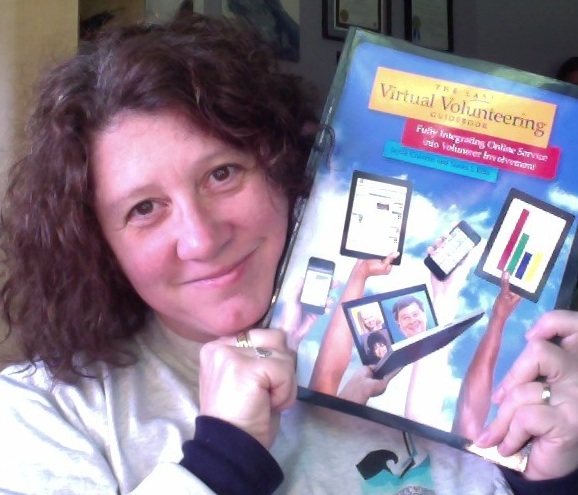
Author Archives: jcravens

About jcravens

Jayne Cravens is an internationally-recognized trainer, researcher and consultant. Her work is focused on communications, volunteer involvement, community engagement, and management for nonprofits, NGOs, and government initiatives. She is a pioneer regarding the research, promotion and practice of virtual volunteering, including virtual teams, microvolunteering and crowdsourcing, and she is a veteran manager of various local and international initiatives. Jayne became active online in 1993, and she created one of the first web sites focused on helping to build the capacity of nonprofits to use the Internet. She has been interviewed for and quoted in articles in The New York Times, The Wall Street Journal and the Associated Press, as well as for reports by CNN, Deutsche Well, the BBC, and various local radio stations, TV stations and blogs. Resources from her web site, coyotecommunications.com, are frequently cited in reports and articles by a variety of organizations, online and in-print. Women's empowerment and women's full access to employment and education options remains a cross-cutting theme in all of her work. Jayne received her BA in Journalism from Western Kentucky University and her Master's degree in Development Management from Open University in the U.K. A native of Kentucky, she has worked for the United Nations, lived in Germany and Afghanistan, and visited more than 30 countries, many of them by motorcycle. She is currently based near Portland, Oregon in the USA.

Too many volunteer matching web sites?

This blog was written in 2013. Note the January 2025 update at the end of the blog 

Here is a phrase I think I could live the rest of my life without reading or hearing again:

A new web site has been launched to match volunteers with non-profit organizations/NGOs.

I think I’ve read or heard this phrase 20 times in the last 20 years.

In the USA alone, we’re swimming in volunteer-matching web sites. Nationally, we’ve got  VolunteerMatchIdealist/Action Without Borders, HandsOn Network, Volunteer Solutions and All for Good/United We Serve/usaservice.org (and more, but those are the most well-known – and there are even more that have come and gone!). Many USA cities have their own volunteer-matching web sites as well. Plus, online social networking sites allow organizations to recruit volunteers as well.

Why is that a bad thing, to have so many platforms trying to serve the same organizations and volunteers? Because the vast majority of volunteer-involving organizations don’t have time to put their volunteering opportunities into each of those services, but a volunteer may use just one or two of those services and, therefore, will miss out volunteering opportunities posted to platforms he or she didn’t use. The result: less volunteer matching, not more.

I like hearing about new sites launched in other countries where such web sites don’t already exist and serve a region specifically, that are in the local language, or sites focused on a particular type of volunteering: financial management and fundraising, communications and marketing, web site development, language translation, web site development, micro volunteering, etc. Those are needed! And I really like when existing volunteer matching web sites announce that they will allow volunteering opportunities to be tagged as virtual or online, and allow their databases of opportunities to be searchable regarding such.

Before you develop yet another volunteer-matching web site:

  • Make sure there isn’t one already in existence that well serves the communities you are targeting. That means visiting existing volunteer matching sites and assessing what audience you think the site is not serving, or what service the site is not offering, but is very much needed.
  • Ask volunteer-involving organizations you want to use your service if they would use your service, instead of or in addition to what they are already using online. Ask them what they need from your service. Build your site based on their needs – not on what you think they need.
  • Get agreements with a core-group of volunteer-involving organizations, committing them to use your newly-launched service. Their involvement will add credibility to your effort. Representatives from at least some of this core group should serve on your advisory committee for this volunteer matching service.
  • Don’t create a roster of available volunteers. It never works – volunteers won’t keep their information up-to-date. A roster of volunteering opportunities, where volunteer choose tasks to be involved in, always works better than a roster of volunteers that organizations search through looking for available experts.
  • Be ready to say how this service is different from what is already out there – to the press, to donors, and to the organizations that already provide similar services.

Why not pursue the development of an online resource the volunteer-involving sector really needs! For instance:

  • a site that lists all of these volunteer-matching sites, and allows users to comment about each, rate the effectiveness and usefulness of each, etc. The site could also offer advice to both organizations and to potential volunteers on how to use volunteer-matching databases, to get the most out of them.
  • a site with a database of organizations, where each can update their information to talk about the impact volunteers have for their organizations and clients. The information would never be out-of-date, and the information could help other organizations get ideas on new ways to involve volunteers.
  • a site that offers a searchable database allowing organizations to share their volunteer policies, forms and other materials as models for other organizations. Organizations would be thrilled to use such a database to find sample volunteer orientations, volunteer applications, and other policy documents.
  • a site that offers legal and professional commentaries about state and national laws that could (and do) affect the involvement of volunteers.

I would use all of those sites!

Also see:

Using Third Party Volunteer Matching Web Sites & Apps to Recruit Volunteers

January 2025 update:

The long-time industry leader in volunteer matching web sites, VolunteerMatch, will soon be going away; the URL and assets are still there, as I write this, but the URL will eventually point to Idealist, a volunteer matching site that has floundered for years in the shadow of VolunteerMatch.

I’m stunned that VolunteerMatch could not attract the funding it needed to continue, especially in this time when we so need people to come together regarding common causes we care about and to start caring about each other again. And it’s difficult news, because I was involved with VolunteerMatch when it first launched and was called ImpactOnline, because that association is why I was chosen to direct the Virtual Volunteering Project and then went on to work for the United Nations directing its online volunteering service, and because I have relied on VolunteerMatch so much in the last three years to recruit local volunteers for the local Habitat for Humanity affiliate where I work.

I have a list of every volunteer matching web site I know of, in any country, here. If you have one, and it’s existed for more than three months, let me know in the comments and I’ll add it. Be sure to let me know if it serves a particular region or is for a particular type of volunteering. And let me know if it’s a web site or a phone-only app.

Also, here’s a list of all of the various volunteer recruitment / volunteer matching web sites of 1999. There are more than 30. Most are long gone. You can see what they looked like if you look them up on archive.org. Before you develop yet another one, have a look – what’s different about yours?

Making certain volunteers feel unwelcomed because of your language

Many volunteers are motivated by religious reasons to donate their time and expertise, and enjoy religious messages in association with their service. But many of these volunteers don’t realize that their messages regarding their belief and volunteering, made to other volunteers, can make those that are not of the same religion, or not religious at all, quite uncomfortable – even unwelcomed.

Take this message posted to the Volunteer Firefighters Facebook page, which assumes all volunteer firefighters are religious or, if they aren’t, they should be:

inappropriate

In case you don’t get it, the message literally means if a firefighter is faced with something challenging in his or her firefighting or in life in general, that person should pray to God (or Gods or Goddesses, perhaps?). The responses to the message are mostly “amens” — confirming the religious nature of the message.

Remember, this isn’t a Facebook group specifically for Christian firefighters or Muslim firefighters or Jewish firefighters or Hindu firefighters, etc. – the group is called Volunteer Firefighters. The assumption from the title is that it means ALL volunteer firefighters, not just religious ones.

What does this message say to non-relgious firefighters? It says: “You should believe in God. If you don’t, you should. Religion is how you can handle tough situations.” Imagine, for a moment, how that makes non-believing volunteer firefighters feel. If you can’t, then can you imagine if the administrators posted a message that assumed all volunteer firefighters are atheists and, if they aren’t, they should be? If a message was posted saying that the best way to handle challenging situations in life was to NOT believe in a god? Can you understand how that kind of message would be completely inappropriate for a group for all volunteer firefighters, not just religious ones?

As I noted in my earlier blog, Do you welcome people with your language?, inspired by a similar incident: most people who have been made uncomfortable by the mixing of religion and volunteering at an otherwise secular event or in an otherwise secular group are probably never going to say anything about their discomfort when the activity is infused with religion, particularly from the group’s organizers or administrators. No one wants to be seen as ruining an event or a feeling for others, even if the activity makes them feel less a member of the group – and they also don’t want to be singled out for “saving” later. Also, if you haven’t heard any complaints about these type of religious messages on your group, could it be because you’ve created an atmosphere where non-believers/other-believers don’t feel welcomed to be a part of your group – or to volunteer at all?

Sadly, this blog will be used to say I’m against religion and against religiously-motivated volunteers. I’m not, at all.

May 6, 2014 update: 

The administrator of the Volunteer Firefighters Facebook page didn’t notice the link to my blog post that I made on his group until just a few days ago, and decided to repost it to encourage people to comment. And comment they did – as you can see below. The comments started off overwhelmingly negative – just as I predicted, I was accused of being anti-Christian. Which is fascinating, as, today, I once again did a presentation for a Christian-based nonprofit regarding volunteer engagement, per their request. They do great work regarding social justice, human rights and poverty alleviation, in my opinion, and as their stated motivation is their religion, they do a lot of praying and references to their beliefs in their work with volunteers. And I have no problem with that at all – they are a religious organization and, as such, they know they are exclusionary, they are honest and upfront about that, and I respect it – and am still able to give them advice about how to improve their volunteer engagement. If I were anti-Christian, I’d refuse to work with them.

If the Volunteer Firefighters Facebook group isn’t going to focus on welcoming ALL volunteer firefighters, and is going to assume that, because most of their members are religious, then promoting religion is just dandy, then I hope they change the name of their group to Christian Volunteer Firefighters or the Religious Volunteer Firefighters. Why not be truthful and upfront about what you will – and won’t – include in your organization?

Big thanks to the Friendly Atheist for picking up the story, which resulted in the counter comments here and far more on his blog.

Also see:

Time Magazine asserts there are no organized Atheist volunteers

Do you welcome people with your language?

If you have benefited from this blog or other parts of my web site or my YouTube videos and would like to support the time that went into researching information, developing material, preparing articles, updating pages, etc. (I receive no funding for this work), here is how you can help.

Assessing the Flow of Tech Talent into Government & Civil Society

Assessing the Flow of Tech Talent into Government & Civil Society: An evaluation of the technology talent landscape shows a severe paucity of individuals with technical skills in computer science, data science, and the Internet or other information technology expertise in civil society and government. The report investigates broadly the health of the talent pipeline that connects individuals studying or working in information technology-related disciplines to careers in public sector and civil society institutions. Barriers to recruitment and retention of individuals with the requisite skills include compensation, a perceived inability to pursue groundbreaking work, and cultural aversion to innovation.

This report was written by Freedman Consulting, LLC, and was commissioned by the Ford Foundation and the John D. and Catherine T. MacArthur Foundation. Excerpt from the executive summary:

Technology now mediates a vast set of relationships, but the number of individuals who can understand, build, and work with these evolving technology tools and platforms remains relatively small… through the effective use of technology is among the greatest contemporary opportunities for the public sector.

Civil society faces a similar set of challenges and opportunities. Technology has emerged as a transformative tool for how non-governmental organizations are able to build movements, raise money, disseminate information, provide services, and generate conversation.

In addition, both government and civil society will play a crucial role in making decisions about how technology should be used across all sectors of contemporary society. This includes identifying opportunities to utilize technology as a solution, but it also involves a sophisticated and challenging set of conversations about limitations on the use of technology, whether by private or public institutions…

Recent examples illustrate in vivid detail both the complexity of these issues and their growing relevance. The launch of President Barack Obama’s signature domestic policy initiative health care reform has been stymied by significant malfunctioning of HealthCare.Gov, the online portal intended to provide health insurance to millions of Americans… In particular, because HealthCare.Gov was built largely by private contractors, questions have emerged about whether government agencies employ enough individuals with the skills to knowledgeably manage outside vendors for extensive technology projects…

…deep questions remain about the ability for many areas of government and civil society to identify, cultivate, and retain individuals with the necessary skills for success in a world increasingly driven by information technology.

I like the report, upon first glance – but I missed anything about recommendations about how there must be a change in how FUNDERS think. Without a change in how funders think about paying for overhead at nonprofits and community initiatives and about how they pressure nonprofits to keep administrative costs low, the funding needed for the changes recommended in this report isn’t going to happen – and therefore the changes aren’t going to happen.

Safety of volunteers contributes to a shelter closing

Thursday, I listened to an absolutely amazing interview on OPB’s Think Out Loud (it’s a local radio show on Portland, Oregon’s local NPR affiliate) regarding why a Portland church will not be opening a warming shelter for the homeless this year. One of the biggest reasons they will not be opening this year: concerns about the safety of volunteers.

This heart-breaking interview shows why having a good heart and some willing volunteers is just NOT ENOUGH for certain critical community issues – and may even put volunteers in danger and enable the problems to continue. This interview also shows why the homeless need so much more than a warm place to sleep and a smile. It’s a painful reality check – and there are no winners.

Also see:

volunteer managers: you are NOT psychic!

Dec. 5: International Volunteer Day for Economic & Social Development

graphic by Jayne Cravens representing volunteersDecember 5 is International Volunteer Day for Economic and Social Development, as declared by the United Nations General Assembly per its resolution 40/212 in 1985.

This is not a day to honor only international volunteers; the international in the title describes the day, not the volunteer. It’s a day to honor, specifically, those volunteers who contribute to economic and social developmentSuch volunteers deserve their own day.

I say this every year in coversations and on social media, and I’ve said it before on my blog: I think it’s a shame to try to turn December 5 into just another day to celebrate any volunteer, because there are PLENTY of days and weeks to honor all volunteers and encourage more volunteering (so many that maybe it’s even time for a culling of such).

Let’s keep December 5 specifically for volunteers who contribute to economic and social development, per its original intention; let’s give these volunteers their due, as per the original purpose of this day’s designation.

Examples of this type of volunteering are volunteers who help these initiatives:

Bpeace: helping start-up businesses in Afghanistan, Rwanda and El Salvador.

Adelante Mujeres: offers Latina women and their families in the Forest Grove / Cornelius / Hillsboro, Oregon area tools to achieve self-determination in the areas of Education, Empowerment and Enterprise. This includes these three programs: Adelante Empresas, a small business development program that offers support and marketing opportunities to aspiring Latino entrepreneurs; Adelante Agricultura trains Latino farmers in sustainable agriculture by teaching sustainable farming methods and ecological land management; and Forest Grove Farmers Market (FGFM), offering opportunities for clients to sell their wares.

Austin Free-Net: volunteers help with computer literacy training, which helps clients find jobs. In Austin, Texas, USA.

Renaissance Entrepreneurship Center: a non-profit organization that provides small business training and support services to women and men throughout the San Francisco Bay Area in California, USA.

SCORE: through this nonprofit in the USA, volunteers help thousands of entrepreneurs start small businesses and achieve new levels of success in their existing businesses.

PeaceCorps: many of the volunteers serving in this program are focused on helping to develop or expand income-generation activities by people and communities in developing countries.

KIVAKiva Fellows travel to and live in the host country of one of its partner microfinance institutions (MFI) for a minimum of 12 weeks.

Aga Khan Foundation Canada (AKFC): many of its volunteers work in efforts related to economic development in countries around the world.

International Services division of Canadian Executive Service Organization (CESO): Provides service related to economic development to communities within Canada and in many other countries around the world. This includes services related to strategic planning, business development, accounting and finance, organizational development, and production and operations.

Thank you to the many volunteers who help with the range of economic and social development needs in the world! Today is all about YOU.

My previous blog on this subject has a long list of examples of volunteers contributing to economic and social development.

crowdcrafting.org – crowdsourcing for anyone

Crowdcrafting.org is an open source software platform launched this year for developing and sharing projects that rely on the help of thousands of online volunteers. “It enables the rapid development of online citizen science applications, by both amateur and professional scientists.”

There are already many citizen science projects that harness virtual volunteering, in fields as diverse as proteomics and astronomy. These projects often involve hundreds of thousands of dedicated online volunteers over many years. The objective of Crowdcrafting is to make it quick and easy for professional scientists as well as amateurs to design and launch their own online citizen science projects. This enables even relatively small projects to get started, which may require the effort of just a hundred volunteers for only a few weeks.

An example occurred after the tropical storm that wreaked havoc in the Philippines. A volunteer initiative called Digital Humanitarian Network (which has been mentioned many times here on the TechSoup forum) used Crowdcrafting to launch a project called Philippines Typhoon. This enabled online volunteers to classify thousands of tweets about the impact of the storm, in order to more rapidly filter information that could be vital to first responders.

Applications already running on Crowdcrafting range from classifying images of magnetic molecules to analyzing tweets about natural disasters. During the testing phase, some 50 new applications have been created, with over 50 more under development. The Crowdcrafting platform is hosted by University of Geneva, and is a joint initiative between the Open Knowledge Foundation and the Citizen Cyberscience Centre, a Geneva-based partnership co-founded by University of Geneva. The Sloan Foundation has recently awarded a grant to this joint initiative for the further development of the Crowdcrafting platform.

Here’s an example, where volunteers are sought to transcribe a PDF.

Commenting on the underlying technology, Rufus Pollock, founder of the Open Knowledge Foundation, said, “Crowdcrafting is powered by the open-source PyBossa software, developed by ourselves in collaboration with the Citizen Cyberscience Centre. Its aim is to make it quick and easy to do crowdsourcing for good—getting volunteers to help out with tasks such as image classification, transcription and geocoding in relation to scientific and humanitarian projects.”

The project is talked about on a blog posted both here and here, by Francois Grey, a Shuttleworth Fellow, focusing on the advancement of Open Science, specifically Citizen Cyberscience. He is coordinator of the Citizen Cyberscience Centre.

Also see:

Call for Papers re: Internships

Call for Papers: Special issue of tripleC: Communication, Capitalism & Critique: Interrogating Internships

Edited by Nicole S. Cohen (University of Toronto Mississauga), Greig de Peuter (Wilfrid Laurier University), Enda Brophy (Simon Fraser University)

Download complete call for papers in pdf format

tripleC: Communication, Capitalism & Critique is a non-profit open access journal focusing on the study of media, digital media, information and communication in contemporary capitalist societies. For this task, articles should employ critical theories and/or empirical research inspired by critical theories and/or philosophy and ethics guided by critical thinking as well as relate the analysis to power structures and inequalities of capitalism, especially forms of stratification such as class, racist and other ideologies and capitalist patriarchy. The journal is especially interested in how analyses relate to normative, political and critical dimensions and how they help illuminating conditions that foster or hinder the advancement of an inclusive, just and participatory information society. It publishes both theoretical and empirical contributions as well as reflections and book reviews.

From the call for papers:

When publisher Condé Nast cancelled its internship program in October 2013, the response was mixed: many cheered the end of a program that asked debt-laden youth to labour for free, while others lamented the closure of one of the only routes into media work. When depicted in the mainstream media, internships are surrounded by an aura of glamour: rapper Kanye West did a stint at luxury designer Fendi, Lady Gaga arranged one at designer Philip Treacy, and Hollywood portrayed the phenomenon in the movie The Internship. The gloss is fading, however: digital electronics manufacturer Foxconn was caught employing student interns on dubious terms on its assembly lines; former interns launched a successful class-action suit against Fox Searchlight Pictures; and Ross Perlin’s Intern Nation: How to Earn Nothing and Learn Little in the Brave New Economy (Verso, 2011) was vital in pushing internships into a critical spotlight internationally. Within just a few years, internships have become a high-profile subject, garnering media attention, catalyzing activism, provoking government action, and sparking lawsuits against massive corporations.

Although internships are prevalent in communication, cultural, media, and entertainment industries, scholarly literature on internships from communication and cultural studies remains limited. This special issue of tripleC seeks to situate internships within the labour turn in research in communication studies and beyond. The issue will interrogate some of the multiple articulations between and among internships, capitalism, communication, and culture.

Length:

  • Peer-reviewed academic articles: 5,000-8,000 words not including references
  • Interviews, reports from organizations, non-academic articles: 1,000-2,500 words not including references
  • Key concept entries: 1,000-2,000 words not including references

Publishing Schedule:

        Jan. 15, 2014: deadline for proposals (300-500 word abstract)
        Feb. 1, 2014: notification of acceptance (scholarly articles still subject to peer review)
        June 1, 2014: deadline for first drafts
        Aug. 1, 2014: editorial feedback provided
        Oct. 1, 2014: final drafts submitted
        Nov. 1, 2014: publication of special issue

Follow tripleC on Facebook

Me now: it would be so great if someone would submit a paper regarding interns as volunteers at nonprofit organizations!

also see: It’s real: the unpaid internships & volunteers controversy.

How do international NGOs use Twitter?

In the latest installment of the award-winning Twiplomacy study, global public relations and communications firm Burson-Marsteller looks at how international organisations use Twitter to promote their stories and how they engage with their followers. In November 2013, Burson-Marsteller analysed the 223 Twitter accounts of 101 international organisations and non-profit organizations. Over the past six years, all leading international organisations have set up at least one institutional Twitter account, and half of the 101 organisations analysed in this study have created a personal account for the head of the organization.

This is a terrific report. It not only looks at retweets, but also how many of these organizations are on other tweeters’ lists. I also like that the study looked at executive director’s tweets, not just the organizations, and that how often they interacted with others on Twitter was analyzed.

A great way to learn how success on Twitter can look – lessons for even small organizations, not just large, international ones.

It’s real: the unpaid internships & volunteers controversy

Believe it or not, there are people that do not believe there is an ongoing, at times impassioned, debate as to whether or not unpaid interns supporting charities, nonprofits or non-government organizations (NGOs) are volunteers. These non-believers say that the issue is resolved – that unpaid interns aren’t volunteers, and that’s that. These non-believers are the same people that also do not believe that employees or executives on loan, pro bono consultants, or people doing community service for a court or a class at mission-based organizations are volunteers. Their definition of volunteer is extremely limited: the term is to be used only for people that donate time primarily out of the goodness of their heart, with NO expectations of benefits like job skills development, career exploration, social connections, etc.. For them, the motivation of the person defines volunteer, not their pay status or the reason the role was reserved specifically for unpaid staff.

The reality, however, is that there is a very real, ongoing debate among those that advocate for and research volunteerism, those that involve volunteers, and volunteers themselves, about who is and isn’t a volunteer, including debate regarding whether or not unpaid interns should be considered volunteers.

If you know me, you know that I’m firmly in the big tent camp: of course unpaid interns at nonprofits, charities, NGOs, schools and other mission-based organizations are volunteers, just as employees or executives on loan, pro bono consultants, or people doing community service for a court or a class at such organizations are volunteers, just as people who are volunteering primarily to improve their employability or explore careers or making social connections are still volunteers. However, I also know that not everyone thinks that way, and fully acknowledge that this is an ongoing debate – that there are people with differing opinions on the issue.

Some of my previous blogs on the subject, with links to articles about how this is an ongoing controversy (and not just in the USA) include:

As the first link notes, this is not just a problem in the USA: there is not universal agreement in other countries either about unpaid interns as volunteers.

For instance, the European Volunteer Centre feels that unpaid internships are

mistakenly perceived to be or even presented as volunteering.”

Yet CEV also says that

Volunteering is an outstanding source of learning and a contributor to personal and professional development. CEV considers it important to recognize volunteering as a source of non-formal and informal learning, while keeping a balance in order not to move the focus from the benefit to others to the benefit of the individual in the form of qualifications or recognition of skills.”

Do you see the contradiction? Of course all mission-based organizations have a primary focus on benefiting others or the environment, rather than benefitting any individual, including employees and unpaid staff (volunteers), but any organization of quality will also have a second or tertiary priority of supporting staff – paid employees and unpaid volunteers – in expanding their qualifications or skills. Also, the reality is that there are a LOT of volunteers who are donating service primarily to benefit themselves in terms of skills development, career exploration, job connections, social connections, having fun, and on and on – those motivations don’t make them any less of a volunteer than the person that is there primarily out of the goodness of the heart (which I remain unconvinced any volunteer actually does, primarily, but that’s another blog).

The ILO’s Manual on the measurement of volunteer work is similarly confusing, saying

Volunteers may receive non-monetary benefits from volunteering in the form of skills development, social connections, job contacts, social standing and a feeling of self- worth (p. 14)

But then, later on that same page, saying

Unpaid apprenticeships required for entry into a job and internships and student volunteer work required for graduation or continuation in a school or training programme violate the non-compulsory feature of the definition and should therefore not be considered as volunteer work. (ILO 2011 p. 14)

On the UKVPMs online discussion group for managers of volunteers in the United Kingdom, debate on this subject happened as recently as December 20121. The longest debate on UKVPMs happened in July 2011, with more than 50 messages and more than a dozen people debating the issue2.

Controversies regarding unpaid interns can easily be found in newspaper articles and on Twitter, and further discussions regarding the controversies and emotions on this subject can be found in the comments section beneath most of these online articles, such as these, all retrieved in July 2013 (URLs provided in text in case links no longer work, in which case, type such into archive.org):

Brussels army of ‘slave’ trainees escapes EU gaze, Reuters, June 27, 2013
Retrieved from http://news.yahoo.com/brussels-army-slave-trainees-escapes-123155558.html The European Commission offers some 1,400 sought-after five-month traineeships a year… Yet the pay is well below the Belgian minimum wage requirement of 1,500 euros per month. Many other advertised positions offer monthly stipends of a few hundred euros and sometimes nothing at all. Traineeships are supposed to provide training, but the line between that and actual employment is often blurred.

Are charities’ unpaid interns really ‘volunteers’?
A legal loophole means charities needn’t pay their interns. But pricing graduates out of the sector is damaging and unfair, The Guardian, 28 June 2011
Retrieved from http://www.guardian.co.uk/commentisfree/2011/jun/28/charities-unpaid-interns-graduates.
“You have to be rich to work for a charity now,” an intern told me recently. “I’m passionate about helping others but after six months of unpaid work it’s a luxury I can’t afford any more. So I’m giving up to do something else.”

NUJ wins first unpaid internship tribunal, The Drum, May 2011
Retrieved from http://www.thedrum.com/news/2011/05/13/nuj-wins-first-unpaid-internship-tribunal.
Payment for interns looks likely to become a reality as the National Union of Journalists celebrates having successfully sued TPG Web Publishing to pay a member who had untaken an unpaid internship at the company.

There are consequences for this confusion: unpaid interns are mobilizing and voicing their own concerns about their employment status and treatment – and not just at for-profit companies, but at nonprofits and NGOs. There are at least seven Twitter accounts representing the interests of such unpaid interns:

@HagueInterns – Hague Interns Association. “HIA is an association of interns working at UN-related and intergov’t orgs in The Hague. We work to improve intern welfare & promote intern rights.”

@UnpaidIsUnfair – “Unpaid internships are unfair. The United Nations should be no exception. Please sign our petition and tell the UN that young people matter.”

@EricGlatt – Interns ≠ Free Labor. “Working to end #wagetheft guised as #unpaidinternships. Law student & Public Interest Fellow at Georgetown.”

@InternLabor – Intern Labor Rights. “In this era of historic inequality, class divide, soaring student debt and persistent unemployment we call for an end to unpaid internships: Pay your interns!” internlaborrights.com

@FairPayCampaign – Join the fight to end unpaid internships in the U.S.A. Launching Summer 2013.

@canadianinterns – “The Canadian Intern Association advocates against the exploitation of interns and aims to improve the internship experience for both interns and employers.”

@InternJustice – “Protecting the rights and wages of interns.”

The debate regarding whether or not unpaid interns at charities, nonprofits, NGOs and other organizations are volunteers doesn’t just complicate discussions about volunteerism; it also complicates discussions and policies about volunteering as a tool for increasing marketable skills or career exploration, especially for young people.

Author, researcher and trainer Susan Ellis, who has authored or co-authored of 12 books related to volunteer management, researched and written more than 120 articles on volunteer management for dozens of publications, trains worldwide regarding volunteerism, and founded the largest publisher of volunteerism-related books, addresses this debate regularly. For instance, in this November 2004 “Hot Topic” blog, she notes:

It’s fine to distinguish specific challenging volunteer assignments that need to be filled by qualified people with more-than-average hours available per week. But why not make these available to anyone willing and able to meet the requirements – not just students? Think about the illogic of assuming that a student, often quite inexperienced, can fulfill an intensive role just because s/he is a student, while an adult “volunteer” who may be truly qualified is relegated to less consequential tasks simply because of being placed into a different category of worker.

Further, the skill necessary to create a meaningful “internship” is exactly the same task analysis that ought to be brought to any work designed for volunteers. It might even elicit more creativity if staff were asked to develop volunteer roles that allowed the doer to grow and learn – at any age and for any reason…

Maybe it’s time to examine our own reactions to the words volunteer and intern. Both are descriptors, not job titles. Neither really tells us what the person is actually doing, nor necessarily the skills the person brings. But if one connotes nice helper to you and the other connotes serious learner, ask yourself why both can’t be both. Then ask yourself whether the distinction has been made in your agency mainly to professionalize internships… and why that wouldn’t be positive as an approach to all volunteered assistance. (Ellis 2004).

Ellis’s blog resulted in more than 20 comments, some from Europe, from both organisations and interns, further demonstrating that there is not universal agreement regarding the status of unpaid interns as volunteers.

This is a real controversy, and the issue remains unresolved. The next time someone tries to tell you there is no debate on this subject, that the issue is resolved, even in Europe, feel free to share the information in this blog!

Footnotes:

1 UKVPMs Messages 8992 to 9005, most under the subject line “volunteering vs unpaid internships – the debate continues.”

2 UKVPMs Most of the messages between 7846 through 7909, under the subject lines “Who is a volunteer and who isn’t?” and “Should charities offer unpaid internships?”

Also see this web page, Online & print articles about or addressing controversies regarding volunteers replacing paid staff, and these blog posts:

Free training video: Using Internet & Smartphone Apps to Work With Volunteers

This workshop, Real Tools for Real People: Using Internet & Smartphone Apps to Work With Volunteers, is a 90 minute training video made at the October Corporation for National and Community Service 2013 Pacific Cluster Learning Community Conference, with twang (I’d been in Kentucky two weeks previously). It’s focused on managers of AmeriCorps, VISTA, SeniorCorps and other national service members, however, it’s applicable to any initiative involving volunteers.

Sorry that the video doesn’t pick up the laughs from the terrific audience of about 50 or more people.