Tag Archives: environment

Love for NGOs in Belize

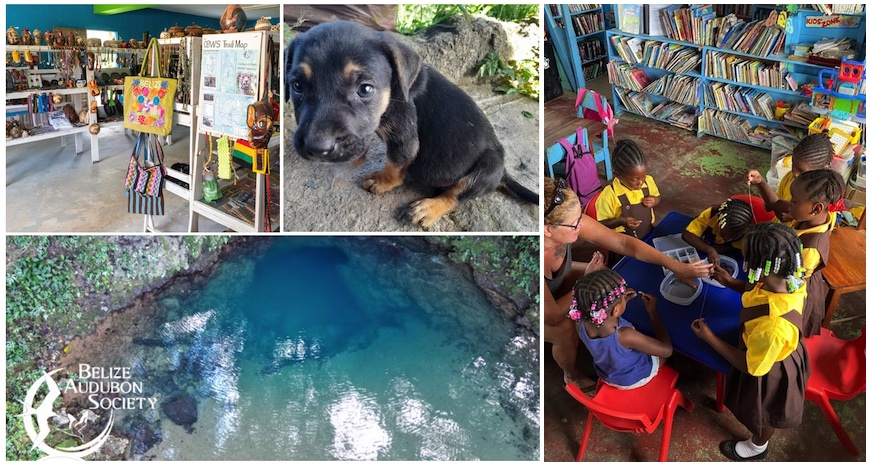
A montage of four photos, each representing one of the NGOs that is highlighted below. The first photo is of a gift shop, the second is of an adorable puppy, the next is of children in a library, and the last is of a natural spring swimming hole in Belize.

Tomorrow is Valentine’s Day, and in honor of love, I’m going to show some love for the NGOs I interacted with or noticed while on my recent two-week trip to Belize.

I was not volunteering in Belize; I was vacationing. But when I travel, I always do so with a mind to transire benefaciendo: “to travel along while doing good.” So here’s a thread to highlight some awesome NGOs I encountered as a tourist in Belize:

The Belize Audubon Society. They staffed some of the sanctuaries and parks we visited. And staff was always AWESOME. Note: they have volunteering opportunities!

Cayo Animal Welfare Society. It’s the Humane Society serving San Ignacio / Santa Elena and the Cayo District of Belize. I wrote them about a disturbing incident of dog abuse by the people operating a snack shack at Cahal Pech & they promptly wrote back.

Maya Center Women’s Group. They have a cultural center & gift shop at the entrance of Cockscomb Basin Wildlife Sanctuary. They are local artisans & by purchasing from them, you help sustain their families. They are lovely to talk to.

Miss Bertie’s Hopkins Community Library. We walked by it every day we were in Hopkins, Belize. But I never went in, because it was either closed or OH so busy & I didn’t want to be a bother. But what an important resource!

Please show them some love as well: go like some of their Facebook posts. If you can, make a financial donation to any or all of them!

Why did these groups get my attention? Because I encountered them while visiting a site and they were particularly helpful, because they had a great presence wherever they were located and that presence jumped out at me when I went by, and/or because I asked them a question online and they responded. Does YOUR nonprofit or NGO meet all of that criteria, wherever it is in the world?

And next time you travel, I hope you will consider keeping in mind transire benefaciendo.

Wildlife Crime (prevention/response) Tech Challenge

As demand for products from wildlife has skyrocketed, criminal networks and corrupt officials exploit porous borders and weak institutions to profit from wildlife trafficking. These syndicates are more organized, sophisticated, and technologically advanced than ever before.

Are you a mobile developer, conservation biologist, engineer, forensic scientist, social media analyst, or entrepreneur with a great idea? USAID’s Wildlife Crime Tech Challenge will reward the most innovative science and technology solutions—at any stage of innovation, from anywhere in the world, and from all areas of expertise—that can be scaled to address one or more of the four issues identified on the page: detect transit routes, strengthen forensic evidence, reduce consumer demand, tackle corruption.

Follow on Twitter at @wildlife_tech

What to do with old/vintage software.

Welcome to one of the most popular blogs I have ever written. It’s popularity is because of the subject, right there in the title: people want to know what to do with old and vintage software, as much as they want to know what to do with old hardware, and this blog that you are reading now is what comes up when they look online.

But the original contents of this blog were published in February 2014. That was a thousand years ago, in terms of tech.

I’ve kept the original text of the blog here – you can get to it if you scroll down. But note that it is woefully out of date, and most of the links don’t work anymore.

Here are two things to add to the original blog:

Goodwill or a Habitat ReStore MIGHT take your software IF the store has a tech section and IF the person that accepts donations at that store sees a value in the software. Go to the store yourself and look for a section selling tech, and if there isn’t one, they are probably NOT going to take it.

If there is no market for the software, check with your local government’s environmental or waste management office to see if they have a way of disposing of the disks or books in an environmentally-responsible manner.

Below is the original blog, published 9 February 2014.

I’m betting you have a shelf or drawer full of old software that won’t work on your computer – and hasn’t for YEARS. You’ve got disks, you’ve got books, but it’s all completely unusable, and has been a long time. What are your options for out-of-date software that will no longer work on any computer or device you have because of a change/upgrade in operating systems, other than throwing it away? And do user agreements mean you have to just throw it away?

First, let me say that this blog is not a legal document and I’m not offering you legal advice. I’m presenting you research I’ve done and what it means to me. If you are that worried about being sued by a company for reselling software, you should stop reading now – and destroy the software before throwing it away, period.

There is NOT an ultimate legal agreement regarding reselling software. There’s not even agreement from software companies about reselling software. For instance, Adobe says “if you upgrade from Adobe Acrobat 6 to Acrobat 7, you cannot sell Acrobat 6 to someone else. If you purchase a new license, rather than upgrade your old software, you are permitted to transfer your old license. That is, as long as you did not purchase the original license with a volume licensing arrangement.” But in the case of Vernor v. Autodesk, the courts said that because Autodesk had said, explicitly, that old software had to be destroyed – that Vernor never owned it, merely licensed it – he was not allowed to resell it. One wonders if Vernor had thrown the software into the trash, and someone had retrieved it and started using it, rather than Vernor trying to sell it on eBay, if Autodesk could have sued Vernor for not truly destroying the software.

So, before you sell old software

  • Search for legal cases concerning that software on Google or Bing. If you see a case where the manufacturer of that software has sued a reseller, destroy the software and then throw the software away.
  • Make CERTAIN it is truly vintage, as in version you have is NOT available for purchase from the original software manufacturer, is no longer supported by the company, and is NOT available from BestBuy or other resellers; also, that it does not work with the current Mac or Windows operating systems.

Once you’ve met that benchmark:

  • Look to see if the version you have is being sold on eBay or Craigslist. If it is being sold by others, you will probably be safe doing it as well.
  • Put all the original disks and books together. Old software is of more use when the original documentation is available.
  • If there is detailed information online about this vintage software, such as on Wikipedia or a tribute page, link to it on any online information you post, and be detailed about what the software will work on – and what it will NOT work on – in terms of hardware and operating systems.
  • Try eBay and Craigslist for reselling.
  • I’m uncertain about using social media for this – I’d hate for you to attract attention for an overzealous lawyer who doesn’t understand that what you are selling is no longer supported by the company and no longer works on modern hardware or operating systems.
  • If you want to donate the software, try Craigslist, your social media accounts, any freecycle-type online forum or group in your community, and clubs for vintage computers. Note if you are willing to mail the software and pay those postage costs yourself. ook to see if there are nonprofits in your area that accept donations of old software, like FreeGeek in Portland, Oregon. Goodwill might take it. World Computer Exchange might take it.
  • Take your items to a local swap meet and hope for the best.
  • Look for a working vintage computer that the software would work on, buy it and set it up in your house with your vintage software as a conversation piece or a play thing.

This web page, EMS Old Software Exchange, says it buys and sells “the world’s largest selection of old/used/out-of-print software for the PC and other microcomputers.” But I can’t tell if it’s still in operation. And note that it has info on how to find out if your user agreement forbids you reselling a particular software tool.

Here’s the wikipedia entry for abandonware.

Also see: Shout out to nonprofit efforts to refurbish computers.

Also see my page on how I use my lime green clam shell iBook, bought in 2000. It also has advice on using these old Apple laptops that I’ve found from various sources online. Unfortunately, as of 2013, I can no longer get online with this device.

What’s your advice for selling or donating used, old software? And have you ever looked for older versions of software for a vintage computer that you use?

This article is the second most popular entry on my blog. If you have benefited from this blog or other parts of my web site or my YouTube videos and would like to support the time that went into researching information, developing material, preparing articles, updating pages, paying for this web site to be hosted, etc. (I receive no funding for this work), here is how you can help.

Using a Cell Phone or Feature Phone as a Smart Phone

Happy New Year!

I’m a big believer in NOT upgrading your computer hardware, cell phone, etc. every year. Such a practice is bad for the environment (creating a ridiculous amount of e-waste), the upgrade is not always an improvement over previous tech, and not everyone can afford the latest and greatest technology. 

My latest web page representing this philosophy:

Using a Cell Phone or Feature Phone as a Smart Phone

Though it may be hard for those of you have smart phones to believe, not everyone has a smart phone. Millions of people simply cannot afford a smart phone. Some of them use a simple cell phone, with very limited capabilities: the ability to make and receive phone calls and text messages. Some people have something that’s more than a cell phone but less than a smart phone: they have a feature phone, which has some web browsing capabilities.

Can you use a simple cell phone or a feature phone as a smart phone? Yes! There are several free online tools that can help you use whatever phone you have interact with various Internet tools, and I’ve tried to outline them on this page. Additional suggestions are always welcomed (as are first-hand accounts by cell phone and feature phone users).

I hope to update my page on Resources For Users of Older Computers in 2012 as well. This has, at times, been one of the most popular pages on my web site, along with my page on using an iBook still running OS9 (yup – you can still use such).

On a bit of a related note, I also spent the holidays researching and creating a page for people that travel, regarding Using the Internet to Share Your Adventure During Your Adventure. It has advice on blogging, photo-sharing, tweeting, etc. while you are traveling. It’s part of a growing section of my web site on advice for women travelers.

Also see: Electronic Waste is EVERYONE’S Responsibility
When computers, stereos, VCRs, iPods, walkmans, video games, software, and cell phones are put into land fills, they leak poisons and heavy metals into the ground, endangering our lives and the health of our planet. With 48.5 million computers discarded each year, the USA is a particularly poor recycler and global citizen, exporting its hazardous electronic waste to developing countries, often illegally, and with horrific impacts on human health and the environment in these countries. This page will help your organization dispose of its electronic waste in an environmentally-friendly manner.

Your org can benefit from “2012 International Year of…”

Each year has various theme designations from the United Nations General Assembly. So far, 2012 is:

International Year of Cooperatives. Organizations focused on microfinance, rural business development, small farmers and all organizations that support co-ops / cooperative enterprises should already be planning what they are going to do to leverage this year’s designation to promote their work and the needs of those they serve. Credit unions and even REI need to be thinking about leveraging the International Year of Cooperatives as well!

International Year of Sustainable Energy for All. Organizations focused on food production, health, climate change, jobs, the environment and, ofcourse, sustainable or alternative energy should already be planning what they are going to do to leverage this year’s designation to promote their work and the needs of those they serve. 

More designations may come.

Your nonprofit, non-governmental organization (NGO), charity, grassroots organization or even government agencies doesn’t have to have a mission specifically-focused on these themes to leverage them for your own organization’s use:

  • Girl Scouts / Girl Guides, or a class or club at a school, could engage in various activities to highlight cooperatives or sustainable energy or for their membership to learn about such.
  • A local business association could highlight area cooperatives or local companies focused on alternative energy on its web site, or create a media guide for the press on such, so that there is a local angle in the media regarding these international designations.
  • A utility cooperative could issue a media guide or create a section on its web site to highlight either International Year theme (or both!).
  • Any environmentally-focused organization could leverage the themes of either day to talk about their work or their concerns in an event, a press conference or a dedicated page on their web site.

You can use these designations to tie in your organization’s events and programs, through issuing press releases, writing op-ed pieces for local media, blogging on a related topic, offering yourself for interviews to radio and TV, or even holding a special event. By doing so, you increase the chance of your organization coming to the attention of anyone doing a search online for information about these international year designations.

Also, look for Twitter tags that are trending on these topics, so can have your Tweets reach an even wider audience.

For a list of these UN days, weeks, years and decades, see either this part of the UNESCO web site or this page by the UN Association of Canada.

Volunteers trying to help on their own

The Nonprofit Quarterly picked up a story about a 240-acre nature preserve in Northeastern New Jersey asking volunteers to please stop “doing good” on their own, because unsanctioned “trail improvements” are causing serious damage to the preserve. Conservancy members have found places where certain fruit-bearing native vines “are being cut wholesale,” threatening a source of food for small animals that live in the woods. In another instance, someone had removed logs and branches from steep trail beds, which could lead to serious erosion.

To prevent further damage, the nonprofit group has sent notices and put up signs along trails telling people who want to initiate their own projects to leave things alone. “We appreciate volunteerism, and we realize a lot of people have good intentions,” said Theresa Trapp, the conservancy’s treasurer. “But we really need people to contact us before doing any work.”

Some of the people doing these “trail improvements” could be mountain bikers. One official who has seen similar problems in county’s parks said mountain bikers will create their own trails, “and if something’s in their way, they’ll move it.”

This isn’t the first time I’ve heard of people thinking they are being proactive as volunteers, without seeking approval first from an organization and, instead, actually doing some harm. For instance, there are people who, once they become an official volunteer of an organization, think they are now official representatives of the organization, and will represent themselves as such to others:

  • they may organize a volunteering event without clearing it with the organization first,
  • book themselves as speakers to community groups,
  • start replying in online discussion groups as though they represent the organization,

Even worse: some people put themselves and others at risk with their independent volunteering following a disaster; this happened following Hurricane Katrina in the Gulf Coast of the USA with a few people who charged in on their own (I wish I’d kept track of all the stories I read about this happening, particularly with people handling chainsaws – one man hurt himself while he was alone in a largely abandoned area).

It’s not enough to have a few lines in your written policies and procedures about when a volunteer should, and should not, represent themselves as volunteers, how they should propose activities, your confidentiality policies, etc.; you need to remind your volunteers and the general public of these policies: on your online discussion group for volunteers, in your online or paper newsletter, on your web site, on your social networking profiles such as Facebook, and maybe even through an interview on the local TV news or a local newspaper.

If you discover a volunteer is doing activities in the name of your organization, but outside of the approval of your organization, contact that person immediately – not via email, but with a phone call or in-person meeting. Tell the person what you have heard and ask the volunteer if what you have heard is true. Welcome that person’s own explanation/description of the circumstances. And then review together the policies of the organization and how this might, or might not, be a violation. If you need more time to investigate, by all means, do so.

If it’s someone outside your organization, again, call that person immediately. Tell the person what you have heard and ask the person if what you have heard is true. Welcome that person’s own explanation/description of the circumstances. Explain carefully why the activity is inappropriate (if it is). And consider: is there a way to make this person an official volunteer and channel his or her energies for your organization in a more appropriate way?

In either case, followup with both email and, as appropriate, a message sent via postal mail, confirming the details of your meeting and the next steps.

And on a related note: How do you know what is being said about your organization or yourself in the public spaces online — on blogs, in captions on Flickr photos, in newspaper articles, and in public online discussion groups?

My favorite tool for tracking what’s being said about an organization I’m working with, or even just me, is GoogleAlerts. This free service automatically notifies you if there is any new content online in a public space — including traditional print media that publishes their stories online — that mentions whatever phrase or phrases you want to track. It won’t tell you about email conversations, as those are private, or about postings on private online spaces (a private online discussion group, for instance, or someone’s Facebook profile that has all of its privacy settings on — so long as Facebook keeps allowing such privacy settings, which it may not always do).

You can use GoogleAlerts or similar tools to track:

  • Your name
  • Your organization’s name
  • Your executive director’s name
  • Another organization (your competition, a partner, an organization you aspire to be like, etc.)
  • A particular subject matter
  • Etc.

Start with two GoogleAlerts at first — one of just your name, and one of your organization’s name. Putting a name in quotes is best, so that you will get only exact matches (I don’t want every newspaper story that mentions Jayne and also Cravens, but specifically, Jayne Cravens, and that won’t happen unless I put my entire name in quotes, like this: “Jayne Cravens”). You will then receive an email when something is published online with your alert name, with a link to the mention. You can set the alerts to come as the mentions happen (for instance, when the blog is posted that mentions your name), in a daily summary, or in a weekly summary.


Be careful when you choose subjects to track; you don’t want to track something generic like dogs, because you will be overwhelmed with alerts. You would want to track something specific instead in one alert, like
dogs abandoned Nowhere County “Humane Society”

GoogleAlerts or similar tools help you respond quickly to newspaper articles, blog posts — even criticism. And you most certainly should respond online quickly, with praise, with thanks or with more or clarifying information, as the situation demands.

With all that said, do NOT try to shut down a volunteer’s blog about his or her experience with your organization. Blogging by volunteers should be encouraged, not discouraged, within the policies of the organization (not talking about confidential information, for instance, or not disparaging co-workers in public).