Commentary, resources & discussion re: nonprofits/ngos, communications, community engagement, volunteerism, effective humanitarian aid & development, ethics, women's empowerment & management ethics. Posts at least twice a month, usually on Tuesdays.
I also note that most of the reasons in that list are, in fact, appropriate reasons to volunteer locally, in your own community or region, and why that is.
I also address on this page the pushback comment I often get when I make such a list: “Oh, then volunteering abroad should be ONLY for the privileged?!?”
I’m tired of seeing volunteering, locally or abroad, that’s more focused on volunteers and their feelings and personal needs and ambitions than on the people and communities to be served.
I’m tired of seeing local people excluded from decision-making and participation that is supposed to positively affect their lives. Because I’m tired of seeing the remnants of white colonialism and supremacy present in volunteering and other nonprofit/NGO activities. Because I loathe vanity volunteering (volunteering that’s all about the ego of the volunteer).
I really do want volunteers to help, not hurt.
There are lots of links on the page about how to approach volunteering abroad ethically, and where to find credible programs, as well as links to all of my posts against unethical voluntourism, vanity volunteering, etc.
And if you disagree with what I’ve written, by all means, comment below (but please read the ENTIRE page first), or write your own blog or web page and then contact me and let me know the link. I’d like to read your thoughts.
If you have benefited from this blog or other parts of my web site and would like to support the time that went into researching information, developing material, preparing articles, updating pages, etc. (I receive no funding for this work), here is how you can help.
Rob Jackson is a volunteer engagement consultant based in the United Kingdom. Rob was a manager of volunteers himself for many years, and his training and writing is based in reality and practicality. We met online back in the 1990s when he started UKVPMs, an online community for managers of volunteers in the UK, and have been colleagues (and good friends) ever since.
Rob wrote this on his Facebook page, and with permission, I’m reprinting it here on my blog:
It’s time for a new way to think about local volunteering infrastructure.
In recent months I’ve read stories of how lockdown volunteering was especially effective where local groups (formal and informal) were connected to their local volunteering infrastructure organisations (Volunteer Centres).
This comes as no surprise to me. For six years I worked closely with Volunteer Centres as part of the team at Volunteering England. I’ve been a trustee of two Volunteer Centres in my time. I know their value and importance.
Yet too often local infrastructure is seen as either an encumbrance or an irrelevance. Why fund a Volunteer Centre when people can volunteer without them? Surely technology can do the work of a Volunteer Centre better than a human? Who needs a Volunteer Centre when we have the internet?
These arguments miss a crucial point. Volunteering infrastructure isn’t a building or office, a snazzy website or matching software.
Volunteering infrastructure is people. It is connections. It is relationships.
Cuts to Volunteer Centres may realise a quick financial saving, but it’s far more expensive to have to rebuild them down the line.
Volunteering infrastructure is a valuable investment in the underlying and enabling fabric of a thriving, vibrant local community.
It’s time we saw it that way and supported it properly.
Perfectly said, Rob. And not just for the UK. You can comment here, but please also comment on Rob’s original post if you are on Facebook.
If you have benefited from this blog, my other blogs, or other parts of my web site and would like to support the time that went into researching information, developing material, preparing articles, updating pages, etc. (I receive no funding for this work), here is how you can help.
A week ago was Valentine’s Day in the USA, and it’s not too late to talk about LOVE for the people at your program that support volunteers, and a great way to show them some love is to pay for what’s needed to fund effective volunteer engagement!
I talk a lot about funding volunteer engagement, how if communities – including corporations, foundations and governments – want for more people to volunteer, and want more nonprofits and community programs to involve volunteers, they are going to have to pay for it, in cash. What would funders be paying for to increase community engagement, to increase volunteerism?
Salaries for part-time or full-time managers of volunteers.
Training for ALL staff in effective volunteer engagement (not just the person in charge of volunteer engagement), like how to create meaningful, appropriate assignments, how to appropriately support vounteers, how to report safety and quality concerns, etc.
Training for the person in charge of volunteer engagement in skills that could help in better support and recruit volunteers, like basic video or audio editing skills, so they can produce simple YouTube videos, podcasts, etc., or classes in another language, such as Spanish, or classes in facilitation, conflict management, DEI (diversity, equity and inclusion), etc.
Subscriptions to services that have the information and news they need, like Engage.
Volunteer management software, computers, smart phones, video conferencing software (free versions often don’t provide a manager of volunteers all they need to effectively work with volunteers), etc.
Registration fees and travel expenses for staff to attend conferences that provide speakers and learning experiences that can help improve volunteer engagement.
Renting meeting or event spaces for volunteer-related activities.
Funds for volunteer recognition: gift cards, swag, etc.
All of the above is the “overhead’ that too many corporations and foundations refuse to fund. When I say volunteers are NOT free, these are the expenses I mean. Let me say it once again: if communities, corporations, foundations and governments want more people to volunteer, and want more nonprofits and community programs to involve volunteers, they are going to have to pay for it, in cash.
If you have benefited from this blog, my other blogs, or other parts of my web site and would like to support the time that went into researching information, developing material, preparing articles, updating pages, etc. (I receive no funding for this work), here is how you can help.
An online multimedia platform that allows people to create an avatar for themselves and “live” in an online virtual world. Avatars interact with places, objects and other avatars, exploring the virtual world, meeting other residents, socializing, having business meetings, hosting events, participating in group activities, building, creating, shopping, collaborating, even trading virtual property and services with one another.
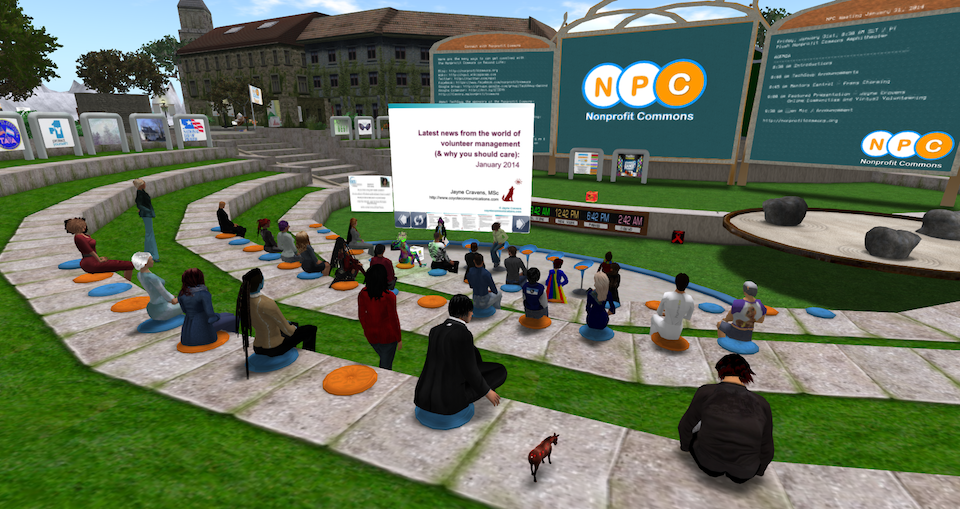
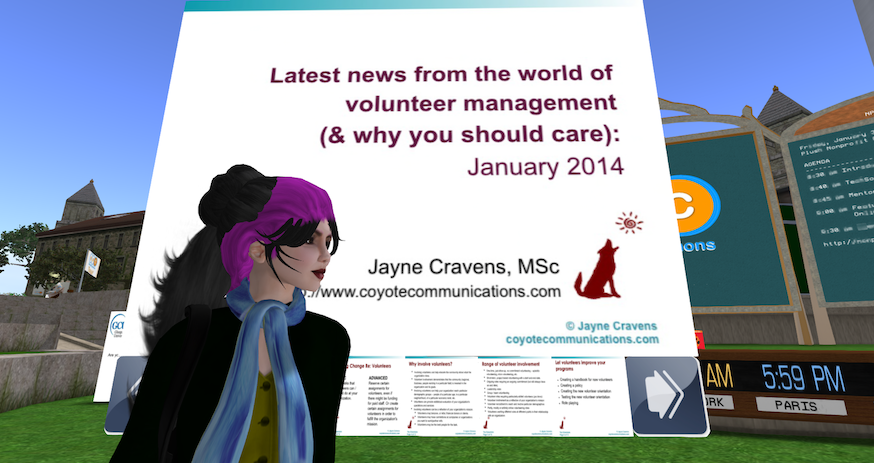
Mark Zuckerberg’s Metaverse? No! I’m talking about Second Life, which launched back in 2003. The image at the top of this blog, and the image below, are of me, as an avatar, leading an event in Second Life for TechSoup back in 2014:
TechSoup was an early and passionate adopter of Second Life, hosting numerous online events there. If you do a search for Second Life on the TechSoup forum, you would find numerous references to the platform and TechSoup activities there over the years.
Mark Zuckerberg, founder of Facebook (now Meta), said to much fanfare that he wanted to launch his own metaverse. The new virtual-reality app Horizon Worlds is Facebook’s first foray into the much-hyped “metaverse” for Facebook parent company Meta. Horizon Worlds, a beta version of which featured prominently in Zuckerberg’s announcement, launched Dec. 9 in the United States and Canada on the company’s Oculus virtual-reality platform and represents its first major attempt to deliver on his vision.
Were you on Second Life? Are you still on Second Life? Did you participate in TechSoup’s events on Second Life, or any other nonprofit-related activities? What do you think emerging virtual worlds, including Meta’s projects, can learn from Second Life? Comment below!
Second Life is so thoroughly steeped in conditions that have impeded the development of successful social norms in other communities that any system of social norms in Second Life will ultimately fail. Because social norms will likely fail to successfully maximize resident welfare, regulatory schemes imposed both by the operators of the virtual world and by real-world governing institutions are needed to enhance the functioning of this particular alternative reality inhabited by millions.
Do you think Meta’s virtual world is addressing this issue? Do you think they need to plan for how to address such?And are you worried about safety at all with any online platforms? Comment below!
Nina Jane Patel was targeted with sexual harassment in Facebook/Meta’s platforms. “Within 60 seconds of joining — I was verbally & sexually harassed — 3–4 male avatars, with male voices, essentially, but virtually gang-raped my avatar & took photos…” The 43-year-old mother said it was such a “horrible experience that happened so fast” before she even had a chance to think about using “the safety barrier,” adding that she “froze.” She continued by confessing how both her “physiological and psychological” reaction was similar to it happening in real life. “Virtual reality has essentially been designed so the mind and body can’t differentiate virtual/digital experiences from real,” Patel wrote.
This is similar to assaults that happened in Second LIfe. Examples:
Horizon Worlds is supposed to be limited to adults 18 and older. In practice, however, very young kids appear to be among its earliest adopters. Some say the presence of children in Meta’s fledgling metaverse raises a grave concern: that by mixing children with adult strangers in a largely self-moderated virtual world, the company is inadvertently creating a hunting ground for sexual predators.
When new online forums arise that attract kids, sexual predators “are often among the first to arrive,” said Sarah Gardner, vice president of external affairs at Thorn, a tech nonprofit that focuses on protecting children from online sexual abuse. “They see an environment that is not well protected and does not have clear systems of reporting. They’ll go there first to take advantage of the fact that it is a safe ground for them to abuse or groom kids.”
Could nonprofits that engage in an online metaverse be putting their clients or others at risk by asking them to be there too? Comment below!
There’s one more consideration: accessibility. If you engage with people in a graphics-based environment, you are leaving out people who have sight-impairments. How will auditory displays work for graphics-based environments to address accessibility issues (I’m asking because I really don’t know)? Or is it a matter of ensuring you never limit your service delivery and volunteer engagement to only a graphics-based environment?
There is section devoted to virtual volunteering and avatar-based environments in The Last Virtual Volunteering Guidebook. The section offers some examples of nonprofits using Second Life to engage with clients and volunteers, and offers specific advice on how a nonprofit should get started using such environments, considerations to explore and pitfalls to avoid – all of which is relevant for any graphics-based virtual world. The rest of the book is easily adaptable to engaging with volunteers in graphics-based/avatar-based virtual worlds as well.
Looking forward to hearing your comments!
If you have benefited from this blog or other parts of my web site and would like to support the time that went into researching information, developing material, preparing articles, updating pages, etc. (I receive no funding for this work), here is how you can help.
The Communications Initiative is a resource I rely on regularly. I cannot say enough fantastic things about it. Over the last several months, I have been unsubscribing from a lot of email newsletters and unfollowing a lot of pages on Facebook, trying to declutter my online life, but I continue to make time to read the Communications Initiative updates. If you work in any capacity regarding communicating with clients or the general public regarding your nonprofit, NGO or government agency, this is a must-use resource.
Your outreach seeks to educate, involve, and engage your organization’s stakeholders. Outreach that honors diversity, equity, and inclusion is no different, other than the intentionality of your decisions. It requires you to understand who your audience is beyond the data points. It requires you to know what their priorities are, and then to craft messages and engagements that are inclusive to them. DEI outreach goes beyond reaching out, it requires them to bring people in.
We’ve created these nine tips with the communicator in mind. It’s flexible, so use it as a checklist, a launching point for a discussion, or even an assessment survey to improve your DEI communications.
If you have benefited from this blog, my other blogs, or other parts of my web site and would like to support the time that went into researching information, developing material, preparing articles, updating pages, etc. (I receive no funding for this work), here is how you can help.
The National Volunteer Fire Council (NVFC)has partnered with Cottage Lane Productions to develop a new episode of the volunteer firefighter recruitment series Ride With Us. The series takes prospective volunteers into a firehouse to show them, as much as a video can, what it’s like to be a volunteer firefighter. These can be used by any fire station as a part of its own recruitment and onboarding of volunteer firefighters and first responders.
If you have benefited from this blog or other parts of my web site and would like to support the time that went into researching information, developing material, preparing articles, updating pages, etc. (I receive no funding for this work), here is how you can help.
Those working with volunteers should not have to beg for a spot on the IT staff’s to-do list or argue for basic functions they feel are necessary. If you encounter resistance, go higher and make your case to a manager above both functions. Detail in writing your technical needs to work with volunteers and explain why you are asking for certain post ings or functionality. Just as the author of a book has more say over its contents than the printer, the content and priorities of a Web site or other Inter net outreach should be determined not by IT staff but by those directly involved in what needs to be accomplished. While it is fair to mutually deter mine deadlines with IT staff, your tech-related requests should not be answered with “when we have the time.” Settle for nothing less than real dates for completion of work, getting upper management to back you up. (page 17)
What are the consequences of not having the web pages your program needs regarding volunteer engagement? Or not having a private online discussion group for volunteers? Or not having volunteer management software? Write those out, explicitly – it’s part of the business case you need to have in writing, the evidence you need to shut down arguments against IT support for the IT you need to effectively recruit, engage and support volunteers.
In addition, you have every right to circumvent reluctant IT staff who aren’t doing what they should in terms of support for what you need. There are ways to mobilize volunteers to debunk their arguments against doing what you need in terms of IT.
For instance, if you have new pages you want added to your organization’s web site, and your web master says he doesn’t have time to create and add them, recruit a volunteer to design those pages for you, using your organization’s own web pages as a template, then present the finished pages to your web master: “Here are the pages we want added to the site, all prepared exactly the same as our current page, plus our current main page regarding volunteering with us, with updated links.” With the pages complete, the only thing the web master has to do is upload them to your site – nothing more. If he refuses? Time to have a sit down with HIS supervisor!
Another option: recruit volunteers to build your own free WordPress site with all of the information you regarding volunteer engagement at your program: requirements, accomplishments, recognition, application process, etc. Then ask the web master to link to those pages from the appropriate places on the organization’s web site. If he refuses? Time to have a sit down with HIS supervisor!
Need a private online group for your volunteers? You can do so for free with GoogleGroups – a much better option than a Facebook Group (many people like to keep their Facebook activities and their profile there separate from volunteering and professional activities). A volunteer could be recruited to create such a GoogleGroup for you and help you use it. Get it set up, start using it, make it an essential part of your work, and report on how it’s become essential and how you are using it to your supervisor – and make sure that supervisor knows that it was volunteers who made it possible, not the IT staff at your organization. If you use the group for a year or more and find you need something more advanced later, you will have a track record of success to show that it’s a worthwhile endeavor worthy of investment, one that the IT staff will need to support.
If you want volunteer engagement at your organization to be treated at the same level of importance as fundraising at your organization, you have to insist on it, not just hope for it. It’s so easy to recruit volunteers with the IT skills you need to better engage and support all volunteers. Want to be seen as a leader? Then LEAD. No one knows what you need to do your job better than YOU. And tech-savy volunteers are out there, ready to help you make it happen!
If you have benefited from this blog or other parts of my web site and would like to support the time that went into researching information, developing material, preparing articles, updating pages, etc. (I receive no funding for this work), here is how you can help.
Video continues to surge in popularity as a way to meet just about any outreach goal. And that means every nonprofit, big or small, needs to be thinking strategically about what videos it needs to produce and share – and where it should be sharing those videos.
Videos aren’t difficult to produce: if you have a smart phone that records video and/or audio, you can create videos to share online about your organization. That includes Androids, not just Apple devices. If any employee or volunteer has an Apple Macintosh computer, you have easy-to-use video editing software already on that computer: iMovie. Affordable video-editing software for non-Apple computers is easy to find online. Even if you have only photos, you can use them to create a video with audio for most of the proposed activities below.
As always: volunteers can be a GREAT help in producing these videos! If you don’t have an employee that can produce these videos, and cannot afford to pay a consultant, volunteers may be a great option – in fact, there are people actively searching for these kind of online volunteering tasks. Any volunteer that knows how to use iMovie or its equivalent can produce videos from you from any raw video you have from a smart phone, recorded Zoom meeting, camera, etc. Volunteers can also provide closed captioning and transcriptions of videos. Volunteers can also help you brainstorm ideas for videos your nonprofit should create.
If you have benefited from this blog, my other blogs, or other parts of my web site and would like to support the time that went into researching information, developing material, preparing articles, updating pages, etc. (I receive no funding for this work), here is how you can help.
When it comes to a successful web site for a nonprofit, an NGO, a government agency, a school or other mission-based, cause-based initiative, content is king. When I say successful, I’m talking about a web site where the people that organization is targeting come to that site, and those people find what they are looking for: through experiencing the site, people have an understanding how this program can serve them or their community, know if the program is successful, can sign up to volunteer and can easily make a financial donation.
I’ve seen beautifully-designed web sites that meet all accessibility and usability standards that never say what the organization really does, what programs they offer, why I should care, if they involve volunteers, etc. The organization invested in design, but not content.
Lizzie Bruce has a wonderful blog, “Why Do You Need a Content Designer? The Words Just Appear, Right?” that says so much of what I’ve been trying to stay for years. It’s comforting to know I’m not alone in trumpeting the need for focusing on content in developing a web site (or any other outreach tool, for that matter).
If you have benefited from this blog or other parts of my web site and would like to support the time that went into researching information, developing material, preparing articles, updating pages, etc. (I receive no funding for this work), here is how you can help.
For many years, in promoting virtual volunteering, I’ve talked about how it’s very hard to fake it when you volunteer online: if you say you have web design skills, and I get you started on a project, I find out very quickly if you really do have web design skills or not. If you say that you can translate something from English to Spanish because of your language fluency, I find out very quickly if that’s true or not. With online volunteers, I’m experiencing people based on their work and productivity almost immediately.
By contrast, I have been fooled many times by onsite volunteers: they come in on time, they are oh-so-nice, I see them onsite, walking in the halls or sitting at a desk, we chat here and there, and I just assume they are doing what they are supposed to be doing. I mean, they are THERE, right? I can see them and, therefore, they are volunteering, right? And later, I find out they haven’t done most, or any, of what they signed up to do, or they haven’t been doing it well.
That isn’t to say that I prefer online volunteers to onsite volunteers, but it certainly has changed how I manage people, volunteer and employee alike, onsite or online: I require onsite staff I am managing to check-in and report on what they are doing as often as online volunteers, and in the same way: in writing, via email or an online system I’ve set up. I want to know very quickly if a volunteer or employee is doing what they’ve signed up to do, what I NEED them to do. Weekly or bi-weekly check-ins are a must – it can be as simple as an email, but I have to have an update, something more than “I’m working on that.” And I do the same: my direct reports know what I’m working on as well, what is challenging me, what my priorities are, what my deadlines are, etc.
I’ve also said many times that organizations that start employing virtual volunteering – using the Internet to support and engage volunteers – may find out, as a result, that their manager of volunteers isn’t a very good manager. That person may have also have been judged by being seen walking in the halls, talking to volunteers and sitting at a desk, and always having a smile for everyone, rather than on abilities to create tasks and roles for volunteers, guiding staff who work with volunteers, tracking successes with volunteers, identifying challenges and addressing them, etc.
Similar thoughts can be found in this essay in The Atlantic by Ed Zitron. He’s writing about how companies need to let go of the idea that employees and consultants need to always be onsite:
Remote work lays bare many brutal inefficiencies and problems that executives don’t want to deal with because they reflect poorly on leaders and those they’ve hired. Remote work empowers those who produce and disempowers those who have succeeded by being excellent diplomats and poor workers, along with those who have succeeded by always finding someone to blame for their failures. It removes the ability to seem productive (by sitting at your desk looking stressed or always being on the phone), and also, crucially, may reveal how many bosses and managers simply don’t contribute to the bottom line… I have known so many people within my industry (and in others) who have built careers on “playing nice” rather than on producing something. I have seen examples within companies I’ve worked with of people who have clearly stuck around because they’re well liked versus productive…Remote work makes who does and doesn’t actually do work way more obvious.
How nice to see the corporate world once again catching up with the nonprofit world (grin).
I’m never going to want to entirely stop working with people in same place, at the same time. I do think there are some things that can happen in an office that just cannot happen remotely. An example: at a nonprofit that produced an event with more than 150 online volunteers in an eight-week period, the night before the launch, myself and another staff member sat at the same table, in the same place and time in Austin, Texas, with our laptops, a massive whiteboard and some yummy snacks, rapidly putting together all of the things that had to be in place. It was hours of frantic, at-times stressful, incredibly energizing work, and there’s an efficiency and clarity in having the person right there, at the table across from you, reacting in real-time, that can never be matched by Slack or Zoom. By the time we were finished from this marathon work session, we were mentally spent but oh-so-celebratory, and we broke out our favorite live musical moments on YouTube and all sang along at the top of our lungs. That wouldn’t have been at all the same at home. It wouldn’t have been as productive or as fun. But I carried that experience, and the onsite event launch, back with me when I returned to my home office in Oregon, and it fueled my remote work for the next several weeks. I felt oh-so-close to co-workers I’d spent those intense days with. Our incredible productivity and teamwork continued for the eight weeks of the project when we all went back to working remotely, and we were a stronger team for that onsite, face-to-face experience, no question – but working remotely after that was not just fine, but much more appropriate for the bulk of the project.
I was the chair of a board of directors last year, for a program that gives away small grants to nonprofits. We asked the county government agency a few times three years ago if we could have at least some meetings remotely, and were told, absolutely, NO. When the pandemic came along, suddenly, that thing we were not allowed to do, that could not be done, was permissible and possible. And I think our board meetings have been much more efficient as a result, with much better attendance, and much more productive. Do I want to get together face-to-face eventually? Sometimes, yes. But there’s no question: the norm for these board meetings should be online.
If you are a manager of volunteers and you want a better way to support and engage all of your volunteers, even if all of their service is onsite at your organization, The Last Virtual Volunteering Guidebook is worth your time. And if you want to create more tasks and roles for volunteers online – and you should, no matter the focus of your organization, even if your volunteers do things that must be done onsite, like care for animals in a shelter, repair roofs on homes where elderly people live, plant trees, whatever – this is the book for you. It’s available both as a traditional print publication and as a digital book.
If you have benefited from this blog or other parts of my web site and would like to support the time that went into researching information, developing material, preparing articles, updating pages, etc. (I receive no funding for this work), here is how you can help.