Category Archives: Community / Volunteer Engagement

Your flow chart for volunteers

Too often, volunteer involvement is described this way:

Volunteers contact us, we give them an assignment, they do it. Ta da!

This simplified description comes often from people who are from the for-profit/corporate sector or who are in senior management – they have no idea how much work it takes behind the scenes for successful volunteer engagement.

Volunteers should certainly feel like getting into an assignment is seamless and quick, but to give volunteers that experience actually takes a LOT of planning behind-the-scenes by the organization. For instance, there are rarely a plethora of well-defined tasks or roles laying around a nonprofit office waiting to be done by just anyone with some time on their hands and a good heart. It takes a lot of time and support to develop volunteering assignments, including “micro-volunteering” tasks that will take just a few hours, and not just any person is appropriate every assignment – some require particular skills, a certain amount of time within a specific time frame, or work at a particular type of day.

In addition, a person’s desire to volunteer is often not enough for a volunteer to be successful: a candidate needs to be screened at least a bit in order to make sure the volunteer understands the very real commitment he or she is making, even if that commitment is just a couple of hours. The candidate may need to be further screened to make sure he or she really does know how to do the assignment. To not do any screening means much more time down the road for the organization, tracking down volunteers, correcting sub-par assignments, finding more volunteers or staff to re-do assignments that were poorly done or not done at all, etc.

And, ofcourse, supporting volunteers takes a lot of time, no matter how automated you make the process. Someone has to be contacting volunteers to ensure they are getting assignments done, have the support they need, etc. Someone has to keep volunteers in-the-loop about what’s happening at the organization, and to recognize the value of their work – otherwise, those volunteers go away.

A terrific, easy exercise that can be really helpful in showing just what it takes for your organization or an individual department to involve and support volunteers successfully is to create a flow chart mapping your volunteer engagement, or a series of maps for different parts of the volunteer management process — the volunteer in-take process, the volunteer assignment development and matching process, the volunteer support assignment, etc. You could do charts for each of these processes, and then show how they all intersect.

You can do this mapping exercise alone, by yourself (if you are the coordinator of volunteer program or involve large numbers of volunteers yourself), or you can do this with a group of employees and volunteers. A dry erase white board with markers is best, but any computer program that allows you to do a flow chart or graphics will work as well.

Here’s one example of what a volunteer in-take flow chart could look like as a result of your mapping exercise (every organization is different):

Don’t be surprised if, in doing this process, you find gaps in your volunteer management process. I’ve done this mapping process with several departments and organizations, and the results have been revealing. Many times, I’ve found that an organization thinks it isn’t recruiting enough volunteers when, actually, it is — a lot of people are, in fact, responding to recruitment messages, but their information isn’t being forwarded to the coordinator of volunteers, or the volunteers are getting responses weeks or months after they express interest, instead of within hours or a few days. If I’m evaluating a volunteer program and an organization cannot produce such a chart — they don’t know what happens when someone calls, they don’t know how information gets to the coordinator of volunteers, the coordinator can’t say how many calls or emails he or she gets every month from potential volunteers, etc. — I know just how deep problems may be regarding the organization’s recruitment, involvement and support of volunteers.

Doing a chart correctly may require interviewing more than one person. For instance, just to map the volunteer in-take process correctly takes interviewing every person who answers the organization’s phone or main email address.

When I’m in charge of coordinating volunteers, I find this exercise quite helpful because it helps me educate fellow staff quickly on what it takes to involve volunteers successfully and helps explain why I’m doing whatever it is I’m doing.

Again, the example above is just for a volunteer in-take process (it doesn’t show how a volunteer is matched to an assignment, or how an assignment gets developed in the first place), and your map could be different for your organization. Maybe you don’t have an onsite orientation; your volunteer orientation may just be an email message, or may be an online video candidates for volunteering can view on their own. In either case, your map needs to show how you know they have read that email message or viewed that video.
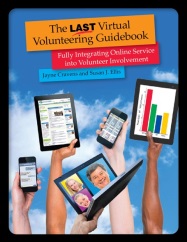
Update: this chart and the methodology behind it are detailed in The Last Virtual Volunteering Guidebook: Fully Integrating Online Service Into Volunteer Involvement. The book can help you fully explore the reality of remote volunteer engagement, in terms of policy and procedures, to ensure success, as well as using the Internet to support and engage ALL volunteers, including those that provide some or all of their service onsite. This book was helpful long before the global pandemic spurred so many organizations to, at last, embrace virtual volunteering. This is the most comprehensive resource anywhere on working with online volunteers, and on using the Internet to support ALL volunteers, including those you might not think of as “online” volunteers.

If you have benefited from this blog or other parts of my web site or my YouTube videos and would like to support the time that went into researching information, developing material, preparing articles, updating pages, etc. (I receive no funding for this work), here is how you can help.

Volunteers trying to help on their own

The Nonprofit Quarterly picked up a story about a 240-acre nature preserve in Northeastern New Jersey asking volunteers to please stop “doing good” on their own, because unsanctioned “trail improvements” are causing serious damage to the preserve. Conservancy members have found places where certain fruit-bearing native vines “are being cut wholesale,” threatening a source of food for small animals that live in the woods. In another instance, someone had removed logs and branches from steep trail beds, which could lead to serious erosion.

To prevent further damage, the nonprofit group has sent notices and put up signs along trails telling people who want to initiate their own projects to leave things alone. “We appreciate volunteerism, and we realize a lot of people have good intentions,” said Theresa Trapp, the conservancy’s treasurer. “But we really need people to contact us before doing any work.”

Some of the people doing these “trail improvements” could be mountain bikers. One official who has seen similar problems in county’s parks said mountain bikers will create their own trails, “and if something’s in their way, they’ll move it.”

This isn’t the first time I’ve heard of people thinking they are being proactive as volunteers, without seeking approval first from an organization and, instead, actually doing some harm. For instance, there are people who, once they become an official volunteer of an organization, think they are now official representatives of the organization, and will represent themselves as such to others:

  • they may organize a volunteering event without clearing it with the organization first,
  • book themselves as speakers to community groups,
  • start replying in online discussion groups as though they represent the organization,

Even worse: some people put themselves and others at risk with their independent volunteering following a disaster; this happened following Hurricane Katrina in the Gulf Coast of the USA with a few people who charged in on their own (I wish I’d kept track of all the stories I read about this happening, particularly with people handling chainsaws – one man hurt himself while he was alone in a largely abandoned area).

It’s not enough to have a few lines in your written policies and procedures about when a volunteer should, and should not, represent themselves as volunteers, how they should propose activities, your confidentiality policies, etc.; you need to remind your volunteers and the general public of these policies: on your online discussion group for volunteers, in your online or paper newsletter, on your web site, on your social networking profiles such as Facebook, and maybe even through an interview on the local TV news or a local newspaper.

If you discover a volunteer is doing activities in the name of your organization, but outside of the approval of your organization, contact that person immediately – not via email, but with a phone call or in-person meeting. Tell the person what you have heard and ask the volunteer if what you have heard is true. Welcome that person’s own explanation/description of the circumstances. And then review together the policies of the organization and how this might, or might not, be a violation. If you need more time to investigate, by all means, do so.

If it’s someone outside your organization, again, call that person immediately. Tell the person what you have heard and ask the person if what you have heard is true. Welcome that person’s own explanation/description of the circumstances. Explain carefully why the activity is inappropriate (if it is). And consider: is there a way to make this person an official volunteer and channel his or her energies for your organization in a more appropriate way?

In either case, followup with both email and, as appropriate, a message sent via postal mail, confirming the details of your meeting and the next steps.

And on a related note: How do you know what is being said about your organization or yourself in the public spaces online — on blogs, in captions on Flickr photos, in newspaper articles, and in public online discussion groups?

My favorite tool for tracking what’s being said about an organization I’m working with, or even just me, is GoogleAlerts. This free service automatically notifies you if there is any new content online in a public space — including traditional print media that publishes their stories online — that mentions whatever phrase or phrases you want to track. It won’t tell you about email conversations, as those are private, or about postings on private online spaces (a private online discussion group, for instance, or someone’s Facebook profile that has all of its privacy settings on — so long as Facebook keeps allowing such privacy settings, which it may not always do).

You can use GoogleAlerts or similar tools to track:

  • Your name
  • Your organization’s name
  • Your executive director’s name
  • Another organization (your competition, a partner, an organization you aspire to be like, etc.)
  • A particular subject matter
  • Etc.

Start with two GoogleAlerts at first — one of just your name, and one of your organization’s name. Putting a name in quotes is best, so that you will get only exact matches (I don’t want every newspaper story that mentions Jayne and also Cravens, but specifically, Jayne Cravens, and that won’t happen unless I put my entire name in quotes, like this: “Jayne Cravens”). You will then receive an email when something is published online with your alert name, with a link to the mention. You can set the alerts to come as the mentions happen (for instance, when the blog is posted that mentions your name), in a daily summary, or in a weekly summary.


Be careful when you choose subjects to track; you don’t want to track something generic like dogs, because you will be overwhelmed with alerts. You would want to track something specific instead in one alert, like
dogs abandoned Nowhere County “Humane Society”

GoogleAlerts or similar tools help you respond quickly to newspaper articles, blog posts — even criticism. And you most certainly should respond online quickly, with praise, with thanks or with more or clarifying information, as the situation demands.

With all that said, do NOT try to shut down a volunteer’s blog about his or her experience with your organization. Blogging by volunteers should be encouraged, not discouraged, within the policies of the organization (not talking about confidential information, for instance, or not disparaging co-workers in public).

Needed: Online Volunteering Research

On the Volunteers & Technology forum at TechSoup, someone asked me what I thought the top five potential research areas are regarding online volunteering.

My answer is there, but I’ll put it here as well, with some additional info.

First, I should note that no institution is doing online research regarding online volunteering, and no one person is consistently doing it, including me — I do it when I can, as I have no funding to do such (and, actually, I haven’t been seeking any). I’ve done more in the last two years, for the revision of the Virtual Volunteering Guidebook (to be released early next year), than I’ve done in the 10 years before — but I was stunned at the lack of research by other people I could reference.

Studies regarding volunteering don’t include anything about online volunteering, despite the practice being more than 30 years old. I get an email about twice a year from some graduate student wanting to do a study about online volunteering, and I’m happy to help them, but their topic is always the same, and not at all what’s needed by the field: the motivation of online volunteers. Snooze.

For practitioners — as in nonprofit and government staff that want to be successful in engaging online volunteers — I think the priority research needs regarding online volunteering are the following, but not in any order of priority — any of them would be hugely welcomed by practitioners:

    • What are the factors for success in an online volunteering completing a volunteering assignment.
  • What are the factors that keep an online volunteer supporting an organization for at least a year.

For those first two, practitioners have been talking about this, and I’ve been talking to them about it, but I haven’t been researching it in a consistent way that would meet rigorous academic standards. For those who have been involving online volunteers themselves: we know the answers, for the most part, but the only actual academic research is from back in the 1990s. There really needs to be current research, and not by me. Such research would be an affirmation that’s really needed by practitioners in mobilizing resources to involve volunteers and, as there are a few people running around claiming loudly that no screening, no orientation, no prepping of online volunteers is needed at all, that online volunteers will magically complete their assignments without organizations being so “bureaucratic”, it means a lot of volunteer managers can get push back from senior management when asking for critically-needed resources to properly screen and support online volunteers.

Other research priorities, IMO:

    • Are there management needs that are different for online volunteers representing different groups (by age, by geographic region, by profession, by education level, etc.) to complete assignments and to be inspired to continue supporting an organization over months rather than just days or weeks.
    • How much does involving online volunteers cost – a comparison of at least 20 organizations in the USA (or any one country, for that matter).
    • What differences are there in the success of involving online volunteers in non-English-speaking countries in Europe in comparison with North America?
  • What differences are there in the success of involving online volunteers in developing or transitional countries where Internet access is available to large portions of the population (India, Nigeria, South Africa, Pakistan, Poland, etc.) in comparison with North America?

Okay, that was six instead of five. Those last two are needed hugely. Online volunteering is happening in other countries, whether the NGOs there admit it or not. I’ll never forget doing a training in Germany for about a dozen folks, and once I explained what online volunteering was, it turned out four organizations there were involving online volunteers — they hadn’t realized it, however.  Spain is doing a LOT regarding online volunteering — but no one is tracking it/researching it (I’d say they are ahead of even the UK in terms of online volunteer engagement — they were as of 2001, anyway).

Now, what I didn’t say on the TechSoup forum: why aren’t academics, organizations and institutions including online volunteering in their studies regarding volunteering? Why do they continue to ignore a practice that’s more than 30 years old, and has been talked about widely — in newspapers, at conferences, in online discussion groups — since the late 1990s? Here is why I think that’s the case:

    • Intellectual laziness on the part of of the organizations — and, in some cases, on the part of individual researchers.
    • These organizations and institutions, and many academics, are simply not in touch with what is happening on the front lines of volunteer engagement. They don’t participate in online discussion groups about nonprofits, with practitioners, for instance. Their silence is deafening.
    • They do not listen to others outside their immediate circle — and they let funders, even from the corporate world, define their research topics. Try writing, say, the Corporation for National Service or the Pew Research Center about online volunteering and the need for research or the need for it to be consistently included in volunteerism research, and see if they respond. Yes, I’ve tried, more than once. No, they never wrote back. I gave up.

Your thoughts?

Special Issue on the Voluntary Work of Students in Higher Education

The Journal of Academic Ethics invites papers for a special issue on the general topic of the voluntary work and volunteerism of students at university. Papers are welcome which consider the values, ethics, motivations, challenges, effectiveness, etc, of voluntary work or related topics. Articles that consider voluntary work as a method to ameliorate social and educational exclusion are particularly encouraged as is original empirical research, both quantitative and qualitative. Papers that explore the ‘volunteering journeys’ of students and contributions that consider the international nature of voluntary work are also most welcome.

Deadline: January 31st 2011

See Call for Papers (Voluntary Work and Volunteerism at University)

Also see:

V for Volunteer(ing)—The Journeys of Undergraduate Volunteers

The Rise of Voluntary Work in Higher Education and Corporate Social Responsibility in Business: Perspectives of Students and Graduate Employees

Another anti-volunteer union

Unionized school employees in Petaluma, California, some of whom have been laid off due to budget cuts, do not like it that parent volunteers are now doing the work they were once paid to do. But even more: the union does not believe volunteers should be involved in the schools at all. Loretta Kruusmagi, president of the 350-member employees’ union bargaining unit at Petaluma Junior High School in California, said of the parents. “Our stand is you can’t have volunteers, they can’t do our work.”

On the one hand, I completely agree that the primary reason to involve volunteers should never be to save money:

But, ofcourse, on the other hand, volunteer involvement is essential for all sorts of other reasons, and I question the credibility of nonprofit organizations and government agencies focused on services to the public, like schools and state parks, that do not involve volunteers in a variety of ways, including in decision-making roles.

I believe passionately that certain positions — even the majority of positions in entire programs at some organizations — should be reserved for volunteers. The majority of programming by the Girl Scouts of the USA is delivered by volunteers. The majority of programming by the American Red Cross is delivered by volunteers. Going all-volunteer can be the right thing to do for all sorts of reasons that have nothing to do with money saved: It’s been true for the Pine Creek Information Center, it’s been true for the Aid Workers Network, and it’s true of lots of other organizations.

Why involve volunteers? What are the appropriate reasons?

    • Volunteer involvement allows members of the community to come into your agency, as volunteers (and, therefore, with no financial stake in the agency), to see for themselves the work your organization does.
    • Community engagement is community ownership. Volunteer involvement demostrates that the community is invested in the organization and its goals.
    • Involving volunteers — representatives of the community — helps educate the community about what the organization does.
    • Certain positions may be best done by volunteers. Volunteers can do anything. They can be counselors, advisers, theater ushers, short-term consultants, board members, projects leaders, project assistants, event coordinators, event staff, first responders, coaches, program leaders, classroom assistants, and on-and-on. Always be able to say why your agency wants volunteers, specifically, in those positions rather than paid staff (and never say it’s to save money!).
    • Involving volunteers creates support for your organization in other ways. How many volunteers are also financial donors? Have volunteers spoken at local government meetings or written letters to the editor of your local newspaper on your organization’s behalf? Are there any influential community members (elected officials?) who are former volunteers with your organization? What have volunteers done to educate friends and family about your organization and its mission?
    • Involving volunteers can be a reflection of your organization’s mission. If you are a nonprofit theater, for instance, you probably involve unpaid ushers. What have ushers experienced that is a reflection of your mission (which may be to present theater productions of that are of cultural significance for your community, or to ensure that community members of all ages and backgrounds are introduced to and educated about the place of theater in our society, etc.). If you involve volunteers as interns, how could you tie this involvement to the mission of your organization?
    • Involving volunteers can help your organization reach particular demographic groups — people of a particular age, in a particular neighborhood, of a particular economic level, etc., especially groups who might not be involved with your organization otherwise.
    • Involving volunteers can create partnerships with other organizations (nonprofits, government, business). Involving volunteers from a corporation might spur that corporation to give your agency a grant. Involving volunteers from a government office could lead to a program partnership.
    • Volunteer involvement can garner good PR (in media reports, government reports, blogs, etc.) regarding your community involvement.

There is no question that parents have the right to help out in public schools! Union president Loretta Kruusmagi is wrong, wrong, wrong to say otherwise. Just as the union of professional firefighters in the USA is wrong to “not condone” volunteer firefighters. Volunteers can, in fact, be the loudest non-Union voice in support of unions and other professionals. Since volunteers have no financial interest in the organization where they donate their service, their voice of support for professionals and their services, and their voice against budget cuts, can get the attention of the community, funders and the press.

For schools, nonprofits and others thinking volunteers are a great cost-cutting idea, see Frazzled Moms Push Back Against Volunteering.

To learn more on how to talk about the true value of volunteers, I highly recommend Susan Ellis’ outstanding book From the Top Down. The third edition has just been released.

Aid workers in fiction – new ABC show in January

There’s nonfiction books and documentaries about humanitarian workers, but not many dramatizations. I suspect the lack of novels, movie dramas and TV show dramatizations about aid workers, both paid and volunteer, is not because audiences wouldn’t enjoy reading or seeing such; rather, it’s probably because of the difficultly of writing a story that isn’t stereotypical, formulaic, or patronizing: person from North America, Europe or Australia goes to a poor part of the world and helps poor people and experiences wacky cultural differences while learning from local people and growing personally as well. Roll credits. There’s also the big fear of insulting people in developing countries, showing them as needy, ignorant, ineffectual, childlike, etc. while the aid worker is always benevolent and knowledgeable.

Not that such fictionalizations aren’t tried, sometimes with success:

    • I think Northern Exposure did probably the best job of any work of fiction of showing an outsider coming into a ‘foreign” place to help: Dr. Fleischman wasn’t an international aid worker, but going from New York City to rural Alaska comes about as close as you can get, and the local people, including the indigenous people, were presented in a very respectful light, each character allowed to be quite individual, interesting and, yet, less-than-perfect (human!).
    • The Constant Gardener does a decent job showing just how powerless aid workers are amid the chaos of extreme poverty and the influence of much better funded entities and armed groups. I thought the episodes of ER in Season 9 and 10 when a few characters worked in the Congo did a similarly good job of showing such.
    • I adored the VISTA volunteer in the novel in The Milagro Beanfield War, for being so utterly naive and unprepared and finding his situation completely surreal – I’ve so been that person at various times over the years (and, for the record, VISTAs are much better prepared for their placements these days!).
    • The Poisonwood Bible does a fantastic job of showing the very bad (and a bit of the good) by missionaries who are in a poor country to preach and do a little development work as well. While most aid workers are not missionaries, there’s some excellent do NOT do this moments in the book humanitarian workers can learn from.
    • The story arc from the TV show ER, starting with “Kisangani,” which originally aired 15 May 2003, through “Makemba,” which originally aired 11 Dec. 2003 , where two of the show’s doctors are working at a clinic in the Congo, is an excellent representation of what humanitarian work in a conflict zone can look like.

I write all this in anticipation of Off the Map, which will premier in January on USA-based television network ABC and will probably get shown in other countries as well eventually. The series takes place in “la Ciudad de las Estrellas,” a village in the South American jungle. “Six doctors, all of whom are running away from some sort of emotional issues and personal demons back home, arrive at the clinic and soon realize their new path is much different than anything they’ve ever dealt with as they battle the elements in this challenging and dangerous environment.” Sounds like there’s great potential for it to be stereotypical, formulaic and/or patronizing. But I’ll give it a try. I already see a big story problem: a poor village wouldn’t get SIX doctors. They’d get ONE doctor, if they were lucky, and that doctor would be the only one in a 500 mile radius.

If any executives are looking for stories to adapt to fiction, look no further than Peace Corps Worldwide, “where returned volunteers share their expertise and experiences.”

Slackervism on Facebook again

Back in January of this year, those of you on FaceBook probably saw lots of female friends, family and colleagues posting a colour/color in their status updates  — just one word, or a group of words, like “pink” or “blue” or “nude” or “white with black trim.” It was the color of the bra the posting person was wearing. Some people claimed it was an effort to raise awareness about breast cancer.

However, there is no data whatsoever saying that this what-color-is-your-bra campaign increased the number of women getting medical checkups regarding their breast health, doing self-examinations regularly, etc. There’s no data whatsoever that says someone knows about breast cancer now and how it impacts women that didn’t already know that before the campaign. Yes, Susan G. Komen for the Cure said they got some donations they think may have because some people followed up their bra color status with a link to its web site. But others reported no donations at all.

Lately, people are changing their Facebook profile photos to a cartoon character. They say this is to raise awareness about child abuse. Yet, there is no information offered on child abuse, no information offered on how to prevent such, etc. And there’s no data whatsoever that says someone knows about child abuse now that didn’t already know that before this “campaign.” No one is discussing child abuse; they are discussing cartoon characters.

I think it is yet another example of slackervism, where people clicked something online, or did something equally simple online, and walked away thinking, “Wow, I really made a difference”, but they didn’t. My fear is that these people then do not do what’s really needed — like volunteer or make a donation to an organization like Parents Anonymous, or Prevent Child Abuse America or know how to report suspected child abuse — because they think what they’ve done on Facebook has real impact, that that’s enough to make a difference.

And it’s interesting to note that when I challenged friends and colleagues about this — when they would post the cartoon photo and say, “This is to raise awareness about child abuse”, and I would post a comment asking “how”, people because very defensive, claiming that I didn’t care about child abuse or was “spoiling the fun.” Yes, it’s a lot of fun to change your profile to something silly — I do it often on my personal FaceBook page. But creating this false sense of activism is dangerous. Here’s what so many people are thinking as a result of campaigns like this: Why make time to volunteer or why reserve any money to help others when just clicking helps someone somehow? I can change the world just by clicking something or changing my Facebook status, right? Have a look at the Community Service section of YahooAnswers or similar online fora to see how often people ask for ideas for “just click and help” web sites, because they “love helping without having to really do anything” (do a search on FreeRice if you doubt me).

I made recommendations regarding the bra color-to-raise-cancer-awareness last year, detailing what would have taken this from slackervism to real activism. So, what would have made this cartoon-charater-as-a-profile-pic a true social marketing/health marketing campaign, with real impact (changed behavior, new awareness, etc.) regarding child abuse?

    • Encouraging people to not only change their profile picture, and not just saying it’s to prevent child abuse, but also, to link to a web site for more information about child abuse, including specific aspects of such: child neglect, shaken baby syndrome, child sexual abuse, etc., and information on what to do if you suspect child abuse.
    • Having a banner on the home page of your child abuse-prevention or information site saying, “Did you change your FaceBook status photo to a cartoon character?”, which links to a page focused on educating people about child abuse and encouraging people to participate in the campaign.
  • Having a FaceBook fan page specifically associated with this campaign, and using it to not only educate about child abuse, but also, to survey fans about the impact of the campaign regarding their actions (did they have a discussion this week with friends about child abuse, or just cartoon characters?)

Online volunteering / virtual volunteering is not slackervism. Here’s more on what ROI for online action really looks like. Also see the Women of Uganda Network (WOUGNET) status updates on Facebook from Nov. 25 – Dec. 2, 2010, for an example of an EFFECTIVE online awareness campaign using Facebook regarding preventing and responding to abuse of women.

Baby Boomer Volunteers – don’t believe all of the hype

Volunteer researchers and consultants have been talking about how new retirees from the “Baby Boomer” generation (born between 1946 and 1964) will affect volunteer support and involvement since at least the 1990s. I did a presentation back in 1998 or so about such, to an incredulous audience; I did an updated version of the same presentation just this year, more than 10 years later, and the audience was completely receptive, probably because they have already worked with so many volunteers from that generation.

The Baby Boomer generation volunteers differently than the greatest generation – that’s something I think most everyone agrees on. However, some of the expectations and predictions about what more Baby Boomer volunteers really mean for volunteer managers are… well, they are “out there.” Andy Fryer does a great job at his December OzVPM blog of talking about the realities of involving Baby Boomer volunteers — and countering the hype. It’s Australia-focused, but what he says really applies to most of the Western world, including the USA.

And speaking of Australian colleagues, be sure to subscribe to Martin Cowling’s new blog!


International Volunteer Day for Economic and Social Development

December 5 – today – is International Volunteer Day for Economic and Social Development, as declared by the United Nations General Assembly per its resolution 40/212 in 1985.

This is not a day to honor only international volunteers; the international in the title describes the day, not the volunteer. It’s a day to honor, specifically, those volunteers who contribute to economic and social development. Such volunteers deserve their own day. Such volunteers are part of the reason I bristle at all the warm and fuzzy language used about volunteers.

I think it’s a shame to try to turn the day into just another day to celebrate any volunteer — there are plenty of days and weeks to honor all volunteers and encourage more volunteering; why not keep December 5 specifically for volunteers who contribute to economic and social development, per its original intention?

And just to be clear: by volunteer, I mean someone who is not paid for his or her service, and if he or she has a “stipend”, it covers only very essential expenses so the volunteer can give up employment entirely during his or her stint as a volunteer, rather than the stipend being as much, if not more, than some mid and high-level government workers of a country are making. Yes, that’s a dig.

Here’s how I volunteer.

International Association of Fire Fighters is anti-volunteer

Some of the most vocal opponents to volunteers being used to replace employees and save money are volunteer managers and volunteer management consultants.

Yes, the people who are in charge of promoting volunteer involvement in nonprofits and in singing the praises of volunteers are the same people who balk at the idea of paid staff being let go and replaced with unpaid staff in order to balance the books.

We volunteer managers and volunteer management consultants believe passionately that volunteers have a much more important value than saving money:

  • involving volunteers gives community members a first-hand look at organizations and issues important to their neighborhoods, environments and families.
  • involving volunteers gives the community a feeling of ownership in an organization or issue.
  • involving volunteers creates advocates for an organization or issue, advocates that a lot of government officials and potential funders will listen to with particular interest since they have no financial stake in the organization they are promoting.
  • involving volunteers gives a diversity of people a voice in the organizations that involve them.
  • involving volunteers augments the work of paid employees.
  • some tasks are more appropriate for volunteers than paid staff, not because of level of responsibility but because of the kind of task. This can include everything from mentoring programs to disaster services (the majority of services by the American Red Cross and Girl Scouts of the USA, to name but two organizations, are delivered by volunteers, and that is NOT to save money!)

We volunteer managers and volunteer management consultants continually speak out against volunteers used as replacements for paid staff in order to save money.

So it’s with a great deal of confusion, sadness, and even anger that I recently discovered that the International Association of Fire Fighters, a labor union in the USA representing professional firefighters, is against volunteer firefighters:

Let me be as clear as possible. We as a union, by Convention actions, do not represent or condone volunteer, part-time or paid on-call fire fighters… We as a union, by Convention actions, do not represent or condone volunteer, part-time or paid on-call fire fighters… Although an IAFF member may make a personal choice to join a volunteer fire department, that personal choice is one that can have serious consequences under our Constitution, including the loss of IAFF membership.

Harold A. Schaitberger
General President
International Association of Fire Fighters
September 20, 2002 letter to all IAFF Affiliate Presidents 1

Volunteer firefighters could have stood side-by-side with IAFF members and fought against budget cuts or efforts to replace paid staff with volunteers over the years. Volunteer firefighters could have fought together to ensure firefighting programs are fully funded. They could have been united in calls for firefighters, paid or volunteer, to receive all the training that is needed among all firefighters, paid or unpaid. Instead, the IAFF has declared war on volunteer firefighters — and volunteers in general.

In a meeting with a representative of the State of Oregon Fire Training Section last year, I was informed that the agency makes no distinction among professionals or volunteers when delivering or certifying firefighting training. To them, they are all firefighters, and they are judged on their official credentials and experience, period, not whether or not they are paid.

As it should be.

Before 1850, no city in the USA had fully paid, full-time firefighters.2 Cities began to employ full-time firefighters when people realized full-time firefighters were needed to deal with the number and kind of fires happening in large cities. The USA is now a mix of paid and volunteer-staffed fire houses. But at some point, some paid fire fighters in the USA decided volunteers were a threat. And the IAFF has made that schism official.

This is in stark contrast with Germany, a country that is frequently derided by various folks here in the USA for being too inflexible in its labor laws and government social safety nets, all of which are most definitely pro-labor. It may come as a shock to you, if that’s your point of view, that Germany has a much longer tradition of volunteer firefighting than the USA; many of its volunteer fire companies are much older than our own country. Paid firefighters see no threat from volunteer firefighters, and the firefighting union there happily allows professional firefighters to volunteer in fire fighting stations in their own villages where they live (in contrast to the big cities where they work). I can find no record of a professional fire station in Germany having been converted into an all-volunteer station in order to save money. Even now, Germany has more volunteer firefighters, per capita, than in the USA, and no professional firefighter has lost his or her job to a volunteer.

IAFF’s position on volunteer firefighters is outdated, misguided, outrageous and wrong-headed. It does nothing to protect the jobs of paid firefighters. The consequences of that stand are to the detriment of communities, citizens and environments — and even to paid firefighters themselves.

I could also write an entire blog about the fallacy of the word “International” in IAFF’s title, but I’ll save that for another time.

I hope that state and local volunteer management associations all over the USA will take a public stand on this issue. Please blog about it. Please put something in your Facebook status about it. Tweet about it. Put something in your newsletter about it. Maybe we can help IAFF see that volunteers are not a threat, that volunteers are, in fact, in support of career firefighters. Maybe IAFF members will seek new leadership that understands this.

More:

1 Schaitberger’s comments have disappeared from the IAFF web site since this blog was originally published.

2 Ditzel, Paul C. Fire Engines, Firefighters: the Men, Equipment, and Machines, from Colonial Days to the Present. New York: Crown, 1976.