Category Archives: Community / Volunteer Engagement

Measuring the Impact of Volunteers: book announcement

Want to make me cranky? Suggest that the best way to measure volunteer engagement is to count how many volunteers have been involved in a set period, how many hours they’ve given, and a monetary value for those hours. Such thinking manifests itself in statements like this, taken from a nonprofit in Oregon:

Volunteers play a huge role in everything we do. In 2010, 870 volunteers contributed 10,824 hours of service, the equivalent of 5.5 additional full-time employees!

Yes, that’s right: this nonprofit is proud to say that volunteer engagement allowed this organization to keep 5.5 people from being employed!

Another cringe-worthy statement about the value of volunteers – yes, someone really said this, although I’ve edited a few words to hide their identity:

[[Organization-name-redacted]] volunteers in [[name-of-city redacted]] put in $700,000 worth of free man hours last year… It means each of its 7,000 volunteers here contributed about $100 – the amount their time would have been worth had they been paid.

I have a web page talking about the dire consequences of this kind of thinking, as well as a range of blogs, listed at the end of this one. That same web page talks about much better ways to talk about the value of volunteers – but it really takes more than a web page to explain how an organization can measure the true value of volunteers.

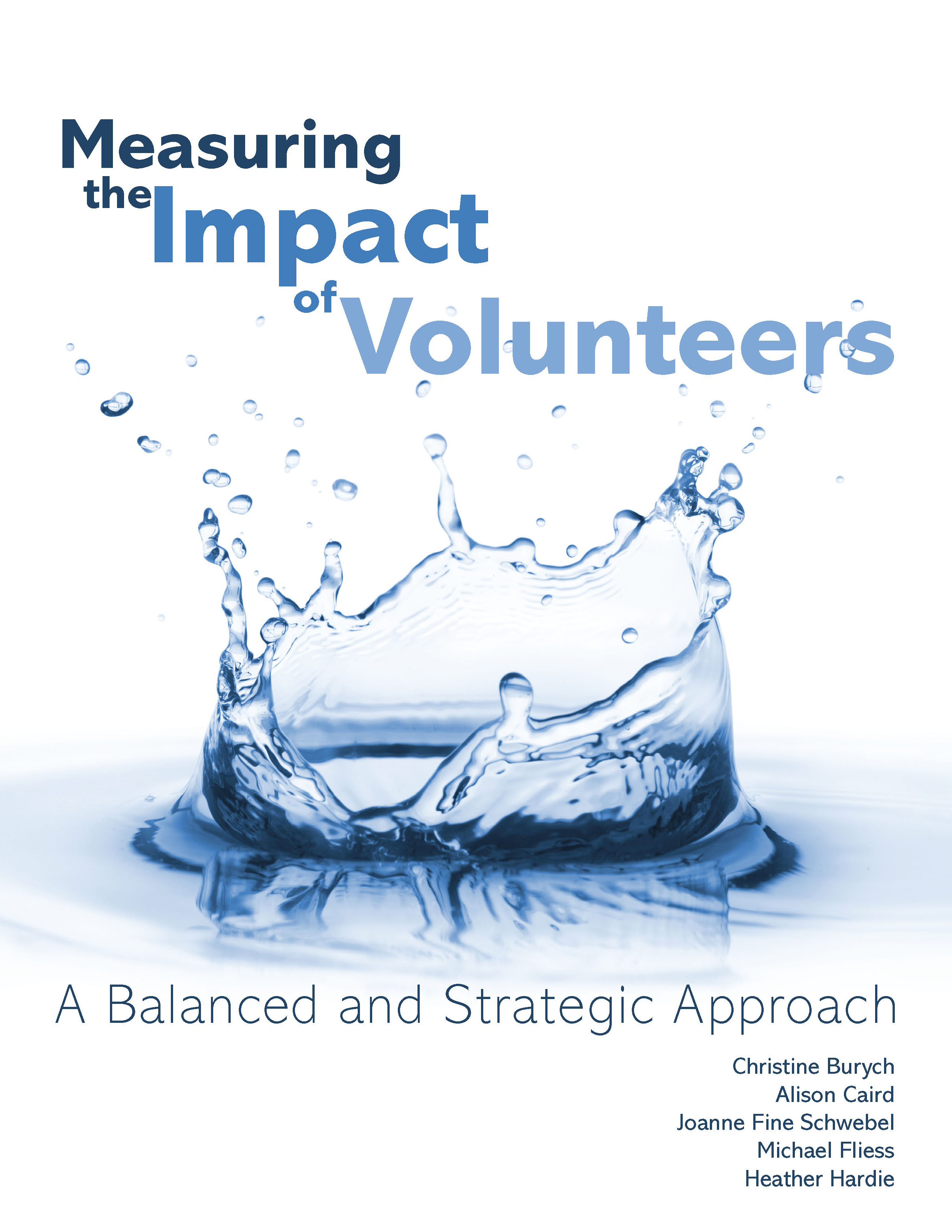
9780940576728_FRONTcover copyThat’s why I was very happy to get an alert from Energize, Inc. about a new book, Measuring the Impact of Volunteers: A Balanced and Strategic Approach, by ChristineBurych, Alison Caird, Joanne Fine Schwebel, Michael Fliess and Heather Hardie. This book is an in-depth planning tool, evaluation tool and reporting tool. How refreshing to see volunteer value talked about in-depth – not just as an add-on to yet another book on volunteer management. But the book’s importance goes even further: the book will not only be helpful to the person responsible for volunteer engagement at an organization; the book will also push senior management to look at volunteer engagement as much, much more than “free labor” (which it isn’t, of course). Marketing managers need to read this book. The Executive Director needs to read this book. Program managers need to read this book. The book is yet another justification for thinking of the person responsible for the volunteer engagement program at any agency as a volunteerism specialist – a person that needs ongoing training and support (including MONEY) to do her (or his) job. This book shows why the position – whether it’s called volunteer manager, community engagement director, coordinator of volunteers, whatever – is essential, not just nice, and why that person needs to be at the senior management table.

I really hope this book will also push the Independent Sector, the United Nations, other organizations and other consultants to, at last, abandon their push of a dollar value as the best measurement of volunteer engagement.

For more on the subject of the value of volunteer or community engagement, here are my blogs on the subject (yeah, it’s a big deal with me):

Firsts… or almost

logoI didn’t invent virtual volunteering. I started involving online volunteers in 1995, and did a workshop that same year about it for what was then the Nonprofit Center of San Francisco (now Compasspoint), but I didn’t know it was called virtual volunteering, a term coined by Steve Glikbarg at what was then Impact Online (now VolunteerMatch), until more than a year later. I know, and frequently remind people, that online volunteers have been providing services to various causes since the Internet was invented, long before I got online in the 90s. But I was the first to try to identify elements of successful engagement of online volunteers, via the Virtual Volunteering Project, I think I was the first to do a workshop on the subject, even if I didn’t call it that, and I’m very proud of that.

I didn’t write the first paper on using handheld computer tech as a part of humanitarian, environmental or advocacy efforts – I wrote the second. At least I think it was second. It was published in October 2001 as a series of web pages when I worked at the UN, at a time when handheld tech was called personal digital assistants, or PDAs. People are shocked that the predecessor to the smartphone and cellphone was used to help address a variety of community, environmental and social issues before the turn of the century, that apps4good isn’t all that novel of an idea.

And I probably didn’t write the first papers on fan-based communities that come together because of a love of a particular movie, TV show, comic, actor, book or genre and, amid their socializing, also engage in volunteering. Those kinds of communities played a huge role in my learning how to communicate online with various age groups and people of very different backgrounds, which in turn greatly influenced how I worked with online volunteers. In fact, I can still see some influences of that experience in The Last Virtual Volunteering Guidebook. But I stopped researching them in 1999. So I was quite thrilled to recently to find this paper, “The media festival volunteer: Connecting online and on-ground fan labor,” in my research to update a page on the Virtual Volunteering wiki that tracks research that’s been done regarding virtual volunteering. It’s a 2014 paper by Robert Moses Peaslee, Jessica El-Khoury, and Ashley Liles, and uses data gathered at Fantastic Fest in Austin, Texas, in September 2012. It is published on Transformative Works and Cultures, an online journal launched in 2009 that looks at various aspects of fan fiction (fan-created fiction inspired by their favorite movies, TV shows and books), comic book fandom, movie fandom, video game fandom, comic and fan conventions, and more.

It’s nice being a pioneer… though I don’t think my early contributions are much to brag about. But I do enjoy seeing things I thought were interesting back in the 90s finally getting the attention they deserve.

Also see

Early History of Nonprofits & the Internet.

Apps4Good movement is more than 15 years old

vvbooklittleThe Last Virtual Volunteering Guidebook, a book decades in the making, by Susan J. Ellis and myself. Tools come and go, but certain community engagement principles never change, and our book can be used with the very latest digital engagement initiatives and “hot” new technologies meant to help people volunteer, advocate for causes they care about, connect with communities and make a difference.

Fewer Pilots, More Scale: Making Digital Development Work

Back in September 2014, I starting whining about the lack of anything sustainable coming from most of the hackathons / hacks4good / apps4good I was seeing popping up all over in support of nonprofit organizations, government initiatives and various communities, in the USA and abroad. My whining culminated in this blog, where are the evaluations of hacksforgood / appsforgood?

I’m so pleased to see this outstanding blog (IMO) by Ann Mei Chang, Executive Director at U.S. Global Development Lab at USAID, which says, in part:

“despite the potential impact, distorted incentives encourage one-off, flashy pilots (many sourced through hackathons, contests, and PR opportunities), undermining the potential for sustainable and scalable digital solutions. In fact, the proliferation of duplicative and uncoordinated mobile health applications caused an overwhelmed Uganda Ministry of Health to call a moratorium on further efforts in 2012, to ensure a focus on interoperable and sustainable systems… (in developing countries, there is) a lack of relevant platforms and infrastructure (that) means that developers end up spending the vast majority of their time rebuilding similar components from scratch, ending up with less time and money to truly innovate. Too much time and effort is wasted on duplicative work like beneficiary registration and tracking, negotiating and integrating with mobile operators, and promotion and distribution. The result is one-off systems that are fragile, unintegrated, not designed to scale, and unsustainable.

“This cannot continue. The development community needs to invest in reusable systems and the collaboration necessary to build and use these systems. This will mean smarter solutions designed for scale and sustainability.”

Right on, Ann Mei Chang & USAID!

In addition, Ben Ramalingam’s recent Institute of Development Studies blog points out that responsible digital development must also consider the risks of unintended consequences, exaggerating existing inequities, security, and repression.

USAID helped draft the Principles for Digital Development, a set of best practices for building technology-enabled programs, starting with the user. The Principles have been endorsed by over 50 development organizations, including the Bill and Melinda Gates Foundation, Sida, UNICEF, WFP, and USAID. In February, USAID launched a report based on conversations with donors, implementing partners, and development practitioners to better understand how the Principles work in real-world contexts and how we can best integrate them into our organizations.

Also see:

Volunteers are more important than social media in Presidential elections

Please see the end of this blog for an update nine months later.

graphic by Jayne Cravens representing volunteersLast night, the public radio show Marketplace here in the USA did an excellent story about the vital role volunteers play in a successful Presidential campaign. Social media is great, but the reality is that it’s old-fashioned volunteer engagement – people calling neighbors to get out the vote, driving neighbors to the polls, etc. – that wins elections. The story is available for free online, and if you are outside the USA and can’t access it, just download Hotspot Shield – you’ll be able to using that.

My favorite points from the article:

“It takes $670,000 dollars in ad buys in a general election to get the same number of estimated votes as you would by opening a field office which is about $21,000 dollars to maintain throughout an election season.” — Joshua Darr, assistant professor of political communication at Louisiana State University, quoted in the article.

“Donald Trump’s performance in Iowa has widely been blamed on his lack of volunteer organizing. ”

“Networks of lawn-trodding volunteers aren’t something you can just whip up overnight, and the people who build these networks are not a dime a dozen.”

I’m THRILLED with this story. It touches on so many things I promote in my work: that highly-skilled managers of volunteers, fully supported and funded, are required for effective volunteer engagement, that volunteers are not free, and that, sometimes, volunteers are the BEST people to do a task.

For the record, I knew President Obama was going to win re-election, despite what the polls were saying, because his campaign was getting new volunteers, and keeping volunteers, all over the country, right up to election day, while Romney’s campaign was closing offices many weeks before. And when I volunteer for political campaigns, I always rewrite the script I’m given, so that the first thing I always say is, “Hi, I’m Jayne Cravens, and I’m a volunteer with the such-and-such campaign,” because I know the person on the other end is much more likely to listen to me knowing I’m a volunteer, not a paid staffer.

And note: volunteer engagement might be cheaper than national news spots, but it still costs money. I know a lot of managers of volunteers that would love $21,000 for their volunteer engagement… and with that said, be sure to sign this petition at Change.org that calls on Congress to provide funding for the effective management of the volunteers it is requiring public lands, including National Forests, to involve.

vvbooklittleSuch a shame people managing presidential campaigns, senate campaigns, congressional campaigns, grassroots campaigns – whatever the campaign – aren’t buying The Last Virtual Volunteering Guidebook in bulk! Tools come and go, but certain community engagement principles never change, and our book can be used with the very latest digital engagement initiatives and “hot” new technologies meant to help people volunteer, advocate for causes they care about, connect with communities and make a difference.

— end original blog —

November 28, 2016 update:

I was wrong. This election was not won by volunteers nor by volunteer management. As my November 28 blog details, social media DID win this election. It proved an ideal vehicle for promoting misinformation. As I noted in my last blog, BuzzFeed reported that fake news stories about the USA Presidential election this year generated more engagement on Facebook than the top election stories from 19 major news outlets COMBINED – that included major news outlets such as The New York Times, The Washington Post, CNN, and NBC News, and on and on. And the majority of these fake news stories did NOT come from any campaign operatives; rather, they came from a man in Los Angeles who originally built fake news sites to as a way to expose the extreme right, a plan that most certainly did NOT work. And these fake stories, most of which promoted Trump as a candidate, were shared by millions of people via social media – people who believed them, and most of whom never signed up to be an official Trump campaign volunteer. See my November 28 blog for more details. A blog in December offers even more details on how volunteers were engaged, officially and unofficially, in this campaign, and how a well-managed, vast army of volunteers did NOT win this election.

Volunteers broke Flint water story

It was VOLUNTEERS – unpaid people donating their time and expertise – that conducted the long-distance, independent sampling of Flint’s water and releasing findings that forced the government, the media, and the world to pay attention. That’s what unpaid “citizen scientists” are: volunteers. These 25 volunteers—four undergrads, 11 graduate students, seven post-docs and three faculty members—united “to help resolve scientific uncertainties associated with drinking water issues being reported in the City of Flint, Michigan.”

Local groups like WaterYouFightingFor and the Michigan ACLU (among others) also mobilized volunteers, helping local Flint citizens – as volunteers – to collect water samples.

THIS is the value of volunteers – not money saved, not paid staff replaced, but rather, a job done BETTER because it was done by unpaid people. Would the Independent Sector or UN Volunteers or the Corporation for National Service try to put a dollar value on this volunteer time donated in order to show the value of this volunteering?!

There is a GoFundMe page up for this volunteer team of scientists and students operating out of Virginia Tech, to help them cover the costs, paid out of their own pockets, for this work. The group goes by the name FlintWaterStudy and formed in August 2015.

More via The Nonprofit Quarterly.

Also see:

Make volunteering transformative, not about # of hours

Images, in the style of petroglyphs, of people doing various activities, like writing or construction.

Online Q & A sites, like Quora and Yahoo Answers, are packed with young people asking “how many volunteering hours should I have to get into a great university?”

It’s a question that makes me want to cry. In my answer to these questions, I try to explain that number of volunteering hours means nothing to university admission boards or scholarship committees, that, instead, such volunteering should be about engaging in activities that demonstrate your skills in problem-solving, research, networking, persuasive speaking and consensus-building, and that in talking about such, you should emphasize what you learned, challenges you faced, what it was like to work with people different from yourself, etc. – not number of hours completed. I say so as best I can on my web page about Ideas for Leadership Volunteering Activities.

But Richard Weissbourd on the PBS News Hour this week said it better than I can. Weissbourd is a senior lecturer at the Harvard Graduate School of Education and the lead author of a new report that calls on colleges to lower the pressure on students to impress admissions committees by racking up achievements and accolades. On the PBS News Hour, he said the goal of volunteering by young people should be “meaningful ethical engagement. It’s being involved in your community, concern for others, concern for the greater good, for the public good… it’s not about doing a brief stint overseas. It is about doing something meaningful, doing something in a diverse group, doing it for a year, nine months to a year, doing it for a sustained period of time. And the chances are greater that you’re going to get something out of that kind of experience, and you’re going to be able to describe in the application in a way that’s meaningful and expresses what was meaningful about it to you.”

Video and full transcript here.

I cheered and clapped. And my dog got scared and ran into her crate. Ooops.

Now, if I could just get the Corporation for National Service, the Points of Light Foundation, the Independent Sector, and others to stop valuing volunteers by number of hours given and a dollar value for those hours…

Also see:

EU Aid Volunteers on track to include virtual volunteering

eu aid volunteersTwo years ago, I had the pleasure of being hired to put together the online volunteering strategy for the European Union Aid Volunteers initiative. I provided:

  • Background on virtual volunteering – what it means in the EU context, what basic best practices have long been established, etc.
  • Details on the infrastructure and capacity that will be needed by host organizations and online volunteers in the EU Aid Volunteers initiative in order to participate, including policies and procedures and how to address issues around confidentiality and safety
  • Possibilities for how online volunteering in support of the EU Aid Volunteers initiative might look, in terms of applications, screening, assignment creation, volunteer matching and supporting
  • How to integrate returned volunteer alumni networks and peer-to-peer online mentoring into the scheme
  • How to evaluate the online volunteering component of the EU Aid Volunteers initiative
  • How the contributions of online volunteers might be recognized
  • Recruitment of online volunteers to support EU Aid Volunteers and volunteer sending organizations
  • How to address potential risks and challenges, like protection of personal data, protection of confidential data of organizations, fear of negative behavior online, lack of understanding of and support for volunteer management among some agencies, labour concerns that can arise with volunteer engagement, and what to call online volunteers that support the EU Aid Volunteer initiative.

What I loved most about this assignment is that it combined both my background in international aid and development and my background regarding volunteer engagement, particularly virtual volunteering. I don’t often get to combine them!

For the last two years, I’ve checked in regularly on the EU Aid Volunteers web page, managed by the EU Humanitarian Aid and Civil Protection department (ECHO), to see how things are coming along with this initiative, particularly with regard to virtual volunteering.
eu aid volunteersAt long last, I saw this (at left) as part of the FAQ about the initiative on the EU Aid Volunteers web page .

Hurrah! I’m thrilled to see this. Virtual volunteering is coming! I don’t know when, and I don’t know exactly what it will look like – I made recommendations, but ECHO is under no obligation to undertake them, of course. But, it’s coming!

I have EU Aid Volunteers in a Google Alert, and I also follow @eu_echo on Twitter, to keep up-to-date on this initiative, in case you are interested in doing so as well.

Exploitation of volunteers in refugee camps?

UNLogoFounded in 1991 as a temporary shelter for Somalis fleeing horrific violence in their homeland, the Dadaab complex in Kenya now houses nearly half a million refugees, and is supported by a variety of international agencies, including the United Nations. Children have been born there and grown up there – it’s the only home they’ve ever known. Conditions there are often deplorable. Ben Rawlence profiles nine of the camp’s residents in his new book, City of Thorns, and details the profound challenges in providing even basic services there, let alone helping refugees get out of their precarious situation. Rawlence was interviewed on the radio show Fresh Air (the broadcast is available for free online). And his comments about volunteers in the camp grabbed my attention – and not for the right reasons.

In October 2011, security conditions in the Dadaab camp changed drastically after the kidnapping of two Spanish aid workers by al-Shabab, the radical self-described Islamist group. The kidnapping caused the U.N. to evacuate much of its international staff and shut down all non-lifesaving activities, such as counseling, sanitation support, public health education, fuel deliveries to the boreholes to pump water, schools, and training. Food rations continued, distributed by refugee volunteers, and the hospital was staffed by just a skeleton staff, providing minimal medical care. Rawlence explained this in the Fresh Air interview – the emphasis is mine:

In order to fill the gap, the refugees themselves had to step up and run things… Life deteriorated quite quickly. The situation in the hospitals became quite critical. Their water shortages were very grave. The food continued as normal, but there was an outbreak of cholera right afterwards because the kidnapping coincided with the rainy season. And the capability to deal with the cholera outbreak wasn’t there. So for about four to five months, the camp was plunged into a real crisis. And the aid agencies issued several warnings, saying that, you know, life can’t go on like this. We’ve really got to turn things around… What really happened was that a new model emerged where the camp was run by refugee volunteers. And the agencies realized that instead of paying expensive Kenyan or expatriate staff to run services that they could rely on cheap volunteers and pay them stipends. So while the services themselves are back and running, it’s not quite how it used to be. And although the refugees are happy because there’s perhaps more work for them, there is less depth of expertise. There are, you know, not so many foreign qualified nurses and so on that there need to be. So things have moved to a much more sort of shaky footing.

I think it’s absolutely required to involve refugees in the work of running the camp – and in decision-making regarding the camp. Creating volunteering opportunities for refugees, particularly the teenagers, is not just nice, but vital. But to staff positions with refugee volunteers – people living in extreme poverty, desperate for paid work – specifically so that money can be saved by not bringing in much-needed expert staff? That’s absolutely outrageous.

Now, to be fair, Rawlence is calling these people volunteers, and others call them refugee incentive workers. This is a class of worker used by the UN and other international NGOs that’s meant to get around government restrictions regarding refugees undertaking paid work. Refugees, per Kenyan law, cannot receive salaries, even if those payments are coming from international agencies; however, refugrees are permitted to receive what are termed as incentives or stipends. These stipends are nowhere near what a salary would be for the work they do as community health workers, carpenters, masons, security guards, teachers, nurses, clinical officers,  water engineers, sanitation workers, etc. – and nowhere near what these people need to support themselves and their family. They workers also receive no minimum hours of work, maternity leave or sick leave. Kakuma News Reflector – A Refugee Free Press blogged about this – and not kindly, and explains the perils for refugees in this situation quite well.

There’s a lot wrong with this situation – the primary problem is the horrific conditions refugees are facing and the impossible nature of their circumstances in terms of getting proper access to work and education opportunities, proper healthcare and proper security. But the words being used regarding these stipended workers is also troubling – this is not at all what volunteering is supposed to be.

Also see:
UN Agencies: Defend your “internships”

Virtual Volunteering Guidebook: 2 year anniversary

vvbooklittleIt’s the two-year anniversary of the publication of The Last Virtual Volunteering Guidebook, available for purchase in paperback or as an ebook (PDF). It’s written by me and Susan Ellis, and is the result of more than 20 years of research and experience regarding virtual volunteering, including online micro volunteering, crowd sourcing, digital volunteering, online mentoring and all the various manifestations of online service. Did you know that virtual volunteering was a practice that was more than 20 years old? You would if you read the guidebook!

Susan and I wrote The Last Virtual Volunteering Guidebook in such a way that it would be timeless – as timeless as a book about using computers, laptops, smart phones and other networked devices could be. We didn’t want it to be out-of-date in just a few months. That’s not easy when it comes to technology, but we gave it a try – and upon re-reading my own book, I was shocked at how successful we were! Three years later, it still reflects what works, and what doesn’t, in working with volunteers online. In fact, I use it as a reference myself – there are times I’m asked a question about working with volunteers online, or facing a dilemma regarding working with volunteers myself, and I go back to the book to see what we said – and, tada, there’s the answer! Oh, to have the memory of Sherlock Holmes…

The Last Virtual Volunteering Guidebook details the basics for getting started with involving and supporting volunteers online, but it goes much farther, offering detailed information to help organizations that are already engaged in virtual volunteering with improving and expanding their programs. It offers a lot of international perspectives as well.

The book includes:

  • Detailed advice on virtual volunteering assignment, including one-time “Byte-Sized” tasks (micro-volunteering), longer-term, higher-responsibility roles and virtual team assignments.
  • A thorough look at various practices for screening and matching volunteers to assignments, with an eye to getting the most capable volunteers into your volunteering ranks and preventing incomplete assignments or burdensome management tasks
  • How to make online volunteer roles accessible and diverse
  • More details about how to work successfully with online volunteers, so that they are successful, your organization benefits and volunteer managers aren’t overwhelmed
  • Ensuring safety – and balancing safety with program goals
  • Respecting privacy of both the organization and online volunteers themselves
  • Online mentoring
  • Blogging by, for and about volunteers
  • Online activism
  • Spontaneous online volunteers
  • Live online events with volunteers
  • The future of virtual volunteering and how to start planning for oncoming trends

There’s also a chapter just for online volunteers themselves, which organizations can also use in creating their own materials for online volunteers.

In conjunction with the guidebook, we’ve maintained the Virtual Volunteering Wiki, a free online resource and collaborative space for sharing resources regarding virtual volunteering. We are seeking a partner university or college that could recruit an intern from among students studying in its post-graduate program to keep this wiki updated.

Here’s why we called it the LAST guidebook and reviews of The Last Virtual Volunteering Guidebook.

The Last Virtual Volunteering Guidebook is available for purchase in paperback or as an ebook (PDF).

If you read the book, I would so appreciate it if you could write and post a review of it on the Amazon and Barnes and Noble web sites (you can write the same review on both sites).

Vanity Volunteering: all about the volunteer

graphic by Jayne Cravens representing volunteersIf you regularly read my blog and web site materials or have seen me present, then you know just how strongly I believe in the importance of the involvement of volunteers in nonprofit/mission-based causes. I believe that volunteer engagement represents community investment, can allow people from different walks of life to be associated with a cause more deeply than just donating money, can allow people who don’t want to or cannot quit their day jobs to be involved in a cause, educates people about a cause through firsthand experiences, and can demonstrate the organization’s transparency regarding decision-making and administration. Service activities can educate volunteers to be better advocates for a cause, even change their behavior or feelings regarding certain issues, activities and groups. And I believe any of these reasons are far, far better reasons for involving volunteers than to save money by not paying staff.

I feel so strongly about the importance of volunteer engagement that when I see nonprofit organizations that don’t involve volunteers in some way, it makes me suspicious of them – how invested is this organization in the community it’s supposed to serve if it isn’t letting the community participate behind-the-scenes? How much does this organization really want to be a part of the community if the only way I can be a part of that organization is to work for it, professionally?

But I also have to say that I am wary of the value of a lot of volunteer activities, much more so now, having worked for international humanitarian aid and development agencies for more than 15 years. I regularly witness or hear about volunteering activities abroad and right here in the USA that are more about making the givers of service feel good than about benefitting the cause that the organization is supposed to serve. Voluntourism gets accused of this a lot: people going for a week or two to a poor community, usually in another country, and doing things that local people would love to do themselves, and be paid to do themselves, like build wells, build schools, repair houses, play with orphans, teach a few English classes, etc. Do those activities primarily benefit local people or a critical cause, or are they actually more about being great money-makers for organizations, including religious groups, that know Westerners will pay big bucks for a feel-good volunteering experience and lots of touching photos of them in exotic or devastated locations? There are even tragic consequences from this kind of volunteering, such as the rise of orphan voluntourism, where children that are NOT orphans are presented as such, in need of help from short-term international volunteers, people with little or no expertise regarding the needs of at-risk children.

An article from December 2015 in Cracked captured my wariness about some volunteering, particularly around the holidays. It’s called “5 Realities Of A Homeless Shelter At Christmas.” Regarding homeless shelters, the article notes:

These charities exist to help people with serious problems. They do not exist to round up sideshows and parade them around for gawkers, or to help regular folks gain perspective on their own lives. Surprisingly, not everyone is aware of this.

The article also notes:

Remember, these people are homeless for a reason. We don’t mean “because they’re jerks and deserve it”; we mean that mental illness and substance abuse issues run rampant. If you reserve your charitable feelings only for those capable of showing gratitude in some satisfying way, you’ll be neglecting the ones who need help the most. They show their gratitude by still being alive the next time Christmas comes around.

This all came to mind recently when I found an article about a young boy who created his own nonprofit so he, personally, could hand out food to homeless people in the city where he lives. That’s the primary purpose of the nonprofit: to give him an outlet to hand out food to homeless people. He’s well under age, so I’m not going to name him or his nonprofit or say where he is – I also really do not want to humiliate a kid, especially one that has such a big heart. But his nonprofit seems to be more about him than the homeless: the nonprofit has his name in the title, the web site for the organization is filled with many, many more photos of him than homeless people, and on the web site, a link for more information doesn’t say “About our organization,” but rather, “About me.”

He says he started his nonprofit because organizations serving the homeless turned him away as a volunteer because he’s “too young to help,” and that made him “sad.” What I suspect shelters and food kitchens actually said is that many of their clients are not allowed, legally, to be around anyone under 18, and the organization would, therefore, be causing those people to break the law by interacting with a child. They probably also told him that shelter staff need to put their resources into helping clients, not diverting such to ensuring the safety and heart-warming learning experience of underage volunteers.

The web site for this child’s organization has no information about the nutritional needs of the homeless or statistics on food availability for the homeless in this particular city. The web site has no information about the causes of homelessness. The aforementioned Cracked article correctly points out that when homeless people die, it’s most often from heart disease, substance abuse and trauma, rarely from hunger, although, of course, nutrition is a big challenge and hardship for many homeless people. The principle causes of food insecurity in the United States are unemployment, high housing costs, low wages and poverty, lack of access to SNAP (food stamps), and medical or health costs, but the web site for this child’s nonprofit never mentions any of these realities – it makes it sounds like he’s personally keeping these folks alive, that most homeless people die of starvation. Even if his nonprofit isn’t going to address any of those causes of hunger, shouldn’t those causes be mentioned somewhere on his site? This young man’s nonprofit could make a HUGE difference by helping people, particularly young people, understand why people are homeless, why they experience food insecurity – and they could take that knowledge to the ballot box, and make donation decisions based on that knowledge. Instead, this nonprofit, as demonstrated by the web site and by the media coverage of the nonprofit, is about making a little boy feel like he’s making a difference in the world, and making us feel good about him.

Robert Lupton, a veteran community activist based in Atlanta and author of Toxic Charity: How the Church Hurts Those They Help and How to Reverse It, was quoted in an opinion piece in The Atlanta Journal-Constitution, saying this about various volunteer groups that show up to hand out food in Atlanta parks: “The folks that come and hand out sandwiches? I call that harmful charity. It’s irresponsible… Who is this service activity for? To help the homeless? Or someone else?” I am not as down on charity as Lupton; in contrast to him, I do believe charity and aid will always be needed, that food banks and on-the-street food handout programs cannot and should not be replaced entirely by community development / empowerment / teach-a-man-to-fish programs, and I think there are very good things that can come from group volunteering projects in communities . But I do agree with him that a lot of high-profile volunteering seems more about making the giver have a feel-good experience and lots of great photos than focusing on the primary needs of those to be served.

No one is too young to volunteer, but there are volunteering activities in which a youth or child may NOT participate, because it would be illegal or inappropriate. Even with that restriction, there is no cause a young person can’t support in some meaningful way as a volunteer, including helping the homeless, and there are many ways a young person can volunteer, no matter how young he or she is. Volunteering is a great way to teach children about compassion and empathy, but it shouldn’t perpetuate old-fashioned ideas about volunteering, that it’s just about charity, and that its primary purpose is about well-off people giving food and items to poor people, but not talking about why there are poor people and not addressing those reasons. Volunteering by youth shouldn’t be primarily about making the kids feel good about themselves. Volunteering by youth should educate those young people about why causes are important, about community challenges, and/or about people very different from themselves. And volunteering should ALWAYS be primarily about what the person or cause needs most, not about the volunteers themselves. That means sometimes telling well-meaning people, even young people, “It’s great that you want to help, but the way you want to help is not what’s needed most and, in fact, can take valuable resources away from what we really need. And what we really need is…”

This is not a call for a volunteer motivation “purity” test. Volunteering doesn’t have to be selfless – as I have said many times in my workshops, I’m a part of Generation X, and I’ve never volunteered “to be nice” in my entire life; I’ve volunteered because I’m angry about a situation and want to do something about it, because I’m lonely or bored, because I want to explore careers, because I’m curious about an organization or activity, because I want to develop a skill or get experience for my résumé, because it sounds fun, because I want the fabulous t-shirt, and on and on. Almost any reason to volunteer is a great reason to volunteer. What I’m questioning are some of the reasons volunteering activities are created – what I’m saying is that they may actually do harm rather than good.

Even with all my disclaimers and all my work to date promoting volunteerism, I have a feeling this blog is still going to get me accused of being anti-volunteer. Nothing could be farther from the truth. But vanity volunteering… sorry, I’m just not a fan.

For more on this subject – written by others:

Symptoms of a Vanity Nonprofit by Mark Fulop, from May 28, 2014.

The Most Outlandish Charity Trends: Is It About Vanity?, from MainStreet an online financial magazine & news site by TheStreet, in April 2014.

Vanity Charity, an opinion piece by Alan Cantor, published online on March 5, 2013

This 2012 Cracked article: “5 Popular Forms of Charity (That Aren’t Helping).

This New York Times Magazine article, “The Vanity of Volunteerism,” from July 2000.

#InstagrammingAfrica: The Narcissism of Global Voluntourism , from the Pacific Standard, June 2014

This Boston Globe article, Corporate volunteers can be a burden for nonprofits, from March 2015

How to judge a charity: the five questions no one asked Kids Company (How do you know if a charity is changing lives?), 2 January 2016 article from The Spectator

Added Jan. 18: In The Reductive Seduction of Other People’s Problems, Courtney Martin warns against a line of thinking which leads privileged young Westerners to think they can solve serious social problems in developing countries. Ms. Martin points to failed international development efforts like the now-infamous PlayPump, a piece of playground equipment that was meant to also pump underground water in remote communities. It was embraced by the development community — though the pumps didn’t, in fact, work. “It’s dangerous for the people whose problems you’ve mistakenly diagnosed as easily solvable. There is real fallout when well-intentioned people attempt to solve problems without acknowledging the underlying complexity.”

July 17, 2017 updateCharities and voluntourism fuelling ‘orphanage crisis’ in Haiti, says NGO. At least 30,000 children live in privately-run orphanages in Haiti, but an estimated 80% of the children living in these facilities are not actually orphaned: they have one or more living parent, and almost all have other relatives, according to the Haitian government.

And for more by me, on related topics: