
Category Archives: Community / Volunteer Engagement

Hosting International Volunteers: A Where-To-Start Guide For Local Organizations

I’m seeing more and more local organizations – non-governmental organizations (NGOs), charities, schools – in developing countries posting on sites like Reddit, asking foreign volunteers to travel to their countries and volunteer. These NGOs and others offer no information on whether or not its legal for foreigners to come to the country and volunteer, no information on what they will do to ensure volunteers will be safe, no information on what screening they do of volunteers to ensure safety of volunteers – they just post, “Hey, we help orphans / wildlife / women, and you can come here and help us.”

It’s troubling.

The reality is that it is not ethical nor appropriate for any NGO to recruit foreign volunteers unless they are already involving LOCAL volunteers and have the full endorsement of local people for the work they do, and it is inappropriate for them to recruit foreign volunteers unless they have complete information on assignments, safety, screening, quality control and more.

That said, some NGOs have a legitimate need for foreign volunteers, and this page on my web site is meant to help.

Hosting International Volunteers: A Where-To-Start Guide For Local Organizations provides detailed suggestions for NGOs in developing countries interested in gaining access to foreign volunteers. This is a “getting started” guide, NOT a comprehensive guide: it’s impossible within the boundaries of a simple web page to detail all an organization needs to do to host volunteers from other countries.

Also see:

If you have benefited from this blog or other parts of my web site and would like to support the time that went into researching information, developing material, preparing articles, updating pages, etc. (I receive no funding for this work), here is how you can help

How to counter the ongoing drop in volunteer firefighter numbers

In March 2019, the National Fire Protection Association (NFPA) published its 2017 U.S. Fire Department Profile report. It’s based on data collected via a national survey of fire departments. The report estimates that there were 682,600 volunteer firefighters in the USA in 2017. That is down significantly from the 814,850 and 729,000 volunteer firefighters that the NFPA estimates were active in the U.S. in 2015 and 2016, respectively. The volunteer firefighter numbers for 2016 and 2017 are the lowest recorded levels since the NFPA began the survey in 1983. 

According to the report, 83,550 of the 132,250 reduction in volunteer firefighters between 2015 and 2017 occurred in fire departments protecting communities with populations of 2,500 or fewer residents. The NFPA estimates an overall decline of 83,900 firefighters (career and volunteer combined) in those communities, a reduction of more than 20 percent over a two-year span. 

In addition to the decline in the number of firefighters serving in the smallest communities, the average age of those firefighters continued to increase in 2017. Fifty-three percent of firefighters serving communities with populations of 2,500 or less were over the age of 40, and 32 percent were over the age of 50 in 2017. This continues an aging trend that has been happening for years among the population of firefighters in small communities.

Number of Firefighters in the U.S., 1983, 1990, 2000, 2010, and 2015-2017

YearTotalCareerVolunteer
1983*1,111,200226,600884,600
19901,025,650253,000 772,650
20001,064,150286,800777,350
20101,103,300335,150768,150
2015 1,149,300345,600814,850
20161,090,100361,100729,000
20171,056,200373,600682,600

*Note, this is the first year for which firefighter numbers are available from the NFPA.
Source: NFPA Survey of Fire Departments for U.S. Fire Experience

As the National Volunteer Fire Council notes, it is important to note that these numbers are estimates based on responses to a survey of a sample of U.S. fire departments that is designed to be representative of the overall U.S. Fire Service. Approximately 8.7 percent of fire departments surveyed responded to the survey. Any annual differences reflect both actual changes in what is being measured as well as year-on-year statistical and sampling variability.

The NVFC says that, this year, the federal government will award more than $40 million to local fire departments to help pay for volunteer recruitment and retention efforts through the Staffing for Adequate Fire and Emergency Response (SAFER) grant program, funded out of the Federal Emergency Management Agency. And that’s great. But it’s going to take a huge change in the attitude of most local fire departments for this money to make a difference. As I said in my blog why you can’t find/keep volunteer firefighters: There ARE potential volunteer firefighters out there, even in your small town. There are a LOT of people who are hungry to connect, hungry for a deeper, substantial activity that connects them with the community and causes they believe in, one that gives them an immersive, hands-on, intense experience. Volunteer firefighting can have a great deal of appeal to today’s young people. But if you don’t have a welcoming environment, if you aren’t trying to reach them where they are, if you aren’t using social media, and if you are just talking about all the work that has to be done and the obligations to be fulfilled, those young people are going to overlook you and even go elsewhere and numbers will continue to decline.

In short: we will never, ever go back to a time when volunteer firefighters are recruited in the way they were before the 1980s. The recruitment of volunteer firefighters must radically evolve. How volunteer firefighters are engaged must radically evolve. And it’s going to take more than money.

Also see:

All of my blogs regarding volunteer firefighters.

If you have benefited from this blog or other parts of my web site and would like to support the time that went into researching information, developing material, preparing articles, updating pages, etc. (I receive no funding for this work), here is how you can help.

Teaching youth about poverty – teaching compassion or supremacy?

I’ve drafted a new resource: Ideas for Teaching Children Compassion & Understanding Instead of Pity With Regard To Poverty. It’s part of the section of my web site to help people that want to volunteer, rather than those that manage volunteers.

It was inspired by so many of the ideas for volunteering for young people that, in my opinion, are dreadful, suggestions that teach supremacy and superiority, that encourage a young person’s introduction to different regions of the world – say, the country’s of Africa – through a lense of poverty instead of first talking about the beautiful culture and rich history and many talents and skills of the people there.

How can adults – parents and teachers – encourage young people to be compassionate for and kind to others while not cultivating pity and feelings of superiority? Here are some ideas. It’s a first draft – suggestions welcomed (post in the comments or contact me directly).

If you have benefited from this blog or other parts of my web site and would like to support the time that went into researching information, developing material, preparing articles, updating pages, etc. (I receive no funding for this work), here is how you can help.

Justifying a position as “volunteer” instead of “paid staff”

From February 2001 through much of February 2005, I worked at the United Nations Volunteers (UNV) program, managing the UN’s Online Volunteering service (formerly NetAid) and the United Nations Information Technology Service (UNITeS), an initiative created by then Secretary General Kofi Annan. UNITeS promoted the importance of engaging volunteers in information and communications technologies for development (ICT4D) activities and supported volunteers engaged in ICT4D initiatives. The UNITeS staff worked from the premise that a key to getting communities, government, civil society and individuals in developing countries to leverage computers and the Internet so that they benefit from their use was to involve volunteers in introducing the tech, building people’s capacity to use it, supporting digital literacy, etc.

UNV places and supports thousands of highly-skilled people throughout the world to undertake a variety of highly-skilled work: HIV education, providing medical care, managing schools, training teachers, managing a government office’s communications, being apart of Ebola response, and on and on. When a placement would get approved for a UN volunteer to work on a project that related somehow to computers or the Internet, there was a program manager for a particular region who would come to my office, per my association with the UNITeS initaitive, hand me the Terms of Reference for the volunteer placement and say, “UNI-Tize this.”

What she meant was this: add in required skills and responsibilities that justify this being done by someone under a UN Volunteers contract, rather than another type of UN contract that would require the payment of more money to the person that fills the position and the designation of that person as a consultant or staff member.

I’ve long believed that any organization that recruits volunteers, for whatever reason, must have a written statement that explains explicitly why that organization reserves certain tasks / assignments / roles for volunteers. The thousands of experts that are recruited and placed by UNV all over the world, working at a variety of agencies (mostly UNDP), in a variety of areas, are called UN Volunteers, or UNVs, but often, there’s not much to show that they are volunteers, especially given the generous financial compensation UNVs receive. The vision of UNV – as well as other volunteer-sending organizations like Peace Corps and VSO – is that the people that are volunteers through their programs are NOT necessarily people who are career humanitarians; rather, the volunteers are professionals willing to give up six months to two years of their jobs/careers and the compensation that would come with such and, instead, work as a part of a humanitarian endeavor. But I’m sorry to say that, for many agencies, involving people under UNV contracts is a way to save money, as such contracts are far, far cheaper than hiring someone as an employee or consultant outright.

When that UNV program manager gave me those TOS to “uni-tize,” I went through and added responsibilities regarding

  • building the capacities of local counterparts regarding whatever it was he or she was doing, with an eye to this UNV position becoming unnecessary as local people take over. I treated every UNV placement that was “Uni-Tized” as one that would eventually be taken over by a full-time, paid local person NOT under a UNV contract, and for that to happen, local capacity had to be built.
  • creating at least one, local event that could help build the skills of community members regarding some aspect of computer and Internet use: where to find information about current market prices for agricultural products, where to find reliable maternal health information, how to evaluate the credibility of online information, etc. In this case, “Uni-Tize” meant to evangelize regarding ICTs for various development activities (ICT4D).
  • suggestions to involve local volunteers in their work in some way, reaching out to students at nearby universities, or at home on leave from university, to help them gain experience that would help in their future careers. In this case, “Uni-Tize” meant to get local volunteers invested in the work of UNVs in some way.
  • suggestions to make particular efforts to reach out to women, girls, religious and ethnic minorities and people with disabilities in any of the above aforementioned activities, to take all of the tasks beyond merely getting tasks done.

I have to admit I loved looking up from my desk and seeing her standing there with a printout of a Terms of Reference in her hand, or getting an email from her for help to “Uni-Tize” an assignment. It was always challenging to really think about what would make the assignment worthy of the word volunteer. To me, my additions made those UNV placements fully justified in using the word “volunteer” to describe their work, to show that this was more than just a job that had a UNV contract.

I’ve said it before, I say it again: create a mission statement for your organization’s volunteer engagement that explicitly says WHY your organization or department involves volunteers. Such a statement will guide employees in how they think about volunteers and guide current volunteers in thinking about their role at the organization. It will help your organization avoid the reputation for being just a low-cost staffing solution – something no volunteer really wants to be a part of. Here’s more about my philosophy regarding justifying volunteer engagement and making certain roles volunteer instead of paid.

If you have benefited from this blog or other parts of my web site and would like to support the time that went into researching information, developing material, preparing articles, updating pages, etc. (I receive no funding for this work), here is how you can help.

Also see:

Easy way to get a video made & posted re: your org

You don’t have a video on YouTube, with a link on your own web site, that talks about how great your nonprofit is? Or a video that shows what volunteering is like at your organization or celebrating volunteers at your program? SHAME ON YOU! In this era of smart phones, there’s no excuses for not having such a video – or more than one!

Here’s how you can get such a video produced and online QUICKLY, with the help of volunteers.

First: make sure every volunteer, employee and consultant at your organization has signed a photo and video release form – examples of these are easy to find online. You want to have signed permission from all of your staff, always, to take video of photos of them and use them in promotional materials. It’s a good idea to require that any person sign these on their very first day of working at your organization. If you haven’t been doing this, then print several copies out and have volunteers sign them when they sign in for their next shift, when they attend an event, etc., and keep track of everyone who has and hasn’t signed. You will also need to have releases on hand for members of the public or clients to sign if you film them at your facilities. If anyone refuses to sign – and that is their right – you may not film them.

From among your current and previous volunteers, or through whatever volunteer recruitment tools you use (like VolunteerMatch, AllforGood, posts to your web site, posts to Facebook or other social media, etc.), recruit volunteers who will pair up during volunteering activities: one volunteer will do the actual task, as usual (this should be one of your veteran volunteers) and one will record the volunteer for a few moments doing the task with his or her smartphone (always landscape – hold the phone sideways!). Sound isn’t important. Each volunteer should try to get at least a full 60 seconds of footage.

So, for instance, at a nonprofit animal shelter, if you paired up volunteers, you would have raw video footage from various smart phones (they can all be different kinds) of:

  • a volunteer staffing the front desk and interacting with clients
  • volunteers interacting with animals
  • volunteers dealing with inventory
  • volunteers pouring dog food or cat food
  • a volunteer taking photos of new animals for your web site
  • etc.

Recruit a video editing volunteer who will gather all of the videos together in one place online, a place where staff at your organization can always access the raw footage in case this volunteer is unable to complete the task. For instance, all volunteers could be asked to upload their footage to a YouTube account set up specifically for this project, and for footage to be uploaded so that it is not public. If they don’t know how to upload footage, they could get guidance from someone at your organization the next time they are onsite at your organization.

Where to recruit a video editing volunteer? From your current volunteers (and have them ask their family members), previous volunteers, via a post on your web site which you link to from an announcement on your social media channels, via a video production class at the nearest high school, college or university, via employees at a large company where they have an in-house marketing staff, etc. What about asking the faculty of such a class to turn your video needs into a class assignment, with different teams of students each producing a video based on raw footage and then your voting on which you think is the best? Be sure to write a full description of what the volunteer video editor’s duties are, that you will include in all recruitment materials so expectations are clear.

This video editing volunteer will be charged with:

  • editing bits and pieces of the raw video into a 2 or 3 minute video
  • adding in copyright-free music (easy to find such via archive.org)
  • adding in titles and captions that say whatever it is you want to say about your organization and how great it is, perhaps also about why your volunteers are so wonderful and essential

The video editor presents the first draft of his or her work to appropriate staff and, once staff approves, up it goes onto your organization’s YouTube channel.

You could do something similar regarding interviewing clients to talk about how they have benefitted from your services, or talking to volunteers about why they enjoy volunteering, or talking to donors about why they donate money. For videos where people will be interviewed and sound during recordings IS important, recruit your video recording volunteers from a video production class at the nearest high school, college or university, via employees at a large company where they have an in-house marketing staff, etc. Be sure to write a full description of what the volunteer video recorder’s duties are, that you will include in all recruitment materials so expectations are clear. What about asking the faculty of such a class to turn your video needs into a class assignment? And, again, this person or team should put all of the raw video footage in one place online, a place where staff at your organization can always access the raw footage in case this volunteer is unable to complete the task.

For any video where words will be spoken, you will need to recruit a volunteer who will caption the video on YouTube. I have recruited online volunteers to do this for my short video projects for nonprofits via VolunteerMatch – recruitment of such a volunteer has always taken less than three days! Here’s more about recruiting volunteers to caption videos.

There is no excuse whatsoever for NOT having such videos about your organization’s work! And video editing is shockingly easy: I do it myself, self-taught, on my ancient Macintosh computer. Here’s a video I put together for Knowbility, a nonprofit in Austin, Texas, showcasing nonprofits it was working with in its OpenAIR program. I had video footage from various organizations, all remote to me (hundreds, even thousands, of miles from me) – none of the video was what I had shot myself. I also had some slides of information as visuals. I spliced it all together using the free video-editing tool that was on my ancient Mac, then laid in some music – something I’d never, ever done before – using copyright-free music I found on archive.org, and finally transcribing using the free captioning tool on YouTube. My video is not going to win any awards: my transitions between videos and “moments” arent’ very good – but I had just one day to do it, and the video was VERY effective at the event at which it was shown. Imagine what a volunteer who DOES have some video editing experience, with several days, could do for YOUR organization!

If you have benefited from this blog or other parts of my web site and would like to support the time that went into researching information, developing material, preparing articles, updating pages, etc. (I receive no funding for this work), here is how you can help.

Also see:

Rethinking ethics of volunteering abroad medical missions

I am a HUGE fan of m NPR’s Goats & Soda program. This is an excerpt from a recent article:

In 1969, volunteer teams of doctors and nurses from a U.S. charity called Interplast began flying to poor countries to do reconstructive surgery. They operated on children with cleft lips, cleft palates or burn scars so thick their limbs were immobilized. It sounded like a great idea. The team members donated their time, paid for their travel and lodging and sometimes their supplies, and got to do good…

Today, missions are sponsored by churches, universities and charities. There are for-profit missions as well that collect fees from volunteers, mostly students. A 2016 estimate put the annual cost of getting doctors and other health care workers to sites around the world at $3.7 billion, paid for by donors or health personnel themselves.

But today there’s some real soul-searching going on about this kind of fly-in. At conferences and in academic papers, health professionals are asking: Is this really the most effective way to provide health care to the developing world?

This article from NPR’s Goats & Soda program explores the ethics of this volunteering abroad practice. There are growing concerns about what happens when these volunteers leave, and there’s a lot of concern that the care they’re providing may not be culturally appropriate or even wanted by the people on the ground. Sociologist Judith Lasker, author of the 2016 book Hoping to Help, worked with the Catholic Health Association on a study that showed that about half the money spent on medical missions goes for travel costs for the teams. “It doesn’t seem like a very cost-effective strategy,” she says. After she told a local health provider in Haiti the cost of the airfare for bringing in a single American doctor, the Haitian said to Lasker, “Imagine how many antibiotics that could buy.”

Please read the article before commenting!

And if you are not following NPR’s Goats & Soda on Social media, you really, really need to be. I follow @GoadsandSoda on Twitter. It’s terrific for people that work in humanitarian interventions or development abroad, or want to understand them – but it’s also good for anyone involved in nonprofit work in their own countries to read. There are a lot of issues that bring up that are local to any charitable activity locally – not just internationally.

Update: This September 2019 article from the American Medical Association explores ethical implications of international medical volunteering, such as scope of practice, continuity of care, and erosion of local health systems, and offers a personal perspective from a related field.

If you have benefited from this blog or other parts of my web site and would like to support the time that went into researching information, developing material, preparing articles, updating pages, etc. (I receive no funding for this work), here is how you can help.

Also see:

A History of Americans as Volunteers – a book you need

My long-time colleague and friend, Susan Ellis, along with Katherine Campbell, wrote the book on volunteerism in the USA – literally. It’s called By the People: A History of Americans as Volunteers. The latest and last version is the New Century Edition (2005) and it’s available for purchase from Energize.

I remain stunned that this book isn’t cited at least once in most academic papers regarding volunteerism. It certainly should at least be referenced in any course at a USA college or university regarding volunteerism. It should be cited throughout Wikipedia articles on anything related to volunteerism or community service as well, and cited in any article that dares to try to talk about the history of volunteer firefighting in the USA.

The book does a fantastic job of showing how volunteers helped to form some of the largest organizations in the USA today, from Goodwill to the YWCA to the American Red Cross to the Sierra Club – efforts often lead by women – and how volunteers have played such an important role in establishing the American character, one that relishes community-driven, independent and do-it-yourself driven efforts to address community needs and concerns. The book provides repeated examples of how volunteers seized a social issue in the USA, amplified it and pushed for it to be addressed, from the abolition of slavery to the health of soldiers to the civil rights movement and so many things before and after. I love how the role of women in leading volunteering efforts is repeatedly cited, not regulated to one chapter but permeating the book in example after example.

The parts of the book about volunteer firefighting history are particularly enlightening. The book notes that, in the early days of volunteer firefighting in the USA, in the 1800s and 1900s, “Because of the danger involved, being a volunteer fireman carried social status. Rivalry was strong among the volunteers, and street fights frequently erupted as companies battled to reach fires first.” The fights sometimes lasted for days! The authors quote A History of the People of the United States by John Bach McMaster, who said of the firefighter fights, “Of all causes of disorder they were the worst. Around their houses hung gangs of loafers, ‘runners’ who, when an alarm was run, ran with the engines and took part in the fight almost certain to occur.” These mob scenes ultimately brought an end to voluntary firefighting in the major cities in the USA, though volunteer fire brigades in urban settings came back during times of war.

It would be interesting to see if a revision of the book would have addressed the approach of the volunteer firefighting union in the USA, which actively discourages volunteer firefighting in a push for professionalization of all roles, or the rise in anti-volunteering movements – but, sadly, Susan passed away earlier this year, so the book will not be revised.

Virtual volunteering started as soon as the Internet began, in the 1970s, and the 2005 edition of By the People: A History of Americans as Volunteers mentions virtual volunteering at least five times – it’s an example of just how in-tune Susan was with emerging trends in volunteerism (while now, in 2019, there are still some researchers and consultants who will try to say virtual volunteering is “new”). There’s also good mention of the International Year of Volunteers in 2001, a global campaign that was one of the most popular designations by the United Nations in its history of such “Year of” declarations.

I do have some criticisms. For instance, I’m shocked that the authors don’t go much more into the role that volunteers played in forcing the US Government in the 1980s to address the AIDS crisis, to elevate discussions about HIV, and to meet the needs of people with HIV/AIDS. The unique mobilization of volunteers in these causes is worthy of an entire book itself, and certainly worthy of more than a small mention in this book. 

Also, there is nothing about American Indians before their time being forced on reservations, except their violence towards whites. There are documented examples of volunteer aid from American Indians to early White settlers and these are worthy of note.

And then there are some jaw-dropping statements. One is that “Not until well into the twentieth century did most Americans have the leisure and subsequent need and desire for the arts.” In fact, most Americans – and most people – have always had a need and desire for the arts and made time for such! The music and theater of the 1800s throughout the USA still influence the music, theater and folklore of today!

Two others statements in the book are, I’m sorry to say, worthy of outright condemnation.

On page 116 is this: “One unique aspect of the Civil War was that hardly any women were raped during the open hostilities… Then came Reconstruction, and with it the influx of the corrupt northern profiteers who riles up the freed slave and changed the South into a crime-ridden area. For the first time, women were not safe from rape…” It’s a paragraph I have read and re-read and just cannot fathom how anyone outside of a delusional Southerner who longs for the myth of the Confederacy would think it’s true. The sexual violence against black women alone during the time of the Civil War should have prevented these sentences from ever being written by these authors. Any suspicions that this assertion of “hardly any women were raped” during the Civil War was confirmed by the research of Kim Murphy, and though her book did not come out until 2014, her research didn’t, I remain dumbfounded that anyone thought otherwise. Maureen Stutzman’s article “Rape in the American Civil War: Race, Class, and Gender in the Case of Harriet McKinley and Perry Pierson,” which appeared in a 2009 issue of the University of Albany’s journal “Transcending Silence,” also offers perspectives on the truth about sexual violence in that period. In addition, Reconstruction, once Ulyss S Grant assumed office, brought black Americans incredible opportunity and liberty, allowing them to become property owners, business owners and office holders in numbers never imagined. Reconstruction did not make the South a “crime-ridden area.”

The other statement is this, on page 117: “In the beginning, the Klan’s concern as a volunteer group was to control crime, not to punish people with unpopular political views.” In fact, from its founding, the Klan was a terrorist organization that sought to restore white supremacy by threats and violence, including murder, against black and white Republicans. This is indisputable! The 1871 Congressional Hearings on the founding and early activities of the Ku Klux Klan, with their heart-wrenching first-hand testimonies of people who were terrorized by the Klan, accurately and thoroughly document the immediate and widespread terrorism by what was then a new organization. Only someone who believed the outrageous narrative of Birth of Nation would ever assert otherwise. I’m going to assume that the authors’ viewpoints on these issues GREATLY, VASTLY evolved since they wrote these words and they would never make such assertions in their later careers – based on my relationship with one of the authors and her dedication to human rights, I just cannot imagine otherwise. 

But even with these jaw-droppingly inappropriate statements, By the People: A History of Americans as Volunteers is a book anyone who writes about volunteering needs to reference. I refer to it regularly. It is a treasure-trove of information. 

Also see:

Consequences for faking community service

Various online forums are packed with questions by people looking to fake their community service required as part of a court sentence, probation or graduation requirement. Community service is so easy to accumulate, and actually doing the hours gets a person all the benefits of any volunteering: references and skills for paid work, accomplishments that can look great on a résumé, a LinkedIn profile or a university application, etc. It’s not just unethical and, in some cases, a violation of court orders that leads to additional charges – it’s stupid to fake community service hours.

Are there ever consequences for faking community service for the courts? Yes. Often, it’s a felony charge from the court and a revocation of probation.

Here’s a sampling of the consequences for getting caught faking community service:

Two women, Kendricia Shaylon Tate and Jordan Lynn Brown, ordered to perform community service, went to jail in Floyd County, Georgia without bond in February 2019, charged with felonies for faking documentation for their court-ordered community service.

In September 2017, the former treasurer of the Wichita County GOP, Jonathan Paul Lyne, on probation for drug and tampering charges, was accused of faking his community supervision. He had to serve 180 days in the county jail before being transferred to a substance abuse felony punishment facility.

Illinois resident Russell Phillip was sentenced to 2 1/2 years of probation and 25 days in the sheriff’s work program in April 2017 for creating a charity that sold letters claiming completion of court-ordered community service hours. In addition to the work program, Phillip was ordered by the judge to pay about $900 in costs and pay the probation department $25 a month for the next 30 months. He operated a flower shop and also ran a program called “Flowers for Heroes” that was registered with the probation department as a place where people could do court-ordered community service.

Courts getting tougher re: online community service, a review of some of the actions courts are taking to prevent the faking of commuity service. 2017 January 12

Selling community service leads to arrest, conviction, a blog about the legal action that lead the demise of the unscrupulous Community Service Help, and about how the owner of the notorious the Caffeine Awareness Association pled guilty to a false-filing felony. 2016 July 01

A central New York woman was jailed in January 2015 for allegedly providing forged paperwork to Chester Town Court indicating she had completed community service that she had been directed to do for an earlier misdemeanor attempted criminal possession of stolen property conviction, police said. Kristen L. Kozerski, 33, of Newfield was charged with second-degree forgery and first-degree offering a false instrument for filing, both felonies, after an investigation by State Police. The arrest was the second in less than a year of someone who filed a forged community service form in Chester Town Court. Richard D. Didelot, 40, of Columbia, South Carolina, was charged in May with counts of falsifying business records and offering a false instrument for filing after Chester Town Justice James McDermott became suspicious of forms he filed and checked whether he performed community service. He pleaded guilty to second-degree offering a false instrument for filing, a misdemeanor and was fined $250 and sentenced to a conditional discharge.

Sandy Springs, Georgia Parks and Recreation Director Ronnie Young is out of a job after he admitted forging a signature on his son’s court-ordered community service form. His son, Reid Young, was sentenced to 60 hours of community service after he was arrested for underage alcohol violations. A secretary in the county probation discovered the fraud while reviewing time from Reid Young, who was ordered by the judge to redo the hours elsewhere.

Musician Chris Brown was given 1,000 hours of community labor for faking his community service in 2013.

Dominick Iervasi, an 18-year-old New City, New York resident, was first sentenced in 2010 over a motor vehicle incident, but then he faked documents, claiming he had completed 25 hours of court-ordered community service, and was charged in 2012 with two counts of first-degree offering a false instrument for filing, a felony.

Here are resources if you have been assigned community service by a court or as a requirement for graduation. And here are resources if you want community service / volunteering for university applications or just to establish yourself as a leader in your community, for whatever reason.

I blog about this issue a lot, FYI.

cover of Virtual Volunteering book with hands raising up various Internet connected devices

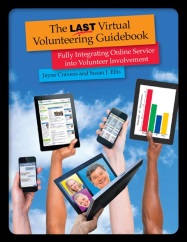
The Last Virtual Volunteering Guidebook offers detailed advice that would help any court understand how to evaluate the legitimacy of an online volunteering program. It’s geared towards nonprofits, charities, government programs, schools and others that want to involve online volunteers and to use the Internet to support ALL volunteers, including onsite volunteers, but any court or probation officer would find it helpful, as more and more people assigned community service need and seek legitimate, credible online volunteering options. If you are worried about how such volunteering is “real” and how you would verify such community service, this is the resource that will help you.

If you have benefited from this blog or other parts of my web site or my YouTube videos and would like to support the time that went into researching information, developing material, preparing articles, updating pages, etc. (I receive no funding for this work), here is how you can help

What’s New Regarding Virtual Volunteering

Despite lack of funding, I do my best to keep tabs on what’s going on regarding virtual volunteering: initiatives using the Internet to support and involve volunteers. What I’m particularly interested in are virtual volunteering activities that are new to me, are particularly innovative or particularly successful. I have a series of Google Alerts I use to keep tabs on news stories, press releases and blogs that use certain words and phrases that are good leads on virtual volunteering – remember, most initiatives that involve online volunteers never use the phrase virtual volunteering, and maybe not even the word volunteer.  That makes finding stories quite difficult.

I keep a list of news regarding virtual volunteering on the Virtual Volunteering Wiki. I did an analysis of this by year and found that 2014 and 2015 were prolific years regarding news related to virtual volunteering, but that after that, the number of stories I’ve found drops each year. Why the drop in stories about virtual volunteering each year for the last five years? I think it’s because there’s not that much that seems newsworthy about virtual volunteering anymore – after all, virtual volunteering is more than 35 years old.

I also use my news searches to update this web page that lists Virtual Volunteering initiatives, to help those looking for online volunteering. While my book with Susan J. Ellis, The Last Virtual Volunteering Guidebook, is focused on helping organizations engage and support volunteers using the Internet, this page is meant to help people that want to be online volunteers. It lists more than 100 places to find virtual volunteering opportunities, and some of the sites I link to, in turn, list dozens, even hundreds, of organizations recruiting online volunteers.

In maintaining this list and in searching for virtual volunteering news, I’ve seen that, in the last five years, there has been a proliferation of opportunities for online volunteers to transcribe scanned historical documents or to tag photos. Examples:

The Old Weather project, where online volunteers transcribe hand-written weather observations made by Royal Navy ships around the time of World War I; using old weather observations can help predict our climate’s future.

Decoding World War I Punchcards, to help tag digitized punch cards that represent soldiers in World War I served by the YMCA, housed at the Kautz Family YMCA Archives, University of Minnesota Libraries. 25,926 men and women are represented by these cards. By digitizing these cards and having them properly tagged, this project seeks to shed light on these individuals and make freely available the biographical and demographic information contained within these cards.

The Freedom on the Move (FOTM) public database project at Cornell University mobilizes online volunteers to add data tags and transcribe scans of newspaper advertisements offering rewards for the capture of fugitive slaves – enslaved Americans seeking freedom and, often, their families. The resulting database will allow users to examine spatial patterns and compare trends over time.

These virtual volunteering transcription and tagging programs used to be few and, therefore,  newsworthy. One of the things that made them newsworthy is that they are microvolunteering or microtasks: a volunteer can spend just a few minutes accomplishing something, or spend hours transcribing and tagging. Now, there’s well more than 100 such programs – Zooniverse alone provides links to more than 80 such projects. There’s just nothing really new or innovative anymore about microvolunteering. But it is addictive: I lost a lot of time trying out one of these programs and one project turns into 20 – it’s better than CandyCrush!

What innovation is needed regarding virtual volunteering? A way for online volunteers to participate in these microvolunteering tasks in a way that the time they spend on them and their accomplishments could be automatically tracked, resulting in a report the volunteer could show as he or she wants to: on social media, to a high school administrator who wants to see the number of volunteering hours a student has undertaken or to a probation officer or other officer of the court who wants to see the number of community service hours a person has completed. If some aspiring hackathon or socially-responsible company or whatever wants to create this tool, just give me credit for the inspiration, please?

If you have benefited from this blog or other parts of my web site and would like to support the time that went into researching information, developing material, preparing articles, updating pages, etc. (I receive no funding for this work), here is how you can help.

Also see:

Do you want volunteer feedback? Not if you don’t ask for it.

graphic by Jayne Cravens representing volunteers

As I’ve said before on my blog, so much of my recommendations regarding volunteer engagement come from my own experience either managing and supporting volunteers or being a volunteer – or trying to volunteer – myself, as well as from feedback from people that volunteer – or try to volunteer – themselves.

Here’s another example:

I have done a volunteering gig three times where I spend the night at a church that serves as a temporary overnight shelter for three families experiencing homelessness. The families are enrolled in a program by a nonprofit in the county where I live. My liaison is the church that is in charge of recruiting volunteers for that week of the shelter. My role in these three times I’ve volunteered: I show up at 7:45 p.m., I may or may not interact with the families, who start arriving at 8 (it depends on what they and their children want – not everyone is in the mood to socialize, including the kids), the families retreat to their rooms at 9, I set up my cot and lock things up with the other volunteer, read or play on my computer for an hour, then it’s lights out at 10. At 6 a.m. or so, the volunteers get up and, at 6:30, we knock on the doors of the families with a hearty and, no doubt, terribly annoying “Good morning!” The families need to be out by 7 a.m. and we lock up and leave.

90% of my volunteering is sleeping. How cool is that?!?

Anyway, here’s an email I sent to the organization that works with these homeless families and oversees the churches that recruit volunteers to support their program, with some editing to protect identities because I am NOT trying to shame anyone. I sent it more than a week ago:

One of the problems with involving volunteer management consultants as volunteers is you get emails like this…

I appreciate so much the opportunity to volunteer to support the ORGNAMEREDACTED temporary family shelter at the NAMEREDACTED Church here in COMMUNITYWHEREILIVE. Last night was my third time being a volunteer host. I’m sorry my schedule doesn’t allow me to do it more.

However, I’m surprised that volunteers don’t receive an email followup from ORGNAMEREDACTED at some point early on to ask if they have felt prepared for the role, how things have gone in their volunteering experiences, if we are facing any challenges, how the program might be improved, what we like most about the experience, if the experience has affected how we view homelessness, etc.

Volunteers usually won’t provide feedback, even ask a question, unless they are specifically asked for such. Just because an organization might not be hearing of any challenges or problems or suggestions doesn’t mean they aren’t there. 

I also am surprised no one from ORGNAMEREDACTED has reached out to volunteers about other ways to support the organization, how to get program updates, etc.

Again, I appreciate so much the opportunity to volunteer to support the families in your program and hope my comments are accepted in the spirit of helpfulness.

Are volunteers happy? Are clients happy with volunteers? Are volunteers facing any challenges? Is there a regular/ongoing issue that might need to be addressed? Are volunteers doing what they should be doing? Is there something that needs to be improved regarding this program? Is there anything going on beyond a shift being staffed – is there a better awareness about issues around homelessness? There is NO WAY for this organization to know the answers to any of these questions because they’ve never asked their volunteers – and if they are assuming that volunteers will speak up without asking, they are mistaken (I’m one of the few exception to that rule).

There are a number of ways the organization could respond to me:

  • A defensive message about the workload and stress the organization is under that prevents them from reaching out to volunteers and inviting their feedback after shifts
  • A defensive message that says I should have taken this up with the church liaison and not the actual organization, that I shouldn’t have put this into an email, etc.
  • A defensive message that says that there is a statement on page such-and-such of the notebook of support materials for volunteers on the table next to the coffee machine at the church that is currently hosting the shelter that clearly states that volunteer feedback is welcomed and how to submit it.
  • A defensive message that implies I’m an unhappy volunteer and, therefore, perhaps this isn’t the right opportunity for me
  • A thank you message, but no other feedback
  • A thank you message that also asks me for advice on how they could implement such a feedback system that wouldn’t be a time or financial burden on the organization

Predictions?

Perhaps this organization involves volunteers just to get tasks done. What a shame.

Also see: