Category Archives: Community / Volunteer Engagement

Volunteering to build community cohesion

One of the reasons I loathe the way the Points of Light Foundation and other organizations promote the value of volunteering – with a monetary value and number of hours – is because it ignores the far greater value of volunteering and the far better reasons for an organization to engage volunteers.

I’ll say it yet again: engaging volunteers isn’t always just to get a task done. Sometimes, volunteering has much larger, more important goals – like a group volunteering effort done to help demonstrate solidarity and understanding between different groups. Volunteers can help build community cohesion and better community understanding. Volunteers can help change minds – without ever asking volunteers to change their minds.

Do you really think the best, most efficient, cheapest way to build affordable housing is by gathering a different group of volunteers each day to build a house together? No – no, it’s not. If that’s why you think Habitat Humanity does what it does, you are REALLY missing the larger point of their mobilization of volunteers.

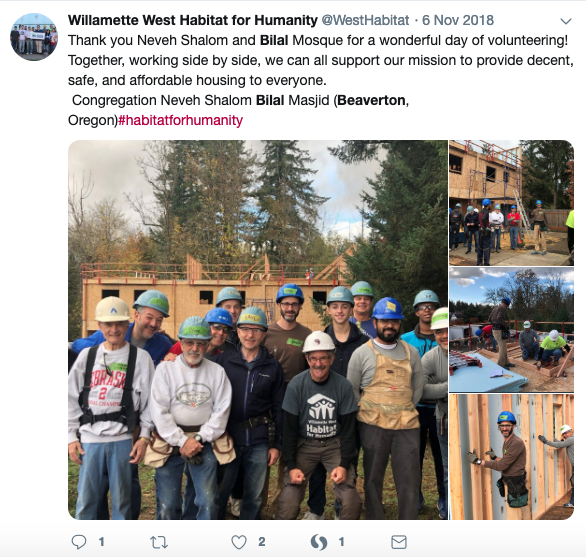
Here’s yet another example of what I mean when I go on this regular tirade: in Washington County, Oregon, members of an Islamic mosque’s congregation and members of a Jewish temple’s congregation got together to volunteer for a Habitat for Humanity build project in November 2018. Here’s a tweet about the event, with a photo:

This happens all the time, all across the USA. Habitat chapters LOVE bringing together different groups to volunteer side-by-side. Is the value of that the number of hours they volunteered and the monetary value of those hours? No.

If your organization is recruiting volunteers just to get tasks done, you are missing out on the value of volunteers.

And on a side note: four months later, this tweet had only two “likes” and no retweets. Every person on the build site should have been invited to retweet and “like” this if they are on Twitter. Every staff person at Habitat with a Twitter account should have been invited to retweet and “like” this. Don’t post something as wonderful as this and hope it might get noticed – ask your staff and volunteers, including your board members, to share it! Here’s more advice on using social media.

If you have benefited from this blog or other parts of my web site and would like to support the time that went into developing material, researching information, preparing articles, updating pages, etc., here is how you can help.

Also see:
No fooling: advice for volunteers

graphic by Jayne Cravens representing volunteersMy consulting work is focused on helping nonprofits, NGOs, government programs, etc. But I monitor online sites like Quora, Reddit and YahooAnswers, as well having conversations with various people, and the result of that is that I have found many people are struggling with a whole host of issues related to their own volunteering – or attempts to volunteer.

So many corporate folks thought all potential volunteers needed was a web site to search for opportunities. But while such sites have proliferated, guidance on how to choose a volunteering assignment, the options available, things to consider before signing up, even how to complain about a volunteering experience, are severely lacking.

Because of this lack of guidance for volunteers and people that want to volunteer, I created a section on my web site focused on helping people who want to make a difference in some way, through volunteering or through a career. The pages also are meant to help people who are assigned community service by a court or by a school, not only to help them access opportunities but also to move beyond “I have to do this so I am.” Please note that the pages do have advertising – clicks on ads help me pay the costs of hosting my web site, including the blog you are reading now, and pay for Internet access. Please also note I receive no funding for the time I spend researching topics and creating materials for this blog or my web site. 

The resources also include:

Detailed information for teens that want or need to find community service or volunteering tasks.

Ways you can volunteer, no matter how young you are (a lot of folks are under 13 but really, really want to do something)

Advice for family volunteering – volunteering by families with children.

Advice for volunteering as a group / volunteering in a group and a special page of advice specifically regarding group volunteering for atheist and secular volunteers (how to find welcoming opportunities for groups of volunteers that are not religious-based/faith-based).

How to find or create volunteering opportunities to help seniors / elders / the elderly that moves well beyond the “go be nice to old people” advice on other pages. 

Advice for finding volunteer activities during the holidays (spoiler alert: start looking in as early as August – not even kidding).

Online Volunteering / Virtual Volunteering: finding volunteering tasks you can do from wherever you are in the world. While my book with Susan J. Ellis, The Last Virtual Volunteering Guidebook, is focused on helping organizations, this page is meant to help people that want to be online volunteers.

Volunteering to help after major disasters for those that have ever wanted to help people affected by a sudden event like an earthquake, flood, tornado, hurricane, fire or human-caused event, this resource details what you need to do NOW. 

Volunteering to address a volunteer’s own mental health, designed to help a person have realistic expectations for volunteering to address his or her own loneliness, depression, anxiety, etc., and to avoid an experience that will make the volunteer feel worse instead of better.

Volunteering with organizations that help animals and wildlife. This is one of the most sought-after types of volunteering, and many people think they should pay large amounts of money to go overseas and help wildlife (and that wildlife is, in fact, being exploited and endangered by these volunteers).

Volunteering on public lands in the USA. While national parks, national forests, national monuments, federally-managed historic sites, Bureau of Land Management land, state parks, wetlands, etc. have fairly decent and easy-to-find information for potential volunteers, there’s no one page that tells people what all of their options are – I’ve tried to address that.

Using your business skills for good – volunteering your business management skills, to help people start, expand or improve small businesses / micro enterprises, to help people building businesses in high-poverty areas, and to help people entering or re-entering the workforce.

Volunteering in pursuit of a medical, veterinary or social work degree / career – volunteering that will help build your skills and give you experience applying skills to work in these fields.

Ideas for Leadership Volunteering Activities. These are more than just do-it-yourself volunteering – these are ideas to create or lead a sustainable, lasting benefit to a community, recruiting others to help and to have a leadership role as a volunteer. These can also be activities for a Capstone project, the Girl Scouts Gold Award, the Duke of Edinburgh’s Award (U.K.), a mitzvah project, or even scholarship consideration. This is also a resource for any person that wants to create his or her own volunteering activity.

Fund raising for a cause or organization – how to raise money for a nonprofit, non-governmental organization (NGO), charity or program you care about.

Crowdfunding for a personal cause: raising money to help with health care costs for a sick family member, someone in a dire financial crisis, etc. (as opposed to raising money for a nonprofit)

Donating things instead of cash or time (in-kind contributions) – do people living in poverty, or people after a disaster, really want your used shoes, your used clothes, your used car, etc.?

Creating or holding a successful community event or fund raising event – before you throw a concert or marathon or comedy show or whatever to raise money, read this.

How to make a difference internationally / globally/ in another country Without going abroad. Yes, there really are ways you can help without moving or traveling.

Ideas for Funding Your Volunteering Abroad Trip. This resource includes suggestions of ethical programs and questions to ask any program that wants your money to give you your feel-good short-term volunteering experience in another country.

Tax credits for volunteering – advice for residents of the USA.

How you can advocate for an issue important to you. If there is something you want to tell people about, to prompt them to care, even to prompt them to action, this resource is for you.

Also see my blogs to discourage people from voluntourism and the dangers of “volunteering” to help wildlife abroad.

If you have benefited from this blog or other parts of my web site and would like to support the time that went into developing material, researching information, preparing articles, updating pages, etc., here is how you can help.

Charity isn’t enough

The current Presidential administration in the USA wants to cut federal funding for a range of programs, including Special Olympics. Betsy DeVos, the President’s Secretary of Education, says it’s because these programs “enjoy robust support from private donations.”

Charity has never been enough to address homelessness, illiteracy, maternal health problems, gaps in education, the needs by those affected by domestic violence, the needs of people with disabilities, and on and on. Charity isn’t enough to promote the arts (arts involvement isn’t just nice – it’s essential to a whole range of quality of life issues), maintain public lands, and on and on. Charity is essential – but, alone, it will NEVER be enough, for Special Olympics or any other ESSENTIAL program. There MUST be government funding – tax dollars – for human service, environment, education and arts programs to be more than little feel-good PR moments benefitting just a small group of people.

My mother announced when I was 14 that I would be volunteering to escort the Henderson County team to the state Special Olympics in Bowling Green, Kentucky – a cousin was involved in organizing and this was how we, as a family, would support her – with me. Yes, it was a “voluntold” moment. I had never been around people with developmental disabilities and I had no idea what Special Olympics was and I had no idea who Eunice Shriver, the featured speaker, was. I won’t say I entirely understood it all at 14, but that participation changed ME for life and how I relate to people with developmental disabilities. It put me on a lifetime journey of trying to understand – all because of volunteering at one Special Olympics event. It wasn’t just a “nice” thing to be involved, not a oh, look at these poor children isn’t their spirit adorable thing – it was a TRANSFORMATION, for athlete, family member, volunteer and audience alike. This is so much more than “charity.” And government support is necessary for it to be anything more than a few small events here and there.

In fact, the Oregon Special Olympics keeps canceling events because of lack of funding. Special Olympics Oregon lost $325,000 on $4.5 million in revenue in 2016, lost more in 2017, and expects to lose money again in 2018, according to a news release. The reality is that corporations and other funders are NOT stepping up to fulfill the needs of Special Olympics.

The San Francisco Bay Area, including Silicon Valley, has rapidly become the richest region in the country. It’s a place where $100,000 Teslas are commonplace, unfiltered “raw water” goes for $37 a jug, and companies pay mega bucks for parties for employees, featuring high-profile comedians and other celebrities. Yet Sacred Heart Community Service, a San Jose nonprofit that helps low-income families with food, clothing, heating bills, and other services, actually received less in individual donations from the community in 2017 than it did the previous year. “We’re still not sure what it could be attributed to,” Jill Mitsch, the funds development manager at Sacred Heart, said in this story about corporate profits and philanthropy in Silicon Valley. It’s not the only nonprofit trying to keep donations up—the United Way of Silicon Valley folded in 2016 amidst stagnant contributions. Here’s more in this story. Record homelessness, record numbers of people needing health care, more and more polarization in society, more and more social isolation, less and less feelings of community – and, yet, Silicon Valley is holding on tightly to its wealth and not investing in the nonprofits that cannot keep up with demand.

Charity isn’t enough. In fact, volunteering, by itself, isn’t enough to save the world. But that’s another blog…

Also see:

Volunteer (mis)management at schools

Here in the USA, ’tis the season for volunteers at school book fairs to raise money for various projects at the school that aren’t funded anymore because of ongoing tax cuts!

And it’s a time of year when I get terrific insights into volunteer (mis)management.

My friends know that I research, train and write about volunteer engagement. Their texts and emails to me are a fountain of insight. Here’s a recent series of texts from a friend back in Kentucky, which I’ve slightly edited to protect the identity of the school, and the link at the end of her text is mine:

I signed up to volunteer at the Used Book Sale at school. I signed up to sort books. I got ready, drove to the school, and signed in… only to be told “oh, we don’t need any volunteers today. We will need some Wednesday though.” They asked for volunteers for Monday and Tuesday and I signed up on their sign up list for Monday. They had my email address and phone number, yet nobody bothered to call or email me and let me know I wasn’t needed. They let me drive all that way and then sent me home. This is not an uncommon thing with this school. The night I worked the basketball tournament, I had signed up to work the gate but when I arrived there was already someone working the gate so they told me that “maybe they could use me somewhere else.” I asked and they put me in the concession stand. They had other volunteers for the concession stand too who ended up going home because I was working it – that means I took someone else’s place. And remember: parents have to volunteer so our kids can go to that pizza party. Because of my disability, a “good” day is really valuable to me – I don’t appreciate them wasting my good day like that – there are other things I could have been doing.

Maybe this doesn’t really sound like a big deal. But it is. Schools need volunteers. This isn’t about the pizza party – it’s about a school desperate to staff events highly valued by their students – and these type of students have a very positive effect on student academic performance and discipline issues. This volunteer is frustrated. Once she fulfills her obligations in terms of hours, she’s not going to volunteer even an hour more.

Feeling smug, Oregonians? Well, here’s an email I myself got recently:

Our SPRING Scholastic Book Fair is coming up on March 20 and 21 in the East Cafeteria during Parent Teacher Conferences! Book sales will start on Wednesday from 2 – 8 pm and continue on Thursday from 8 am – 8 pm.

We are asking for VOLUNTEERS to help with set up on Wednesday, book sales on Wednesday and Thursday (1-hour shifts) and packing up after the fair on Thursday. Please check the link below for times that we still need volunteers and sign up for one or more shifts! We say it every time, but we really CANNOT do this without you!

Thanks so much for your help!!!

What school? I don’t know. In what city? I don’t know. The email came from a gmail account. Are there rules for book fair volunteers, like policies for interacting with kids? No idea. Are volunteers going to handle money? No idea. In fact, I had no idea why I got the email – I’m not a parent. After some back and forth with the sender, I discovered that this is a nearby school to where I live here in Oregon. I signed up months ago on the school district web site to help with activities in the school system. I was interested in helping at one-time events or even talking to students who might be interested in a career path similar to my own (a squiggly, meandering career path that starts in the arts, goes through journalism, goes back to the arts, goes into communications for nonprofits, and just keeps getting more abstract…). I never got a response from the school district. Did I pass the criminal background check? Is there a web site I’m supposed to review to learn about the rules for being a volunteer? Are there things I shouldn’t say around children? What if they ask me for my email address? Would there be a new volunteer orientation? Since I never got a response or any answers to those questions, I had completely forgotten about signing up to help to volunteer months before – as, indeed, I do with more than half of the places I sign up to volunteer because they never reply to my application or sign up on VolunteerMatch.

The schools in my district are installing all sorts of machines at entrances to screen visitors and keep kids safe. They might want to look into their volunteering policies and procedures as well.


If you have benefited from this blog or other parts of my web site and would like to support the time that went into developing material, researching information, preparing articles, updating pages, etc., here is how you can help.

Also see:

Trump is trying to eliminate national service – again

For the third consecutive year, Donald Trump’s annual budget proposal calls for the elimination of the Corporation for National and Community Service (CNCS). This is the federal agency that oversees national service and volunteering efforts, including AmeriCorps, VISTA, Conservation Corps (the modern-day CCC) and Senior Corps. This is a part of Trump’s ongoing war on volunteerism.

The annual budget of CNCS is $1.08 billion, less than 0.03 percent of the overall federal budget. For the past two years, the USA Congress has rejected Trump’s elimination proposals, instead giving AmeriCorps and Senior Corps a $19 million increase in funding for the current fiscal year.

AmeriCorps members are well known for their essential response and recovery efforts following natural disasters in the USA. For instance, For a year and a half after the 2011 tornado in Joplin, Missouri, AmeriCorps members created a missing persons call center, transported volunteers into the field to help with debris removal, moved people from temporary to permanent housing, delivered donated items to families, assisted with minor repair jobs, and coordinated volunteer efforts by various individuals and groups, both local folks and people coming in from other parts of the USA. You can read more in this story by the Joplin Globe. I warned via this blog in 2017 about this possibly happening.

I’ve written about this before, in 2017. And then I wrote about the attempt for this to happen in 2018. And as I said then: I have seen, first hand, the impact that these national service members have had on nonprofit and public institutions, and those they serve, across this nation. These programs are a part of what make my country great – great right now. Members of these services provide CRITICAL services that benefit millions of people in our country. Members go on to an intense awareness about community issues that make them better citizens, more educated votes, and more productive members of society. The first President George Bush (Republican), President Bill Clinton (Democrat), the second President George Bush (Republican), and President Barack Obama (Democrat) all supported these national service programs. If these national service programs are eliminated, millions will suffer, and yet another great thing about these United States will go away.

If you are a US citizen, I strongly encourage you to:

  1. Call your Congressional Representative and two US Senators and share your opinion about national service funding. Calling or sending a postal letter is most effective; emails are too easily ignored.
  2. Look online, particularly via social media, for efforts to publicly support national service.
  3. Contact your local newspapers with a letter to the editor in support of CNCS programs.
  4. Help local nonprofits post information on their web site and via social media about the difference national service members have made in supporting community goals and improving the quality of life in your community.

And to think that, earlier this year, there was a call to expand national service by the National Commission on Military, National, and Public Service, a federal panel.

It’s not enough for you to read this blog and be outraged: you must take action or this is going to happen.

Update May 9, 2019: The US House Appropriations Committee rejected Donald Trump’s proposal to eliminate the Corporation for National and Community Service. The committee also introduced an FY20 spending bill to fund CNCS at $1.14 billion, an increase of $55 million above the FY2019 enacted level. You can find more details about how much funding the House Appropriations Committee has proposed for each CNCS program in this legislative update.

know before you go: volunteering by foreigners is illegal in some countries

I’m one of the moderators of the forum on Reddit – called a subreddit – on volunteering. Most of the questions on that forum are by people looking to volunteer and, often, they are looking to volunteer for a few weeks in another country. This is voluntourism, and anyone who reads this blog regularly knows I’m not fond of the practice: it is vanity volunteering, focused on giving a foreigner a feel-good experience rather than actually helping someone and, in fact, such “volunteering” can actually harm children, wildlife – even the volunteers themselves.

In some countries, volunteering by foreigners is, in fact, illegal. Despite its illegality, some NGOs – which are really for-profit companies – try to recruit foreigners to pay thousands of dollars to come “help” in their communities.

For instance, in most cases, volunteering by foreigners in Indonesia is illegal. The Indonesian immigration police in the country make regular visits to certain communities to check the legal status of people who say they are volunteers and foreigners who say they are being paid to work. You can read a news report from July 2016 about one of the raids on foreign volunteers here.

Bukit Lawang in North Sumatra, Indonesia is a popular tourist destination located on the edge of the Gunung Leuser National Park, a UNESCO World Heritage Site home to numerous bird, plant and mammal species, most famously the Sumatran orangutan (Pongo abelii). Nearby tourist businesses operate jungle treks, transport, tours, and other activities in the area – and field a LOT of questions about wildlife volunteering.

bukitlawang.com has a page about the laws regarding volunteering by foreigners in Indonesia, one that I wish more countries and popular tourism sites had. The Bukit Lawang page says that the main type of foreign visas for the country are the following (the bullets are cut and pasted from the site):

    • visa-free entry permit (received on arrival, free, at the airport) – voluntary work is always illegal

    • visa-on-arrival (paid on arrival at the airport at the cost of $35) – voluntary work is always illegal

    • tourist visa (paid abroad at the cost of around $50) – voluntary work is always illegal

    • social visa (paid abroad at the cost of around $50) – voluntary work is usually illegal. For the voluntary work to be legal, the social visa must have been sponsored (with an accompanying letter) by a registered Indonesian yayasan (charity/foundation) and during the application, the sponsorship letter must state that the foreigner is performing volunteer work for the foundation. A sponsorship letter that merely says something along the lines of ‘I am an Indonesian citizen and I am sponsoring Mr. X to visit Indonesia’ would NOT be valid for volunteer work in Indonesia, it ONLY entitles you to stay in Indonesia for a holiday/family visit, and no kind of work is permitted. A sponsorship letter from an individual, one that is not stamped by a charity/foundation is almost certainly NOT valid for work in Indonesia.

  • KITAS – sponsored by a charity or employer. This costs around $1200 per year (including work permit and visa) and is valid for paid and/or unpaid work of the specified nature at the specified employer.

The page also offers the following throughs about voluntourism. Remember – these are coming from an Indonesia-based organization:

Voluntourism is big business around the globe. In Indonesia specific considerations are:

    • low cost of labour – the minimum wage is around $5/day, and many earn even less. If you emphasise the ‘tourism’ aspect of voluntourism, then it may make sense to spend thousands on your trip, but the ‘volunteer’ element may be lacking.

    • your skills – if you are a young person with no work or life experience unfortunately you may have little to offer except your time. Effective volunteers will have specific skills that are relevant and scarce in a rural developing area.

    • culture differences – Indonesian culture is very different from your own. Communities are interconnected and foreigners are ‘other’. You will also face a language barrier – while those working in tourism will speak English, these are certainly not the people in need of help – those in need are generally far from the tourist areas.

    • transparency – Indonesia does not have a big charity culture; rather, charity is said to begin at home, and the concept of working for free is largely alien. You should therefore check exactly how the goals of the charity or project organiser himself are aligned with those of the charity. Do not be afraid to ask questions. Indonesian staff need money, but they must explain to volunteers exactly how they benefit financially from their charity.

    • safeguarding – Indonesia and other developing countries are open and have few safeguarding policies in place. This means that children can be at risk. If your project is working with children be sure to check about their safeguarding policies

    • effectiveness – be sure that your project is effective in achieving its and your goals. Ask specific questions and look at how results are measured.

  • immigration concerns – your volunteer work is likely to be illegal – see above.

It’s refreshing to see a local institution speak out so strongly against voluntourism and be so explicit about what the law is.

All that said, I should note that it is certainly possible for foreigners to visit Gunung Leuser National Park and see the Sumatran orangutan, something I hope to do myself someday. I learned about it by reading Lone Rider by Elspeth Beard. She’s one of the first women to ride a motorcycle all around the world, doing so back in 1982 – 1984. She wrote about an NGO working in this area, helping to address the huge problem of Indonesians abducting baby orangutans and then wanting to get rid of them when they grow older and are so much harder to care for. Her account of this visit is a good example of transire benefaciendo: “to travel along while doing good” – she didn’t attempt to work at the NGO as a volunteer (which would have been illegal), but she did elevate its work through her book.

I did something similar in Hungary: while camping in Hortobágyi Neuzeti Park, a sea of grasslands, the camp host told us that there was a bird rescue clinic right next door. The next morning, I went there. It turned out the clinic allowed visitors, so we toured, taking photos of their rehabilitation rooms and spaces and getting information, which I translated once we were home so that I could write about the Hortobágy Bird Clinic on my blog. Here is the web site of the clinic as well.

In addition to researching the laws regarding foreign volunteers in a country where you want to go, you should also look at your own country’s laws regarding going elsewhere to volunteer. For instance, Tauqir Sharif, 31, from Walthamstow, England, founded the organization Live Updates from Syria in 2012, providing support and assistance for families in Syria and raising awareness about the devastating situation on the ground. He has been living and working in Idlib, Syria alongside his British wife, Racquell Hayden-Best. He had his UK citizenship revoked in May 2017.
If you have benefited from this blog or other parts of my web site and would like to support the time that went into developing material, researching information, preparing articles, updating pages, etc., here is how you can help.

Also see:

Also see: My consulting services

Susan Ellis Matters

In the winter of 1996, I started a new job, directing The Virtual Volunteering Project. I was based in Austin, Texas, and I flew to Washington, DC to meet one of the advisors of the project, Susan J. Ellis.

She terrified me.

She seemed to know absolutely everything there is to know about volunteerism. She had thought about virtual volunteering far, far more than I ever had. She was absolutely sure of the impact online volunteers could have on the world and had already envisioned specific examples of possibilities. She wasn’t surprised at all by anything I told her regarding what I knew about working with online volunteers or what I knew about organizations engaged in virtual volunteering. She was five steps ahead of me no matter what I was saying or thinking. It was one of the most intimidating meetings I’ve ever had.

I have remained in awe of Susan’s expertise and ways of thinking and strategizing every day since that meeting, but I also am so happy that, since then, Susan became a frequent collaborator and good friend. Back in those early days, we would do workshops together at various volunteer management and volunteerism conferences and ask the room, “How many of you have an email address?” Maybe a quarter of the room would raise their hands. I wanted to be tentative and gentle about introducing virtual volunteering – she didn’t, and would challenge the room with statements about how they had better get ahead of this because, if they didn’t, tech-savvy volunteers would create their own efforts and leave them behind. Over the four years I directed the Virtual Volunteering Project, I became far bolder in my statements and advice as well, and it was because of her. She never officially consulted on the United Nation’s Online Volunteering Service when I directed the project at UNV, but so much of what I did in managing that service was because of what she taught me, and any success regarding that service is, in part, because of her. 

Her book From the Top Down: The Executive Role in Successful Volunteer Involvement changed everything I had been thinking about volunteerism, and I still refer to it regularly when trying to create a presentation or a research paper or write a blog post. When she told me she had suggested the authors writing the book What We Learned (the Hard Way) about Supervising Volunteers to contact me for a contribution, I was floored – what did I know?!? She had so much more faith in me than I ever did in myself. I read her oh-so-provocative Hot Topics, her monthly blog series, and was inspired for months to come with new questions and comments for colleagues – and always checked it whenever I had what I thought was a new idea because, very often, Susan had the same questions or comments months or even years before me.  

The first time I visited the Energize, Inc. office in Philadelphia in 1998, we were both active participants on CyberVPM, a then very popular and pioneering online group to discuss volunteer management. Sitting in her office, we decided to author a joint post and propose a discussion that the President Bill Clinton intern/sex scandal was, in fact, a volunteer management issue, since the intern was unpaid and, therefore, a volunteer. Many on the group balked at the idea of discussing “politics”, but Susan didn’t back down: she asked point blank how these organizations would handle the same situation in their own organizations, what policies they had in place to address it, etc. 

Susan was disruptive long before it became fashionable to be such.  

Let’s be clear: there is no person on Earth who has done as much to promote volunteerism and the best practices for engaging and support volunteers than Susan J. Ellis. Her contributions cannot be overstated. That any academic paper regarding any aspect of volunteerim can be written without quoting Susan at some point is beyond me. I have not done a presentation on volunteer engagement in the last 22 years that I did not reference Susan Ellis. 

Susan wasn’t just a pioneer regarding the identification and promotion of volunteer management best practices and innovations, she wasn’t just a guru regarding all things volunteerism: Susan J. Ellis was a pioneer geek fan girl. Her company, Energize, Inc., was named for the term “energize” in Star Trek, and she had fantastic stories about being a Trekker in the earliest days of the show. She also was a huge fan of David McCallum and The Man From U.N.C.L.E. and a few years ago, over a huge sandwich at a Schlesinger’s, a legendary traditional Jewish deli in Philadelphia, she told me a wonderful story of waiting outside a stage door as a starry-eyed young fan girl so she could show McCallum, who was appearing in a stage production, the scrapbook she’d put together for years watching his show. She did, indeed, meet him and show him her work, and he had seemed quite impressed. Many years later, she decided to wait outside another stage door for him in a different show, just to get another autograph, and he said upon seeing her, “You’re the girl with the scrapbook.” She beamed at that story, as any fangirl does, to be remembered by someone whose career you have followed and promoted with such passion.

Susan also wrote a Master’s thesis on the history of scrapple, a traditional and not-at-all kosher food of Pennsylvania, and I not only read it when I last stayed at her house, I also delighted in playing for her the scrapple song by one of my favorite performers, Robbie Fulks. I had intended to get him to autograph something for her in March when i see him perform, to honor her scrapple research. 

In 2005, Susan and I were at yet another volunteerism conference together – I had been living in Germany for four years. And we sat at a table and had a conversation in German. She was so delighted to hear me stumble through the language of her parents and to be able to have a bit of back and forth in it. It’s one of MANY moments I cherish with her. 

The blanket on my couch is the one Susan gave me as a wedding present. One of my favorite outfits is one I bought when I met up with her in London to tell her I had started a completely revising our book on virtual volunteering. And, of course, so many of the books she wrote and published are on my bookshelves. 

You have probably noticed by now that I’m talking about Susan in the past tense. Susan passed away yesterday morning, Sunday, February 25. I wanted to wait a day before posting my tribute online because I wanted to make sure that those who were closest to her would know this news by now and wouldn’t learn it by reading this blog or any social media posts I made.

Seven years ago, Susan was diagnosed with cancer. She made a remarkable recovery from that initial diagnosis and the toll the initial treatment took on her, but never quite a full one: the cancer kept showing up in other places and the treatments greatly affected her health in a myriad of ways. She handled her health challenges with remarkable grace and humor, even coming back from the brink in late 2017 – her friends, of course, dubbed her Susan Ellis: hard to kill. But ultimately, the fight became too much. I’m so glad that her final days were peaceful and surrounded by friends. 

Please check the Energize, Inc. web site for details about Susan’s funeral and burial, which will be happening quite quickly, as well as the memorial in Philadelphia next weekend. Any other plans for remembering Susan will be posted there as well. 

I made a Flickr group of photos of and “to” Susan you can see here.

SO many of us are having trouble thinking about a world without Susan. I’m so grateful to have been mentored by her – and to have been able to call her my friend. 

Update: her official obituary from her company. Also, the newly formed Susan J. Ellis Foundation will, in the coming months, “provide grants or support programs that will expand volunteer administration and support education and research activities in volunteerism” and contributions are being accepted for it. 

Susan’s obituary in the Philadelphia Inquirer

school parent volunteer engagement ethics

graphic by Jayne Cravens representing volunteersI got this message from a friend. And then I had another situation I had wanted to offer up on a blog as well. So… what do you think about the ethics of required parental volunteering in schools?

I’m preparing to go to [[name of private school redacted]] to work a basketball game. I don’t want to go at all but I have to put in so many volunteer hours every school year for my daughter to be able to go see a movie with her class at the end of the year. And nobody wants to be that deadbeat parent whose child has to stay behind because they didn’t volunteer enough. She’s not even playing basketball! They’ve got quite a racket going here: work me for 20 hours for a $20 movie trip.

Apparently, a parent can’t simply pay the movie ticket admission and, say, a bit for gas: they must volunteer or the child isn’t allowed to go on the trip.

A neighbor also told me that her son is on the swim team for the public high school where he attends but she can’t afford all of the fees for him to participate, so the school gave her the option of volunteering 30 hours a semester so her son could participate.

But, on the other hand, students at schools with high volunteer involvement flourish – good grades, fewer discipline problems, etc.; schools without much parental involvement struggle – students with poor grades, more discipline problems, etc., so there is a big incentive by this and other schools to get parents into the school for student events or into the classroom. And this kind of required time better guarantees that happening.

What are your thoughts about the ethics and optics of either of these cases? What about a situation where a parent absolutely cannot volunteer, because of childcare issues, caregiver issues, job issues or lack of transportation? What if a parent has a conviction that precludes him or her from ever volunteering in a school?

Also see:

Comparing schools with high & low volunteer engagement

How schools & small governments should be using social media

Volunteering to help your own mental health

I see things like this posted to various online fora regularly – and even sometimes get emails that say something like this:

I’m sad and bored and need a change in my life. I feel like I have no direction. I need to reconnect to humanity and feel like I have a purpose. I want to go overseas and really make a difference somewhere, like helping refugees or orphans. I see the videos on TV and it really breaks my heart. But all the places I’ve looked into want me to have at least a university degree and some experience. I don’t have any experience, but I have a really good heart, I’m a hard worker, and I also really need this. Don’t suggest the Peace Corps – not only do they want me to have a degree, they want me to go for a really long time. I just want to go for a month or two. I think this would really help me have more purpose in life and be happier. I’d really love something that lets me just keep traveling on and on and pays for my travel and places to stay. 

Or this:

Hi, I am a 22-year-old male living in the Atlanta area. I’ve had mental health issues and substance abuse issues, and it’s hard to put into words, but a coping mechanism I have been taught was to find a happy place and go to it. The only time I can remember feeling overwhelming joy was working at Summer camps. I’ve never been so happy as I was watching those kids have fun and being able to teach them things they’d never learn otherwise. I’m willing to give any amount of time and effort so I can feel that way again.

Or this:

I’ve been dealing with mental health problems for about five years. I think what I need is to immerse myself in volunteering and make a difference. What I am looking for: (1) Away from the town where I live. Out of the country would be great. (2) Ideally something with an atmosphere where good people  who would be supportive of my mental health and accommodate me, because I have social anxiety and trouble interacting with people. (3) Dealing with something truly important, addressing a serious problem. I was thinking maybe something to prevent infant mortality, but I might not have the mental capacity for something that serious, and I don’t want to make my mental state worse. Climate change is another thing that might be good. I want something that’s bigger than myself and my mindstate. (4) An organization that provides a very immersive situation so I’m deeply connected with the people I am working with, and where I can see a difference being made. (5) Well-structured. It would be less anxiety-provoking if I don’t have to make too many of my own decisions. (6) The option to leave and go back home when I want.

Each of those three requests is based on an actual posts I’ve read on various public platforms – I’ve changed some words here and there so as not to single out any real person for their request, and changed some phrases for clarity.

I have no doubt these people sincerely want to help, but I am stunned at their expectations of  host organizations regarding the volunteer experience they want.

Volunteer hosting organizations – nonprofits, charities, schools, government agencies, etc. – have thousands of priorities that come before a goal of ensuring a person’s volunteering experience helps that person feel less lonely or improves that person’s self-esteem. Of course these organizations want volunteers to have a good experience – but they also aren’t therapists and they haven’t set up their volunteering as therapy – volunteering set up as therapy requires expertise, resources and constant supervision that most nonprofits, NGOs and charities do NOT have, and an emphasis on such would, in fact, take away from their primary mission of helping people experiencing homelessness or domestic violence, or promoting and celebrating the arts, or cleaning up a watershed, or accommodating lost, abandoned and surrendered animals, or supporting small-scale family farmers, and on and on. These organizations do not have a mandate nor the resources to create volunteering opportunities with the primary or even secondary purpose of giving volunteers a feel-good experience worthy of Instagram, helping them become more social or helping them address their own mental health issues.

Here’s also something you should know up front about volunteering: a volunteering role may not give you a sense of purpose and fulfillment. It may not increase your self-confidence. It may not improve your mental health. It may not make you feel like a superhero. It may not give you a feeling of accomplishment. It may, instead, be stressful and frustrating. The people you are there to help may annoy you. You may walk away from it feeling a sense of failure rather than accomplishment. There is no guarantee you are going to have the experience depicted on the volunteer recruitment materials.

The reality is that volunteering can be a LOT like dating: it may take spending time with a lot of different people, in various different places, before you find one that fits you – and you have to accept that, after months or even years, it may turn sour and it has to end.

Absolutely, volunteering can positively affect a volunteer’s mental health. Volunteering can help a person meet other people, give someone a sense of well-being, help develop a new social circle – you may even meet the person you want to marry through volunteering. Volunteering can even help you develop skills to improve your employment options. Volunteering can be good for you, mentally and physically, no question. But you cannot assume any of this is going to happen just by signing up to volunteer somewhere. You cannot assume volunteering is going to never be anxiety-inducing or never be stressful.

I have lots more detailed advice specifically for people seeking volunteering as a way to alleviate loneliness and mild depression here.

Is it possible for an organization to create such volunteering experiences for people seeking to improve their mental health? Sure! You may see a group of volunteers cleaning up a beach and not realize that they are all part of a therapy group for people with eating disorders. You may see a regular work crew around your county repairing playgrounds and public facilities and not know that they are recovering from addiction and do this volunteering under the supervision of a treatment program. You may interact with a volunteer at a local animal shelter and never know that the volunteer was coached for weeks by his therapist on how to apply for a volunteering role and then coached and supported by that therapist for the first three months of his or her service. You may be a volunteer working alongside other volunteers in a public awareness campaign and never realize that the volunteer in charge of putting together the newsletter got dumped by her fiancé and is using this experience to rebuild her confidence. But note that it’s not the organization hosting the volunteers that is responsible for their mental health support – it’s a therapy group or a professional therapist, and the host organization has been fully briefed and, sometimes, even financially supported to help accommodate these volunteers.

Also see:

the growing youth & loneliness crisis (& lack of empathy crisis) – could volunteer engagement help?

The results of a nationwide survey by the health insurer Cigna released last year said that nearly 50 percent of respondents in the USA felt alone or left out always or sometimes. Two in Five felt like “they lack companionship,” that their “relationships aren’t meaningful” and that they “are isolated from others.” And the loneliest demographic among respondents was young people: members of Generation Z, born between the mid-1990s and the early 2000s, had the highest loneliness score, followed by Millennials. Yesterday, CBS Sunday Morning did segment that mentions this Cigna study and on the growing loneliness epidemic in the USA.

And then there is this report: significantly large numbers regarding unemployment among young people worldwide: in 2017, it was reported by CNN Money that youth unemployment in the eurozone has been stuck between 19% to 25% for the past eight years. In Spain and Greece, it’s north of 40%. The number of people in Italy aged between 15-29 years that are not in education, employment or training rose by 21 percent from 2008 to 2012, to 23.9 percent, and that number hasn’t improved seven years later. In Arab states, youth unemployment is around 30%. The incidence of unemployment among youth in Northern Africa was at 29.3% in 2016, representing the second highest rate across all regions.

Economists and government officials focus on the cost of unemployment to the economy as a whole, but for the unemployed, it’s a personal issue. Young people need jobs for the obvious reason: they need income to give them employment to pay for what they need to survive, day-to-day. But studies have shown that prolonged unemployment harms the mental health of workers and can actually worsen physical health and shorten lifespans as well. Prolonged unemployment can lead to an erosion of skills and, more worryingly, lead to pessimism, resentment and anger. Those negative feelings can be targeted at anyone that an unemployed person blames for their situation – people not from the area, people who are perceived as not at risk for unemployment, people perceived as taking the jobs the unemployed want, government officials, institutions, and anyone who is perceived as different.

While promoting volunteer engagement does nothing to address the immediate financial needs of the unemployed, volunteering can help a person with skills development for a career change and eventual employment. Could volunteer engagement also address other issues, like disconnection from society, resentment and anger for certain groups of people, like immigrants or ethnic minorities, and growing distrust in institutions? Can volunteering can give a person a connection to other people and to society as a whole, help increase their awareness about people and cultures different from their own and help build or restore trust in people and institutions? I think so, though there’s little data that directly supports my position.

When an organization involves volunteers, it gives non-staff a first hand, in-person experience with programs that are trying to improve the community or the environment – anything from promoting the arts to helping children’s education to accommodating dogs and cats that have been found or surrendered. This volunteer engagement can help build trust in organizations, in institutions, in the community and among people. It can give a volunteer a sense of value and influence. Volunteer engagement can play a vital role in building social cohesion and intercultural understanding, bringing together different segments of a population in a setting that can help build relationships and community. Volunteer management is community engagement and, as such, I believe volunteer engagement can help to address youth unemployment, cultural conflicts, intergenerational misunderstandings, integration, community cohesion, social integration, and on and on.

However, I’m not at all calling for business and government to start yet another Get-Out-And-Volunteer campaign. Please, don’t do that. Rather, this is a call for business and government to realize that, if they expect nonprofits, NGOs, charities and other organizations to involve more young people as volunteers, they need to provide the funding for that to happen.

Volunteers are not free. I just don’t know how many times I’m going to have to say that for it to finally be understood. For organizations to involve volunteers effectively, to involve more volunteers and to create opportunities for volunteers that go beyond just getting work done but also to build civic engagement and greater trust in the community, these volunteer-involving organizations must have the expertise to do it – which may come from training (which isn’t free) or hiring staff (also not cost-free) – and they may need additional resources to support additional volunteers, such as software or physical spaces.

Are corporations, governments, foundations and individual donors ready to step up and fund what’s needed to increase volunteer engagement, especially among young people?

April 16, 2019 update: Since the late 1960s, researchers have surveyed young people on their levels of empathy, testing their agreement with statements such as: “It’s not really my problem if others are in trouble and need help” or “Before criticizing somebody I try to imagine how I would feel if I were in their place.” According to this NPR article, Sara Konrath, an associate professor and researcher at Indiana University, collected decades of studies and noticed that, starting around 2000, the line starts to slide and young people are becoming less empathetic: more students were saying it’s not their problem to help people in trouble, not their job to see the world from someone else’s perspective. By 2009, on all the standard measures, Konrath found, young people on average measure 40 percent less empathetic than the previous generation. Again: could volunteer engagement help? Could exposing young people to those different from themselves help? And are corporations, governments, foundations and individual donors ready to step up and fund what’s needed to increase volunteer engagement, especially among young people?

July 16, 2019 update: US Teen and the number of suicide deaths among young people began climbing around 2008 and reached a new high in 2017, according to the Centers for Disease Control and Prevention. Suicide rates lately have been increasing in all age groups in America, in almost every state. The number of teens diagnosed with clinical depression grew 37 percent between 2005 and 2014. And suicide attempts are on the rise as well.

July 27, 2025 update: The headline proclaims Americans under 30 are so miserable that the U.S. just fell to a historic low ranking in the annual World Happiness Report. “If you were only to assess those below 30, the U.S. wouldn’t even rank in the top 60 happiest countries, the report finds.” It’s not at all a surprising finding: people are increasingly on their own, isolated from interactions with others. People are wearing headphones when and if they walk, listening to music or talking to someone, and not greeting anyone they pass, or talking to anyone when they stop. There are far less of us in face-to-face situations with other community members having any sort of shared experience, like watching a movie, attending a local sports event, participating in a pick-up basketball game, and on and on. Many students are taking classes from home rather than going into an actual classroom. And many young people aren’t volunteering, though they would like to do so, if posts to r/volunteer on Reddit are any indication; rather, they are being turned away, or are so sensitive to guidance that they feel like it’s criticism.

Also see:

Welcoming immigrants as volunteers at your organization

Internet-mediated volunteering – the impact for Europe“, part of the ICT4EMPL Future Work project. This 2013 study on virtual volunteering in European countries includes information on volunteering as a path to employability and social inclusion, especially for young people.

Volunteering to Address Your Own Mental Health (Depression, Loneliness, Anxiety, etc.)

Deriding the monetary value of volunteer hours: my mission in life?

can volunteer engagement cultivate innovation?

Volunteer management is community engagement

hey, corporations: time to put your money where your mouth is re: nonprofits & innovation

Corporations: here’s what nonprofits really need