Category Archives: Community Relations/Outreach

Expand national service programs in the USA?

graphic by Jayne Cravens representing volunteersAccording to this story from National Public Radio, the National Commission on Military, National, and Public Service, a federal panel (USA), says it is working on answers to those questions — and is considering how the USA could implement a universal service program and whether it should be mandatory or optional. The commission is due to submit its final report in March 2020. Between now and then, the panel will hold public hearings on ideas of how to meet America’s service needs. The first such hearing is slated for Feb. 21 in Washington, D.C.

The possibilities under consideration range from boosting the stipend volunteers receive during service to awarding college credit for national service work. Another potential plan would create a Public Service Corps program, similar to the Reserve Officers’ Training Corps, which could offer scholarships and special training to “students at colleges throughout the nation in exchange for a commitment to work in civil service.”

And the commission noted an option to “retain programs to forgive student loans for Americans who work in public service careers for at least a decade.”

My thoughts: initially, President Trump proposed eliminating all of the current USA national service programs – AmeriCorps, SeniorCorps, etc. – so any recommendation to actually expand national service would be DOA during this administration. Also, mandatory service is VERY expensive to implement: this new, additional workforce, even if they are entirely unpaid, must be properly screened, trained and supported in whatever volunteer role they take on, and organizations will need funding to create roles for this new volunteer workforce – where will those additional funds come from? Young people who engage in community service for several weeks will need to receive something substantial, such as a living stipend (in lieu of paid work – money they very much need), or significant breaks on tuition. Finally, Germany got rid of its mandatory service requirements a few years back – it was just way, way too expensive to maintain anymore.

Your thoughts?

Paying thousands to volunteer abroad & ignoring same opportunities at home

Late last year, I did an all-day training for a state fish and wildlife department – a government agency – about how to better engage volunteers: how to better design tasks for a variety of volunteers, to better support volunteers, to better track what they are doing and to recruit – not just recruiting volunteers to get tasks done, but also to recruit in order to reach a variety of communities and people. The people I taught were a mix of biologists and long-time volunteer leaders who had never had training in volunteer management.

(read more about my consulting services and training work)

Before doing this type of intensive, specialized training, I do a lot of research to look at what similar organizations might be doing, trends that the client might want to consider, etc. One of the things that struck me as I was researching state fish and wildlife departments all over the USA was how many activities these agencies have for volunteers that people will pay thousands to go do in another country: building and repairing fish and wildlife habitats, counting wildlife, reporting on habitat conditions and more.

I thought about how this is true of so many other agencies as well: there are nonprofits and government programs all over the USA that will help people learn English, that help refugees navigate their new homes, that help people better understand the risks associated with HIV/AIDS, that help people who have lost their home, that help impoverished women with maternal health and infant care, and on and on – yet, people are willing to pay thousands of dollars for voluntourism experiences that make them feel like they are helping refugees, helping children, helping people at risk, etc., rather than participating in these programs just around the corner – or, at least, in their own country.

I don’t like voluntourism, where people pay money to go to another country and feel like they are helping people or the environment in just a few weeks, and I blog about my distaste frequently. So many – not all, but so many – are scams: a supposed wildlife sanctuary captures wild animals and puts them into enclosures and then sells voluntourism experiences, bringing in foreigners to “help.” A supposed orphanage is full of children who have parents, but the parents are paid to keep their children in the “orphanage” so that foreigners will pay large sums of money to come from overseas and “help.” The organizations take anyone who can pay – they don’t need anyone with actual skills or expertise because, supposedly, no one locally can do this “work”, so they must bring in anyone from abroad with “a good heart.” Sure, there are some worthwhile organizations for short-term volunteering abroad – and I list them on this free resource on my web site. But most are, to me, loathsome.

But I also am puzzled as to why so many nonprofits and government agencies in the USA – and other countries – do such a lousy job of talking about their volunteering opportunities. When I told the state agency I was training that people pay thousands of dollars to go do in, say, Kenya, many of the same volunteering tasks that this state agency struggles to find volunteering activities for, they were stunned. But it’s true!

Have a look at some of those shiny, heart-warming voluntourism sites. I’m not going to link to them here, but trust me, they are easy to find on Google or Bing. Look at photos on their sites, the language they use – look how much fun they make volunteering sound, or how they make volunteering sound like a challenge worthy of traveling thousands of miles for – and paying top dollar to experience. Now look at your organization’s web site: how does your agency talk about volunteers and the activities they do? Don’t oversell your program, but do recognize that any activity that allows volunteers to be outside, to be very physical, or to interact with clients are highly desired by many people. What you may see as just more work to do they may see as an opportunity to make a real difference in a cause they care about deeply.

Here’s more of my advice on volunteer recruitment:

And here’s more of my blogs regarding voluntourism and Westerners going to help abroad:

My voluntourism-related & ethics-related blogs (and how I define scam)

Read more about my consulting services and training work.

Why your public meetings are so sparsely attended

You represent a nonprofit. Or a local government citizens committee or board. Or an activist group.
You have a monthly, bi-monthly, quarterly or yearly meeting, open to the public. You want your members or the public to attend.

But meeting attendance is poor. Why?

I’ll tell you why! It’s one, or more, or ALL of these reasons:

  • You don’t make it crystal clear why the meetings happen. Why are you having this meeting? What happens at this meeting? Will I sit and hear a lecture? Will I watch a video? Will I have to offer an opinion or participate in some group exercise or vote? Can I just listen and observe? Why do you want me there? What will the meeting be like? All of these questions should be explicitly answered on your web site, in your email newsletter, on your Facebook event page, and in any other ways that you communicate about the meeting. This is the number one reason few people are coming to your meeting.
  • You put the information for the meeting in just ONE place. That one place could be your newsletter. That one place could be your web site. That one place could be a Facebook event page. Worst of all, that one place could be a PDF file somebody has to download as an attachment from email or from a web site (a lot of people don’t even bother opening a PDF). The information needs to be in multiple places. Does your city have a web site of community events and, if so, have you sent them this meeting information? What about the nearest public library? What about to civic organizations, business associations, neighborhood groups and cultural groups?
  • The meeting information isn’t updated on your web site. It’s 2019, but your web site is still talking about 2018. The upcoming meeting is in February, but your web site is still talking about December. The outdated information makes someone wonder if the meetings are still happening, even if your web site said that your group meets on the second Thursday of every month.
  • Your web site just says your group meets on the second Thursday of every month – or whatever. And that might be true, but it’s not enough to prove that this meeting really happens. Photos from the last meeting, or the minutes from the last meeting, or the focus or agenda for the next two meetings, with the actual meeting dates included, would affirm that, yes, these meetings really happen.
  • There’s no information about parking. Is free parking nearby?
  • People can’t get to your meeting by public transport easily. There’s a bus, but it only goes by every half hour, and there’s only one other bus it connects to – in a city of more than 50 buses. That means, to get to you and your hour-long meeting, most people would have to take mass transit around four hours round trip.
  • You don’t provide child care. And you probably don’t want a bored child – or more than one bored child – at your very important meeting.
  • Your meeting is at a time when I can’t attend. You didn’t survey membership or potential members and find out when the best time is for them to meet. Or you don’t offer meetings at different times – maybe every other month’s meeting could be in the evening instead of the afternoon.

There is no excuse for not addressing those first five bullets. None. Start with those. You may find that you need to ask people to RSVP for meetings and then text them a reminder, to better ensure they will attend. You may find you need to post reminders to social media as well. You may even need to look into broadcasting the meetings online, so that those who can’t attend in person can view the meeting online, perhaps even participate online as well (ask questions, vote, etc.).

If, after doing at least these first five bullets, your meetings are still poorly attended, then it’s time to sit down and call 10, 20, even 30 people you really want to attend these meetings and ask them why they can’t, or won’t, attend and if these reasons can be addressed.

Also see:

Online volunteers help with database of fugitive slave ads

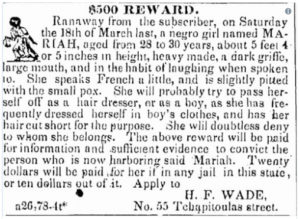
The Freedom on the Move (FOTM) public database project at Cornell University is a major digital database effort to bring together North American fugitive slave advertisements in newspapers from regional, state, and other collections – and online volunteers will be invited to add data tags to the screened entries and to transcribe the ads. This online public engagement by FOTM will allow database users to examine spatial patterns and compare trends over time.

“Ironically, in trying to retrieve their property — the people they claimed as things — enslavers left us mounds of evidence about the humanity of the people they bought and sold,” said Dr. Mary Niall Mitchell, professor of early American history at the University of New Orleans and one of the three lead historians on FOTM.

Mitchell explained. “At what time of year were enslaved people most likely to run? What places did they frequent? What skills did they have? How many could read and write? Or were likely to ‘pass’ for white, or claim to be free? What did they wear? Where were they suspected to be hiding and with whom? Under what circumstances did women run away?”

FOTM received funding from the National Endowment for the Humanities (NEH) digital humanities grants.

Here is an excellent article on about the database, from which I took Dr. Mitchell’s quotes.

Anyway, I gave it a try. I transcribed one ad. I would have liked to have done more, but I kept getting an error message on final submission, so I wasn’t sure if my attempt was even received. I’m wondering if I’m going to receive any sort of update or email from the project, if there is going to be any effort to keep me in the loop about the project and encourage me to transcribe more ads, if there will be any effort to survey me about my experience, or if there will be any solicitations for funding.

I’m also still thinking about that young woman I read about, who had fled someone in South Carolina and was suspected of being harbored by her enslaved mother somewhere… she’s a real person to me now. I hope she was never captured. I hope she got away. I hope she got to reach some dreams. I hope she was happy. Are other volunteers similarly connecting with the information the are transcribing on a human level?

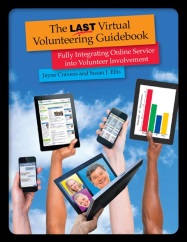
vvbooklittleA shame organizers aren’t calling this a virtual volunteering initiative – because it is! Instead, they use the term “crowdsourcing.” It’s also a micro-volunteering initiative. I hope at least the organizers of this initiative will consider reading The LAST Virtual Volunteering Guidebook. The book, which I co-wrote with Susan Ellis, has lots of detailed suggestions and specifics about virtual volunteering, including task and role development, suggestions on support and supervision of online volunteers, guidelines for evaluating virtual volunteering activities, suggestions for risk management, online safety, ensuring client and volunteer confidentiality and setting boundaries for relationships in virtual volunteering, and much more. The LAST Virtual Volunteering Guidebook is available both as a traditional printed book and as a digital book.

Tearing down women who dare to lead

The next time you see a glowing article about or an interview with a woman who has started her own initiative or nonprofit in the town or neighborhood where she lives, or who is running for office, or who is leading a fight against some polluter or oppressor in her area, no matter what country it’s happening in, consider what this woman is probably dealing with that isn’t talked about in the article: vicious, constant personal attacks and criticisms.

In a blog I wrote a year ago, called Barriers to women’s leadership we don’t talk about, I wrote about women in other countries who pay a hefty price in their attempts to be ambitious at work and exert any kind of leadership, particularly via gossip but also per constant insults and criticisms from other women. And I noted that those barriers happen right here in the USA to women who try to lead in some way, small or large.

Women are continually, regularly discouraged from thinking of themselves as powerful or ambitious or worthy of leading in any efforts, no matter how large or small. When women try to lead – whether on a project or even just regarding a topic during a discussion- the reaction can be discouraging or even ugly. The reactions come from colleagues, from the community, even from those they try to serve. Even from family members.

Women who try to lead are often subjected to insults and attacks designed specifically to prey on personal fears and insecurities. I’ve certainly it experienced myself. Newly-elected congresswoman Alexandria Ocasio-Cortez is experiencing it to a degree that would make most people wither – any Internet search of her name will illustrate it. 

Right here in the small town in Oregon where I live, a few years ago, a young woman decided to create a participatory project that she hoped would build community cohesion, something the population was struggling with. She planned carefully, encouraged and welcomed participation, shared decision-making and made it completely transparent, and personally reached out and guided participants in the project, all while making sure her vision was always at the forefront – it was about that vision, not about her. The project flourished: more and more people participated and her vision was being realized: more and more people became aware of local government meetings and action (and how to participate in such), new resources from the county public health office, road conditions, and even new restaurant openings. Rumors were quickly squashed. Neighbors were helping each other – neighbors who might never have met otherwise. Involvement in her project grew to a number that was more than 25% of the population, and it included me – I was skeptical at first, but quickly bought into her efforts. A newspaper wrote a story about her efforts. At a debate for candidates running for local office, two candidates talked about her project in their remarks and how it was so important to the community and they wanted to better leverage it.

But some people didn’t like her success. A small minority of participants provided constant public and private criticism of how she moderated and facilitated activities and how she reinforced the goals of the project, and rarely was the criticism constructive. People who violated the project’s policies – policies that are in writing and about which regular reminders are sent – were angry when they were gently reprimanded, even if that reprimand happened well behind the scenes, discreetly. They were furious when their actions, in violation of the written policies, lead them to being blocked from further participation. The founder received personal insults via direct message and text, like the one posted next to this paragraph (it’s one of the milder ones, actually). At least one person created a fake account on Facebook and posted outrageous messages, trying to make people think it was the group founder. At least three rival projects were launched by disgruntled former participants  – all failed after just a few weeks or months. But that tiny, vocal, persistent minority and their constant insults and attacks finally did her in: after four years, she resigned her role as project owner and manager, not because she thought the project needed fresh leadership, not because there were people who had demonstrated that they were ready to take over, but because, emotionally, she just couldn’t take the belittling and abusive comments anymore. It will now be up to the remaining volunteers to keep the project going. And maybe the project will continue. But what I’m worried about is that she’s probably going to continue to be targeted for comments by people in any endeavor she undertakes in this small town because she DARED to lead.

For anyone who offers advice for women who want to be leaders that is focused on smoothing out presentation style and being more gentle or diplomatic, I say, quite frankly: bollocks. Being overly concerned by one’s image with everyone or even the most vocal group of critics, however large or small, diminishes that person’s mental and emotional resources needed for leadership. People who are distracted about how everyone else perceives them – or even a vocal minority – are less clear about their goals and less capable of reaching them. And make no mistake: women are targeted by this kind of criticism far, far more than men.

I hate most of the articles I have ever read on women’s leadership. One I did not hate is Women Rising: The Unseen Barriers by Herminia Ibarra, Robin J. Ely and Deborah M. Kolb. A version of the article was published in the September 2013 issue of Harvard Business Review. And I loved this quote from the article in particular:

Integrating leadership into one’s core identity is particularly challenging for women, who must establish credibility in a culture that is deeply conflicted about whether, when, and how they should exercise authority. 

The reality is that effective leaders must have the confidence, and maybe even arrogance, to take initiative and action despite insults and criticisms. They have to know when a criticism is something to be considered, something to be used for improvement, and when it’s meant solely to be spiteful, to undermine and derail efforts and to personally attack someone and undermine their confidence. Effective leaders must be firmly anchored in their purpose. They need to always keep their cause, mission, project, objective, key message, whatever it is, as the first and foremost priority in all they do, and remember that everything they do needs to be true to that cause or message – a cause or message bigger than themselves. Absolutely, leaders need to listen to and consider comments and criticism about their performance – but they also need to know when to ignore insults. They need to know when they are hearing constructive criticism and when something is being said or done solely to tear someone down. And that can be difficult for even the best leaders.

When men are firmly anchored in their purpose, they are admired as confident. When women do this – well, we all know what is said about women who do this. But maybe instead of telling women to alter their behaviors if they want to be leaders, we need to start calling out the double standards in how we describe and respond to women leaders.

Updated April 15, 2021: A comic strip demonstrates the challenges women face online. It’s developed by Kenya ICT Action Network (KICTANet). In a story of three differently aged, differently shaped and differently employed women, we see what violence can look like online, how the seemingly harmless can actually contribute to it, and what we can all do to prevent it and to create a safer space for women online.

Also see:

Governments cracking down on nonprofits & NGOs

Budapest, Hungary is one of my very favorite cities, and not just because I think it has the BEST FOOD IN THE WORLD. Budapest has what I consider the perfect mix of gorgeous history all around and vibrant new ideas from its young people. It feels unique and ancient while also feeling bold and progressive. It’s an energy that both preserves what’s best about a community or country (history, architecture, environment, the arts, etc.) and helps it prosper and move forward, particularly in times of great economic and cultural change.

It is with great sadness that I read about efforts by the Hungarian government to shut down the Aurora community centre.  “Now, the Aurora, which rents office space to a handful of NGOs — including LGBTQ and Roma support groups — says it has been pushed to the brink of closure by far-right attacks, police raids and municipality moves to buy the building… NGOs are routinely attacked through legal measures, criminal investigations and smear campaigns — something the Aurora told CNN it has experienced first-hand.”

“We wanted to create a safe environment for civil organizations,” said Adam Schonberger, director of Marom Budapest, the Jewish youth group that founded the community center in 2014. “By doing this we became a sort of enemy of the state. We didn’t set out to be a political organisation — but this is how we’ve found ourselves.” Schonberger didn’t think authorities had targeted Aurora because of its Jewish roots. Instead, he put the harassment down to the group’s values of “social inclusion, building civil society and fighting for human rights.”

Here’s Aurora on Facebook. And here is the Aurora’s web site.

I am very partial to these kind of non-governmental organizations (NGOs) – what we call nonprofits in the USA – that help cultivate grassroots efforts, encourage the sharing and exploration of ideas, and help incubate emerging movements and other NGOs. I believe these NGOs can play an important role in helping immigrants assimilate in a country as well and help the country benefit from the talents and ideas these immigrants may bring. I’ve had the pleasure of addressing groups like this in Eastern Europe, and in the USA in Lexington, Kentucky, and I’ve walked away feeling renewed and energized. Add in promotion and celebration of the arts, like Appalshop does in Eastern Kentucky, and I’m ready to pack up and move to a remote town in Eastern, Kentucky.

This NGO’s struggles are part of an ongoing shift all over Europe, and indeed, the world, in local and national governments that are rejecting diversity, changing times, dissent and intellectualism, and governing from a place of fear. I could think that I’m isolated from this trend here in the USA, where I’m living these days, but I am not. I remember back in the 1990s, when similar political groups went after arts organizations, even going so far as trying to defund the National Endowment for the Arts (NEA) and the National Endowment for the Humanities (NEH) – I helped arrange for Christopher Reeve, a co-founder the Creative Coalition and then performing at a theater where I was working, to debate Pat Robertson about the NEA on CNN’s Crossfire on July 16, 1990, and the theaters where I worked back in those days all felt pressure regarding their artistic choices because of these movements. Those controversies are still here, as any search on Google and Bing shows.

Nonprofits in the USA need to watch carefully what’s happening in other countries and think about how such could happen here. Remember the Association of Community Organizations for Reform Now (ACORN)? It was a collection of community-based nonprofits and programs all over the USA that advocated for low- and moderate-income families. They worked to address neighborhood safety, voter registration, health care, affordable housing and other social issues for low-income people. At its peak, ACORN had more than 1,200 neighborhood chapters in over 100 cities across the USA. But ACORN was targeted by conservative political activists who secretly recorded and released highly-edited videos of interactions with low-level ACORN personnel in several offices, portraying the staff as encouraging criminal behavior. Despite multiple investigations on the federal, state, and county level that found that the released tapes were selectively edited to portray ACORN as negatively as possible and that nothing in the videos warranted criminal charges, the organization was doomed: politicians pounced and the public relations fallout resulted in almost immediate loss of funding from government agencies and from private donors.

There are growing misconceptions about the role of nonprofits in the USA and this could fuel local, state and national movements against nonprofit organizations – not just arts organizations. Nonprofits of every kind need to make sure they are inviting the public and local and state government officials regularly to see their work and WHY their work matters to the entire community, not just their target client/audience. Most nonprofit organizations need to do a much better job using the Web to show accountability. In short: don’t think it can’t happen here.

Also see:

The Impact of In-Person Usability Demos on Web Designers

“During (Knowbility’s John Slatin) AccessU, I had the opportunity to sit in on a series of assistive technology demos and witness firsthand how people with disabilities use the internet. That experience completely changed the way I looked at building a website… There is nothing like seeing the ‘a-ha’ moment from people’s faces the first time they see someone use assistive technology.”

The power of an in-person demo regarding usability of a web site from the point of view of a person with a disability is explained in this Knowbility blog by Christi Barker.

An example of the reaction of one of Barker’s students to a demo she later arranged:

“For example, as a designer, we care a lot about how things like buttons are put on websites. However, for vision-impaired people, the aesthetic or the structure of the layout does not mean the same thing to them. Sometimes, it only decreases the ability for them to stay connected with the world. That was the first time I perceived the many inconveniences in their life. Their stories are inspiring and have made me start thinking about what can I do to make a difference in their lives.”

Knowbility is a nonprofit organization with a mission is to create a more inclusive digital world for all abilities.

And remember: accessibility is a human rights issue. And if your organization claims to work towards inclusion of any kind, that should include accessibility for people with disabilities to your web site.

Accessibility: a human rights & a digital divide issue too many ignore

Pioneering in “hacks for good”: Knowbility

Knowbility’s AccessU 2019: Call for Papers

Growing misconceptions about the role of nonprofits in the USA

In addition to sitting in on various local government meetings in the small town where I live in Oregon, I’ve been volunteering with a local unit of my state’s League of Women Voters, registering voters and sitting in on numerous candidate debates. My goal in these activities, which I’ve said before, is to compare what I’ve seen and experienced abroad working in international aid and development with what happens locally in my own community in the USA.

In doing these activities, I’ve noticed a disturbing trend that greatly affects nonprofits in terms of how the public, the private sector and government think about them, and how the public, the private sector and government feel about their funding and support for such. There is a growing chorus of elected officials and their supporters who say variations of the following:

There are enough resources in our region, via nonprofits and communities of faith – charity – for anyone who is homeless, who has an addiction or has mental issues to get the help they need. All someone needs to do to get help is to contact those organizations. 

There was a time in the USA when poverty was successfully and completely addressed by charity, usually through churches, not by government. Charity used to help all the people that were poor, and we should go back to that way of addressing poverty. 

People who have addiction issues, mental issues, homelessness issues or any issues associated with poverty just aren’t working hard enough. They lack morals or willpower and they could stop their drug use or their slide into mental illness simply by choosing to, by really trying.

These statements are not true.

The truth:

Programs that serve the homeless, whether they provide temporary housing or more permanent housing, or even just serve food, are utterly overwhelmed all across the USA and do not have enough resources to help everyone that needs it. Their waiting lists for housing assistance are months, even a few years. And providing food and temporary shelter does not prevent homelessness nor reduce the number of people who are homeless.

Before the creation of Social Security, most people in the USA supported themselves into old age by working. The 1930 census found 58 percent of men over 65 still in the workforce; in contrast, by 2002, the figure was 18 percent. Children and other relatives bore the major cost of supporting the aged. The Great Depression swept this world away: many of the elderly could no longer find work and their family could not afford to support them anymore. To get by in that time, the elderly took to panhandling, moving into dingy, unsafe almshouses or poorhouses, many run by charities or churches, or simply dying impoverished, which was the fate that befell 1 in every 2 older Americans in the years after the 1929 stock market crash.

Homelessness and poverty can be triggered by a range of issues in the USA, including divorce, medical bills/bankruptcy, income vs. housing affordability, decline in public/government assistance and mental health issues. Simply getting a different, better-paying job usually isn’t an option for someone facing homelessness and poverty.

Addiction is a chronic disease that creates a compulsion or even a physical need to use drugs. Drugs, including alcohol, affect the brain’s “reward circuit,” causing euphoria as well as flooding the brain with the chemical messenger dopamine. A properly functioning reward system doesn’t result in addiction. Whether a person is born with a disfunctional reward system or if the disfunction results entirely from drug use continues to be debated and researched; most agree that a combination of genetic, environmental and developmental factors influences risk for addiction, and the more risk factors a person has, the greater the chance that taking drugs can lead to addiction. The initial decision to take drugs is voluntary for most people and often relates to a medical issue rather than recreation, but repeated use of drugs, including alcohol, can lead to brain changes that interfere with an addicted person’s ability to resist intense urges to continue to use. As with most other chronic diseases, such as diabetes, asthma, or heart disease, treatment for drug addiction generally isn’t a cure. Addiction is treatable,  however, like other chronic diseases, such as diabetes, asthma, or heart disease, treatment for drug addiction requires professional intervention and guidance – a person can’t address the issues entirely on their own.

So, that’s the truth. But how did the misinformation happen, and how does this misinformation affect nonprofits now?

The misinformation happened not only because of the political agendas of the people saying such; it also has happened because nonprofits have done a poor job of explicitly, frequently talking about the issues they are addressing and educating the public about those issues.

If anyone believes any of these myths, then any sense of urgency regarding homelessness, addiction or poverty vanishes for potential donors, whether individuals or corporate giving programs or foundations. In addition to these myths creating the idea that nonprofits, communities of faith and “charity” can address all the needs of anyone at risk for harm in a community, these myths also create the idea that poverty happens primarily because of bad personal choices: if you’re homeless, then you just have been lazy and not bothered to contact a nonprofit that could help you. If you are addicted to opioids, it’s because you lack willpower.

I’ve been looking at the web sites of various nonprofit organizations serving my communities and various others, and, for the most part, all I see are pleas for support, for donations. What I don’t see:

  • a list, with citations, as to what causes a man, a woman or an entire family to be homeless, with profiles of clients (actual names can be changed and photos can be taken in such as way as to hide the identity of clients)
  • what activities precede a person becoming addicted to a substance, particularly opioids, with profiles of clients (again, actual names can be changed and photos can be taken in such as way as to hide the identity of clients)
  • a list of exactly what donations to a nonprofit pay for (emphasizing why paid staff is needed, rather than relying solely on volunteers helping whenever they might have some time)
  • information on the number of people the organization turns away, or puts on waiting lists, because it does not have the resources to help them, information on what activities or services the community needs but that the organization cannot provide because of a lack of resources, etc.

Nonprofits have got to be much more deliberate and direct in all of their communications about the issues they are addressing, why those issues exist, and what resources they lack. If tax cuts and tax breaks for corporations have resulted in less money for these critical services, nonprofits must say so. 

Our futures depend on it.

Sources:

Homelessness in Portland, Sept. 26, 2018, Travel Oregon

Roads before homes: Our Homeless Crisis, March 18, 2015, The Oregonian

U.S. Department of Housing and Urban Development. The 2016 Annual Homeless Assessment Report (AHAR) to Congress, November 2016

National Alliance to End Homelessness. Homelessness: A State of Emergency.Feb. 6, 2016

“A Great Calamity Has Come Upon Us”, Jan. 23, 2005, The New York Times

16 Ways People Survived Before Social Security — Could You Do It?, April 12, 2018, GoBankingRates

What causes homelessness, downloaded Nov. 2, 2018

Why Are People Homeless?, July 2009, National Coalition for the Homeless

Understanding Drug Use and Addiction, June 2018, National Institute on Drug Abuse, National Institutes of Health, U.S. Department of Health and Human Services (and see more sources at the end of this NIH article)

Also see:

Updated: How Misinformation Can Derail Aid & Relief Efforts

There are lots of obstacles that can stand in the way of human, community and institutional development, aid and relief efforts, or government health initiatives, or even elections. But there is one obstacle that, until recently, rarely got discussed: widespread misunderstanding and myth-spreading.

Folklore, rumors (or rumours) and urban myths / urban legends, as well as organized misinformation campaigns and “fake news”, often interfere with relief and development activities, and government initiatives, including public health initiatives — even bringing such to a grinding halt. They also create ongoing misunderstandings among communities and cultures, prevent people from seeking help, encourage people to engage in unhealthy and even dangerous practices, cultivate mistrust of people and institutions, have even lead to mobs of people attacking someone or others for no reason other than something they heard from a friend of a friend of a friend, motivated legislators to introduce laws to address something that doesn’t exist, and influenced elections. And with the advent of social media like Twitter and Facebook, as well as just text messaging among cell phones, spreading misinformation is easier than ever.

Since 2004, I have been gathering and sharing both examples of this phenomenon, and compiling recommendations on preventing folklore, rumors and urban myths from interfering with development and aid/relief efforts and government initiatives. I do this research and entirely on my own, as a volunteer, with no funding from anyone. I update the information as my free time allows – and time has allowed such.

Once upon a time, I had wanted it to be the topic of my Master’s Degree thesis, but back in 2004, I couldn’t get an agency to go on record to tell their story. The few representatives of organizations that I talked to didn’t want to give any attention to the misinformation campaigns that were targeting them. With the advent of social media and the proliferation of misinformation, government agencies and nonprofits are scrambling to address rumors before they get out of hand – and before people are killed as a result. For instance, in 2017, in India, in the southern state of Telangana, videos were circulated among villagers that had been staged or edited in a particular way and claimed to show children being abducted by a criminal gang were circulated in more than 400 villages in the southern Indian state of Telangana via WhatsApp and an Indian messaging service called ShareChat. These videos claimed that the children were being abducted in order to harvest their organs. The claims in these videos were completely false. But because so many people believed what they saw in these videos, people stopped going out of night, several completely innocent people were attacked by mobs who accused them of being organ thieves, and at least 25 people were murdered – lynched – falsely accused of being a part of the gang. Here’s more about the consequences of such misinformation campaigns and how the situation in India was addressed.

Also see:

Scammers target those that care about soldiers, world affairs

Aid workers need to help local staff avoid scams 

You have an obligation to be truthful online

My voluntourism-related & ethics-related blogs (and how I define scam)

Knowbility’s AccessU 2019: Call for Papers

Knowbility’s John Slatin AccessU 2019: Call for Papers

Proposal submission deadline: Friday, January 24, 2019 at 11:59pm CST

Passionate about accessibility and inclusion?

Think you have a thing or two to share about accessibility?

Accidentally used the phrase “cool as an #a11y cat” in a sentence once?

Knowbility wants to hear from you!

Please complete this online form if:

– You are available to be in Austin, Texas, USA May 15-17, 2019 for AccessU
– You are a skilled practitioner in the field of web and app accessibility
– You are a great teacher
– You want to share practical skills that make the web and other online tools better for everyone
– You find it incredibly difficult to say no to fun

AccessU is the time of year where some of the most amazing instructors in this field get to roll up their sleeves, let their hair loose (here’s lookin’ at you, Denis Boudreau), and dive in as they share their expertise in a hands-on, practical training environment. In addition to valuable networking opportunities and free breakfasts/lunches each day, AccessU instructors receive a complimentary conference badge for Knowbility’s 2.5 day conference from Wednesday, May 15 to Friday, May 17, 2019.

Proposal notifications will be sent by email for each submission no later than February 10, 2019 at 11:59pm CST.

Just want to attend AccessU and soak up the knowledge? Get 2019 tickets at 2018 prices. Sale ends on December 31, 2018, or once the limited seats are gone (only 50 of each ticket type!). Ticket information and pricing at the AccessU web site.

If you have any questions, please email accessu@knowbility.org or call (512) 527-3138.

Also see:

Pioneering in “hacks for good”: Knowbility

Lessons for online outreach to nonprofits, NGOs & charities