Author Archives: jcravens

About jcravens

Jayne Cravens is an internationally-recognized trainer, researcher and consultant. Her work is focused on communications, volunteer involvement, community engagement, and management for nonprofits, NGOs, and government initiatives. She is a pioneer regarding the research, promotion and practice of virtual volunteering, including virtual teams, microvolunteering and crowdsourcing, and she is a veteran manager of various local and international initiatives. Jayne became active online in 1993, and she created one of the first web sites focused on helping to build the capacity of nonprofits to use the Internet. She has been interviewed for and quoted in articles in The New York Times, The Wall Street Journal and the Associated Press, as well as for reports by CNN, Deutsche Well, the BBC, and various local radio stations, TV stations and blogs. Resources from her web site, coyotecommunications.com, are frequently cited in reports and articles by a variety of organizations, online and in-print. Women's empowerment and women's full access to employment and education options remains a cross-cutting theme in all of her work. Jayne received her BA in Journalism from Western Kentucky University and her Master's degree in Development Management from Open University in the U.K. A native of Kentucky, she has worked for the United Nations, lived in Germany and Afghanistan, and visited more than 30 countries, many of them by motorcycle. She is currently based near Portland, Oregon in the USA.

Systemic Exclusion in Volunteer Engagement

graphic by Jayne Cravens representing volunteers

You would have to be living under a rock to have not heard the term systemic racism or institutional racism. It refers to how ideas of white superiority are embedded at a systemic or institutional level all over the USA (and, indeed, all over the world): the standards of beauty promoted in ads and magazines and movies almost always being a white woman. Black Americans incarcerated at greater rates than white Americans, despite there NOT being a difference in the level of crime committed. The combination of deep mistrust of banks and targeting black Americans by for-profit paycheck advance companies and rent-to-own companies that keep a disproportionate number of black Americans crushed under debt. A Harvard study found job candidates were more likely to get an interview when they “whitened” their name. It’s the tendency of people in stores – of a variety of ethnicities – to follow someone who is black or Hispanic around the shop, but not a white woman. It’s a white woman calling the police on a black man in a public park who is bird watching.

I was so impressed with the Audubon Society immediately commenting on that last infamous incident with a series of tweets that began with this one on May 26:

“Black Americans often face terrible daily dangers in outdoor spaces, where they are subjected to unwarranted suspicion, confrontation, and violence. The outdoors – and the joy of birds – should be safe and welcoming for all people.”

In cooperation with other groups, like Outdoor Afro, they also promoted #BlackBirdersWeek and #BlackInNature on Twitter, featuring wonderful photos of black people and black families enjoying nature and talking about their love of bird watching.

I am sure there are people who said, “The Audubon Society is about birds, not politics, and I don’t like this.” I am so glad the Audubon Society ignored them. If the society lost donors over it, I’m so sorry – I hope they gained far more.

I hope every nonprofit, no matter their focus, no matter the mission, will make a similar public statement, if they haven’t already, about racism and exclusion. This is a cross-cutting issue. Animal shelters, environmental groups, nonprofit theaters, dance companies, museums, historical societies, and on and on – they all need to make a statement, right now, about what is happening and how it relates to their work and their communities.

Which brings me to you. And to me. People focused on recruiting and supporting volunteers, creating assignments for volunteers, consulting about aspects of volunteer engagement, and on and on. What are we doing about systemic racism in nonprofits, particularly volunteer engagement, particularly among managers of volunteers? I am sure that the vast majority of managers of volunteers absolutely abhor deliberate acts of racism and that they want to be more inclusive. And since they don’t engage in deliberate acts of racism, they often shut down at the term “systemic racism.” So, if they can’t say that volunteer engagement at most nonprofits is embedded with systemic racism, can we AT LEAST admit to systemic exclusion?

Take an organization that has decided to exclude anyone as a volunteer who has ever been convicted of a crime, no matter what the crime is, no matter how long ago that crime occurred. That policy automatically excludes a disproportionate number of black Americans as volunteers, because African Americans are incarcerated at more than 5 times the rate of whites. In public schools in particular, the “no convictions” prohibition has the consequence of excluding black people, particularly black men, as volunteers – and schools that have a low number of parental vounteers have students that, overall, don’t do nearly as well academically as in schools where the number is high. Is the policy REALLY about safety, or is it laziness? Let’s just exclude everyone with a conviction rather than to have to think about it too much.

When I read an article about service clubs – nonprofit organizations where members meet regularly to volunteer for charitable works either by direct hands-on efforts or by raising money for other organizations – the list is almost always the same: Lions, Rotary International, Civitan International, Kiwanis, Optimist International, the Junior League, etc. What gets left out? Service clubs specifically representing black residents, Latino residents or Asian residents. Yes, all of the usual clubs are supposed to be open to everyone, and there are some chapters that are wonderfully diverse – but most chapters aren’t diverse, and to focus just on them leaves oh-so-many out – and leaves specific communities out. When I read about an organization’s volunteer recruitment outreach to “communities of faith”, I see a listing of churches with, primarily, white congregations – and all Christian.

When I lived in Austin, Texas, I was charged with increasing the number of people attending a local associations meeting. I emailed groups this association had never contacted before, and at our next meeting, for the first time, attendees represented a variety of ethnicities, neighborhoods, ages and economic backgrounds – but the presentation, on recognizing volunteer contributions, was so white-centric, so middle-class centric, and so women-centric, most of those new attendees never returned.

Those are three examples of systemic racism in volunteer engagement. I don’t think most of the people involved in those three examples are racists, by definition, and had any intention to exclude people of a particular race. But that’s what has happened, and we are perpetuating the practices that perpetuate it.

And then there are organizations that proudly tout their work in digital inclusion, addressing digital redlining, digital literacy, economic factors that keep communities in poverty and out of digital access, many of whom are focused specifically on black communities, but then balk at the idea that their online spaces should be accessible for people with disabilities. That’s systemic exclusion, and it’s something people with disabilities experience regularly from groups that are oh-so-proud of their diversity.

Can systemic racism show up in virtual volunteering engagement? Absolutely. As soon as online volunteer roles cross into the realm of warranting the knowing full names, hearing voices, seeing the faces of volunteers, implicit bias can creep into how those volunteers are (or are not) engaged.

I have tried to have conversations about diversity over the years at organizations where I’ve worked, in my workshops and in various consultancies. It is, by far, the most contentious topic I try to address as a consultant, and not just regarding race: I still get a shiver down my spine when I think of the angry, hostile people that made up the majority of an audience at a Corporation for National Service conference where I talked about recruiting the “new” seniors – Baby Boomers – in SeniorCorps programs. I get a bit of that hostility, though not nearly as overt, when I talk to groups about how to recruit specifically to increase diversity among volunteers. It’s not easy and I know I’ve lost some consulting gigs because I have asked some tough questions, but I’m going to keep doing so, of others – and myself.

I’m on an ongoing journey to look for ways I exclude without intending to, in my consulting, in my volunteer engagement, in my communications strategies, in my language, and on and on. I would like for you to do so as well.

What’s the difference in for-profits & nonprofits?

Misconceptions abound about the differences in a for-profit business/corporation and a not-for-profit business. I’m hearing misconceptions in particular from the for-profit world, the corporate world, regarding what nonprofits and are and how they are different from the corporate world.

This is how I explain the difference, and how I try to address the misconceptions people have about these two different sectors:

A for-profit business or corporation exists to make more money than its expenses (a profit). It can have a mission – to provide a certain kind of product or service – and it can throw words in that mission like “quality” and “care”, but its success is ultimately judged regarding whether or not it’s profitable: whether or not it generates enough money to cover all expenses, to pay all employees a salary (usually enough to make people not want to seek employment elsewhere), to pay the senior management a hearty bonus beyond their regular, competitive salary and to pay all investors a profit on their investment. That for-profit business could have frequent staff turnover and low morale and not have very good products or services, but if it’s paying all of its bills and generating a good profit margin, it’s considered a successful business. A for-profit business may have a board of directors, a board that gets paid with profits from the company, or it may be owned by one person, who decides to share the profit with employees beyond their salaries (profit-sharing) or may pocket those profits entirely.

A not-for-profit business, also known as a nonprofit, exists to fulfill a mission, and this mission statement drives the development of all programs. It often does this through activities and services that are not provided by the for-profit sector. A nonprofit’s ultimate success is judged on whether or not it engages in activities that fulfill that mission. Some nonprofits are staffed entirely by volunteers (unpaid staff). Some nonprofits are staffed entirely by paid employees. Some nonprofits are staffed by a combination of both. Most nonprofits are pressured by funders not to pay their employees the same rate as their for-profit counterparts – the funders believe that nonprofit staff should be paid far less than for-profit staff, for a whole variety of reasons that I’m not going to get into here. Nonprofits are funded by a combination of donations from individuals, grants from foundations and corporations, and, just like for-profit organizations, contracts or fees for services from corporations, government or individuals. The healthiest nonprofits, financially-speaking, have a combination of these revenue streams – in other words, a healthy nonprofit doesn’t rely on just one source of income. Many nonprofits charge for some of or all of their services, but they have a focus on keeping fees affordable, so that their programs aren’t financially out-of-reach by most people. Since a nonprofit cannot exist without money to pay staff, to pay for its space and to cover all of the expenses incurred in the process of providing its services, then it is possible for a very successful nonprofit, one that is meeting its mission to do whatever it exists to do – shelter abandoned or surrendered animals and offer them for adoption, provide dance classes for inner-city children, tutor young people to improve their grades, provide outdoor activities for people with intellectual disabilities, whatever – and has a big demand for its services or programs to cease operations because it doesn’t attract enough funding to cover expenses. A nonprofit has a board of directors which legally owns and the business and is fiscally-responsible for the business – and is entirely volunteer (unpaid). If the nonprofit generates a profit – and this DOES happen – the nonprofit cannot pocket that money.

I prefer to call the latter a mission-based organization, or a cause-based organization since, in fact, not-for-profits CAN and DO sometimes generate a profit.

So, in sum, the difference in a nonprofit and a for-profit is the first one exists to fulfill a mission, primarily, that will improve or preserve our quality of life or environment, regardless of the profitability of such. Its success is measured on meeting that mission. The second one exists to make money – that is its primary purpose, and it might choose to do that ethically and with a secondary measure, but if a for-profit doesn’t make money, it is a failure, period.

A nonprofit isn’t automatically better or nobler than a for-profit. A nonprofit doesn’t necessarily operate with more passion or integrity than a for-profit. A nonprofit does not necessarily have happier, more dedicated employees.

A for-profit isn’t automatically better than a nonprofit. A for-profit isn’t automatically more efficient or more professional than a nonprofit. A for-profit might be far more ethical than a nonprofit, and have staff that are far more committed to doing quality work than a nonprofit.

Staff at nonprofits can have as much training, education and experience – and even more – than staff at a for-profit. Staff at for-profits aren’t always more “expert” in a particular subject, like marketing or project management, than staff at nonprofits. 

There are for-profit homes for people with disabilities and nonprofit homes for people with disabilities. There are for-profit hospices and nonprofit hospices. You cannot tell the difference in them by just standing in the lobby or living room, or observing staff, or looking at the credentials of staff: you can tell only if you look at where the home gets its money and if it has a board of directors that gets paid.

What does the difference in a nonprofit and a for-profit really look like? Consider a for-profit movie theater and a not-for-profit movie theater. Picture them as being across the street from each other. 

The for-profit theater shows first-run movies and movies expected to be blockbusters because those movies make the most money – the most profit. It doesn’t matter for the theater’s success if the movies have any cultural relevance, if they attract a diverse audience, or if they are considered “good” by critics – what matters is they attract a lot of paying customers, who buy lots of snacks for the movie, enough for the theater to be profitable. 

The nonprofit theater has a mission to show movies that celebrate human diversity and differences, that address humanity’s most serious concerns, and that represent the range of creativity possible on the screen. It has goals to both entertain, to build the awareness in its audiences about the diverse ways film can be used to communicate a variety of messages and celebrate, and to use movies to bring people together for a shared experience, to create more community understanding and cohesion. As long as there are enough people attending for the theater to say that they are meeting their goals – and has some audience surveys or feedback to demonstrate this – it is considered a success.

The aforementioned nonprofit theater would sell tickets to its movies, perhaps at the same price as the for-profit theater, but it probably has just one or two screens and it probably doesn’t attract the full houses that the for-profit theater does, therefore, ticket sales and concession sales are never going to cover the costs of its operations. The nonprofit theater may even have a “pay what you can” night, ensuring that no one is prevented from experiencing a film because they cannot pay.

The owner of that theater may be a more knowledgeable, more passionate movie fan than the nonprofit theater owner across the street. The for-profit theater owner may be more generous and nicer than the theater owner across the street and may provide better customer service than the nonprofit theater – for-profit staff doesn’t have any relation to the quality of the character of the staff or even the leader.

Both of these theaters add value to their communities. Some people may choose to move to the community because of access to one or both of these theaters. They may share some of the same moviegoers. They may even sometimes want to show the same movies: a low-budget, highly-acclaimed independent film may become a massive commercial success, and those two theaters may compete to see who gets the rights to show the film. 

For the most part, nonprofits fill a niche that for-profit companies don’t and provide services or activities that at least a small group of people feel are important, even vital, but that aren’t fully commercially viable. A community may urgently need more services for adults with intellectual disabilities, but there just isn’t enough promise of income for a for-profit to want to offer the services – so a group of concerned citizens forms a nonprofit to provide those services. A group of people may want the community to be able to regularly experience live theater, so it forms a nonprofit to provide that. 

There are both for-profit and nonprofit hospitals. And hospices. And music festivals. And sports leagues. I live three doors down from a for-profit group home for adults with intellectual disabilities. Often, it can be difficult for an outsider to see the difference between a for-profit and a nonprofit: they may look the same in terms of the services they provide and the way their staff members approach their work, and they may provide equal quality of care and services. 

A way you might be able to tell the difference in a for-profit and a non-profit is in how they use social media and how they measure success in their use of such. A for-profit is going to use its social media almost exclusively and ultimately to try to sell its products and services. Its success in using social media is measured by how many followers it has and how much it can tie sales and income to its social media activity. By contrast, a nonprofit is going to use social media for a range of goals, some having to do with income-generation (attendance at events, sales of something, donations) but others having to do with its goals, which might be to build community cohesion, to create greater awareness about a particular issue, to encourage people to volunteer, to vote, to recycle, and on and on. Its success in using social media is measured in how many exchanges it has with others on that social media platform, comments it receives on retweets, and WHO retweets – if the US Congressional representative for that nonprofit’s region retweets a message, that’s social media success. 

That’s how I explain the difference between a for-profit and a not-for-profit. I offer all of the above both for all the people who don’t seem to know, and also for all the people trying to distinguish nonprofits from for-profits by culture, efficiency or expertise. It’s a baseless comparison.

If you have benefited from this blog or other parts of my web site and would like to support the time that went into researching information, developing material, preparing articles, updating pages, etc. (I receive no funding for this work), here is how you can help

What we will need for live theater to continue

I’d like to see a nationwide flourishing of the regional theater movement, with local theaters considering how best to earn the title of an essential service in their particular community, while being supported and valued by that community and the government. A WPA Federal Theatre Project for a new century, perhaps. — Statement by Michael Cerveris, Tony-winning actor of Fun Home., in this L A Times Article article.

Some of the most exciting, fulfilling times of my life were working far off stage, working to promote live theatre, live performance, not just marketing a show but promoting the value of all arts to our communities, to social cohesion, to education, to mental health and on and on.

Artists, being artists, are talking about what artistic ventures they want to pursue when performance spaces open again, once the risk of COVID-19 has been drastically reduced, and that’s GREAT… but I’ve been looking for something that makes me say, Okay, there it is, this is what we need to ensure theater emerges from this pandemic with a real, solid future.

I finally read the statement that makes me give something to support and advocate for. Cerveris words stopped me in my tracks. To me, they are what every theater in the USA, and every person that loves theater, needs to work towards. And it has to be more than government support; we have to build relationships with and pressure on the cash-flush corporations all around us to give substantial monetary support to ensure live theater continues.

More about the USA Work Progress Administration Federal Theatre Project.

Also see highlights and resources from the research for my final paper for my Master’s Degree, regarding the non-artistic elements necessary for success in “Theater as a Tool for Development” initiatives.

How will SARS-CoV-2 & COVID-19 affect volunteering abroad?

SARS-CoV-2, the infectious disease which causes Coronavirus disease 2019 (COVID-19), will change volunteering abroad – and all international humanitarian response.

This change won’t be just for the next two years – it could be forever. I have been thinking a lot about that lately, and was going to write about it – but this editorial analysis by Ali Al Mokdad at DevEx says everything I’ve been thinking – and more.

Mokdad notes that the ongoing pandemic means that many international non-governmental organizations “will finally pay extra attention to the importance of nationalizing and localizing interventions, and that “community-based interventions and empowering local staff will be among the main themes of the new cultural and operational shift that the pandemic is causing.” It notes that “we are going to see more local staff as program managers, site managers, coordinators, and senior members in leadership positions within INGOs” and that, as INGOs reduce their rate of direct implementation – putting international staff into the field – their staff profiles could shift from that of operational expertise to fundraising, technical support, analysis, advocacy, and strategic leadership positions.

This shift is also going to greatly affect volunteering abroad programs. Mokdad notes the criticisms of voluntourism (as have I) and adds:

The economic situation and safety considerations after COVID-19 will not provide a chance for people interested in unpaid internships to go abroad to support country mission programs. INGOs will not be able to afford the risk of offering such opportunities, and people will not be able to afford working without pay. Unpaid internships and voluntary work will only increase at the local and national level, but voluntourism will slowly disappear.

I will add one more thing: I see a big demand coming for high-responsibility, high-impact remote volunteering – virtual volunteering in support of locally-based NGOs in the developing world. I see it as both a substitution for many short-term volunteering abroad programs for the next two years, and a permanent option even beyond that. And I may be getting funding to explore the idea. Stay tuned.

What do you think?

Here’s all of my many blogs about voluntourism.

And here is something I am soft launching: Ideas for High Impact Virtual Volunteering Activities: This resource is for people seeking ideas for an online project that will mobilize online volunteers in activities that lead to a sustainable, lasting benefit to a community or cause, particularly for a community or audience that is at-risk or under-served. I created it especially for programs looking for ways to engage online volunteers in high-responsibility, high-impact tasks focused on communities in the developing world, because onsite volunteering abroad is not an option – which is the reality in 2020, and probably 2021, because of Coronavirus disease 2019 (COVID-19), an infectious disease caused by severe acute respiratory syndrome coronavirus 2 (SARS-CoV-2). These ideas absolutely can be adapted for remote volunteering within the same country where the online volunteers live as well – “remote” could mean across town rather than around the world.

If you have benefited from this blog or other parts of my web site and would like to support the time that went into researching information, developing material, preparing articles, updating pages, etc. (I receive no funding for this work), here is how you can help

New UN Initiative seeks “Information Volunteers”

Verified is a United Nations initiative to encourage people to check the validity of news, advice and information before sharing it. Verified is looking for “Information Volunteers” to sign up to receive a daily Verified briefing and then to share the fact-based advice and information with their networks.

You’re engaging right now in the biggest project of social collaboration the world has seen. Bigger than the moon landing, than the Olympics, than the building of the tallest skyscraper or longest bridge. Billions of people are working together – the doctor on the other side of the country. The parent homeschooling their child. The scientist working on the vaccine. The nurse working around the clock. You, reading this. Working towards one common goal: to look after each other.

In this crisis, sharing trusted and verified information will help keep everyone safe, while misinformation can put lives in danger. If you want to make sure the content you’re sharing helps the world, sign up to receive Verified content, and always look out for the Verified tick.

We’re doing this for each other – for everyone on the biggest team the world has ever seen.

The initiative is available in a variety of languages:

This is in addition to the UN’s main virtual volunteering initiative, the UN’s Online Volunteering Service.

Yup, I’ve signed up!

Also see:

You have an obligation to be truthful online

Points of Light Conference, June 10-12, is free & online (& I’ll present re: virtual volunteering)

Points of Light Conference Logo

The Points of Light Conference (formerly the Points of Light Foundation Conference) is a large annual conference celebrating and promoting volunteerism in the USA. Representatives from nonprofits, government programs, business, civic leaders, activists and volunteers themselves gather annually to celebrate, collaborate and share knowledge and resources related to volunteering and volunteers.

Traditionally held as an in-person event, the 2020 Points of Light Conference, June 10-12, will be an online experience this year, with a particular focus on sharing information related to volunteering during the COVID-19 pandemic.

It is FREE to attend, but you must register to access the recorded workshops, Q & A sessions, and discussion boards associated with each workshop – including mine, on June 12, regarding virtual volunteering. After June 12, my virtual volunteering workshop, about 36 minutes long, will be available on my YouTube channel.

The conference web site is: pointsoflightconference.org

Out-of-work professionals pushing back against volunteer engagement

graphic by Jayne Cravens representing volunteers

It happens regularly: people who are seeking paid work, or who have been laid off from jobs, pushing back against volunteer engagement by previous and potential employers.

I am passionate about volunteer engagement as fundamental to both nonprofit and government programs, as fundamental to giving communities an opportunity to see firsthand what’s happening at these organizations and contributing to a civil society as well, but I am also passionate about volunteers NOT being used just to “save money”, and never to replace paid staff that do not have many alternatives for paid work. It’s why I believe any program should have to say WHY they involve volunteers and say, in writing, how every volunteer engagement will lead to something transformative. It’s why I have joined online protesters and said UN Agencies must defend their unpaid “internships”. It’s why I tell every person who asks me for a webinar or to consult on a project, “here are my consulting rates.” I have very strict guidelines for when I will offer my professional services for free – and even then, sometimes, I enter gray areas where I have to really think about the ethics about what I’m doing.

Once again, there is conflict between people who need paid work and the involvement of volunteers (unpaid labor). This time: many freelancers in the United Kingdom believe furloughed workers who are receiving 80% of their salary and are volunteering their time and professional expertise online (virtual volunteering) with charities via sites like Furlonteer.com are taking away much-needed paid work. This BBC article offers more details about this conflict.

My thoughts: I hope that freelancers will direct their very justified anger at FUNDERS – corporations, foundations, government agencies and individuals – who have whined that nonprofits need to “keep overhead low,” who have often refused outright to pay for anything they consider to be overhead, and who don’t believe nonprofits should ever spend money on expertise – not competitive salaries for employees and not decent salaries for consultants. Nonprofits, charities, NGOs, and other mission-based programs are frequently put into the impossible position by funders of delivering critical services without spending what’s needed for that to happen. Further contributing to the pressure to “get people to do it for free!” are programs like the Points of Light Foundation, the Independent Sector and even the United Nations who loudly, proudly promote the value of volunteering by an hourly rate – the amount of money saved because employees or consultants don’t do those tasks and volunteers are unpaid.

On the Furlonteer.com web site are these words: CHARITIES ARE DESPERATE FOR YOUR HELP. Well, WHY is that? Who created the conditions that have made charities desperate for this help? FUNDERS. I am looking at corporations and foundations in particular.

Also see:

Get to know your volunteers now on a new level

Most of the articles I’ve read on “tips for working with remote staff during COVID-19 lockdowns” have been way more basic than I need, say what should be obvious (at least to me – like the importance of starting meetings on-time and make sure you use your mute button when you aren’t talking) and really don’t offer much insight into this particular way of working. In short, when I read most of these articles, I say “Meh” and move on.

However, Charity Village in Canada shared 8 Tips for Nonprofit Leaders to Better Support Virtual Teams by Maryann Kerr and it’s outstanding. There are really great suggestions here that every nonprofit and government program needs to read and apply to their interactions with remote staff – I hope more than a few folks are brave enough to send the article to managers, including executive directors, who just aren’t getting what working from home during a pandemic is REALLY like and what their expectations of their staff REALLY should be.

In addition, many of these suggestions are applicable to virtual volunteering. Here are my favorite recommendations from the article that I think you need to be thinking about with your volunteers now as they do more service and interactions online:

Be patient and considerate of the specific challenges of your team. This is both a collective and unique experience for each of us. Some will be home alone and lonely.  Others may be desperate for a moment of peace. Still others may be caring for elderly family members or a combination of all three.

Speak up and don’t skip the hard stuff. This moment in history asks each of us to dig deep and develop our own innate ability to lead. You do not need to hold a position of leadership to act.  Speaking up, on your own behalf, and on behalf of others, is an act of leadership. If you have a concern or question, it is likely shared by others.

Get to know each other on a whole new level. Whether you use Patrick Lencioni’s Personal Histories Exercise or the Clifton Strengths Finder or any number of other team building activities available online and adaptable to a video conference – just do it. Lencioni’s is a favorite because I’ve never seen it fail to improve a team’s understanding of each other. Do team members have hidden talents they’d like to share?  A song, a poem, a musical instrument? A piece of artwork or craft they’d like to show?  You are suddenly in each other’s homes. Use this as an opportunity to see each other as whole human beings not just workers. 

Explore your values as individuals, teams and as an organization. Start with a free Personal Values Assessment  and then facilitate a discussion about what is important to you as individuals and how this is reflected in how you will work together.  Examine how these compare to your stated values as an organization.  How can you ensure you live these values, particularly now?

Again, I want to emphasize those four suggestions are from Maryann Kerr, not me – she gets all the credit!

But I will add that, in a past blog, I myself wrote this in a blog:

Successfully working with people remotely is a very human endeavor that people who are amiable, understanding and thoughtful tend to excel in.

And, indeed, that’s proven to be true yet again as millions of people experience remote work amid chaotic or lonely homes.

Also see these blogs and web pages from me:

Building a team culture among remote workers: yoga, cocktails & games

Team building activities for remote workers

Re-creating offline excitement & a human touch online

Virtual volunteering: it’s oh-so-personal

The dynamics of online culture & community

Leading in a virtual world

And this video about how personal working with online volunteers has been for me.

vvbooklittle

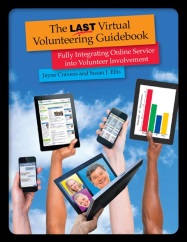
And, of course, for more advice on working with remote volunteers, or using the Internet to support and involve volunteers, check out The Last Virtual Volunteering Guidebook. Tools come and go – but certain community engagement principles never change. you will not find a more detailed guide anywhere for working with online volunteers and using the Internet to support and involve all volunteers – even after home quarantines are over and volunteers start coming back onsite to your workspace. It’s available both as a traditional paperback and as an online book. It’s co-written by myself and Susan Ellis.

If you have benefited from this blog or other parts of my web site and would like to support the time that went into researching information, developing material, preparing articles, updating pages, etc. (I receive no funding for this work), here is how you can help

Bill before US Congress: Pandemic Response & Opportunity Through National Service

A bill in the USA Congress, the Pandemic Response & Opportunity Through National Service Act, would expand AmeriCorps and SeniorCorps to aid in COVID-19 recovery efforts, including growing AmeriCorps to 750,000 positions over a three-year period; boost the AmeriCorps living stipend so that individuals regardless of financial situation can participate; increase the education award to cover up to two years of public university tuition; ramp up Senior Corps teleworking technology, and more. These programs are a part of the Corporation for National and Community Service.

More about the bill, from a group advocating support for such at this link: Support the Pandemic Response and Opportunity Through National Service Act.

Full disclosure: I have signed. I absolutely support this bill.

Also see:

If you have benefited from this blog or other parts of my web site and would like to support the time that went into researching information, developing material, preparing articles, updating pages, etc. (I receive no funding for this work), here is how you can help

Recruiting Volunteers To Serve in Difficult, Dangerous or Controversial Roles

There are people who want to volunteer in difficult or dangerous roles – it’s what they specifically seek out. Over on the Reddit group regarding voluntourism, as I write this blog, there are lots of messages from people, mostly young people, seeking to help on the “front lines” regarding people affected by COVID-19, either because they are ill or because they are isolated and needing help in lockdowns. Many online recruitment sites, like VolunteerMatch, have curated volunteering opportunities posted on their site that related to COVID-19 in some way, due to overwhelming demand from potential volunteers.

Some volunteering is perceived as difficult by potential volunteers and the general public, because of the clients that volunteers will work with or the kind of activities volunteers must undertake. Examples: serving as a Big Brother/Big Sister, mentoring a foster child, assisting adults with developmental disabilities, volunteering in a shelter for women experiencing domestic violence, or staffing a suicide hotline.

Some volunteering is perceived as difficult AND dangerous, such as fire fighting, search and rescue, volunteering with incarcerated people in a jail or prison or volunteering with people who are formerly-incarcerated.

Some volunteering is perceived as controversial, such as providing water stations in the desert for people entering a country illegally and can die from dehydration, or defending a women’s health clinic patients from protesters, or various protest and activism roles.

Difficult, dangerous and/or controversial roles actually appeal to many people who want to volunteer: they feel strongly about the cause, or they want to do something substantial and challenging. But other roles may seem too intimidating to new recruits, like mentoring a young person going through the foster care system, working with young people in the juvenile justice system, working with people with intellectual disabilities, or working with seniors.

How do you recruit for roles that might seem difficult, dangerous, even controversial? How do you recruit for a subject area or role that might provoke an initial reaction of fear among potential volunteers?

This web page, on my site, offers detailed advice.

Also see:

If you have benefited from this blog or other parts of my web site and would like to support the time that went into researching information, developing material, preparing articles, updating pages, etc. (I receive no funding for this work), here is how you can help