Al Gore Campaign Pioneered Virtual Volunteering

algoreweblaunch
Back in 2000, when Al Gore ran for President of the USA, his campaign championed virtual volunteering, including microvolunteering, by recruiting online volunteers to help online with his election efforts. I was getting ready to leave the Virtual Volunteering Project at the time, to work for UNDP/UNV in Germany, and was not able to document these pioneering efforts at the time. I remembered this effort recently, per the current (and seemingly never-ending) Presidential campaign in the USA, and went digging on archive.org to find the original materials from that campaign regarding this work with online volunteers. They are worth looking at – they are still an excellent example of how to clarify expectations for a virtual volunteering role, something I emphasize again and again in The Last Virtual Volunteering Guidebook. They also show that virtual volunteering, including microvlunteering, is NOT a new idea.

He even had an “app” for people with personal digital assistants (PDAs), the precursor to the smart phone.

Somewhere on the archived Gore-for-President site is also a mention of either online volunteering or virtual volunteering, but I can’t find it anymore…

And by the way: Al Gore never claimed he invented the Internet. But he was most certainly one of the visionaries responsible for helping to bring it into being, by fostering its development in a legislative sense.

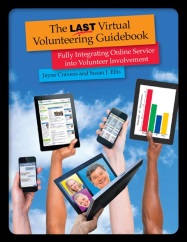
cover of Virtual Volunteering book with hands raising up various Internet connected devicesFor the present day: the Last Virtual Volunteering Guidebook: Fully Integrating Online Service Into Volunteer Involvement can help your nonprofit, NGO, charity, government program or other group introduce virtual volunteering, expand your virtual volunteering, and improve how you use the Internet to support ALL volunteers. These can can be volunteers in short-term, “microvolunteering” tasks or longer-term, more high-responsibility roles, and everything in between. These can be volunteers who do some or most of their service onsite, at your organization or volunteers who do most or all of their service remotely, rarely or ever onsite and in-person with you. This is the most comprehensive resource anywhere on working with online volunteers, and on using the Internet to support ALL volunteers, including those you might not think of as “online” volunteers.

If you have benefited from this blog or other parts of my web site and would like to support the time that went into researching information, developing material, preparing articles, updating pages, etc. (I receive no funding for this work), here is how you can help.

Also see:

Why I still don’t like “International Volunteer Manager’s Day”

logoNovember 5 is celebrated by some as International Volunteer Manager’s Day. And I’m not fond of it. I’ve said so in conversations, and in a post on OzVPM back in October 2009 . But I wanted to revisit why I’m not fond of it.

I call it “hug-your-volunteer-manager” day. I compare it to Mother’s Day.  And I don’t mean that as a compliment. 

Mother’s Day didn’t transform mothers’ lives. It didn’t elevate the status of mothers. It didn’t improve maternal health. It didn’t make women want to become mothers. It wasn’t transformative regarding how society thought about mothers. That’s what the founder of Mother’s Day wanted, and instead, she saw the day become a commercial celebration, a day of sweetness, but not substance. In fact, the person who led the campaign to adopt Mother’s Day in the USA later regretted it because of how empty and commercial the celebration was, in contrary to her intentions, and even filed a lawsuit to stop a Mother’s Day Festival.

Maybe I would be more attracted to the day if it was a day less about cute memes and inspiring quotes and was, instead, devoted to encouraging people that are in charge of the engagement of volunteers to:

  • go to their supervisors and ask for salary and budget increases
  • put themselves on the agenda to address their organization’s board of directors regarding the importance of quality volunteer support and ask for a larger budget for this support
  • write their local newspapers and blog in response to whatever the latest volunteerism campaign is (because there is ALWAYS one going on somewhere), debunking myths like “volunteers are free” and talking about why volunteer management is essential to such a campaign’s success (and writing the campaign leaders as well)
  • have a meeting with the person responsible for the annual report to present a proposal regarding how the contributions of volunteers will be noted in the next annual report, and absolutely refuse for that information to be presented in terms of money
  • launch a new, updated, detailed section of the organization’s web site that gives volunteers as high a profile as donors, and ensure that the link to “support us” doesn’t just link to a page on how to make a cash donation
  • use social media to promote the impact of volunteers at the organization, or to assert volunteers aren’t cost-free, or to push back against those that want us to value volunteers primarily in terms of money saved by not paying staff
  • develop an action plan for the next year with concrete actions to elevate the role of volunteers and volunteer management within the organization (the board, the staff, partner organizations, etc.)
  • present a strategy to expand the engagement of volunteers at the organization
  • present a strategy for training staff to work better with volunteers, create more assignments, etc.
  • vow to never, ever write another Facebook post or blog or online discussion comment whining about how overworked and underpaid they are – or at least not to write one for six months.

No pins. No mugs. No flowers. No posters. No t-shirts. No buttons. No badges. No memes. Not for this day. Instead, concrete, even provocative, action, by managers of volunteers – real activism – to elevate respect for their roles and their work, to increase the recognition of the vital importance of volunteerism specialists, so much so that people choose it as a career. To be transformative regarding how society thought about volunteer engagement and those in charge of such.

When “participatory” & “consultation” are just words

social cohesionWhen you work in humanitarian initiatives in other countries, whether your project concerns water or HIV/AIDS or maternal health or vaccines or bridge construction or government web sites or whatever, your nonprofit headquarters and your donors will emphasize over and over that you must employ ways for the local people to participate in decision-making.1,2

Yet, too often participatory decision-making doesn’t happen in developed countries, by the governments that fund overseas initiatives and demand details about how participatory decision-making was assured.

The backlash against the European Commission (the government of the European Union), manifested most recently by Brexit and the Belgian region of Wallonia rejecting a long-planned free trade pact between the EU and Canada3, are great examples of lack of participatory decision-making.

So is the anger in Portland, Oregon regarding the new contract with Portland Police Department4, 5

And so is the anger and protests regarding the Dakota Access Pipeline. The pipeline is being built by Texas-based Energy Transfer Partners and will transport as many as 570,000 barrels of crude oil daily from North Dakota to Illinois. The Midwest Alliance for Infrastructure Now, a group that supports the pipeline, says 100% of the affected landowners in North Dakota, where part of the Standing Rock Sioux Tribe lives, voluntarily signed easements to allow for construction, and the Army Corps of Engineers, the consulting agency for the project, has a list of dates it said it contacted the tribe, or tried to and never heard back.6, 7 In addition, government officials believe they have followed the consultation process promoted by the President’s office in 2010.8

But the Seattle Times says “Environmental documents filed by the company show that during its permit application the tribe was not even listed in the entities consulted during a piecemeal, fast-track review of the project by the Corps. Company contractors contacted the county weed board, the Audubon Society, county commissioners and more. But not the Standing Rock Sioux Tribe, permitting documents show.” The company has not allowed the tribe’s archaeological experts to review the ground in the path of the pipeline as it comes toward Standing Rock. The tribe’s expert, Tim Mentz Sr., in a review at the invitation of a private landowner, discovered some important artifacts, including stone effigies, burial sites and rare depictions of celestial constellations. The Seattle Times says, “So confident was Energy Transfer Partners that its work would go smoothly, that it started building the pipeline last spring, long before it had all its last permits in hand.”9

There can be no argument that tribes have been historically unable to influence projects that affect them and the land they hold sacred so this feels like just yet another land grab against native people in the USA that will marginalize them and hurt their lives. Sarah Krakoff, a professor at the University of Colorado specializing in American Indian Law and Natural Resources Law, says, “Sometimes what the agencies think of as adequate and with all good intentions do not feel adequate from the tribal side. Either because the process isn’t meaningful to them, it doesn’t accord with their timeframe or decision frame.”

Even when participatory decision-making is emphasized, the actions taken that are supposed to provide ways for lots of different people to influence what’s happening can be just for show; any community activist can tell a story about meticulously capturing the input of a group through a variety of listening exercises, only to have all that feedback utterly ignored in the final plans. I don’t know that this happened in the case of the Dakota Access Pipeline, but I’ve seen it happen overseas in my own humanitarian agency work; it’s infuriating.

And even well-done participatory decision-making isn’t always enough to keep protests at bay: until 2016, the ongoing consultative processes regarding the Malheur National Wildlife Refuge between local people, including ranchers, birders, outdoor enthusiasts, environmentalists, tribal members and others was considered a model for other communities. But that process, including a landmark 2013 agreement, didn’t stop people from far outside the area from using guns and force to invade the refuge, occupy it and cause many thousands of dollars in damage, including to private property and tribal lands.10, 11

On a related note, social media posts the Dakota Access Pipeline are often tagged with #NoDAPL, and slackervism / slactivism abounds, with people posting memes in support of the the Standing Rock Sioux Tribe, or adjusting their Facebook page to show they are at the Standing Rock Indian Reservation when they actually aren’t.12 It’s supposed to somehow create support for the tribe and to confuse law enforcement authorities regarding who is at Standing Rock and who isn’t, but Snopes points out that there’s no record that such has helped at all, including in attracting more “material assistance.”13

Since I’m really not fond of slacktivism, here are ways to REALLY help re: #NoDAPL without leaving your house or coffee shop or wherever you are with Internet and phone access :

(1) Call North Dakota governor Jack Dalrymple at 701-328-2200, leaving a RESPECTFUL, firm message on this subject (I find writing out the statement & reading from it helps me).

(2) Call the White House at (202) 456-1111 or (202) 456-1414 & tell President Obama to rescind the Army Corps of Engineers’ Permit for the Dakota Access Pipeline.

(3) Sign the petition at petitions.whitehouse.gov

(4) Contact the executives of Energy Transfer Partners that are building the pipeline:

Lee Hanse, Executive Vice President
Telephone: (210) 403-6455 or email: Lee.Hanse@energytransfer.com

Glenn Emery, Vice President
Telephone: (210) 403-6762 or email: Glenn.Emery@energytransfer.com

Also see:

Sources:

  1. Oil workers and oil communities: counterplanning from the commons in Nigeria, Terisa E. Turner 1997
  2. LEFT BEHIND; As Oil Riches Flow, Poor Village Cries Out, New York Times
  3. Wallonia rejects EU ultimatum over Canada free trade deal, EuroNews
  4. Portland City Council approves police contract amid unruly protest, Oregon Live
  5. Why protesters are mad about the police contract, Oregon Live
  6. What to Know About the Dakota Access Pipeline Protests, Time
  7. Tribal Consultation At Heart Of Pipeline Fight, insideenergy.org
  8. Guidance for Implementing E.O. 13175, “Consultation and Coordination with Indian Tribal Governments” , whitehouse.gov
  9. The violent Dakota Access Pipeline protest raged for hours — until this tribal elder stepped in, Seattle Times
  10. Audubon Society of Portland Statement on the Occupation of Malheur National Wildlife Refuge
  11. Beyond the Oregon Protests: The Search for Common Ground, Environment 360, Yale University
  12. Standing Rock Facebook Check-in, CNN
  13. Facebook check-in at Standing Rock, Snopes

Gossip’s toll in your workplace

gossipBack in March 2010, an article (registration may be required for access) in Workplace.com highlighted a study in the Journal of Contemporary Ethnography regarding workplace gossip. It reviewed how rumors among employees about a company can dilute authority, can poison workplace congeniality and contribute to staff turnover, all of which can cause harm an organization without ever becoming public (external to the organization). The study is focused on paid employees, but, of course, its findings are important to nonprofits and volunteers as well. The study’s author, sociologist Tim Hallett, calls such gossip “reputational warfare,” and says that once a bad reputation has been solidified, justified or not, it usually sticks — often with negative consequences for the entire organization.

Employees and volunteers will always talk internally about how things are going at an organization, what they think the future holds, what obstacles they see facing the country, etc. There’s nothing wrong with that. But a misunderstanding, a small fear, an unanswered question or an observation by someone uninformed about a situation can turn conversations into negative gossip, layout the foundation for mistrust, conflict, and negative public relations.

Don’t try to stop conversations about the internal workings of an organization – those conversations can be important informal training for new staff and help you discover and address issues before they become full-blown problems. But do work to make sure conversations by staff – employees, consultants and volunteers – are fact-based and within the bounds of your confidentiality policies, and work continually to create a culture where employees and volunteers share their fears, questions and suppositions early with supervisors, without fear of retribution for merely expressing a fear or asking a question.

Gossip tends to crop up when there are voids in communication. Therefore, address fears, questions and suppositions quickly and regularly. Filling the void with information — about possible office relocation, promotions, layoffs, firings, conflicts with funders or partners, budget shortfalls, etc. If a situation must be kept confidential and can’t be shared with employees, consultants and/or volunteers — for instance, the reasons why a staff person was fired — then explain why such information is kept confidential, in such a way that employees realize that you will honor their personnel issues, positive or negative, in a confidential manner as well. If the information could be damaging to the organization if released too early, then say so, explicitly. If you should have released the information sooner internally, apologize to staff and talk about what you will be doing to ensure that information is not withheld again — or ask them how they would have liked the situation to have been handled.

If you don’t want to commit anything or everything to writing, such as in a company-wide memo, then meet individually with staff and volunteers, have the executive director or a senior manager address individual department meetings, and have all-staff meetings. Give employees multiple opportunities to ask questions and voice concerns about rumors that they have heard.

But how do you know gossip is happening? By having trusting relationships across the organization – including across an organization’s hierarchy. That comes from regular conversations, formal and informal, and by showing explicitly how feedback from staff is heard, how suggestions from volunteers does influence the organization, etc. And building trust would take several more blogs to explore…

In short, you must create a culture of faith and trust among your paid staff and volunteers in each other and in the organizational leadership in order to prevent damaging gossip. It’s much easier to create and sustain such a culture than it is to try to overcome “reputational warfare.”

Also see

For Nonprofit Organizations: How to Handle Online Criticism.

Feuds in the nonprofit/NGO/charity world

Research Explaining How Websites Encourage Volunteering & Philanthropy

graphic by Jayne Cravens representing volunteersMost practitioners in volunteer management and community engagement don’t have time to review academic literature to see if there might be information that’s helpful in their work – and even if they do have time, academic language can be inaccessible for non-academics. I try to read as much as I can and then summarize and pass on the information that can help practitioners in their work, or even just give them ammunition for a project or funding proposal.

Below are links to two academic papers that are worth at least a skim by anyone trying to use web sites to encourage philanthropy, including volunteering. The reference lists at the end of each papers are gold mines of research for further reading:

Persuasion in Prosocial Domains: Explaining the Persuasive Affordances of Volunteering
by Peter Slattery, Patrick Finnegan and Lesley Land, all three of the Australian School of Business, UNSW Australia, and Richard Vidgen of Hull University Business School, University of Hull, UK. Presented at the Twenty Second European Conference on Information Systems, Tel Aviv, 2014.

Abstract: As technology becomes increasingly pervasive and invasive, it increasingly facilitates and instigates behaviour. Prosocial behaviours, such as volunteering, activism and philanthropy, are activities that are considered to be particularly beneficial to others. Prosocial behaviours are important within IS as: (i) they are encouraged by IS stakeholders including volunteering organisations and charities, and; (ii) they contribute to tackling social issues. However, while information technology is poised to become increasingly important for facilitating prosocial behaviour, little is known about how digital artefacts can encourage it. To address this research gap, this study seeks to explain how website features persuade in prosocial online contexts. The study uses the Repertory Grid Technique (RGT) to examine individuals’ experiences of persuasion on live volunteering websites. The analysis reveals that ease of use, trust, and creating positive emotion are important factors in persuading users to volunteer.

Examining How Perceptions of Websites Encourage Prosocial Behaviour
by Peter Slattery, Patrick Finnegan and Richard Vidgen of Australian School of Business, UNSW Australia. Presented at the Thirty Seventh International Conference on Information Systems, Dublin 2016.

Abstract: Organisations are increasingly reliant on information and communications technology (ICT) to encourage prosocial behaviour (i.e., volunteering, philanthropy and activism). However, little is known about how to use ICT to encourage prosocial behaviour. Given this research gap, the objective of this study is to outline and test a research model that assesses the role of specific perceptions of websites in encouraging prosocial behaviour. To do this, we review the literature to derive a theoretical model of relevant perceptions. We then test the extent to which this model can predict participants’ volunteering and philanthropic behaviour subsequent to their usage of a website that encourages prosocial behaviour. The findings are expected to contribute by (i) giving insights into how perceptions of websites encourage prosocial behaviour, (ii) explaining the roles of negative and positive affect in ICT domains, and (iii) developing a “persuasiveness of website scale” to help IS researchers to measure this construct.

In addition, Mr. Slattery’s 2016 PhD thesis is Explaining How Websites Are Used to Encourage Volunteering and Philanthropy. The thesis restricted from public access until March 2018, but some of its research is repeated in the aforementioned papers.

Also see this list of research and evaluations of virtual volunteering, as a practice in general or focused on specific projects, on the Virtual Volunteering wiki.

papers on cyberactivism by women in Iran & Azerbaijan

angryjayneIf you are interested in digital engagement or human rights advocacy anywhere, it’s worth your time to read the following papers. In addition, both concern women’s engagement and feminism specifically. The most exciting things happening regarding cyber activism, in my opinion, are happening in countries outside North America and Western Europe, particularly in countries where freedom of expression is not assured by law nor practice.

(1) Women’s voices: The journey towards cyberfeminism in Iran, by Mansoureh Shojaee, Part of the International Institute of Social Studies of Erasmus University Working Paper Series.

The working paper looks at the history of Iranian media by and for women, culminating in cyberfeminism. The main focus are women’s websites and cyber campaigns dedicated to improving women’s rights, and how they helped to mobilize Iranian women’s movements. There are two main case studies: The main case study on websites is the “Feminist School” as an important site for feminist discourse and women’s movements managed from inside Iran. The main case study in relation to cyber campaigns is the “My stealthy freedom” campaign which is undertaken from outside Iran. Through these two case studies, the paper aims to answer the following questions: To what extent and how do these sites provide strategic opportunities for the Iranian women’s movement to advocating gender equality and women’s rights? And did the cyber campaign help to build coalitions between women’s movements inside Iran and diaspora activism outside of Iran? The case studies are based on the author’s earlier work on the history of the women’ movement, interviews with leaders and directors of women’s websites and directors of mobilizing cyber campaigns along with self-reflective and discourse analysis of the websites and campaigns.

(2) Azerbaijani Women, Online Mediatized Activism and Offline Mass Mobilization by Ilkin Mehrabov, Karlstad University, Sweden

Abstract: Despite its post-Soviet history, Azerbaijan is an under-investigated country in academic research—compared with the other former constituencies, such as the Baltic countries or Russia, of the USSR—and gender questions of the contemporary Azerbaijani society are even less touched on. Within the current context of the post-“Arab Spring” era of mediatized connectivity and collective political engagement, this article looks into and analyzes how Azerbaijani women participate in different online and offline social and political movements, and if (and how) they are impeded by the increased state authoritarianism in Azerbaijan. Using data, obtained from online information resources, yearly reports of human rights organizations, focus group discussions, and interviews, the study detects four major activist constellations within the Azerbaijani field of gendered politics. Based on the analysis of conditions of detected groups, the article claims that flash mobs, a tactic employed mainly by liberal activists, emerge as the promising way in overcoming the normative nature of Azerbaijani patriarchal society, thus providing an opportunity for normalization and internalization of the feeling of being on the street and acting in concert with others—the practices which might lead towards an increasing participation of (especially young) women in the political processes of the country.

Some Truths About Volunteer Retention

graphic by Jayne Cravens representing volunteersI’ve been trying to draft a blog about volunteer retention… and then read the latest update from Susan Ellis and Energize, Inc. and her article said it better than I can say it myself. This is reposted online with permission from Susan:

SOME TRUTHS ABOUT VOLUNTEER RETENTION

Schools used to focus on the 3 Rs (reading, ‘riting, and ‘rithmetic), but in volunteer management we have the 2 Rs: recruitment and retention. I can’t tell you how often I’ve been asked to speak on both in a single session! Apart from this request minimizing what it takes to do all the critical tasks of volunteer management, the real problem is that recruitment and retention do not mirror each other.

You can do activities to recruit volunteers, interview them, train them, etc. But you cannot spend Tuesday mornings “retaining” them. Retention happens when everything else is going right. It is an outcome, not a task.

One of the problems with retention is defining it. People often ask me what a “good rate” of retention is, as though there is some external standard for all volunteer programs. Of course there is no such thing.

The desire to measure effective retention is tied to the fervent wish that volunteers might stay forever! Turnover has to be anticipated and planned for (and I might mention that there is lots of turnover among employees, too). How realistic are your expectations for the length of time volunteers will remain with your organization?

Some volunteers leave because things have changed in their own lives…and you had nothing to do with it. People get married, have babies, move away, change jobs, become ill – that’s life. The only thing you can do is leave the door open for a possible return. A volunteer who is forced to leave for external reasons may be willing to remain involved as a trainer of new volunteers, as an on-call substitute in a pinch, or at least as a reader of your newsletter. If the person is moving to another city, might you refer them to a counterpart program in the new location?

Here are some thoughts to ponder:

  • Retention can only be defined in relation to the commitment made by each volunteer at the start of service. So your recordkeeping system should show the amount of time the volunteer promised during the interview and then, if the person stays to that point, you have “retained” them! Anything afterwards is additional.
  • Do you clearly state the minimum commitment that is needed from a volunteer to make the training period worthwhile or to be able to make a difference to the client or cause? (This may be a different amount of time for each volunteer position.) Then, when you interview applicants, do you discuss anticipated length of stay? If neither of these things happen, how can you possibly know what volunteers intend to do in terms of longevity?
  • If a lot of volunteers leave in the first months of their work, it’s a symptom that what they expected and what they experienced did not match. Recruiting and interviewing are the start of the retention process!
  • Is there a pattern to when and from where volunteers drop off? Does one unit seem to keep people happy for a long time while another unit has a revolving door of new recruits? Analyze why and problem solve the situation.
  • Who is staying? Are you keeping long-time volunteers or the best volunteers? These may not be the same people! Again, assess what is going on. If newer recruits or people with top skills seem to become disenchanted with the program, why? How can you re-commit them?

The list of reasons why people volunteer in the first place is very long. After time, however, the reasons volunteers remain committed to your organization distills down to four factors:

  • The work they are doing is visibly meaningful
  • They feel appreciated for their service
  • They continue to learn and grow
  • They enjoy it
  • Quite simple, really – and the outcome of a welcoming, well-run volunteer program.

This outstanding blog content comes from Susan J. Ellis, President of Energize, Inc. More of Susan’s wisdom via her amazing books and services. It is HIGHLY recommended you subscribe to Energize Inc.’s FREE Monthly Volunteer Management E-mail Update for more great stuff!

Volunteering & social cohesion in a post Brexit world

social cohesionOn 15 September, the National Council for Voluntary Organisations (NCVO) National Volunteering Forum met in Manchester, England to talk about the potential implications of Brexit for volunteering, and to discuss evidence and real life examples demonstrating the role that volunteering can play in improving social cohesion. The slides from the event are shared online, and the associated tweets, here.

The tweets are SO worth reading, a mix of comments said at the forum and comments from people following online. GREAT questions and comments that will give you pause, because you shouldn’t think of obstacles to social cohesion as just a British phenomena: all over Europe, as well as the USA, Pakistan, India, Afghanistan, Mexico, and on and on, societies are struggling with divided socio-political landscapes. Emotions are running high, driving nationalist movements and, often, racist and xenophobia movements as well. In many places, neighbors aren’t talking to neighbors because of differences in politics, religion, language, values and more.

As I note in my paper “Internet-mediated Volunteering in the EU: Its history, prevalence, and approaches and how it relates to employability and social inclusion” for the European Commission in 2014, researchers for vInspired, in exploring the contribution of volunteering to employability for young people, found that volunteering contributed to young people’s feeling of social inclusion:

  • Volunteering helped young people to develop their networks and mix with a more diverse social group. It also increased their ability to work within and across authority structures. This suggests that providing volunteering opportunities to a wide range of young people will help to break-down social barriers and lead to greater community cohesion and personal well- being.
  • The positive contribution made by young people to the organisations and communities with which they were involved, helped to overcome the negative stereotypes often applied to them, and improved perceptions of young people amongst adults such as staff, volunteers and service users.
  • Many young people are currently in a precarious economic position with the high level of youth unemployment, and some commentators are warning of a lost generation. Helping young people to stay connected to society and their communities, to develop leadership and employability skills that will shape their future, is one of the most urgent and critical tasks of the next decade.

As I note in that paper, this and other research demonstrates that volunteering can play a crucial role in building the personal resilience and capabilities that young people need to prosper in the work place and in society in general.

However, garnering those benefits from volunteering, as well as using it to encourage social cohesion, multi-cultural understanding, reconciliation, etc., is a tall order giving the current landscape in many countries:

  • War and dire economic circumstances are driving immigration at a historic rate, with desperate people seeking to migrate to more peaceful, prosperous countries, straining resources and emotions of those living in areas immigrants want to travel through or to.
  • Different ethnic, socio-economic and religious groups, among others, are clashing over everything from perceived threats to their culture and values to police relations to access to jobs to perceptions of crime rates and quality of life compared to the past.
  • Certain people are being excluded from participating fully in the societies where they reside, or from receiving the same employment, educational, societal and other benefits others in that society may receive. These people feel they are marginalized, that they have limited access to decision-making bodies, various institutions and employment.
  • Some people’s religious and ethical values clash with public social and working life, where others that have different ethical values also socialize and work. Not everyone embraces ideas of free expression, equality for all humans in all aspects of life (employment, education, marriage, etc.), democracy, non-traditional roles for women, and the value of diversity and inclusiveness. When these people are living in a society that insists on these values, by practice and laws, hostilities can arise, with ideas of tolerance and multicultural understanding clashing with deeply held beliefs and legal practices regarding human rights.
  • Change is rampant and is frightening to many people, particularly when economic situations are fragile, or perceived as such. People are hearing different languages than the one they have grown up with, they are seeing people dressing in a way that’s different than what they believe should be the cultural norm, and technology is rapidly changing employment, education and how services are delivered. The popularity of a restaurant serving food that isn’t perceived as indigenous or is perceived as being from a country local people don’t like, a poster in a church that isn’t in the official or unofficial national language,  a woman not wearing what local people believe she should be wearing – all of these acts can be perceived by a community as a threat to their local culture and values, and lead to hostilities.

The result of all of this is people feeling more and more powerless over the decisions and forces that affect their day to day lives. Fear and uncertainty is sweeping many communities, misinformation is rampant, and everything in the environment feels politicized. Many communities are becoming more segregated, with people choosing to live and socialize with people they perceive as like them in terms of culture and values, and choosing to stay away from festivals, neighborhoods, even restaurants where they believe a different culture prevails.

Can volunteering help bridge divides, increase understanding, reduce hostilities and nurture respect and social cohesion? Certainly there are organizations and researchers that think so:

What’s lacking is research showing that these efforts have, indeed, lead to multi-cultural understanding, a lessening of hostilities, etc. 

In my paper about Internet-mediated volunteering in EU countries, I identified challenges to promoting online volunteering as a pathway to social inclusion, and I believe it is, in fact, the biggest challenge for ANY volunteering as a pathway to social inclusion: resistance to including social inclusion goals into current volunteer engagement at an organization. In other words, most managers of volunteers don’t want to make social inclusion a part of their goals for volunteer engagement. Most organizations that involve volunteers have no stated reason relating to contributing to greater social inclusion for volunteers. They may not see the benefits of adapting their volunteer engagement to contribute to such. They may not have the expertise in how to do this. And they may not have the resources needed to build their expertise to do this. Agencies may resist adapting volunteer engagement schemes to include a social inclusion element, for fear of it draining resources or focus from their primary missions which may have nothing to do with social inclusion. In short: any effort to leverage volunteering as a path to greater social cohesion has to include money to pay for training of those in charge of volunteering engagement at various agencies. Otherwise, such efforts will, every likely, be doomed to failure.

Also see:

Managers of volunteers & resistance to diversity – my blog about comments that are generated when a discussion breaks out about diversifying volunteering ranks.

This lesson plan from the University of Nebraska Extension office, “Engaging Intergenerational Volunteers“, offers practical tips on having volunteers from a variety of age groups working together, as does this how-to guide from Bridges Together.

The Victoria Volunteering Portal (Australia) offers an excellent free guide on encouraging diversity among volunteer ranks.

I also offer my own free guide on Recruiting Local Volunteers To Increase Diversity Among the Ranks.

Song of frustration re: volunteering

handstopDave Carroll became famous for writing a song and making a video about United Airlines smashing his guitar and not taking responsibility for it. The video went viral, Mr. Carroll not only appeared on various media outlets as a result, including CNN and The View, not only did United give him the financial settlement and apology he’d been demanding for months, he also became a paid speaker for various conferences and retreats, talking about “inhuman customer-service policies” and their unseen costs: loss of customer trust (and, therefore, customers), brand destruction, and more.

In February of this year, after he tried to volunteer at his son’s school, Mr. Carroll produced another song and video, this one about his frustration at trying to volunteer at his son’s school. It’s called “There’s Got to Be a Better Way.” You can watch the entire video, where Mr. Carroll makes fun of the volunteer screening at length, or just jump to the song about the experience at the 5:56 mark.

IMO, the video and song are a PERFECT example of thoughtless volunteer screening, where nonprofit and public sector organizations are interested just in checking a box rather than doing MEANINGFUL, effective screening of someone to work with kids.

I am so tired of seeing the question on discussion groups for managers of volunteers: “Where can I get a cheap criminal background check for potential volunteers?” or “How do I get a discount at the police station for police to do background checks of potential volunteers.” These people are looking for a box to check, rather than creating a culture that keeps everyone safe. Instead, read Screening Volunteers to Prevent Child Sexual Abuse: A Community Guide for Youth Organizations (it’s free to download) and use its very effective ways for screening out inappropriate candidates and creating a culture of safety. Combine it with Beyond Police Checks: The Definitive Volunteer & Employee Screening Guidebook by Linda Graff, available from Energize, Inc. (but not for free), and you’ve got a solid, more-than-basic understanding of risk management in volunteer engagement activities, and know how to better assure safety without driving away quality volunteering candidates. You also will understand how mindlessly enforcing protocols, without thinking about their purpose, doesn’t keep anyone safe.

Also see these related blogs:

Screening applicants by reviewing their online activities

Safety in virtual volunteering

Keeping volunteers safe – & keeping everyone safe with volunteers

That moment when you totally change your mind about volunteer engagement

wizardAn email I received a few days ago. I’ve changed it a bit to hide the identity of the author:

I want to thank you, sincerely, for challenging me to think about my understanding of volunteering. You really got me thinking. I had a 3.5 hour drive ahead of me last night, and the discussions around mandated community service and volunteerism kept rolling around in my mind. In my current role, I haven’t really had to think about court mandated service as volunteering and from personal experience, I don’t know if those mandated, would consider themselves volunteers? I am trying to resolve this, for my own benefit at this stage, and I am finding it quite difficult! I intend on mulling this over a bit more. I trying to consider the benefits/detriment of either belief…. Challenged? Yes!

I love making people uncomfortable about volunteer engagement. I love challenging oh-so-solid notions about who is and isn’t a volunteer, the value of volunteering, and why people volunteer. Why? Because volunteer engagement is so much bigger than just, “We’ve got work to do. Let’s get some good-hearted people to do it for free!”, and I so want this mentality to change!

The results of this? I’ve made people angry. I’ve made people tear up. Some people have double-downed on their oh-so-rigid definitions. But most, while challenged, have also been inspired. They don’t all come to the exact same conclusions as me regarding volunteer engagement and its value, but they definitely broaden their original ideas.

I remember my big ah ha moment regarding volunteer engagement, via an event by Triumph motorcycles. And my blog, Should the NFL involve volunteers for the Super Bowl?, talks further about why I changed my mind about volunteers supporting for-profit settings, in certain situations.

Want me to challenge your organization? Complete details about my consulting services.

Also see:

Have you ever changed your mind?

Volunteer manager Fight Club

Missed opportunity with #volunteers: “No one ever asked me for my name. They didn’t have a sign in sheet.”