Volunteers Along Immigrant & Refugee Journey

refugeesLast year, e-Volunteerism, a publication by Energize, Inc. and Susan Ellis, featured an article about volunteers at the front lines of the ongoing refugee crisis in Europe, and how their impassioned scramble to help—though often inefficient and always insufficient—nonetheless addressed grave needs and sent a message to governments to respond. But the images of these orange-vested volunteers, often entirely self-funded and pulling refugees from boats and greeting them with blankets on Mediterranean shores, represent just a fraction of the diverse volunteer sector that serves the needs of immigrants and refugees worldwide. And these borders and shorelines are not the end of the journey; for the immigrants and refugees, they are where new journeys begin. While some immigrants’ first steps inside a country are more perilous than others, even immigrants who arrive safely at an airport are still plunged into uncertainty and vulnerability. Settling into a new life, a new job, new customs, a new language, and the new experience of being a racial, ethnic, or religious minority can often be a more daunting journey than getting to the country in the first place.

A new e-Volunteerism Voices article by Kerry Martin explores how volunteers engage with immigrants and refugees at every stage of their journey. It focuses on the current situation in the USA (which has relevant implications for other countries) by assessing the nature of volunteer services for three distinct groups: 1) refugees formally resettled through government and other authorized organizations; 2) recent immigrants (non-refugees) who are undocumented, at risk of losing their immigration status, or in need of support due to poverty, exploitation, abuse, etc.; and 3) refugees unrecognized by the U.S. and not formally resettled, primarily those fleeing from gang violence in Honduras, El Salvador, and Guatemala.

The full article is available to subscribers of e-Volunteerism and it’s worth subscribing to read this article!

Also see:

Reality Check: Volunteering Abroad / Internationally

Funding Your Volunteering Abroad Trip (& where to find credible volunteering abroad/work abroad programs)

How to Pursue a Career with the United Nations or Other International Humanitarian or Development Organizations, Including Non-Governmental Organizations (NGOs)

Vanity Volunteering: all about the volunteer

Folklore, Rumors & Misinformation Campaigns Interfering with Humanitarian Efforts & Government Initiatives

gossipUPDATED:

Preventing Folklore, Rumors, Urban Myths & Organized Misinformation Campaigns From Interfering with Development & Aid/Relief Efforts & Government Initiatives

Folklore, rumors and contemporary myths / legends often interfere with development aid activities and government initiatives, including public health programs – even bringing such to a grinding halt. They create ongoing misunderstandings and mistrust, prevent people from seeking help, encourage people to engage in unhealthy and even dangerous practices, and have even lead to mobs of people attacking someone or others because of something they heard from a friend of a friend of a friend. With social media like Twitter and Facebook, as well as simple text messaging among cell phones, spreading misinformation is easier than ever.

Added to the mix: fake news sites set up specifically to mislead people, as well as crowdsourced efforts by professional online provocateurs and automated troll bots pumping out thousands of comments, countering misinformation efforts has to be a priority for aid and development organizations, as well as government agencies.

Since 2004, I have been gathering and sharing both examples of this phenomena, and recommendations on preventing folklore, rumors and urban myths from interfering with development and aid/relief efforts and government initiatives. I’ve recently updated this information with new information regarding countering organized misinformation campaigns.

Anyone working in development or relief efforts, or working in government organizations, needs to be aware of the power of rumor and myth-sharing, and be prepared to prevent and to counter such. This page is an effort to help those workers:

  • cultivate trust in the community through communications, thereby creating an environment less susceptible to rumor-baiting
  • quickly identify rumors and misinformation campaigns that have the potential to derail humanitarian aid and development efforts
  • quickly respond to rumors and misinformation campaigns that could derail or are interfering with humanitarian aid and development efforts

And, FYI: I do this entirely on my own, as a volunteer, with no funding from anyone. I update the information as my free time allows.

Also see:

Did Facebook hurt the Syrian Revolution?

Why is it that social media can help win an election in one country and cannot stop a month-long massacre in another?

Erica Chenoweth, a professor at the School of International Studies at the University of Denver, has argued that social media is helping dictators, while giving the masses an illusion of empowerment and political worthiness.

At a recent lecture at Columbia University, when asked for an example where social media played a negative role in a social movement, Chenoweth paused a little to finally say, “what comes to my mind now is Syria.”

Indeed, social media hurt the Syrian uprising. It gave the Syrian people the hope that the old dictatorship can be toppled just by uploading videos of protests and publishing critical posts. Many were convinced that if social media helped Egyptians get rid of Hosni Mubarak, it would help them overthrow Bashar al-Assad.

It created the false illusion that toppling him would be easy and doable.

The above quote is from Ian interesting article by Al Jazeera.

There can’t be any argument that digital activism can have a massive impact, sometimes even more than volunteer engagement, as shown by the 2016 USA election, but it can also be slackervism/slacktivism, when virtual activism stays virtual.

Is social media, Facebook in particular, hurting activism in the USA as well?

Also see:

20 Years Ago: The Virtual Volunteering Project

vvlogoThe Virtual Volunteering Project officially launched 20 years ago this month. It was the first attempt by anyone, anywhere, to research online volunteer service and document what works, and what doesn’t. I directed the initiative at its launch – and now, two decades later, I’m in a mood to reflect.

The Virtual Volunteering Project was the brainchild of Steve Glikbarg and Cindy Shove, co-founders of Impact Online (what became VolunteerMatch). In fact, Glikbarg probably originally coined the phrase virtual volunteering, back in the mid or even early 1990s. In its first two years, the Virtual Volunteering Project was funded primarily with the support of the James Irvine Foundation. Additional support in this first phase of the Project came from the David and Lucile Packard Foundation, the Morino Institute and the Mitsubishi Electric America Foundation. The Charles A. Dana Center, a research institute at the University of Texas at Austin, hosted the Project for most of its life.

How did I start on the road to becoming a virtual volunteering expert? In 1995, while working at Joint Venture: Silicon Valley, the two volunteer interns I’d taken on to build web sites for all of the initiatives we were managing said they would prefer to build the sites on their own computers back on campus, rather than at our office, because their computers were better and it was more convenient for them. They would bring their work to me on disks when they were finished. What a great idea! It worked out very well – they got to work on their own schedule, from their homes, on better computers, and I got what I needed. So I offered the option of working remotely part of the time, even most of the time, to every volunteer I recruited after that at Joint Venture. The next year, Cindy contacted me about running a new virtual volunteering initiative she and Steve had just gotten funded. “What’s ‘virtual volunteering?'” I asked. “It’s what you’ve been doing with your volunteers and talking about on USENET!” she replied.

The Virtual Volunteering Project officially launched in December 1996. It was quite rough at first; the vast majority of the programs that involved volunteers donating some or all of their time online never used the phrase virtual volunteering. In fact, that’s still true today! I remember thinking in those first several weeks that most online volunteers would be 20 something men living in Silicon Valley; imagine my surprise to find out, rather quickly, that most online volunteers were women living all over the USA – and beyond! I was also stunned at how quickly I found more than 100 virtual volunteering initiatives, most of which didn’t know about each other. With the help of online and onsite volunteers myself, I researched virtual volunteering activities, created and continually updated web pages about it, and marketed what I was learning, via both traditional press releases and frequent posts to various online discussion groups. I also involved online volunteers myself – more than 300 over more than four years. As a result, I was invited to speak at a lot of conferences and was quoted in a lot of traditional press, like The Wall Street Journal and The New York Times.

I left the Virtual Volunteering Project in Janaury 2001, to prepare for my move to Germany to work for the United Nations to run the virtual volunteering component of NetAid, which became the stand-alone Online Volunteering service. I got that UN job because of my online activities, including participation in various online communities. In subsequent UN and international work, even when the focus isn’t virtual volunteering but, say, communications, I’ve found a way to inject at least a little virtual volunteering capacity building and involvement into the work.

Now, it’s 20 years after the launch of the Virtual Volunteering Project, which is archived here. Not much has changed in terms of best practices in virtual volunteering, the practices that make virtual volunteering effective for nonprofits, NGOs, government programs, schools and more, though there’s lots of new jargon now in the mix: micro volunteering, crowdsourcing, digital volunteering, the Cloud, etc.

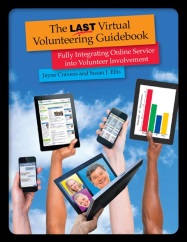
vvbooklittle The Last Virtual Volunteering Guidebook, by Susan J. Ellis and myself, is our attempt to document all these best practices over the more than three decades virtual volunteering has been happening, in a comprehensive, detailed way, so that the collective knowledge can be used with the latest digital engagement initiatives to help people volunteer, advocate for causes they care about, connect with communities and make a difference. It’s a tool primarily for organizations, but there’s also information for online volunteers themselves. It’s available both in traditional print form and in digital version. Thanks to everyone who has purchased it so far! Bonus points if you can find the sci fi/fan girl references in the book…

Also see:

Early History of Nonprofits & the Internet

Al Gore Campaign Pioneered Virtual Volunteering

Lessons on effective, valuable online communities – from the 1990s

Online volunteers created a music festival in St. Louis

Updated: research regarding virtual volunteering

How did volunteers impact the 2016 USA Presidential election?

social cohesionIn 2012, I knew that President Obama was going to be re-elected because of the number of people volunteering for his campaign was far, far more than the Mitt Romney campaign. And I was right.

Four years later, I thought, like most everyone, that Secretary Hillary Clinton was going to win because, like President Obama, she had a far superior official deployment of volunteers, and management of such, than the Donald Trump campaign. She did, indeed, win the popular vote, garnering more than two million more votes than Trump and also receiving more votes than any person in the history of the USA for President except for President Obama. But she lost the election because of the USA’s archaic electoral college rules. Even with that popular vote win, however, the race was far, far closer than I ever expected, given the massive difference in volunteer numbers for the two campaigns.

PBS profiled the gap in the number of Trump volunteers versus those of the Clinton campaign in August, noting “the Trump campaign faces a jaw-dropping gap in the ground game: Hillary Clinton currently has more than three times the number of campaign offices in critical states than does Donald Trump.” As of Aug. 30, Clinton had 291 offices in 15 battleground states, compared to just 88 for Trump. Clinton was using a refined version of the data-driven, on-the-ground volunteering machine that won two elections for Barack Obama. “Trump, on the other hand, insists he does not need traditional campaign tactics to win the election, pointing to his overwhelming nomination victory achieved with a relatively small team and little spending.”

Then, in early November, FoxNews.com noted that, while Trump had far, far fewer official offices and official volunteers than Clinton, he had people acting entirely independently on behalf of his campaign, “an army of volunteers who began boosting his ground game, in some cases, before the professionals got heavily involved.” The outlet “talked to volunteers in five western states who were among Trump’s main source of on-the-ground support at a time when neither the Trump campaign nor the RNC had dedicated staff.” These volunteers were calling friends, hosting campaign parties, posting signs, sharing information on social media and registering voters, entirely on their own, with no official direction.

Volunteers who officially signed up for Donald Trump’s campaign, to help with phone banking, had to sign a lengthy, jargon-filled nondisclosure agreement that would prevent them from saying anything bad about the GOP nominee, his family, companies or products for the rest of their lives. You can see the entire contract here and highlights of the most outrageous parts of the agreement here. By contrast, Hillary Clinton’s campaign didn’t require phone bank volunteers to sign any sort of agreement – which was probably a big factor in her having far more official volunteers. And also by contrast, unofficial volunteers for Trump also never signed any agreement, and there was no organization counting them in the official volunteer rolls – they took their campaign action ideas from each other, not the campaign.

The reality is that this election was not won by volunteers nor volunteer management. In fact, a headline of one of my earlier blogs, Volunteers are more important than social media in Presidential elections, has been proven wrong by this election, as my blog before the one you are reading now details. Social media DID win this election. It proved an ideal vehicle for promoting misinformation and generating fear and excitement that turned into action. As I noted in my last blog, BuzzFeed reported that fake news stories about the USA Presidential election this year generated more engagement on Facebook than the top election stories from 19 major news outlets COMBINED – that included major news outlets such as The New York Times, The Washington Post, CNN, and NBC News, and on and on. And the majority of these fake news stories did NOT come from any campaign operatives; rather, they came from a man in Los Angeles who originally built fake news sites as a way to expose the extreme right, a plan that most certainly did NOT work. And these fake stories, most of which promoted Trump for President and made false claims regarding Hillary Clinton, were shared by millions of people via social media – independent, passionate volunteers who believed them.

What does this mean for the future of volunteer engagement in Presidential elections? Please share your thoughts in the comments below.

Also see:

Al Gore Campaign Pioneered Virtual Volunteering

Update:
Donald Trump might be more popular than you think, from Politico, Feb. 2, 2017

fake news, folklore & friendships

gossipIt wasn’t getting a journalism degree, or being a journalist, that made me a skeptic when it comes to sensational stories. It was a folklore class. Urban Folklore 371, to be exact. It was a very popular class at Western Kentucky University back in the late 1980s, both for people getting a degree in folklore studies and for people needing humanities courses for whatever their degree program was, like me. Class studies focused on contemporary, largely non-religious-based legends, customs and beliefs in the USA. One class might focus on watching a film about the games kids play on a playground and how those games explore the things they fear – marriage, childbirth, stranger danger, being ostracized by their peers, etc. Another class might review the difference versions of the “vanishing hitchhiker” story and why such stories are so popular in so many different cultures, and how the story changes over time.

I heard at least one student say, “That’s not a true story?! I always thought it was!” at least once in every class. Because of that class, I realized there were legends being told as truth all around me, by friends, by family, even by newspapers. “I heard it from my cousin” or “My friend saw it in a newspaper” or “My Mom saw it on Oprah” was usually the preface to some outlandish story told as fact. But the class taught me that, in fact, no woman was ever killed by spiders nesting in her elaborate hairdo, that there has never been a killer with a hook for a hand that attacked a couple in a parked car in a nearby town, that there is no actor who has never had a gerbil removed from his anus, and on and on and on.

I became the “um – that’s not true” girl at various places where I worked. And then via email. And I still am, now on social media. And what I have learned from being little Ms. Debunker is that people REALLY do NOT like these stories debunked. In fact, pointing out the facts that prove these stories aren’t true, no matter how gently I try to do it, often makes people very angry.

Back in the 1990s, a friend sent me yet another forwarded email. This time, the text said the email was from Microsoft Founder Bill Gates, that he’d written a program that would trace everyone to whom the email message was sent, and that he was beta testing the program. The email encouraged people to forward the message and said that if it reaches 1,000 people, everyone on the list would receive $1,000. Of course, it wasn’t true – I knew it as soon as I saw it. She’d sent me several of these type of emails – one that said people that forwarded the message would get a free trip to Disney World, another said we’d all get free computers, and on and on. I had been deleting them, but I was tired of it. So I looked online, found a site that debunked the myth, and sent her the link. I didn’t make any judgement statements; I just said, “This is a myth. Here’s more info. You might want to let everyone know you sent to, as well as the person you got it from,” or something similar.

She was not happy with me. In fact, it almost ended our friendship. She told me that the Internet was “a place for having fun” and “you can’t win if you don’t play” and what did she have to lose by forwarding the message even if it sounded fishy?

And that kind of reaction kept happening. Three new friends I made back in 2010, after I’d moved back to the USA, all unfriended me on Facebook the same day, outraged that I pointed out several things they were posting as their status updates – about how Facebook was going to start charging users, about how putting up a disclaimer on your Facebook page would stop the company from being able to sell your information, and on and on – were all urban legends, all untrue. Their reaction was almost verbatim of what that friend via email had said: Facebook is “a place for having fun” and “it’s better to be safe and share it” and what did they have to lose by sharing the message even if it sounded fishy? Also, they said they did not have time to “check every single thing online.”

Now, in 2016, I have friends that are furious with me for posting science-based web sites that debunk their posts from quack sites like the “Food Babe” claiming that GMOs cause cancer or that vaccines cause autism (to be clear, these are MYTHS). Two journalists – JOURNALISTS – were mad at me when I pointed out that a status update one had shared – it urged users to use the Facebook check-in function to say they were at Standing Rock in North Dakota, that this would somehow prevent the Morton County Sheriff’s Department there from geotargeting DAPL protesters – was promoting false information. I wasn’t just annoyed by the message – I found it imprudent, and yet another example of slackervism or slacktivism: people truly wishing to assist the protesters were checking in on Facebook rather than doing something that would REALLY make a difference, like sending funds to support the protest efforts or writing their Congressional representatives in support of the protesters. It also misdirects people from the nefarious ways law enforcement really does surveil people on social media. I would have thought journalists would know better than engage in such behavior.

Contemporary legends online cause harm, and it’s bothered me long before the Standing Rock/Facebook book check-in myth. Since 2004, I have been gathering and sharing examples of how rumors and urban / contemporary myths often interfere with relief and development activities, and government initiatives, including public health initiatives — even bringing such to a grinding halt. These myths create ongoing misunderstandings among communities and cultures, prevent people from seeking help, encourage people to engage in unhealthy and even dangerous practices, cultivate mistrust of people and institutions, and have even lead to mobs of people attacking someone or others for no reason other than something they heard from a friend of a friend of a friend. With the advent of social media like Twitter and Facebook, as well as just text messaging among cell phones, spreading misinformation is easier than ever.

Based on my experience as a researcher and a communications practitioner, and everything I’ve read – and I read a LOT on this subject – rumors that interfere with development and aid/relief efforts and government health initiatives come from:

  • misinterpretations of what a person or community is seeing, hearing or experiencing,
  • from previous community experiences or their cultural beliefs,
  • willful misrepresentation by people who, for whatever reason, want to derail a development or relief activity,
  • unintentional but inappropriate or hard-to-understand words or actions by a communicator, or
  • the desire of an individual or community to believe an alternative narrative, a desire that is stronger than the facts

That list of bullet points was central to the long list I made of recommendations on preventing folklore, rumors and urban myths from interfering with such initiatives. I made that list to help aid workers, particularly people leading public health initiatives. For years, I’ve updated that list and felt really good about it being comprehensive and realistic, and I’ve employed some of the methods myself in my work.

But are these recommendations enough anymore? I’m not sure. Because BuzzFeed reported that fake news stories about the USA Presidential election this year generated more engagement on Facebook than the top election stories from 19 major news outlets COMBINED – that included major news outlets such as The New York Times, The Washington Post, CNN, and NBC News, and on and on. And a new study from Stanford researchers evaluated students’ ability to assess information sources, and described the results as “dismaying,” “bleak” and a “threat to democracy,” as reported by NPR News. Researchers said students displayed a “stunning and dismaying consistency” in their responses, getting duped again and again. The researchers weren’t looking for high-level analysis of data but just a “reasonable bar” of, for instance, telling fake accounts from real ones, activist groups from neutral sources and ads from articles. And the students failed. Miserably. And then there’s my own experience seeing the reaction a lot of people have to references to sites like snopes.com or truthorfiction.com or hoax-slayer.com or the Pulitzer Prize-winning site Politico that debunk myths; those people claim that “These sites aren’t true. They’re biased.” And that’s that – just a simple dismissal, so they can continue to cling to falsehoods.

National Public Radio did a story a few days ago about a man in Los Angeles who decided to build fake news sites that publish outrageous, blatantly false stories that promote stories that extreme far-right groups in the USA (also known as “alt-right”) would love to believe; he thought that when these stories were picked up by white supremacist web sites and promoted as true, he and others, particularly major media outlets, would be able to point out that the stories were entirely fiction, created only as bait, and that the white supremacists were promoting such as fact. But instead, thousands of people with no formal association with white supremacists groups shared these stories as fact – reaching millions more people. He wrote one fake story for one of his fake sites on how customers in Colorado marijuana shops were using food stamps to buy pot. Again, this story is NOT TRUE. But it led to a state representative in Colorado proposing actual legislation to prevent people from using their food stamps to buy marijuana; a state legislator was creating legislation and outrage based on something that had never happened.

BTW, to see these fake news sites for yourself, just go to Google and search for snopes is biased, and you will get a long list of links to fake news sites, most right-wing, all fighting against debunking fact-based sites like Snopes. I refuse to name those fake news sites because I don’t want them to get any more traffic than they already do.

Competent decision-making depends on people – the decision-makers – having reliable, accurate facts put in a meaningful and appropriate context. Reason – the power of the mind to think, understand and form judgments by a process of logic – relies on being able to evaluate information regarding credibility and truth. But fact-based decision-making, the idea of being logical and using reason and intellect, have become things to eschew. The Modis Operandi for many is go with your gut, not with the facts. Go not for truth, but truthiness.

I always thought that last bullet in my list of why people believe myths, “the desire of an individual or community to believe an alternative narrative, a desire that is stronger than the facts,” was easy to address. Now, given all the aforementioned, I’m not at all sure.

I’m going to keep calling out myths whenever I see them, and if it costs me Facebook friends, so be it. I prefer the truth, even when the truth hurts, even when the truth causes me to have to reconsider an opinion. There is a growing lack of media literacy and science literacy in the USA – and, indeed, the world. And the consequences of this could be catastrophic – if they haven’t been already. People need to be able to not just access information, but also to analyze it and evaluate the source. That’s just not happening. And I’ve no idea how to change things.

Also see:

8:10 am Nov. 28, 2016 Update: Filippo Menczer, Professor of Computer Science and Informatics and Director of the Center for Complex Networks and Systems Research at Indiana University, Bloomington, authored the article Why Fake News Is So Incredibly Effective, published in Time and The Conversation. Excerpts: “Our lab got a personal lesson in this when our own research project became the subject of a vicious misinformation campaign in the run-up to the 2014 U.S. midterm elections. When we investigated what was happening, we found fake news stories about our research being predominantly shared by Twitter users within one partisan echo chamber, a large and homogeneous community of politically active users. These people were quick to retweet and impervious to debunking information.” Also of note: “We developed the BotOrNot tool to detect social bots. It’s not perfect, but accurate enough to uncover persuasion campaigns in the Brexit and antivax movements… our lab is building a platform called Hoaxy to track and visualize the spread of unverified claims and corresponding fact-checking on social media. That will give us real-world data, with which we can inform our simulated social networks. Then we can test possible approaches to fighting fake news.”

1:05 pm Nov. 29, 2016 Updates:

Donald Trump and the Rise of Alt-Reality Media: You think the truth took a hit last year? It’s about to get worse. A lot worse. from Politico.

For Some, Scientists Aren’t The Authority On Science from NPR

Dec. 3, 2016 Updates:

Spread of Fake News Provokes Anxiety in Italy from The New York Times

Dec. 6, 2016 Updates:

A North Carolina man read online that a pizza restaurant in northwest Washington, DC, was harboring young children as sex slaves as part of a child-abuse ring, so he drove six hours from his home to the restaurant, and not long after arriving, he fired from an assault-like AR-15 rifle. No one was injured, and he’s been arrested, but, as The New York Times notes,  “the shooting underscores the stubborn lasting power of fake news and how hard it is to stamp out. Debunking false news articles can sometimes stoke the outrage of the believers, leading fake news purveyors to feed that appetite with more misinformation. Efforts by social media companies to control the spread of these stories are limited, and shutting one online discussion thread down simply pushes the fake news creators to move to another space online. The articles were exposed as false by publications including The New York Times, The Washington Post and the fact-checking website Snopes. But the debunking did not squash the conspiracy theories about the pizzeria — instead, it led to the opposite. ‘The reason why it’s so hard to stop fake news is that the facts don’t change people’s minds,’ said Leslie Harris, a former president of the Center for Democracy & Technology, a nonprofit that promotes free speech and open internet policies.”

Dec. 9, 2016 update

“Fakes, News and the Election: A New Taxonomy for the Study of Misleading Information within the Hybrid Media System”

Giglietto, Fabio and Iannelli, Laura and Rossi, Luca and Valeriani, Augusto

November 30, 2016. Convegno AssoComPol 2016 (Urbino, 15-17 Dicembre 2016), Forthcoming. Available at SSRN: https://ssrn.com/abstract=2878774

Abstract:
The widely unexpected outcome of the 2016 US Presidential election prompted a broad debate on the role played by “fake-news” circulating on social media during political campaigns. Despite a relatively vast amount of existing literature on the topic, a general lack of conceptual coherence and a rapidly changing news eco-system hinder the development of effective strategies to tackle the issue. Leveraging on four strands of research in the existing scholarship, the paper introduces a radically new model aimed at describing the process through which misleading information spreads within the hybrid media system in the post-truth era. The application of the model results in four different typologies of propagations. These typologies are used to describe real cases of misleading information from the 2016 US Presidential election. The paper discusses the contribution and implication of the model in tackling the issue of misleading information on a theoretical, empirical, and practical level.

Also see: Feuds in the nonprofit/NGO/charity world

Nonprofits & NGOs: you MUST give people a way to donate online

fundhuntingThe following quote is from a blog in 2013 by Sue Gardner (hi, Sue!!) of the Wikimedia Foundation, which administers Wikipedia. The quote is about how the many-small-donors-instead-of-a-few-big-ones works so well for Wikimedia, a nonprofit:

We don’t give board seats in exchange for cash… people who donated lots of money have no more influence than people who donate small amounts — and, importantly, no more influence than Wikipedia editors… We at the WMF get to focus on our core work of supporting and developing Wikipedia, and when donors talk with us we want to hear what they say, because they are Wikipedia readers. (That matters. I remember in the early days spending time with major donor prospects who didn’t actually use Wikipedia, and their opinions were, unsurprisingly, not very helpful.)

It’s not only that they have many, many donors of small amounts, rather than a few donors that give huge amounts of money, it’s also that their donors are users of their initiatives, primarily Wikipedia – in fact, many are volunteers for these initiatives.

This isn’t a new model. I worked in professional, nonprofit theater for many years, and this was their model as well; each theater had hundreds, even thousands, of donors that gave, for the most part, small amounts, and the vast majority of those donors were also performance ticket buyers. I learned that a healthy nonprofit theater has at least half of its expenses covered by such individual donors.

Of course, the many-small-donors models wouldn’t work for every nonprofit. But if your nonprofit had at least 100 clients, volunteers and/or event attendees in a year, you MUST have a way for those people to donate via your web site. There is absolutely no excuse for NOT having this way of giving, and no excuse for NOT encouraging such donations.

How about this: at least once a year, I have been ready to donate to a particular nonprofit, I’ve gone to the web site to do so, and, ta da: no way to donate online; the only way to donate is by sending a check or money order. And so, I end up not donating at all.

This happened to me last month regarding a nonprofit right here in Forest Grove, Oregon, where I live. I was going to say something to the nonprofit, but instead, decided to turn my thoughts into a blog for small nonprofits in particular. I hope they notice. I don’t have lots of money: when I donate, I’m giving up the price of a movie ticket and popcorn. Most nonprofits would claim that they would not say no to any amount of cash someone wanted to donate, including that small amount. Yet, that’s just what they do when they don’t have a way for people to donate online.

According to Blackbaud’s 2015 Charitable Giving Report, 93% of funds given to nonprofit organizations came from traditional means in 2015 – major gifts, annual funds, fundraising events, checks, snail mail and by phone. Only 7.1% of donations to nonprofits came in online. HOWEVER, online giving has been steadily growing over the last few years, up 9.2% from 2014 to 2015, and 14% of online giving in 2015 originated on a mobile device. I’ve no doubt the numbers are just going to keep going up. A good summary of the Blackbaud report is here. In addition, a study of younger supporters (age 20-35) found that 56% preferred donating online via an organization’s website.

The excuse I hear by most nonprofits for not having a way for someone to donate online?

We don’t want to have to lose some of the donation to processing fees. 

Let me be clear: you are losing ALL of the online donation by not having a way for people to donate this way to your organization. Those people that go to your web site and can’t find a way to donate online don’t say, “Oh, I’ll write a check then.” Nope – they just don’t give at all.

As of the time of this blog’s writing, Paypal charges 2.2% + $0.30 per transaction on any donation ($0 to $100,000) to a registered nonprofit with 501(c)(3) status. Wouldn’t you rather get most of a donation than none of it?

There’s no service that doesn’t have some kind of processing fee for donations to nonprofits, at least not in the USA. Some services, like Paypal or Google Wallet, just charge a transaction on every donation, but don’t provide any features, like a customized web page. Services like First Giving charge more, but also provide more services, like tracking and managing donor information and easily integrating into whatever donor database you are already using. Which should you use? That depends on the size of your nonprofit’s budget, how many donors you are expecting to donate online and how much information you need from those donors. Have a look at what other nonprofits in your community are doing in terms of allowing for online donations, and don’t hesitate to pick up the phone and give them a call and ask for advice (we need nonprofits collaborating together MORE!). Also, talk to your financial institution, the bank or credit union where you deposit your organization’s funds – they may have options as well.

And if you are looking for a magical third party crowdfunding site that will bring in lots of donations for your organization merely by your inputting all of your information and asking for money, forget it – that’s not how successful online fundraising works for 99% of nonprofits. Rare is the donor who goes to a third party web site with no idea of who he or she is going to give money to.  Most nonprofits that raise money through online means are raising that money through their own web sites, and raise that money from people in their communities that are familiar with their work and want to support them, from people that have attended the organization’s events, or from people that have seen an ad on TV or radio.

More: 

Excellent advice from someone else on how to encourage donations online to your organization

More advice for what should be on your organization’s web site

Also see Survival Strategies for Nonprofits

How Will Trump Presidency Affect Humanitarian Aid & Development?

Note: since this blog’s publication in November, I’ve been adding how Trump’s presidency actually is affecting humanitarian aid & development:

How will the Trump Presidency affect humanitarian aid and development policy and practice?

And how will it affect humanitarian aid and development workers from the USA?

Effects on the work

2015-07-21-SDGsAid and development efforts in the last 10 years have made amazing strides in terms of addressing issues that make many people, even a majority of people, very uncomfortable, even angry. It’s oh-so-popular to put in a well for drinking water or to build a school for young children or to provide maternal health care, but it’s rarely as popular in those same communities to encourage women to demand their sexual partners to use a condom to prevent HIV/AIDS, or to suggest a plan for providing housing and other help for refugees from other countries. Women’s equal rights to education, life choices, roles in society and employment are now unquestioned in the policies of most international development agencies, including the United Nations, something I wasn’t expecting when I started working internationally. Honestly, I fully expected some kind of “out” in UN policy documents to allow local people to refuse rights for women, if the refusal was based on religious or cultural grounds. But the UN has stood firm, at least officially. Yes, the UN and other aid agencies absolutely look for accommodation within local cultural and religious practices, they absolutely encourage recognition of local values, and that may mean your meeting with a local village is segregated, with all the men in one place, and all the women in another. It requires very delicate maneuvering at times, but the core policy and priority regarding women’s rights, and other rights, does not change.

Reaching women in socially-conservative areas, like Afghanistan, can be an incredible challenge, as you navigate a culture that does not want women in public and is easily angered if they perceive an attack on their religion. And just because local senior staff are singing the praises of gender mainstreaming doesn’t mean the staff they supervise has bought in. But, as an aid worker, you have to find a way. It is your mandate. You find a workaround. Because you know that full civil rights for all people is the only way a country can prosper and become resilient to corruption, crime, and armed civil unrest, and when civil rights for any residents are curbed, officially or by widespread cultural practice, the entire country suffers, and your aid and humanitarian efforts will ultimately fail.

Something that shocks a lot of people is that the UN has a human rights mandate that includes rights for people that are lesbian, gay, bisexual, transgender and queer (LGBTQ). The United Nations Free & Equal initiative is on Twitter (@free_equal) and on Facebook. It is an initiative of the Office of the High Commissioner for United Nations Human Rights. There is this video from the UN Secretary General in support of the Free & Equal initiative. I was stunned, and thrilled, to find this out a while back. It’s a daring position, given the majority attitudes about LGBTQ people throughout the world, including right here in the USA. In promoting equality and human rights, it’s a great comfort to know that a major international development agency has your back, policy wise.

The United States Agency for International Development (USAID), a government agency, also has the  LGBT Global Development Partnership. It was put into the planning and formation stages by Secretary of State Hillary Clinton and then launched in April 2013 under the tenure of Secretary of State John Kerry. The initiative works to strengthen the capacity of local LGBTQ leaders and civil society organizations in developing countries and to enable the economic empowerment of LGBTQ people in those countries through enhanced entrepreneurship and small and medium-sized enterprise development.

The UN and USAID initiatives in support of LGBTQ people are in response to the violence, economic hardship, stigma and political marginalization that are a daily fact of life for millions of LGBTQ people throughout the world. These people experience a lack of employment opportunities, discrimination in access to health care, housing and education and violations of their civil rights regularly because of their sexual preference. 83 countries and territories currently criminalize LGBTQ behavior or identification, and at least eight have laws allowing the imposition of the death penalty for same-sex relations. These USAID and UN initiatives are desperately needed, as are women’s empowerment initiatives. As are initiatives to help refugees. As are initiatives to help religious minorities. As are initiatives to help people with disabilities. And on and on.

But now, the USA elections of 2016 show that the majority of people in the USA support politicians dedicated to eliminating the civil rights gained by LDBTQ people in the USA over the last five years. Donald Trump is on the record as planning to create a militarized deportation force to remove 11 million undocumented immigrants from the USA, to ban the entry of Muslims into the USA and aggressively surveil any Muslim already here, to punish women for accessing abortion once he makes it illegal with the help of his Supreme Court appointees and Congress, and to change our nation’s libel laws and to restrict freedom of expression and freedom of the press. He talks about fully militarizing and otherwise empowering police to enforce “law and order” regarding Black and Latino Americans and other racial minorities in their own communities. He has said climate change is a “hoax” and that he will eliminate all government programs that address such. He promotes myths about vaccine safety. International programs that run contrary to these soon-to-be official policy positions in the USA, that run contrary to the values of many millions of Americans who support this administration, are now in severe danger of being eliminated as well.

Even if all of these initiatives are, miraculously, not cut by the Trump administration, they will be much, much harder to deliver in years to come by aid and development workers. Why? Because any local person can look an American aid worker right in the eye and say, “Why are you promoting something – freedom of the press, rights for immigrants, rights for gay people, reducing car emissions, reducing green house gases, increasing wind and solar energy, vaccines for children – that most people in your own country do not support?” Any person can say, “Your own President mocks powerful public women, and brags of sexually assaulting them. Why is it wrong that men in my country are doing the same as him?” People in developing countries intensely watch what happens in the USA, and they are always on the lookout for hypocrisy, for the USA demanding something of another country that it does not do itself. That a majority of American voters support a political party and government lead by a man who promotes nativism, authoritarianism, misogyny and racism will fuel these movements in other countries, resulting in pushback against humanitarian aid and development workers’ efforts for the rights of women, the rights of ethnic and religious minorities, the rights of LGBTQ people, the rights of immigrants and refugees, and on and on.

US development policy can—and has—lifted millions out of poverty and social exclusion, and played a role in transforming countries for the better and creating peace and prosperity where it would not be otherwise. Travel the world, talk to people, you hear the stories over and over, in Africa, in Eastern Europe, and even in Afghanistan, by people that have experienced this transformation first hand. Yes, there is still vast amounts of work to do, and many gains are fragile, but that lives have improved and business has flourished because of USAID and similar efforts simply cannot be denied. These programs not only benefit local people in their everyday lives; they also create social and economic stability that, in turn, creates a market for USA-made products and reduces the need for American military action. A lot of support for USAID and other development agencies comes from a motivation for growing the USA’s markets overseas rather than any feeling of compassion – and I’m okay with that, because such investment still helps local people, which is MY motivation. Weak or failed states are havens for armed criminal groups, some motivated by religion but most motivated by greed, and these groups not only keep their home country in chaos, they also destabilize neighboring countries. Human freedoms in such countries are at risk – and so are their economies, and all the economies attached to such. And that includes the USA. Natural disasters, including pandemics, also destabilize countries – which, in turn, threatens surrounding countries – and ultimately threatens the USA.

Nancy Birdsall and Ben Leo wrote in White House and the World:

Gender discrimination, corruption, lack of opportunity, and repressive governments in many parts of the developing world are an affront to universal values. America is often the only actor capable of marshaling the resources, political capital, and technical know-how required to address these tough issues.

In addition to security threats, the US economy and the American workforce are more reliant than ever on developing-country markets. US exports to developing countries have grown by more than 400 percent over the last 20 years. Today, they total more than $600 billion annually and are greater than US exports to China, Europe, and Japan combined. Brazil, Colombia, India, Korea, Malaysia, Turkey, and other countries are leading markets for US exports. Three decades ago, these were relatively poor countries that offered limited US export potential. Populous countries like Bangladesh, Ethiopia, and Nigeria have the potential to be the next wave of emerging markets. It makes strategic sense to further advance America’s global prosperity agenda, thereby helping to grow middle-class societies that drive democratic change, promote peace with their neighbors, and reliably purchase US products and services.

Even if what happened far away didn’t affect the USA, I would still want to help – that’s who I am – but the reality is that even neo-liberals have acknowledged this reality, hence why even Republican Presidents in the USA in the last three decades, until now, have supported the idea of a global economy and foreign aid.

(for USA-based readers, particularly Trump supporters – the term neo-liberal doesn’t mean left wing. In the rest of the word, the word liberal means someone who believes unfettered free market capitalism is the best economic and social policy for the world – in the USA, we call those people libertarians or Republicans).

Effects on aid workers

Trump has said he will reauthorize waterboarding and other forms of torture. This, coupled with his stated attitudes about Muslims, immigrants and refugees from Syria, has the potential to put workers in aid and development from the USA, working abroad, in further danger than they already face. It is yet another thing people from the USA working in humanitarian aid and development must consider, must be mindful of as they are offered posts abroad, and must think about as they navigate another country’s landscape.

Distancing yourself from these policies and statements on social media, including Facebook, might adversely affect your employability with USAID and international agencies that receive funding from the US government during the Trump President and Republic control of the federal government, however, such posts could also help you in your work with people from other countries, people angered and further disempowered by Trump’s foreign policy. That doesn’t mean you post anti-Trump memes on Instagram or are ever have to say publicly who you voted for. It could mean posting sometimes on social media of your support of and concern for Muslim Americans, Syrian refugees, people in Yemen, Afghanistan, Iraq, Iran, the Occupied Palestinian territories, human rights for immigrants, etc., and your condemnation of waterboarding, torture and any violations of human rights.

It was already difficult for female aid workers to complain about sexual harassment on the job; when I complained about such 10 years ago, while doing field work, I was told by a UN HR manager, “Well, you just have to ignore it and not let it bother you. If you can’t, you can always quit.” That’s the usual response, I quickly learned when talking to colleagues. But now, women aid workers from the USA are going to be at even greater risk of sexual harassment and assault because of the Trump presidency. The incoming President has, by his statements and behavior, made it acceptable for anyone, including politicians and other government representatives, to rate women by their looks and to insult women reporters, politicians, artists and celebrities with most vile statements about their character, appearance – even their sexuality. His bragging about sexual assault also normalizes such behavior in the minds of many men, in the USA and abroad. Megyn Kelly, a reporter for the politically right-wing Fox News channel, noted to Trump during a Presidential debate she moderated: “You’ve called women you don’t like ‘fat pigs,’ ‘dogs,’ ‘slobs’ and ‘disgusting animals.’ Your Twitter account has several disparaging comments about women’s looks. You once told a contestant on ‘Celebrity Apprentice’ it would be a pretty picture to see her on her knees.” Imagine a female aid worker having such comments directed at her by men she is working with, and when she says these comments are inappropriate, is told, “But it’s what your own President says!” It will be hard to demand such comments stop when the head of the most power country on Earth is saying the same.

For male aid workers in particular, repeated statements on social media and as a part of your aid and development work in support of women’s equal rights and respect for women, as well as condemnations of sexual harassment and assault, can help counter the dangerous narrative being established about acceptable treatment of women. More than ever, your female colleagues need you to speak up when you hear people you are working with joking about sexual assault or women’s behavior.

Final thoughts for now

It’s all quite dire, I know. But it’s based on what Trump and GOP members of the House and Senate have said and promised, and therefore, it must be considered as really happening. Organizations and governments abroad that have counted on support from UN and USAID need to think about what they will do if that support vanishes, both the financial support and the rhetorical support. Aid workers from the USA, more than ever before, need to be conscious of how they are perceived abroad, and remember that the safety climate in a place can change dramatically per a rumor or a sound byte on the news. And aid agencies need to revise all of their safety measures for their staff, particularly women, and to think about how they will reinforce their anti-sexual-harassment policies in the face of this new climate.

Also see:

US aid for women’s sexual health worldwide under threat, from The Guardian

Taking a stand when you are supposed to be neutral/not controversial

Update Dec 1

The UN in the Era of Trump from Centre for Policy Research, United Nations University

The $64,000 Question: Can the UN Survive the Trump Era?, from PassBlue.

Battles to end poverty, inequality will falter in Trump era, experts predict, from Reuters

Also, I’ve gotten two comments from people taking issue with my comment “the USA elections of 2016 show that the majority of people in the USA support politicians dedicated to eliminating the civil rights gained by LDBTQ people in the USA over the last five years.” It is true that Secretary Clinton garnered more votes on election day – and that her lead in the results continues to grow: As of Dec. 1, Clinton has garnered 65,152,112 votes, compared to Trump’s 62,625,928. That’s a margin of 2.53 million votes. The Democratic Party nominee’s margin in the popular vote is also rapidly approaching 2 percentage points. But I’m not sure the vote really does represent what a majority of Americans think. Perhaps I’ve got more access outside the bubble than a lot of folks, but being from a rural part of the USA, I see and hear a jaw-dropping amount of glee over the soon-to-come rollback regarding civil rights gains in the USA. There’s no question in my mind that this is, indeed, what a majority of people in the USA want – and that’s something we need to accept in order to address and change it.

Update:
Donald Trump might be more popular than you think, from Politico, Feb. 2, 2017

Update January 13, 2017

From an article today in The New York Times: “a series of questions from the Trump transition team to the State Department indicate an overall skepticism about the value of foreign aid, and even about American security interests, on the world’s second-largest continent… the tone of the questions suggest an American retreat from development and humanitarian goals, while at the same time trying to push forward business opportunities across the continent.” The article says, “The questions seem to reflect the inaccurate view shared by many Americans about how much the United States spends on foreign aid and global health programs.” In the article, Monde Muyangwa, director of the Africa program at the Woodrow Wilson Institute, noted that “the framing of some of their questions suggests a narrower definition of U.S. interests in Africa, and a more transactional and short-term approach to policy and engagement with African countries.” Ms. Muyangwa said the queries could signal “a dramatic turn in how the United States will engage with the continent.” The article notes that Former President George W. Bush quadrupled foreign assistance levels to African countries during his term, and President Obama largely maintained that, even as his administration was making cuts elsewhere.

Update Jan. 26,  2017

More from undispatch.com Trump dramatically expanded the scope of the Global Gag Rule to include all global health assistance provided by the US government. Rather than applying the Global Gag Rule exclusively to US assistance for family planning in the developing world, which amounts to about $575 million per year, the Trump memo applies it to “global health assistance furnished by all department or agencies.” In other words, NGOs that distribute bed nets for malaria, provide childhood vaccines, support early childhood nutrition and brain development, run HIV programs, fight ebola or Zika, and much more, must now certify their compliance with the Global Gag Rule or risk losing US funds.

Update February 8, 2017: Charities Say That Trump’s Refugee Ban Will Be “Incredibly Problematic” For Their Work Abroad. Charities operating in countries on the US president’s banned list, or employing staff with dual nationality from these nations, also warned the ban would jeopardise their work. A nonprofit has said plans to have Syrians speak to the US Congress have had to be shelved.

Update February 27, 2017: With aid under attack, we need stories of development progress more than ever – from the Overseas Development Institute (ODI), the UK’s leading independent think tank on international development and humanitarian issues.

2017 National Summit on Volunteer Engagement Leadership

The Minnesota Association for Volunteer Administration (MAVA) is going to host the first national conference in the USA in more than a decade for people in charge of supporting and involving volunteers. The 2017 National Summit on Volunteer Engagement Leadership will be
July 26 – 28, 2017 in St. Paul, Minnesota. If you want to present at the conference (presenters are NOT paid), your proposal is due November 30, 2016. Please review the Request for Proposal Instructions before submitting a proposal.

Registration to attend the conference will open February 1, 2017.

It’s great that someone is attempting to have a national conference for managers of volunteers – it hasn’t happened in the USA since 2005. Back in 2006, the Association for Volunteer Administration (AVA), the national association of managers of volunteers, went under, due to financial mismanagement. With it went the annual national conference, the largest event in the world focused on the people and systems needed to support and involve volunteers, and event that helped elevate conversations about volunteerism beyond people-that-work-for-free-are-so-nice. The loss of AVA and its annual conference hurt not just managers of volunteers, but all volunteerism – there was no one who was championing the people in charge of creating tasks for volunteers and supporting volunteers in those tasks, and there was no one advocating for the resources those people need to do those jobs. I believe it’s why it’s been so hard to refute claims that the best way to measure volunteer value is by giving a monetary value to service hours, and why, in this era where everything is about community engagement, managers of volunteers at nonprofits have been largely left out of the conversation.

I would love to attend but, unfortunately, I don’t have the funds. If you would like to sponsor part or all of my flight or accommodation costs, please contact me ASAP at jc@coyotecommunications.com (as the deadline for presentation proposals is Nov. 30, I need ot hear from you before then!).

And on a side note: if someone doesn’t update the Wikipedia page for the Association for Leaders in Volunteer Engagement (ALIVE) with citations OTHER than the ALIVE web site, the page is going to get deleted. I’ve donated a LOT of time to updating volunteering-associated pages on Wikipedia – it’s time for others to step in.

To Do List the Day After the USA election (2016)

The USA Presidental election is over in the USA at last. While not everyone is happy with the results, everyone is happy that it is over. It feels like it’s been going on for two years or more!!

This Presidential election has been contentious, controversial and very, very heated. I wrote in another blog about mistrust being rampant in so many communities in the USA and elsewhere, but the reality is that, fueled by this election, mistrust has seeped into organizations and families all over the USA: friendships have dissolved, many people aren’t speaking to various family members, and employees and volunteers may also not be speaking to each other because of what’s been said and done in this election, perceptions of the candidates and perceptions of the candidates’ supporters.

Strong feelings about the election and the issues it raised can poison workplace congeniality, kill employee and staff motivation and drive the exit of employees and volunteers you really didn’t want to lose. Maybe some of this has already happened at your nonprofit or government agency. You may need to do a number of things over many months to ease tensions, heal hurt feelings, reinforce your policies regarding workplace behavior and culture, and make sure everyone understands that the mission of your organization is always the priority while acting in an official capacity as an employee or volunteer.

You could:

  • Encourage departments to organize lunch together one day every other week, or do this for your entire organization if staff numbers are small, for a few months. You could introduce non-work topics for each lunchtime: recommendations for binge-watching, best classic black and white movies, predictions about March Madness, etc. Or have lunchtime trivia contests. The goal is to create fun, friendly, non-political conversations and help employees and volunteers again see each other as real people with real feelings. You don’t have to say why you are doing this – just do it.
  • Have a simple, fun contest for staff. For instance, ask them to bring in photos of themselves as babies or very young children, or in a Halloween costume, put the photos on the bulletin board in a common area and ask people to say who they think each person is. Or staff can bring in photos of pets they have, or have had, and staff can guess what animal belongs to what staff member. Or have a weekly staff award, like most tenacious, or most congenial, or person with a work situation that would make the best reality show. The winner could get a gift card. Again, this creates fun, friendly, non-political conversations and help employees and volunteers again see each other as real people.
  • Consider posting appropriate quotes in the break room that encourage humanity and kindness. For instance, from Abraham Lincoln’s Second Inaugural Address: Let us strive on to finish the work we are in, to bind up the nation’s wounds, to care for him who shall have borne the battle and for his widow and his orphan, to do all which may achieve and cherish a just and lasting peace among ourselves and with all nations. Or this quote from Carlos P. Romulo: Brotherhood is the very price and condition of man’s survival.
  • Organize several activities over the course of coming weeks that will remind staff and volunteers of the mission of your organization, such as a Q & A with frontline or program staff, a video of clients talking about the difference the organization makes, etc. This is good advice anytime, not just after a contentious election.
  • Remind staff in various ways that, at your organization, people matter, and in the workplace, we need to take care of each other, we need to have each other’s back. Cite individuals in front of all staff that have demonstrated this, or any teamwork, in some way. Have a brainstorming session on what kinds of words your staff would like, ideally, to be able to say about their workplace culture.
  • Note in an all-staff meeting that your organization’s staff has the right and responsibility to ensure that the work environment is free of hostility aimed at employees, consultants, volunteers or clients because of protected classification, such as race or gender, and that there are federal and state laws that prohibit hostile work environments on the basis of sex, race and religion. It’s better to do this in-person, in a conversational tone than a memo, as it feels less like a cold command, but certainly, you can also send out a written memo as a reminder of what you discussed in a recent meeting on this topic.
  • Remind staff – employees and volunteers – that, in the workplace, political discussions should never interfere with work, should be avoided with clients, and among staff, should never be allowed to devolve into debates over race, national origin, gender roles or religion, as such talk could be construed as creating a hostile work environment, even by someone not participating in such debates but just hearing such. Remind staff that such discussions should not happen in the workplace and, instead, should happen outside of the organization. This may require a written memo to drive home the point if things are getting out of hand.
  • Immediately take aside any employee, consultant or volunteer who seems to be crossing the line regarding political comments and remind them in specific terms what they have said that is inappropriate and in violation of your policies. Take appropriate action for repeat offensives, including dismissal.
  • If your organization, as a part of its mission, is focused on issues that came up frequently in the election, such as marriage, immigration, refugees, veterans, safety, government transparency, women’s health, insurance coverage, etc., make sure all staff, including non-program staff, know where the organization stands on these issues and knows how to properly refer any questions or criticisms of such.
  • Be absolutely strict on senior staff demonstrating the behavior they want out of subordinates and volunteers in all of the above. If they aren’t walking the talk, all of the aforementioned is for naught.
  • Be prepared to say goodbye to employees, consultants or volunteers who cannot let go of hostility about the election and are letting such affect their work and the work place.
  • Welcome questions or discussions from staff about any of the above.

If you try anything at your organization, or are struggling with staff cohesion, share your experience in the comments below.

Also see:

For Nonprofit Organizations: How to Handle Online Criticism

Addressing anger in the workplace (including online)

If you have benefited from this blog or other parts of my web site and would like to support the time that went into researching information, developing material, preparing articles, updating pages, etc. (I receive no funding for this work), here is how you can help.