ICTs to reach & educate at-risk communities

Apps, social media, text messaging/SMS and other information and communication technologies (ICTs) are already playing a crucial role in educating people regarding public health issues, reaching marginalized communities and helping those that may be targets of harassment and discrimination. But in all of these tech4good initiatives, the importance of safety and security for those doing the outreach and those in the target audience is critical. People trying to promote a tech4good initiative do not want the technology to be used by hostile parties to identify, track and target people based on their health, lifestyle or beliefs.

For those interested in using ICTs to reach marginalized communities, or those interested in how to communicate vital information about topics that are frowned-upon in religiously conservative communities, the new publication Pioneering HIV services for and with men having sex with men in MENA: A case study about empowering and increasing access to quality HIV prevention, care and support to MSM in a hostile environment, is well worth your time to read. The United States Agency for International Development (USAID) funded this project, and the 48-page publication was produced by the International HIV/AIDS Alliance and co-authored by Tania Kisserli, Nathalie Likhite and Manuel Couffignal. The publication includes two pages on how ICTs help to reach hidden communities threatened by police raids and rising homophobia in the MENA (Middle East and North Africa) region – for instance, how applications such as Grindr that are frequently accessed by men having sex with men (MSM) in the MENA region and provide virtual venues for disseminating information on HIV prevention, treatment and support services.”

The publication includes two pages on how ICTs help to reach hidden communities threatened by police raids and rising homophobia in the MENA (Middle East and North Africa) region – for instance, how applications such as Grindr that are frequently accessed by men having sex with men (MSM) in the MENA region and provide virtual venues for disseminating information on HIV prevention, treatment and support services.”

This is from the report (note that this is with British spellings):

In 2015, the partners of the MENA programme implemented a pilot online peer outreach project to reach more MSM, in partnership with the South East Asian Foundation B-Change Technology.

In order to improve the understanding of the online habits and behaviours of MSM, two anonymous web surveys were launched online to collect information among MSM (living in Algeria, Lebanon, Morocco and Tunisia), recruited via Facebook and instant messaging channels. The first survey assessed technology use and included questions about mobile devices and tech-based sexual networking. The second survey collected further data on social media behaviours, with questions about using social networks, interpersonal communications, and negative experiences online. The results confirmed the penetration of internet and mobile technologies in urban centres, and highlighted the widespread use by MSM of mainstream social networks (predominantly Facebook) and global gay dating apps, especially in the evening. The predominant website for sexual networking was reported to be Planet Romeo; the predominant smartphone app for sexual networking was Grindr. The results also revealed that while MSM use smartphone instant messaging (SMS and Whatsapp mainly) to communicate and chat with friends, they tend to use the telephone when communicating with health providers. Sexual networking among this cohort demonstrated a preference for web-based methods versus offline (public space) networking. A significant proportion of negative experiences using social media or apps was also reported, in particular cases of breach of confidentiality online.

Based on these findings, the partners designed a pilot information and communications technology (ICT)-based intervention. Experienced peer educators created avatars representing different profiles of beneficiaries, collectively designed an online peer outreach intervention and developed the corresponding standard operating procedures and M&E framework. This was identified as the most feasible output based on existing resources and ICT experience. Building the capacity of community groups for this intervention would result in more effective use of popular social media platforms for MSM-peer outreach activities. Local trainings of ‘online peer educators’ were organised to strengthen digital security, content creation systems, online outreach procedures, conduct of peer educators online, and M&E framework to measure the outcomes towards the HIV continuum of care.

The trained ‘online peer educators’ created ‘virtual peer educators’ accounts/profiles and contacted MSM though internet and social media in their respective countries, mainly on Facebook, Whatsapp, Grindr, Hornet, Planet Romeo, Badoo, Tango and Babel, and mostly during evening and night shifts. The objective was to contact MSM not reached by the usual outreach in public spaces, and hence continue expanding the package of prevention services available to MSM. They provided interpersonal communications on HIV and STIs, disseminated IEC materials online, encouraged them to take an HIV test and referred them to prevention services provided by the partner organisations, as well as public health services in their country.

This test phase lasted from July to September 2015 in Agadir, Beirut, Tunis and Sousse. The results were promising; during the month of September 2015, the six online peer educators of ASCS in Agadir for instance reached 546 MSM via chat rooms, websites, apps and instant messaging. They referred 148 MSM for an HIV test and 86 MSM for an STI consultation. During this period ASCS noticed an increase of number of MSM visiting the association to collect condoms and lubricant; ASCS peer educators appreciated this new type of outreach work compared to street outreach, the latter being uneasy due to growing harassment of police. Some challenges that peer educators faced online were similar to ‘traditional’ or face-to-face outreach work: high interest in sexual health, initially reluctance to visit association or uptake services, or to change risk behaviour.

“The virtual prevention pilot project has allowed us to reach a significant number of MSM, in particular those who remain hidden and aren’t reached through our outreach activities in the streets.” — peer educator and university student in Morocco

Some of the lessons learned from this pilot project:

  • Overall high acceptability: many MSM are eager to engage in an online conversation about HIV and STI prevention, rights and services; virtual spaces are perceived as safe to talk freely about sexual practices with no face-to-face bias; however, a significant proportion of MSM contacted online refused any discussion relating to sexual health and HIV.
  • Strong operational procedures and human resource capacity are required to maintain a high quality ICT tool that maintains privacy and confidentiality; consequently, organisational ICT capacity needs to be assessed and strengthened before initiating an online prevention project.
  • Monitoring and evaluation challenges: it is not easy to measure service use or user engagement online or to clearly show the link between use of ICT and uptake of services; monitoring of referral pathways between outreach CSOs and friendly providers needs to be aligned to track referral from virtual spaces to services.

One thing I do wonder: were any of these people involve volunteers?

Also see:

Community radio – we are in dire need of it

logoAs I said in a blog last year, I don’t come from just a town in Kentucky; I come from a community. It’s not always cohesive, there are conflicts (thankfully, mostly unarmed), not everyone likes each other, but it’s a community: people there have common experiences and common values, across economic and education levels, even if they don’t have the same religion or political beliefs. In addition to the local newspaper, one of the things that has helped to build this sense of community in my hometown is the local radio station, WSON. For many residents, listening in the morning to WSON is a non-negotiable morning ritual. Listeners hear about school sporting events, obituaries and funeral notices, farm reports, information on community arts events, information on events at the local community college, and interviews with candidates for local office. In the evenings, high school basketball games – boys and girls – or baseball or football games are broadcast live. You can see their program lineup here.

As a result, even if you don’t have children, you care about the schools in the area. You know when friends and co-workers have had a death in the family. You have opinions about local elections or local bond issues coming up and you’re more likely to vote. I haven’t lived in Henderson since I was 18, yet, anytime I go back, I listen to WSON in the mornings, because I know my family will be talking about what they heard later in the day. It’s hilarious to see my sister’s Facebook posts when she’s listening to a high school sports event on WSON, posting her pleas to the Interwebs for the team to do better, or her congrats for the team doing well.

Now, I live thousands of miles away, in a city in Oregon that’s just about the same size as where I’m from, but there’s no community radio station, commercial or nonprofit. The local paper is published only twice a week and isn’t read by most residents – I have a lot of thoughts as to why, mostly having to do with the quality of reporting, but I’ll save that for another blog. Most people I talk to here don’t know when there is a local election coming up, let alone who is running or what ordinances they are being asked to consider. Twice I found out a neighbor had died weeks after his or her passing, and I was mortified that I hadn’t offered condolences to the surving spouse at the time. I don’t know when events at the local university are happening, and frequently hear about things I would have loved to have attended.

Facebook helps a little to know what’s going on, but it’s not enough. Even if an organization types its events into the Facebook event feature, and frequently shares that event on their status update, people on Facebook may never see it in their newsfeed, because of the network’s algorithms, which push sponsored content and often hide the content from a user’s friends and from pages that user has liked. Twitter helps only if I happen to be on Twitter at the exact moment a local event is posted – otherwise, I miss the tweet, and the event. I try to remember to visit to various web sites and Facebook communities to see what’s going on, but I often forget. TV? The TV stations here are all based in, or focused on, Portland – they rarely even talk about the state legislature (which is in Salem), let alone something nearby. Public radio? Again, the nearest public radio station is focused on Portland, not any of the cities or towns around it (I love OPB, I really do – but it’s no substitute for a local station).

World Radio Day is February 13. It’s promoted by UNESCO, and it’s an example of how the United Nations and other international development agencies still have a lot of programs that leverage radio to help promote agricultural knowledge, educate communities about HIV/AIDS, keep a community up-to-date about a water and sanitation project that will affect the area, help promote gender equality and opportunities for women, promote inter-cultural understanding and tolerance among different groups in the same area, and on and on. Radio remains a powerful force for human rights and development. Here are examples:

I can listen to the radio for free, and while mowing the lawn, driving in my car, cleaning my house, etc. – I can’t do that with a newspaper or TV. What about a podcast? Well, that could work if you have a fantastic broadband connection – here in my town, most people don’t – or you remember to download the podcast every day, which I’m sure I wouldn’t. As Radio Boise says:

A radio can be found very inexpensively at almost any thrift store, plugged into an electrical outlet, and the sounds of nearby broadcasts come spilling out, instantly available. The internet, a wonderful place, is rarely provided for free and, because our country is so large, it will take a long time to develop a pervasive public wireless network. And mobile is also a reality – but also has a monthly fee for access. Radio can be heard by anyone, even by a kid with a crystal-based home-made radio or like me, with an old stereo receiver that my parents gave me that has a simple bundle of wire shoved into the antenna port, or streaming online in a browser or your mobile phone . . . the root of the broadcast, radio, is a signal sent into the air and received for free…

The internet provides vast means in which you can entertain your ears, most of which at their root are computer programs. When human beings program a show to share on the airwaves, the idea is that a warmth and personality is communicated with awareness of our communities’ nuances that the automated mechanisms cannot provide. That is one definition of community.

Imagine attendance surging at community theater productions and local sports events, imagine donations increasing to local nonprofits. Imagine the local police being able to be interviewed on a local public affairs show and putting to rest rumors that are creating conflict and fear within the community. Imagine local service clubs not having to disband from lack of members, but rather, seeing a surge in membership. Imagine people running for office getting to each make a pitch to listeners. Imagine not finding out your neighbor died two weeks ago because you cheerily asked his wife, “So, how’s your husband!” – imagine, instead, being able to attend the funeral or send flowers.

In my community, in addition to all that desperately-needed local information a local radio station could provide in English, it could provide an hour-long program in Spanish, helping our growing Spanish-speaking population to know about public events and free events at the local library that could help them integrate into our community even more.

This town where I live, right here in the USA, needs a local radio station. And I bet this is true for towns all across this country.  When local information disappears, local connections disappear as well. And I think it’s disappearing here – and in communities across this country.

So, now all we need is the space, the equipment, the know-how and the appropriate federal filings. Piece of cake. The Prometheus Radio Project says “Many stations get on the air for under $15,000 and can stay on the air for less than $1,000 per month.” Maybe if I win the lottery…

Also see:

Goodbye newspaper, goodbye community?

My Blogs re: social cohesion, building understanding

Evaluation Re: Peace Corps’ Sexual Assault Risk Reduction & Response Program

Kate Puzey was a 24-year-old Peace Corps volunteer from Cumming, Georgia, who was murdered in 2009 in the West African village of Badjoude, Benin, soon after she had reported a colleague for allegedly molesting some of the young girls they taught. The story prompted the USA television network 20/20 to do an investigative piece about women Peace Corps members who were sexually-assaulted while serving abroad, and how these women’s needs both before and after these crimes were not addressed by the Peace Corps. The media attention and public outcry lead to the Kate Puzey Peace Corps Volunteer Protection Act of 2011, legislation that provides whistleblower protection for Peace Corps volunteers, a safeguard that is was in place for federal employees but not for Peace Corps volunteers at that time, protection that would have given Kate more protection when she reported her allegations. In addition, the legislation requires the Peace Corps to develop sexual assault risk-reduction and response training and protocol in consultation with experts that complies with best practices in the sexual assault field. The training also was to be tailored to the specific countries in which volunteers serve.

Seven years after Kate’s death, and six years after the legislation named for her, the Final Evaluation Report: The Peace Corps’ Sexual Assault Risk Reduction and Response Program (IG-17-01-E) was released by the USA Office of Inspector General on November 28, 2016. I missed it at its release, and just stumbled upon it online a few weeks ago.

The evaluation found that Peace Corps largely complied with the requirements in the Kate Puzey Act and that, compared to an evaluation in 2013, the Peace Corps markedly improved how it supported volunteers who had reported a sexual assault. However, the inspector general also found individual cases where the Peace Corps did not meet its standard to respond effectively and compassionately to victims of sexual assault, including a few instances of victim blaming and improperly sharing confidential details with staff. “Some applicants were either not aware of the crime and risks previous Volunteers had faced in their country of service or they did not understand the information that was provided to them.” From the executive summary:

We found that the Peace Corps had developed its sexual assault training in accordance with the
Kate Puzey Act requirements: it incorporated available best practices, it consulted with experts in
the sexual assault field, and it involved the Office of Victim Advocacy in the training design
process.

However, we found that some Volunteers had not learned important information in the sexual
assault risk reduction and response sessions, including the difference between restricted and
standard reporting, the services available to a victim of a sexual assault, how to report a sexual
assault incident, and the identity and role of Sexual Assault Response Liaisons at post. The
training was insufficiently tailored to the country of service (as required by the Act), was not
responsive to the needs of diverse Volunteers, and did not address the problem of sexual
harassment. In addition, some staff delivered the training inconsistently due to poor training
skills. Furthermore, the Peace Corps’ approach to assessing the Volunteer training was
incomplete and did not provide a useful measure of training effectiveness.

You can read the full report here. Whether your nonprofit or government agency is international or entirely local, whether your paid or volunteer staff work in various sites or all under one roof, you should read this report and think about how your agency is, or isn’t, equipped to ensure the safety of employees, consultants, volunteers and clients, and ways to improve.

Peace Corps volunteers who are the victim of a crime have access to professional victim advocates 24 hours a day at 202.409.2704 or victimadvocate@peacecorps.gov. The Peace Corps provides an around the clock, anonymous sexual assault hotline accessible to volunteers by phone, text, or online chat that is staffed by external crisis counselors at pcsaveshelpline.org. Call from outside the USA: 001.408.844.HELP (4357). From within the USA: 408.844.HELP (4357). Read more from the Peace Corps regarding its Sexual Assault Risk Reduction and Response (SARRR) efforts.

Also see:

Capacity Assessment Tool for Mission-Based Organizations

This is AWESOME: a free NGO Capacity Assessment Tool. It can be used to identify an NGO’s or a nonprofit’s strengths and weaknesses and help to establish a unified, coherent vision of what a mission-based organization can be. The tool provides a step-by-step way to map where an organization is and can help those working with the agency or program, including consultants, board members, employees, volunteers, clients, and others, to decide which functional areas need to be strengthened and how to go about to strengthen them.

Sharing the results of using this tool in funding proposals and even on your web site can demonstrate to donors and potential donors the capabilities of your organization.

The tool was compiled by Europe Foundation (EPF) in the country of Georgia, and is based on various resources, including USAID – an NGO Capacity Assessment Supporting Tool from USAID (2000), the NGO Sustainability Index 2004-2008, the Civil Society Index (2009) from CIVICUS, and Peace Corps/Slovakia NGO Characteristics Assessment for Recommended Development (NGO CARD) 1996-1997.

EPF also hosts a clinic to support NGOs and the Georgian civil society sector, on the first Friday of the month from 3 to 5 p.m., and has a grants program for NGO initiatives in Georgia.

Also see:

Resources re: labor laws and volunteering

graphic by Jayne Cravens representing volunteersLabor laws regarding volunteering vary from country to country. For instance, in the USA, creating a written contract or memorandum of understanding with a volunteer, ensuring there is an agreement on what is expected of a volunteer, is normal and entirely legal, but in the United Kingdom, such can make the volunteer a paid employee, and due for financial compensation.

How should you determine who is a volunteer and who should be paid for the hours they work at your organization, no matter what country you are in?

There are terrific resources on the US Department of Labor web site regarding volunteerism that can help any nonprofit or charity, in any country, think about both why it involves volunteers and how it should talk about the value of volunteerism, as well as the qualities of a well-run volunteering program. Although it’s USA-centric and cites USA law, much of what it proposes regarding volunteerism is based in ethics as much as law.

For instance, there’s this detailed response by DOL staff to someone asking if the time employees spend on volunteer activities outside their employer’s worksite or on activities outside their regular work are compensable working time. For instance, “Does the employer have a duty to compensate non-exempt employees for the time they spend volunteering on a Habitat for Humanity project outside of normal working hours?” Any corporation that organizes volunteering activities for its employees needs to read this document carefully.

Employees volunteering outside of their jobs, at the direction of their employer, is further explored in this response from the DOL, which talks about nurses being asked to volunteer their time, unpaid, to participate in community service activities, such as taking blood pressure at a health fair, teaching child care classes to expectant parents, participating in “career day” at a local school, helping the Red Cross, or helping with the hospital picnic. Other activities in question involve employee attendance at patient care conferences, task force meetings, and committee meetings on their days off or outside regular working hours.

Also see:

Fact Sheet #71: Internship Programs Under The Fair Labor Standards Act

Whether an incentive based pay plan at a company, which includes civic and charitable volunteer activities, complies with the minimum wage and overtime provisions of the Fair Labor Standards Act (FLSA).

Both of these are USA-centric as well but, again, the advice is terrific for other countries as well. Of course, you should still check to see what your country’s laws are regarding volunteers, including interns or anyone to whom you aren’t paying at least a legal minimum wage.

In addition, there’s also this Safety and Health Checklist for Voluntary and Community-Based Organizations Engaged in Disaster Recovery Demolition and Construction Activities. This detailed document emphasizes the importance of such organizations promoting the health and safety of their work teams, including volunteers, and provides a checklist outlining some of the hazards frequently encountered during disaster response and recovery operations and what the organization should have in place to support and protect volunteers, including what training volunteer work teams should have. This checklist is great no matter what country you are in.

Having a mission statement for your organization’s volunteer engagement can protect you from over-zealous staff members, consultants and corporate funders who want to push for volunteers to replace paid staff and save money, or to increase volunteer engagement in areas of the nonprofits work that would be inappropriate. It also could help protect you against lawsuits from volunteers who feel they were merely unpaid workers. The US Department of Labor (DOL) and US Federal Courts want to see that the work of volunteers is distinctly different from the duties of the organization’s employees – and their guidelines on how they make the determination regarding who is a volunteer and who should be paid are good guidelines for volunteering other countries as well. To determine whether an individual is truly volunteering, the DOL and US Federal Courts look to:

  • The nature of the entity receiving the volunteer services
  • The character of the volunteer services (activities) themselves
  • The amount of control the employer or engaging organization exerts over the volunteer
  • Compensation or benefits provided to the volunteer, or that the individual expects
  • Whether the volunteer work displaces paid work by regular employees

You can read more from the DOL here.

Also see Is Your Volunteer Really an Employee? The Answer Might Surprise You [Part 1] and Is Your Volunteer Really an Employee? The Answer Might Surprise You [Part 2].

If these links ever stop working, cut and paste the URL of any one of them into archive.org, and you should be able to access an archived version of the document.

Learn more about how to talk about the value of volunteers.


Medical Voluntourism Can Cause Serious Harm

In a recent blog hosted by the Scientific American, Noelle Sullivan, a member of the faculty in global health studies at Northwestern University, says her research shows that some people volunteering abroad for a few weeks, or several weeks, to engage in medical “help” for people in developing countries “does indeed cause harm. In fact, the international volunteer placement industry opens the door to potentially disastrous outcomes.”

Empirical data about the medical voluntourism industry is sparse, but Sullivan does have solid data: “I’ve studied medical volunteering in Tanzania since 2011, including over 1,600 hours observing volunteer-patient interactions across six health facilities. I have spoken with more than 200 foreign volunteers in Tanzania, plus conducted formal interviews with 48 foreign volunteers and 90 hosting health professionals.

She notes a variety of voluntourism web sites that invite volunteers with little or no medical training to do invasive procedures abroad, including providing vaccines, pulling teeth, providing male circumcisions, suturing and delivering babies. “Most volunteers I’ve observed deliver at least one baby, despite being unlicensed to do so.”

Her examples in the article are stunning: in Tanzania in 2015, her team encountered a young woman that’s called Mary in her article:

Mary routinely delivered babies unassisted by local midwives because she appeared familiar with the procedure—a skill she said she learned in 2013 on a previous volunteer stint.

Mary violated obstetrics best practices, doing unnecessary episiotomies (cutting the skin between the vaginal opening and anus to make room for the baby’s head) and pulling breech babies (babies positioned bottom instead of head-first in the birth canal). Once routine in obstetrics, current guidelines restrict episiotomy to exceptional cases because they may cause permanent problems for the mother, including incontinence. Meanwhile, pulling breech babies can cause suffocation.

After Mary’s departure, we learned she was not a medical student at all; she was an undergraduate student, unaware of the risks in what she was doing. 

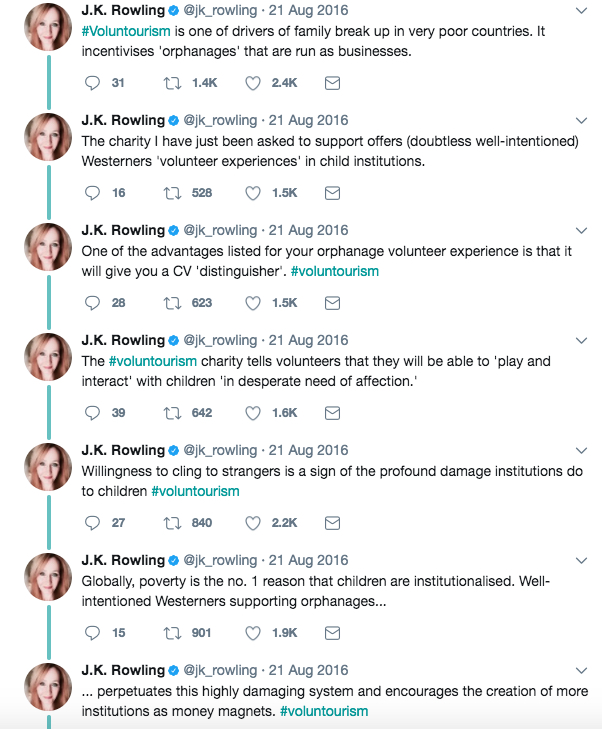
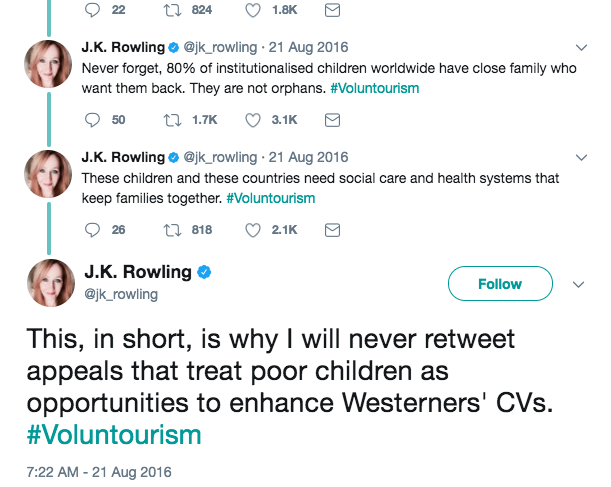
Voluntourism – where volunteers pay large amounts of money to go abroad for a few weeks, or even several weeks, to engage in a short-term activity that will give them a sense of helping people, animals or the environment – is a growing industry. I look at most of it with great skepticism in terms of actually helping anyone, because it’s focused on the wants of the volunteer – that feel-good, often highly photogenic experience – not the critical local needs of local people or the environment, and there’s little screening of volunteers – most everyone is taken, so long as they can pay. What these foreigners bring through these voluntourism programs is often not skills, experience or capabilities that cannot be found locally – it’s money.

The End Humanitarian Douchery campaign takes a much stronger stand against voluntourism in any form than I do, drawing attention to the negative consequences such can have for local communities in particular. The campaign organizers offer tips on “how to find a program that will have a truly POSITIVE impact on the host community.” Likewise, ‘Looks good on your CV’: The sociology of voluntourism recruitment in higher education, an academic paper by Colleen McGloin of the University of Wollongong, Australia and Nichole Georgeou, of Australian Catholic University, says that “voluntourism reinforces the dominant paradigm that the poor of developing countries require the help of affluent westerners to induce development. And this article is advice from someone who paid to volunteer abroad – and realized she shouldn’t be. All are worth reading, no matter where you stand on the issue of voluntourism or volunteering abroad.

I do think there are some effective short-term pay-to-volunteer abroad programs, among them Bpeace and Humanist Service Corps. But both of these programs are driven by what local people want, and they do NOT take just any volunteer that can pay.

This is my reality check regarding volunteering abroad, which reviews all the different types of programs. It links to many articles that discuss the dangers of voluntourism programs to local people, and to volunteers themselves, and to quality advice on how to make a real difference abroad.

July 17, 2017 updateCharities and voluntourism fuelling ‘orphanage crisis’ in Haiti, says NGO. At least 30,000 children live in privately-run orphanages in Haiti, but an estimated 80% of the children living in these facilities are not actually orphaned: they have one or more living parent, and almost all have other relatives, according to the Haitian government.

Also see “More harm than good? The questionable ethics of medical volunteering and international student placements” by Irmgard Bauer in Tropical Diseases, Travel Medicine and Vaccines, volume 3, Article number: 5 (2017)

April 11, 2018 update: Goats and Soda, a program on National Public Radio about news in the developing world, has an editorial about medical tourism. “Doctors and medical students are flocking to programs where they spend a couple of weeks to months volunteering in what’s called a ‘low-resource’ country. In these places, medical expertise and technology may lag behind richer nations. And sometimes their eagerness to help can have unintended negative consequences.” The official name of such programs is the “short-term clinical experience in global health” — which goes by the clunky acronym of STEGH. These overseas volunteers can end up doing harm: Perhaps a doctor performs a surgery, then goes home. The patient develops complications, and there’s no local health-care worker who can help them. Or maybe the visiting medical professionals offer free care that takes business away from local docs. Medical students might want to try a surgery they wouldn’t be able to do in the U.S. because they haven’t had enough training. Medications that are provided for these docs may be past their expiration date. And students sometimes are oblivious to local customs — say, that women dress modestly or a physician should not touch a patient of the opposite sex. Dr. Lawrence Loh, adjunct professor at the University of Toronto’s Dalla Lana School of Public Health, has researched and published widely over the past decade on the ethics of short-term volunteering abroad. he notes in the article:  “Medical missions, if not conducted with the local community, represent another form of cultural colonialism.” Regarding the problem of trainees overstepping their skill set, he notes, “The golden rule is if you can’t do it in North America, you probably can’t do it over there.” He stresses the importance of having faculty overseeing medical student volunteers. “We need to get away from the idea of parachuting into communities without consulting with local hospitals and clinicians.” The American College of Physicians has issued a position paper on “ethical obligations” for these medical volunteers, both doctors and students. Published in the Annals of Internal Medicine, the paper has been widely praised — but critics have also raised one major concern — no one from the developing world was part of the committee preparing the guidelines. Read the entire editorial about medical tourism here.

November 2019 update: Just found this resource – a 2014 paper, Medical voluntourism in Honduras: ‘Helping’ the poor? by Sharon McLennan of Massey University in New Zealand. It’s based on qualitative research with medical voluntourists in Honduras. The research found that while ostensibly helpful, volunteer tourism in Honduras is often harmful, entrenching paternalism and inequitable relationships; and that many voluntourists are ignorant of the underlying power and privilege issues inherent in voluntourism.” While there are examples of volunteer tourism as both educational and as a form of social action, the paper argues that these are not natural consequences of voluntourism but must be nurtured. As such this paper highlights some implications for practice, noting that addressing the paternalism inherent in much medical voluntourism requires an honest appraisal of the benefits and harm of voluntourism by sending and host organisations, education and consciousness-raising amongst volunteers, and long-term relationship building.

Also see:

Treat volunteers like employees? Great idea, awful idea

graphic by Jayne Cravens representing volunteersBack in 2009, the Volunteer Centre South Derbyshire, in England, featured one of my posts from UKVPMs (a discussion group for volunteer managers in the United Kingdom) on its blog in response to an article that says treating volunteers like employees is a great idea. I’m flattered that they thought my thoughts so worthy!

Here was the situation that I commented on:

In this commentary in the Guardian, the writer talks about a volunteer DJ at a small Christian radio project in South Manchester, England, who was fired when staff became aware that he is gay. The writer’s conclusion is that the employment laws need to apply to volunteers in order to protect them from being fired for no good reason.

Here was my response from UKVPMs (edited a bit for clarity):

On the one hand, I don’t believe in requiring volunteers to do things that staff are not required to do: background checks should be for everyone, not just the volunteers. The anti-discrimination policy of the organization applies to everyone, not just paid staff. Neither paid staff nor volunteer staff should be exploited or mistreated or neglected.

But on the other hand, I also come from the point of view that:

  • volunteering with a nonprofit is a privilege, not a right. I involve volunteers so long as it explicitly benefits the mission of the organization, and if forced to choose, my loyalty would be to the mission of the organization and those it serves rather than to a volunteer.
  • volunteers are human beings and should absolutely be expected to be treated as such, however, they are NOT employees, and therefore are not entitled by law to any of the same legal benefits of an employee.
  • volunteers are managed by a volunteer coordinator, rather than a human resources director, because volunteers are NOT employees.

So I read this article with a lot of empathy and sympathy, but then cringed at “Volunteers should be protected against unfair dismissal.” Legally protected? If so, legally protected how?

The primary consequence of an employee being unfairly dismissed is that he or she loses income. There are other consequences, but loss of income is the primary consequence, and we all know that income is necessary for survival. The laws that protect employees from being unfairly dismissed aren’t designed to do anything other than to prevent an employee from losing income and to restore an unfairly-treated employee’s lost income; the laws aren’t designed to restore anyone’s dignity or honor.

What would be the legal redress of a volunteer wronged? If a volunteer is granted the ability to sue regarding dismissal, what will the compensation be if whatever deciding body sides with the volunteer? Will he or she receive money? If so, say goodbye to volunteer involvement at probably most organizations; they aren’t going to risk that kind of financial expenditure. Reinstatement? The organization will be forced to involve the volunteer in his or her previous role? Does that volunteer then become untouchable, meaning the organization will have to keep the kinds of files, including regular evaluations, on volunteers that they maintain for staff in order to justify the disciplining, the requirement for training or the firing of a volunteer?

I guess in summary: I don’t ever want any volunteer dismissed for arbitrary reasons, I don’t ever want any volunteer mistreated or exploited, and I want us all to work to make sure that never happens, but I also don’t want volunteers to become employees, for a variety of reasons that I hope I’ve made clear (not sure I have).

And so I don’t really know what the answer is…

And I still don’t.

UK House of Lords Select Committee on Charities

graphic by Jayne Cravens representing volunteersThe United Kingdom’s House of Lords Select Committee on Charities was appointed on 25 May 2016 “to consider issues related to sustaining the charity sector and the challenges of charity governance.” The committee has issued a report, Stronger charities for a stronger society (HL Paper 133).

There are some good points in the report. For instance, the committee recommends that government funding of charities be “based on impact and social value rather than simply on the lowest cost.” The committee also encourages government “to recognise the added benefits of charities’ involvement in service delivery, and urge local authorities to consider grant programmes wherever possible.” And the committee also highlighted a great observation about risk aversion in mission-based organizations:

371. We also heard that risk aversion and a lack of organisational flexibility were a problem. NAVCA said that “charities need to be bolder, and boards need a greater appetite for risk, if the sector is to adapt and deliver greater impact in a changing world.” Rebecca Bunce from the Small Charities Coalition highlighted the consequences that resulted from trustees not understanding digital technology sufficiently.

372. Helen Milner said that trustees who were risk averse on digital tools were approaching the issue from the wrong starting point: “If they are saying, ‘Digital feels like a risk’, they are asking themselves the wrong question. They should be saying, ‘What is our strategy? Where do we want to be in three years’ time? How are we going to get there? Do we want to help more people and how are we going to reach them?’ Digital ought then, naturally, to become part of that solution.”

I really, really love that observation. Expect to see it quoted frequently by me in the future.

But, for the most part, the report is full of observations that should have been made 20 years ago – and were made 20 years ago by various consultants and nonprofits, myself included. I’m glad that a government body is realizing that “We are living through a time of profound economic, social and technological change and the environment in which charities are working is altering dramatically,” as the report says. But that’s a statement that could be said in the 1990s, when public access to the Internet exploded.

The report also never mentions virtual volunteering by name or concept, and that’s incredibly disappointing; virtual volunteering is a practice that is more than 30 years old. When this report talks about “digital technologies” being used by charities, it’s only to build awareness, not to support and engage volunteers. Meanwhile, on an online discussion group I’m on for managers of volunteers, the discussion last week was about the best platforms for training volunteers online. What a shame that the authors of this report are so out-of-touch regarding nonprofit, NGO and charity use of online technologies to engage and support volunteers.

The report also sees volunteers only in terms of economic value:

“The charity sector relies heavily on volunteers and many charities told us that they could not do their work without them. 372 The Association of Volunteer Managers suggested that the economic benefit of volunteering could exceed £50 billion a year, 373 while other witnesses highlighted the value of volunteers in community cohesion.”

Do I have to say yet again that this talk of the economic benefits of volunteer hours are why so many labor unions and others are turning against volunteer engagement? Do I have to say yet again that no volunteer says, “I really want to volunteer so I can save money by not being paid!” It’s true: deriding the monetary value of volunteer hours is now my mission in life

Also see:

Initiatives opposed to some or all volunteering (unpaid work)
& online & print articles about or addressing controversies regarding volunteers replacing paid staff

Involving volunteers: a cop out for paying staff?

More on the UK’s Big Society

Criticism Continues for UK Government Talk Re Volunteers

Changes in working with volunteers: scary & energizing

logoAlmost 20 years ago, I co-presented at the national conference in Orlando by the Corporation for National Service. The presentation was regarding the emerging senior volunteer — the Baby Boomer. I was the representative from Generation X, another presenter was a Boomer himself, and the other presenter was of the then current senior age group. We thought it was a rather benign but important topic. We certainly had fun putting together our presentation via phone and email (we were in different parts of the USA and had never met face-to-face until the day of the presentation).

The day of the presentation came, and we had a full room waiting to hear us. Our presentation began, with much energy: we talked about how the emerging senior volunteer — the Baby Boomer — wanted to volunteer their professional skills, not just stuff envelopes. How they were willing to commit a lot of hours provided it came with a high-level of responsibility. How they weren’t interested in giving unselfishly as much as wanting to have a real impact and feel like, as a result of their volunteering, they had made a real difference. How this was a great opportunity for volunteering programs…. right?

We were all but booed out of the room.

The workshop attendees, who worked exclusively with senior volunteers, primarily from the “Greatest Generation,” did not hide their venom for our message, and about 15 minutes into our talk, we knew we were in trouble. Amid sighs and folded arms and scowls, attendees started raising their hands to comment and express their obvious frustration. They called these emerging senior volunteers “selfish” and “lazy,” even “un-American.” The characterizations would have never been said about an ethnic group, but it was open season on Boomers. One said, “I’m not changing, and if they don’t like it, they can go somewhere else.” Another said, “I would rather our current volunteers die off and our organization close than work with these people.” One added, to me, directly, in front of the whole group, “You don’t want to know what I think of your generation.”

It was, by far, the angriest, most hostile group I’ve ever addressed.

The only comfort was after the presentation was over, after most of the attendees had stormed out of the room: a woman came up to us in tears — literally crying — and shook all of our hands, saying “I’ve tried to say the same thing, and they were like this to me too.”

More than 10 years later, I shared most of the above via a blog because of an article in the Associated Press that confirmed all that we said at that presentation. The article said boomer volunteers “are increasingly seeking to use their professional skills as volunteers, eschewing office and administrative tasks and seeking roles in marketing, publicity, fund raising, and management.” You can see the article by going to archive.org and looking for this URL:
www.nytimes.com/aponline/2010/03/04/business/AP-US-Retirement-Today-Volunteering.html

I’m reviving that blog, saved from a long-defunct platform, because I still think about this incident every time I get in front of a group or have a discussion about trends in volunteer management. In that previous blog, I also wrote:

  • I wonder what ever happened to all those very, very angry volunteer managers, who I don’t think hated boomer volunteers as much as they hated change. Did they quit their jobs? Did they begrudgingly change? Were they fired?
  • I’ve never worked with these “traditional” volunteers the AP article and others talk about, volunteers happy to do any mundane administrative tasks without question, who do whatever they are told without comment. I’ve been working with volunteers for many years, and they have always wanted something worthwhile through their service beyond just work to do.
  • I bet someone writes almost exactly this same story in five years in a major newspaper or wire service, implying it’s a “new trend.”

Of course, since that presentation, the management of volunteers has changed even more radically. I talked about this in May 2006 on my web site. And let’s be clear: innovations regarding management of volunteers aren’t really about technology. The innovation is using technology so that it is:

giving volunteers a bigger voice in what they do at an organization (and, in the end, actually giving them lots more to do, and even more responsibility, which they like very, very much), on engaging in activities that exude transparency and openness in all aspects of decision-making and management, and on being immediately responsive to volunteers’ and other supporters’ thoughts, suggestions and criticisms — and how not doing so isn’t because of a lack of resources but, rather, misdirected priorities and lack of transparency. Tiny nonprofit organizations with very little staff are doing extraordinary things with volunteers, and making the volunteers feel included and energized, not with pins and t-shirts but through greater and more meaningful involvement — and this movement is being fueled by inclusive uses of technology.

It makes for another big challenge to many people who are expected to successfully engage volunteers, but it’s also a big opportunity to raise the profile of volunteer managers within organizations. It makes volunteer management a lot more interesting.

Are you ready? Scared? Angry? Let’s hear from you in the comments below.

Also see:

If you have benefited from this blog or other parts of my web site or my YouTube videos and would like to support the time that went into researching information, developing material, preparing articles, updating pages, etc. (I receive no funding for this work), here is how you can help

Short-term deployments with Peace Corps & UNV

From February 2001 to February 2005, I worked at the headquarters of United Nations Volunteers, in Bonn, Germany. Sometimes, people outside the UN would say, upon learning where I worked, “Oh, you’re just a volunteer?”

My UNV colleagues would get this comment too, and would visibly bristle at the idea that anyone would think they were a volunteer!  They would quickly assure the person that they were not merely a volunteer – they were, in fact, a fully-paid staff person with a UNDP contract!

By contrast, here’s how I would answer such a comment:

Oh, no, I’m not a UN Volunteer. I don’t think I’m qualified to be a UN Volunteer. I would probably be turned away if I applied. International UN Volunteers are experts in their professional field, highly skilled and experienced. I’m just an employee at headquarters, and my role is to support UN volunteers out in the field, doing amazing things.

A UNV HQ colleague was with me once when I said that, and her eyes became huge when she heard my response. Later, she told me she’d never thought of UN Volunteers the way I had talked about them, and that it had never dawned her that, in fact, maybe she wasn’t qualified to be a UN Volunteer either.

I know of two UNV HQ staff, both my colleagues and dear friends, who decided to apply to become international UN Volunteers themselves, were accepted into the UNV roster, and were deployed for two years to a developing country. Both of these colleagues worked in ICT. After those in-the-field experiences, they went on to be employees at other UN agencies, and I thought it was a shame UNV hadn’t worked hard to entice them back to HQ, as they would have brought a much-needed perspective to headquarters.

As I was leaving UNV HQ, where I managed the UN Online Volunteering service and helped manage the United Nations Information Technology Services (UNITeS), I decided to apply as an international UNV myself. I decided that maybe I had acquired the qualifications at last to be a UNV. I was delighted when I was accepted into the UNV roster – the UNV staff that decided which applications to accept were in Cyprus, I had no personal relationship with them at all, and there was no policy (and still isn’t) on automatically accepting UNDP staff as UN Volunteers. I was available only for six-month assignments, however, and those were, and are, few and far between. I interviewed for two such assignments – and didn’t get either. Which should just go to show you how competitive the process to be a UNV is. I eventually got a six-month UNDP gig in Afghanistan, but it was as a consultant, not a UN Volunteer.

Now, at this time in my life, I can no longer do a full six-month assignment, so I doubt I’ll ever deploy as a UNV. When you read about me going to abroad for a UN gig now, it’s for less than four months – like in Ukraine – and, again, it’s as a UNDP contractor (which I love – great colleagues, fascinating work and the pay is good).

But there is this part of me that still really wants to go abroad as a volunteer.

So, for more than two years, I’ve been watching listings at the Peace Corps Response web site. This is a program by the Peace Corps that places highly-skilled volunteers in short-term assignments abroad, from four to 12 months. It’s open to US citizens. I’ve been looking for an appropriate four-month gig and, at long last, I’ve applied for a position. I think it fits my expertise perfectly. But I also know that this is a highly-competitive program, and I may not even make the interview round. Still, it was fascinating to go through part of the Peace Corps application process. I’ve also been a reference for a friend that applied for the regular Peace Corps, so I’ve seen that part of the online process as well.

Fingers crossed!

One last note: the Peace Corps Response program, the entire Peace Corps program, and all United States Agency for International Development (USAID), are under threat of severe cuts by the current Presidential administration in the USA, as well as by current Congressional leadership. I encourage you to write your US Congressional Representative, your US Senators, national media and your local media, and let them know what you think of these proposed cuts.

April 20, 2018 update: Here is a blog by Jasmin Blessing, a UN Volunteer with UN Women in Ecuador. It is a really nice example of what effective volunteering abroad looks like.

Also see: