What can you do in a gap year during a pandemic

I am seeing questions on Quora and Reddit about what to do in a gap year from university during the pandemic, from people who seem to think that there’s a safe place to go, and a safe way to get there, without contracting nor spreading the novel coronavirus. It’s so frustrating – the reality is that no one should travel now unless it’s essential travel, and certainly not for a year: situations within countries, at borders and on airlines change dramatically from month to month, which can strand you somewhere abroad, with hotels or homestays closed, plus, you could contribute to the spreading of the virus, even if you never contract it yourself.

So, what ARE the options for a student who decides not to start a new semester or entire study year at a university in the Fall or Spring?

You could, in a gap year, or gap semester, stay in your community and:

The more you volunteer, the more you will be transformed by the experience, the more you will learn, and the more you should see leadership opportunities you might want to initiate or undertake. You may end up leading your own virtual project at a program you have worked with and established trust with.

You can also:

  • Trace your family tree, scan family photos, upload those photos online and record family members on video calls talking about family memories. There will never be a better time to work with family members online to get your family names and dates and places and stories recorded.
     
  • Study another language. Duolingo and Babbel are two great resources.
     
  • Take classes that are NOT offered at the university you will attend. Some good resources for free courses are Open University’s Open Learn and MIT’s Open Courseware.

The key to any of the above working is that you need a SCHEDULE and a COMMITMENT. Create a workspace where you will do these things. Carve out a regular time of day and days of the week you will do these activities. Create deadlines. Track your progress. Celebrate your accomplishments and results. Learn from your mistakes and challenges. Document your experiences with a journal or a blog or YouTube videos. And if you do this, then at the end of a year, you will have something much more substantial to show for it than Instagram photos that say, “Hey, look at me!” You will have something much more substantial than vanity volunteering. In fact, you will have proven you can work remotely, something employers very much like to see.

Also see:

If you have benefited from this blog or other parts of my web site and would like to support the time that went into researching information, developing material, preparing articles, updating pages, etc. (I receive no funding for this work), here is how you can help

How to create partnerships for virtual volunteering

Volunteers have always been the drivers of virtual volunteering, much more than programs that host volunteers. And it’s still true now, in 2020.

Back in the 1990s, when Impact Online (now VolunteerMatch) launched one of the first volunteer-matching services online, there were FAR more people visiting the web site that wanted to volunteer than there were organizations posting assignments, and those assignments were supposed to be all ONSITE, but volunteers kept asking Impact Online staff for things they could do ONLINE. That’s why Impact Online launched the Virtual Volunteering Project in 1996: to promote the idea of involving online volunteers to host organizations and train them on how to do it. When I began directing the UN’s Online Volunteering service in February 2001, I stopped all outreach to potential volunteers and turned all attention to outreach to and support for potential host organizations, because this global service had the same issue: far more volunteers wanting to serve online than there were things for them to do.

Here we are decades later, with a global pandemic and thousands and thousands of volunteers wanting to engage online, but not able to find enough opportunities. I see it all over the Internet, particularly on the Reddit community – the subreddit – dedicated to discussions about and resources regarding volunteering, r/volunteer: young people, with no experience in mentoring, tutoring or counseling, are trying to launch their own virtual volunteering initiatives, recruiting plenty of volunteers but then not being able to find schools or programs to work with.

I’m doing my best to help schools, nonprofits, NGOs, charities and government agencies quickly launch roles and activities for online volunteers, with

But I cannot do this alone. Those of you who want to volunteer online have to help. You are going to have to help schools, nonprofits, NGOs, charities and others that you want to help online to create online roles and activities and to learn about the benefits of virtual volunteering. Otherwise, you are going to continue to be frustrated.

First, do NOT write an organization and say “We want to partner with you!” Words like “partner” and “partnership” are too big, too daunting, for most programs to think about. It sounds like lots of work with no funding. It’s not a message schools, nonprofits, etc. want to hear.

Instead, your first outreach should be something like this:

Hello! We are a group of five students / employees from name of school / company, and…

  • we saw that you have 10 videos on YouTube about your program, but they are not closed-captioned / they are not captioned correctly. We would like to volunteer to fix that for you over the next two weeks…
  • we would like to help make your web site be more accessible for people with disabilities. We could spend 10 hours for one week next month adding alt text to all of the photos and graphics on your site and changing all of your “read more” and “click here” links to descriptive links that would make sense for those with a sight-impairments…
  • we would like to translate all of the text from your last newsletter to Spanish…
  • we would like to help create a monthly podcast for your program for the next four months. Each month, we would interview a staff member or a recipient of your program’s service and adapt that recording to a 15-minute podcast format, with intro and exit music, appropriate edits and full text transcription. We would help you post this to…
  • We think the work our local historical society is so important, and we would like to work with you to improve these listings on Wikipedia regarding our local history…

And adding:

We want whatever we do for your program as online volunteers, entirely unpaid, to be something your program wants and needs, something that will be meaningful and beneficial to your organization, not just something we can do. Could we meet by video conference sometime next week to explore these ideas?

In other words, you need to be specific about the project or activity you want to do with them as online volunteers, and to make it clear that your are offering as volunteers and do not expect any payment whatsoever. You need to make it sound like a great idea that isn’t going to cost the organization anything and isn’t going to create more work for them and isn’t going to require a long-term investment. Your outreach needs to prompt a program to say, “We need and want this!” Remember: most nonprofits, NGOs, schools and other community groups are overwhelmed with work, severely under-staffed and facing massive budget cuts. They don’t have time for any more work whatsoever. They will be open to ideas for projects that will immediately have benefits to their organization, especially in terms of attracting more financial support.

Your goal with that initial project is to provide such a great experience that the nonprofit, charity, school or NGO is open to further collaborations – and perhaps much more advanced activities, like from this list of high impact virtual volunteering projects. But first, you have to give them a simple, worthwhile experience that creates a solid, trusting relationship.

Do not write a program and suggest a big, ambitious project that they do not have a great deal of experience doing OFFLINE already. That means you don’t write a senior residence facility and say, “We want to start an online friendly visitor program with your residents!” Who will screen your volunteers to ensure they are appropriate for coming in contact with this vulnerable population? Who will train volunteers regarding appropriate and inappropriate topics of conversation, how to get started with a first conversation, etc.? What will your safety standards be? How will you set boundaries – what if a resident starts calling and texting a volunteer frequently throughout the week and this is beyond what the volunteer wants to be involved with? In other words, a lot of virtual volunteering projects require way more than just a platform for interactions.

Also see:

vvbooklittle

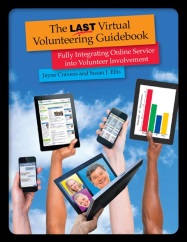
For much more detailed advice on creating assignments for online volunteers, for working with online volunteers, for using the Internet to support and involve ALL volunteers, including volunteers that provide service onsite, and for ensuring success in virtual volunteering, check out The Last Virtual Volunteering Guidebook. Tools come and go – but certain community engagement principles never change. You will not find a more detailed guide anywhere for working with online volunteers and using the Internet to support and involve all volunteers – even after home quarantines are over and volunteers start coming back onsite to your workspace. It’s available both as a traditional paperback and as an online book. It’s co-written by myself and Susan Ellis.

If you have benefited from this blog or other parts of my web site and would like to support the time that went into researching information, developing material, preparing articles, updating pages, etc. (I receive no funding for this work), here is how you can help

You do not need to meet via video conference with every potential volunteer

Most virtual volunteering assignments are text-based or designed-based: translating text from one language to another, transcribing podcasts, captioning videos, managing an online discussion group, designing a database, designing a graphic, and on and on. And one of the reasons I have really loved virtual volunteering is that, when it’s also limited to text-based communications with volunteers, potential volunteers can’t be judged regarding how they look or sound. Instead, volunteers in virtual volunteering, at least until recently, are judged by the quality of the character they show through their words and work. I don’t like to think of myself as prejudiced, but I have often wondered if I have been reluctant to involve a volunteer onsite because of unconscious bias on my part upon meeting a volunteer candidate face-to-face.

Virtual volunteering encounters in previous years have hidden the weight, ethnicity, hair color, age, accents, and other physical traits of online volunteers from the person onboarding that volunteer, and vice versa. But now, video conferencing is all the rage, and many programs are requiring that volunteer applicants participate in a live online meeting before they can volunteer online. As Susan Ellis and I note in our book, The Last Virtual Volunteering Guidebook:

Today’s preference to actually see and hear each other online is a double-edged sword: it can make electronic communication more personal and personable, but it can also inject offline prejudices evoked by how someone looks.

As a result of this rush to online video, are online volunteering candidates being turned away from programs because of possible but unacknowledged biases on the part of the manager of volunteers or whoever is initially screening applicants?

Are people that want to volunteer online hesitating to apply because they do not like how they look on video, don’t feel confident regarding their speaking voice or presentation skills, or are uncomfortable with welcoming someone “into” their home, even virtually?

Do people that would be interested in volunteering with you online on a text-based assignment decide not to apply because their Internet access isn’t fast enough for live video conferencing?

Are there people that would be interested in volunteering with you online that aren’t in your same time zone or who work or have home care duties that prevent them from being available at all the times you want to have a live video chat?

Think carefully before you make a meeting by video with potential volunteers mandatory. Is such a video meeting really necessary for the assignment the volunteer will do? Absolutely, certain tasks and roles require you to know if the volunteer is well-spoken, understands how to present themselves in a reputable, credible, clear manner, etc. But if it’s not required, per the role the volunteer is applying for, then consider how to balance your need for something personal with the volunteer’s desire for privacy. Consider how freeing it can be for a volunteer to be judged by the excellent web site they build for you rather than the physical disability people see immediately upon meeting them (not that people with disabilities EVER want to hide!). Consider how good it can feel for a person who is uncomfortable with his or her weight to be valued because of the excellent moderation skills and dynamic personality they show on your online community (again, not that any person, regardless of their weight, should EVER want to hide!).

vvbooklittle

For a lot more about screening and orienting online volunteers, as well as designing tasks, providing support for volunteers using online tools, evaluating virtual volunteering, designing an online mentoring program and much more, check out The Last Virtual Volunteering Guidebook, available for purchase as a traditional print book or as a digital book. The book is an oh-so-much-cheaper way to get intense consulting regarding every aspect virtual volunteering, including more high-impact digital engagement schemes, than to hire me. You will not find a more detailed guide anywhere for working with online volunteers and using the Internet to support and involve all volunteers. It’s available both as a traditional paperback and as an online book. I also think it would be a great resource for anyone doing research regarding virtual volunteering as well.

Also see:

If you have benefited from this blog or other parts of my web site and would like to support the time that went into researching information, developing material, preparing articles, updating pages, etc. (I receive no funding for this work), here is how you can help

Schools & Courts: you need to accept historical transcription online projects as community service

Projects abound where online volunteers transcribe scanned documents for universities, nonprofits and government archives. By doing this, the documents become more searchable for researchers and more accessible to everyone. Through these programs, online volunteers are helping to amplify and preserve the stories of escaped enslaved people, the thoughts of and to people like Abraham Lincoln, Theodore Roosevelt, people who attended political meetings held at the state and national levels in the 1800s to free enslaved people or gain women the vote, and on and on. It can be a surprisingly intimate experience for the volunteer, one that benefits many thousands of people for years – for generations – to come.

I’ve done this myself as an online volunteer, and it was quite an emotional experience for me, transcribing newspaper ads seeking people who had escaped enslavement in the 1800s in the USA, part of the Freedom on the Move (FOTM) project. I have a list of every online transcription project for online volunteers that I know about at this resource on finding virtual volunteering roles and activities.

These historical transcription projects are wonderful virtual volunteering experiences, but most schools and courts will not accept this volunteering for required community service because they have a piece of paper that must be signed by someone from the project affirming that the volunteer did the service.

YA’LL NEED TO CHANGE.

These historical transcription projects are PERFECT for both students seeking community service hours required for graduation and for people who are ordered by the courts to do so.

Using suggestions already in The Last Virtual Volunteering Guidebook: Fully Integrating Online Service Into Volunteer Involvement and a previous blog on supervising online volunteers in court-ordered settings as guidance, here’s how high schools and courts could verify community service hours via online historical transcription projects:

  • Require the volunteer to keep track of service hours on a Google Doc spreadsheet that that person gives you access to for viewing, so you can check-in at any time to see if they have updated it. It should have the name of the project or organization, a web address for more info, the date and time of volunteering service provided by the volunteer, the hours or minutes spent, and a summary of what the volunteer did (“transcribed a letter by George Washington to Alexander Hamilton from June 1775.”). Check into that spreadsheet weekly or every other week to see if it’s been updated.
  • Require that the volunteer take a photo on their smartphone every time they start transcribing a new document and every time they finish, and that they upload this photo to a private Flickr account album (Flickr is free), one that only the user (the volunteer) and you can see. You can spot check the time and date stamps on photos to see if the data corresponds to the aforementioned spreadsheet data (just spot check – you don’t have to do them all).
  • Require the volunteer take a screenshot of each document they are going to transcribe, and each transcription they complete, and to upload these screenshots to the aforementioned Flickr account album. This provides more documentation for confirming if a person did the assignment.
  • Require the volunteer take a selfie of himself or herself at the computer, about to do the work and then again at the completion, and upload these screenshots to the aforementioned Flickr account private album that only you and that volunteer can see. This provides more documentation for confirming if a person did the assignment.

Give the volunteer one to two hours of credit for service hours JUST for setting up and maintaining the Google Doc and the Flickr account correctly.

Could a volunteer fake all this? Yes, and it would take that volunteer about as many hours to create the fake documents, screenshots and summaries as it would for them to do the ACTUAL volunteering and record-keeping – meaning they would still have had to do all this time to fulfill community service hours, even if they didn’t end up doing what they said they were doing.

Could someone else do all of this service for the person? Yes: a parent, a sibling, a friend, or someone the person pays could do all of this. And this happens in onsite, in-person volunteering. People also frequently show up to volunteer at a beach clean up as community service, sign in, go sit in their cars and smoke or listen to music, then come back at the end and get their paperwork signed off that they did the hours. It’s the chance every program takes in not supervising people doing community service every moment. While Lindsay Lohan probably had her assistance do her online court-ordered community service, I don’t think most people do.

Doesn’t this create a lot of followup by the assigning body? Yes. For schools, keeping track of this is a GREAT assignment for an online volunteer, or group of online volunteers. For courts: sorry, but you all have never done well in this department with onsite, face-to-face folks – I’ve seen the forged paperwork first-hand for nonprofits that don’t exist or for nonprofits that have never seen or heard of the person that supposedly did the service. Let this be your opportunity to up your game in terms of confirming court-ordered community service completion.

cover of Virtual Volunteering book with hands raising up various Internet connected devices

There’s also my book, co-written with Susan Ellis which goes into a great deal of detail on supervising and supporting online volunteers, and how to track their progress: The Last Virtual Volunteering Guidebook: Fully Integrating Online Service Into Volunteer Involvement. In this time of a global pandemic, as well as this time where every program should be looking at how to be more inclusive and accommodating for working parents, people with home care requirements (for children for parents, for other relatives, etc.), people with transportation issues and people with disabilities, every program that relates to people completing community service for a graduation requirement or a court requirement should read this book.

Here are all of my blogs about some aspect of court-ordered community service.

If you have benefited from this blog or other parts of my web site or my YouTube videos and would like to support the time that went into researching information, developing material, preparing articles, updating pages, etc. (I receive no funding for this work), here is how you can help

How Wikipedia’s volunteers became the web’s best weapon against misinformation

Interesting article from Fast Company that offers insights on the quality of service volunteers – unpaid staff – can provide:

While places like Facebook, YouTube, and Twitter struggle to fend off a barrage of false content, with their scattershot mix of policies, fact-checkers, and algorithms, one of the web’s most robust weapons against misinformation is an archaic-looking website written by anyone with an internet connection, and moderated by a largely anonymous crew of volunteers…

Wikipedia is not immune from the manipulation that spreads elsewhere online, but it has proven to be a largely dependable resource—not only for the topics you’d find in an old leather-bound encyclopedia, but also for news and controversial current events, too. Twenty years after it sputtered onto the web, it’s now a de facto pillar in our fact-checking infrastructure. Its pages often top Google search and feed the knowledge panels that appear at the top of those results. Big Tech’s own efforts to stop misinformation also rely upon Wikipedia: YouTube viewers searching for videos about the moon landing conspiracy may see links to Wikipedia pages debunking those theories, while Facebook has experimented with showing users links to the encyclopedia when they view posts from dubious websites…

Wikipedia’s lessons in protecting the truth are only growing more valuable.

But all is not well at Wikipedia among the volunteers:

As many of the site’s own editors readily admit in dozens of forums, the community is plagued by problems with diversity and harassment. It’s thought that only about 20% of the editing community is female, and only about 18% of Wikipedia’s biographical articles are about women. The bias and blind spots that can result from those workplace issues are harmful to an encyclopedia that’s meant to be for everyone. Localization is also a concern given Wikipedia’s goal to make knowledge available to the whole world: The encyclopedia currently exists in 299 languages, but the English version still far outpaces the others, comprising 12% of the project’s total articles.

The community has also struggled to retain new blood. Editors often accuse each other of bias, and some argue that its political pages exhibit a center-left bent, though recent research suggests that the community’s devotion to its editorial policies washes that out over time. Less-experienced editors can also be turned off by aggressive veterans who spout Wikipedia’s sometimes arcane rules to make their case, especially around the encyclopedia’s more controversial political pages.

The article’s author took a crack at editing, using WikiLoop Battlefield, a community-built website which lets anyone review a random recent Wikipedia edit for possible vandalism or misinformation. After using it to correct and entry, a few days later, a message popped up on the author’s Wikipedia user page.

“Congratulations,” it read. “You have been recognized as the weekly champion of counter-vandalism of WikiLoop Battlefield.”

For a moment I felt like a hero.

I wonder how many volunteers can say an organization they support made them feel that way.

And for those of you interested in editing Wikipedia – this Wikipedia Cheat Sheet is essential.

Thoughts on new UN paper re: Volunteering Practices in the 21st Century

Two decades after the International Year of Volunteering 2001, the United Nations General Assembly requested the United Nations Volunteers program and the International Federation of the Red Cross and Red Crescent Societies (IFRC) to organize a Global Technical Meeting on “Reimagining Volunteering for the 2030 Agenda” in July 2020 as a milestone in the Plan of Action to Integrate Volunteering into the 2030 Agenda. A resulting associated paper, “Volunteering Practices in the Twenty-First Century,” revisits the 1999/2000 background paper “Volunteering and Social Development“. The new paper is available in ArabicChinese, English, French, Russian and Spanish.

I love the paper! Author Chris Millora, UNESCO Chair in Adult Literacy and Learning for Social Transformation at the University of East Anglia, United Kingdom, has done what I have begged volunteer management trainers and researchers to do since 2014: for the most part, HE DOESN’T SEPARATE ONLINE VOLUNTEERING FROM ONSITE VOLUNTEERING. Yes, the paper acknowledges that volunteering can happen onsite or online, but otherwise, people are just volunteers – not in the sense of merely but in the sense of solely. Virtual volunteering is completely incorporated into how volunteering is presented in Millora’s paper, rather than being talked about as something completely separate. For instance, in reviewing what the paper calls “the five categories of volunteering,” – Mutual aid or self-help, Philanthropy or service to others, Participation, Advocacy and Leisure, two examples are presented to illustrate “volunteer activities include various combinations and intensities of these elements,” and both of the examples include virtual volunteering elements – but neither example separates online volunteers as somehow completely different than traditional onsite volunteering (page 17). When this paper says

Volunteering is relevant throughout people’s lives and people may take part in multiple aspects at different times. Volunteering is both a means and an end to achieving, challenging, disrupting and even shaping development outcomes.

It means ALL volunteering – onsite, online, microtasks/episodic, high-impact, and on and on.

Remember why Susan Ellis and I called our book The Last Virtual Volunteering Guidebook? What we didn’t mean is that there will or should never be a further need to write or talk about the latest developments in engaging volunteers online. What we do mean is that we hope that talk about virtual volunteering stops being segregated to a separate book or separate chapter at the end of a book or report about volunteer management or volunteerism, that volunteers are just VOLUNTEERS, no matter where they do their service. Millora’s paper does that!

In the paper from 20 years ago, Volunteering and social development, by Justin Davis Smith, virtual volunteering is hinted at but never named. The only reference is when the paper notes that communication technology tools “open up new opportunities for voluntary activity” and “the spread of global information technology opens up new opportunities for home-based involvement in volunteering for groups, such as disabled people, who were previously excluded from participation” – both are references to virtual volunteering but without ever saying the term. It was so disappointing, because, at the time of this paper’s creation, the Virtual Volunteering Project had existed for three years and had already documented a few hundred programs engaging thousands of online volunteers, and the NetAid web site had been launched in September 1999 and involved UN Volunteers and UNDP. It’s so strange that none of this is mentioned. Very glad that the new paper is spot on in putting virtual volunteering in its rightful place within talk of volunteerism and its importance to the world.

As I have said over and over, virtual volunteering is more than 35 years old, it’s not new, it can no longer be considered innovative, and online volunteers don’t think of themselves online volunteers – they think of themselves as volunteers. There will still be presentations and trainings and books on different ways volunteers provide service and different aspects of volunteering engagement – group volunteering, micro-task/micro-volunteering/episodic volunteering, youth volunteering, accessibility, diversity, and, yes, virtual volunteering. And that’s how it should be. But in talks about volunteering and volunteerism, it’s so overdue to stop segregating virtual volunteering from onsite, traditional volunteering. Chris Millora gets it. Others?

Also see my video submission regarding the Global Technical Meeting on Reimagining Volunteering for the 2030 Agenda (it’s very short).

If you have benefited from this blog, my other blogs, or other parts of my web site and would like to support the time that went into researching information, developing material, preparing articles, updating pages, etc. (I receive no funding for this work), here is how you can help

Delivering arts programming online & helping arts nonprofits survive COVID-19

Let’s get right to this list of resources for nonprofit theaters, dance groups, music groups and other performance groups regarding program delivery and community engagement during COVID-19 (a curated list):

How Theater Companies are Innovating During the COVID-19 crisis

Dance Magazine checks in with three artistic directors to see how they’re handling life in the age of coronavirus. Apr 09, 2020

Coronavirus pushes L.A. dance companies toward the inevitable: Going virtual

Gibney Agnes Varis Performing Arts Center COVID-19 RESOURCE LIST

Theatre community rallies, adapts during COVID-19 pandemic

COVID-19 Theatre Resources from the SETC

Resources for Choral Leaders/Managers During the Pandemic

Genuine engagement through Zoom calls: a post on the TechSoup community from someone who says she “learned a lot about hosting fun and effective video sessions, including music circles with up to 100 participants from up to seven countries.”

21 simple things to do while your programs are on hold during COVID-19 quarantines   

Your nonprofit is still relevant during COVID19 – SHOW HOW 

What we will need for live theatre to continue: a call to political action

Update: Arts Groups Hold Pittsburgh’s First Virtual, Collective Fundraiser.

Update: Washington Ballet “virtual” gala spreads COVID-19 among artists and volunteers.

Update: Example of a virtual art therapy session.

if you have additional online resources that can help nonprofit theaters, dance groups, music groups and other performance groups regarding program delivery and community engagement during COVID-19, please comment below.

Why do I care? Theatre and live music performances have been a hugely important part of my life for as long as I can remember. They were my joy in grade school and my sanctuary on more occasions I could list. I believe the arts, including non-performance, like museums, play a fundamentally-important role in a community’s health.

I got my start in nonprofit management via nonprofit theatre organizations. I wrote my master’s degree thesis on the non-artistic elements necessary for theatre, dance and music to be used as a tool for public health and other community development initiatives. Months ago, I had written a blog about how arts organizations – performing arts centers, theaters, museums – have always been masters of customer relations and data management, how masterful the best of them, no matter how small, are at customer relations and customer loyalty, and turning event attendees into long term financial supporters. I consider my early professional experience at places like the Capitol Arts Center in Bowling Green, Kentucky, Hartford Stage in Connecticut and the Williamstown Theatre Festival in Massachusetts to have been pivotal in building my skilIs in data management, project management, customer relations and so much more, skills I’ve applied in every job I have ever had, including international development work in Afghanistan – yes, really. It was a blog meant to celebrate arts organizations for having oh-so-much to teach other nonprofits – and government programs and for-profit companies as well. I kept delaying the publishing of that blog. First by a week, then two weeks, then a few weeks, because things came up that seemed more urgent. I figured that I would publish it right after I got back from my epic Baja, California, Mexico motorcycle adventure.

Well, when I got back from that epic adventure, I returned to a country being ravaged by Covid-19, an inbox full of emails asking me urgently for my consulting rates regarding virtual volunteering, and GoogleAlerts filled with news of newly-launched virtual volunteering schemes (many done with no regard to safety). So that blog got pushed farther and farther on the publishing calendar.

And now, I read the draft, and I want to cry. Because live theater, live dance, onsite museum tours, live music… none of that is happening. And none of that may happen for the rest of 2020. And many nonprofits that produce these events and exhibits aren’t going to survive the year. I have so many friends that still worked in the arts in some way, or some aspect of event management, and their jobs are gone.

Sports will come back. People will watch sports on TV even with no audiences. But the arts… can they survive this? I enjoy watching filmed versions of stage productions, but so many people loathe it, and it’s true: it’s no substitute at all for seeing a performance live. Maybe I’m comfortable with viewing televised productions because, growing up in a small town In Henderson, Kentucky, things like Great Performances on PBS were my only way of seeing Broadway shows or the opera. I go back to that grateful persona, starving for access when I watch Frankenstein presented by the UK’s National Theatre Live, or the Donmar Warehouse all-female production of Julius Caesar directed Phyllida Lloyd and shown on Great Performances. So often, such televised productions of stage shows are all I have access to – and that’s true for so many others.

But I long to sit in a dark hall and watch people act on a stage. Or to stand shoulder-to-shoulder with others while hearing amazing live music. Or wander through an art museum, not thinking about being two meters away from each other person. And it looks like none of us can do that safely for the rest of 2020. And maybe through 2021. And maybe longer. And the nonprofits, and even for-profit companies, that have brought us these experiences, may not survive. And that sends me into an emotional tailspin.

And not one national political leader is talking about what to do about this.

If you have benefited from this blog, my other blogs, or other parts of my web site and would like to support the time that went into researching information, developing material, preparing articles, updating pages, etc. (I receive no funding for this work), here is how you can help

Setting up an online mentoring program

I have certain keywords in my Google Alerts notifications via email, so I know about news articles, blogs and public online discussions that mention virtual volunteering, among various other topics. As you can imagine, with the current pandemic, my daily Google Alert emails are very long these days (before the pandemic, I would go many days with no updates at all).

One thing I’m seeing regularly in these updates are articles about schools that are scrambling to set up online mentoring programs, where adults will mentor or tutor students, like this article out of Florida:
Leon County Schools considers virtual volunteering opportunities in reopening plan.

I’ve been researching and training on virtual volunteering, including online mentoring programs, since the 1990s, and for all of the various school districts and individual school districts out there, I wanted to let you know about some free resources I have that can help you in setting up an online mentoring or online tutoring program:

  • Five free on-demand videos that, altogether, are less than an hour & take you through the fundamentals of virtual volunteering, of engaging volunteers online (policies, creating assignments, safety, confidentiality, support, much more).
cover of Virtual Volunteering book with hands raising up various Internet connected devices

There’s also my book, co-written with Susan Ellis, which isn’t free, but does go into a great deal of detail on how to set up an online mentoring program: The Last Virtual Volunteering Guidebook: Fully Integrating Online Service Into Volunteer Involvement. One of the most important bits of advice from the book regarding online mentoring or online tutoring, something I learned from two decades of looking at various such programs: don’t try to launch online versions of these programs unless you have been doing ONSITE versions of these programs. If your school had an onsite mentoring program before the pandemic, or you have staff that has experience with onsite mentoring elsewhere, by all means, pursue setting up an online program. But if your school didn’t have an onsite mentoring program already, if your school wasn’t already involving ONSITE volunteers, you need to give online mentoring or tutoring a LOT more thought and I can guarantee that you are NOT ready to start a program in the Fall of 2020!

If you are a volunteer at a school or a concerned parent of a student at a school and you know that school might be considering online mentoring or online tutoring, I hope you will consider buying The Last Virtual Volunteering Guidebook and giving it to the volunteer coordinator at the school, who may not have the budget for such.

July 9, 2020 update: For those of you wanting to start an online mentoring or online tutoring program, please AT LEAST read the standards for screening participants for an online mentoring program (both volunteers and mentees), from E-MENTORING SUPPLEMENT TO THE ELEMENTS OF EFFECTIVE PRACTICE FOR MENTORING, December 2019, a publication of MENTOR (formerly the National Mentoring Partnership). On a related note, in the UK, SWGfL has issued Safeguarding considerations and guidance when appointing online tutors for Schools in England, that includes a Recruitment Checklist, an Expectations Checklist, and Induction Checklist, and several links to other resources that should be applied to both online mentoring and online tutoring. If you are starting an online mentoring program in the UK, you need to read through at least this web site and what it links to and make sure your program adheres to the guidelines from experts in mentoring. If you are outside of the USA and the UK, both of these resources are still essential reading, in order to keep all participants safe.

More: systemic racism in volunteer engagement

graphic by Jayne Cravens representing volunteers

Earlier this month, I wrote a blog about systemic exclusion, including systemic racism, in volunteer management – in how we recruit volunteers, in how we screen volunteers, even in virtual volunteering. It’s been my most popular blog this year, and my most re-posted & retweeted by others – thank you to all who read and shared and commented (so far, comments have been on LinkedIn and Twitter, rather than on the blog itself).

There’s another place that systemic racism shows up in volunteer engagement, and it is something that’s been discussed for a few years now. It’s the practice of the White Savior. The term white savior, sometimes called white savior complex, refers to a belief and practice, conscious or not, that it takes white people to provide effective help to non-white people, and in the practice of volunteerism, it’s usually most common in the practice of white people from North America, Europe and Australia feeling that they are needed in Africa to dig wells, build schools and playgrounds, “care” for “orphans” for a few weeks, etc. That is a form of white supremacy, even if the volunteers themselves would never identify as racist and may even be vocal advocates against racism, as a concept or practice. Much of what is called voluntourism is rooted in white supremacy.

But this is not just a characteristic of voluntourism – paying to go abroad and “volunteer” for a few weeks, or international programs like Feed My Starving Children, which ship food to people in developing countries, rather than buying food from local sources in those countries, which both feeds far more local people than food donations every could and gives much-needed jobs to local people – also rooted in white supremacy (and vanity volunteering, for that matter). White supremacy can also be found in some volunteering within the USA (and no doubt other countries as well).

Again, I want to emphasize that this isn’t to imply that white volunteers are racists. But I do emphasize that volunteers can participate in systems that have roots in white supremacy without knowing it, even in their own communities.

One of the few academic articles I’ve seen looking at this is However Kindly Intentioned: Structural Racism and Volunteer CASA Programs, published in March 2017 and written by Amy Mulzer, a Staff Attorney and Clinical Instructor of Law in the Disability and Civil Rights Clinic, Brooklyn Law School, and Tara Urs, an Attorney for The Defender Association Division of the King County Department of Public Defense. CASA stands for Court Appointed Special Advocates: volunteer guardians appointed by the family court to represent the “best interests” of children who enter the child welfare system. The paper looks at the impact of the race and privilege of these volunteer child advocates on child welfare decision-making. “There is reason to question the power that CASAs have been given to influence the course of children’s lives, and even more reason to question the unhesitating acceptance of this state of affairs by the majority of those working within the system. Why does the legal system assume that a group of volunteers — mostly middle-class white women — will make better decisions for a low-income child of color than her own family, community, or the child herself could make? What is it about CASAs that makes them not only acceptable, but practically untouchable? However kindly intentioned their work may be, this paper posits that CASAs essentially give voice to white supremacy — the same white supremacy that permeates the system as a whole and that allows us to so easily accept the idea that children in the child welfare system actually require the ‘gift’ of a CASA, and do not already have an abundance of ‘important people’ in their lives.”

Here’s an example of white supremacy in volunteer engagement from my own observation: a director of community engagement at a university told me that one of the most popular volunteer events among her mostly white students was when they traveled to a distant reservation for a tribal group every year and split wood for a few days for elderly members for the upcoming winter. I asked if the volunteers worked alongside young people from the tribe. The answer was no. I asked if this task was something the tribe had contacted the university about, saying that they needed people from outside their reservation to do this labor. She never gave a clear answer, just that the students were addressing a need and how “transformed” the students felt by their activities. By the time she was done telling me about the program, how much her students enjoyed it, how it “taught them about poverty,” how the volunteers were “changed” by the experience, all I could think was: this program reinforces the image for these students of helpless native Americans and does little to educate these young people about this culture and their history.

I have heard people who volunteer to serve food to people who are homeless or who are otherwise food insecure, or Habitat Humanity, balk that recipients of service they encountered, often black Americans, are not passive and grateful for their service, that they aren’t effusive in their appreciation. They also express surprise that the recipients of service didn’t “look poor.”

Please note: the voices of those purportedly helped are almost entirely absent on the web sites of many USA nonprofits, not just websites of companies that arrange voluntourism trips abroad. And also note there is a predominance of white people in the ranks of senior staff of nonprofits in the USA, even if their focus is on communities dominated by other cultures and ethnicities.

Consider these observations by Andrew Fisher, who co-founded and led the Community Food Security Coalition, in this 2017 article, “Food banks feed people. Why don’t they fight hunger?“:

While many food banks dedicate some portion of their resources to advocating for federal nutrition programs and tax credits for corporate food donations, only a handful actually take a position on wages, housing, or health care—the policies that can most effectively alleviate hunger by attacking its root cause: poverty. In the food bank community, support for these issues remains controversial, with many preferring (not) to step out of their comfort zone of delivering free food…

One Washington state food bank employee expressed the disconnect between her organization’s white board and its primarily immigrant clientele as the primary factor in reinforcing her food bank’s contribution to structural racism.

There is a frequent but unspoken conflict between the important work nonprofits do, and that volunteers help them do, and the oppressive power dynamics these nonprofits and volunteers can help to maintain, however unintentionally on their part. It’s similar to my diatribes against vanity volunteering: we assume that because the volunteers “have good hearts” and “just want to help”, whatever it is they want to do is automatically good. As I said earlier, I’m sure many of these volunteers would be horrified at the implication that they are participating in the perpetuation of white supremacy. And perhaps I’m going to get some outraged comments on this blog that its horrifying I would imply such. Then I’ll have to start talking about white fragility — a term that commonly refers to the avoidance of difficult racial conversations in order to prevent white discomfort.

Criticizing good intentions of volunteering or activism can discourage people from volunteering and trying to do good in the world. So I have to qualify these observations with saying I want volunteering to continue, I want volunteers to continue to learn about cultures and people different from their own through their service, and I think volunteer engagement can build cultural understanding and community cohesion. But none of that is true if volunteer engagement reinforces white supremacy and colonial power structures.

I think many volunteers are ready for these conversations. Consider that I shared the summary of the critical analysis of Court Appointed Special Advocates on the Reddit community to discuss CASA, and the responses from volunteers weren’t defensive but, rather, were self-reflective and self-challenging.

I’ll repeat myself from another blog: I’m on an ongoing journey to look for ways I exclude without intending to, in my consulting, in my volunteer engagement, in my communications strategies, in my language, and on and on. I’m now adding in how I volunteer to the mix. And, again, I would like for you to do so as well.

Also see:

My previous blog about systemic exclusion, including systemic racism, in volunteer management

Teaching youth about poverty – teaching compassion or supremacy?

A review of a book by a colleague and notes about its own problematic views on race.

Recognizing Racism in Volunteer Engagement – blog from Lisa Joyslin, Minnesota Association for Volunteer Administration

Recruiting Local Volunteers To Increase Diversity Among the Ranks

Make All Volunteering as Accessible as Possible
Tips for creating an accommodating and welcoming environment for volunteers with disabilities.

Free training in virtual volunteering (involving & supporting volunteers using online tools)

Jayne ponders a point
Me pondering a point I make in one of my webinars.

I have a series of free, short videos on my YouTube channel that, altogether, in less than one hour, create a basic training regarding virtual volunteering – in using the Internet to involve and support volunteers. The videos are focused on staff – employees or volunteers – who are responsible for recruiting and supporting volunteers at nonprofits, NGOs, charities, government programs and other mission-based initiatives.

Here is the order I recommend you watch my videos in if you want a full, basic orientation in virtual volunteering:

Altogether, these videos cover developing initial online roles and activities for volunteers, how to rapidly engage online volunteers, how to expand virtual volunteering, how to adjust policies, how to address safety and confidentiality, the importance of keeping a human touch in interactions, addressing the most common questions and resistance to virtual volunteering and much, much more.

You have my permission to show any one of these videos, or some or all these videos, at any gathering or event of your own – a volunteer management workshop or conference, for instance – however, you must show any video you choose to show in its entirety.

(October 14, 2020 update: there’s a new, additional video, especially for corporations and businesses: Virtual Volunteering: Guidance for Corporate Employee Volunteering Programs. It’s 7 minutes long).

Does this mean there is no need to hire me as a consultant or as a trainer regarding virtual volunteering? I hope that’s not what it means! Rather, I hope It means there’s no need to hire me or anyone else for a basic virtual volunteering workshop. In fact, I would like to see basic virtual volunteering workshops go away entirely, because I think any workshop on, say, the basics of volunteer management, should fully integrate using the Internet to involve and support volunteers. A workshop on retaining volunteers should fully integrate using the internet to support and manage volunteers. A workshop on better recognizing and valuing volunteers should fully integrate using the internet to recognize and valuing volunteers. In short, virtual volunteering shouldn’t be regulated/segregated into a separate topic. It’s long overdue to FULLY integrate using the internet into involving ALL volunteers, even those you don’t think of as “online volunteers.”

What I’m much more interested in doing as a professional consultant is creating workshops or advising, as a paid consultant, on specific aspects of higher-level virtual volunteering, like:

  • online mentoring – considerations for such a program’s setup, setting goals for a program, evaluating such a program, etc.
  • online volunteers with particular skills or expertise training others remotely in something not virtual volunteering related, like public health messaging, teaching online media literacy to elderly people, helping public information officers prevent and respond to misinformation, etc.
  • online communities where people who previously participated in an onsite program advise people currently participating in an onsite program
vvbooklittle

Are my series of free videos a substitute for purchasing my book, The Last Virtual Volunteering Guidebook? I don’t think so. While my videos will, I hope, win over in last holdouts regarding virtual volunteering (few that they are), and will help programs rapidly, almost immediately, create and expand online activities and roles for online volunteers (something that became essential during the COVID-19 pandemic), the book is an oh-so-much-cheaper way to get intense consulting regarding every aspect virtual volunteering, including more high-impact digital engagement schemes, than to hire me. You will not find a more detailed guide anywhere for working with online volunteers and using the Internet to support and involve all volunteers. It’s available both as a traditional paperback and as an online book. I also think it would be a great resource for anyone doing research regarding virtual volunteering as well. The book is co-written by myself and Susan Ellis.

If you have benefited from this blog or other parts of my web site and would like to support the time that went into researching information, developing material, preparing articles, updating pages, etc. (I receive no funding for this work), here is how you can help