Category Archives: Community / Volunteer Engagement

Women & the Digital Divide: still a reality?

Nine years ago, TechSoup hosted a series of week-long online events regarding the digital divide, and I had the honor of co-hosting the thread regarding gender – specifically, barriers to women and girls from using computer and Internet tech, including access to public Internet spaces. Long after the event was over, people kept posting to the thread here and there. The last posts were in February 2011.

This event was quite transformative for me. It lead to this: Women’s Access to Public Internet Access, a resource I developed through research & experience (and continue to update) to support the development of women-only Internet centers/technology centers/etc., or women-only hours at such public Internet access points, in developing and transitional countries.

I would love to revisit the topic: visit this re-introduction to the thread and reply there with your thoughts:

What’s changed since this discussion took place?

What hasn’t changed?

Do you see any barriers to women and girls regarding use of computers, the Internet and related tools, in your country or anywhere else and, if so, what are they?

Or do you think the divide is bridged?

And it’s worth noting that I posted about this thread to the Digital Inclusion Network (formerly the Digital Divide Network), and got a reply off-list from Girl Geek Dinners Bologna. They have launched a project called Smart Women, which “aims to contribute to the dissemination of digital culture in Italy.” It is a kind of road show that will cross Italy within a week, talking about women’s access to digital tools and spaces. From the web site (my translation along with Google translate – hope I got it right):

“Because in Italy we often talk about digital, but women are often excluded from the discussion… We want to talk about digital culture and opportunities with Italian and foreign women, because we believe that cultural exchange leads to the growth and stimulation of new initiatives. A the same time we want to enhance the excellence of local resources, triggering a call to action aimed at involving women in each city. We will leave from Bologna, where we will be guests of Smart City Forum Exhibition, from here we will stop in Florence, Rome, Naples and Cosenza.”

Digital divide, women, Italy and food? So sorry I don’t live in Europe anymore….

Managers of volunteers love spreadsheets

In a recent survey of nonprofits, NGOs, and other mission-based organizations regarding the online tools they use to support volunteers and track their information, Rob Jackson and I found that:

  • the most-used tool reported tool used by those surveyed to track and manage volunteers was spreadsheets – that could be Microsoft Excel, OpenOffice, GoogleDocs, or any other  spreadsheet program

The results of the survey are here (in PDF). Rob and I didn’t ask what these organizations were using spreadsheets for, specifically. I would guess:

  • to more easily produce graphs/charts with data generated with the volunteer management software
  • to more easily produce some kind of report (a list of volunteers that will attend an event on Sunday, with their full and last names, email and phone number)

It’s something that software designers need to consider: software needs to at least export selected data easily into a format that can be read by a spreadsheet.

Here’s a question I wished we’d ask on this survey:

What does software – whether on computers or your smart phone – allow you to do now regarding supporting and tracking volunteers, that is absolutely fabulous: how does it save your organization money, how does it help you be more responsive to volunteers, how does it free up your time to do other things (and what are those other things you do?), how does it help you show volunteer impact, and on and on.

So – why not answer that question now over on TechSoup?!

Be sure to say what software you use, whether it’s a specific volunteer management software or a spreadsheet (Excel, Google Docs, OpenOffice, whatever).

You have to register in order to be able to post to the TechSoup community, but registration is free, and it will allow you to

What’s so fabulous about software tools for volunteer management?

Last week, Rob Jackson and I published the results of a survey (in PDF) regarding software used by nonprofits, NGOs, charities, schools, government agencies and others to manage volunteer information. The purpose of the survey was to gather some basic data that might help organizations that involve volunteers to make better-informed decisions when choosing software, and to help software designers to understand the needs of those organizations.

Here’s a question I wished we’d ask on this survey:

What does software – whether on computers or your smart phone – allow you to do now regarding supporting and tracking volunteers, that is absolutely fabulous: how does it save your organization money, how does it help you be more responsive to volunteers, how does it free up your time to do other things (and what are those other things you do?), how does it help you show volunteer impact, and on and on.

So – why not answer that question now over on TechSoup?!

Be sure to say what software you use, whether it’s a specific volunteer management software or a spreadsheet (Excel, Google Docs, OpenOffice, whatever).

You have to register in order to be able to post to the TechSoup community, but registration is free, and it will allow you to

What do volunteers do? The answer may surprise you

graphic by Jayne Cravens representing volunteersLast week, Rob Jackson and I published the results of a survey (in PDF) regarding software used by nonprofits, NGOs, charities, schools, government agencies and others to manage volunteer information. The purpose of the survey was to gather some basic data that might help organizations that involve volunteers to make better-informed decisions when choosing software, and to help software designers to understand the needs of those organizations.

But we learned some things that had nothing to do with software.

We asked a lot of questions that didn’t related directly to software, like about how many volunteers these organizations managed, as well as what volunteers did.

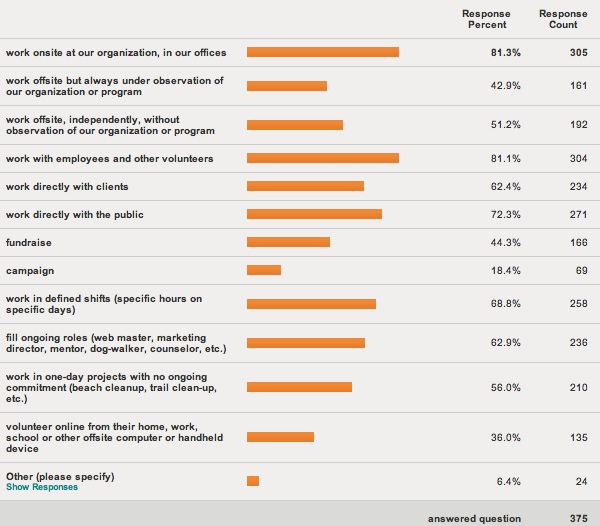
We expected the percentage of volunteers that worked onsite to be huge. We were very surprised, and pleased, to find, instead, that so many organizations that responded to our survey involved volunteers that:

  • worked offsite, with no direct supervision by staff
  • worked directly with clients
  • worked directly with the general public
  • worked online from their home, work, school or other offsite computer or handheld device
    (virtual volunteering, including microvolunteering)
  • engaged in on-off activities, like a beach cleanup – otherwise known as episodic volunteering

You can see the breakdown for yourself here:

chart grouping responses

We believe this diversity of responses is enough to bust the long-held stereotype that most volunteers work only onsite, directly under staff supervision, or that the vast majority of volunteers undertake long-term responsibilities, and that episodic volunteering or microvolunteering is a radical new, untested concept.

May we say goodbye to those stereotypes at long last? There’s no one way to involve volunteers – there never has been! Let’s recognize the reality of the diversity of ways volunteers are supporting organizations!

See the rest of the results of our survey (in PDF).

Results of survey re volunteer management software

At last! The results of the survey of volunteer management software launched by Rob Jackson (robjacksonconsulting.com) and Jayne Cravens (coyotecommunications.com) — ME — are compiled and ready for release!

In March and April 2012, Rob and I drafted and circulated a survey regarding software used to manage volunteer information. The purpose of the survey was to gather some basic data that might help organizations that involve volunteers to make better-informed decisions when choosing software, and to help software designers to understand the needs of those organizations. We also wanted to get a sense of what organizations were thinking about volunteer management software.

At long last, we’re publishing the results of the survey here (in PDF). It includes an executive summary of our findings, as well as the complete responses to questions and our analysis of such. Rob and I did not have time to analyze all of the comments made in answer to some questions; for all questions, we listed the comments made, but we did not always offer any observations about such, or group the responses into categories.

We welcome the efforts of other researchers to offer their own analysis of the data provided.

Software companies and designers: you can learn a LOT from this report to improve your products and your communications with customers!

Have a comment about the survey? Offer it below, or via UKVPMs.

Thanks to everyone who responded to the survey!


Have you ever changed your mind?

Have you ever changed your mind? Have you ever decided to let go of a long-held opinion and embrace one you had long opposed? Particularly regarding issues that affect your approach in your professional or volunteering work?

I have. A few examples:

  • I thought instant messaging was a useless distraction. A colleague changed my mind.
  • I thought Twitter was a useless distraction. Actually using it, and following people like Howard Sherman and Rob Jackson and Skepchicks, convinced me otherwise.
  • I used to think it was ethically unacceptable, under any and all circumstances, for a for-profit company to involve volunteers. I had railed against it more than once. It took Triumph Motorcycles to change my mind.
  • I don’t like certificates in return for volunteering. I don’t value them. And I thought most other people did too. But a member of my staff was passionate in her conviction to try it. So we tried it. They turned out to be one of the most popular features of the UN’s Online Volunteering service.

I’m open to being wrong, or to admitting I haven’t been fully-informed, or to new facts. I’m open to having my mind changed – through solid facts and examples. I like working to change minds – you have to like it if you are going to work in communications / outreach – but I also have to be as open as I want others to be.

But beware: if you want to change my mind, I need facts, and lots of them!

Okay, now you: share in the comments how you have had your mind changed with regard to your work or volunteering.

Say it! Say it! “MANAGERS OF VOLUNTEERS”

graphic by Jayne Cravens representing volunteersImagine you work with youth. You help a group of youth to develop skills or explore careers or improve their grades or appreciate the arts or practice an art form – whatever. Maybe you are a choir teacher or a Girl Scout leader or a tutoring program coordinator. There’s a big, national conference on working with youth coming up, and you think, great, I am so going to that! I want to get lots of tips to help me be a better leader and supporter of youth!

You arrive at the conference, and the opening speakers are all people who go on and on about how important it is to work with youth. Corporations that fund youth programs are lauded, youth are lauded, parents are lauded, politicians and celebrities that say Youth are great! are lauded – but no one ever mentions the people like you, that actually work with youth, that design and lead these programs and make them happen.

You didn’t come to the conference to be convinced to work with youth; you already work with youth. You know how great working with youth is. You have every intention of continuing to work with youth. You came to the conference to get the knowledge and tools you need to work more effectively with youth. And you were expecting for youth workers such as yourself to at least be mentioned on the first day of the conference.

That would be a really crazy scenario. But it’s how a lot of managers of volunteers feel about current national or international “volunteerism” conferences: these are focused on celebrating volunteerism, and that’s nice, but those that actually work with volunteers, that make that volunteer involvement happen, don’t get mentioned on the first day amid all the celebration of volunteers and the celebrities and politicians that love them.

Volunteers are not free. Volunteers also do not magically appear to build houses or clean up a park or tutor young people. In fact, successful volunteer engagement is absolutely impossible without someone coordinating all of the people and activities, training people, screening people, etc. – that person could be a volunteer himself or herself, it could be a paid person, it could be an employee on loan from a corporation, but make no mistake, that person, that volunteer manager, is real and absolutely essential – and deserves to be named at some point during the opening activities that kick off, say, the National Conference on Volunteering and Service?

After attending five of the national conferences on volunteering in the USA, I stopped attending (I think my last one was in 2004). By my last conference, I was tired of managers of volunteers being ignored amid all the celebrations of celebrities and politicians who think volunteers are so swell and magical, and tired of seeing and presenting the same workshops over and over. I was tired of my ideas for advanced volunteer management topics being rejected – organizers wanted only very basic workshops introducing the concept of virtual volunteering (a practice that by the year 2001 was already more than 30 years old!), if at all, and certainly nothing more advanced than that. I gave up.

It took the 2006 NetSquared conferences to remind me of what a conference for those that work with volunteers could be. Here’s why I loved that conference – it would be so great if those that organize the NCVS conference (which will be in Washington, D.C. yet again!) would read it, think about it, and rise to the challenge of presenting such a conference!

If they did, I would so be there….

Note: this blog is in response to a series of tweets by people associated with the NCVS who were miffed (maybe even outraged?) that the conference’s lack of recognition for those that manage volunteer programs was being talked about online. It’s a shame that, instead of listening and considering, they got defensive, even accusatory (apparently, because I wasn’t there, I’m not supposed to talk about it). It’s not too late to turn this into a win, to consider the criticism and really think about ways to take the conference to the next level – and to ensure volunteer managers are acknowledged. I’d be the first to publicly laud organizers if that happened.

Pioneering in “hacks for good”: Knowbility

Hackathons, hacks for good, hackfests or codefests are quite the buzz words these days.

There are a lot of new initiatives getting a lot of attention for mobilizing people with high tech skills to help various causes at individual events: these initiatives bring these people together to spend the day, or maybe a few days in a week, at computers, usually in one big room, with everyone using their skills to do good, eat some good food, take lots of fun photos of everyone in action, and celebrate the great work at the end of the day.

Good stuff. But one of the first organizations to do this, Knowbility, gets lost amongst the much better-funded, higher profile newcomer groups, and it’s such a shame, because more people really should get to know Knowbility!

AIR Houston 2007

Knowbility is a national nonprofit organization based in Austin, Texas that creates technology programs that support independent living for people with disabilities, including veterans. Knowbility’s signature event is its Accessibility Internet Rally (AIR) – a hackathon that brings together teams of web designers to learn about web design accessibility standards, and then to apply those standards in a competition to create web sites for nonprofit organizations. The result of an AIR event isn’t just a fun day and new web sites; all participants walk away with an understanding of web design accessibility standards they didn’t have before that they can apply to their daily professional work, and the volunteer teams, most of them from the corporate sector, learn about the unique work of nonprofit organizations, creating opportunities for better partnerships in the future.

Knowbility’s activities have earned all sorts of awards and recognition – like the Peter F. Drucker Foundation Recognition for Nonprofit Innovation. On September 21, 2000, the White House issued a press release to highlight programs across the country that are helping to bridge the digital divide for people with disabilities and Knowbility’s AIR event in Colorado was mentioned by President Clinton as a new and noteworthy initiative. And I’ll never forget when they got mentioned at the end of Oprah’s talk show, resulting in an onslaught of emails and phone calls and oh-so-much excitement.

Knowbility earns more than 60% of its revenue through fee-for-service offerings. But that means it still relies heavily on grants and donations. Knowbility is worth your financial support. I really want this organization to continue – more than that, I actually want this organization to launch more AIR events and other activities all over the USA, and beyond! Knowbility is worth your investment.

And if you have ever been involved with Knowbility in any way, consider blogging about your expereince, talking about it on your Facebook status update or Twitter feed or Google Plus profile or other social media profile, and linking to the donation page.

Here are some other blogs I’ve written about Knowbility:

Hackathons for good? That’s volunteering!

Volunteer online & make web sites accessible

Volunteer online with TechSoup

I’m doing some work with TechSoup, a nonprofit based in San Francisco, and I’m recruiting online volunteers to help in two roles:

Wiki Contributor/Editor – online opportunity
This is in support of a wiki regarding Online Community Engagement. The goal of the wiki is to provide essential information and links related to online community engagement, particularly regarding the cultivation of communities of practice / knowledge networks. Please visit the wiki to learn more. We’re looking for one – three online volunteers ready to help with proofreading (correction of spelling, checking links, etc.) and adding resources. Volunteers should have excellent writing skills, be an expert at finding resources online, and be ready to see a task through to its completion.

Online Community Forum Subject Expert
Offer advice to nonprofits via the TechSoup online community forum regarding software use, database choices, using tech tools to engage and support clients, remote staff and volunteers, FOSS options, accessibility, building staff capacities, community tech center management, IT security – whatever your area of tech expertise! Frequent community forum participants may be invited to become community moderators, committing for at least three months (with possibility of renewal) to ensuring various forum branches have fresh information every week. Volunteers should have excellent writing skills and an understanding of how nonprofits use at least some aspect of computer or Internet tools.

These are virtual opportunities, and it’s not just for two volunteers – multiple volunteers can help in each of these roles.

Want to apply? In addition to the requirements already stated, you should also have a good understanding of how people and organizations communicate online, have excellent, reliable Internet access, commit to at least two hours a week (10 hours a month), and commit to at least three months in this role.

To apply, click on the volunteer role title and express your interest (via VolunteerMatch).

I’m happy to sign off on any paperwork a volunteer might need for a class. And if you want to call it an internship, I’ll be happy to call it such.

So, why have these roles been reserved for volunteers? Why do I want volunteers to help in these tasks?

  • Fresh ideas from volunteers – there’s just nothing like them. They are unfettered ideas. And such ideas are needed!
  • More involvement of volunteers means more opportunities for people and organizations to participate in decision-making – and this can create more ownership by the community TechSoup seeks to serve.
  • It provides opportunities for professional development; many people are looking for activities that will look great on their résumés, or for a university-level class that requires a practicum. This is a way to help a few folks in that quest – just as many of us have been helped along the way.

Here’s more about justifications for involving volunteers – something I think any organization to do before recruiting volunteers.

Nonprofits & volunteers – time to brag on Techsoup!

There are a LOT of opportunities right now on TechSoup for nonprofit employees and volunteers to share experiences and offer advice. Here are some recent questions and topics oh-so-ripe for your comment:

Nonprofit looking for Best Practices for Gathering Emails, other Info from New Donors.

Nonprofits, libraries, universities, others using Moodle? There’s someone looking for advice from you!

How does your nonprofit, library, other mission-based organization deal with “bad” tech etiquette?

What’s your experience with ICTs for rural economic development?

A small nonprofit maritime museum books sailing trips – & needs software advice for reservations

Are you a nonprofit or volunteer using Ubuntu Linux?

Nonprofit that collects veterinary medical supplies seeks inventory management software for Mac.

Firing a volunteer over insulting musings on Facebook re: a nonprofit or library?

Software for Substance Abuse and Mental Health Treatment?

Nonprofits & libraries: are employees, #volunteers using Google Drive, iCloud, Dropbox, other cloud apps? Share!

Nonprofit with network question: Some entries in NPS logs are in Hex others in plain text. Help?

SMS Engagement for civil society, the humanitarian sector, nonprofits, government programs – your experience?