Category Archives: Community / Volunteer Engagement

Milestone: more than 100 virtual volunteering research articles

As of October 2020, a milestone has been reached regarding virtual volunteering: I’ve found more than 100 research articles, dating back to 1997 and most with a university association, related to virtual volunteering. These are all listed here at the Virtual Volunteering Wiki.

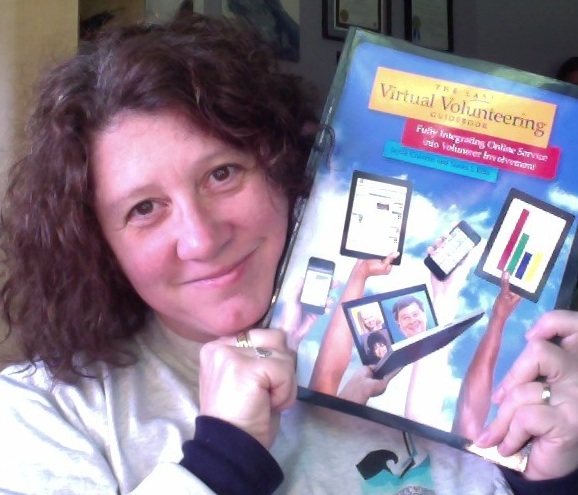
I started tracking published research regarding virtual volunteering – using the internet to engage and support volunteers – when I directed the Virtual Volunteering Project at the University of Texas at Austin. I began heading the project in December 1996 and within several months of looking, I not only had found about 100 programs, most at nonprofits, a few at schools, that were involving online volunteers, I also realized that the practice was at least a couple of decades old, first starting at the Project Gutenberg, a volunteer effort that began in 1971 to digitize, archive and distribute the full texts of public domain books, such as works by Jane Austen, Charles Dickens, Sir Arthur Conan Doyle and Mark Twain. But what I had trouble finding was academic research on the subject. I had found a fair amount by the time The Last Virtual Volunteering Guidebook was published, but even so, it seemed still to be rather on the lean side for a practice that was so well-established.

I had no funding to research and write The Last Virtual Volunteering Guidebook, and I’ve had no funding to continue maintaining the Virtual Volunteering Wiki, which tracks news and research regarding using the Internet to engage and support volunteers. But, indeed, I’ve maintained the wiki all these years, focusing on things that I deemed newsworthy and, especially, academic research. When I realized that there are now more than 100 research articles, dating back to 1997 and most with a university association, related to virtual volunteering, I felt it was worth celebrating. And this is just the English-language material: I bet there is a fair amount in Spanish, given Spain’s leadership in virtual volunteering for a couple of decades now.

Note that sometimes research articles do not call the unpaid contributors or unpaid virtual team members “volunteers.” For instance, any research paper on Wikipedia contributors could be considered research on virtual volunteering, as Wikipedia contributors – Wikipedians – are unpaid by Wikimedia for those contributions.

Also note that many of the papers make the mistake of talking about virtual volunteering as new, ignoring or overlooking its more than three-decade history. When I read that this is a “new” practice in an academic paper recently published, especially a thesis or dissertation, it makes it very hard for me to take the rest of the research seriously. I wish more university professors would catch that inaccurate point of view early on in a PhD student’s exploration of the subject.

It’s so wonderful to see that virtual volunteering now has a rich research history to go along with its rich history of practice, and I love reading perspectives about virtual volunteering by people who ARE NOT ME. Look, it’s been fun to be the world’s expert regarding virtual volunteering, but I’m so hungry to read perspectives by other people, particularly regarding what works best in supporting online volunteers, particularly different demographics of such volunteers – is it different to involve teen online volunteers in India versus tech-savy senior volunteers in Germany? Is there something that works well supporting online volunteers in South Africa that is different than what’s done in Spain? Is engaging and supporting rural online volunteers different from engaging and supporting urban or suburban online volunteers, even in the same country? I’d love to see such comparative studies!

What’s not needed? Research on the motivations of people who volunteer online. Good grief, people, ENOUGH!

I would also love beyond words if a university would step forward and be willing to take over management of the Virtual Volunteering Wiki. Having university students and faculty maintaining this would make it a much more rich and valuable resource. Any takers?

Let me be frank: I’m going to eventually retire. I’ll always be interested in virtual volunteering, and I’ll be an online volunteer myself for, I hope, decades to come (in between my extensive motorcycle riding). But just as there is no one Queen or King of All Things Volunteer Management, there shouldn’t be just one person, or always the same person, keeping track of news and research regarding virtual volunteering and distilling the key points of such. It’s overdue for new leaders, and a diversity of new leaders, to emerge in this field. I stand ready to support those new leaders (or, at least, figuratively – I can’t stand as long as I used to).

If you have benefited from this blog or other parts of my web site and would like to support the time that went into researching information, developing material, preparing articles, updating pages, etc. (I receive no funding for this work), here is how you can help

Addressing anger in the workplace (including online)

Mental Illness Awareness Week 2020, October 4-10, is winding down, and it’s a good time to remind ourselves that we are ALL all under a tremendous amount of stress now per so many, many things associated with the global pandemic (at least if we’re among those taking it seriously). And some of us are also dealing with enormous amounts of anger from customers, clients and others.

I wrote a series of tweets, published Wednesday, to talk about dealing with intense anger from co-workers, clients, customers and others. The first was an introduction tweet that had much of the same content of the opening paragraph. Here is the content of the rest of the tweets:

Anger isn’t automatically a bad thing. Anger fuels social justice movements, human rights movements & important changes in societies & systems. Anger can even be an effective motivator of volunteerism. But anger can also hijack a person’s life in negative, even dangerous ways. [2/17]

Intense anger can affect reasoning and self-control, which can be further weakened by substance use &/or mental illness, ranging from depression to delusional thinking. That kind of intense anger can affect, even destroy, your work and relationships. [3/17]

If you are seen as a perpetually and irrational angry or vindictive person, it can affect your employability, your ability to keep employees and volunteers at your nonprofit – & even the funding of your nonprofit, NGO or charity. [4/17]

If you are online a lot, you see intense, irrational anger among trolls, those people whose primary purpose online seems to be to hurt others. Many aren’t anonymous: they don’t care that their barrage of insults hurts their professional reputation. [5/17]

That kind of intense, irrational anger and aggression are closely tied to several mental health conditions, including major depression, bipolar, irritability, Oppositional defiant behavior, Narcissistic personality, and PTSD https://www.goodtherapy.org/learn-about-therapy/issues/anger [6/17]

Program managers at nonprofits, NGOs & charities, as well as managers of volunteers, need to support staff in dealing with angry customers, clients, volunteers, donors and others. Dealing with intensely angry people is draining and people need to feel supported in this work. [7/17]

It’s not just your social media manager: even if your nonprofit, NGO or charity staff are all working from home, they may be dealing with intensely, even irrationally angry customers, clients, volunteers, donors and others. [8/17]

And your staff may be dealing with situations such that they are quite angry themselves and it may be affecting their work. Senior managers need to assume that both of these scenarios might be happening and take steps to help. [9/17]

Remind staff that you know things are tough now & that tensions can be running high among staff & volunteers, as well as those they’re dealing with. Talk openly about anger: how to deal with it ourselves & with it among customers, clients, volunteers, donors & others. [10/18]

Emphasize SAFETY. People should feel safe in doing their work. Talk about what harassment looks like. Give staff safe ways to report harassment from colleagues, customers and the public and to talk openly about the difficulty in dealing with it. [11/18]

Make sure staff know when harassment becomes something potentially illegal and even dangerous. Know when to call police. These resources regarding online harassment, defamation & libel can help: http://www.coyotebroad.com/work/harass.shtml [12/18]

Circulate mental health support resources among all employees, volunteers and consultants, including those focused specifically on dealing with anger, like Anger management: 10 tips to tame your temper from the Mayo Clinic:
https://www.mayoclinic.org/healthy-lifestyle/adult-health/in-depth/anger-management/art-20045434 [13/18]

Psychologists can help people recognize and avoid the triggers that make them angry. They can also provide ways to help people manage the inevitable anger that sometimes flares without warning.
https://www.apa.org/topics/understanding-anger [14/18]

Is your temper hijacking your life? Tips and techniques can help you get anger under control and express your feelings in healthier ways.
https://www.helpguide.org/articles/relationships-communication/anger-management.htm [15/18]

Here are Anger Management Treatment Program Options
https://www.psychguides.com/anger-management/treatment/
[16/18]

Here is advice on What To Do When You Have Anger Issues
https://www.betterhelp.com/advice/anger/what-to-do-when-you-have-anger-issues/ [17/18]

& the best for last: NAMI is the National Alliance on Mental Illness. The NAMI HelpLine can be reached Monday through Friday, 10 am–6 pm, ET. 1-800-950-NAMI (6264) or info@nami.org [18/18]

Twice this year, I have dealt with intensely angry and irrational people in my work. In both cases, it’s been utterly exhausting. In one case, heartbreaking, because it is related to dementia to someone I respect a great deal, and in another case, it’s terrifying, because I fear it could turn violent. And as an independent consultant, with no staff – it’s just me – I don’t have a supervisor to check in on me, I don’t have a staff to delegate some responsibilities too, and I can’t follow a lot of the advice I’ve just offered above. Coupled with the global pandemic and a very intense political situation, these are particularly difficult times for independent consultants. So I want to give a specific shout out to such consultants who are in a similar position. Reach out to me if you need to talk.

In addition, the same day, I tweeted about domestic violence and the importance of any workplace having a domestic violence policy and training staff, including volunteers, on how to recognize domestic violence and where to find guidance and resources for themselves or co-workers – because all that is also a mental health issue and is most definitely, and sadly, related to helping someone navigate, and protect themselves from, someone else’s anger. I won’t re-create those tweets here, but here’s the start of that much shorter series.

If you have benefited from this blog or other parts of my web site and would like to support the time that went into researching information, developing material, preparing articles, updating pages, etc. (I receive no funding for this work), here is how you can help

how not to treat volunteers: another saga

graphic by Jayne Cravens representing volunteers

I get inspiration for a lot of my blogs from stories that my friends tell me about their own volunteering experiences, from comments on my blogs from volunteers, and from my own attempts at volunteering.

Here’s a comment I got recently from a neighbor who is volunteering to send postcards to registered voters regarding the upcoming elections here in the USA. Through an advocacy group, volunteers like her handwrite messages on the postcards encouraging the recipient to vote. It’s very important that the postcards be handwritten and personalized – recipients are more likely to read the postcards because they are handwritten and because they are coming from a volunteer, specifically – not a paid campaign worker. Here’s her message to me about her frustration:

Jayne, here’s a suggestion for a blog post: please do not simply assume your volunteers will do more than they have committed to. I committed to write 30 postcards this week. For me, this was a stretch as far as my time goes. My contact at this organization brought me *60* postcards and a list of where to send them, plus a request for three postcards written in Spanish (but not providing me with a Spanish-language script). She said, “Can you just ask somebody else to write the rest if you don’t want to?” Now that I am actually looking at the instructions for writing this postcard, I see that they asked me to fit far more text into the postcard that is possible to fit. So they didn’t test their idea. Grrrr. This makes me amazingly cranky and demotivates me to write her damn postcards. Also, I am cranky these days anyway.

This person is one of the most dedicated campaign volunteers I have ever seen: I’ve seen her at demonstrations of all kinds, she has a sign in her front yard for a campaign she supports (and offered them to others in the neighborhood), she shares advocacy messages on her Facebook page, and I see her a day or two every week walking down to our nearby post office with a stack of postcards she has personally addressed. She feels a great sense of urgency regarding the upcoming election, just like so many volunteers do about the nonprofit they are supporting. That commitment and that sense of urgency are easy to take advantage of when an organization needs additional help. At first, a volunteer might not say no: they feel needed, they feel valued, and they feel like they are really helping out in a dire time of need. But if this keeps happening, volunteers QUIT. And they send messages to me about how frustrated they are, and I get to write a blog about it!

Don’t put volunteers in an awkward situation when you need more work done than they have agreed to do. Tell them your need for additional hours or for an additional task to be done and say, “if this is too much for you, please say so – we don’t want to overwhelm you, we value your service.” And mean that. If the volunteer says no, respect the no.

What’s your alternative? Surely you have an online community of all of your local volunteers, and you can just post to that community, let people know you have extra work to be done, and ask who could do it – right?

Weeks ago, this particular advocacy group should have made a list of assistive independent living centers, where residents live on their own in their own apartments with minimal assistance – where they still prepare their own food, still live largely independently, still drive, etc. Because of the global pandemic, many of these senior citizens are stuck in their homes without much to do, and they would have LOVED to have volunteered for an initiative like this (and if they are anything like my maternal grandmother, they have BEAUTIFUL cursive, legible handwriting – I always recognized my grandmother’s letters, which she wrote to me until she died at almost 102). Instead, they kept going back to the same well – and the well is running dry.

Other blogs about frustrated volunteers:

If you have benefited from this blog or other parts of my web site and would like to support the time that went into researching information, developing material, preparing articles, updating pages, etc. (I receive no funding for this work), here is how you can help

Study measures interest in volunteering in May 2020

graphic by Jayne Cravens representing volunteers

Points of Light commissioned a research study to understand the state of American civic engagement – in all its facets – as of May 2020, and to explore the path forward for catalyzing deeper and broader civic participation. Researchers surveyed 1,441 adults in May for the report, which says it has a margin of error of plus or minus 2.8 percentage points.

The study found that the pandemic and other catastrophes prompted a surge in interest in volunteering in May: While only 36 percent of American adults say they volunteered within the last year, 60 percent said they are interested in doing so in May, and 73 percent said volunteering is more important than ever. According to the survey, Gen Z already demonstrates higher rates of civic engagement than older generations.

The study also found that 75 percent of Americans said in May that donating to nonprofits is more important than ever because of the Covid-19 crisis, while 54 percent reported giving to charity a year ago.

Note that by civic engagement, the survey did not just mean volunteering. Activities measured included:

  • Donated money to a nonprofit
  • Signed a petition
  • Purchase decisions based on company’s social responsibility
  • Participated in volunteer activities
  • Posted or started group/campaign for issue on social media
  • Contacted elected official about issue
  • Considered applying/taking job because of company’s social responsibility
  • Attended demonstration or rally for issue
  • Public service thru military, elected office, nonprofit board
  • Voted in every/almost every election in past few years

Volunteer Preferences and the percentages of people that selected such:

  • Focus on global issues impacting our world: 18%
  • Not interact directly with people benefiting: 24%
  • Volunteer directly or with friends/ neighbors, not through organization: 28%
  • Participate at home/online: 30%
  • Activities where I help someone one-on-one: 27%
  • One-time activities: 29%

A much bigger group selected these “opposite” options of each of the bulleted items above:

  • Focus on issues directly impacting my community +37 —> 55%
  • Interact directly with people who are benefiting +22 —> 46%
  • Volunteer through an organization +15 —> 43%
  • Participate in person +12 —> 42%
  • Activities where I help groups of people +14 —> 41%
  • Activities that I can do on a regular basis +10 —> 39%

I hope that the way this was presented wasn’t done to imply that volunteering from home, online (virtual volunteering) doesn’t allow for volunteering activities that many people preferred: interacting with someone one-on-one, interacting directly with people benefitting, and focusing on issues directly impacting a volunteer’s community. All of these things are possible in virtual volunteering and have been the preferred activities of online volunteers, at least according to all of the research I’ve done since the late 1990s – indeed, when I’ve said that a greater portion of online volunteers want a more substantial experience than a few minutes of microvolunteering, a lot of tech bros – people with corporate backgrounds and tech backgrounds, not volunteerism backgrounds – have really pushed back. Yet, once again, the latest research shows it’s true.

According to the survey, the top barriers to volunteering (among those interested in volunteering who have not done so) are the following – the same things those of us in the volunteer management field have heard year after year:

  • Unsure how to get involved or where to find opportunities 44%
  • Cannot find opportunities near me 44%
  • Not sure what I can do that would be helpful 43%
  • Busy, don’t have time to volunteer 42%
  • Haven’t found a group of volunteers with whom I fit 41%
  • Haven’t found opportunities matching my skills, abilities 41% ‘
  • Rather do other things when I have free time 34%
  • Uncomfortable volunteering with people I don’t know 33%
  • Don’t believe my efforts will make a difference 26%

From the volunteer perspective, a worthwhile experience is:

  • discoverable. Can be easily found online.
  • local. Addresses an issue important to my community.
  • credible. Delivered by an organization with local/issue expertise.
  • social. Allows me to invite my friends and family.
  • authentic. Explains why my actions will matter, upfront.
  • personal. Allows me to engage with beneficiaries.
  • impactful. Shows me the outcomes of my actions.
  • repeatable. Provides an avenue for me to reengage.

This part was my favorite part of the study, in fact – what makes a worthwhile experience. How many managers of volunteer programs are going to use this to improve their own volunteer engagement schemes? And, again, this supports everything I’ve said about micro volunteering – it’s nice, it’s worth exploring, but it’s NOT what most volunteers are looking for.

Here’s the full research study. It would be fascinating to compare this to now – in May, the country was experiencing a pandemic “surge”, where people were feeling optimistic and community-minded. Now, it’s almost October, and we’re most definitely in pandemic “fatigue” where people are feeling anxious, even negative, and rebellious.

Also see:

The Nonprofit & NGO Guide to Using Reddit

A new resource from me: The Nonprofit & NGO Guide to Using Reddit

As of July 2019, Reddit ranked as the No. 5 most visited web site in the USA and No. 13 in the world. Reddit is a community of communities, and its communities are called subreddits. Statistics suggest that 74% of Reddit users are male. Users tend to be significantly younger than other online communities like Facebook with less than 1% of users being 65 or over.

If you want to reach a younger demographic regarding your volunteering opportunities, your awareness messages, your data that shows your value to the community and more, you need to build posts to Reddit into your marketing strategy, no matter what your nonprofit’s size or focus. This resource tells you how to do it. It covers how to find subreddits to join or read regularly based on your nonprofit or NGO mission, how to choose a user name, how to guide staff who may already have a Reddit user account, whether or not you should create your own subreddit and more.

And note: manging your Reddit presence and monitoring Reddit for discussions about your organization or program is a terrific role for an online volunteer!

If you have benefited from this blog or other parts of my web site and would like to support the time that went into researching information, developing material, preparing articles, updating pages, etc. (I receive no funding for this work), here is how you can help

One-ish Day Activities for Volunteering Using IT (Hacks4Good, for instance)

UPDATED: One-ish Day Activities for IT Volunteers or Volunteering Using IT (Hacks4Good, for instance)

image of a panel discussion

For a couple of decades now, volunteers have been getting together for intense, one-day events, or events of just a few days, to build web pages, to write code (hackathons, apps4good, etc.), to edit Wikipedia pages, to transcribe historical documents and more. These have usually been, in the past, gatherings of onsite volunteers, where everyone is in one location, together, but even before the global pandemic, these activities were involving or mobilizing remote volunteers – online volunteers helping from wherever they were in the world.

This resource has been revised to take into consideration more virtual volunteering / remote volunteering, rather than everyone being in the same room. The revision, with greater emphasis on remote volunteers, was prompted by probably half a dozen inquiries to me in the last four months saying something along these lines:

We have all these corporations / businesses calling us because nonprofits have suspended their onsite volunteering. These companies want to engage in group online volunteering, but don’t know what that would really look like.

In addition to updating One-ish Day Activities for IT Volunteers or Volunteering Using IT (Hacks4Good, for instance), these folks should also view these ideas for high-impact virtual volunteering projects.

But with all that said, businesses/corporations also need to keep in mind that nonprofits are under terrific financial strain right now. They need to consider this recent blog by Jerome Tennille, which says in part:

Many companies are seeking to pivot successfully from in-person employee engagement to forms that allow for social distancing whether virtually or remote. In their quest to achieve this some companies have sought to place that burden on their non-profit partners in the communities they serve. Unfortunately, by placing this responsibility on the non-profit organizations…

Remember: Volunteers are not free for the nonprofit or community group expected to involve them. If you ask an agency to create volunteering opportunities specifically for your employees, you are asking them to spend money and resources they may not be able to afford – so be ready to make an appropriate financial – CASH – donation to a nonprofit or school if you want a customized volunteering gig for your employees at that nonprofit or school. Here’s more advice on how to create successful and appropriate volunteering activities for employees.

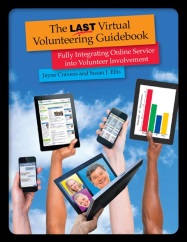
cover of Virtual Volunteering book with hands raising up various Internet connected devices

For much more detailed advice on creating assignments for online volunteers, for working with online volunteers, for using the Internet to support and involve ALL volunteers, including volunteers that provide service onsite, and for ensuring success in virtual volunteering, check out The Last Virtual Volunteering Guidebook. Tools come and go – but certain community engagement principles never change. You will not find a more detailed guide anywhere for working with online volunteers and using the Internet to support and involve all volunteers – even after home quarantines are over and volunteers start coming back onsite to your workspace. It’s available both as a traditional paperback and as an online book. It’s co-written by myself and Susan Ellis.

If you have benefited from this blog or other parts of my web site and would like to support the time that went into researching information, developing material, preparing articles, updating pages, etc. (I receive no funding for this work), here is how you can help

A review of The Last Virtual Volunteering Guidebook

How did I miss this wonderful 2014 review by Thomas W. McKee of The Last Virtual Volunteering Guidebook: Fully Integrating Online Service into Volunteer Involvement, a book I co-wrote with Susan Ellis? Somehow I did – I just recently found it on the Amazon page for the book:

Since most books on technology are outdated by the time the ink dries on the printed version, I teased Susan Ellis about using the word “LAST” in the title of a book about virtual volunteering. She assured me, however, that the word “LAST” was carefully chosen for a very specific purpose. After reading the book, I now understand the wisely chosen word “LAST.” The authors do acknowledge that the technology tools we use today will change, but the principles outlined will always apply to future virtual volunteering because Guidebook is not just another book on technology. It is a book on the integration of technology into all aspects of volunteer engagement so that organizations avoid the silo compartmentalization of virtual vs. traditional volunteers.

Wow. This is exactly how Susan and I tried to write this book!

What we don’t mean is that there will or should never be a further need to write or talk about the latest developments in engaging volunteers online.

What we do mean is that, from this moment on, we hope that talk about virtual volunteering won’t be segregated to a separate book or separate chapter at the end of a book about volunteer management. Our dream is that this is a turning point regarding talk and training about volunteer engagement, and

  • any book about volunteer management, whether it’s a book about basic principals in general, group volunteering, episodic volunteering, skills-based volunteering, teen volunteering, whatever, has advice about using the Internet to support and involve volunteers integrated throughout the material.
  • any workshop about some aspect of volunteer management, whether it’s about the fundamentals of volunteer management, recruitment, risk management, adults working with children, whatever, fully integrates advice about using the Internet as a part of those activities.

In short, NO MORE SEGREGATION OF INTERNET-MEDIATED VOLUNTEERING in books about volunteer management, in workshops about volunteer management, and in references to volunteer engagement, as a whole. Virtual volunteering should not be an “add on” in any of these scenarios – not only in a book or training about volunteer engagement, but also, not in any volunteer engagement scheme at any organization. In fact, our dream is that we no longer hear about onsite volunteers as one group and online volunteers as another, separate group when talking about how to work with volunteers – how about we talk about volunteers, period? The exception: research. Absolutely, let’s have research on virtual volunteering, specifically – but NOT the motivation of online volunteers (enough!). Let’s have research that organizations actually need. What do they need? ASK THEM.

cover of Virtual Volunteering book with hands raising up various Internet connected devices

The Last Virtual Volunteering Guidebook: Fully Integrating Online Service Into Volunteer Involvement is available both as a traditional print book and as an e-book. Tools come and go, but certain community engagement/volunteer management principles never change. You will not find a more detailed guide anywhere for working with online volunteers and using the Internet to support and involve all volunteers – even after home quarantines are over and volunteers start coming back onsite to your workspace. Reviews assignment creation, changes you will need to make to policies and procedures, how to evaluate your program’s effectiveness, how to build a sense of team among online volunteers and so, so much more. And if you are a volunteer at a school or a concerned parent of a student at a school and you know that school might be considering online mentoring or online tutoring, I hope you will consider buying The Last Virtual Volunteering Guidebook and giving it to the volunteer coordinator at the school, who may not have the budget for such.

We published this six years before COVID-19 / the novel coronavirus, and never thought about how a global pandemic, social distancing and home quarantines would lead to a sudden, urgent rise in interest in virtual volunteering. I’m just glad the book is seeing such renewed interest (far more have been sold this year, in 2020, than even in the first year it was published).

Also see:

Why did we call it the LAST guidebook?

LinkedIn Group for the discussion of virtual volunteering.

When Words Get in the Way (Like “Virtual Volunteering”)

Your right to turn away volunteers who won’t adhere to safety measures (& your right to refuse to volunteer at an unsafe program)

Nonprofits, schools, charities, NGOs: you have every legal and moral right to require onsite volunteers to properly wear masks or face shields during service, and to ask a volunteer to leave that refuses to comply.

Just make sure that you have communicated with volunteers in multiple ways about the requirement at your volunteer sites for face masks and social distancing and any other safety measures related to COVID-19 or any other issue of concern. You should:

  • Email all volunteers directly.
  • Include the notice in your regular newsletter.
  • Add the notice to your web pages regarding volunteering with your program.
  • Post it to your online discussion group for volunteers.
  • Send a reminder to all volunteers the day before they are going to show up onsite for volunteering service.

If you can text volunteers with a reminder, do that too! You may want to do a YouTube video of your Executive Director stating this policy, for a more personal touch – as well as to show that this is a policy that is supported from the very top.

These are the requirements I believe programs should adhere to during this pandemic.

And here’s a sample of communication via email, in your newsletter or via a video:

As we have all probably heard by now, wearing a mask helps to drastically reduce the spread of COVID-19. By your wearing a mask or face shield, you help to prevent others from catching the Novel Coronavirus – remember, you may have it but not be showing any symptoms, and even if you are not showing symptoms, you can spread this virus. The safety of our volunteers, clients and staff is of paramount importance to our program, and it is only if we all wear masks or face shields and socially distance that we can continue to operate at least some of our onsite programs. This link goes to our state’s public health agency and has guidance on the proper way to wear a mask. (add in the link).

If you cannot or will not wear a face mask or face shield, you will not be able to volunteer onsite with our program at this time, but you are welcomed to help us as an online volunteer by… (add in your virtual volunteering roles here).

If you don’t feel comfortable volunteering onsite now, we completely understand, and we hope you will consider volunteering with us online by… (add in your virtual volunteering roles here).

If you have any questions, please contact… (add that person’s name and contact info).

Thank you so much for all of your volunteer support. We will get through this together, and we’re committed to all of us getting through this.

Also:

  • Your paid staff need to adhere to the same rules regarding face masks and social distancing.
  • If you think some volunteers may not be able to access a proper facemask, provide links on where to find free or affordable facemasks.
  • Tell the person who will see volunteers first at a site what they should say to someone who approaches and is not wearing a mask, or is not wearing it properly, and to whom they should report anyone who becomes upset or refuses.
  • Thank volunteers repeatedly for wearing a face mask or face shield correctly.

You may lose volunteers over this policy, but losing volunteers because of how they feel about a public health issue is far preferable to spreading COVID-19 to volunteers, clients or staff.

On the flip side, volunteers have every right to refuse to volunteer onsite at a program that does not require staff and clients to properly wear masks or face shields. Before you volunteer onsite, ask the program what measures are in place to help prevent the spread of COVID-19. Again, these are the requirements I believe programs should adhere to during this pandemic. If you decide you cannot safely volunteer, write an email saying so (and you may want to write the board of directors as well).

Also see:

If you have benefited from this blog, my other blogs, or other parts of my web site and would like to support the time that went into researching information, developing material, preparing articles, updating pages, etc. (I receive no funding for this work), here is how you can help

Ethics of paying to volunteer online

It is not unusual, nor automatically unethical, for a program to charge people who want to participate as a volunteer in a program. Even the Girl Scouts of the USA asks volunteers to pay a very small fee to become an official member (but will waive that fee for anyone who says they cannot afford it), and some Habitat for Humanity chapters and food banks asks groups coming from one organization, particularly from the corporate world, to pay a fee to help cover the costs of staff that set up the site for their feel-good-for-a-few-hours volunteering gig.

Volunteers are not free: people have to screen applicants (and even if a program has an automated system that screens applicants, someone has to be paid to build that system), train those volunteers (again, even if this is an automated system, someone usually has to be paid to build it), support the volunteers, track their progress, etc. Volunteers might be asked to pay for their own criminal background checks or a uniform as well. Most programs that have a cost they ask volunteers to pay will waive that cost for any qualified applicant who says they cannot afford it.

There are also online programs that ask volunteers to pay a fee in order to participate in their virtual volunteering activities. There are the programs I consider ethical, like Business Council for Peace (BPEACE), a USA-based nonprofit that recruits business professionals to help entrepreneurs in countries emerging from conflict to create and expand businesses and employment (particularly for women), like El Salvador and Guatemala. Bpeace asks its Skillanthropists to make a monthly donation during their participation, which both helps cover just a bit of BPEACE’s costs and which makes the volunteers financial investors as well, which can help with retainment. There are also university programs that have pivoted their student volunteering programs abroad to online versions because of the COVID-19 pandemic, and the tuition that students pay to participate helps cover the substantial administrative costs of converting these programs online (including hiring me sometimes – I’ve done workshops for two universities to prepare their administrative staff, partner NGOs and students for virtual volunteering – that work earlier this year lead me to create this robust list of high-impact virtual volunteering projects).

But there are the online programs I consider highly unethical for asking volunteers to “donate.” For instance, there’s a nonprofit that has no list of board of directors or staff – just lots of information about its founder (and, apparently, sole employee), who wants to charge people $250 “to initiate” a request to volunteer with the initiatives it says it has created, like a “teen hackathon” that has no dates of actual hackathons and stock photos (not photos of its supposed events – probably because there haven’t been any). This “organization” also has an emphasis on recruiting volunteers who can develop iOS Mobile Apps so the nonprofit to accept donations, and to “conduct a fundraiser for your app development” for its program. And it wants volunteers to, on its behalf conduct “outreach to employees of matching gift companies” to donate to the “nonprofit” – thereby doubling the gift.

There are also programs, many of which that used to regularly post to the volunteer sections of Craigslist, claiming that if you will “fundraise” (pay) a certain amount for a nonprofit with a dubious, vague mission statement, the nonprofit will provide a letter saying you did a certain amount of community service (volunteering) hours for them – how many hours they will say depends on how much “fundraising” you did (how much you pay them). There’s also “nonprofits” that say you can pay to “take courses online” and then get a certificate asserting how many hours you spent in those “community service” classes.

I first blogged about such scams in 2011, and kept blogging throughout the years about such:

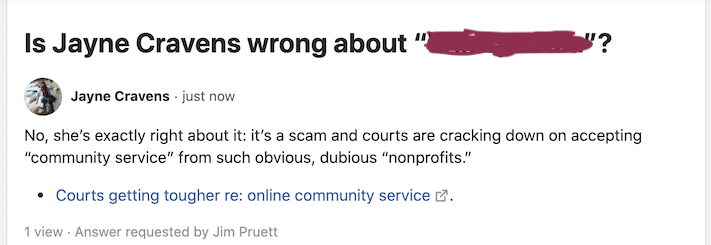
One person got so frustrated with me outing their “nonprofit” for being a scam that they created a Quora question specifically about me.

My advice: NEVER make a donation in order to volunteer online unless the program:

  • is a 501 c 3 listed on Guidestar (if in the USA) or is a long-established, credible PUBLIC university.
  • lists its board of directors, staff members (and their credentials), and yearly financials/annual reports.
  • lists events and program it has undertaken, with dates, number of participants, measures of success, etc. – if it says they do teen hackathons, what were the dates of those hackathons, how many teens participated in each, where were they and where is the list of apps that were developed?
  • will put you in touch with an actual, long-term online volunteer with the program who will answer your questions via phone or video conference.
  • will say, in writing, that the photos on its web site are NOT stock photos but are, in fact, photos of volunteers, clients or other participants (or, if not, has an excellent reason for using a stock photo).

If any news reporter wants to do a story specifically about these virtual volunteering scams and wants the names of actual programs I consider unethical and, possibly, illegal, email me at jayne @ coyotebroad.com (note spaces) and I will be happy to pass over the list I maintain. And I’m happy to be interviewed about these programs and how people can know the difference between legitimate virtual volunteering programs online, like these, and those that are there primarily to take your money.

vvbooklittle

For very detailed information about the qualities of a credible virtual volunteering program, including online mentoring programs, there is The Last Virtual Volunteering Guidebook, available for purchase as a traditional print book or as a digital book. You will not find a more detailed, realistic guide anywhere for working with online volunteers, for using the Internet to support and involve all volunteers, and for evaluating the effectiveness and results of virtual volunteering activities. It’s a book written for those managing programs that want to involve online volunteers or to better support traditional volunteers with online tools, for those that want to improve their existing virtual volunteering programs, and for those undertaking research regarding virtual volunteering for any reason. If you are a consultant that wants to train others regarding virtual volunteering, this is your guide on how to become an expert (along with volunteering online and engaging volunteers yourself, which is essential to be a credible trainer).

August 24, 2020 update: here are four articles from other organizations and consultants that talk about how to evaluate the credibility of a nonprofit or charity before you donate or volunteer:

Also see, from, my web site, these resources on evaluating a nonprofit’s credibility:

  • The Information About & For Volunteers You Should Have on Your Web Site: If your program involves volunteers, or wants to involve volunteers, there are certain things your organization or department must have on its web site. To not have this information says that your organization or department takes volunteers for granted, does not value volunteers beyond money saved in salaries, or is not really ready to involve volunteers.

July 12, 2022 update: I just found a company promoting virtual volunteering to support communities in the developing world – and it requires online volunteers to pay to participate: the one-month fee is $800 and the six-month fee is $2300. These fees are absolutely outrageous and entirely uncalled for. I’m not linking to them, just as I don’t link to other unethical programs, because I don’t want to promote them, but if you want to know the name of such, especially if you are from the media, feel free to contact me.

June 9, 2025 update: The debate about paying to volunteer continues to rage, especially regarding people paying to volunteer in another country. Is voluntourism always unethical? Believe it or not, I don’t think voluntourism is always bad. A change, I know… I can evolve!

If you have benefited from this blog or other parts of my web site and would like to support the time that went into researching information, developing material, preparing articles, updating pages, etc. (I receive no funding for this work), here is how you can help

What can you do in a gap year during a pandemic

I am seeing questions on Quora and Reddit about what to do in a gap year from university during the pandemic, from people who seem to think that there’s a safe place to go, and a safe way to get there, without contracting nor spreading the novel coronavirus. It’s so frustrating – the reality is that no one should travel now unless it’s essential travel, and certainly not for a year: situations within countries, at borders and on airlines change dramatically from month to month, which can strand you somewhere abroad, with hotels or homestays closed, plus, you could contribute to the spreading of the virus, even if you never contract it yourself.

So, what ARE the options for a student who decides not to start a new semester or entire study year at a university in the Fall or Spring?

You could, in a gap year, or gap semester, stay in your community and:

The more you volunteer, the more you will be transformed by the experience, the more you will learn, and the more you should see leadership opportunities you might want to initiate or undertake. You may end up leading your own virtual project at a program you have worked with and established trust with.

You can also:

  • Trace your family tree, scan family photos, upload those photos online and record family members on video calls talking about family memories. There will never be a better time to work with family members online to get your family names and dates and places and stories recorded.
     
  • Study another language. Duolingo and Babbel are two great resources.
     
  • Take classes that are NOT offered at the university you will attend. Some good resources for free courses are Open University’s Open Learn and MIT’s Open Courseware.

The key to any of the above working is that you need a SCHEDULE and a COMMITMENT. Create a workspace where you will do these things. Carve out a regular time of day and days of the week you will do these activities. Create deadlines. Track your progress. Celebrate your accomplishments and results. Learn from your mistakes and challenges. Document your experiences with a journal or a blog or YouTube videos. And if you do this, then at the end of a year, you will have something much more substantial to show for it than Instagram photos that say, “Hey, look at me!” You will have something much more substantial than vanity volunteering. In fact, you will have proven you can work remotely, something employers very much like to see.

Also see:

If you have benefited from this blog or other parts of my web site and would like to support the time that went into researching information, developing material, preparing articles, updating pages, etc. (I receive no funding for this work), here is how you can help