Commentary, resources & discussion re: nonprofits/ngos, communications, community engagement, volunteerism, effective humanitarian aid & development, ethics, women's empowerment & management ethics. Posts at least twice a month, usually on Tuesdays.
Category Archives: Community / Volunteer Engagement
I really do mean that headline: I hope we will stop talking about virtual volunteering.
What I mean is: I hope we will stop talking about online volunteers versus onsite volunteers. I would be so happy to never hear the phrase “virtual” volunteers, distinguishing them from “real” volunteers, ever again. I hope that, at last, all managers of volunteers realize they need to be using the Internet to engage and support ALL volunteers.
Co-author Susan Ellis and I wanted The Last Virtual Volunteering Guidebook to be a turning point, to be the last time anyone talked about using the Internet to engage and support volunteers as something separate and completely different than engaging and supporting traditional onsite volunteers. We hoped the book would be the moment that virtual volunteering stopped being segregated to separate books or a separate chapter at the end of a volunteer management book or a separate workshop on volunteer recruitment, volunteer support, etc.
Sadly, the publication of the book was not the turning point we were hoping for.
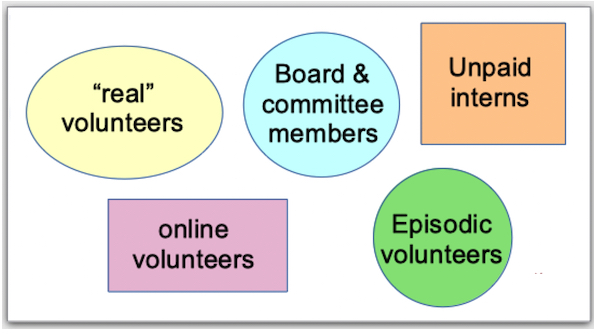
So… could the pandemic and the massive rise in popularity of virtual volunteering be that turning point? Could this be the moment that we stop thinking of volunteer engagement this way, with groups completely segregated from each other:
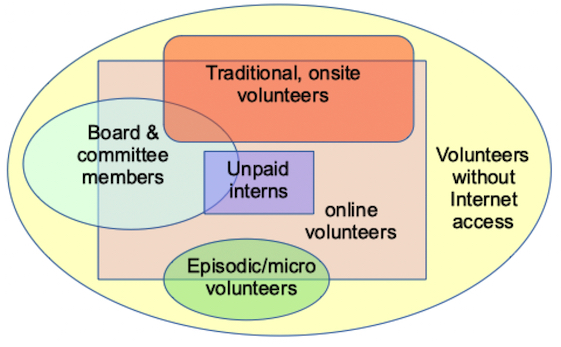
And, instead, we think of volunteer engagement this way, with everyone in the yellow oval being volunteers and intersecting together, and being in more than one grouping?
They are all volunteers. And unless the volunteers don’t have Internet access, you should be using the Internet to engage and support all of your volunteers – to refuse to do so creates so much more work for you, the manager, and leaves out so, so many people as volunteers – it undermines any goals you might have regarding diversity and inclusion.
(Yes, there are volunteers without Internet access – just as there are volunteers who don’t like your traditional thank-you banquet and choose not to attend, or volunteers who don’t like working with the public or in groups and prefer to work behind-the-scenes, alone. No one thing you do onsite, face-to-face is appropriate for all volunteers.)
If you are writing a book or teaching a class about the basics of volunteer management, it should talk about using the Internet to support and engage volunteers – not at the end, but throughout the book or workshop. If you are going to focus on how to
identify tasks for volunteers
recruit volunteers
keep volunteers engaged/volunteer retainment
recognize/honor volunteers.
Then you should be talking about:
identifying tasks people can do online, not just onsite
using the Internet to recruit volunteers for both onsite and online roles and tasks.
using Internet tools to keep volunteers engaged/volunteer retainment
using your web site, YouTube, social media and other Internet tools to recognize and honor volunteers.
You don’t even have to say the phrase virtual volunteering in your workshop or article. People don’t think of themselves as online volunteers – just as volunteers, so why are you talking about them as this completely separate group?!
The Last Virtual Volunteering Guidebook is a volunteer management book for anyone that supports or engages volunteers, or who cares about the overall volunteer engagement at their agency. The book has never been just for people that want to involve online volunteers. In fact, the book emphasizes support for ALL VOLUNTEERS more than any other topic. When Susan Ellis and I wrote The Last Virtual Volunteering Guidebook, we never envisioned a global pandemic creating this massive, sudden shift to virtual volunteering for so many agencies, and I’m glad the book has been helpful to so many in these trying, fatiguing times, but I worry that people are thinking of virtual volunteering as something that will go away when the pandemic eases. Just as virtual volunteering is a practice that’s more than 35 years old and undertaken by thousands of organizations long before 2020, it will continue to be not only a reality, and an expectation.
If you have benefited from this blog or other parts of my web site or my YouTube videos and would like to support the time that went into researching information, developing material, preparing articles, updating pages, etc. (I receive no funding for this work), here is how you can help.
In pre-pandemic times, an online meeting felt like a luxury, a welcomed relief from driving to a site or taking mass transit. Now, because of COVID-19. when the only way to safely work together is online or via the phone, we’re all burned out by online meetings, and there’s nothing virtual about our fatigue.
In addition, volunteering onsite is a way to be a different person than we are at our paid work or in a classroom or even with our families. It’s a way to feel like we’re making a difference in the world. It can be a refreshing change from other parts of our life. For people that live alone, volunteering onsite can provide a much needed social life. While I think online volunteering can be wonderfully personal, I also know that virtual meetings, virtually all the time, is not the world most of us want to live in.
Volunteers are exhausted. Many that still have jobs and struggling to do those and assume new family care obligations – children are in virtual school and some older relatives have moved back in with younger family members. Many are having to look over their finances every day. Most everyone is scared of for their own health as well as everyone else in their household. And many people, especially living alone, are oh-so-lonely. Volunteering these days doesn’t offer the time out it did in pre-pandemic times – it can just feel like another online meeting.
But nonprofits still need volunteers, and volunteers still need volunteering. I know so many nonprofits, NGOs, charities and other groups have a huge amount on their plate these days and far more stresses than usual, but we all need to take a deep breath and spare some thoughts for both our current volunteers and those we want to recruit.
How to Recruit & Engage Volunteers in a Time of Virtual Fatigue, an article is by WBT Systems, which produces TopClass LMS, a learning management system for membership-based associations, has great advice for any program involving volunteers. It starts with some basics from quality volunteer engagement we should all know and apply even in non-pandemic times, like creating realistic roles for volunteers and emphasizing why the task matters to the program and the difference it will make. But then it gets into more specific advice that relates to current remote working challenges, which I’ve reframed and expanded below.
For instance, we all need to better commit to SHORT meetings that have a definite purpose and a definite start and end time. Don’t have a general, open group volunteer meeting; have a here’s-what-everyone’s-doing meeting, devoted exclusively to elevator speeches from each volunteer. Or have a celebrate-one-accomplishment meeting, devoted solely to quick updates. Whatever the meeting, be able to answer these questions: what do I want to happen as a result of this meeting? Why does this meeting matter? Why can’t you ask for this info via email?
I like to prepare my meetings as though it’s a stage performance: I like start and end on time and know exactly what I want to say, but also be ready for a spontaneous improv moment! I also am ready to facilitate: to frankly, politely tell a person who is going too long that we are going to have to table that discussion until later, for instance, because we need to hear from everyone.
Also regarding meetings, the article suggests telling volunteers you will open up an online meeting 15 minutes before the start and leave it open 15 minutes after so they have a chance for chatting, if they wish. I have REALLY enjoyed this in meetings and webinars.
I sometimes encourage people I’m meeting with to have the meeting in a different room than they are in usually – and I do the same. The same rules apply: you should be in a well-lit room that does not have lots of distractions, if at all possible (people walking through the space, intrusive sound, etc.). Otherwise, you might be surprised at how refreshing it feels to have a meeting in a different room, or even just in a different place in the usual room.
In addition, I like when I don’t have to have a full meeting to get a question resolved or check-in with everyone – I like having a Slack channel just for volunteers I’m working with, so they can check-in or ask a question of me, any time. It’s a virtual way of dropping by my office. And it keeps messages out of my email in-box.
The WBT Systems article suggests that you “Invite someone to Zoombomb the end of the meeting, perhaps the CEO, board chair or another leader who thanks the volunteers for giving their time and talent.” I LOVE this idea.
I’m somewhat tepid on the idea of things like encouraging everyone to wear a hat, or having everyone bring a toy to a meeting, etc. – the article doesn’t suggest this, but I’ve seen it elsewhere. I’m not big on ice breakers before every onsite meeting – I do not like having my time wasted, especially when I’ve schlepped across town or had to juggle to carve out time for a meeting, and everyone going around the room talking about who their favorite superhero is (Wonder Woman in the DC universe, Jane as Thor in Marvel). Online, I can find meeting games even more annoying. I want to feel like my time is valued and what’s most needed is getting done. In the end, you have to know your audience, you have to experiment and be observant, you have to be open to what is NOT working, and you have to work towards balance.
Don’t assume staff working with volunteers, or even volunteers themselves, understand how to lead and manage virtually. Yes, I’m going to yet again recommend The Last Virtual Volunteering Guidebook, which emphasizes support for volunteers more than any other topic. Also, if you have time, look for videos and articles that could help others, and if you don’t have time, recruit a volunteer to curate such for you to review and share.
When Susan Ellis and I wrote The Last Virtual Volunteering Guidebook, we never envisioned a global pandemic creating this massive, sudden shift to virtual volunteering for so many agencies. I’m glad to be able to recommend this detailed resource for ensuring success in virtual volunteering, with far more information than a blog or webinar ever could.
If you have benefited from this blog or other parts of my web site or my YouTube videos and would like to support the time that went into researching information, developing material, preparing articles, updating pages, etc. (I receive no funding for this work), here is how you can help.
I’m preparing to teach a class on online community management for nonprofits, through a college back East in the USA (details in the coming weeks), and I realized recently I had done a presentation that I can use in class. The presentation is from 2014 for a group called OCTribe, a monthly in-person meeting in San Francisco. It was a meetup for online community managers, enthusiasts and innovators interested in social networking applications, social media and online group collaboration. “We discuss tools and strategies to enhance participation in the various online communities we support.” The event was hosted at the TechSoup offices.
My presentation, which was also live-streamed on YouTube, is exactly as it is titled: online community management as volunteer management. I look at participants in an online community, especially when I’m the moderator or facilitator of that community, as volunteers – they aren’t paid to participate, they aren’t paid to contribute, and yet, they do. I think cultivating new community members is a lot like cultivating new volunteers, I think supporting and keeping community members is a lot like supporting and keeping new volunteers, and on and on.
I have the presentation available both as a podcast (about 40 minutes) that you can live stream from my web site or download, however you like, and in a video that I have edited. The video isn’t very good, but don’t worry about seeing the slides – I say out loud during the presentation most everything that is on them. I also repeat the questions and comments people ask.
Also, the Last Virtual Volunteering Guidebook: Fully Integrating Online Service Into Volunteer Involvement can help you better work with people online – specifically volunteers, and including participants in an online community that relates to the work of a nonprofit, NGO, library, environmental issue, humanitarian concern, and on and on. This book was helpful long before the global pandemic spurred so many organizations to, at last, embrace virtual volunteering. This is the most comprehensive resource anywhere on working with online volunteers, and on using the Internet to support ALL volunteers, including those you might not think of as online volunteers. It’s available both as a traditional paperback book and in electronic format.
If you have benefited from this blog or other parts of my web site or my YouTube videos and would like to support the time that went into researching information, developing material, preparing articles, updating pages, etc. (I receive no funding for this work), here is how you can help.
The world will get safer as more people get vaccinated against SARS-CoV-2, the infectious disease which causes Coronavirus disease 2019 (COVID-19), but health officials are saying over and over that our world is going to stay the way it is for most of 2021, and probably well into 2022: face masks will continue to be needed in order not to spread this or other viruses, even if you aren’t sick from such. We will need to continue to avoid groups of people, including large crowds. We will need to socially distance. People vulnerable to the illness will need to continue to be protected.
And while lots of precautions will, I hope, continue to be taken to ensure onsite volunteering can be done safely amid the ongoing threat from COVID-19, it also means that virtual volunteering – using the Internet to support and engage volunteers – is going to still be necessary, even for organizations that avoided the practice for decades. And the reality is that virtual volunteering – a practice that’s more than 35 years old and that thousands of organizations were leveraging long before the global pandemic – is a tool that creates an avenue to involve volunteers that could not be involved otherwise and is an avenue of volunteering that many people actively seek out even when there isn’t a dangerous virus lurking about.
High Impact virtual volunteering has always been something many volunteers have sought. While many consultants, especially from the private sector, say the trend for volunteers is towards micro-tasks, I disagree: I hear people saying they want to make a real impact in volunteering, an investment of time that makes a real difference, that isn’t just about minutes or hours done, and isn’t about a check box of tasks completed. I’ve been talking about the desire of volunteers for this kind of deeper-investment virtual volunteering since 2015, including in this blog, the future of virtual volunteering? Deeper relationships, higher impact. In that blog, I said:
When volunteers interact with clients directly, it’s a highly personal activity, no matter the mission of the organization. These volunteer roles involve building and maintaining trust and cultivating relationships – not just getting a task done. It takes many hours and a real commitment – it can’t be done just when the volunteer might have some extra time. And altogether, that means that, unlike microvolunteering, these direct service virtual volunteering roles aren’t available to absolutely anyone with a networked device, Internet access and a good heart. These roles discriminate: if you don’t have the skills and the time, you don’t get to do them. And, believe it or not, the very high bar for participation is very appealing to a growing number of people that want to volunteer.
I always have to remind people at this point that I’m not opposed to microvolunteering – online tasks that take just a few minutes or hours for a volunteer to complete, require little or not training of the online volunteer, and require no ongoing commitment. I’ve been writing about microvolunteering before it was called that – I gave it the name byte-sized volunteering back in the 1990s, but the name didn’t stick. If you want to give lots of people a taste of your program, with an eye to cultivating those people into longer-term volunteers, and/or donors, and you have the time to create and support microvolunteering assignments, great, go for it!
But I continue to hear and see a growing number of comments, especially young people, saying they want more than just a “quickie” volunteering experience. They want more than number-of-hours volunteering and a list of tasks that need done. They want something high-impact. They want to feel like they have really made a difference. They want to make a real connection with the organization and those, or the mission, it serves. And not just for virtual volunteering! They also want it for onsite volunteering.
When a university contacted me this year about what their student volunteering abroad program could look like online instead, a program where students provided medical help with medical and public health professionals in other countries, I put together a quick list of what this could look like, based on these resources I’d continued to maintain, and I’ve been adding to it ever since. This list of what high-impact virtual volunteering looks like, with links to examples, is for people seeking ideas for an online project that will mobilize online volunteers in activities that lead to a sustainable, lasting benefit to a community or cause, particularly for a community or audience that is at-risk or under-served. It was created especially for programs looking for ways to engage online volunteers in high-responsibility, high-impact tasks focused on communities in the developing world. Note that these ideas absolutely can be adapted for remote volunteering within the same country where the online volunteers live as well – “remote” could mean across town rather than around the world.
Also, the Last Virtual Volunteering Guidebook: Fully Integrating Online Service Into Volunteer Involvement can help you better work with people online – specifically volunteers. These can be volunteers in short-term, “microvolunteering” tasks or longer-term, more high-responsibility roles, like what is highlighted here in the blog you are reading now. These can be volunteers who do some or most of their service onsite, at your organization, or volunteers who do most or all of their service remotely, rarely or ever onsite and in-person with you. This book was helpful long before the global pandemic spurred so many organizations to, at last, embrace virtual volunteering. This is the most comprehensive resource anywhere on working with online volunteers, and on using the Internet to support ALL volunteers, including those you might not think of as “online” volunteers.
If you have benefited from this blog or other parts of my web site or my YouTube videos and would like to support the time that went into researching information, developing material, preparing articles, updating pages, etc. (I receive no funding for this work), here is how you can help.
Can volunteering repair a nation? I don’t mean dealing with infrastructure after a war or natural disaster – we know that volunteers are terrific at repairing homes, clearing roads, helping at shelters, rowing boats, etc. I mean can volunteerism be an effective tool when a nation’s people are so divided that they don’t even see reality the same way?
Maybe.
I confess that I am not one for talking about volunteering as a way to access “warm fuzzies” – for optimistic, hopeful moments of restoration of faith in all humanity. Personally, I’m a skeptic at best and a cynic at worst. But I do believe in volunteer engagement as an amazing tool: to build awareness about an issue among a group or population, to give the community a hands-on experience regarding a cause, to educate a group about the realities of a topic, to build understanding among people who may not know much about each other, or might even be hostile, and maybe, just maybe, to restore faith in institutions and other people.
A lot of politicians are talking about coming together and unity among people in the USA, but, as we all are fully aware, that’s going to take more than just talking about it. It’s also only a matter of time before some of those same people start suggesting volunteerism as a salve to heal the nation’s wounds and “unify” the people. They are picturing people of different political parties working side-by-side to clean up trash or paint over graffiti or build something.
But here is what’s going to be missing from that call-to-volunteer-and-let’s-come-together rhetoric, and what it’s going to take for volunteer engagement to lead to bridge-building among people who are oh-so-polarized:
Nonprofits expected to involve volunteers, especially MORE volunteers, need MONEY. Why? Because volunteers are never free. Want nonprofits to create more roles and tasks for more volunteers? Give those nonprofits cash: for staff to supervise and support volunteers, for staff training in effective volunteer engagement, and for all of the snazzy tech tools you want nonprofits to use to engage with volunteers. And that’s just to start: these nonprofits will also need training in recruiting for diversity, in conflict management, regarding effective facilitation, in inclusive volunteer engagement and communication, and more if you want them to fulfill your dreams of unity – and that requires skills they may not have, and to get those skills requires classes and consultants and that costs money.
Ready to fund childcare? Because if you want more people to volunteer, and you want a greater diversity of people to volunteer, someone is going to have to pay for childcare for volunteers with children.
Government has to bring nonprofits to the table for discussions about how to bring disparate groups of people together. If the mayor is having a council on ways to create reconciliation among a diverse city, local nonprofits need to be in the discussions. If a regional or state government body is exploring methods, nonprofits have to be there – not just the big, major nonprofits but the small grassroots groups too. And a key segment that has to be there in discussions: ARTS GROUPS: theater, dance, music, literature and fine arts.
We all have to stop talking about volunteering only as a way to get tasks done. We have to talk about volunteering as a way for all participants – volunteers, employees and clients – to have a transformational experience. And that means that, often, involving volunteers means tasks will not be done as efficiently and economically as possible: it’s much easier to hire one person or involve one highly-skilled volunteer to do a task than to create a way for a group of dissimilar people with a range of skills and experiences to do it at a time when everyone in that group might be available. It also means making volunteering about learning about an issue related to the mission of the organization – climate change, the reasons people are homeless, the challenges faced by under-employed people, etc. – again, not just getting work done, and not all people charged with creating volunteering tasks and roles and managing volunteers have the skillset to do that.
Accept that some people aren’t going to be engaged as volunteers because of a requirement at many nonprofits and community groups regarding respect and conduct of employees, consultants and volunteers, because of requirements regarding safety, and because of the potential of volunteers to spread misinformation about the focus of the nonprofit or the cause it addresses. For instance, someone who believes and promotes misinformation about child trafficking on their social media is going to be inappropriate to help at organizations related to children. Someone who does not believe in the safety of vaccines or believes the Earth is flat or refutes other science, and let’s that be known, is going to probably be inappropriate in a range of volunteering roles related to human health, marine health, outdoor geological sites, etc., especially if they will interact with other volunteers or the public. Many nonprofits have a stated commitment to creating a work culture that promotes respect and prohibits words or actions that create a hostile work environment for others. Many nonprofits have a stated commitment to equality and inclusion, and a stated refutation of racism, sexism or hate speech, and a volunteer or employee engaging in actions or language outside of their work that is in contrast to that culture could, as a result upon discovery, be dismissed. Nonprofits should not be pressured to involve volunteers who engage in misinformation that would harm the clients a nonprofit works with or that runs counter to the mission of the organization. Nonprofits should not be pressured to engage volunteers who carry weapons if that nonprofit has a policy that prevents weapons from their workspaces. And all of that means some people are going to be excluded from volunteer engagement at some organizations. Before you decide that’s somehow wrong, that everyone should have a right to volunteer anywhere they want to, note that I myself am excluded from volunteering at some organizations because I cannot adhere to their religious belief requirements, and I accept that.
It’s a tall order to ask organizations focused on some aspect of the environment and outdoor spaces – wildlife habitat preservation, restoring wetlands, cleaning up trash at the beach, rescue groups, etc. – to engage in additional activities to counter misinformation among volunteers regarding climate change, but that’s exactly what nonprofits need to be funded and empowered to do if we are going for “unity.” The lack of science literacy is resulting in many of the divisions in the USA, and if governments and corporations desire nonprofits to address science misinformation and lack of trust through volunteerism, they need to be prepared to fund the activities needed to train staff to make that happen, and to give staff the time to make that happen. .
So, governments and corporations: are you ready to invite nonprofits to the table, as well as to fund all that’s necessary for this monumental task of unity?
If you have benefited from this blog or other parts of my web site or my YouTube videos and would like to support the time that went into researching information, developing material, preparing articles, updating pages, etc. (I receive no funding for this work), here is how you can help.
I have to start this blog with three disclaimers, because if I don’t, I will get accused of hating volunteerism, hating charity and not liking days of service:
First: yes, I support volunteering. I am, in fact, a passionate supporter of volunteer engagement. I believe nonprofits, NGOs, charities and any community-focused initiative should create roles and task for volunteers, specifically, and should have an ongoing commitment to volunteer engagement. If I didn’t believe that, I would not have devoted a significant portion of my career, my web site and my blog to the factors for success in volunteer engagement.
Second: No, I am not opposed to all charity. Sometimes, absolutely, the best thing to do in a situation is to provide temporary relief, like food or a tent. But I do have some reservations about people’s emphasis on charity rather than transformation.
Third: I am not opposed, outright, to days-of-service, like Make a Difference Day, Join Hands Day, Good Deeds Day, MLK Day of Service, and all the many, many other ones, nor to volunteering over the holidays. I just have some reservations about the intense focus on such.
The road to hell is lined with good intentions. The statement is even true when about the act of volunteering. Volunteerism is a social construct that’s taught, when done thoughtlessly (with good intentions) can result of negative outcomes. January 13, 2020.
and
The act of volunteering is a social construct. This is taught to us. But, maybe we need to unlearn some of what we understand about it. Why? Because it’s not universally valued globally. Maybe we need to reimagine it philosophically. January 12, 2020.
Both were tweeted in association with his recent blog: The Misunderstood Social Construct That “Does Good”. And for many, this is NOT going to be an easy blog to read. But anyone who wants to promote volunteerism, and in particular, any corporate program that wants to mobilize its employees to volunteer for a cause or any individual that wants to mobilize friends or fellow students to volunteer, really needs to read Jerome’s blog, which says, in part:
We must decouple community service from holidays and societally prescribed dates in history, then position volunteering as something to do based on need year-round and think about our place in solving an issue and whether that conflicts with our (or others) expectations.
It is something I’ve been blogging about for a while myself, and NOT to much fanfare – in fact, I’ve made some people mad for daring to question some volunteerism initiatives and activities by volunteers themselves, especially DIY volunteers. Here are the blogs I’ve written over the years on a related note:
Absolutely, there is an entitlement regarding volunteerism, even domestic volunteering, that I find really, really distasteful, patriarchal, colonialist, classist and, at times, racist. And I’m so, so happy to not be alone in this feeling.
Keep asking the hard questions, Jerome.
January 20, 2021 update: After tweeting about this blog, someone suggested I read the 2006 piece “What We Don’t Talk About When We Don’t Talk About Service” by Adam Davis, which proposes that volunteering / community service is an expression of how we “cherish inequality.” An excerpt: “I want to call into question the assumption or conclusion that Service Is Good (SIG)… Here is an exaggerated pass at the relation between inequality and service: I serve you because I want to; I choose to. You receive my service because you have to; you need it. I live in the realm of freedom; you live in the realm of necessity. Serving you, I confirm my relative superiority. Being served, you confirm your inferiority… Do acts of service move us toward equality? Might some acts of service enshrine and even extend the very gap they mean to bridge?” A good piece, if a bit too lengthy.
If you have benefited from this blog or other parts of my web site or my YouTube videos and would like to support the time that went into researching information, developing material, preparing articles, updating pages, etc. (I receive no funding for this work), here is how you can help.
On Wednesday, December 2, 2020, the US Federal Communications Commission (FCC) hosted a webinar on “Virtual Volunteerism.” The purpose of the webinar was to illustrate how broadband allows volunteers in a variety of regions to engage in substantial, high-impact virtual volunteering activities. The webinar presented a panel of representatives from virtual volunteering initiatives – nonprofits that have programs that involve online volunteers primarily, rather than traditional programs that added an online volunteering component (a screen capture of participants is above). I was pleased to have been called on by the FCC to make recommendations about programs they could feature in this webinar, some of which are profiled in The Last Virtual Volunteering Guidebook.
The webinar was facilitated by David Savolaine from the Consumer Affairs and Outreach Division, who contacted me for references for presenters, and Eduard Bartholme, FCC Associate Chief in the Consumer and Governmental Affairs Bureau.
The webinar panelists talked mostly about the specifics of how their initiatives involve online volunteers (the exact roles that volunteers undertake), how those volunteers are supported and how those volunteers are central to their initiative’s online program delivery and mission.
It’s rare that there is a presentation on virtual volunteering where audiences get to hear directly, at length, from organizations that are engaging online volunteers. Most presentations on virtual volunteering are by people like me – researchers and consultants about the practice – or by people from the corporate sector either bragging about their employees that volunteer online in a program they designed or that have launched yet another web-based platform to recruit online volunteers. There’s no better place to learn about factors for success in engaging volunteers online than by talking to the nonprofits and NGOs engaging such volunteers – which is why The Last Virtual Volunteering Guidebook quotes extensively a variety of organizations that involve online volunteers, to illustrate how the recommendations in the book are put into practice.
The panelists talked about the makeup of their online volunteers (quite diverse), the personal, substantial relationships online volunteers have with clients and each other (something I devoted an entire video to on YouTube), and what’s key to success in supporting the volunteers to ensure they are successful – keys that are detailed in The Last Virtual Volunteering Guidebook. I’ll summarize them below:
Recruitment
When asked how they recruit people to volunteer with their initiatives, all of the panelists said they don’t actively recruit – instead, volunteers find them. Be My Eyes noted that they had 10,000 people sign up to volunteer within the first 24 hours of their launch – far more than they have opportunities for. The representative from Be My Eyes noted, “The key is people having a great experience and they tell their friends about it. We haven’t spent any money on marketing on anything like that.” Infinite Family and Open Street Maps affirmed that volunteers having a great experience and telling their friends is key for not having to actively recruit volunteers.
Per the disproportionate number of roles and assignments for online volunteers versus demand that so manhy virtual volunteering initiatives report, Naoual Driouich in the United Nations Volunteers New York office said, “For the volunteers, I will say to be patient and to continue applying for opportunities, not to give up, even if the opportunity closes, even if there is a waiting list. Just continue looking for opportunities.”
It’s worth noting that in my four years of managing the Virtual Volunteering Project and the four years managing the UN’s Online Volunteering service, those programs were never marketed to people to encourage them to volunteer online – instead, we marketed exclusively to programs to host online volunteers. And, yet, there was always, always, far more people contacting me that wanted to volunteer than there were roles and tasks for them to do.
Make the experience collaborative
Mikel Maron of the Open Street Map Foundation noted a key to ensuring sustainability of a program that I would love to write an entire blog about, and it would make a great research topic to see how this works at other organizations:
I think opening up the opportunity to your volunteers to create with you and to figure out what you’re doing together is really an amazing way to build something, to build a platform. It takes some humility because you don’t know everything, but the result can be – if you can find a way of gathering together and figuring out things together its amazing, and it created more dedicated volunteers if they really have a stake, not just in what they do, but how they do it.
Amy Stokes, Infinite Family, agreed:
I think we’re all learning together, certainly we are in our organization.
Support Volunteers
Infinite Family is an international online mentoring program, which brings together adult mentors in the USA together with students in South Africa, via a special platform the organization uses for interactions. Amy Stokes of Infinite Family noted in the webinar,
One of the things that we found that is really important is (providing) ongoing support for the volunteers throughout the relationship. We have an on-call site all the time (to help with) stressful situations tech problems, whatever. Volunteers know there’s always somebody there to help with ongoing challenges.
She noted that volunteers are all using different tools to access Infinite Family’s tools and resources – they are using different browsers and different operating systems – and so the nonprofit has tried to create a platform that will work across these systems – and it doesn’t always.
The interaction between the browser, the operating system, the application, whatever your ISP is doing that day – all of a sudden, something that worked a week ago beautifully won’t work at all. Sometimes, tech companies don’t put out notes to say, ‘Oh, we’re going to do this and it might affect the rest of your system.’ And so, sometimes, a volunteer reaches out and says ‘What is going wrong?’ It might not work today, they might not be doing anything wrong. We find that it helps if we tell them upfront, at the very beginning, ‘You know, this is a tech thing. You’re probably used to everything working in your world and you can control it. But now you’re working in a lot of other worlds at the same time, and we can’t control all of those things…’ I mean, how many times do you log in at the last minute to do something and the app pops up and says, ‘Oh, no, you’ve got to change your password. Or, Oh, no, you’ve got to upgrade, please download.’ You just have to build in a kind of flexibility.
Ashley Womble of Crisis Text Hotline also talked about the importance of support to volunteers when you are asking them to use a custom online tool:
We teach as part of our training how to use our platform. We don’t expect crisis counselors and volunteers to come to us knowing how to use our platform at all. We built it and we have to train them… certainly, we can’t know whenever people are going to have Internet issues, but we do help in the beginning (with training) and that reduces a lot of the stress.
A diversity of people and experiences
Mikel Maron of the Open Street Map Foundation noted the importance of remembering that every place in the world is not the same when you are dealing with online volunteers that are in other regions, especially in other countries.
I spent a lot of time working in Kenya and it looked very different to volunteer in a place where you may also have a struggle to make ends meet day-to-day. But people (from those places) also want to contribute.
So Open Street Map has to help support those online contributors. “How do you testify what a road is in rural Kenya versus the middle of London?” He says that organizations need to consider how different people from different places communicate online.
We’re a global project and even if you all speak English… there’s just a lot of assumptions about our communications and we miscommunicate all the time…. Within Open Street Map that just means we’re constantly on our toes and learning about how we can connect to others. On the flip side, it’s amazing we get to connect with others through what we do. We learn so much about other places and other people and really build rich relationships with people on the other side of the world and around the corner.
Crisis Text Line had a unique approach:
We’re also gamefied our program a little bit. Based on the number of conversations people have, they get to a certain level, and people want to work up the ladder so they can unlock different perks, as you might in a video game. That’s worked really well for us. I know I’m personally very proud that I’m a level four, and I can’t wait to become a level fie, and I’ll be spending more time myself volunteering in the organization.
Final advice
Naoual Driouich in the United Nations Volunteers New York office had this advice for organizations that want to involve online volunteers, and I think she’s absolutely correct:
Please put yourselves in the shoes of the online volunteer when you put together the opportunity. Make sure it is complete and straight forward.
I absolutely agree. When host organizations put themselves into the shoes of volunteers, thinking, “What would I need to be able to do this assignment if I was not already a part of this organization? What would I need to be successful?” they end up instituting the support volunteers need.
As noted earlier, some of these initiatives, and all of what they noted was essential to success, are profiled or detailed in The Last Virtual Volunteering Guidebook. The book, available as an online book and in traditional print form, offers much more detailed advice on creating assignments for online volunteers, for working with online volunteers, for using the Internet to support and involve ALL volunteers, including volunteers that provide service onsite, and for ensuring success in virtual volunteering. It also talks about policies and procedures, such as how developing written agreements to be signed by both online volunteers and their host organization (page 66) can prevent problems down the road, not only regarding ownership and use of what an online volunteer create, including web sites and code, but also regarding confidentiality and privacy in using of the volunteer’s information, including images of them, regarding confidentiality regarding the organization and the information the volunteer has access to, particularly client information, regarding how the online volunteer should represent his or her association with the program online (in emails, on social media, on LinkedIn, etc.), and liability regarding malware.
When I directed the Virtual Volunteering Project back in the 1990s and did workshops introducing virtual volunteering to a room full of representatives from nonprofits and government agencies, an early question I got was, “Who owns what an online volunteer creates as a part of their service?” So I asked the various experts in traditional volunteer management for the answer – and they didn’t know! That question had never come up for them. It took cornering a panel of lawyers at a conference (they were presenting on liability and volunteers) to get the answer: volunteers own what they create.
Two more recent articles confirm this:
In this article from INFORMATION OUTLOOK V16 N04 JULY/AUGUST 2012, Volunteers are Copyright Owners, Too!, author and copyright lawyer Lesley Ellen Harris notes, “Whether it be an article, image, video, business plan, table based on research, or other type of content, it is possible that the material being created by your volunteers is automatically protected by copyright (yes, even without registering the material or using a copyright symbol).” The article strongly recommends entering into a copyright agreement with volunteers to help prevent problems, such as a volunteer quitting and demanding that you stop using their work.
This February 2019 article from copyrightlaws.com, Who Owns Copyright in Works By Volunteers, affirms the previous recommendation: “You may want to consider developing an agreement with your volunteers that transfers to your organization the copyright in any works they create for you. Such an agreement ensures your organization can use their work as needed. It can also address the liability of volunteers using third-party works without obtaining permission.” It’s something companies frequently include in a contract that an employee or contractor/consultant signs, but that they often forget to have volunteers sign.
As noted in The Last Virtual Volunteering Guidebook, developing written agreements to be signed by both online volunteers and their host organization (page 66) can prevent problems down the road, not only regarding ownership and use of what an online volunteer create, including web sites and code, but also regarding confidentiality and privacy in using of the volunteer’s information, including images of them, regarding confidentiality regarding the organization and the information the volunteer has access to, particularly client information, regarding how the online volunteer should represent his or her association with the program online (in emails, on social media, on LinkedIn, etc.), and liability regarding malware.
That said, I regularly look for controversies regarding volunteers and the materials they create for programs they support, particularly regarding copyright, and haven’t found anything. But just because there hasn’t been a newspaper article, newsletter article or blog about it doesn’t mean it hasn’t happened.
And note: I’m not a lawyer. Don’t use this blog as your ultimate, last guidance. If volunteers are creating things for you, or engaging in activities that result in a product or program you use (photos, a strategy, a database, etc.), talk to a lawyer about legal agreements you may want to have volunteers sign regarding use and ownership of what they create for your program.
If you have benefited from this blog or other parts of my web site or my YouTube videos and would like to support the time that went into researching information, developing material, preparing articles, updating pages, etc. (I receive no funding for this work), here is how you can help.
I see lots of young people online who are wondering how to build up their skills and résumés in this time of COVID-19, or to explore careers with so many onsite experiences closed to them. I want to remind them all (they all read my blog, right?) that volunteering to help with an online community is a great way to get experience, to build your skills, to build your knowledge, to build your portfolio and to network for jobs.
Don’t believe me? I’ve been helping with online communities since 1993 or so, mostly as a volunteer. And those experiences have played a substantial part in both getting professional positions and getting experience that’s helped me in my offline work.
The first online community I participated in was the soc.org.nonprofit USENET newsgroup. It was created in June 1994 and gatewayed to the email-based mailing list USNONPROFIT-L. The community was for the discussion of nonprofit management and program issues. I found it soon after it was created and, after a couple of years of participating, because I was such a prolific contributor, I got asked to co-moderate it, as a volunteer, and I did so for several years. My participation there, and some onsite volunteering and collaboration, lead me to being offered a paid position: to direct the Virtual Volunteering Project.
In the late 1990s, I participated in three other online communities, all on YahooGroups: CyberVPM, UKVPMs, and OZVPM, all focused on managers of volunteers. It was because of my participation in those three communities, talking about the VV Project and virtual volunteering in general, that I got noticed by a United Nations agency in charge of the online volunteering portion of NetAid, and ended up directing what became the UN’s Online Volunteering Service. I also have lifelong colleagues and friends because of my volunteer participation in those three communities specifically.
In 2001 or so, while living in Germany and working for the UN Volunteers program, I started participating in the then newly-launched TechSoup online community. You can see an early version of that community on the Internet Wayback machine. I was a very active volunteer contributor and ended up getting asked to be a volunteer moderator, helping to introduce topics, answer questions and delete spam, and to lead a couple of online events. And years later, in 2009, after volunteering on and off, I got a part-time contracting gig helping with the community and some online events. I’ve done that off and on ever since (including now!).
Around that same time, someone set up an online community for people working in international aid and development work. I joined that community and, once again, I was a prolific contributor, as a volunteer, and eventually got asked to be a volunteer board member of the newly-formed nonprofit that got set up to support the community. The Aid Workers Network lasted for just a few years, but I got asked about that experience regularly in job interviews, and there are two people that remain my professional colleagues to this day.
On Reddit, I’ve been the volunteer moderator for the volunteer community, the community service subreddit, and the inclusion subreddit, for a few years now – and I got a short, well-paid consulting gig earlier this year because of my activities on the volunteer subreddit specifically.
So, that’s my story on how volunteering to contribute, moderate, facilitate and lead online communities has helped me professionally. It could help you, too:
Look for Reddit communities that represent what you want to do professionally or as a volunteer. Read a lot before you contribute, and always read as much as you yourself post. When you feel ready, post helpful, on-topic questions, advice and comments. Follow the rules. If you do this regularly, don’t be surprised if you end up getting asked to be a moderator. Even if you aren’t asked to be a moderator, if you think your contributions show your expertise, workstyle and character, consider including a link to your Reddit profile on your résumé.
Use Google, Bing or Duck Duck Go, and on Facebook, to find online communities hosted on other platforms that relate to what you want to do, whether its humanitarian work, nonprofit theater management, rescuing wildlife, logistics after disasters, whatever. As always, read a lot before you contribute, and always read as much as you post. Post helpful, on-topic questions, advice and comments and follow the rules. You might get asked to be a moderator, but regardless, you’ll create an online profile potential employers might find quite interesting.
And if your nonprofit, NGO, charity, library, etc. has an online community, the contributors to that community are volunteers, even if you don’t call them such, even if you also call them clients or community members instead. If they are asking questions, offering comments and advice, introducing discussions on your community, even debating (but are staying on topic) and you aren’t paying them, they are online volunteers, they are contributing their time and talents, and you are engaged in virtual volunteering.
For detailed advice on creating assignments for online volunteers, for working with online volunteers, for using the Internet to support and involve ALL volunteers (including those providing service onsite), and for ensuring success in virtual volunteering, check out The Last Virtual Volunteering Guidebook. You will not find a more detailed guide anywhere for working with online volunteers and using the Internet to support and involve all volunteers. It’s available both as a traditional paperback and as an online book. It’s co-written by myself and Susan Ellis. If your organization wants to better engage the people who contribute to your online communities – and, yes, those are online volunteers – this book can help.
If you have benefited from this blog or other parts of my web site and would like to support the time that went into researching information, developing material, preparing articles, updating pages, etc. (I receive no funding for this work), here is how you can help.
If your nonprofit, NGO, library, school or other mission-based program is involving online volunteers, or if your business / corporation has a virtual volunteering component in its employee volunteering program, below is a list of public online spaces where you can share information about your program: what software volunteers use to check-in or communicate with you, what they use to collaborate with each other, what tools and techniques (IT-based or otherwise) you use to support online/remote volunteers, your successes, your challenges, etc. These are also great places to ask questions and for advice regarding virtual volunteering:
You can share exactly the same information across all three of those online communities because each of those communities reaches a very different audience – the Linkedin group reaches a mix of people at a variety of programs working with volunteers as well as corporate representatives and university students and faculty. The subreddit reaches a younger and mostly male audience that you probably won’t reach otherwise. The TechSoup community reaches a mix of nonprofit folks and tech-savvy people who care about nonprofits. In short, there is very little audience crossover on those three communities.
(note that only the Reddit group is for recruiting online volunteers; on TechSoup, you should use this forum to recruit online volunteers)
Why share publicly about your experience working with online volunteers, including challenges? It’s a great way to both brag about what you are doing – and what you are doing is worth bragging about – and to learn from others. No one has a monopoly on knowledge about virtual volunteering – everyone is constantly learning, including me – and this is how we can all learn together.
The reality is that there needs to be a much greater diversity of contributions to those groups regarding virtual volunteering and I’m NOT going to work forever. This call is also my effort to try to cultivate a greater number of voices talking about virtual volunteering – there was far, far more online discussion about it back in the late 1990s than there is now!
Full disclosure: I am a moderator for all three of those groups, and I’m also hoping to see emerging leadership such that I can hand over the reins on these eventually!
For much more detailed advice on creating assignments for online volunteers, for working with online volunteers, for using the Internet to support and involve ALL volunteers, including volunteers that provide service onsite, and for ensuring success in virtual volunteering, check out The Last Virtual Volunteering Guidebook. Tools come and go – but certain community engagement principles never change. You will not find a more detailed guide anywhere for working with online volunteers and using the Internet to support and involve all volunteers – even after home quarantines are over and volunteers start coming back onsite to your workspace. It’s available both as a traditional paperback and as an online book. It’s co-written by myself and Susan Ellis.
If you have benefited from this blog or other parts of my web site and would like to support the time that went into researching information, developing material, preparing articles, updating pages, etc. (I receive no funding for this work), here is how you can help.