Category Archives: Community / Volunteer Engagement

Busco información en español sobre cómo trabajar con voluntarios

graphic by Jayne Cravens representing volunteers

Busco información en español sobre cómo trabajar con voluntarios. Información sobre apoyo y gestión de voluntarios. Puede enfocarse en un país de habla español (España, México, etc.) o en una comunidad de EE. UU. Pueden ser libros para comprar o información gratuita en línea.

He encontrado esta guía gratuita de HacesFalta. La información sobre cómo trabajar con voluntarios comienza en la página 64. La sección tiene cuatro páginas

También encontré este consejo para los padres, para participar en las escuelas.https://kidshealth.org/es/parents/school-esp.html

Y Claves para la Gestión del Voluntariado en las Entidades no Lucrativas de la Coordinadora de Organizaciones No Gubernamentales para el Desarrollo de la Comunidad Autónoma de La Rioja (CONGDCAR) en España.

Y “La Importancia de la Participación de los Padres en las Escuelas.”

Y La Guía del Voluntariado Virtual.

Y La entrada de Voluntariado en Wikipedia.

Mas?

(Perdóname por mis malas habilidades en español)

21 May 2021 actualización: El canal de YouTube de La Plataforma del Voluntariado de España. La PVE de es una organización no gubernamental que coordina la promoción y difusión del voluntariado y la acción solidaria a nivel estatal, una actividad que en nuestro país desarrollan casi 3 millones de personas. Uno de los objetivos principales de la PVE es la sensibilización social sobre el voluntariado a través del arte y la cultura.

Does your web site make people cry?

drawing of two people, one using a smartphone and one using a desktop computer

I’m an advocate for accessibility on the World Wide Web. I’m not a web designer, but I am a human, and just as I want every person to be able to easily enter a public building and see a movie, get a passport, buy a meal, enjoy artwork, get medical care, complain to the management, etc., I want every person to be able to access the critical information and services they need via the Internet. Accessibility isn’t just nice to do in a web site design – it’s a sign of respect. It’s a human right. And a site that doesn’t try to be accessible is, to me, a sign of profound disrespect.

Just how distressing and painful an inaccessible web site can be was brought home for me recently: an elderly neighbor needed to put her sweet, beloved 12-year-old dog down. She was heartbroken. It was important to her for this procedure to be done in her own home, so she could be there at the moment of his death – something she couldn’t do in a vet’s office because of COVID-19 precautions. She booked an appointment through a company that specializes in euthanasia for pets at home via phone. Then she went online to pay. Her only Internet access is through her Android phone. She went through the very lengthy online form four times, and four times, she got to the end and there was a frowny face and the words, “Show you are human.” She didn’t understand what it meant. She clicked everywhere she could think of, hit return over and over and, each time, would have to go back and start all over. She was in tears by the time she texted me, begging for help.

I had to make the appointment for her on my Apple laptop, and I was confused by the form several times – it often wasn’t clear which field box went with which field box description. When I got to the end of the form, I was presented with a captcha – that’s what wasn’t working on her smartphone when she was trying to pay. By the end of the process, we were both even more stressed out – we had wanted to focus that day on saying goodbye to a beloved friend, and instead, we were both emotionally drained by an inaccessble web site.

How many older people have been in the same position because of an inaccessible web site? How many people have been urgently trying to make an appointment, pay a bill, get critically-needed information, and have been frustrated and even demoralized by an inaccessible web site? How many web sites have literally made people cry?

These accessibility recommendations from the State of Illinois are a good place to start in making a web site more accessible. 

And the keyword #WebWeWant on Twitter is a good one to follow.

Also see:

If you have benefited from this blog or other parts of my web site or my YouTube videos and would like to support the time that went into researching information, developing material, preparing articles, updating pages, etc. (I receive no funding for this work), here is how you can help

What should my next virtual volunteering video be?

Since the start of the global pandemic last year, I have been creating and sharing videos to help organizations understand virtual volunteering and to quickly create roles and activities for online volunteers. I share them on my YouTube channel. These videos include:

I’m a professional consultant, and I cannot pay my bills with my goodwill and sharing free videos. However, sacrificing some – indeed, a lot – of my potential income to try to mitigate at least some of the negative impacts of the pandemic on nonprofits has been my way of feeling like I’m doing something worthwhile in this intense, tough time, as a way to feel not quite so helpless.

So, let me continue to try to help in my own small way: what would you like my next free training about virtual volunteering to be? What is a subject I could cover in just 5 to 15 minutes that would help your nonprofit, charity, school, NGO, library or other cause-based program regarding virtual volunteering? Please note the subject you need most in the comments below.

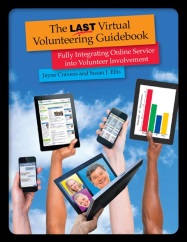
cover of Virtual Volunteering book with hands raising up various Internet connected devices

While I don’t think these videos nor my blogs are a substitute for reading my book, The Last Virtual Volunteering Guidebook, I do believe that the information can help nonprofits who already have experience involving volunteers in traditional settings – onsite, face-to-face – pivot quickly in creating roles and tasks for online volunteers. But if you want to deeply integrate virtual volunteering into your program and expand your engagement of online volunteers, such as in an online mentoring program or other scheme where online volunteers will interact with clients, you will not find a more detailed guide anywhere for working with online volunteers and using the Internet to support and involve all volunteers – even after home quarantines are over and volunteers start coming back onsite to your workspace. And purchasing the book is far, far cheaper than hiring me as a consultant or trainer regarding virtual volunteering – though you can still do that!

Also, FYI, please note my videos that aren’t specifically about virtual volunteering, including:

Looking forward to reading your suggestions!

Volunteering is no substitute for government programs

graphic by Jayne Cravens representing volunteers

The Washington Post published an editorial on Monday by Katherine Turk, an associate professor of history at the University of North Carolina at Chapel Hill and the author of. The headline and subhead:

Volunteering and generosity are no substitutes for government programs.

Conservatives have weaponized Americans’ desire to help to attack the social safety net.

As the editorial notes:

…as we honor these selfless acts, we should also recall National Volunteering Week’s dark origins story, when president Richard Nixon distorted benevolence to serve the least generous of goals. This history makes it clear that volunteering cannot stand in for government provided support…

…(President) Nixon, a Republican, set out to change the conversation about what the government owed to citizens when he became president in 1969. In particular, he sought to shrink Aid to Families With Dependent Children (often called simply “welfare”), the program that paid modest sums to low-income families. He also wanted to fulfill his campaign promise to be a president of “law and order” by redirecting War on Poverty funds into expanding incarceration and more aggressive policing in urban communities of color.

To lay the groundwork for these changes, Nixon took up his predecessors’ focus on volunteerism, and warped it. Many Americans needed assistance, Nixon claimed, but their generous fellow citizens could meet those needs. Volunteer programs should replace government-funded and run services… Nixon outlined an ambitious vision in which teens tutored youths; business leaders mentored aspiring entrepreneurs; housewives cooked for elderly neighbors, and those elderly served as foster grandparents. Most anyone could be recruited to aid another person free.

This praise for volunteerism helped erode the notion that basic sustenance was a right — something for which Americans shouldn’t have to rely upon the vagaries of charity. 

I strongly encourage you to read the entire editorial. As for me, I love volunteer engagement, I love volunteerism – and I absolutely agree with this editorial.

I won’t repeat myself – I have blogged about this so many times. I’ll let those past blogs speak for me:

Your local adventure – & opportunity to help humanity or the environment – awaits

Below is a question and answer from an interview with by Paul Salopek on the post-pandemic world, and I think its message is something every person that wants to volunteer abroad, or any person that wants to be a humanitarian worker abroad, needs to reflect on:

How can storytellers, who are often used to traveling and seeking stories out in the field, adapt to the new reality and continue telling the stories while staying at home?

I’ve always suggested to journalism students that it’s easy to jet off to some war and make your name covering such dramatic material. It’s actually the most unimaginative, even lazy, way to success. And I say this as a former war reporter. It’s much harder—but far more impressive, in my opinion—to document the same human drama at home. On your city block. In your house. If you tell me that the spiritual, existential dread of a lonesome woman or man in a middle-class suburb is somehow less interesting or “authentic” than a refugee’s woes, I’ll tell you that you are in danger of producing shallow cartoons, not original, impactful work. Take the lockdown as a challenge. Dig deeper into the warzone of your own heart.

A thousand times this! I feel exactly the same way about people that say they want to volunteer abroad but have not done locally whatever it is they want to do in another country: it’s an unimaginative, lazy way of thinking about helping others and making a difference. It is far, far more impressive to engage in meaningful local volunteering opportunities helping educate people with HIV, helping immigrants and refugees, helping unsheltered people, helping foster kids, helping people access the critical services they need, helping to educate people about their rights, introducing arts or sports or outdoor recreation to people in your own community. If you tell me helping abroad is somehow more “authentic” than helping in your own community – or even another community in your own country – I’ll tell you the same thing: you are in danger of producing shallow cartoons, not original, impactful work. In fact, I’ll tell you you’re in danger of promoting a colonialist, even racist, view of the world.

I’m not at all opposed to wanting to work or volunteer abroad. But I am opposed to looking at it as something primarily to help yourself, to give you some spiritual experience, some experience that is completely different than issues in your own country, and something that is more genuine, more lofty than doing the same work locally.

When I moved back to the USA after living and working abroad for eight years, I decided I was going to try to do locally what I had done abroad. It has not been easy: I am looked at with much more suspicion here in Oregon than in communities in Afghanistan, Egypt or Ukraine. In those places, I had the label as “from the United Nations” and “foreign expert.” Here, I’m an outsider who can’t possibly think of the issues faced in local communities in Oregon as worthwhile or exciting as the other places I’ve been. When I go to local government meetings, volunteer at political candidate forums, apply to join a citizens’ advisory group, apply to volunteer with a nonprofit or even apply for a job, people will ask questions with an incredulous tone, like “But why do you want to be in Oregon instead of one of those really exciting places?” and “Why do you want to work here at this government office instead of abroad for some exciting international agency?” Never mind that the work is almost exactly the same. Yes, really, it’s oh-so-similar: researching local conflicts and grudges, understanding local history, attending local events, being respectful of local culture, being careful with word choices in order to stay neutral, filling out lots of forms, writing lots of reports, producing lots of slides for presentations, finding informal acts and conversation points that can build trust (being aware of weddings, births, graduations and other family events, sharing meals, etc.), knowing my neighbors and their complexities and navigating such as necessary (that house is a place for people who have to stay sober, this man has an extensive gun collection, that woman gets angry about dogs peeing on her lawn, this house gets a lot of visits by the police), and so forth.

There’s a nonprofit in the town where I live now that engages in work with local immigrants that is exactly the same as work an initiative I worked in as part of a government-UN partnership abroad: they train women in creating and managing their own small businesses and micro enterprises, most regarding agriculture. And the executive director of this nonprofit was incredulous when I told her how similar her work was to what I’d been a part of in Afghanistan: the approach, the challenges, the conflicts, and on and on.

And local experiences are SO valuable in work abroad: I watched other foreign co-workers feeling uncomfortable in deeply-religious Islamic communities where there were prayers before government meetings, while I recalled my hometown in Kentucky where prayers are said before just about any gathering or meeting (including a presentation I was doing regarding social media management). And my familiarity with professional wrestling has proven valuable everywhere from work with inner-city kids in Washington, DC to talking to security guards in Egypt.

This isn’t to say you shouldn’t want to go abroad. Traveling abroad is an extraordinary experience. Let’s remember that Mr. Salopek is traveling right now, despite the pandemic – he’s not in his home country, telling local stories: he’s been traveling for more than seven years on an unprecedented transcontinental 21,000-mile odyssey along the migration route of early humans. And I am writing as someone that’s been to more than 35 countries and as someone who has worked abroad in humanitarian work, and I cannot deny that it wasn’t an adventure and, at times, as mental and spiritual high. Nor can I deny that I am dreaming of getting a new stamp in my passport.

And like me, Mr. Salopek is a man of privilege – it’s nice to be able to say “Stop over-planning your life so much,” but it also has to be acknowledged that most people in the world don’t have the luxury of living the life that Mr. Salopek does, and that a white man crossing a country’s border gets very different treatment than a black man. A white man working at a foreign itinerant farm laborer is going to be treated differently than a woman of any ethnicity.

But with all that acknowledged, I believe, fervently, that you have to have done locally whatever it is you want to do internationally if you truly want to be “authentic.”

Also see:

Your thoughts? Let’s hear them in the comments below.

If you have benefited from this blog or other parts of my web site and would like to support the time that went into developing material, researching information, preparing articles, updating pages, etc., here is how you can help.

The ethics of volunteering abroad during a global pandemic

I am regularly reading posts and getting emails from unvaccinated young people who want to “get away” from the lockdowns in their own country by volunteering abroad. And these people are stunned that I respond with my very strongly-worded assertion that this is a horrific, selfish idea.

If you are being told by health authorities in your own country that you shouldn’t be gathering with others because it’s not safe, why do you think you should be allowed / approved of to go abroad?

The main office of the Centers for Disease Control and Prevention (CDC) in the USA sent out this tweet at the end of March 2021:

When you’re fully vaccinated for #COVID19, you can start doing some things again, like gathering indoors w/ other fully vaccinated people. Still protect yourself & others in public places – wear a mask, stay at least 6ft apart, & avoid crowds. More: https://bit.ly/3btJaFU.

The CDC’s guidance here goes for volunteering abroad too.

For people who want to volunteer abroad now: please, please note that there is a global pandemic happening right now. As of the end of March 2021, around three million people were counted as having died from diseases associated with the novel coronavirus (2019-nCoV), primarily COVID19, and not only is that death toll probably a gross underestimation, it also doesn’t count the many more who have died because they could not get the medical care they needed because of how many resources have had to be diverted to treating COVID-19. In addition, there is no number regarding how many people have been permanently disabled from the disease.

Travel by non-vaccinated people spreads the disease, and spreads the variants of the disease to new areas. In short, travel by non-vaccinated people kills people. And that includes people traveling abroad to “volunteer” because, you know, lockdowns are such a bummer.

The Peace Corps is NOT sending volunteers abroad right now, both because it wants to keep volunteers safe and because it wants to keep communities abroad safe. There is no ethical, credible volunteer hosting or volunteer sending organization that is mobilizing foreign volunteers and sending them abroad for any roles except for critically-needed services, like medical care or public health education, such as through UN Volunteers.

If you are eying a company that says it is sending volunteers abroad right now to rescue turtles or build water wells or lead English classes, that company is unscrupulous and reckless and just wants your money.

And if I’m looking at candidates for a job and I see on a CV that someone went abroad with one of these companies during a global pandemic, I’m going to put that candidate aside, because no way would I consider someone so reckless for a workplace I’m in charge of.

Also see:

If you have benefited from this blog or other parts of my web site or my YouTube videos and would like to support the time that went into researching information, developing material, preparing articles, updating pages, etc. (I receive no funding for this work), here is how you can help

Infuriating statements about volunteering

graphic by Jayne Cravens representing volunteers

When it comes to talking about volunteer engagement, I am just not at all about bunnies and fluff and warm fuzzies and hugs. I don’t like talking about volunteers as nice but, rather, as necessary, for a whole range of reasons that have nothing to do with money. I think talking about volunteers in terms of warm fuzzies devalues both what volunteers do and what the nonprofits and other programs they support do.

I also cringe over the idea of entitlement regarding volunteers: those people who believe that their desire to do a certain kind of volunteering should be all they need to get to do that volunteering, regardless of what people actually need.

I admit it: I’m not very kind in response to such people. Especially lately.

There are statements and attitudes about volunteering that make my blood boil. They contribute to volunteer engagement not being taken seriously and not being financially supported, and in some cases, to a patriarchal, colonialist view of volunteering, and excuse for volunteers for having that view.

Here are some of those statements that send me over the edge:

  • Volunteering is great, but it’s not serious, like a job. Volunteers can never do something as well as someone that’s paid to do that thing. they can never be experts.
  • People can volunteer whenever they might have some time and solve homelessness, create economic opportunities leading to equity, stop climate change, and solve other serious social and environmental issues. Volunteering is something you do when you don’t really have anything else to do or when you feel like doing it.
  • I feel like I would be good at counseling people, because I do it with friends / at my bartending job, so I should get to counsel people as a volunteer, but I don’t want to have to go through a bunch of training.
  • I like animals, so I should get to volunteer with wildlife, like elephants and baby orphaned tigers.
  • My company’s employees want to work with kids, so the local school should let us host a pizza party for the sixth graders this Friday, from noon to 1.
  • People in poor communities wish people with really “good hearts” from other places will come to their communities and do things local people would like to do themselves: build schools, care for orphaned children, build wells, care for wildlife, etc. And those people in those poor communities want to give these foreign volunteers free housing and these people are so grateful that these volunteers come there, even for just a week or two.
  • Volunteers are cost-free.

I read comments like these all the time on Quora and Reddit. Here’s a perfect example of such. I’ve edited for brevity (the original post is much longer):

I am curious if working for nonprofits or volunteering can become be lucrative at all. I wish I could just live off tips or donations from people that I’ve made their lives better.

I spend a lot of time just talking to people about their problems. Genuinely listening and focusing on them, trying to guide or nurture towards where they are looking to grow, or nudge them towards solutions that are just out of reach. I spend a few minutes a day just answering posts in FB vent groups or lonely people. Just generally check in with people and see how I can make their day better.

I always liked the sense of freedom from volunteering. Especially in a situation where you can work as much or as little as you want. Come in whenever, or on a loose schedule, etc.

Is there low pressure, humanistic jobs, volunteer work, or non profit work that would support a minimalist lifestyle but provide enough to not stagnate? I’m not afraid of labor, but would want to do it on my own terms.

The privilege in this post… the vanity… the stereotypes about not just volunteering but about the help people in crisis need, that it’s all something you can do whenever you might feel like it, and just do it, ’cause, you know, you have a good heart and you really “get” people… yes, my blood is boiling.

While I absolutely believe volunteering can be fun, that it can be informal, and that it can be episodic (one-time event, no further obligation), I also believe volunteering should be something that has some sort of actual impact for the organization, that it should serve the organization and its mission primirarily, and that it shouldn’t be mainly about giving a volunteer a feel-good “look, I helped!” experience. While I believe volunteers can have great ideas about what volunteers should do – virtual volunteering has been driven mostly by volunteers, in fact – I also believe that the final say regarding volunteer engagement is always what the organization and its clients need.

I also believe volunteering, even for just a few hours, is a real commitment, because the issues addressed by volunteer are real, sometimes even urgent, issues. Come in whenever you might feel like it? I would fire volunteers for that. It’s profoundly disrespectful to the causes nonprofits attempt to address.

The work of nonprofits is serious. That work addresses homelessness, it helps the environment, it helps people experiencing domestic violence, it helps communities with a range of quality of life issues, it helps people recover from disasters and on and on. It is not for “whenever I might feel like it because, you know, freedom!” Volunteering is not for the cavalier. It’s not for photos for your Instagram page.

My advice to the person I quoted above? Maybe doing some episodic volunteering, like cleaning up a beach – but, you know, only if you might maybe feel like it.

I’m tired.

Also see:

If you have benefited from this blog or other parts of my web site or my YouTube videos and would like to support the time that went into researching information, developing material, preparing articles, updating pages, etc. (I receive no funding for this work), here is how you can help

FREE books on management of volunteers

Wow. The Ellis Archive has released a bunch of volunteer management books for FREE. These are books that Susan Ellis sold for years through her company, Energize, Inc.

If you don’t know: Susan was the world’s expert on the effective management of volunteers, and her company, Energize, was the world’s largest publisher of books on volunteer management. I was her disciple when it came to volunteer management, one of many. And she was the first promoters of virtual volunteering. We wrote The Last Virtual Volunteering Guidebook together (it’s not free, however).  

If you are a person that works with volunteers, or wants to, all of these books are worth your time to read (don’t just download them!)

Funded by the Susan J. Ellis Foundation, the Ellis Archive primarily consists of digitized documents from Susan J. Ellis‘ personal resource library. The Ellis Archive is searchable by title, source, year, author, and keyword topic. Special tags also exist for Research, Non-US/International, and AVA history items.Items in the archive are organized into 32 keyword topics, with some cross-referencing. These topics also represent a broad range of mission-focused areas, such as the arts, criminal justice, social services, the environment, healthcare, government, education, etc. Most content originates from 1970 through 2004. However, there are seminal works dated as early as 1947, and a few documents as recent as 2010. Also included are numerous items from the private libraries of two pioneer volunteer leaders – Harriet Naylor and Ivan Scheier, prodigious writers and highly respected mentors to Susan. Much of Scheier’s work was originally digitized by Regis University and now continues to be accessible as part of this Archive. In addition, the Minnesota Office of Volunteer Services Resource Library gave a few of its publications to Susan when that office closed in 2002; these publications are now a part of this Archive. The Archive also includes historical items documenting some of the history of the Association for Volunteer Administration (AVA).

National Service Has Presidential Support Again!

The previous presidential administration tried repeatedly to eliminate national service.

By contrast, the current administration, headed by President Joe Biden, has designated $1 billion in the Fiscal Year 2021 Reconciliation Bill, known as the American Rescue Plan, for the Corporation for National and Community Service (CNCS). The investment will help to stabilize existing national service programs, increase the benefits for those who serve, and deploy additional full and part-time members to support their communities’ response to COVID-19.

In a statementAnnMaura Connolly, President of Voices for National Service, said:

Since the coronavirus outbreak, members of AmeriCorps and AmeriCorps Seniors have acted quickly and creatively to address gaps in services and persistent inequities that have only been worsened by the pandemic… The additional funding provides a triple bottom line: the opportunity to engage more Americans in pandemic relief efforts, such as helping schools safely reopen and tackling the growing hunger crisis; an important accelerator for increasing equity in national service; and a proven pathway help prepare young people prepare for future jobs, particularly for populations hardest hit by the pandemic.

And I am being contacted by state AmeriCorps programs again, at long last, regarding training in volunteer support and management. In fact, one program bought 26 copies from me of the Last Virtual Volunteering Guidebook: Fully Integrating Online Service Into Volunteer Involvement for each AmeriCorps member of various public health initiatives.

Make no mistake: this funding from Congress, lead by the President is, in part, because of vocal activism by nonprofits and others to their US Representatives and Senators. It’s long overdue for nonprofits to speak out on these and so many other issues. You ARE allowed to do this if you have nonprofit status!

I am a huge fan of AmeriCorps, particularly VISTA and NCCC. I wish more young people knew about these opportunities. I wish these had been options for me when I was in my 20s. And the help from AmeriCorps isn’t just within the bounds of a service site: there are so many fantastic resources out there because of these national service programs, like this Toolkit for Working with Rural Volunteers. I have the honor to work with AmeriCorps members many times, first back in the 1990s, when I helped put together a handbook for AmeriCorpsVISTAs in charge of managing school-based volunteers for Sanchez Elementary School in Austin, Texas, written by various AmeriCorps members over the years in the program. I also have frequently trained AmeriCorps members on volunteer management 101, and I have a page especially for AmeriCorps members that curates the volunteer management resources I reference in my workshops.

FYI, Voices for National Service was founded in 2003 and is a coalition of national service programs, state service commissions and individual champions, who work to ensure Americans of all ages and backgrounds have the opportunity to serve and volunteer in their community.

Also see:

If you have benefited from this blog or other parts of my web site and would like to support the time that went into researching information, developing material, preparing articles, updating pages, etc. (I receive no funding for this work), here is how you can help

Virtual Volunteering & Employability

Back in 2012 and 2013, I was part of the ICT4EMPL Future Work project, focused on the countries of the European Union and funded by the European Commission. The overall project aimed to inform policy regarding “new forms of work” and pathways to employability that involved online technologies. The overall ICT4EMPL project produced a series of reports on the state of play of novel forms of internet-mediated work activity: crowd-sourced labour, crowdfunding, and internet-mediated work exchange (timebanks and complementary currency) and, of course, internet-mediated volunteering (virtual volunteering).

For this project, I got to research and map the prevalence of virtual volunteering in Europe and explore how virtual volunteering could support people’s employability: Here my complete final paper. And here is the Wiki I created for the project.

Included in this paper was Chapter 4, Internet-mediated volunteering and employability. I’ve reproduced the text from Chapter 4 on the web so that it’s more findable.

Traditional volunteering – onsite, face-to-face – has been a good source for people to acquire or enhance new skills, explore careers and network with others all towards improving their employability. As the paper notes, along with enhancing technical skills and subject knowledge, employers also want other skills, many of which can be acquired through virtual volunteering:

  • Communication and interpersonal skills,
  • Problem-solving skills,
  • Using your initiative and being self-motivated,
  • Working under pressure and to deadlines,
  • Organizational skills,
  • Team working,
  • Ability to learn and adapt,
  • Numeracy,
  • Valuing diversity and difference

This chapter of my paper looks at how virtual volunteering can help to enhance those skills, as well as challenges and risk in promoting online volunteering as a route to employability.

If your agency or organization is considering virtual volunteering as a path to helping people become more employable, check out the Last Virtual Volunteering Guidebook: Fully Integrating Online Service Into Volunteer Involvement. The book can help you fully explore the reality of remote volunteer engagement and what you and partner organizations will need to put in place, in terms of policy and procedures, to ensure success. This book was helpful long before the global pandemic spurred so many organizations to, at last, embrace virtual volunteering. This is the most comprehensive resource anywhere on working with online volunteers, and on using the Internet to support ALL volunteers, including those you might not think of as “online” volunteers.

If you have benefited from this blog or other parts of my web site or my YouTube videos and would like to support the time that went into researching information, developing material, preparing articles, updating pages, etc. (I receive no funding for this work), here is how you can help