Author Archives: jcravens

About jcravens

Jayne Cravens is an internationally-recognized trainer, researcher and consultant. Her work is focused on communications, volunteer involvement, community engagement, and management for nonprofits, NGOs, and government initiatives. She is a pioneer regarding the research, promotion and practice of virtual volunteering, including virtual teams, microvolunteering and crowdsourcing, and she is a veteran manager of various local and international initiatives. Jayne became active online in 1993, and she created one of the first web sites focused on helping to build the capacity of nonprofits to use the Internet. She has been interviewed for and quoted in articles in The New York Times, The Wall Street Journal and the Associated Press, as well as for reports by CNN, Deutsche Well, the BBC, and various local radio stations, TV stations and blogs. Resources from her web site, coyotecommunications.com, are frequently cited in reports and articles by a variety of organizations, online and in-print. Women's empowerment and women's full access to employment and education options remains a cross-cutting theme in all of her work. Jayne received her BA in Journalism from Western Kentucky University and her Master's degree in Development Management from Open University in the U.K. A native of Kentucky, she has worked for the United Nations, lived in Germany and Afghanistan, and visited more than 30 countries, many of them by motorcycle. She is currently based near Portland, Oregon in the USA.

My web site: online for 20 years!

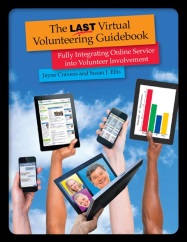
logoLast week, I celebrated the second anniversary of the publication of The Last Virtual Volunteering Guidebook, (available for purchase in paperback or as an ebook (PDF) by Energize, Inc.). But there’s another anniversary as well that snuck up on me:

It’s the 20th anniversary of the launch of my own web site. The first version of my web site was uploaded on January 4, 1996.

Wow. 20 years. That’s centuries in terms of the Internet.

I began creating and posting tips on database management for nonprofits and other tech-related suggestions to the soc.org.nonprofit USENET newsgroup back in 1994 (see A Brief Review of the Early History of Nonprofits and the Internet for more about the early days of nonprofits and the Internet). Back then, questions about how to build and manage databases of volunteers, donors, clients and others was probably THE hot topic on any online discussion about nonprofits – not marketing (the other hot topic was, of course, how to raise funds). Two years later, I created my own web site to post my growing materials and favorite links, focusing on how nonprofits were, or could, use computer and Internet technologies. The earliest version of my web site that I can still access is at archive.org, from 1998. Super, duper simple design – like most of the web back then.

The original spirit of the Internet was to freely give information, as well as to take it, to make accessing information oh-so-easy, and to collaborate with anyone, anywhere. I got really caught up in that spirit. I was quite the Info Superhighway cheerleader back then. I still look at the 90s as a golden age, when sending just a few emails could double the amount of people that attended an event, when emailing a reporter or government official meant he or she would call you back, and when web sites downloaded oh-so-quickly. I wanted my web site to be a reflection of that, as well to promote my expertise and services as a new consultant, but back in the 1990s, it was online discussion groups, like USENET newsgroups, that got me jobs and built my professional reputation, not the web.

Why “Coyote” Communications as a name for my web site? Because I am quite partial to canines, and I think the coyote is unique among them, with qualities I greatly admire. Coyotes are amazingly adaptable to ever-changing surroundings – efforts to control or exterminate the coyote and the massive garbage-production of modern humans have produced an animal that is even more alert, opportunistic, and able to survive, even flourish. They are uniquely American creatures, incredibly misunderstood animals, much smaller than most people think, and often blamed for destruction not of their making. Coyotes are surprisingly, sometimes shockingly, intelligent, have the reputation of being “tricksters,” work well in groups, love to play, and have boundless love for their families. At night, to hear the high quavering cry or the short, high-pitched yips of coyotes is the most beautiful song you can hear outdoors. My only regret in choosing the name for my web site is that it is very hard for non-native English speakers to say, let alone spell, and most people abroad don’t know the word.

So, here I am, online for more than 20 years, and celebrating my two-decade-old web site. And this occurs within days of my 50th birthday. Wow. I’ had real champagne, not virtual bubbly, in case you were wondering.

Exploitation of volunteers in refugee camps?

UNLogoFounded in 1991 as a temporary shelter for Somalis fleeing horrific violence in their homeland, the Dadaab complex in Kenya now houses nearly half a million refugees, and is supported by a variety of international agencies, including the United Nations. Children have been born there and grown up there – it’s the only home they’ve ever known. Conditions there are often deplorable. Ben Rawlence profiles nine of the camp’s residents in his new book, City of Thorns, and details the profound challenges in providing even basic services there, let alone helping refugees get out of their precarious situation. Rawlence was interviewed on the radio show Fresh Air (the broadcast is available for free online). And his comments about volunteers in the camp grabbed my attention – and not for the right reasons.

In October 2011, security conditions in the Dadaab camp changed drastically after the kidnapping of two Spanish aid workers by al-Shabab, the radical self-described Islamist group. The kidnapping caused the U.N. to evacuate much of its international staff and shut down all non-lifesaving activities, such as counseling, sanitation support, public health education, fuel deliveries to the boreholes to pump water, schools, and training. Food rations continued, distributed by refugee volunteers, and the hospital was staffed by just a skeleton staff, providing minimal medical care. Rawlence explained this in the Fresh Air interview – the emphasis is mine:

In order to fill the gap, the refugees themselves had to step up and run things… Life deteriorated quite quickly. The situation in the hospitals became quite critical. Their water shortages were very grave. The food continued as normal, but there was an outbreak of cholera right afterwards because the kidnapping coincided with the rainy season. And the capability to deal with the cholera outbreak wasn’t there. So for about four to five months, the camp was plunged into a real crisis. And the aid agencies issued several warnings, saying that, you know, life can’t go on like this. We’ve really got to turn things around… What really happened was that a new model emerged where the camp was run by refugee volunteers. And the agencies realized that instead of paying expensive Kenyan or expatriate staff to run services that they could rely on cheap volunteers and pay them stipends. So while the services themselves are back and running, it’s not quite how it used to be. And although the refugees are happy because there’s perhaps more work for them, there is less depth of expertise. There are, you know, not so many foreign qualified nurses and so on that there need to be. So things have moved to a much more sort of shaky footing.

I think it’s absolutely required to involve refugees in the work of running the camp – and in decision-making regarding the camp. Creating volunteering opportunities for refugees, particularly the teenagers, is not just nice, but vital. But to staff positions with refugee volunteers – people living in extreme poverty, desperate for paid work – specifically so that money can be saved by not bringing in much-needed expert staff? That’s absolutely outrageous.

Now, to be fair, Rawlence is calling these people volunteers, and others call them refugee incentive workers. This is a class of worker used by the UN and other international NGOs that’s meant to get around government restrictions regarding refugees undertaking paid work. Refugees, per Kenyan law, cannot receive salaries, even if those payments are coming from international agencies; however, refugrees are permitted to receive what are termed as incentives or stipends. These stipends are nowhere near what a salary would be for the work they do as community health workers, carpenters, masons, security guards, teachers, nurses, clinical officers,  water engineers, sanitation workers, etc. – and nowhere near what these people need to support themselves and their family. They workers also receive no minimum hours of work, maternity leave or sick leave. Kakuma News Reflector – A Refugee Free Press blogged about this – and not kindly, and explains the perils for refugees in this situation quite well.

There’s a lot wrong with this situation – the primary problem is the horrific conditions refugees are facing and the impossible nature of their circumstances in terms of getting proper access to work and education opportunities, proper healthcare and proper security. But the words being used regarding these stipended workers is also troubling – this is not at all what volunteering is supposed to be.

Also see:
UN Agencies: Defend your “internships”

Virtual Volunteering Guidebook: 2 year anniversary

vvbooklittleIt’s the two-year anniversary of the publication of The Last Virtual Volunteering Guidebook, available for purchase in paperback or as an ebook (PDF). It’s written by me and Susan Ellis, and is the result of more than 20 years of research and experience regarding virtual volunteering, including online micro volunteering, crowd sourcing, digital volunteering, online mentoring and all the various manifestations of online service. Did you know that virtual volunteering was a practice that was more than 20 years old? You would if you read the guidebook!

Susan and I wrote The Last Virtual Volunteering Guidebook in such a way that it would be timeless – as timeless as a book about using computers, laptops, smart phones and other networked devices could be. We didn’t want it to be out-of-date in just a few months. That’s not easy when it comes to technology, but we gave it a try – and upon re-reading my own book, I was shocked at how successful we were! Three years later, it still reflects what works, and what doesn’t, in working with volunteers online. In fact, I use it as a reference myself – there are times I’m asked a question about working with volunteers online, or facing a dilemma regarding working with volunteers myself, and I go back to the book to see what we said – and, tada, there’s the answer! Oh, to have the memory of Sherlock Holmes…

The Last Virtual Volunteering Guidebook details the basics for getting started with involving and supporting volunteers online, but it goes much farther, offering detailed information to help organizations that are already engaged in virtual volunteering with improving and expanding their programs. It offers a lot of international perspectives as well.

The book includes:

  • Detailed advice on virtual volunteering assignment, including one-time “Byte-Sized” tasks (micro-volunteering), longer-term, higher-responsibility roles and virtual team assignments.
  • A thorough look at various practices for screening and matching volunteers to assignments, with an eye to getting the most capable volunteers into your volunteering ranks and preventing incomplete assignments or burdensome management tasks
  • How to make online volunteer roles accessible and diverse
  • More details about how to work successfully with online volunteers, so that they are successful, your organization benefits and volunteer managers aren’t overwhelmed
  • Ensuring safety – and balancing safety with program goals
  • Respecting privacy of both the organization and online volunteers themselves
  • Online mentoring
  • Blogging by, for and about volunteers
  • Online activism
  • Spontaneous online volunteers
  • Live online events with volunteers
  • The future of virtual volunteering and how to start planning for oncoming trends

There’s also a chapter just for online volunteers themselves, which organizations can also use in creating their own materials for online volunteers.

In conjunction with the guidebook, we’ve maintained the Virtual Volunteering Wiki, a free online resource and collaborative space for sharing resources regarding virtual volunteering. We are seeking a partner university or college that could recruit an intern from among students studying in its post-graduate program to keep this wiki updated.

Here’s why we called it the LAST guidebook and reviews of The Last Virtual Volunteering Guidebook.

The Last Virtual Volunteering Guidebook is available for purchase in paperback or as an ebook (PDF).

If you read the book, I would so appreciate it if you could write and post a review of it on the Amazon and Barnes and Noble web sites (you can write the same review on both sites).

Keynote speaking in South Carolina & Washington state!

logoCome here me speak this month or next!

Me in South Carolina Jan. 27 – 29, 2016
I’ll be the keynote speaker and presenting workshops at the South Carolina Association for Volunteer Administration (SCAVA) annual conference, January 27-29, 2016 in North Myrtle Beach! You do not have to be a member of SCAVA to attend. Join me!

Me in Vancouver, Washington (state – USA) Feb. 11, 2016
I’ll be the keynote speaker at the Nonprofit Network Southwest Washington / Directors of Volunteer Programs Association (DVPA) conference on Thurs., February 11 in Vancouver, Washington (state), USA.

You can book me for your conference or workshop! After February 2016, my consulting schedule is wide open. I am available for presentations, short-term consultations, long-term projects, part-time positions, and, for the right role, a full-time permanent position. Here’s what I can do for your organization/initiative.

There are free online workshops by me which you can view anytime, if you want to know more about my presentation style. Most are more than 45 minutes long:

I’m available for interviews on Skype or your preferred video conferencing tool, and, of course, by phone – I’m on West Coast time (the same as Los Angeles). I’m available for in-person, onsite interviews in and around Portland, Oregon (the area where I live), and am willing to travel most anywhere for an interview or as part of a short-term consultation.

Vanity Volunteering: all about the volunteer

graphic by Jayne Cravens representing volunteersIf you regularly read my blog and web site materials or have seen me present, then you know just how strongly I believe in the importance of the involvement of volunteers in nonprofit/mission-based causes. I believe that volunteer engagement represents community investment, can allow people from different walks of life to be associated with a cause more deeply than just donating money, can allow people who don’t want to or cannot quit their day jobs to be involved in a cause, educates people about a cause through firsthand experiences, and can demonstrate the organization’s transparency regarding decision-making and administration. Service activities can educate volunteers to be better advocates for a cause, even change their behavior or feelings regarding certain issues, activities and groups. And I believe any of these reasons are far, far better reasons for involving volunteers than to save money by not paying staff.

I feel so strongly about the importance of volunteer engagement that when I see nonprofit organizations that don’t involve volunteers in some way, it makes me suspicious of them – how invested is this organization in the community it’s supposed to serve if it isn’t letting the community participate behind-the-scenes? How much does this organization really want to be a part of the community if the only way I can be a part of that organization is to work for it, professionally?

But I also have to say that I am wary of the value of a lot of volunteer activities, much more so now, having worked for international humanitarian aid and development agencies for more than 15 years. I regularly witness or hear about volunteering activities abroad and right here in the USA that are more about making the givers of service feel good than about benefitting the cause that the organization is supposed to serve. Voluntourism gets accused of this a lot: people going for a week or two to a poor community, usually in another country, and doing things that local people would love to do themselves, and be paid to do themselves, like build wells, build schools, repair houses, play with orphans, teach a few English classes, etc. Do those activities primarily benefit local people or a critical cause, or are they actually more about being great money-makers for organizations, including religious groups, that know Westerners will pay big bucks for a feel-good volunteering experience and lots of touching photos of them in exotic or devastated locations? There are even tragic consequences from this kind of volunteering, such as the rise of orphan voluntourism, where children that are NOT orphans are presented as such, in need of help from short-term international volunteers, people with little or no expertise regarding the needs of at-risk children.

An article from December 2015 in Cracked captured my wariness about some volunteering, particularly around the holidays. It’s called “5 Realities Of A Homeless Shelter At Christmas.” Regarding homeless shelters, the article notes:

These charities exist to help people with serious problems. They do not exist to round up sideshows and parade them around for gawkers, or to help regular folks gain perspective on their own lives. Surprisingly, not everyone is aware of this.

The article also notes:

Remember, these people are homeless for a reason. We don’t mean “because they’re jerks and deserve it”; we mean that mental illness and substance abuse issues run rampant. If you reserve your charitable feelings only for those capable of showing gratitude in some satisfying way, you’ll be neglecting the ones who need help the most. They show their gratitude by still being alive the next time Christmas comes around.

This all came to mind recently when I found an article about a young boy who created his own nonprofit so he, personally, could hand out food to homeless people in the city where he lives. That’s the primary purpose of the nonprofit: to give him an outlet to hand out food to homeless people. He’s well under age, so I’m not going to name him or his nonprofit or say where he is – I also really do not want to humiliate a kid, especially one that has such a big heart. But his nonprofit seems to be more about him than the homeless: the nonprofit has his name in the title, the web site for the organization is filled with many, many more photos of him than homeless people, and on the web site, a link for more information doesn’t say “About our organization,” but rather, “About me.”

He says he started his nonprofit because organizations serving the homeless turned him away as a volunteer because he’s “too young to help,” and that made him “sad.” What I suspect shelters and food kitchens actually said is that many of their clients are not allowed, legally, to be around anyone under 18, and the organization would, therefore, be causing those people to break the law by interacting with a child. They probably also told him that shelter staff need to put their resources into helping clients, not diverting such to ensuring the safety and heart-warming learning experience of underage volunteers.

The web site for this child’s organization has no information about the nutritional needs of the homeless or statistics on food availability for the homeless in this particular city. The web site has no information about the causes of homelessness. The aforementioned Cracked article correctly points out that when homeless people die, it’s most often from heart disease, substance abuse and trauma, rarely from hunger, although, of course, nutrition is a big challenge and hardship for many homeless people. The principle causes of food insecurity in the United States are unemployment, high housing costs, low wages and poverty, lack of access to SNAP (food stamps), and medical or health costs, but the web site for this child’s nonprofit never mentions any of these realities – it makes it sounds like he’s personally keeping these folks alive, that most homeless people die of starvation. Even if his nonprofit isn’t going to address any of those causes of hunger, shouldn’t those causes be mentioned somewhere on his site? This young man’s nonprofit could make a HUGE difference by helping people, particularly young people, understand why people are homeless, why they experience food insecurity – and they could take that knowledge to the ballot box, and make donation decisions based on that knowledge. Instead, this nonprofit, as demonstrated by the web site and by the media coverage of the nonprofit, is about making a little boy feel like he’s making a difference in the world, and making us feel good about him.

Robert Lupton, a veteran community activist based in Atlanta and author of Toxic Charity: How the Church Hurts Those They Help and How to Reverse It, was quoted in an opinion piece in The Atlanta Journal-Constitution, saying this about various volunteer groups that show up to hand out food in Atlanta parks: “The folks that come and hand out sandwiches? I call that harmful charity. It’s irresponsible… Who is this service activity for? To help the homeless? Or someone else?” I am not as down on charity as Lupton; in contrast to him, I do believe charity and aid will always be needed, that food banks and on-the-street food handout programs cannot and should not be replaced entirely by community development / empowerment / teach-a-man-to-fish programs, and I think there are very good things that can come from group volunteering projects in communities . But I do agree with him that a lot of high-profile volunteering seems more about making the giver have a feel-good experience and lots of great photos than focusing on the primary needs of those to be served.

No one is too young to volunteer, but there are volunteering activities in which a youth or child may NOT participate, because it would be illegal or inappropriate. Even with that restriction, there is no cause a young person can’t support in some meaningful way as a volunteer, including helping the homeless, and there are many ways a young person can volunteer, no matter how young he or she is. Volunteering is a great way to teach children about compassion and empathy, but it shouldn’t perpetuate old-fashioned ideas about volunteering, that it’s just about charity, and that its primary purpose is about well-off people giving food and items to poor people, but not talking about why there are poor people and not addressing those reasons. Volunteering by youth shouldn’t be primarily about making the kids feel good about themselves. Volunteering by youth should educate those young people about why causes are important, about community challenges, and/or about people very different from themselves. And volunteering should ALWAYS be primarily about what the person or cause needs most, not about the volunteers themselves. That means sometimes telling well-meaning people, even young people, “It’s great that you want to help, but the way you want to help is not what’s needed most and, in fact, can take valuable resources away from what we really need. And what we really need is…”

This is not a call for a volunteer motivation “purity” test. Volunteering doesn’t have to be selfless – as I have said many times in my workshops, I’m a part of Generation X, and I’ve never volunteered “to be nice” in my entire life; I’ve volunteered because I’m angry about a situation and want to do something about it, because I’m lonely or bored, because I want to explore careers, because I’m curious about an organization or activity, because I want to develop a skill or get experience for my résumé, because it sounds fun, because I want the fabulous t-shirt, and on and on. Almost any reason to volunteer is a great reason to volunteer. What I’m questioning are some of the reasons volunteering activities are created – what I’m saying is that they may actually do harm rather than good.

Even with all my disclaimers and all my work to date promoting volunteerism, I have a feeling this blog is still going to get me accused of being anti-volunteer. Nothing could be farther from the truth. But vanity volunteering… sorry, I’m just not a fan.

For more on this subject – written by others:

Symptoms of a Vanity Nonprofit by Mark Fulop, from May 28, 2014.

The Most Outlandish Charity Trends: Is It About Vanity?, from MainStreet an online financial magazine & news site by TheStreet, in April 2014.

Vanity Charity, an opinion piece by Alan Cantor, published online on March 5, 2013

This 2012 Cracked article: “5 Popular Forms of Charity (That Aren’t Helping).

This New York Times Magazine article, “The Vanity of Volunteerism,” from July 2000.

#InstagrammingAfrica: The Narcissism of Global Voluntourism , from the Pacific Standard, June 2014

This Boston Globe article, Corporate volunteers can be a burden for nonprofits, from March 2015

How to judge a charity: the five questions no one asked Kids Company (How do you know if a charity is changing lives?), 2 January 2016 article from The Spectator

Added Jan. 18: In The Reductive Seduction of Other People’s Problems, Courtney Martin warns against a line of thinking which leads privileged young Westerners to think they can solve serious social problems in developing countries. Ms. Martin points to failed international development efforts like the now-infamous PlayPump, a piece of playground equipment that was meant to also pump underground water in remote communities. It was embraced by the development community — though the pumps didn’t, in fact, work. “It’s dangerous for the people whose problems you’ve mistakenly diagnosed as easily solvable. There is real fallout when well-intentioned people attempt to solve problems without acknowledging the underlying complexity.”

July 17, 2017 updateCharities and voluntourism fuelling ‘orphanage crisis’ in Haiti, says NGO. At least 30,000 children live in privately-run orphanages in Haiti, but an estimated 80% of the children living in these facilities are not actually orphaned: they have one or more living parent, and almost all have other relatives, according to the Haitian government.

And for more by me, on related topics:

UN, NGO efforts to counter hate

UNLogoOn December 2, 2015, the United Nations Alliance of Civilizations (UNAOC) held a Symposium on Hate Speech in the Media, with senior officials calling for a global mobilization of citizens to help counter messages that promote xenophobia, violent extremism and prejudice. The symposium was the first of a series that UNAOC will host, called Tracking Hatred,. The next symposium will be held in Baku, Azerbaijan, in April.

The UN Counter Terrorism Executive Directorate (CTED) also organized two days of panel discussions later in December, a collaboration between the public and private sector, called “Preventing Terrorists from Exploiting the Internet and Social Media to Recruit Terrorists and Incite Terrorist Acts, While Respecting Human Rights and Fundamental Freedoms.”

@unaoc, @friendsunaoc, @UN-CTED and other agencies, UN and non-UN alike, are using #SpreadNoHate and #Reclaimingtheweb on Twitter to promote messages from these efforts. I’ll be using them as well, as appropriate, often.

Cristina Gallach, UN Under-Secretary-General for Communications & Public Information, said during the UNAOC event, “Hate speech has been with us for a long time. We will never forget the slaughter of over 800,000 Tutsis and moderate Hutus during a brief three month period in Rwanda in 1994. We will never forget either the six million Jews plus five million others who perished because of one hateful vision… Today, however, more than ever, individuals are using hate speech to foment clashes between civilizations in the name of religion. Their goal is to radicalize young boys and girls, to get them to see the world in black and white, good versus evil, and get them to embrace a path of violence as the only way forward.” She wasn’t just referring to Daesh (also known as ISIL or ISIS), though they are the most high-profile right now and, therefore, they were the primary focus of this event.

From what I’ve read about the symposium, there were lots of comments by speakers about enforcing laws that prohibit incitement of hatred or violence, and about social media companies being compelled to quickly delete content. I’m wary of this kind of talk, as governments use cries of “hate speech” to arrest people that are critical of the government or a religion, such as this 14-year-old boy in Turkey, or these teens in Egypt, or Raif Badawi in Saudi Arabia. I much prefer strategies focused on communications activities that establish and promote a narrative that pushes back against hate and prejudice, and was glad to see that strategy as a focus of two of the CTED panels, one called “privacy and freedom of expression in the digital age” and another that I am very interested in, called “Use of Internet and communications technology for counter-messaging purposes” – the link goes to webcast of the panel, moderated by Steven Siqueira, Acting Deputy Director, CTITF Office- UN Counter-Terrorism Centre (UNCCT) – so wish there was a transcription from this panel! If you want to listen to just a bit, here’s my absolute favorite: go to around the 14:00 point and listen to Humera Khan, Executive Director of Muflehun – she gives realistic, practical advice on mobilizing youth to counter online messages of hate. And then listen to Jonathan Birdwell of the Institute for Strategic Dialogue, right afterward, talking about teaching young people to critically engage with what they read online, and the importance of digital literacy. And then jump to around 36:00 and listen to Abdul-Rehman Malik, who has a provocative, assertive, right-on challenge to governments on this subject. The questions and answers after these three present is worth your time as well. The entire session lasts about 90 minutes, and is really worth your time to listen to (please, UN, release it as a podcast!).

I hope the people involved in these UN and civil society efforts know that, in the last 24 hours, Muslims on Twitter have hilariously trolled a Daesh leader’s call to violence – humor is a powerful tool in fighting against prejudice, and these tech-savvy Muslims are doing it brilliantly. I hope they know about online groups like Quranalyzeit and Sisters in Islam, tiny organizations doing a brilliant job online of countering extremist messages regarding Islam, and doing it as Muslims and from an Islamic perspective. Or about Mohamed Ahmed, a middle-aged father and gas station manager, and one of many Muslims in Minneapolis, Minnesota frustrated by Daesh’s stealthy social media campaigns, and countering it with a social media campaign of his own, AverageMohamed.com.

AND I HOPE EVERYONE KEEPS TALKING. Because I think they are talking about activities and messages that will really work in stopping the violence, and will make all aid and development efforts – about water, about reproductive health, about agricultural, WHATEVER – actually work, actually be sustainable. I so wish all of these efforts were getting more attention online, in traditional media, among all United Nations agencies, among NGOs, and among politicians.

Also see:

Propaganda for good (blog)

Recommendations for UN & UNDP in Ukraine to use Twitter, Facebook, Blogs and Other Social Media to Promote Reconciliation, Social Inclusion, & Peace-Building in Ukraine (PDF)

Reconciliation (a blog of frustration I wrote while working in Ukraine in 2014)

the challenge of spontaneous volunteers

Last week, on Wednesday, a tornado struck in Mississippi, killing 10 people and destroying or damaging hundreds of homes. It struck at night. While watching live coverage on MSNBC, at a news conference held just hours after the tornado in Mississippi, I heard Kenny Holbrook, Fire Chief in Holly Springs, said this, in response to a question about the biggest problem police and fire staff faced during and after the tornado:

The biggest problem we had was spontaneous responders – if you can use that word, spontaneous responders. They just came. And understand that, you know, in an emergency situation like this, everyone wants to help, but this morning, like I say, as of last night, people that were not a member of the law enforcement, EMS, or fire community, we withheld sending them out doing the emergency work. Now that that is finished, we can utilize a lot of this help in the private sector. We can’t assume the responsibility. We don’t know what training people have. So that’s been the probably the hardest part of managing: hundreds of people that you have never met until that moment. 

What Mr. Holbrook is saying is that spontaneous volunteers – people that neither he nor other emergency responders knew, people had no affiliation with any official government agency – showed up at and called police stations and fire stations in the minutes and hours following the tornadoes, wanting to help, in overwhelming numbers, which meant an enormous amount of time had to be spent explaining to those volunteers why they could NOT be involved yet, why they would have to wait hours, even days, to get to be involved – and even then, they might not be able to be involved ever.

It’s a fascinating problem to have: during and after a crisis, there is a deluge of people wanting to help. It may not really sound like a problem, but it is: dealing with these people can take trained people away from actually responding to disaster, as illustrated above. People who have experienced a disaster are especially vulnerable, and need people interacting with them that are trained in disaster response and have been properly screened. Spontaneous volunteers, with no training, can actually cause MORE problems after a disaster than they help: engaging in inappropriate or unsafe activities, providing inaccurate information to survivors and the press, exploiting victims, stealing from damaged or abandoned homes or vehicles, and more.

If your organization responds to disasters in some way, consider recruiting and training volunteers who, after a disaster, will do nothing but deal with people that want to volunteer or donate items in the hours immediately after a disaster. There are people (like me!) who would be happy to go through training NOW in order to be at, say, a fire station within minutes of a crisis and have one job: dealing with any individuals or groups who call or drop by and say, “We’re ready to volunteer!” or “We’ve got a truck load of clothes for the survivors!” Those volunteers can capture names, phone numbers, and services or items offered, can explain why the individual or groups should NOT come to the area at that time, and can explain where to find updated information online (a web site, a Twitter account, etc.) specifically for volunteers and in-kind donations. Also, I’ve blogged about the many things spontaneous online volunteers can do after disasters – not just nice things for online volunteers to do, but critical services that might not be able to be done otherwise.

Fire stations, police stations, animal shelters, schools, other agencies that deal with disasters: plan now for how you are going to deal with spontaneous volunteers! These FREE resources from a variety of agencies can help:

Managing Spontaneous Volunteers in Times of Disaster: The Synergy of Structure and Good Intentions – a free online publication from the Federal Emergency Management Agency (FEMA).

Preventing a Disaster within the Disaster – Effective Use & Management of Unaffiliated Volunteers – manual from a training for National Service participants and program directors by the Corporation for National and Community Service and the Points of Light Foundation & Volunteer Center National Network.

Guide to Managing Spontaneous Unaffiliated Volunteers – from the Western Massachusetts Medical Reserve Corps, for its local affiliates.

Spontaneous Volunteer Management Resource Kit – from the Australian Government Department of Social Services.

How Daesh (ISIS/ISIL) uses Twitter – update on resources

logoI’ve been updating a blog I wrote earlier in December about communications activities not just to create awareness, but to persuade, to change minds, and to create advocates. There’s a new resource there regarding how Daesh (ISIS/ISIL) uses Twitter to create trending hashtags, and new info about an Islamic-based effort to counter Daesh’s messages. Check it out!

What I learned launching my first online petition

logoLast week, I launched my first ever online petition. I chose change.org as the platform. You can read more about the petition, and why I started it, at this blog, OPB & Congress Think Volunteers are Free.

My goal was to have 100 signatures by Sunday evening, and then I would set a new goal Monday morning. I had four days to get there. I thought that goal would be oh-so-easy to meet: I have more than 300 friends on one of my social media accounts, and they are real friends, people I know personally, many of which I’ve known for years, and they are very active on social media and they “like” or respond to much of what I post (about Star Wars, about politics, about my dog and/or cat, etc.). I just knew 100 of them would happily sign the petition well before Sunday evening, just because I posted a status update about it and they love me (grin).

I also tweeted about the petition several times, at different times during different days, to my more than 2000 followers on my professional Twitter account, using various keywords (even tied it to Star Wars: The Force Awakens!), to my almost 600 followers on my personal Twitter account, to my more than 350 friends on Facebook, made up mostly of colleagues and neighbors rather than close friends, and to my Facebook page, which has almost 1000 “likes” (though I didn’t have much hope for that – Facebook, either via my account or my page, hasn’t proven a good way of reaching folks regarding my work or even my vacations). I also did “mention tweets” and direct tweets to various associations of managers of volunteers – DOVIAs – asking them to share the petition with their members. And I gave GooglePlus a go as well.

As of the end of the day on Sunday, at 11 p.m. Pacific Coast USA time, I had 94 signatures. That’s what I still have as I publish this blog on Monday. And most of those did NOT come because of any social media activities. Rather, they came because I emailed or direct-messaged about 80 friends and colleagues and asked each of them, separately, personally, to sign it. THAT laborious method got me far, far more signatures than any of the aforementioned social media blasts, no matter how often I blasted.

Why didn’t others sign? I asked friends and colleagues who didn’t sign, specifically, directly, individually, why they didn’t sign, and the vast majority who responded said they never saw any messages on social media about the petition, especially not the status updates on Facebook. In addition, a few, all managers of volunteers or working somehow in volunteerism, said they were prohibited from signing a petition by their workplace – which is entirely untrue, but they’ve been made to believe that their employer doesn’t allow them to be politically active at all, other than voting.

So, what have I learned in trying to get signatures for my petition:

  • Even when a petition is all about a very hot topic among those that you want to sign the petition – in this case, funding volunteer management, and the target group is those that work with volunteers or promote volunteerism (though absolutely anyone can sign) – that isn’t enough to get people to sign.
  • Direct, person-to-person, customized emails or direct messages, sent individually, from me – messages that I did not cc anyone else on, but each going only to one person, are, by far, the most effective way to get signatures on a petition. BY FAR. I had a 85% sign rate from individuals I messaged directly via email or Facebook. However, I’m reluctant to DM absolutely every one of my 300+  close, personal social media friends… that seems so overwhelming, to them and me.
  • I have some really great friends.
  • Setting a goal for how many people I wanted to sign, by a particular date, really pushed me to keep pushing. I did 10 times more work over the weekend to promote this petition than I had planned to, but I was determined to reach that goal, rather than to be hurt and give up early.
  • Facebook status updates, whether via a personal account or a page, are rather useless in promoting a petition (or most anything), because most of the people that are your Facebook friends or have “liked” your page will never see it – Facebook will never show them those messages in their newsfeed, because they see only “Top stories.” The more people that like that status update, the more people that will see it, so if you are going to do a petition, direct message several people and get at least 10 people to “like” that status update about your petition if you want it to be seen by anyone!
  • We are all drowning in a sea of online information. It has never been harder to reach people! So much noise!
  • You have to get organizations to promote such petitions to their members, because without organizations talking about such, organizations like DOVIAs, this petition will never reach much over 100 people, and will have no hope of going viral, let alone any media outlet paying attention to such. And with that said: thank you, Northwest Oregon Volunteer Administrators Association (NOVAA), based in Portland, Oregon, for helping to raise awareness about this petition!
  • There is a huge misunderstanding by too many managers of volunteers that they are prohibited from signing online petitions, or sharing such petitions. They are absolutely allowed to sign such, as individuals rather than representatives of their organization (though many organizations DO allow this), and they may share such petitions, they are allowed to, so long as they don’t tell people in their message whether or not to sign it but, rather, say, “Interesting: a person/organization has started this petition that says such and such. How do you feel about it? Share in the comments below.” If people sign, that’s their choice – you’ve just informed them of an activity. You can do this about a petition regarding volunteer management – but probably not a political candidate.
  • Associations of managers of volunteers like to complain at conferences and in online discussion groups about how volunteer management isn’t funded – but when they have a chance to make a difference on the issue, they are silent. Very disturbing.

So, what now? Well, today, with still just 94 signers, I’ve:

  • Sent a personal email, individually, to more than a dozen colleagues that are managers of volunteers, that work at nonprofit centers, or that are somehow associated with volunteer leadership, asking them to please consider signing the petition, commenting on it, and promoting it.
  • Posted to several LinkedIn groups.
  • Posted again to Twitter, particularly my pro account, and I will be posting at least twice a day, every day this week, at different times of day, using various keywords.
  • Commented and liked the NOVAA Facebook page where they talked about this petition, so that they are thanked and so that their status update might show up in more members’ newsfeeds.
  • Hope that another association of managers of volunteers – a DOVIA – will decide, oh, hey, this is exactly the kind of thing we need to be doing in order to represent the interests of our members! 
  • Blogged about this experience as a learning experience regarding online communications (and you are now reading this blog!)

And I hope if you have read this blog you will SIGN THIS PETITION.

My next goal is 106 more signers by midnight New Year’s Eve – that would put me at 200 signers and maybe, just maybe, the petition will get the attention of the media. But I’m not holding my breath.

Save Kaavan the Elephant in Pakistan

Here’s what I just wrote to:

Capital Development Authority (CDA): chairman@cda.gov.pk

Pakistan Prime Minister’s office: betterpakistan@gmail.com

Pakistan Embassy in the USA: info@embassyofpakistanusa.org

After living in solitary confinement for 28 years in the Islamabad Zoo, Kaavan the elephant is now suffering from a range of health issues – both mental and physical. The zoo claims he is fine and happy in his barren enclosure – which is impossible. And the evidence shows, he’s in pain, he’s in mental torture, and this has got to stop. Gangrene and neglect will soon take his life. In the wild, elephants can roam up to 30 miles a day. They are extremely emotional and social animals that form strong bonds with other elephants and spend most of their life in family herds. Come on, Pakistan – you are better than this. There are elephant sanctuaries that can give Kaavan the life he deserves. Show mercy, show compassion, be humane: release this elephant immediately to a sanctuary.

Please write them too, in your own words. And sign the Change.org petition.