Author Archives: jcravens

About jcravens

Jayne Cravens is an internationally-recognized trainer, researcher and consultant. Her work is focused on communications, volunteer involvement, community engagement, and management for nonprofits, NGOs, and government initiatives. She is a pioneer regarding the research, promotion and practice of virtual volunteering, including virtual teams, microvolunteering and crowdsourcing, and she is a veteran manager of various local and international initiatives. Jayne became active online in 1993, and she created one of the first web sites focused on helping to build the capacity of nonprofits to use the Internet. She has been interviewed for and quoted in articles in The New York Times, The Wall Street Journal and the Associated Press, as well as for reports by CNN, Deutsche Well, the BBC, and various local radio stations, TV stations and blogs. Resources from her web site, coyotecommunications.com, are frequently cited in reports and articles by a variety of organizations, online and in-print. Women's empowerment and women's full access to employment and education options remains a cross-cutting theme in all of her work. Jayne received her BA in Journalism from Western Kentucky University and her Master's degree in Development Management from Open University in the U.K. A native of Kentucky, she has worked for the United Nations, lived in Germany and Afghanistan, and visited more than 30 countries, many of them by motorcycle. She is currently based near Portland, Oregon in the USA.

Police: use social media to invite community participation, show compassion

handstopI’m noticing a big social media misstep this week: lots of law enforcement agencies, mostly police departments and sheriff’s offices posting in solidarity with Dallas, Texas police – as they absolutely should – but that were silent after the shootings of Alton Sterling and Philando Castile this week.

Of course you should support your own tribe – I certainly do, when it’s one of my tribes: aid workers abroad, nonprofit workers here in the USA, journalists, and Kentuckians.

But it’s also a time to counter narratives that create mistrust and call for violence. It is a time when we all need to show that, even if we disagree, we do not believe violence is the answer, and we stand together, as humans, from a place of compassion and rational thought.

Here’s some ideas for phrases for law enforcement agencies to post on, say, Twitter, when there is a shooting by police of a citizen, and there is controversy about that shooting:

We are closely following events in [[name of city where shooting occurred]]. We hope for compassion  for families affected, peace at protests. 

We strive to build connections in our community. All are welcomed to apply to ride along with 1 of our officers. Info: [[link]]

We welcome local #blacklivesmatter activists to our citizens’ academy, to talk with our officers, ask questions: [[link]]

We provide many ways for any community member to meet with officers, face-to-face, talk with us. Info: [[link]]

We will have a meeting on [[date]]; community members welcomed to come, ask questions re: our policing policies [[link]]  

These are deliberate messages that acknowledge what has happened, and even if you think a civilian shooting is justified, you are showing that you acknowledge that there might be a disconnect with some in your local community, and you want to bridge divides.

Yes, you are going to get hateful responses to such social media messages. But it’s not those people you are reaching out to. You are reaching out to local people in your own community who have had negative experiences with the police, or who are skeptical of law enforcement, for whatever reason. You are saying to those members of your community, “We hear you, even if we don’t agree with everything you are saying, just as you don’t agree with everything we are saying. But we do want to meet you, to know you, to talk with you outside of law enforcement situations. We welcome you. ‘Protect and Serve the community’ means YOU too.”

Of course, you cannot say any of that if it’s not true… but I think, for the majority of law enforcement agencies in the USA, it is. Let’s stop the cycle of outrage with sincere, honest community outreach, transparency and understanding.

Also see:

Is it really *impossible* to break into humanitarian work?

guardian logoI saw a headline recently from the Secret aid worker series from the Global development professionals network in The Guardian:

I’m sick of job rejections – is humanitarian work only for the elite?

The headline struck me, as I constantly read questions on Quora and YahooAnswers from people that want to work in humanitarian aid and development. The questions are so frequent, and so similar, that I created a page of answers to that specific question, and I point people to it often.

Unfortunately, comments on this particular Guardian blog are closed. But I really wanted to respond to it, specifically, not just refer the author to my web page for people like her.

The blogger says she longed for a development job abroad “where I would get to do something real – responding to crises, spearheading interventions and doing hands-on development.” But then she never says anything about her own experience responding to crises, spearheading interventions and “doing hands-on development” anywhere. She never once says, “Here’s my area of expertise, here’s what I’ve proven myself capable of doing that is transferable and needed in the developing world.” She just goes on and on about a desire to work in development.

She’s now “hoping a year in INGO corporate fundraising and some experience in publicity and campaigns can help give me an edge in getting a job that’s a little more hands-on, because that was all the experience I could get. Development is a subject I’ve been passionate about for over five years.”

Again, she never says what it is she has that development agencies really, really need. A year of experience doing one thing, some experience in something else? Passion? Sorry, but it isn’t enough to give you an edge. Not at all.

“I can’t help but feel that humanitarian and development work is for the elites.”

No. But it is for people that have the skills and experience actually needed by local people in post-conflict zones and transitional nations.

Look, I don’t mean to sound mean, but in addition to be a person that seeks work in development – more on that later – I’ve been on the hiring side of things at development agencies. I’ve been on the job development side of things as well. I’ve written the description of the job that we need someone to do, and never once have I thought, “Hey, let’s give this to someone who doesn’t have experience but, by golly, they really want to work in aid and development! As long as they have a Master’s Degree!” The people I serve – the local people of a developing country – want more. They deserve more.

I think for anyone that wants to work in aid work, this blog by Marianne Elliott, Why Your Passion Is Not Enough, is worth reading, particularly this part:

My point is that passion, perseverance and innovation are sometimes highlighted at the expense of professionalism… much more than passion is needed in order to make a positive difference in the world… Just as passionate persistence without professional skills won’t get you a part in The Hobbit, good intentions without professional skill won’t result in doing the good you intend.

I am sometimes invited to talk to university students that want to work in aid and development. One thing I say to every class: to get paid to do something abroad you have to have done it locally in your own community, or somewhere in your own country. You want to help people start micro enterprises? You want to educate young people about HIV/AIDS? You want to open a school? You want to help people become motorcycle mechanics? You want to help respond to a post-disaster situation? You want to help refugrees? Whatever it is, you have to have done it in your own country – why would anyone want to hire you to do something you’ve never done before?

You can pursue such as entry-level paid work at local NGOs and nonprofits and maybe even in government programs, to get that experience. But I warn you, it’s really low-paid when you do it locally in your own country. Or you can do it as a volunteer, outside of your better-paid non-humanitarian work. I was stunned when I interviewed for my first job with UNDP, and one of the interviewers focused in on my volunteer work in communications for an abortion-rights group. He was interested because he wanted to hear about when I’ve had to communicate about a contentious, controversial issue that can bring out people’s hostilities, how I’ve navigated deeply religious communities, and how I’ve communicated about legislation and science. He didn’t care that I did it “just as a volunteer” – the work was real, and he wanted to hear about it. I’ve never forgotten that moment.

I am sympathetic to the person that says they cannot afford to take a low-paying job with a local NGO or nonprofit to get the experience in a field in which they want to build experience. I’m sympathetic to the person that says they cannot afford a Master’s degree. I’m not only sympathetic to people that cannot take unpaid internships at development agencies, but also outraged that they are expected to work full time for no pay. But I’m not sympathetic to someone who says, “I don’t have time to volunteer to gain experience so I can get a job in humanitarian work” or “I don’t want to spend a year or more gaining this experience just through volunteering.” Unless you don’t have time to volunteer because you are a primary caregiver to a family member – in which case you cannot be a humanitarian aid worker anyway – you can make the time. Here’s how: unplug your TV and cancel your Netflix subscription. Ta da: all the time you need. You have to set times and days when you would be able to go onsite to an organization to volunteer, and orient your social life and out-of-work responsibilities around that schedule. If you want to engage in virtual volunteering as well, that’s fine, but you are also going to set times to do the tasks you want to undertake. And this time for volunteering (and experience-gaining) can happen outside of work hours, in case you are having to do paid work outside of your career field in make ends meet. You have to make gaining the experience you need a priority – no whining.

But just as you can’t get an aid job solely based on your desire for such, you can’t get a volunteering gig that will give you the skills you need for an aid job solely because you call a nonprofit and ask for such. Just like a paid job, you are going to have to map the various nonprofits in your area – those that work with immigrants, or formerly incarcerated people, or victims of domestic violence, or young people that need tutoring, or those helping people train for new jobs, or people educating re: HIV/AIDS, etc. –  and research them in terms of what they do and how they currently engage volunteers, and get to know them, approach them, go through their application process, and try, try again. You may have to work with an organization for many months before you get to move into the kind of work you really want to do. And you will have to work for many months, maybe longer, to design and undertake your own project that will have a big impact locally and showcase your talents for your CV.

Job hunting is frustrating for most people, even me. Since 2009, I’ve found it far easier to get international placements than to get a job, short-term or permanent, with a local nonprofit or local government agency in my own county; I can’t decide if local agencies think I sound too good to be true or if they think I’m overqualified for the jobs I’m applying for. But if you think aid work is only for the elites, consider this: I’ve had three jobs with the United Nations, and I didn’t get any of them because someone already at the agency put in a good word for me, or because I went to some elite university (I went to a public university in Kentucky you have probably never heard of). None of the jobs were in the same country, and none had offices where anyone knew me, had worked with me, etc. I got all three because of my skills and experience. I was just an applicant for those three jobs, like everyone else. I actually did some digging to find out how I got the attention of the three hiring managers for each of these jobs. The first was because the job was created for me – I happened to be the most well-qualified expert in the world regarding a very particular subject – virtual volunteering – and this was precisely what was needed. The second job was because I had been a part of UNDP and had a robust communications management background, and not just at the UN – they didn’t really care anything about virtual volunteering, but they did care that the UN’s Online Volunteering service branding and other marketing success was directed by me. The third was again because I had been a part of the United Nations and had a robust communications background, with the addition of having lived in a post-conflict zone – and in that job, I was the third choice for the position (first two folks turned it down), and what got them to really read my CV was my comment at the very end that I ride a motorcycle! And for the record, I’ve applied for far, far, far more international development jobs that didn’t even get an interview for than jobs I did get an offer for. And I still volunteer as my way of keeping my skills sharp, to expand my skills, and to keep learning.

Do unqualified people get hired for humanitarian jobs? Do friends-of-friends, and family members of some connected someone, get hired over qualified people? Do applicants get rejected because of really dumb reasons, like because someone reviewing CVs thinks someone is too old or too young, despite their experience? Sure – just like in the corporate world. It happens because humanitarian agencies are run by humans, and humans are profoundly fallible.

Is a career in international development out-of-reach of people from certain economic classes, because they cannot afford the education? Absolutely – just like being a banker or a doctor or a lawyer or a teacher or so many other professions. I wish it wasn’t true. And I’ll go even farther: there is a strain of racism in the choice of who gets to be an aid worker that no one is talking about. A black Peace Corps member has challenges never faced by a white Peace Corps member, and black American applicants and black African applicants face obstacles as well, yet I don’t hear many people talking about that. And then there are the challenges for women, as applicants and actual workers…

But even with all those admissions, I stand by the belief that working in international development is not just for the elite. Get the skills and experience needed and learn another language well enough to work in it – it won’t be easy, but it can be done.

Also see:

Résumé & Curriculum Vitae (CV) Advice for people looking to work in aid, relief and development.

How did you get to work for the United Nations?!? – my answer to a frequently asked question.

Isn’t my good heart & desire enough to help abroad? – a response to a mother writing on behalf of her daughter that wants to volunteer abroad (but is too shy to write herself – yeah, I know).

In defense of skills over passion.

Misconceptions re: VSO, UNV & Peace Corps.

Being emotionally ready to volunteer – or to continue volunteering. There are training tools for new volunteers that can not only help to build volunteers’ awareness of how to handle a variety of challenges, it also might help to screen out people who are not emotionally nor mentally prepared, or not emotionally resilient enough, to serve. In addition, volunteers can face feelings of isolation, stress, even fear during or because of their volunteering service, especially if they are in high responsibility or high-stress roles. Volunteers in these and other situations may need mental and emotional health support -otherwise, you risk volunteer burnout, or volunteers providing sub-par service.

Universal accessibility in tourism! World Tourism Day theme 2016

tourismforallWorld Tourism Day is September 27 each year, as designated by the United Nations General Assembly, and is meant to foster awareness among the international community of the importance of tourism and its social, cultural, political and economic value. The celebration also seeks to highlight tourism’s potential to contribute to reaching the Sustainable Development Goals (SDGs), addressing some of the most pressing challenges society is faced with today. The lead agency for the day is the UN World Tourism Organization, and the theme of this year’s World Tourism Day is “Promoting Universal Accessibility.”

Accessible Tourism for all is about the creation of environments that can cater for the needs of all of us, whether whether we are traveling or staying at home. May that be due to a disability, even temporary, families with small children, or the ageing population, at some point in our lives, sooner or later, we all benefit of universal accessibility in tourism.

Which is why we want to call upon the right for all of the world’s citizens to experience the incredible diversity of our planet and the beauty of the world we live in. 

LOVE the theme. The organizers are offering a free publication, UNWTO Recommendations on Accessible Information in Tourism (2016) , in English and Spanish. I love this from the introduction of that publication:

Tourist information needs to be designed based on the principles of Universal Design in order to maximise its ease of use by as many people as possible and in varied environmental conditions and situations. This applies equally to print media, graphics and  digital communication formats. No one should be excluded from participating in tourism activities because of poorly designed information tools and systems, as this also implies being excluded from the opportunity of living an independent life.

I am SO pleased to see this emphasis from a United Nations agency! Accessible design for web sites and smart phone apps is a very, very big deal with me – and if you need help with accessible design, there’s no better place to look than the Austin, Texas-based nonprofit Knowbility!

The campaign also has UNWTO Recommendations on Accessible Tourism for All (2013), to advise on ativities for ensuring that people with disabilities have access to the physical environment, the transportation system, information and communications channels, as well as to a wide range of public facilities and services. There are lots more free UNWTO publications regarding accessibility in tourism, as well as logos in English, Spanish, French and Russian in association with this year’s theme,

If you are having an event in association with this theme on World Tourism Day, you can submit it via the web site and it will appear on the official map.

And in case you are wondering why I care so much about this particular day: I’m an avid traveler. I want to use my privilege to see different parts of the world, whether that’s something around the globe from me or in the next county. Travel gives me hope in humanity, because of the incredible kindness I experience. Travel gives me a sense of wonder, because of the incredible natural beauty and human-made marvels I see. Travel gives me a sense of brotherhood with all humans, because of the various representations of history I encounter. I want all people to get to experience this, particularly women. And the economic benefits to local communities regarding tourism are real and something I very much want to support.

Also see Adventure tourism as a tool for economic & community development by me! This is a resource for those that like to explore developing countries / low infrastructure environments, as well as offering more about why I make travel a priority in my life.

(my own blog)

Selling community service leads to arrest, conviction

justiceThe most popular blog I’ve ever published, by far, is an exposé of a for-profit company based in Florida, called Community Service Help, Inc., that claimed it could match people have been assigned court-ordered community service “with a charity that is currently accepting online volunteers” – for a fee, payable by the person in need of community service. But the community service was watching videos. The company was selling paperwork saying people have completed virtual volunteering, that those people then turn into probation officers and the courts. The practice is at least unethical, and, according to at least one state, illegal.

While I have no issue with a nonprofit organization, or even a government agency, charging a volunteer to cover expenses (materials, training, staff time to supervise and support the volunteer, criminal background check, etc.), I have a real problem with companies charging people to fake community service. And as a promoter of virtual volunteering since 1994, before I even knew it was called virtual volunteering, I also have a real problem with someone claiming watching videos is online volunteering. And, for those that might not know, here’s what real, legitimate virtual volunteering looks like. And here’s a wiki about virtual volunteering with even more detailed information.

Community Service Help isn’t the only company selling paperwork to people that need community service hours for the courts, and I’ve mentioned some of the other companies that are pulling off this scam in several blogs (all linked from the end of this one). Actually, I should it wasn’t the only company – its web site went offline in January 2016 and is now for sale. Hurrah! I hope I played a role in that company’s demise, which seemed to be at the hands of a court in Washington State, per this Consumer Protection Division civil complaint and subsequent consent decree.

Companies like Community Service Help post frequently to Craigslist, and I try to keep up on these folks, especially news stories about them, but somehow, I missed this story from 2014!

Caffeine group admits community-service scam

By JENNIFER PELTZ – Associated Press – Thursday, August 7, 2014

NEW YORK (AP) – An anti-caffeine activist pleaded guilty Thursday in a scheme to make court-ordered community service as easy as taking an online quiz.

Marina Kushner and the Caffeine Awareness Association, a group she founded, each pleaded guilty to a false-filing felony. Kushner’s promised sentence includes a $5,000 fine – and 300 hours of legitimate community service.

“A community service sentence is a public and personal responsibility,” Manhattan District Attorney Cyrus R. Vance Jr. said last week in unveiling the case. Kushner’s lawyer, Peter Schaffer, declined to comment Thursday.

Kushner, 47, was arrested recently in Delray Beach, Florida. While Manhattan prosecutors became suspicious after a local defendant filed a letter from the caffeine association to satisfy a community service sentence, questions also had arisen in Washington state and Oregon about a “fast community service” website linked to the group.

The association still exists, offering debunked claims about caffeine, but there’s no page anymore on its web site, at least that I can find, called “quick community service.”

I’ve written and sent a letter to Mr. Vance, thanking him for his pursuit of this company. I’m hoping other prosecutors all over the USA  will take similar action. These companies damage nonprofits, damage courts, damage the idea of community service.

Is it possible, or even appropriate, for people that have been assigned community service hours by the court to do some or all of those hours online? Are they eligible for virtual volunteering? Yes, they are. Here’s detailed advice on supervising online volunteers in court-ordered settings, which I hope nonprofits, probation officers and court representatives will read. And note that Community Service Help and other similar companies would not hold up to the scrutiny recommended in this blog.

My other blogs on these companies that sell virtual volunteering and other community service in order to fool probation officers and courts, which include links to the various media articles about these companies:

Haters gonna hate, November 2014 update on Community Service Help and other similar, unethical companies

Community Service Help Cons Another Person – a first-person account by someone who paid for online community service and had it rejected by the court.

Online community service company tries to seem legit, a November 2013 update about efforts these companies are making to seem legitimate

Update on a virtual volunteering scam, from November 2012.

What online community service is – and is not – the very first blog I wrote exposing this company, back in January 2011, that resulted in the founder of the company calling me at home to beg me to take the blog down

Online volunteer scam goes global, a July 2011 update with links to TV stories trying to expose these scam companies

Courts being fooled by online community service scams, an update from November 2011 that is the most popular blog I’ve ever published

World conference on volunteering for social change

24th IAVE World Volunteer Conference  & 20th Cemefi Annual Meeting
Theme: Volunteering for Social Change
Mexico City, November 7 – 10, 2016

The conference is designed for everyone who, whether in volunteer or paid roles, gives leadership for volunteering in their organization, in their community or at a national or global level.

“Our theme – Volunteering for Social Change – recognizes that volunteering is a powerful way in which individual and collective actions can bring needed change to our communities, our countries and our rapidly globalizing world. At the same time, we know that volunteering contributes to our own personal development – building knowledge of the realities of the world, reinforcing our instinct to care and to respond and reminding us of our ability to make a real difference in the lives of others. Together these two strands – social change and human development – form the framework for our program and accent our goal: to value volunteering as a strategic, high impact action for development.”

The specific objectives of the conference are to:

  • Position volunteering as a tool for change that promotes new dynamics of citizen participation
  • Bring together leaders from NGOs at all levels, businesses, government and academia to learn from one another and to develop mutual support networks
  • Give attention to innovative practices that increase the impact of volunteering on those served and on volunteers themselves
  • Address the issues and challenges volunteering faces in a rapidly changing world
  • Renew our mutual commitment to volunteering that builds solidarity among all people

IAVE and Cemefi share a commitment to the development and protection of the broadest range of volunteer action that addresses critical issues, seeks to build and sustain environments that encourage and value the participation of people in determining the future of their societies, and reinforces the essential value of people caring for their communities and for one another.

The call for presenters is closed.

The tag for the conference is #IAVE2016MX

More info.

No, I won’t be attending. I don’t have the resources to go, unfortunately (sad face). Looking forward to reading tweets and blogs from people that do attend.


Consortium re: volunteers & SDGs, coordinated by Brookings Institution

BBCBANNER_optOn June 14, 2016, people from non-governmental organizations (NGOs), faith-based organizations, corporations, universities, the Peace Corps, and United Nations Volunteers (UNV) came together at the Brookings Institution to answer the question on how to achieve impacts on the United Nations 2030 Sustainable Development Goals (SDGs) through international service. This was also the 10th anniversary gathering of the Building Bridges Coalition, a multi-stakeholder consortium of development volunteers, coordinated by Brookings. The event included the announcement of a new Service Year Alliance partnership with the coalition to step up international volunteers and village-based volunteering capacity around the world.

(note: in this case, the word development has to with humanitarian aid that is focused on building the capacities of humans for improved health, improved education, improved income generation, improved life choices, etc., on community development, institutional development, environmental development, country development, etc.)

According to a summary article about the events by David L. Caprara, “Volunteerism remains a powerful tool for good around the world. Young people, in particular, are motivated by the prospect of creating real and lasting change, as well as gaining valuable learning experiences that come with volunteering.”

Brookings Senior Fellow Homi Kharas, who served as the lead author supporting the high-level panel advising the U.N. secretary-general on the post-2015 development agenda, noted the imperative of engaging community volunteers to scale up effective initiatives, build political awareness, and generate “partnerships with citizens at every level” to achieve the 2030 goals.

Kharas’ call was echoed in reports on effective grassroots initiatives, including Omnimed’s mobilization of 1,200 village health workers in Uganda’s Mukono district, a dramatic reduction of malaria through Peace Corps efforts with Senegal village volunteers, and Seed Global Health’s partnership to scale up medical doctors and nurses to address critical health professional shortages in the developing world.

Civic Enterprises President John Bridgeland and Brookings Senior Fellow E.J. Dionne, Jr. led a panel with Seed Global Health’s Vanessa Kerry and Atlas Corps’ Scott Beale on policy ideas for the next administration, including offering Global Service Fellowships in United States Agency for International Development (USAID) programs to grow health service corps, student service year loan forgiveness, and technical support through State Department volunteer exchanges. There were also representatives from Global Citizen Year, America Solidaria, and International Young Leaders Academy.

The multi-stakeholder volunteering model was showcased by Richard Dictus, executive coordinator of UNV; Peace Corps Director Carrie Hessler-Radelet; USAID Counselor Susan Reischle; and Diane Melley, IBM vice president for Global Citizenship. Melley highlighted IBM’s 280,000 skills-based employee volunteers who are building community capacity in 130 countries along with Impact 2030—a consortium of 60 companies collaborating with the U.N.—that is “integrating service into overall citizenship activities” while furthering the SDGs.

The key role of colleges and universities in the coalition’s action plan—including  linking service year with student learning, impact research, and gap year service—was  outlined by Dean Alan Solomont of Tisch College at Tufts University; Marlboro College President Kevin Quigley; and U.N. Volunteers researcher Ben Lough of University of Illinois Urbana-Champaign.

These panel discussion produced a resolution that highlighted five major priorities:

  1. Engage service abroad programs to more effectively address the 2030 SDGs by mobilizing 10,000 additional service year and short-term volunteers annually and partnerships that leverage local capacity and volunteers in host communities.
  2. Promote a new generation of global leaders through global service fellowships promoting service and study abroad.
  3. Expand cross-sectorial participation and partnerships.
  4. Engage more volunteers of all ages in service abroad.
  5. Study and foster best practices across international service programs, measure community impact, and ensure the highest quality of volunteer safety, well-being, and confidence.

Caprara noted in his article, “Participants agreed that it’s through these types of efforts that volunteer service could become a common strategy throughout the world for meeting pressing challenges. Moreover, the cooperation of individuals and organizations will be vital in laying a foundation on which governments and civil society can build a more prosperous, healthy, and peaceful world.”

In addition, the Building Bridges Coalition produced a webinar on the role of volunteers in achieving the SDGs.  Here is a slide show from the event, as well as the audio.

The Building Bridges Coalition is an all-volunteer 501(c)3 non-profit organization. The coalition encourages international volunteer organizations, large and small, to become members, as well as individuals interested in international volunteer service; there are fees associated with membership. As of the start of 2016, the BBC has seven working groups addressing the issues of greatest interest to coalition members.

Now that you’re awake, Brussels, here are next steps

A fat, middle-aged, politically-left-leaning woman from Kentucky – me –  is not surprised by the anti-European Union vote in the for-now-United Kingdom. I saw this coming. Why didn’t you?

The shock about the vote from “expert” economic policy advisors and political pundits on CNN and the BBC demonstrate shows just how profoundly out of touch they are with the thinking of so many everyday citizens, just like they were in 2005 about France and the Netherlands and how they felt about the EU. I predicted those 2005 results too, by the way. Back in 2005, I sat in Germany each evening after work, listening to all the experts on TV say over and over that there was no way French voters would reject the EU Constitution, and I thought, wow, you are all wrong and I can’t believe you don’t see what’s coming. And when the French rejected that Constitution, as I predicted, those same experts assured the world that the Dutch would approve it, by a wide margin. Again, I shook my head in disbelief at how out-of-touch they were. Three days later, Dutch voters rejected the constitution by 61.6% of voters.

I’m not the brightest bulb in the box, as we say back in my home state. But I listen. I hear. I heard the comments at parties and over lunches. I don’t speak French, or Dutch, or much German, yet I knew what a majority of people were thinking. Why didn’t you?

eu aid volunteersI was involved in creating the virtual volunteering strategy for the EU Aid Volunteers initiative as a consultant. I also was paid by the EU to research and write a paper, Internet-mediated Volunteering in the EU:  Its history, prevalence, and approaches and how it relates to employability and social inclusion, for the ICT4EMPL Future Work project undertaken by the Information Society Unit of the Institute for Prospective Technological Studies at the European Commission’s Joint Research Centre. Yes, I’ve benefitted from the EU. I’m pro EU – I think the common currency and common safety and trade regulations are a great idea. I think the common agreements about human rights are a great idea. While I think the EU needs a lot of reforms, while I think they’ve made a lot of missteps, I’m pro EU. But I also listen – and I hear the backlash.

My biggest problem with the EU is regarding communications: the EU has done a very poor job of communicating to everyday citizens about what’s happening, and why. It’s done a very poor job of making everyday citizens feel a part of the decisions that are being made about their lives. Whether the EU has or has not over-reached is someone else’s blog. I want to talk about just how the EU talks – and listens.

Here’s an example of an EU communications misstep. The flag requirement isn’t really the problem; the way it is communicated, and so easily spun by opponents, is a problem. Here’s another example of an EU misstep, regarding overturning a long-held Germany road rule. It’s these kinds of mistakes, over and over and over again, that have alienated people on the grassroots level. They feel left out. They feel marginalized. The “leave” votes are from people who feel very strongly that their language, their food, their values and even their history are under attack by the EU. I have heard these statements again and again from people in the UK that voted to leave the EU: “We are now in control of our own destiny” and “We’re tired of being talked down to.” You built this sentiment, EU. This is the result of your poor communications.

What now, Brussels? If you want the EU to survive:

  1. The EU must immediately employ the same citizen participatory decision-making in Europe that it demands of projects it funds in the developing world. You must discuss with citizens, not just officials. You must ask for feedback from them and show you have heard that feedback. You do a great job with social media. EU agencies and representatives are awesome on Twitter and Facebook. And that’s probably part of the reason people under 50 in the UK voted to stay in the EU. But, Brussels, you do a lousy job at traditional communications methods, and that’s part of the reason people 50 and over voted to leave. Traditional communications methods: lots interviews on TV, including on morning shows and other high-visibility talk shows. Interviews on the radio and local publications. Take your message directly to the citizenry, and get your feedback directly from them. Then show you are listening – talk about what you are hearing, even if you don’t like what you’re hearing. Say loudly when you have altered something because of the feedback of citizens.
  2. You must celebrate the culture and history of individual European countries. You must demonstrate that you honor individual languages and cultural practices and the different values and the different histories of different countries in the EU family. You are going to have to demonstrate that the word multi-cultural includes absolutely everyone – that’s how you get people to embrace that word, by showing that it includes everyone. You are going to have to have individual EU offices integrate that kind of diverse cultural celebration in all of their work. That doesn’t mean compromising on the standards of, say human rights. That doesn’t mean appeasing extreme right-wing groups. It does mean not freaking out that people want to say “I am French” or “I am Dutch” or “I am English” instead of “I am part of the EU.” I am a Kentuckian. I am a citizen of the USA. I am a citizen of the world. I am not a citizen of NAFTA. I’m no fan of David Cameron, but his comment that “It should be nation states wherever possible and Europe only where necessary” spoke to a lot of people’s hearts – not just right wing nationalists, but also many people who are proud of their heritage but don’t want to force it on anyone else. Ethnic, cultural and gender identifiers are each very personal, precious things, and people, even a left winger like me, are possessive of how they identify and want to be identified. That’s something to keep in mind if you work with… well, people. Nationalism doesn’t have to mean segmentation or segregation. It doesn’t have to mean walls. It can mean, “We’re having an Irish music festival and EVERYONE is welcomed!” It can mean there will be a French cheese festival in a small town in Germany and EVERYONE is welcomed to come try some and buy some (lawdy knows I did when I lived in that small town in Germany…).
  3. Talk about the people of Europe for whom life isn’t going well. Talk about what everyday Greek citizens went through – and are still going through – because of austerity. Show them sympathy. Show them compassion. Say why, ultimately, and clearly, their life will be better because of your economic reforms.
  4. Regularly talk about the benefits of EU membership for everyday people. Show it, in statistics and stories. Sell the ideal every day for ordinary citizens. Don’t just assume people know.

You can survive this, EU. But you are going to have to change how you communicate, quickly!!

Even if all your volunteers are “traditional”, you need to explore virtual volunteering

Even if your program’s volunteers are working onsite, and you frequently interact with them onsite, face-to-face, here are 11 easy ways you should be using the Internet and text messaging to support and involve those volunteers:

  • Have a list of volunteers and their accomplishments on your organization’s web site, and regularly update that list. Photos of volunteers in action are great too. This says to your volunteers, “Your contributions matter to us – YOU matter to us.” It also helps anyone who visits your web site understand that you value volunteers, and helps others at your organization see volunteer engagement as important as financial donations, client relations, and program activities.
  • Profile a volunteer and his or her accomplishments at least twice a month on your program’s Facebook page, Twitter account and other social media. Do this for all the same reasons mentioned in the first bullet.
  • Have an online discussion group for all volunteers, where information of value ot your volunteers is regularly posted, questions are regularly posed, and feedback regularly sought. Use this group to remind volunteers of new policies, or changes in policies, as well. All volunteers should stay on the group when they go on maternity leave, or take a break from volunteering for any reason, to keep them engaged with the organization.
  • Use text messaging to remind volunteers of work shifts, very special events or critical deadlines.
  • Create a policy for volunteers regarding the taking of photos during their service times, and regarding how they should share them and how they should tag them, including how they should tag your organization.
  • Encourage volunteers to allow such photos to be used by your organization, with permission.
  • Invite volunteers to write a blog on behalf of your organization, and if you track volunteer hours, count this time in tracking their service time.
  • Post your volunteer policies online. If you don’t want to share them with the public, post them in a password-protected area. If you have an online discussion group on Yahoo, you can post these in the “files” section, which an be accessed by your group members at any time.
  • Create a one-minute video showcasing the contributions of your volunteers – showing them in action, showing them laughing, etc. – and post it to YouTube or Vimeo, and link it from your web site and all your social media accounts.
  • Look for software that would allow volunteers to submit their completed service hours and volunteering accomplishments online, via their own devices, from wherever they want to, and to be able to see their hours and accomplishments to date.
  • Suggest an app or other online tool – or more than one – that would be particularly helpful for your volunteers as a part of their service. For instance, if a significant number of volunteers take mass transit to get to your location, is there a free app available that could help them buy tickets and find bus and train schedules on demand? If volunteers need to record their mileage during volunteer activities or record hours worked, is there a good, free app you can recommend to them for that? Are there health-related apps your volunteers could use in their work with clients regarding health issues? If volunteers are assisting people in domestic violence situations, do they know about apps that could help them identify places where clients could seek shelter immediately? If volunteers are assisting people living in poverty, do they know about apps that could help them identify free summer meal programs for children?

Please, no “our volunteers are seniors and don’t use the Internet” excuses (the facts dispute this), nor “our clients are homeless/refugees and don’t have smart phones” (again, the facts say otherwise). If you don’t believe most of these folks are online, fine, but there are enough of them online that you need to adopt these 10 simple activities. To do so demonstrates that your program is competent, organized, supportive, even transparent. To not do so will turn young volunteers away, hide the importance and impact of volunteer engagement from both the public and from people at your organization, and make some people suspicious of your stated abilities to meet your mission.

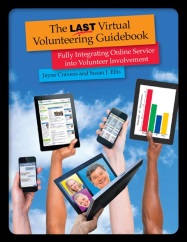
vvbooklittleWant more ideas for using computers, tablets, smart phones, even old-fashioned cell phones, to support and involve volunteers? Or want to create tasks specifically for volunteers to do online, remotely?  The LAST Virtual Volunteering Guidebook has all of this information and more. It’s available both as a traditional printed book and as a digital book. It’s written in a style so that the suggestions can be used with any online tools, both those in use now and those that will become popular after, say, Facebook goes the way of America Online. This is a resource for anyone that works with volunteers – the marketing manager, the director of client services, and on and on – not just the official manager of volunteers.

And if you have more simple ideas for easy ways an organization or program can use the Internet and text messaging to support and involve volunteers, please offer such in the comments below.

Also see why we called it The LAST Virtual Volunteering Guidebook.

Tech & communications jargon versus reality

The Guardian, a media organization based in the UK, has a wonderful online program called the Global Professionals Network, “a space for NGOs, aid workers and development professionals to share knowledge and expertise”. They also have an occasional feature called “The Secret Aidworker,” a column written by anonymous aid workers, talking about the not-so-great parts of humanitarian work.

The most recent blog is an aid worker talking about the “dark side” of humanitarian / development communications. Like me, she trained as a journalist, and it affects both her approach and her ethics regarding public relations and marketing. I was so struck by these two paragraphs from her blog:

The international community is too focused on using gimmicks in outreach campaigns rather than considering who their audience is and what they want. I was recently asked to design an outreach campaign to educate the local community we work in about the work we do. So keeping in mind the low literacy rate of our audience and the limited access they have to online and print media, I designed a communications campaign accordingly. However, that was considered old and outdated.

For my organisation, the use of new technology such as apps and social media held priority over the local regional media, even though I explained much of these were inaccessible to the people we were trying to reach. Too often people think that if a country has access to the internet and mobile phones, every one has access. They don’t consider the cost of mobile data, the literacy rate, or if the locals would even use their devices the same way as in the US and Europe.

Oh, I SO hear this! Not just in humanitarian work, but in all communications work for nonprofits, governments and other mission-based organizations, anywhere. I hear from nonprofits wanting to explore using SnapChat that haven’t updated their web site in months.They want to host a hackathon to develop an app while their manager of volunteers is refused money for posters for a volunteer recruitment campaign. They want to know the best engagement analytics software to purchase while their online community is quiet for weeks, with no staff posting questions, no volunteers sharing information, etc. They want a crowdsourced fundraising campaign but haven’t sent thank you’s to donors this year. They want a viral online marketing campaign to promote something but balk at the idea of a staff person visiting area communities of faith and civic clubs to build personal relationships with local people, especially groups that represent minorities that are under-represented within the organization’s volunteer, client and donor base.

Anyone who knows me knows that I have long been a promoter and advocate of ICT4D. I wrote one of the first papers – back in 2001 – about handheld devices, what were then called PDAs (personal digital assistants), in health and human services, citizens’ reporting, advocacy, etc. I am a pioneer regarding virtual volunteering. I use, and advise on the use of, social media to promote a variety of information and network with others. I regularly post to TechSoup’s Public Computing, ICT4D, and Tech4Good community forum branch about apps4good – smart phone applications meant to educate people about maternal health, help women leave abusive relationships, connect people with emergency housing and more. So I certainly cannot be accused of being a Luddite. But with all that said, I also still see the value of, and know how to leverage, printed flyers, printed posters, paper newsletters, lawn signs, newspaper ads, radio ads, radio interviews, TV interviews, TV ads, onsite speaking engagements, display tables, display booths and other “old fashioned” ways of communicating.

This aid workers blog reminds me of the early days of the World Wide Web, when I would hear an executive director of a nonprofit or the director of a government program talk about how great the agency’s new web site was, but as they talked, I realized they’d never looked at it themselves, and weren’t really fully aware of what the Internet was.

wizardToo many senior staff are bedazzled by buzzwords and jargon they’ve heard from consultants, giving their employees orders to do something based only on what they think is “hip” now. I am just as frustrated by organizations that overly-focus on the latest social media fads for communications as I am by organizations that ignore all things Internet and smart phone-related.

What should you do if you face this in the work place? Use small words and lots of data with your senior staff, and stay tenacious. Remember that a list of potential expenses and budgets for time can make a case for you to do a comprehensive, realistic communications plan. And be explicit and detailed on how your communications efforts will be evaluated for effectiveness.

My other blogs that relate to this:

Request to all those training re: volunteer management

Are you teaching a volunteer management 101 class, where you talk about the basics of successfully managing volunteers?

Are you going to teach a workshop on how to identify tasks for volunteers?

Are you going to teach a workshop on how to recruit volunteers?

Are you going to teach a workshop on how to keep volunteers engaged/volunteer retainment?

Are you going to teach a workshop on how to recognize/honor volunteers?

If you said yes to any of these questions, then here’s a thought. Actually, it’s a very strong suggestion: you absolutely should include virtual volunteering, whether or not you ever say the phrase virtual volunteering. You absolutely should talk about how to use the Internet – email, a web site, social media, third-party web sites – in each and every aspect of those basics of volunteer management. No exceptions. No excuses.

Consider this: no high-quality marketing workshop about event promotion would not talk about the Internet. No high-quality HR seminar or webinar would talk about worker recruitment and not talk about the Internet. No high-quality management class about better-supporting large numbers of employees in their work would not talk about digital networking tools. So why do those that work with volunteers settle for volunteer management workshops, even on the most basic subject, that don’t integrate into the class the Internet use regarding supporting and involving volunteers?

I hear a lot of excuses for consultants and other workshop leaders who don’t talk about Internet tools in a course regarding the management of volunteers:

  • The volunteer managers I’m working with don’t work with volunteers that use the Internet or text messaging
  • The volunteer managers I’m working with are at organizations focused on the arts or the environment or animals or homelessness and therefore don’t need to talk about the Internet or text messaging
  • There’s a separate workshop for talking about digital tools
  • The volunteer managers I’m working with have volunteers that are over 55

ARGH! Not one of those excuses is valid for not integrating talk of the Internet throughout any volunteer workshop addressing basic topics like recruitment, retainment, task identification, etc. NOT ONE. In fact, I think anyone who attends a workshop on working with volunteers, especially a volunteer management 101 course, whether hosted by a volunteer center, a nonprofit support center, or a college or university, whether online or onsite, should ask for at least a partial refund if virtual volunteering is not fully integrated into the course (it’s either not mentioned at all or is briefly mentioned at the end of the class). There is NO excuse for this, it shows a lack of competency on the part of the workshop leader and it’s time to demand better!

As Susan Ellis and I note in The LAST Virtual Volunteering Guidebook, virtual volunteering should not be a separate topic amid discussions about volunteer engagement and management. Instead, virtual volunteering needs to be fully integrated into all such discussions and trainings. No more segregation at the end of the book or workshop! The consequences of not integrating Internet use into volunteer management 101 workshops? It ill-prepares people for working with volunteers. It also immediately contributes to the stereotype that nonprofits are out-of-touch and old-fashioned.

vvbooklittleWe called it The LAST Virtual Volunteering Guidebook not because we don’t think there will be more to say about virtual volunteering in the future, not because we don’t think there will be new developments on the subject, but because we really hope it’s the last book focused only on virtual volunteering, because we hope all books written about working with volunteers, whether in general or regarding a very specific part of the management of volunteers, like mentoring or risk management or recruitment or board member support or whatever, will now fully integrate the use of the Internet/digital tools in their suggestions. We hope that every workshop on any aspect of volunteer management, and every certificate regarding the management of volunteers, will fully integrate the various uses of the Internet in their suggestions. There’s no excuse not to!