Author Archives: jcravens

About jcravens

Jayne Cravens is an internationally-recognized trainer, researcher and consultant. Her work is focused on communications, volunteer involvement, community engagement, and management for nonprofits, NGOs, and government initiatives. She is a pioneer regarding the research, promotion and practice of virtual volunteering, including virtual teams, microvolunteering and crowdsourcing, and she is a veteran manager of various local and international initiatives. Jayne became active online in 1993, and she created one of the first web sites focused on helping to build the capacity of nonprofits to use the Internet. She has been interviewed for and quoted in articles in The New York Times, The Wall Street Journal and the Associated Press, as well as for reports by CNN, Deutsche Well, the BBC, and various local radio stations, TV stations and blogs. Resources from her web site, coyotecommunications.com, are frequently cited in reports and articles by a variety of organizations, online and in-print. Women's empowerment and women's full access to employment and education options remains a cross-cutting theme in all of her work. Jayne received her BA in Journalism from Western Kentucky University and her Master's degree in Development Management from Open University in the U.K. A native of Kentucky, she has worked for the United Nations, lived in Germany and Afghanistan, and visited more than 30 countries, many of them by motorcycle. She is currently based near Portland, Oregon in the USA.

People with disabilities & virtual volunteering

I said it back in the 1990s, and I’ll say it again: Online volunteering / virtual volunteering can allow for the greater participation of people who might find volunteering difficult or impossible because of a disability. This in turn allows organizations to benefit from the additional talent and resources of more volunteers, and allows agencies to further diversify their volunteer talent pool.

In addition, ensuring that your volunteering program – online or onsite – is accommodating for people with disabilities will end up making your program more accessible to everyone. For instance, if you make sure your online training videos have captioning, don’t be surprised when people who have no hearing problems at all thank you, since they can mute the video and watch it at work or in a public area without disturbing people around them.

People with disabilities volunteer for the same reasons as anyone else: they want to contribute their time and energy to improving the quality of life. They want challenging, rewarding, educational service projects that address needs of a community and provide them with outlets for their enthusiasm and talents.

I was reminded of this recently when a fantastic testimonial from Alena Roberts for the Matilda Ziegler Magazine for the Blind was recently reposted to Inclusive Planet about online volunteering / virtual volunteering.

Here are 11 people’s testimonials about how virtual volunteering allowed them to volunteer, despite their disabilities, compiled by the Virtual Volunteering Project, that remain as powerful as when they were first-published back in the late 1990s.

I told this story back in April 2009, but it’s a good time to repeat it now:

Back in the late 1990s, when I was directing the Virtual Volunteering Project, I recruited and involved online volunteers myself to support the Project, feeling that it would be inappropriate to offer advice to other organizations to involve online volunteers unless I was engaged in the practice myself. The only recruiting I did was via the Project’s web site, on a page that was purposely not easy to find; online volunteers were oh-so-easy to recruit even back then, and by making the page harder to find, I regularly received applications from candidates who I knew were actually reading my web site.

One day, an application came in from a guy I’ll call Arnie. It was clear from Arnie’s application that he was… different. His answers to questions on the application were child-like (though everything was spelled correctly), and didn’t at all sound like they were coming from a man in his 40s (he shared his age despite my not asking for it). Among other things, he said that what he wanted to do most as an online volunteer was to share images and messages from the Virgin Mary, a skill set that I didn’t really have a need for at that time… But I kept reading Arnie’s application and thinking, well, while I know this person is very likely mentally disabled based on his answers, he spells just fine and he’s REALLY enthusiastic. There’s really no reason to say no outright. I’ll put him through all of the regular online screening steps and give him a trial assignment and see what happens, just like I do with all volunteers.

Unlike most other online volunteering applicants, Arnie followed all of the directions on the online orientation immediately, to the letter, and within just a couple of hours rather than a couple of days. I don’t remember what the first assignment was that I gave him, but just as the directions in the online orientation stated, he wrote back (within probably an hour) and said that he didn’t feel he could do what was asked for, so could he please have a different assignment? I think the revised assignment I sent him was regarding a list of names of people who had given me their business cards at conferences, but back in the 1990s, many people didn’t put their email addresses and web site addresses on their cards. I asked him to use Google to find that information for me, if possible. The next day, the finished assignment was waiting for me, with profuse apologies for each person he couldn’t find online, and a request for a new assignment.

I slowly became a bit obsessed with trying to create assignments for Arnie. He could do only basic things online, like looking up information, and he needed explicit directions on how to do every task, but he was SO enthusiastic about it all. I started saving things for Arnie to do that I could have done myself in far less time than it would take him to do. For each assignment he always wrote back promptly if he thought an assignment was too difficult, or wrote back to say how happy he was at the assignment, how excited he was to do it, etc.

I think Arnie’s favorite assignment was when I asked him to visit 20 or so web sites that were supposed to be targeted at children; I was putting together a list of things online mentors and young people could do together online, and I wanted to know if these web sites were worthwhile. A paid consultant could not have provided the thorough, brutally honest assessments that Arnie did. Things like

I did not like this site at all, Miss Jayne. It was confusing! I did not know how to use it! It is a bad web site for this reason.

    • or

I liked this site very much, Miss Jayne. It was fun! I showed it to my mother. She thought it was fun too.

I was starting an online mentoring program at a local elementary school in Austin, and I invited all the online volunteers I had worked with to apply to be online mentors. Arnie was probably the first applicant. At first, my reaction was: he can’t do this. I have to tell him no. But then I kept thinking about it — *why* couldn’t Arnie talk online with a 10 year old? His tone would actually be perfect for a 10 year old. They would never know each other’s real name or be able to contact each other outside the web platform we would use for online exchanges, every message he sent would be screened, just like the other mentors. Why not let him go through the whole application process and see if he makes it? So, I did.

Among the screening required was two references who could attest to the candidate’s character and communications abilities. One of Arnie’s references was his doctor. When I called for the reference check, the doctor said, “Are you the Miss Jayne?! I’ve heard about you for a year now! Arnie lives to volunteer with you! It’s changed his life!”

I’m glad I was on the phone, so he couldn’t see me crying.

Arnie survived the screening process and was a wonderful participant in the program. His emails to his student were always perfect, full of questions and enthusiastic comments, written in short, simple sentences. The only thing I ever had to do was ask him to revise an email that had a religious reference in it, not as in “I went to church this weekend and it was fun,” which would have been fine, but as in “I hope you are praying to God every day!” Arnie quickly understood why that was inappropriate once I explained it to him, and it never happened again.

After more than a year of working together, Arnie wrote to say that he would need to take a break from volunteering, because he was getting “too full of worry” when he did assignments. I wrote him after a month saying that I hoped he was doing well, and he wrote back a lengthy, somewhat rambling apology for “letting you down.” I wrote him again to say that was NOT the case at all, wrote lots of encouragement and thank yous, etc. When I didn’t hear from him after a few months, I called his doctor, just to make sure he was okay. He was, but his doctor said he probably wouldn’t be using email anymore, that it had become too overwhelming for him. Sadly, I never heard from Arnie again.

What did I learn from all this?

I became a better volunteer manager for all volunteers because of Arnie. My descriptions of all tasks for volunteers became much more detailed and explicit. I better emphasized to volunteers that the time to drop out of an assignment was right at the start, and that there will be no hard feelings for doing so before the commitment has begun. I started reserving a diversity of tasks specifically for volunteers, and for my own list of tasks, I would always ask, could volunteers help me do any of this? I tried to identify a range of very simple starter assignments, so that new volunteers would not feel overwhelmed — or, if they did, they would know that online volunteering was not for them very early on. I look very much into what a volunteer can do, not what limitations a volunteer may have. I also learned that everyone, people with disabilities and otherwise, screen themselves when it comes to assignments, and it’s rare that someone will ask to volunteer for a task they are unqualified to do.

Since Arnie, I’ve worked with other volunteers with disabilities, though often, I haven’t been aware of such, since online volunteering often masks any disabilities a person may have. I can judge people online only by their abilities, rather than their appearance, if I stick to text-only communications.

When I’m working at a nonprofit organization, I involve volunteers not to save money, not to do what I can’t pay staff to do, but rather, to involve the community in the work of my organization, to create an army of advocates for our work, and to make my work more interesting with input from many more people. I’ll continue to strive to create inclusive programs, not only because it’s the right thing to do, but because, in the end, it helps me be a better contributor.

2014 update:

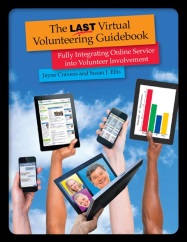
vvbooklittleThe influence of this experience, and many others, as well as extensive research, can be found in The Last Virtual Volunteering Guidebook. This book, which I wrote with Susan J. Ellis, is our attempt to document all of the best practices of working with online volunteers, from the more than three decades that virtual volunteering has been happening. It’s available both in traditional print form and in digital version. If you read the book, I would so appreciate it if you could write and post a review of it on the Amazon and Barnes and Noble web sites (you can write the same review on both sites).

There’s also The Virtual Volunteering Wiki: a free resource featuring a curated list of news articles about virtual volunteering since 1996, an extensive list of examples of virtual volunteering activities, a list of myths about virtual volunteering, the history of virtual volunteering, a list of research and evaluations of virtual volunteering, a list of online mentoring programs, and links to web sites and lists of offline publications related to virtual volunteering in languages in other than English.

And there’s also our LinkedIn Group for the discussion of virtual volunteering.

Also see: Safety in virtual volunteering

Short-term tasks for tech volunteers

There are a variety of ways for nonprofits, non-governmental organizations (NGOs), schools, government agencies and other mission-based organizations to involve volunteers to help with short-term projects relating to computers and the Internet, and short-term assignments are what are sought after most by potential “tech” volunteers. But there is a disconnect: most organizations have trouble identifying short-term tech-related projects.

Back in 2005, myself and by members of TechSoup Global’s Volunteers and Technology online discussion group brainstormed a list of short-term projects for tech volunteers. I’ve added a lot to it over the years – and just updated the list yet again this week.

These one-time, short-term volunteering assignments might takes a few days, a couple of weeks or maybe a month to complete. But each has a definite start date and end date, shouldn’t go on longer than a month (maybe two) and does not require a volunteer to make an ongoing commitment to the organization – once an assignment is done, the volunteer can move on to another assignment, or stop volunteering with the organization altogether.

There are also many long-term, ongoing assignments for tech volunteers, of course, such as web design, web site management, being on-call for tech problems, backing up systems, producing live online events, etc. But before an organization involves volunteers in such high-commitment endeavors, the organization should consider creating a few short-term assignments, to get used to working with tech volunteers and to help staff identify the best candidates for longer-term assignments.

Tags: volunteering, volunteers, episodic, microvolunteer, microvolunteering, engagement, engage, community, outreach, staff, employees, civil society, technology, help, IT, ICT, ICTs

People not following-through on volunteering in disasters

The state of Queensland, Australia suffered from horrific floods in December 2010 and January 2011. Thousands of Australians expressed interest in volunteering, inundating volunteer centers and online message boards.

Recently, Volunteering Queensland offered this Submission to Queensland Floods Commission of Inquiry, which said, in part:

QUEENSLAND’S peak volunteer organisation says the vast majority of people who registered to help clean up following the floods and cyclone Yasi backed off at the last minute.

Some people backed out because they realized this was a real commitment of time, and they couldn’t make that real commitment. Some dropped out because they could not donate a significant amount of time – an hour or two when you might have some time eventually is usually not enough for such a situation. Some backed out because they really were not prepared to volunteer (they hadn’t set up child care, time off from work, transportation, etc.).

Seasoned volunteer managers, of course, aren’t surprised. Even in a non-disaster situation, we have come to expect at least 50 percent of people who express interest in volunteering to drop out. That’s why many volunteer managers, including myself, insist on at least a bit of screening before a volunteer is placed into an assignment, so that drop outs happen in the screening process, not after the assignment is given and we’re counting on those volunteers.

Martin Cowling has done a great blog about this Queensland report, and I encourage you to head over to it, read it, read the comments (yes, I’ve commented there) and respond yourself.

Here is a resource I created following the oil spill in the Gulf of Mexico in 2010, Volunteering To Help After Major Disasters, which I’ve regularly updated at least monthly every since, per the over-whelming number of posts to places like YahooAnswers by people who want to volunteer following a disaster (earthquake, hurricane, tornado, tropical storm, flood, tsunami, oil spill, zombies, etc.). It’s become one of the most popular pages on my web site, despite being posted as almost an after-thought and being focused on people that the majority of my web site is not focused on (it’s not even linked from my home page!).

Tags: volunteering, volunteers, relief, disaster, response, spontaneous, episodic, microvolunteer, microvolunteering. communications, public relations, engagement, engage, community, nonprofit, NGO, not-for-profit, government, outreach, staff, employees, civil society, floods, tornadoes


Helping left behind animals in Japan

I have been riveted by the Facebook status updates of Japan Earthquake Animal Rescue and Support (JEARS), whose volunteers are trying to help the many animals left behind following the earthquake and tsunami in Japan. Some of the animals are homeless or abandoned because their owners are now dead. Some are in this situation because their owners are not allowed to have them wherever they are living now. The stories of animals reunited with their families brings a tear every time. If you speak Japanese and can be entirely self-funded (taking care of your transportation and food and at least some accommodation), you would be welcomed onsite to help with JEARS. Otherwise, the best way you can help is with a financial donation.

JEARS is one of those organizations that gets Facebook, that understands you have to publish regularly with updates that help people understand you are doing great work — not just endless posts about the donations you need or something you are selling.

And on that note: animal shelters in tornado-stricken areas of the USA are facing dire straights. They need money, they need food donations (and donors need to bring it onsite to them – they CANNOT come get it), they need donations of washing machines, they need bedding, and they need people to adopt or foster abandoned dogs and cats. The shelters serving these areas are easy to find on Google.

Corporation for National and Community Service needs a makeover?

Paula Beugen was a part of the movement that lead to the National and Community Service Act of 1990 and the Corporation for National and Community Service. But she is now one of many that is not happy about where the Corporation is today:

In sharp contrast to the excitement that I felt when the Act of 1990 first got the ball rolling to create the Corporation and its programs, I now find myself greatly concerned with the Corporation’s lack of impact on volunteer infrastructure and volunteering. Today, the Corporation is struggling for survival – but does it need a serious makeover no matter what funding level Congress approves for it? 

Of particular concern to her – and to many others, including myself – is the recent emphasis the Corporation has placed on deploying AmeriCorps members as “mobilizers of community volunteers.” As Paula notes:

I have observed a dearth of positions for professional managers of volunteer programs in recent years at the same time the Corporation has been promoting and placing AmeriCorps members as volunteer coordinators. There is an important role for AmeriCorps volunteer coordinators to augment the work of volunteer resources managers within organizations but not to take their place.

Little has been done to educate policymakers that there is more to volunteer resources management than “coordinating” volunteers. This works great in the short run, but the long-term sustainability of results-driven volunteer programs requires substantive investment in volunteer resources management infrastructure… AmeriCorps members can be of enormous help to volunteer-involving organizations, but they cannot substitute for experienced volunteer resources leaders with ongoing commitment to best practices in the volunteer resources management profession.  

These quotes are from Paula’s guest turn for the Energize June Hot Topic. It is very much worth your time to read.

I’ve had my own complaints about the Corporation. I complained repeatedly when their “Reimaging Service” report equated volunteer management with human resources management, and became a drive to apply private sector human resources practices to nonprofit organizations: “there’s a lot of work to be done; let’s get people we don’t have to pay to do it!” They ultimately backed off saying this, though it’s obvious from their actions that they still think it. I hesitate to participate in their invitations to voluntarily consult, because not only will my concerns probably not be addressed, they might use my participation to say, “Look, see, this strategy is the result of a consultive process – and look at all these people who contributed to our final strategy!” with no mention of the criticisms I and others have brought up. (in international development, this is called being World Banked).

I hope you will blog about this issue as well. Online pressure is as vital as face-to-face, offline pressure to keep the Corporation on track!

ICTs & Disaster Response – Roundup

Some terrific resources have come my way over the last few months regarding information communications technologies (ICTs) and disaster response / humanitarian efforts. Here’s a roundup:

Disaster Relief 2.0 – The Future of Information Sharing in Humanitarian Emergencies
The report analyzes how the humanitarian community and the emerging volunteer and technical communities worked together in the aftermath of the 2010 earthquake in Haiti, and recommends ways to improve coordination between these two groups in future emergencies.

Communicating with Disaster Affected Communities (CDAC)
CDAC is a cross-cluster service working to enable humanitarian operations to get information to those populations affected by Haiti’s January 12 2010 earthquake and its aftermath and to channel their voices back to the providers of assistance working with local media and non-mass-media communications. CDAC uses various information and communication methods in an effort to act as a source of expertise and advice, a community of practice, and an advocacy platform that aims at ensuring that the humanitarian sector mainstreams CDAC and that local media play a role in maximising aid effectiveness, accountability, and transparency.

Left in the Dark: The Unmet Need for Information in Humanitarian Responses
This October 2008 policy briefing from the BBC World Service Trust explores the value of providing information and communication to disaster-affected populations by drawing on the example of the Indian Ocean tsunami disaster – where, as stated here, the greatest dissatisfaction of the victims was over the poor information flow. “The humanitarian system as it stands is not equipped with either the capacity or the resources to begin tackling the challenge of providing information to those affected by crises. There is very little dedicated public communications capacity within major humanitarian organisations.”

infoasaid 
infoasaid seeks to improve how aid agencies communicate with disaster-affected communities. The emphasis is on the need to deliver not just material supplies in times of crisis but, rather, information – defined here as aid itself. Amongst its actions: infoasaid is producing a library of generic key messages (with some tailoring for local context) to be conveyed to the affected populations during an emergency.

ICT for Disaster Risk Reduction
This set of case studies explores the ways in which information and communication technology (ICT) has positively impacted the various phases of disaster management. The document highlights the different digital technologies and their use to reduce disaster risks. The need for journalism and media development is also recognised. This is from the Asian and Pacific Training Centre for Information and Communication Technology for Development, but isn’t focused only on Asia and Pacific countries.

10 things aid workers can learn from Haiti about urban disasters
The Disasters Emergency Committee (DEC) office brings together to UK’s largest humanitarian agencies to fundraise after major disasters. The report looks at the world through post-Haiti glasses to pick out other cities with similar geographical and social vulnerabilities. The report points to the importance of disaster risk reduction and preparedness work – as well as agencies’ own continuity planning. ALNAP has a nice blog about the report.

A large NGO donated their security policy and protocols to OpenSecurityDocs. The name of the NGO has been taken out to make it more general for other NGOs. Here is the document. You are invited to donate your security documents for the benefit of other NGOs to this initiative as well. Per your direction, references to your organization can be taken out before your resource is published on the OpenSecurityDocs site. 

Where do I find these resources? Often, via the Communications Initiative. I try to read their email update once-a-week, because I often find resources that help me in my work regarding communictions and community engagement for nonprofits, NGOs, international development agencies and others.

I also find them via who I follow on Twitter. Some recent tweets on the subject of ICTs & Disaster Response that got my attention:

Q: Are crisismappers bound by same accountability frameworks as humanitarian aid workers? A: Unclear, need to explore http://t.co/axAVL1W

[Video] An inside look at the Japanese #RedCross response to the March 11 #earthquake & #tsunami: http://ow.ly/52sCJ

New photos from #Haiti show us the continuing rebuilding efforts around Port-au-Prince. http://ow.ly/51px2 #RedCross

And don’t forget: I’m always looking for examples of how folklore, rumors (or rumours) and urban myths / urban legends interfere with relief and development activities, and government initiatives, and, even better, how these have been addressed. What you send may end up on this web page.

Tags: communications, public relations, engagement, engage, community, nonprofit, NGO, not-for-profit, government, outreach, innovation, non-traditional, innovative, staff, employees, volunteers, civil society, social media, technology, ICTs, Internet, network, smartphones, cell phones

Nonprofits & Tech Discussions – Jump In!

Share a resource, ask a question, or offer your own thoughts about any of these hot topics relating to nonprofits, NGOs, libraries, schools and other community-focused initiatives over on the TechSoup Global Community Forum. Here are four threads on TechSoup that I’m watching in particular:

Tags: communications, public relations, engagement, engage, community, nonprofit, NGO, not-for-profit, government, library, libraries, school, schools, outreach, innovation, non-traditional, innovative, staff, employees, volunteers, civil society, social media, technology, microblogging, microvolunteering, micro, volunteer, volunteering

What is impressive, what is not

Things I’m not impressed by:

  • How many Facebook “likes” or “friends” your organization has
  • How many times your organization “tweets” or your tweet has been retweeted
  • That your organization received an “award” from one of your VENDORS
  • That you “gave up” a corporate career to work in the nonprofit sector
  • How many hours your volunteers contributed last year
  • How many hours of overtime your organization’s employees work most weeks
  • That you are hiring a Rock Star-anything (Rock Star Membership Coordinator, Rock Star Social Media Manager) unless you are PAYING a Rock Star salary and providing Rock Star benefits.
  • Your web site’s use of stock photos
  • That your new web site is coming soon and all your descriptions of how great it’s going to be.

Things I am impressed by:

  • Online activities leading to offline action
  • How your organization handles negative comments on your Facebook page
  • That your organization was recognized by your Governor’s volunteering awards
  • That your tweet last week resulted in a $5000 donation (or more) than you wouldn’t have gotten otherwise
  • What your volunteers accomplished last year, in terms of tangible results (literacy among your clients increased, trees planted, perceptions changed, legislation passed, etc.)
  • Volunteers in leadership positions at your organization (leading a project, serving on an advisory board regarding marketing and outreach, producing a publication or online video, etc.)
  • Happy employees that love going to work and supporting each other, that love collaborating internally and sharing information and resources with each other
  • A competitive salary and benefits package for employees
  • Photos of your own organization’s actual volunteers or clients, however out-of-focus such may be
  • That your new web site is launched, on time, that it’s easy to navigate, that I can quickly find what I’m looking for without having to sit through a video or shut down your blaring audio that starts up automatically, that it works with any browser, and that you obviously incorporated the suggestions of others into the new design.


Recruiting board members with LinkedIn?

On LinkedIn, in the Answers section for nonprofits, someone asked:

How can a non-profit recruit board members through LinkedIn?

Recruiting board members successfully comes from a lot of ongoing cultivation. Using LinkedIn or any other online networking tool to recruit board members has to be a part of a comprehensive, ongoing strategy that involves a lot of different activities, IMO.

It not only doesn’t work to just post somewhere and say, “Hey, we need some board members!”, it also makes it sound like you don’t treat board membership seriously.

The following suggested activities to recruit board members will show that you are a competent, credible, transparent organization, and will give candidates an idea of how seriously you take your organization’s work and how well you support your board members. It also shows you aren’t looking for just anyone. Board membership is an honor, a leadership volunteering opportunity, and should be treated as such in your recruitment!

Start with your web site:

  • Have a full description of what board members do, what weekly or monthly time requirements a board member is committing to (onsite meetings once a month? online meetings once a week?) and for how long (a year? two years?), if attendance to a certain number of meetings is mandatory (IMO, you should always have such a requirement if you want board members to take attenance seriously), if board members are expected to give or raise a certain amount of money each year (you don’t need to say how much on your web site; you can leave that to an interview later), etc.
  • Note on your web site how many board members you are looking for. Two? Three to six?
  • Have photos of your board in action, and a list of all current board members with short bios about each – not just what companies and constiuencies they represent, but also, a personal statement from each about why they volunteer for your organization, why they think such is important, etc.
  • Have complete details on how someone could nominate themselves as a board member, or how they could suggest someone for possible nomination. Make this process super easy.

This information on your organization’s web site is not an afterthought. They are super-important steps that they show how much your organizaton values board members. This information will wow a potential candidate. It will also screen out people who don’t understand the very real commitment of board membership.

Then talk to your current board and map exactly what will happen when a nomination comes in:

  • What research will be done on a candidate, and who will do that research? How and when will a candidate be interviewed, and who will do that interview?
  • What questions will be asked in that interview?
  • What will be the reasons to turn a nominee away, and how will this rejection be communicated?
  • If you turn away a board member, will you encourage that person to volunteer in other ways? (advisory board? volunteer project leader? special events volunteer?)

And once you have done all of these steps, you are ready to:

  • post this leadership volunteering opportunity (that’s what board membership is!) to BoardNetUSA, VolunteerMatch, etc., pointing back to your web site with complete details about what board membership really looks like
  • post something about the opportunity on your own, individual LinkedIn status update for your network (you may want to do this more than once)
  • ask each of your existing board members to do the same on their status updates on LinkedIn, to reach their network
    if it’s appropriate 
  • ask all of your volunteers to post about the opportunity to their LinkedIn status updates as well, if they feel comfortable doing such
  • do the same on Facebook, if it’s appropriate – but note that Facebook is a social networking site, and many people don’t like mixing their business or volunteering with their social activities.

If you have a Come learn about our organization event/open house, list it on the events function of LinkedIn as well, and make sure all staff, board members and other volunteers that will attend RSVP on LinkedIn, so that all of their connections see the attendance, and ask all board members and staff to mention the event in their status updates as well.

Also, look for LinkedIn groups that are regionally-focused on your geographic area; these can be focused on business, on a particular issue, on on someone else’s group, etc. Some of these LinkedIn groups may be appropriate for posting about your board opportunities (most won’t be, but it’s worth it to look). You can also troll those groups and look for people that you think would be great board members based on the quality and content of their posts, and the ask your board member, your staff, your other volunteers and your own professional network if anyone knows a person you’ve identified as a potential candidate and if anyone in your network would be willing to make the initial invitation to an open house or event so that person can get to know your organization.

After three-six months, evaluate your efforts. How many inquiries did you receive? How many formal nominations did you receive? How many new board members have joined or are in process? If people dropped out of the process after expressing interest or being nominated, why did they? If people were rejected, why were they rejected? In answering these questions, you will know what adjustments you need to make in your board recruitment – on LinkedIn and otherwise!

And one final thought: what a great volunteering opportunity it would be for someone to be in charge of this board recruitment process! You could recruit a volunteer just to do all of the above for six months. Designate one staff member to be the primary contact and support person for such a volunteer, and start recruiting just for this position first! There are so many university students studying nonprofit management, business management, HR management, or any number of other subjects, as well as people who are job-hunting, who would love to be able to put on their résumé: instituted and managed a successfully recruitment campaign for such-and-such organization, resulting in three new board members.

Zombies aren’t real, but disaster preparedness is

As has been reported in all over the news for the last few days, the Centers for Disease Control (CDC) in the USA has released a new document that offers suggestions on how to prepare for a zombie invasion. Here’s a nice blog summary of the CDC’s recommendations.

The recommendations are serious, even if the reason is not what the CDC is trying to do is get people to have the preparations in place for a variety of real possible disasters: destructive storms, earthquakes, floods, etc. And it turns out that the preparation for a fictional attack – could be zombies, could be space pirates – are surprisingly similar for reality disaster scenarios.

It’s a daring exercise by the CDC. I love it, but I’m already hearing pundits say, “This is what the CDC uses our tax dollars for? To be cute?” But the CDC isn’t trying to be cute; it’s trying to get the message out about disaster preparedness to people who aren’t getting traditional messages. There have been so many disasters just in the USA lately – massive flooding and highly-destructive tornadoes – not to mention the disasters overseas, and many people are becoming unconsciously resistant to calls to be prepared. 

The CDCs effort is getting huge media play, so the message is definitely reaching many more people. But is this campaign really a success? It’s a media success, certainly, but to know if this is really garnering outcomes, the CDC will have to find out if people really are better prepared for a disaster. Are more people storing the appropriate amounts of water, food, medications, tools and supplies, etc., as a result of this campaign? Have more people sat down with their families and come up with an emergency plan as a result of this campaign? Are all the people blogging and tweeting about this also making appropriate preparations? (before you ask – my husband and I have been prepared for natural disasters, zombie attacks and space pirates for many years now)

And note that the very real disaster of Joplin, Missouri is unfolding before our eyes, and as I am sitting here watching TV and writing this blog, a Joplin official is begging people NOT TO COME INTO THE CITY. Gawkers and un-prepared do-gooders are already getting in the way of rescue and relief efforts. If you don’t have training and resources to help people and animals in that area, if you aren’t prepared to be completely self-sufficient while in the area, providing for your own gas, food, shelter and safety while you are there, please stay away!

If you want to help Joplin, donate to the American Red Cross office nearest the area or to the national office. Also, look for animal shelters serving the area Joplin, Missouri area – all those that are not damaged will soon be over capacity with dogs, cats, horses and other pets and livestock from the area. They will be desperate for funds to transport animals elsewhere, provide food and medical care to the animals they have, etc.

And don’t forget Alabama: The Tuscaloosa Metro Animal Shelter is in desperate need of support, as they are completely overwhelmed with lost and abandoned pets, as is the Humane Society of West Alabama. The Greater Birmingham Humane Society will also need help with the influx of lost and abandoned pets. Making a donation will help buy food and pay for medical services. Adopting a pet from this or any nearby shelter will free up space for other animals.

Here’s advice for Volunteering To Help After Major Disasters. Please call your local American Red Cross and get training NOW for disasters LATER. They have training specifically for disaster response! Or consider volunteering with your local animal shelter NOW and build up your skills and your credibility so that you will be in a place to provide critically-need help in the future.

AND HAVE AN EVACUATION PLAN THAT INCLUDES YOUR PETS!!!