Tag Archives: volunteering

global survey on volunteer management software – revisited

In 2012, Rob Jackson (robjacksonconsulting.com) and Jayne Cravens (coyotecommunications.com) — ME — drafted and circulated a survey regarding software used to manage volunteer information. The purpose of the survey was to gather some basic data that might help organizations that involve volunteers to make better-informed decisions when choosing software, and to help software designers to understand the needs of those organizations. We also wanted to get a sense of what organizations were thinking about volunteer management software.

We promoted the survey every way we knew how – emailing our contacts directly, posting to various online discussion groups, posting repeatedly to our social networks, and asking others to share the survey with their readers and networks. Then we published the results of the survey here (in PDF); it includes an executive summary of our findings, as well as the complete responses to questions and our analysis of such.

It’s the two-year anniversary of this survey, and we think the results are still quite useful. Software companies and designers: you can learn a LOT from this report to improve your products and your communications with customers!

What we learned:

We learned how much managers of volunteers love spreadsheets, even those that have specialized software for managing volunteers.

We also learned a lot from this report that has nothing to do with software. In the survey, we asked a lot of questions that didn’t relate directly to software, like about how many volunteers these organizations managed, as well as what volunteers did. And the answers about what volunteers do at various organizations were surprising.

Rob and I did not have time to analyze all of the comments made in answer to some questions; for all questions, we listed the comments made, but we did not always offer any observations about such, or group the responses into categories. We welcome the efforts of other researchers to offer their own analysis of the data provided.

The thing I have learned since then: I’m not sure volunteer management software is what every organization needs to track and schedule volunteers. The more I talk to people working with volunteers, the more I think that seeking function-based software (scheduling, performance, etc.) rather than volunteer-management software is the answer for a lot of organizations. I’ll write more about that soon.

Perspectives on Volunteering: Voices from the South

A new book on volunteer activity is in the making for the ISTR Book Series: Perspectives on Volunteering: Voices from the South. The aim of this volume is to articulate and examine theories, and perspectives on volunteering in the “South”, meaning presenting various angles of volunteer activity in countries considered developing countries and countries in transition. Comparative issues of all countries are welcome as well as examples of volunteering in  North/South or South/South experiences.

There is a group authors already involved in this publication. “We are interested in would be authors that are working on these issues. To researchers with an interest in this topic, this is an open invitation  to attend a meeting at the ISTR conference in Muenster [Germany]. For those who cannot attend and are interested, please contact the editor.”

Place: University of Muenster (Germany). Room Vom Stein Haus  VS-17
Time : Friday, July 25.   12:30 PM.
parallel to the International Society for Third Sector Research (ISTR) International Conference

Editor:  Jacqueline Butcher, Ph. D
RSVP: jacqueline.butcher@ciesc.org.mx

More info:

The chapters in this book approach volunteering through a series of essays and case studies that present recent academic research, thinking and practice on volunteering. Working from the premise that volunteering is “universal” this collection draws on experiences from Latin America, Africa including Egypt and selected parts of Asia. There is a focus on developing countries and countries in transition documents a fresh set of experiences and perspectives on volunteering. These accounts complement the conventional focus in the literature on ‘the developed’ world – largely northern or western experiences from Europe and North America. While developing countries and countries in transition are in the spotlight for this volume, the developed country experience is not ignored. Rather it is used in this anthology, as a critical reference point for comparisons, allowing points of convergence, disconnect and intersection to emerge.

The primary aim and contribution of this anthology will be to articulate and examine the opinions and perspectives on volunteering in the South. The second objective is to provide a counter point to the dominant conceptual and empirical account of volunteering. Consequently, in identifying chapters the proposed editor did not discount evidence from northern and western countries and rather included this where possible in survey and quantitative studies as a useful reference point and basis for comparison. Finally, the tertiary objective promotes the fuller complexity and texture on volunteering, highlighting its promotion through an appreciation of its potential and promise for expression and impact in different cultures and contexts.

Authors and suggested chapters to date:

Section 1: Volunteering: An introduction and theoretical framework

Chapter 1: Volunteering: a complex social phenomenon
Jacqueline BUTCHER

Section 2: Patterns of Volunteering

Chapter 2: The economic value of volunteering: Comparative estimates among developing, transitional, and developed countries.
Lester SALAMON and Megan HADDOCK

Chapter 3: The effects of volunteering on poverty and development in China, Ghana, Kenya, Mozambique, Nepal and the Philippines
Volunteer Services Overseas (VSO) and the Institute of Development Studies, Sussex University.

Chapter 4: Youth, service and volunteering: A comparative perspective in developing nations.
National Youth Service (NYS)

Chapter 5: The global perspective in corporate volunteering: a focus on the South.
Ken ALLEN

Section 3: Empirical approaches

Chapter 6: Organic/ indigenous practices of volunteering in Uruguay: The influence on Public Policy.
Analía BETTONI and Javier PEREIRA

Chapter 7: Solidarity and Volunteering: a Mexican Study.
Jacqueline BUTCHER and Gustavo VERDUZCO

Chapter 8: Individual volunteering and giving: How and why ordinary individuals give in the context of South Africa: a case study of Gauteng Province.
Susan WILKINSON-MAPOSA

Chapter 9: Promising practices from national programs across the African continent: Preparing youth for citizenship , employment and sustainable livelihoods.
Helene PEROLD and Karena CRONIN

Chapter 10: A typology of local and International volunteering experiences from Tanzania and Mozambique.
Helene PEROLD

Chapter 11: Volunteering at the grassroots: Celebrating the Joy of Volunteering in India
N. DADRAWALA

Chapter 12: Beyond images and perceptions: How important is voluntary action in Buenos Aires?
Mario ROITTER

Chapter 13: Employee volunteering in South Africa.
Fiona BUDD

Chapter 14: Models, developments and effects of trans-border youth volunteer exchange programmes in eastern and southern Africa.
Jacob MATHI

Chapter 15 : Volunteerism and the state: understanding the development of volunteering in China
Ying XU and Ngai PUN

Chapter 16: NGO management of volunteers: the case of Egypt.
Hisham EL ROUBY

Section 4 Conclusions -Volunteer participation.

Chapter 17: Conclusions about experiences and perspectives that come from the South.
Jacqueline BUTCHER

More information about the editor:
Dra. Jacqueline Butcher García-Colín
Directora, Centro de Investigación y Estudios sobre Sociedad Civil, A.C.
conocimiento  para la acción social
Tecnológico de Monterrey, Campus Ciudad de México
Escuela de Humanidades y Ciencias Sociales


Growing backlash against volunteerism?

I first learned of people being against volunteerism back in 1997, when a three-day bipartisan presidential summit aimed at boosting volunteerism and community service efforts across the USA kicked off in Philadelphia.  I was directing the Virtual Volunteering Project at the time. There were arguments from both the far-right and the far-left, and I did my best to compile them. When I would bring up these arguments at various volunteerism conferences or on online groups, my colleagues usually just scoffed – it’s just extremists, it’s not something we need to worry about. 

Since then, I’ve kept an eye on these arguments against volunteerism, because I feel strongly that the arguments must be addressed. Organizations recruiting volunteers need to have these arguments in mind when they are crafting recruitment messages and when they are talking about the value of volunteers. When organizations ignore these arguments against volunteerism, or deny them, they end up with dysfunctional volunteer engagement programs, lack of support for volunteer engagement and, sometimes, very pad PR.

This came to mind over the weekend when I saw this comment in a friend’s Facebook feed:

I’d rather find the means of capitalization and pay people to do the work at hand than to bother with the volunteer work ethic or ability. I was never more personally insulted than as the president of the board of my church.

If you are talking about volunteer involvement as a way to save money, and volunteer contributions in terms of monetary value, then you are part of the problem – you are creating the fuel for these political arguments against volunteerism. And if you are not asking volunteers why they are leaving your organization, and addressing those reasons, you are creating ex-volunteers who are sharing their views with friends and colleagues and further creating a bad image not just for your organization, but for volunteering as a whole.

My other blogs and web pages on this controversy:

Note that the links within some blogs may not work, as I moved all of my blogs from Posterous to WordPress a few months ago, and it broke all of the internal links. Also, some web pages on other organization’s sites have moved since I linked to such, and I either don’t know or haven’t been able to find a new location for the material.

Fans of celebrities & virtual volunteering

Back in the 1990s, I created a section on the Virtual Volunteering Project web site that was focused on how fans of TV shows, movies, singers, sports clubs and celebrities were using the Internet to coordinate philanthropic acts. This was everything from asking people attending a group viewing of a show to bring canned food for a local food bank to organizing an online auction to raise money for a celebrity’s favorite charity. These fans were engaging in philanthropy with no coordination from any charity or the celebrity – they self-organized and off they went, with the Internet playing a central role in their activities.

This kind of virtual volunteering is continuing today! While the volunteering or other philanthropy might happen onsite, the coordination and connection among volunteers is happening mostly online.

One of the most recent examples I found is by fans of British actor Benedict Cumberbatch, who call themselves the Cumbercollective. They are organizing an event to coincide with the actor’s birthday, July 19:

While it’s wonderful that many are able to donate to charity fundraisers in honor of Benedict’s birthday… some fans might find ourselves unable to do so. So, Batch of Kindness was born. What better way to celebrate the birthday of this extraordinary man than to perform acts that show generosity of spirit?

Let’s see how many lives we can impact, even in the smallest of ways, as we fulfill his request to “throw love” to those that need it. The Cumbercollective can give a Batch of Kindness to the world by giving of ourselves in honor of Benedict, who inspires us by his example.

Batch of Kindness organizers have offered these ideas for fans to undertake, and are encouraging participants to tweet about their activities with the tag #batchofkindness on  July 19.

I hope the group will also explore virtual volunteering for their members, online micro volunteering, and group activities so that members can do something together.

Other recent examples:

The Harry Potter Alliance: “We are an army of fans, activists, nerdfighters, teenagers, wizards and muggles dedicated to fighting for social justice with the greatest weapon we have– love. Join us!”

The 501st Legion (Star Wars) “While our organization was founded to simply provide a collective identity for costuming fans with similar interests, the 501st is proud to put its resources to good use through fundraising, charity work, and volunteerism.”

Examples cited in my original article include fans of The X-Files Fans, Xena and Barry Manilow. I also have an archived list from the 1990s that lists fans of Star Trek, Elvis, Christian Bale and more.

I’m sad that I didn’t find a group of Buffy: The Vampire Slayer fans that promote volunteering and donations to support nonprofits that work for the empowerment of women and girls. Is it out there and I just didn’t find it? Do I need to start it? (ha)

I can still inspire old school

Months ago, I did a Volunteer Engagement 101 Workshop in Portland. Here’s feedback from such – which shows I can still inspire old-school action regarding volunteer engagement (not just the cutting edge Internet stuff):

I recently attended your volunteer management training for AmeriCorps
members in Portland…

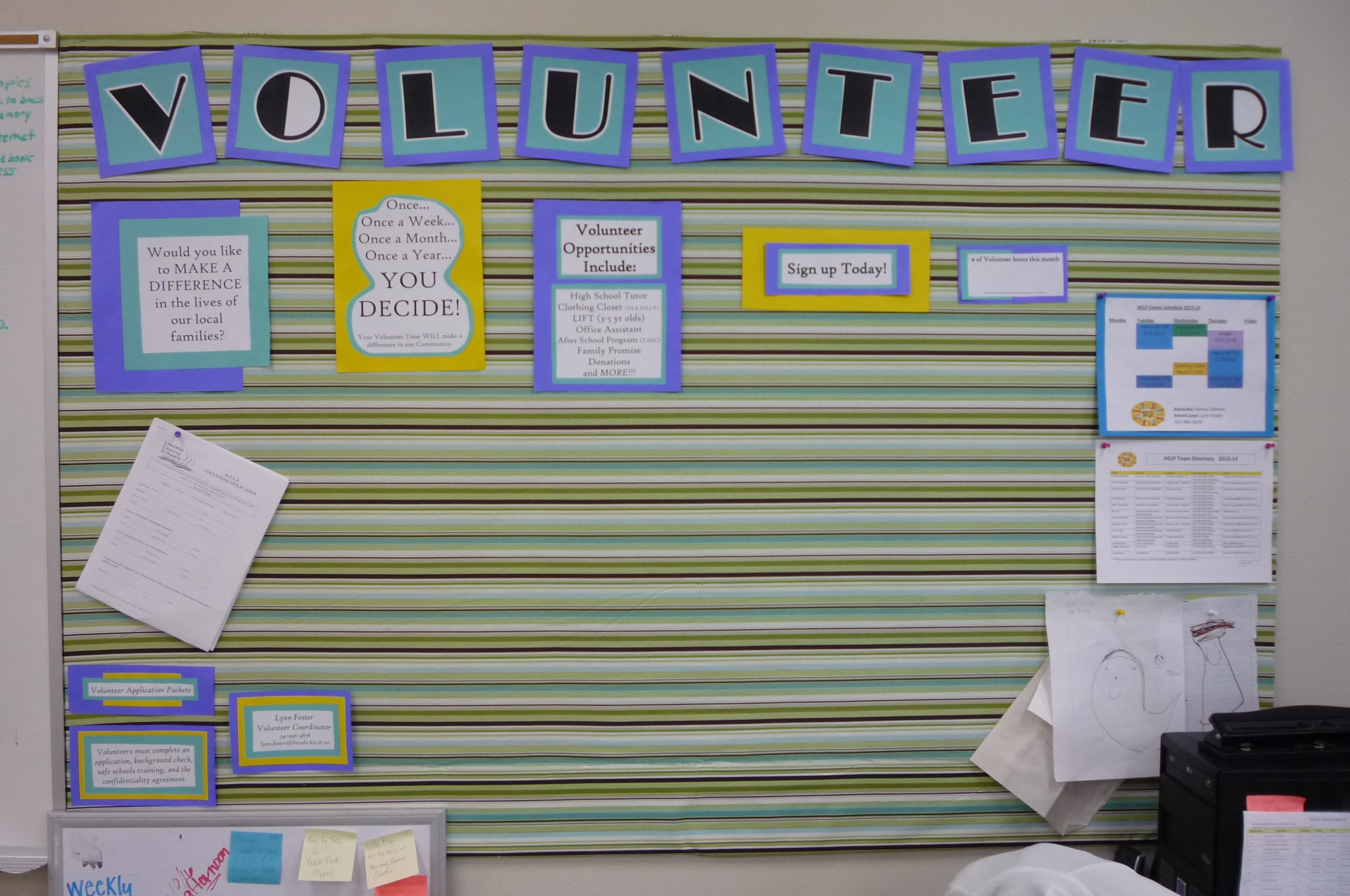
Before Photo Vol BoardI just wanted to email you some before and after photos of my bulletin board at work. This bulletin board sat empty for the first almost 2 months of my service.

It wasn’t until your presentation that I knew exactly what I needed to do. I needed to let everyone know that walks through our doors who to contact if they’d like to volunteer, how to sign up to volunteer, and what vol opportunities we have.

After Photo Vol BoardSo, I took this information and created a large volunteer board. It’s very large and it’s one of the first things people see when they walk in our doors. It’s a work in progress but I wanted to share. Thanks for sharing your time and knowledge with us! You were very inspirational and informational!!

Thanks again,

Lynn Foster, North HELP Center, Volunteer & Resource Specialist, AmeriCorps OSSC

I try. I really do.

coyote1


My Resources for Volunteers (rather than those that work with such)

The vast majority of information on my web site is for nonprofit, NGO and government-agency staff with responsibilities concerning communications or volunteer / community engagement.

But I also have some resources of my web site that are targeted at people that want to volunteer. These include:

Information for those that need to fulfill a community service obligation from a court or school/class.

Resources Especially for Teens to Find Community Service and Volunteering

How to Find Volunteering Opportunities, a resource for adults who want to volunteer.

Advice for volunteering as a group / volunteering in a group

Volunteering with Seniors

Family Volunteer – Volunteering by Families with Children

You are NOT too young to volunteer! Ways you can volunteer, no matter how young you are

Advice for Finding Volunteer Activities During the Holidays

Online Volunteering (Virtual Volunteering) – a resource especially for those that want to volunteer online.

Using Your Business Skills for Good – Volunteering Your Business Management Skills, to help people starting or running small businesses / micro enterprises, to help people building businesses in high-poverty areas, and to help people entering or re-entering the work force.

Volunteering In Pursuit of a Medical, Veterinary or Social Work degree / career

Donating Things Instead of Cash or Time (In-Kind Contributions)

Creating or Holding a Successful Community Event or Fund Raising Event.

Group Volunteering for Atheist and Secular Volunteers

Volunteering To Help After Major Disasters – a realistic guide.

How to Make a Difference Internationally/Globally/in Another Country Without Going Abroad

Ideas for Leadership Volunteering Activities
These are more than just do-it-yourself volunteering – these are ideas to create or lead a sustainable, lasting benefit to a community, recruiting others to help and to have a leadership role as a volunteer. These can also be activities for the Girl Scouts Gold Award, the Duke of Edinburgh’s Award (U.K.), a mitzvah project, or even scholarship consideration.

Reality Check: Volunteering Abroad (especially for citizens of the USA)
Times have changed drastically in the last 30 years regarding Americans and other “westerners” volunteering in other countries. The emphasis in local relief and development efforts is to empower local people, and to hire local people, whenever possible, to address their own issues, build their own capacities, and give them employment. This strategy is much more beneficial to local communities than to bring in an outside volunteer. That said — the days of international volunteers are NOT numbered: there will always be a need for international volunteers, either to fill gaps in knowledge and service in a local situation, or because a more neutral observer/contributor is required. This new page provides tips on gaining the skills and experience that are critically needed to volunteer overseas.

Ideas for Funding Your Volunteering Abroad Trip.

How to Get a Job with the United Nations or Other International Humanitarian or Development Organization

transire benefaciendo: “to travel along while doing good.”
Advice for those wanting to make their travel more than sight-seeing and shopping.

Anger motivates volunteers as much as sympathy

For years, during my workshops on volunteer engagement, I have half-jokingly said I have never volunteered out of the goodness of my heart or to be nice – because I’m not at all a nice person – and have, instead, volunteered because I’m angry about something. I have used this as a way to introduce audiences to the plethora of motivations of volunteers, to help them create better recruitment and engagement schemes.

Now, I have some science to back me up!

Someone sent me this link today: “Anger motivates volunteers as much as sympathy.”  The authors of the study are Dr. Robert Bringle and his students Ashley Hedgepath and Elizabeth Wall at Appalachian State University.  

And it’s not the first study that’s said this: Ilana Silber published “The angry gift: A neglected facet of philanthropy” in 2012. 

It’s a mistake to think that all volunteers are motivated only by kindness or selflessness. There are all sorts of motivations for volunteering. People volunteer because they:

  • like the idea of being associated with the particular organization or activity
  • want experience to put on job applications
  • want to meet people, as friends or for their social or business connections
  • think the activity looks fun
  • like the people that have invited them to volunteer, or like the people volunteering
  • are curious
  • are bored

and, yes, because they are angry about something – about how many discarded pets are at shelters or women’s lack of access to reproductive health information or domestic violence or barriers to girls in STEM-related careers or the condition of the environment and on and on.

And all of these are GREAT reasons for volunteering. Do you welcome all of these volunteers at your organization?

Also see:

Making certain volunteers feel unwelcomed because of your language

Do you welcome people with your language?

Screening Volunteers for Attitude

Mission statements for your volunteer engagement

Welcoming immigrants as volunteers at your organization

Advice for unpaid interns to sue for back pay

The outcry against unpaid internships continues. The latest is from HuffPost College:

Four Ways You Can Seek Back Pay For An Unpaid Internship

Amid its advice is this:

New York has also taken a stronger stance against internships at nonprofits. Federal rules say unpaid internships in government agencies or nonprofits are “generally permissible,” but New York (PDF) says nonprofits still must pay their interns except under limited circumstances. Namely, certain nonprofits may have unpaid interns enrolled in educational programs, as trainees receiving formal instruction, or as volunteers who do completely different tasks than paid employees. The state has an even stricter 11-part test (PDF) for internships at for-profit companies.

Nonprofits and NGOs: you need to be paying attention to this controversy. You need to be thinking about why any task at your organization that is being done by a volunteer – and that includes unpaid interns – beyond “We don’t have money to pay someone to do that.” You need a mission statement for your volunteer engagement and you need to be talking about the value of volunteers far beyond dollar/Euro or other monetary value for their hours!

My other blogs on this controversy:

Note that the links within these blogs may not work, as I moved all of my blogs from Posterous to WordPress a few months ago, and it broke all of the internal links. Also, some web pages on other organization’s sites have moved since I linked to such, and I either don’t know or haven’t been able to find a new location for the material.

How I ended up at a Philly Tech4Good event

When I get to travel for work outside of my home near Portland, Oregon, I do a search on Google and Twitter to see what people and organizations might be worthwhile to connect with while in a particular area. I look for volunteer centers, international nonprofits, nonprofit development/support centers, nonprofits focused on computers and the Internet in some way, and academics that have done research or teach regarding nonprofit management or international aid work. I write each of those organizations, departments or people and ask if we could meet, just so I can hear about their work and so I can offer any advice or resources, in an informal setting.

Sometimes, my schedule fills up quickly, and I get to meet face-to-face with people I might never get to meet otherwise. Other times, I get confused email responses from people that find this old-fashioned “networking” idea as oh-so-strange.

Last week, I went to Philadelphia to present for the Mennonite Central Committee (MCC)’s  US National Thrift Shop Conference, about trends in volunteer engagement. I also contacted a few nonprofits, university offices and government offices to see if they would like to meet. The organizers of Philly Tech Week said yes (thank you, Brian James Kirk and Corinne Warnshuis!).

Philly Tech Week featured an event on the campus of Temple University while I was in the area:  Exploring Civic Volunteering With Technology: Kickoff for Commit Service Pledge. The event was to launch the Commitpledge.com web site that asks Philadelphia-area nonprofits to post tech-related volunteering opportunities, and for volunteers to offer their expertise through the web site to help with those opportunities.

The event also featured a panel discussion by Jeff Friedman, the new Director of eGovernment Business Development at Microsoft and recently a part of the Philadelphia Mayor’s Office of New Urban Mechanics, Mayo Nissen, a New York-based designer who has been involved in urban improvement initiatives involving technology, and Anthony Pisapia, Associate Executive Director of Tech Impact, the nonprofit behind npCloud and VolunteerConnect.

The panelists talked not just about how tech helps nonprofits, but also how it helps governments better engage and support citizens – too many of tech-for-good initiatives leave out government programs, IMO, so this was great to hear.

Some good questions were asked, including:

  • How can big data help more in helping citizens?
  • How do we make products that result from hackathons sustainable?
  • How do we better address the disconnect between tech and who it should serve?

A moment I loved was when, in response to several panelist comments about how to find out what the community needs, an audience member said “Go to city council meetings!” She’s so right – nonprofits and individual citizens are being loud and clear about their needs, in government meetings, in their own meetings, on newspaper Facebook pages, on government program Facebook pages, and on and on. Quit wondering and start reading and listening!

My favorite moment, however, was when Anthony Pisapia said “Nonprofits are geniuses at innovation, but maybe not at technology.” I’ll be quoting this again and again! He’s absolutely right: nonprofits have expertise, and their staff and volunteers do amazing things with very little resources. In fact, they have as much, if not more, to teach the corporate, for-profit world as the other way around! Too many tech folks think nonprofits are incompetent or inefficient; in fact, nonprofits are some of the most innovative entities around.

There was also the inevitable questions of “What’s the difference in a social entrepreneur and a volunteer? Actually, what is a volunteer? Is our goal that, eventually, everyone gets paid for their work?” As I was an observer and outsider, I didn’t enter into that discussion during the event, but afterwards, did my best to answer the question one-on-one. That may turn into a blog…

If you will be in the Portland, Oregon area, and want to meet with me, contact me! Just tell me who you are, what your area of work is, and what you would like from me in terms of a face-to-face discussion.

I write a LOT about tech-related volunteering. Here are some of my resources:


greater good – online

I’ve become fascinated with The Greater Good Science Center at the University of California, Berkeley, a research center devoted to the scientific understanding of individual happiness, compassion, strong social bonding, and altruistic behavior.

Some of their research involves online activities, and they frequently link to studies by others:

whether or not technology makes us lonely — Highlighting three studies that “paint a surprisingly complicated picture of the role of mobile devices in our social lives—and suggest steps we can take to make the most of technology.”

Are Some Social Ties Better Than Others? — Compares online networks with offline social networks, professional friends and others, linking to research to make its point.

How Your Teen Can Thrive Online — Compares two new books look at how the Internet is affecting teens—and what adults can do to help foster a healthy online life for kids.

Can Science Make Facebook More Compassionate? — Facebook is confronting cyberbullying and online conflict. Can a team of researchers help boost kindness among the site’s 900 million users?

Three Ways to Find Happiness on Facebook — According to some interesting research, social media arguably can make us feel more connected and less lonely.

They also link to research about volunteering.

Wouldn’t it be awesome if they would have a look at The Last Virtual Volunteering Guidebook, and start doing research on virtual volunteering?

Oh, and look, they involve volunteers! I wonder if any are online volunteers…