The Impact of In-Person Usability Demos on Web Designers

“During (Knowbility’s John Slatin) AccessU, I had the opportunity to sit in on a series of assistive technology demos and witness firsthand how people with disabilities use the internet. That experience completely changed the way I looked at building a website… There is nothing like seeing the ‘a-ha’ moment from people’s faces the first time they see someone use assistive technology.”

The power of an in-person demo regarding usability of a web site from the point of view of a person with a disability is explained in this Knowbility blog by Christi Barker.

An example of the reaction of one of Barker’s students to a demo she later arranged:

“For example, as a designer, we care a lot about how things like buttons are put on websites. However, for vision-impaired people, the aesthetic or the structure of the layout does not mean the same thing to them. Sometimes, it only decreases the ability for them to stay connected with the world. That was the first time I perceived the many inconveniences in their life. Their stories are inspiring and have made me start thinking about what can I do to make a difference in their lives.”

Knowbility is a nonprofit organization with a mission is to create a more inclusive digital world for all abilities.

And remember: accessibility is a human rights issue. And if your organization claims to work towards inclusion of any kind, that should include accessibility for people with disabilities to your web site.

Accessibility: a human rights & a digital divide issue too many ignore

Pioneering in “hacks for good”: Knowbility

Knowbility’s AccessU 2019: Call for Papers

Holiday gift idea for anyone that works to make a difference

Looking for a gift for someone in your life that works with volunteers, either as a volunteer themselves or as an official manager of such? Or a gift idea for someone studying for a degree in nonprofit management? Or anyone working at a nonprofit, a non-government organization (NGO), or a government program that engages volunteers?

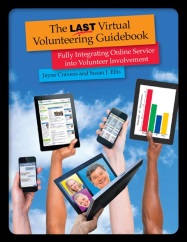
May I not-so-humbly suggest The Last Virtual Volunteering Guidebook?

The book is available for purchase in paperback or as an ebook (PDF) from Energize, Inc., the world’s largest publisher of books regarding volunteer engagement. The book is written by me and Susan Ellis, and is the result of more than 20 years of research and experience regarding virtual volunteering – also known as online micro volunteering, crowd sourcing, digital volunteering, online mentoring and on and on – yes, there are a lot of different names for the various manifestations of online service.

Did you know that virtual volunteering was a practice that was more than 20 years old? You would if you read the guidebook!

This book is for

  • both for practitioners and for academics that do research regarding volunteering.
  • both for people brand new to recruiting and supporting volunteers and for those that are veteran managers of volunteers
  • both for people brand new to virtual volunteering and for experienced managers who are looking for confirmation they are on the right track or information to help them make the case to expand their programs.

Susan and I wrote The Last Virtual Volunteering Guidebook in such a way that it would be timeless – as timeless as a book about using computers, laptops, smart phones and other networked devices could be. We didn’t want it to be out-of-date in just a few months. That’s not easy when it comes to technology, but we gave it a try – and four years later, it still reflects what works, and what doesn’t, in working with volunteers online. In fact, as I’ve said before, I use it as a reference myself – there are times I’m asked a question about working with volunteers online, or facing a dilemma regarding working with volunteers myself, and I go back to the book to see what we said – and, tada, there’s the answer!

The Last Virtual Volunteering Guidebook details the basics for getting started with involving and supporting volunteers online, but it goes much farther, offering detailed information to help organizations that are already engaged in virtual volunteering with improving and expanding their programs. It offers a lot of international perspectives as well.

The book includes:

  • Detailed advice on virtual volunteering assignment, including one-time “Byte-Sized” tasks (micro-volunteering), longer-term, higher-responsibility roles and virtual team assignments.
  • A thorough look at various practices for screening and matching volunteers to assignments, with an eye to getting the most capable volunteers into your volunteering ranks and preventing incomplete assignments or burdensome management tasks
  • How to make online volunteer roles accessible and diverse
  • More details about how to work successfully with online volunteers, so that they are successful, your organization benefits and volunteer managers aren’t overwhelmed
  • Ensuring safety – and balancing safety with program goals
  • Respecting privacy of both the organization and online volunteers themselves
  • Online mentoring
  • Blogging by, for and about volunteers
  • Online activism
  • Spontaneous online volunteers
  • Live online events with volunteers
  • The future of virtual volunteering and how to start planning for oncoming trends

There’s also a chapter just for online volunteers themselves, which organizations can also use in creating their own materials for online volunteers.

In conjunction with the guidebook, we’ve maintained the Virtual Volunteering Wiki, a free online resource and collaborative space for sharing resources regarding virtual volunteering.

Here’s why we called it the LAST guidebook and reviews of The Last Virtual Volunteering Guidebook.

The Last Virtual Volunteering Guidebook is available for purchase in paperback or as an ebook (PDF) by Energize, Inc.

If you read the book, I would so appreciate it if you could write and post a review of it on the Amazon and Barnes and Noble web sites (you can write the same review on both sites).

creating an adventure travel culture in Ghana

What is tourism for economic or community development? What does it look like? Tourism for development is when local people in regions experiencing poverty and/or high-unemployment become employed in the tourism industry, opening and operating hotels, resorts, campgrounds, outfitters, photography safaris, white water rafting and other nature-based recreational activities and accommodation. It’s also when local people are employed to maintain national parks and recreation areas. It’s probably my favorite form of economic development, whether in a “third world” or transitional country or an overlooked region of the USA, because it has so many qualities: it’s sustainable, it promotes the preservation of natural spaces, it encourages multi-cultural learning and understanding, and it promotes getting people outdoors, experiencing natural spaces, something that I enjoy and want all people, especially women, to enjoy.

That’s why stories like this excite me:

“When I was eighteen, a large group of students visited Ghana from the UK for a youth development program. It was an expensive program. It cost thousands of pounds. But I got to join for free because they needed some Ghanaians for a smattering of cultural diversity. The program was a mixture of community service and adventure. We actually came canoeing on this very lake. The whole time I was thinking about how much money was being made from our natural resources. And how much of that money was leaving Ghana. I became determined to make Ghana money out of the Ghana environment. So after graduating college, I set out to build a world-class adventure company. It’s been over five years now. We have twelve full time employees and twenty-five adventure locations. Best of all, I think we’re creating an adventure culture in the country. Our clients were 70 percent foreign when we started. Now they’re 80 percent Ghanaian. Behind me is Survival Island. It’s my latest project and biggest risk yet. I constructed a full ropes course, and one day I hope to build the world’s longest zip line. That would really put Ghana on the adventure map.”

And so Bravehearts Expeditions was born, according to an account by a person profiled Humans of New York, a Facebook page that usually profiles individuals in New York, in their own words, but sometimes goes to other countries and was recently in Ghana. Often, the results of their profiles lead to hundreds, even thousands of people donating to individuals and NGOs. This happened again with this profile of Ghanaian adventure company, which commented on their story, “Thank you immeasurable for telling our story so succinctly. In just seconds we have been overwhelmed by the messages of support and offers of professional assistance by loving readers across the world. ”

Also see:

guide to ethics in app & other tech tool development

I really love this and I would love to see this guide built into all hackathons / hacks4good, the development of apps4good, etc.:

Ethical OS Toolkit: a guide to anticipating the future of impact of today’s technology
Or: how to not regret the things you will build

I have only one disappointment with the guide, but I’ll save that for the end of the blog.

This is from the guide, and explains why this document is needed:

As technologists, it’s only natural that we spend most of our time focusing on how our tech will change the world for the better. Which is great. Everyone loves a sunny disposition. But perhaps it’s more useful, in some ways, to consider the glass half empty. What if, in addition to fantasizing about how our tech will save the world, we spent some time dreading all the ways it might, possibly, perhaps, just maybe, screw everything up? No one can predict exactly what tomorrow will bring (though somewhere in the tech world, someone is no doubt working on it). So until we get that crystal ball app, the best we can hope to do is anticipate the long-term social impact and unexpected uses of the tech we create today.

The last thing you want is to get blindsided by a future YOU helped create. The Ethical OS is here to help you see more clearly.

The guide includes:

  • A checklist of 8 risk zones to help you identify the emerging areas of risk and social harm most critical for your team to start considering now.
  • 14 scenarios to spark conversation and stretch your imagination about the long-term impacts of tech you’re building today.
  • 7 future-proofing strategies to help you take ethical action today.

The risk zones that the guide identifies are:

  • Truth, Disinformation, and Propaganda
  • Addiction & the Dopamine Economy
  • Economic & Asset Inequalities
  • Machine Ethics & Algorithmic Biases
  • Surveillance State
  • Data Control & Monetization
  • Implicit Trust & User Understanding
  • Hateful & Criminal Actors

The Ethical OS is a joint creation of the Institute for the Future and Omidyar Network’s Tech and Society Solutions Lab.

The guide has lots of discussion questions that developers can explore. It’s not so much that the questions have right or wrong answers – they are meant to spur consideration of how a new technology meant to help people could be misused, something that all too many developers DON’T think about.

The guide also has suggested questions for board members and trustees to ask themselves about tech development, so they can understand the possible risks to their organizations as a result of use of the app.

My only disappointment with the guide – and it’s a BIG disappointment – is that the section on Economic & Asset Inequalities never mentions accessibility for people with disabilities. When tech tools are not accessible for people who have sight impairments, people who have hearing impairments, people with mobility issues, etc., those tools create economic and asset inequalities. It’s really inexcusable that this wasn’t mentioned even once.

Some other blog posts regarding tech4good and work ethics:

Growing misconceptions about the role of nonprofits in the USA

In addition to sitting in on various local government meetings in the small town where I live in Oregon, I’ve been volunteering with a local unit of my state’s League of Women Voters, registering voters and sitting in on numerous candidate debates. My goal in these activities, which I’ve said before, is to compare what I’ve seen and experienced abroad working in international aid and development with what happens locally in my own community in the USA.

In doing these activities, I’ve noticed a disturbing trend that greatly affects nonprofits in terms of how the public, the private sector and government think about them, and how the public, the private sector and government feel about their funding and support for such. There is a growing chorus of elected officials and their supporters who say variations of the following:

There are enough resources in our region, via nonprofits and communities of faith – charity – for anyone who is homeless, who has an addiction or has mental issues to get the help they need. All someone needs to do to get help is to contact those organizations. 

There was a time in the USA when poverty was successfully and completely addressed by charity, usually through churches, not by government. Charity used to help all the people that were poor, and we should go back to that way of addressing poverty. 

People who have addiction issues, mental issues, homelessness issues or any issues associated with poverty just aren’t working hard enough. They lack morals or willpower and they could stop their drug use or their slide into mental illness simply by choosing to, by really trying.

These statements are not true.

The truth:

Programs that serve the homeless, whether they provide temporary housing or more permanent housing, or even just serve food, are utterly overwhelmed all across the USA and do not have enough resources to help everyone that needs it. Their waiting lists for housing assistance are months, even a few years. And providing food and temporary shelter does not prevent homelessness nor reduce the number of people who are homeless.

Before the creation of Social Security, most people in the USA supported themselves into old age by working. The 1930 census found 58 percent of men over 65 still in the workforce; in contrast, by 2002, the figure was 18 percent. Children and other relatives bore the major cost of supporting the aged. The Great Depression swept this world away: many of the elderly could no longer find work and their family could not afford to support them anymore. To get by in that time, the elderly took to panhandling, moving into dingy, unsafe almshouses or poorhouses, many run by charities or churches, or simply dying impoverished, which was the fate that befell 1 in every 2 older Americans in the years after the 1929 stock market crash.

Homelessness and poverty can be triggered by a range of issues in the USA, including divorce, medical bills/bankruptcy, income vs. housing affordability, decline in public/government assistance and mental health issues. Simply getting a different, better-paying job usually isn’t an option for someone facing homelessness and poverty.

Addiction is a chronic disease that creates a compulsion or even a physical need to use drugs. Drugs, including alcohol, affect the brain’s “reward circuit,” causing euphoria as well as flooding the brain with the chemical messenger dopamine. A properly functioning reward system doesn’t result in addiction. Whether a person is born with a disfunctional reward system or if the disfunction results entirely from drug use continues to be debated and researched; most agree that a combination of genetic, environmental and developmental factors influences risk for addiction, and the more risk factors a person has, the greater the chance that taking drugs can lead to addiction. The initial decision to take drugs is voluntary for most people and often relates to a medical issue rather than recreation, but repeated use of drugs, including alcohol, can lead to brain changes that interfere with an addicted person’s ability to resist intense urges to continue to use. As with most other chronic diseases, such as diabetes, asthma, or heart disease, treatment for drug addiction generally isn’t a cure. Addiction is treatable,  however, like other chronic diseases, such as diabetes, asthma, or heart disease, treatment for drug addiction requires professional intervention and guidance – a person can’t address the issues entirely on their own.

So, that’s the truth. But how did the misinformation happen, and how does this misinformation affect nonprofits now?

The misinformation happened not only because of the political agendas of the people saying such; it also has happened because nonprofits have done a poor job of explicitly, frequently talking about the issues they are addressing and educating the public about those issues.

If anyone believes any of these myths, then any sense of urgency regarding homelessness, addiction or poverty vanishes for potential donors, whether individuals or corporate giving programs or foundations. In addition to these myths creating the idea that nonprofits, communities of faith and “charity” can address all the needs of anyone at risk for harm in a community, these myths also create the idea that poverty happens primarily because of bad personal choices: if you’re homeless, then you just have been lazy and not bothered to contact a nonprofit that could help you. If you are addicted to opioids, it’s because you lack willpower.

I’ve been looking at the web sites of various nonprofit organizations serving my communities and various others, and, for the most part, all I see are pleas for support, for donations. What I don’t see:

  • a list, with citations, as to what causes a man, a woman or an entire family to be homeless, with profiles of clients (actual names can be changed and photos can be taken in such as way as to hide the identity of clients)
  • what activities precede a person becoming addicted to a substance, particularly opioids, with profiles of clients (again, actual names can be changed and photos can be taken in such as way as to hide the identity of clients)
  • a list of exactly what donations to a nonprofit pay for (emphasizing why paid staff is needed, rather than relying solely on volunteers helping whenever they might have some time)
  • information on the number of people the organization turns away, or puts on waiting lists, because it does not have the resources to help them, information on what activities or services the community needs but that the organization cannot provide because of a lack of resources, etc.

Nonprofits have got to be much more deliberate and direct in all of their communications about the issues they are addressing, why those issues exist, and what resources they lack. If tax cuts and tax breaks for corporations have resulted in less money for these critical services, nonprofits must say so. 

Our futures depend on it.

Sources:

Homelessness in Portland, Sept. 26, 2018, Travel Oregon

Roads before homes: Our Homeless Crisis, March 18, 2015, The Oregonian

U.S. Department of Housing and Urban Development. The 2016 Annual Homeless Assessment Report (AHAR) to Congress, November 2016

National Alliance to End Homelessness. Homelessness: A State of Emergency.Feb. 6, 2016

“A Great Calamity Has Come Upon Us”, Jan. 23, 2005, The New York Times

16 Ways People Survived Before Social Security — Could You Do It?, April 12, 2018, GoBankingRates

What causes homelessness, downloaded Nov. 2, 2018

Why Are People Homeless?, July 2009, National Coalition for the Homeless

Understanding Drug Use and Addiction, June 2018, National Institute on Drug Abuse, National Institutes of Health, U.S. Department of Health and Human Services (and see more sources at the end of this NIH article)

Also see:

Sexual harassment of humanitarian workers

I’m on a Facebook group for humanitarian workers that work in countries other than their own. It’s an invitation-only group, so I’m not going to say the name.

Over the last few weeks, women have posted about experiencing sexual harassment from co-workers and, in one case, a representative of a donor agency, and some have asked how to deal with it.

After sharing some information about her latest experience, one woman asked for specific advice:

What implication will it have to report, how will my colleagues see me after I report, my reputation is in-line, what implication will it bring to my career in this field.

The reality is that NO ONE can answer her questions, because there is no way to know unless someone else has reported before at that specific organization, with exactly the same staff, and can share what happened in their case. Every organization is different. No matter what their policies regarding sexual harassment, it is possible her colleagues will support her and it is possible they won’t. It is possible it will affect her career negatively if she reports and it is possible it won’t.

Of course, there are responses like this to accounts of sexual harassment:

I’m a man and I’m telling you to stand up for such a$$holes.

I’m not sure why men don’t understand that there are consequences for “standing up”: she could be fired for something seemingly unrelated to the harassment, her job could suddenly be eliminated, she could stop being invited to meetings and stop receiving important internal memos, isolating her to the point of being forced to quit, supervisors could share that she’s a “problem” and she could find herself without references and without a job.

Here are responses from women on the Facebook group about how they handled sexual harassment by co-workers or representatives from partner organizations or donor organizations, or what their own fears have been about reporting such:

My experience is that if you stand for yourself, you are labeled as a prude and not funny and/or the person that is so deeply offended that no future communication seems possible.

The only thing that ever worked for me was to find a male “ally” that would intervene in such a situation. Sad but true.

I had a similar situation (inappropriate comments) inside my own organisation: he was the boss of my boss. I never confronted him directly but I told my boss and my colleagues, and they never left me alone with him again.

Sometimes, responding angrily, in the moment, pisses off predators even more and they retaliate by being even more disgusting or threatening.

The problem here is the impact our decision has on our organizations or our future careers. And while most often men accused/investigated for such things are just free to go, with no consequences, women’s career or their organizations’ future is at stake. And that’s unfair. I should not be forced to chose between my dignity, my beneficiaries/colleagues and justice. I should not have to risk more than him. But it is true. And tbh, if you ask me if I chose to speak up and risk that my organization will not be able to support people in need and my colleagues will lose their jobs or my dignity, I will just shut up and smile, both while feeling extremely helpless and frustrated. Fair? Not. Probable? Very.

This is the reality of so many professional women, not just those working in humanitarian assignments abroad: it’s the reality for journalists, for professors, for doctors, for nurses, for women working in manufacturing or food service or retail.

When I was in this position myself – being harassed by a male co-worker – I reported it to the UN HR field office where I worked – and was told by the UN HR representative, “Working in the field is really difficult, and if you aren’t up for these challenges, perhaps you should leave when your contract ends, if not before.” I was stunned. I wasn’t ready to give up the job – and I felt like I would also be giving up my entire career. So, instead, I went to the local staff HR counterpart, someone who was from the country where I was working. I told him what was happening, and told him to never, ever put me in the same car with the perpetrator on field visits – to put no women in his car at all. We had a long, honest talk about it and he had my back – he made sure this guy never got opportunities to be alone with any female staff in cars. I talked to all other women in the office and we agreed to watch out for each other, to never leave anyone alone with this person. I will always be angry that that UN HR person wouldn’t support me – but I also know my career would have been completely derailed if I had officially reported the incident, and I wasn’t ready to lose my career.

This is my advice for a woman experiencing sexual harassment on the job in humanitarian work, and I hope it’s helpful to other women in other professions as well. It’s what I wish I had done:

Remember that your safety and health are most important and you need to do what is best for you.

Email the details of exactly what happened – exactly what was said, where and when – regarding the instances of sexual harassment to a trusted colleague. That doesn’t have to be a colleague at the same organization, but it does need to be someone you trust NOT to forward the email unless and if you ask them to, and will keep the email indefinitely. This will give you a written record of what happened and proof that you told someone close the actual date of what happened. In your account, focus on what was said and done. Don’t just say, “He said sexual things that made me uncomfortable” but, rather, EXACTLY what the person said. Don’t say “He touched me sexually” but, rather, “He put his hand on…” Keep a copy of this email or emails on a computer of your own as well. If you choose not to report now, but to do so later, this email/these emails will be crucial.

Think about ways to keep yourself safe while you are waiting to decide whether or not to report. For instance, do not meet alone with the perpetrator: always take someone with you. Refuse to be in a car alone with the person. If the person comes to your office, insist that the door stay open. If you think it would be helpful, tell trusted co-workers to help you in never meeting along with the person, never being next to the person in a car, etc. Don’t be surprised if, in talking with other women, you find that they have similar stories of being harassed.

I suggest you go to the person that you are supposed to report to at your organization regarding sexual harassment. This is probably someone in human resources. You may want to ask a trusted co-worker to go with you and sit quietly while you speak, to be a witness to what happens. At this meeting, tell exactly what happened, without saying the name of the perpetrator’s name but with as many details as possible. Say that you are not going to say the name of the person at this point, and say why:

I am worried about giving you further information because I worry about my career and how I will be treated if I fully disclose. I would like to know what exactly will happen when I give you the name of this person. How will you investigate? How will this be documented? What other staff members and office will know about the investigation? I am not asking if the person will be fired or reprimanded – I am asking only for how these kinds of cases proceed by office policy, so I can know whether or not I should give further details. 

If you feel comfortable proceeding based on the answers you get, proceed with full reporting and give the perpetrator’s name. If you don’t feel comfortable, say, “I don’t feel comfortable saying more because I’m not getting clear answers” or “I am going to take 24 hours to consider your answers.” No matter what happens at the meeting, you need to write an email of followup with the person you met with, copying the person who was there as a witness, saying, “Thank you for meeting with me on such-and-such date. In our meeting, we agreed that…” and then recount exactly what was said in that meeting, exactly what the answers were to the questions you asked, so that the person cannot later try to say that he or she did or didn’t say something.

Also, rehearse comments to make if the harassment happens again. You want to be able to say these clearly, with a somewhat raised voice so that anyone nearby can hear you, and rehearsing these statements can help you later, in the moment:

“What did you just say to me? Please repeat what you just said to me.”

“I don’t think this is an appropriate comment/conversation and I don’t want to hear it again.”

“That comment makes me uncomfortable and you are not to talk to me that way again.”

Then leave the space immediately, if possible. If you are next to the person in a room, move. If the person walks into a room with you and closes the door, walk over and open it, with no explanation, until someone else enters the room. If you are in a car and the security situation allows it, ask the driver to stop the car, insist if necessary, then exchange seats with a man in the vehicle: “I am going to have to exchange seats with you immediately. Thank you.”

And continue to document any inappropriate behavior or references to such.

Also see:

what aid workers can learn in their home countries to use abroad (& vice versa)

In Afghanistan, I sat in on community meetings and presentations in small towns, where local people, men and women, talked about the community’s most pressing needs and debated how to address them. There were arguments, rivalries, compromise, passion and lots and lots of discussion. Not everyone liked each other, sometimes for personal reasons, sometimes because they had different political agendas. It took forever to make decisions or get things done.

In the small town where I live in Oregon, I sit in on city council meetings, work sessions and forums, where local people, men and women talk about the community’s most pressing needs and debate how to address them. There are arguments, rivalries, compromise, passion and lots and lots of discussion. Not everyone likes each other, sometimes for personal reasons, sometimes because they have different political agendas. It takes forever to make decisions or get things done.

If you have worked overseas with the United Nations, USAID, DFID or any international aid and humanitarian agency, and you are now in your home country, I challenge you to get involved, or at least observe, locally an activity with which you were involved in a developing country. You will find that so many of the complexities, challenges and ignorance you think are typical of a developing country are, in fact, the same as your own home. And, quite frankly, many aid workers are in need of that humbling experience.

And if you want to work internationally in aid and development, I challenge you to get involved locally in efforts that are similar to what you want to do abroad. That could be an agency helping people with HIV/AIDS (and educating the community about such), a nonprofit that helps small family-run farms, a Planned Parenthood clinic, a job-training program, educating people about voting through a chapter of the League of Women Voters and on and on. I’ve written about this before: I’ve said it before, but it’s worth saying again.

Since moving back to the USA in 2009, I still sometimes deploy abroad for brief stints, but in between, one of the ways I keep my skills sharp is by taking my own aforementioned advice, volunteering with a local nonprofits doing similar work to what I’ve done in other countries, serving on a local government’s citizens commission (the one I serve on addresses public safety concerns), and attending city council meetings and work sessions whenever my schedule allows. And if I squint, I often feel like I’m back in Afghanistan. Or Ukraine. Or Egypt. Or Hungary. Or UNV headquarters in Germany.

Also see:

Updated: How Misinformation Can Derail Aid & Relief Efforts

There are lots of obstacles that can stand in the way of human, community and institutional development, aid and relief efforts, or government health initiatives, or even elections. But there is one obstacle that, until recently, rarely got discussed: widespread misunderstanding and myth-spreading.

Folklore, rumors (or rumours) and urban myths / urban legends, as well as organized misinformation campaigns and “fake news”, often interfere with relief and development activities, and government initiatives, including public health initiatives — even bringing such to a grinding halt. They also create ongoing misunderstandings among communities and cultures, prevent people from seeking help, encourage people to engage in unhealthy and even dangerous practices, cultivate mistrust of people and institutions, have even lead to mobs of people attacking someone or others for no reason other than something they heard from a friend of a friend of a friend, motivated legislators to introduce laws to address something that doesn’t exist, and influenced elections. And with the advent of social media like Twitter and Facebook, as well as just text messaging among cell phones, spreading misinformation is easier than ever.

Since 2004, I have been gathering and sharing both examples of this phenomenon, and compiling recommendations on preventing folklore, rumors and urban myths from interfering with development and aid/relief efforts and government initiatives. I do this research and entirely on my own, as a volunteer, with no funding from anyone. I update the information as my free time allows – and time has allowed such.

Once upon a time, I had wanted it to be the topic of my Master’s Degree thesis, but back in 2004, I couldn’t get an agency to go on record to tell their story. The few representatives of organizations that I talked to didn’t want to give any attention to the misinformation campaigns that were targeting them. With the advent of social media and the proliferation of misinformation, government agencies and nonprofits are scrambling to address rumors before they get out of hand – and before people are killed as a result. For instance, in 2017, in India, in the southern state of Telangana, videos were circulated among villagers that had been staged or edited in a particular way and claimed to show children being abducted by a criminal gang were circulated in more than 400 villages in the southern Indian state of Telangana via WhatsApp and an Indian messaging service called ShareChat. These videos claimed that the children were being abducted in order to harvest their organs. The claims in these videos were completely false. But because so many people believed what they saw in these videos, people stopped going out of night, several completely innocent people were attacked by mobs who accused them of being organ thieves, and at least 25 people were murdered – lynched – falsely accused of being a part of the gang. Here’s more about the consequences of such misinformation campaigns and how the situation in India was addressed.

Also see:

Scammers target those that care about soldiers, world affairs

Aid workers need to help local staff avoid scams 

You have an obligation to be truthful online

My voluntourism-related & ethics-related blogs (and how I define scam)

Knowbility’s AccessU 2019: Call for Papers

Knowbility’s John Slatin AccessU 2019: Call for Papers

Proposal submission deadline: Friday, January 24, 2019 at 11:59pm CST

Passionate about accessibility and inclusion?

Think you have a thing or two to share about accessibility?

Accidentally used the phrase “cool as an #a11y cat” in a sentence once?

Knowbility wants to hear from you!

Please complete this online form if:

– You are available to be in Austin, Texas, USA May 15-17, 2019 for AccessU
– You are a skilled practitioner in the field of web and app accessibility
– You are a great teacher
– You want to share practical skills that make the web and other online tools better for everyone
– You find it incredibly difficult to say no to fun

AccessU is the time of year where some of the most amazing instructors in this field get to roll up their sleeves, let their hair loose (here’s lookin’ at you, Denis Boudreau), and dive in as they share their expertise in a hands-on, practical training environment. In addition to valuable networking opportunities and free breakfasts/lunches each day, AccessU instructors receive a complimentary conference badge for Knowbility’s 2.5 day conference from Wednesday, May 15 to Friday, May 17, 2019.

Proposal notifications will be sent by email for each submission no later than February 10, 2019 at 11:59pm CST.

Just want to attend AccessU and soak up the knowledge? Get 2019 tickets at 2018 prices. Sale ends on December 31, 2018, or once the limited seats are gone (only 50 of each ticket type!). Ticket information and pricing at the AccessU web site.

If you have any questions, please email accessu@knowbility.org or call (512) 527-3138.

Also see:

Pioneering in “hacks for good”: Knowbility

Lessons for online outreach to nonprofits, NGOs & charities

Something New & Innovative? How about something that WORKS?

So often – TOO OFTEN – I hear nonprofits, government initiatives, NGOs, charities and other mission-based programs complaining that they aren’t getting good attendance at their events or program activities, or aren’t getting any press coverage, or don’t have enough volunteers, and so they are looking for something innovative and new in marketing.

But is something innovative and new really what they need?

In my junior year at Western Kentucky University, a million years ago, one of my professors proposed an idea to me: for one of my senior year classes, to fulfill my minor in theater, I could be in charge of marketing the Fall Children’s Theatre series, a then-annual event where three to four student-directed productions were presented, all focused on children audiences. I would get credit for a full senior-level class for such. I had also been working at the local arts center as a marketing intern outside of classes and had a wonderful mentor there who had taught me a lot about getting press coverage – combining this experience with my journalism major and newspaper experience, it was an offer I couldn’t refuse!

I was oh-so-successful at getting kids and their parents to the plays. One performance had to be delayed a few minutes because there were so many kids pouring in from an area kindergarten. We consistently sold out of intermission snacks, filling the coffers of our student theater society. Of course, I got an “A” for my efforts: my professor said they had never had so many full houses for the Fall Children’s Theater series.

Was I innovative in my approach to marketing these shows? No. All I did was the basics:

  • Sent press releases in a timely manner, with complete information, to area newspapers, and the one local TV station, in time to get into their calendar sections.
  • Sent press releases to local schools and kindergartens as early as possible.

That’s it. That’s all I did. And I sent these by mail – there was no Internet in my world back in those days. I had no budget to do anything else. All I did to be so wildly successful was the basics of marketing. And I did the basics WELL. Before my involvement, press releases were never sent, or were sent too late for information to be included in a local newspaper or on TV, or didn’t have complete information.

Before you start looking for something innovative to improve attendance at your events, increase program participants, recruit more volunteers, increase your visibility, etc., look at your current communications:

  • Is information on your web site up-to-date and complete, with answers to Who?, What?, Where?, Why? and When? right in the first paragraph of any information about events?
  • When you post about information on social media, do you make sure it includes Who?, What?, Where? and When? (you may not have enough room on Twitter for Why?)
  • Are you sending press releases and announcements to every area media outlet in your area, including newspapers, radio stations and TV stations watched in your area, in a TIMELY manner?
  • If you have a poster or brochure about the event, are the answers to Who?, What?, Where?, Why? and When? obvious and easy to find/easy to see?
  • Has your up-to-date, complete information been emailed directly to every employee, every consultant and every volunteer at your organization, in a timely manner?

There’s nothing innovative about any of that – but these steps are absolutely fundamental to successful marketing by nonprofits. And often, it’s all that’s needed.

Also see: