Category Archives: Community / Volunteer Engagement

History & Evaluation of UNV’s Early Years

Whilst trying to make a list of all of the Executive Coordinators of the United Nations Volunteers program since UNV began in 1970, to update UNV’s profile on Wikipedia, I found quite a delicious document from 1974, which provides the most detailed history of the origins of the UNV program that I have ever read – origins I don’t think most people are aware of, including most staff at UNV – as well as an evaluation of UNV’s first three years of operation.

Some things have changed quite a lot at UNV since this document was published – but some have stayed the same.

The article is The Platonic Acorn: A Case Study of the United Nations Volunteer. It’s by Robert A. Pastor who, at the time of this paper’s publication in 1974, was a graduate student at the Kennedy School of Government at Harvard University. Pastor was a former Peace Corps volunteer who went on to many high-profile international endeavors: he was a member of the National Security Council Staff during the administration of President Jimmy Carter, he was associated with various universities, and also served as a Senior Fellow at the Carter Center, where he established the programs on Latin America and the Caribbean, democracy and election-monitoring, and Chinese village elections. He died of colon cancer in 2014.

His paper about the first years of UNV was published in the journal International Organization, published by Cambridge University Press on behalf of the International Organization Foundation. This article appeared in Volume 28, Issue 3 July 1974, pp. 375-397, and it’s accessible online, for free, from JSTOR. The Abstract for his paper:

This article presents both a history and an administrative analysis of the United Nations Volunteers, an international organization established by a General Assembly resolution in December 1970. The hope that the new organization would presage a new era of multinational volunteerism has proven groundless. In seeking to explain the ineffectiveness of the UN Volunteers, I look inside the organization and find that it has little or no control over its six principal functions. This extreme decentralization of responsibility is then explained not by a static description of the institutional but by focusing on the dynamic process by which state and transnational actors exercised influence during the different stages of the organization’s establishment and development. Those actors whose autonomy was most jeopardized by a new volunteer organization were most active in defining and limiting the scope of its operations. The relative lobbying advantages of state and transnational actors meshed with bureaucratic and budgetary constraints to ensure an enfeebled organization.

Whew!

Pastor is very critical of UNV’s recruitment and placement processes in particular, as it slowed volunteer placement to a crawl. The problem was that, in the 1970s, each stage in the UNV selection process was managed by a different organization in a different location, resulting in 11 different stages between the volunteer-involving organization and the applicant. As a result, as of March 1973, UNV had filled just 93 posts from approximately 400 requests. In addition, 85 percent of volunteers were from least developed countries (LDCs). Then, it was seen as a problem, because the program was supposed to be “universal”, with a significant number of young volunteers from industrialized countries:

The organizational process also helps to explain why there is such a high percentage of volunteers from LDCs, and may help predict why this is likely to continue. Many applicants from LDCs view the UNV as a step into the UN civil service, and thus they are willing to tolerate longer delays than their counterparts in the developed world who generally view volunteer service as precisely that. The result, that LCD volunteers currently count for nearly half of all volunteers, is a bit ironic since one of the original purposes of volunteerism was to exploit the skill surplus of the developed countries.

I have no idea what the timeline is now between the creation of a UNV assignment and placement of a person into that assignment, but mentalities regarding people from developing countries as UNV has greatly changed: UNV now prides itself on a high percentage of volunteers from developed countries, the idea being that it is a reflection of south-to-south cooperation. The average age of UNVs has also increased, from people in their 20s when the program started to 38 now – a program originally designed to channel the energies of youth has become something quite different.

Another criticism by Pastor is that “Although volunteers are supposed to work directly with host country people, they find themselves working with and accountable only to foreign experts.” In the last few years, UNV has focused on its capacity to be a low-cost staffing solution for UN agencies, so this criticism could still be made – and may become a greater issue.

Pastor questions UNV’s ability at the time to fulfill specialized requests for volunteers, and suspects the level of specialization requested is much higher than what is actually necessary. He provides imaginary, outrageous examples of such requests, such as for a “French-speaking sand dune fixation expert.” He says, “Assuming that these specialists exist, the likelihood of finding one who would volunteer is negligible, while the price of the search is exorbitant.” Pastor’s paper was written more than two decades before the Internet became widely used in the USA, and then grew exponentially globally; recruitment of highly-specialized candidates for volunteering is now easy for most situations, and the number of applicants for these assignments shows an abundance of experts willing to take on such volunteering roles.

Another criticism in the document is if the UNV program was, in fact, a volunteer program because of the “high professional calibre” of volunteers – meaning the degree of expertise of the volunteers somehow makes them not really volunteers anymore. He notes that UNV “insists on selling its product as an inexpensive substitute for experts.” Since then, thankfully, the understanding of the word volunteer has changed, and it does not mean amateur, unskilled, or inexperienced. But for UNV now, in 2017, what does volunteer mean? In the USA, a person is a volunteer at a nonprofit or other mission-based organization if he or she is not paid by that agency for services rendered. In fact, the federal agency in charge of regulating labor has strict guidelines on who may be called a volunteer – and who may not. As UNVs, especially national UNVs from the same country where they are serving, receive excellent compensation, called a stipend rather than a salary, what makes them a volunteer? That I cannot answer.

Pastor’s review of UNV is a fascinating document which offers a lot of challenging questions about UNV – and some of these questions, IMO, need to be asked again.  I’m so sorry I can’t thank him for his paper, and talk with him about how UNV has evolved. I would have loved to hear what he thought of the Online Volunteering service in particular, which I think meets many of the goals originally set out for UNV but not realized.

In the course of my research, I also found the book The Role and Status of International Humanitarian Volunteers and Organization: The Rights and Duty to Humanitarian Assistance by Yves Beigbeder, ISBN 0-7923-1190-6. It was published in 1991, and from the pages available on Google, it seems to also have some scathing analysis of UNV’s performance up to that date. It’s hard to find information about the author; there’s scant information online about him, though he seems to be a prolific writer. Online, it says he served at the Nuremberg Tribunal in 1946 and had a “long career in UN organizations as a senior official.” Beigbeder’s book is hard to get hold of; it is offered online for about $100, well beyond the budgets for most folks interested in evaluating volunteer placement agencies (and beyond my own budget as well).

In the book, Beigbeder says that the UNDP Governing Council asked the UNV administrator to undertake a review of the UNV program in 1986 and in 1987. The report was a mixed bag on UNV performance at that time: it was noted that, in Yemen, “UNVs are quickly operational, less demanding in support services and more adaptive to difficult, harsh and isolated working conditions than other technical assistance staff.” But In Papua New Guinea, results were good and bad. “When UNVs have not done well, the cause was either poor project design, noninvolvement by supervisors in developing the job description, job duties imprecise or modified after the arrival of the UNV, wrong selection, or language deficiencies.” All of those can still be problems with UNV assignments – or for any international placement organization, for that matter. Addressing those problems is an ongoing issue.

Finally, my search also lead me to the self-published book Not Only a Refugee: An American UN Volunteer in the Philippines by Eleanor Grogg Stewart, about her time in the early 1980s, specifically in and around 1982, when she worked in a refugee camp. Several pages from her book are available on books.google.com. It’s detailed account of the early days of UNV, as well as trying to navigate UN bureaucracy.

It’s a shame that early accounts and evaluations of nonprofit organizations, international aid agencies, government programs and other mission-based entities are forgotten. It’s so interesting to read how much has changed, how much has improved – and how far we still have to go. How can we know if we’re making a difference if we aren’t looking at what our agencies promised in the past?

One final note: On 31 May, 2017, the Executive Board of UNDP, UNFPA and UNOPS convened in New York to discuss the findings of an independent evaluation of the United Nations Volunteers (UNV) programme and UNV’s new Strategic Framework goals and objectives for 2018-2021. Here is a press release about the meeting, which says Nina Retzlaff is the independent evaluator of the UNV Strategic Framework 2014-2017 and that she elaborated on key points and early findings from her evaluation at the New York meeting, noting that there was a high level of satisfaction from UN partners on the work of UN Volunteers and that “91% of UN partners confirm UNV responds to their needs, [and that] 92% of the UN Volunteers report a satisfactory experience.” She also said that “UNV’s programmatic niche is in Youth and Volunteer Infrastructure.” I would love to read the evaluation but, cannot find out if it’s even been finished, let alone published. It would be fascinating to read how it compares to these earlier aassessments.

Also see:

Evaluation Re: Peace Corps’ Sexual Assault Risk Reduction & Response Program

Kate Puzey was a 24-year-old Peace Corps volunteer from Cumming, Georgia, who was murdered in 2009 in the West African village of Badjoude, Benin, soon after she had reported a colleague for allegedly molesting some of the young girls they taught. The story prompted the USA television network 20/20 to do an investigative piece about women Peace Corps members who were sexually-assaulted while serving abroad, and how these women’s needs both before and after these crimes were not addressed by the Peace Corps. The media attention and public outcry lead to the Kate Puzey Peace Corps Volunteer Protection Act of 2011, legislation that provides whistleblower protection for Peace Corps volunteers, a safeguard that is was in place for federal employees but not for Peace Corps volunteers at that time, protection that would have given Kate more protection when she reported her allegations. In addition, the legislation requires the Peace Corps to develop sexual assault risk-reduction and response training and protocol in consultation with experts that complies with best practices in the sexual assault field. The training also was to be tailored to the specific countries in which volunteers serve.

Seven years after Kate’s death, and six years after the legislation named for her, the Final Evaluation Report: The Peace Corps’ Sexual Assault Risk Reduction and Response Program (IG-17-01-E) was released by the USA Office of Inspector General on November 28, 2016. I missed it at its release, and just stumbled upon it online a few weeks ago.

The evaluation found that Peace Corps largely complied with the requirements in the Kate Puzey Act and that, compared to an evaluation in 2013, the Peace Corps markedly improved how it supported volunteers who had reported a sexual assault. However, the inspector general also found individual cases where the Peace Corps did not meet its standard to respond effectively and compassionately to victims of sexual assault, including a few instances of victim blaming and improperly sharing confidential details with staff. “Some applicants were either not aware of the crime and risks previous Volunteers had faced in their country of service or they did not understand the information that was provided to them.” From the executive summary:

We found that the Peace Corps had developed its sexual assault training in accordance with the
Kate Puzey Act requirements: it incorporated available best practices, it consulted with experts in
the sexual assault field, and it involved the Office of Victim Advocacy in the training design
process.

However, we found that some Volunteers had not learned important information in the sexual
assault risk reduction and response sessions, including the difference between restricted and
standard reporting, the services available to a victim of a sexual assault, how to report a sexual
assault incident, and the identity and role of Sexual Assault Response Liaisons at post. The
training was insufficiently tailored to the country of service (as required by the Act), was not
responsive to the needs of diverse Volunteers, and did not address the problem of sexual
harassment. In addition, some staff delivered the training inconsistently due to poor training
skills. Furthermore, the Peace Corps’ approach to assessing the Volunteer training was
incomplete and did not provide a useful measure of training effectiveness.

You can read the full report here. Whether your nonprofit or government agency is international or entirely local, whether your paid or volunteer staff work in various sites or all under one roof, you should read this report and think about how your agency is, or isn’t, equipped to ensure the safety of employees, consultants, volunteers and clients, and ways to improve.

Peace Corps volunteers who are the victim of a crime have access to professional victim advocates 24 hours a day at 202.409.2704 or victimadvocate@peacecorps.gov. The Peace Corps provides an around the clock, anonymous sexual assault hotline accessible to volunteers by phone, text, or online chat that is staffed by external crisis counselors at pcsaveshelpline.org. Call from outside the USA: 001.408.844.HELP (4357). From within the USA: 408.844.HELP (4357). Read more from the Peace Corps regarding its Sexual Assault Risk Reduction and Response (SARRR) efforts.

Also see:

Resources re: labor laws and volunteering

graphic by Jayne Cravens representing volunteersLabor laws regarding volunteering vary from country to country. For instance, in the USA, creating a written contract or memorandum of understanding with a volunteer, ensuring there is an agreement on what is expected of a volunteer, is normal and entirely legal, but in the United Kingdom, such can make the volunteer a paid employee, and due for financial compensation.

How should you determine who is a volunteer and who should be paid for the hours they work at your organization, no matter what country you are in?

There are terrific resources on the US Department of Labor web site regarding volunteerism that can help any nonprofit or charity, in any country, think about both why it involves volunteers and how it should talk about the value of volunteerism, as well as the qualities of a well-run volunteering program. Although it’s USA-centric and cites USA law, much of what it proposes regarding volunteerism is based in ethics as much as law.

For instance, there’s this detailed response by DOL staff to someone asking if the time employees spend on volunteer activities outside their employer’s worksite or on activities outside their regular work are compensable working time. For instance, “Does the employer have a duty to compensate non-exempt employees for the time they spend volunteering on a Habitat for Humanity project outside of normal working hours?” Any corporation that organizes volunteering activities for its employees needs to read this document carefully.

Employees volunteering outside of their jobs, at the direction of their employer, is further explored in this response from the DOL, which talks about nurses being asked to volunteer their time, unpaid, to participate in community service activities, such as taking blood pressure at a health fair, teaching child care classes to expectant parents, participating in “career day” at a local school, helping the Red Cross, or helping with the hospital picnic. Other activities in question involve employee attendance at patient care conferences, task force meetings, and committee meetings on their days off or outside regular working hours.

Also see:

Fact Sheet #71: Internship Programs Under The Fair Labor Standards Act

Whether an incentive based pay plan at a company, which includes civic and charitable volunteer activities, complies with the minimum wage and overtime provisions of the Fair Labor Standards Act (FLSA).

Both of these are USA-centric as well but, again, the advice is terrific for other countries as well. Of course, you should still check to see what your country’s laws are regarding volunteers, including interns or anyone to whom you aren’t paying at least a legal minimum wage.

In addition, there’s also this Safety and Health Checklist for Voluntary and Community-Based Organizations Engaged in Disaster Recovery Demolition and Construction Activities. This detailed document emphasizes the importance of such organizations promoting the health and safety of their work teams, including volunteers, and provides a checklist outlining some of the hazards frequently encountered during disaster response and recovery operations and what the organization should have in place to support and protect volunteers, including what training volunteer work teams should have. This checklist is great no matter what country you are in.

Having a mission statement for your organization’s volunteer engagement can protect you from over-zealous staff members, consultants and corporate funders who want to push for volunteers to replace paid staff and save money, or to increase volunteer engagement in areas of the nonprofits work that would be inappropriate. It also could help protect you against lawsuits from volunteers who feel they were merely unpaid workers. The US Department of Labor (DOL) and US Federal Courts want to see that the work of volunteers is distinctly different from the duties of the organization’s employees – and their guidelines on how they make the determination regarding who is a volunteer and who should be paid are good guidelines for volunteering other countries as well. To determine whether an individual is truly volunteering, the DOL and US Federal Courts look to:

  • The nature of the entity receiving the volunteer services
  • The character of the volunteer services (activities) themselves
  • The amount of control the employer or engaging organization exerts over the volunteer
  • Compensation or benefits provided to the volunteer, or that the individual expects
  • Whether the volunteer work displaces paid work by regular employees

You can read more from the DOL here.

Also see Is Your Volunteer Really an Employee? The Answer Might Surprise You [Part 1] and Is Your Volunteer Really an Employee? The Answer Might Surprise You [Part 2].

If these links ever stop working, cut and paste the URL of any one of them into archive.org, and you should be able to access an archived version of the document.

Learn more about how to talk about the value of volunteers.


Medical Voluntourism Can Cause Serious Harm

In a recent blog hosted by the Scientific American, Noelle Sullivan, a member of the faculty in global health studies at Northwestern University, says her research shows that some people volunteering abroad for a few weeks, or several weeks, to engage in medical “help” for people in developing countries “does indeed cause harm. In fact, the international volunteer placement industry opens the door to potentially disastrous outcomes.”

Empirical data about the medical voluntourism industry is sparse, but Sullivan does have solid data: “I’ve studied medical volunteering in Tanzania since 2011, including over 1,600 hours observing volunteer-patient interactions across six health facilities. I have spoken with more than 200 foreign volunteers in Tanzania, plus conducted formal interviews with 48 foreign volunteers and 90 hosting health professionals.

She notes a variety of voluntourism web sites that invite volunteers with little or no medical training to do invasive procedures abroad, including providing vaccines, pulling teeth, providing male circumcisions, suturing and delivering babies. “Most volunteers I’ve observed deliver at least one baby, despite being unlicensed to do so.”

Her examples in the article are stunning: in Tanzania in 2015, her team encountered a young woman that’s called Mary in her article:

Mary routinely delivered babies unassisted by local midwives because she appeared familiar with the procedure—a skill she said she learned in 2013 on a previous volunteer stint.

Mary violated obstetrics best practices, doing unnecessary episiotomies (cutting the skin between the vaginal opening and anus to make room for the baby’s head) and pulling breech babies (babies positioned bottom instead of head-first in the birth canal). Once routine in obstetrics, current guidelines restrict episiotomy to exceptional cases because they may cause permanent problems for the mother, including incontinence. Meanwhile, pulling breech babies can cause suffocation.

After Mary’s departure, we learned she was not a medical student at all; she was an undergraduate student, unaware of the risks in what she was doing. 

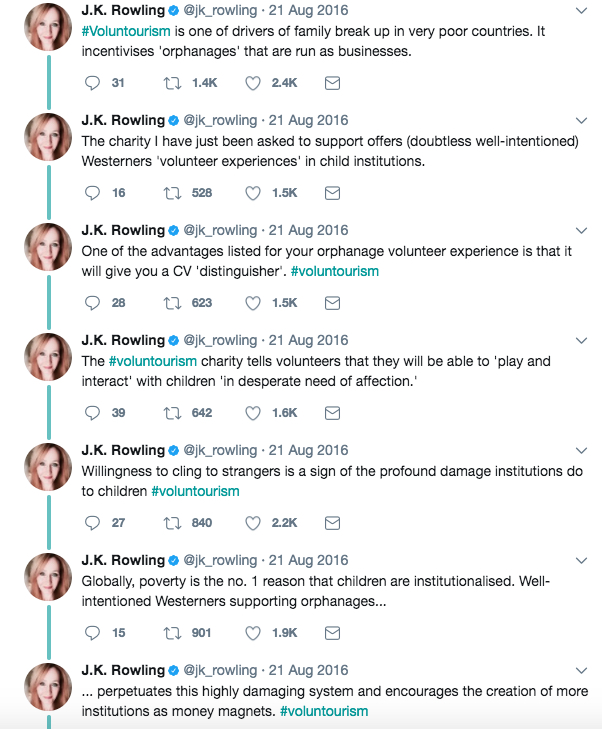
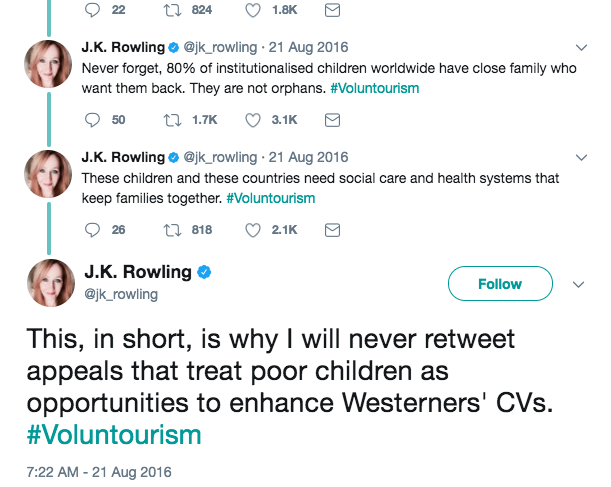
Voluntourism – where volunteers pay large amounts of money to go abroad for a few weeks, or even several weeks, to engage in a short-term activity that will give them a sense of helping people, animals or the environment – is a growing industry. I look at most of it with great skepticism in terms of actually helping anyone, because it’s focused on the wants of the volunteer – that feel-good, often highly photogenic experience – not the critical local needs of local people or the environment, and there’s little screening of volunteers – most everyone is taken, so long as they can pay. What these foreigners bring through these voluntourism programs is often not skills, experience or capabilities that cannot be found locally – it’s money.

The End Humanitarian Douchery campaign takes a much stronger stand against voluntourism in any form than I do, drawing attention to the negative consequences such can have for local communities in particular. The campaign organizers offer tips on “how to find a program that will have a truly POSITIVE impact on the host community.” Likewise, ‘Looks good on your CV’: The sociology of voluntourism recruitment in higher education, an academic paper by Colleen McGloin of the University of Wollongong, Australia and Nichole Georgeou, of Australian Catholic University, says that “voluntourism reinforces the dominant paradigm that the poor of developing countries require the help of affluent westerners to induce development. And this article is advice from someone who paid to volunteer abroad – and realized she shouldn’t be. All are worth reading, no matter where you stand on the issue of voluntourism or volunteering abroad.

I do think there are some effective short-term pay-to-volunteer abroad programs, among them Bpeace and Humanist Service Corps. But both of these programs are driven by what local people want, and they do NOT take just any volunteer that can pay.

This is my reality check regarding volunteering abroad, which reviews all the different types of programs. It links to many articles that discuss the dangers of voluntourism programs to local people, and to volunteers themselves, and to quality advice on how to make a real difference abroad.

July 17, 2017 updateCharities and voluntourism fuelling ‘orphanage crisis’ in Haiti, says NGO. At least 30,000 children live in privately-run orphanages in Haiti, but an estimated 80% of the children living in these facilities are not actually orphaned: they have one or more living parent, and almost all have other relatives, according to the Haitian government.

Also see “More harm than good? The questionable ethics of medical volunteering and international student placements” by Irmgard Bauer in Tropical Diseases, Travel Medicine and Vaccines, volume 3, Article number: 5 (2017)

April 11, 2018 update: Goats and Soda, a program on National Public Radio about news in the developing world, has an editorial about medical tourism. “Doctors and medical students are flocking to programs where they spend a couple of weeks to months volunteering in what’s called a ‘low-resource’ country. In these places, medical expertise and technology may lag behind richer nations. And sometimes their eagerness to help can have unintended negative consequences.” The official name of such programs is the “short-term clinical experience in global health” — which goes by the clunky acronym of STEGH. These overseas volunteers can end up doing harm: Perhaps a doctor performs a surgery, then goes home. The patient develops complications, and there’s no local health-care worker who can help them. Or maybe the visiting medical professionals offer free care that takes business away from local docs. Medical students might want to try a surgery they wouldn’t be able to do in the U.S. because they haven’t had enough training. Medications that are provided for these docs may be past their expiration date. And students sometimes are oblivious to local customs — say, that women dress modestly or a physician should not touch a patient of the opposite sex. Dr. Lawrence Loh, adjunct professor at the University of Toronto’s Dalla Lana School of Public Health, has researched and published widely over the past decade on the ethics of short-term volunteering abroad. he notes in the article:  “Medical missions, if not conducted with the local community, represent another form of cultural colonialism.” Regarding the problem of trainees overstepping their skill set, he notes, “The golden rule is if you can’t do it in North America, you probably can’t do it over there.” He stresses the importance of having faculty overseeing medical student volunteers. “We need to get away from the idea of parachuting into communities without consulting with local hospitals and clinicians.” The American College of Physicians has issued a position paper on “ethical obligations” for these medical volunteers, both doctors and students. Published in the Annals of Internal Medicine, the paper has been widely praised — but critics have also raised one major concern — no one from the developing world was part of the committee preparing the guidelines. Read the entire editorial about medical tourism here.

November 2019 update: Just found this resource – a 2014 paper, Medical voluntourism in Honduras: ‘Helping’ the poor? by Sharon McLennan of Massey University in New Zealand. It’s based on qualitative research with medical voluntourists in Honduras. The research found that while ostensibly helpful, volunteer tourism in Honduras is often harmful, entrenching paternalism and inequitable relationships; and that many voluntourists are ignorant of the underlying power and privilege issues inherent in voluntourism.” While there are examples of volunteer tourism as both educational and as a form of social action, the paper argues that these are not natural consequences of voluntourism but must be nurtured. As such this paper highlights some implications for practice, noting that addressing the paternalism inherent in much medical voluntourism requires an honest appraisal of the benefits and harm of voluntourism by sending and host organisations, education and consciousness-raising amongst volunteers, and long-term relationship building.

Also see:

Treat volunteers like employees? Great idea, awful idea

graphic by Jayne Cravens representing volunteersBack in 2009, the Volunteer Centre South Derbyshire, in England, featured one of my posts from UKVPMs (a discussion group for volunteer managers in the United Kingdom) on its blog in response to an article that says treating volunteers like employees is a great idea. I’m flattered that they thought my thoughts so worthy!

Here was the situation that I commented on:

In this commentary in the Guardian, the writer talks about a volunteer DJ at a small Christian radio project in South Manchester, England, who was fired when staff became aware that he is gay. The writer’s conclusion is that the employment laws need to apply to volunteers in order to protect them from being fired for no good reason.

Here was my response from UKVPMs (edited a bit for clarity):

On the one hand, I don’t believe in requiring volunteers to do things that staff are not required to do: background checks should be for everyone, not just the volunteers. The anti-discrimination policy of the organization applies to everyone, not just paid staff. Neither paid staff nor volunteer staff should be exploited or mistreated or neglected.

But on the other hand, I also come from the point of view that:

  • volunteering with a nonprofit is a privilege, not a right. I involve volunteers so long as it explicitly benefits the mission of the organization, and if forced to choose, my loyalty would be to the mission of the organization and those it serves rather than to a volunteer.
  • volunteers are human beings and should absolutely be expected to be treated as such, however, they are NOT employees, and therefore are not entitled by law to any of the same legal benefits of an employee.
  • volunteers are managed by a volunteer coordinator, rather than a human resources director, because volunteers are NOT employees.

So I read this article with a lot of empathy and sympathy, but then cringed at “Volunteers should be protected against unfair dismissal.” Legally protected? If so, legally protected how?

The primary consequence of an employee being unfairly dismissed is that he or she loses income. There are other consequences, but loss of income is the primary consequence, and we all know that income is necessary for survival. The laws that protect employees from being unfairly dismissed aren’t designed to do anything other than to prevent an employee from losing income and to restore an unfairly-treated employee’s lost income; the laws aren’t designed to restore anyone’s dignity or honor.

What would be the legal redress of a volunteer wronged? If a volunteer is granted the ability to sue regarding dismissal, what will the compensation be if whatever deciding body sides with the volunteer? Will he or she receive money? If so, say goodbye to volunteer involvement at probably most organizations; they aren’t going to risk that kind of financial expenditure. Reinstatement? The organization will be forced to involve the volunteer in his or her previous role? Does that volunteer then become untouchable, meaning the organization will have to keep the kinds of files, including regular evaluations, on volunteers that they maintain for staff in order to justify the disciplining, the requirement for training or the firing of a volunteer?

I guess in summary: I don’t ever want any volunteer dismissed for arbitrary reasons, I don’t ever want any volunteer mistreated or exploited, and I want us all to work to make sure that never happens, but I also don’t want volunteers to become employees, for a variety of reasons that I hope I’ve made clear (not sure I have).

And so I don’t really know what the answer is…

And I still don’t.

UK House of Lords Select Committee on Charities

graphic by Jayne Cravens representing volunteersThe United Kingdom’s House of Lords Select Committee on Charities was appointed on 25 May 2016 “to consider issues related to sustaining the charity sector and the challenges of charity governance.” The committee has issued a report, Stronger charities for a stronger society (HL Paper 133).

There are some good points in the report. For instance, the committee recommends that government funding of charities be “based on impact and social value rather than simply on the lowest cost.” The committee also encourages government “to recognise the added benefits of charities’ involvement in service delivery, and urge local authorities to consider grant programmes wherever possible.” And the committee also highlighted a great observation about risk aversion in mission-based organizations:

371. We also heard that risk aversion and a lack of organisational flexibility were a problem. NAVCA said that “charities need to be bolder, and boards need a greater appetite for risk, if the sector is to adapt and deliver greater impact in a changing world.” Rebecca Bunce from the Small Charities Coalition highlighted the consequences that resulted from trustees not understanding digital technology sufficiently.

372. Helen Milner said that trustees who were risk averse on digital tools were approaching the issue from the wrong starting point: “If they are saying, ‘Digital feels like a risk’, they are asking themselves the wrong question. They should be saying, ‘What is our strategy? Where do we want to be in three years’ time? How are we going to get there? Do we want to help more people and how are we going to reach them?’ Digital ought then, naturally, to become part of that solution.”

I really, really love that observation. Expect to see it quoted frequently by me in the future.

But, for the most part, the report is full of observations that should have been made 20 years ago – and were made 20 years ago by various consultants and nonprofits, myself included. I’m glad that a government body is realizing that “We are living through a time of profound economic, social and technological change and the environment in which charities are working is altering dramatically,” as the report says. But that’s a statement that could be said in the 1990s, when public access to the Internet exploded.

The report also never mentions virtual volunteering by name or concept, and that’s incredibly disappointing; virtual volunteering is a practice that is more than 30 years old. When this report talks about “digital technologies” being used by charities, it’s only to build awareness, not to support and engage volunteers. Meanwhile, on an online discussion group I’m on for managers of volunteers, the discussion last week was about the best platforms for training volunteers online. What a shame that the authors of this report are so out-of-touch regarding nonprofit, NGO and charity use of online technologies to engage and support volunteers.

The report also sees volunteers only in terms of economic value:

“The charity sector relies heavily on volunteers and many charities told us that they could not do their work without them. 372 The Association of Volunteer Managers suggested that the economic benefit of volunteering could exceed £50 billion a year, 373 while other witnesses highlighted the value of volunteers in community cohesion.”

Do I have to say yet again that this talk of the economic benefits of volunteer hours are why so many labor unions and others are turning against volunteer engagement? Do I have to say yet again that no volunteer says, “I really want to volunteer so I can save money by not being paid!” It’s true: deriding the monetary value of volunteer hours is now my mission in life

Also see:

Initiatives opposed to some or all volunteering (unpaid work)
& online & print articles about or addressing controversies regarding volunteers replacing paid staff

Involving volunteers: a cop out for paying staff?

More on the UK’s Big Society

Criticism Continues for UK Government Talk Re Volunteers

Changes in working with volunteers: scary & energizing

logoAlmost 20 years ago, I co-presented at the national conference in Orlando by the Corporation for National Service. The presentation was regarding the emerging senior volunteer — the Baby Boomer. I was the representative from Generation X, another presenter was a Boomer himself, and the other presenter was of the then current senior age group. We thought it was a rather benign but important topic. We certainly had fun putting together our presentation via phone and email (we were in different parts of the USA and had never met face-to-face until the day of the presentation).

The day of the presentation came, and we had a full room waiting to hear us. Our presentation began, with much energy: we talked about how the emerging senior volunteer — the Baby Boomer — wanted to volunteer their professional skills, not just stuff envelopes. How they were willing to commit a lot of hours provided it came with a high-level of responsibility. How they weren’t interested in giving unselfishly as much as wanting to have a real impact and feel like, as a result of their volunteering, they had made a real difference. How this was a great opportunity for volunteering programs…. right?

We were all but booed out of the room.

The workshop attendees, who worked exclusively with senior volunteers, primarily from the “Greatest Generation,” did not hide their venom for our message, and about 15 minutes into our talk, we knew we were in trouble. Amid sighs and folded arms and scowls, attendees started raising their hands to comment and express their obvious frustration. They called these emerging senior volunteers “selfish” and “lazy,” even “un-American.” The characterizations would have never been said about an ethnic group, but it was open season on Boomers. One said, “I’m not changing, and if they don’t like it, they can go somewhere else.” Another said, “I would rather our current volunteers die off and our organization close than work with these people.” One added, to me, directly, in front of the whole group, “You don’t want to know what I think of your generation.”

It was, by far, the angriest, most hostile group I’ve ever addressed.

The only comfort was after the presentation was over, after most of the attendees had stormed out of the room: a woman came up to us in tears — literally crying — and shook all of our hands, saying “I’ve tried to say the same thing, and they were like this to me too.”

More than 10 years later, I shared most of the above via a blog because of an article in the Associated Press that confirmed all that we said at that presentation. The article said boomer volunteers “are increasingly seeking to use their professional skills as volunteers, eschewing office and administrative tasks and seeking roles in marketing, publicity, fund raising, and management.” You can see the article by going to archive.org and looking for this URL:
www.nytimes.com/aponline/2010/03/04/business/AP-US-Retirement-Today-Volunteering.html

I’m reviving that blog, saved from a long-defunct platform, because I still think about this incident every time I get in front of a group or have a discussion about trends in volunteer management. In that previous blog, I also wrote:

  • I wonder what ever happened to all those very, very angry volunteer managers, who I don’t think hated boomer volunteers as much as they hated change. Did they quit their jobs? Did they begrudgingly change? Were they fired?
  • I’ve never worked with these “traditional” volunteers the AP article and others talk about, volunteers happy to do any mundane administrative tasks without question, who do whatever they are told without comment. I’ve been working with volunteers for many years, and they have always wanted something worthwhile through their service beyond just work to do.
  • I bet someone writes almost exactly this same story in five years in a major newspaper or wire service, implying it’s a “new trend.”

Of course, since that presentation, the management of volunteers has changed even more radically. I talked about this in May 2006 on my web site. And let’s be clear: innovations regarding management of volunteers aren’t really about technology. The innovation is using technology so that it is:

giving volunteers a bigger voice in what they do at an organization (and, in the end, actually giving them lots more to do, and even more responsibility, which they like very, very much), on engaging in activities that exude transparency and openness in all aspects of decision-making and management, and on being immediately responsive to volunteers’ and other supporters’ thoughts, suggestions and criticisms — and how not doing so isn’t because of a lack of resources but, rather, misdirected priorities and lack of transparency. Tiny nonprofit organizations with very little staff are doing extraordinary things with volunteers, and making the volunteers feel included and energized, not with pins and t-shirts but through greater and more meaningful involvement — and this movement is being fueled by inclusive uses of technology.

It makes for another big challenge to many people who are expected to successfully engage volunteers, but it’s also a big opportunity to raise the profile of volunteer managers within organizations. It makes volunteer management a lot more interesting.

Are you ready? Scared? Angry? Let’s hear from you in the comments below.

Also see:

If you have benefited from this blog or other parts of my web site or my YouTube videos and would like to support the time that went into researching information, developing material, preparing articles, updating pages, etc. (I receive no funding for this work), here is how you can help

Short-term deployments with Peace Corps & UNV

From February 2001 to February 2005, I worked at the headquarters of United Nations Volunteers, in Bonn, Germany. Sometimes, people outside the UN would say, upon learning where I worked, “Oh, you’re just a volunteer?”

My UNV colleagues would get this comment too, and would visibly bristle at the idea that anyone would think they were a volunteer!  They would quickly assure the person that they were not merely a volunteer – they were, in fact, a fully-paid staff person with a UNDP contract!

By contrast, here’s how I would answer such a comment:

Oh, no, I’m not a UN Volunteer. I don’t think I’m qualified to be a UN Volunteer. I would probably be turned away if I applied. International UN Volunteers are experts in their professional field, highly skilled and experienced. I’m just an employee at headquarters, and my role is to support UN volunteers out in the field, doing amazing things.

A UNV HQ colleague was with me once when I said that, and her eyes became huge when she heard my response. Later, she told me she’d never thought of UN Volunteers the way I had talked about them, and that it had never dawned her that, in fact, maybe she wasn’t qualified to be a UN Volunteer either.

I know of two UNV HQ staff, both my colleagues and dear friends, who decided to apply to become international UN Volunteers themselves, were accepted into the UNV roster, and were deployed for two years to a developing country. Both of these colleagues worked in ICT. After those in-the-field experiences, they went on to be employees at other UN agencies, and I thought it was a shame UNV hadn’t worked hard to entice them back to HQ, as they would have brought a much-needed perspective to headquarters.

As I was leaving UNV HQ, where I managed the UN Online Volunteering service and helped manage the United Nations Information Technology Services (UNITeS), I decided to apply as an international UNV myself. I decided that maybe I had acquired the qualifications at last to be a UNV. I was delighted when I was accepted into the UNV roster – the UNV staff that decided which applications to accept were in Cyprus, I had no personal relationship with them at all, and there was no policy (and still isn’t) on automatically accepting UNDP staff as UN Volunteers. I was available only for six-month assignments, however, and those were, and are, few and far between. I interviewed for two such assignments – and didn’t get either. Which should just go to show you how competitive the process to be a UNV is. I eventually got a six-month UNDP gig in Afghanistan, but it was as a consultant, not a UN Volunteer.

Now, at this time in my life, I can no longer do a full six-month assignment, so I doubt I’ll ever deploy as a UNV. When you read about me going to abroad for a UN gig now, it’s for less than four months – like in Ukraine – and, again, it’s as a UNDP contractor (which I love – great colleagues, fascinating work and the pay is good).

But there is this part of me that still really wants to go abroad as a volunteer.

So, for more than two years, I’ve been watching listings at the Peace Corps Response web site. This is a program by the Peace Corps that places highly-skilled volunteers in short-term assignments abroad, from four to 12 months. It’s open to US citizens. I’ve been looking for an appropriate four-month gig and, at long last, I’ve applied for a position. I think it fits my expertise perfectly. But I also know that this is a highly-competitive program, and I may not even make the interview round. Still, it was fascinating to go through part of the Peace Corps application process. I’ve also been a reference for a friend that applied for the regular Peace Corps, so I’ve seen that part of the online process as well.

Fingers crossed!

One last note: the Peace Corps Response program, the entire Peace Corps program, and all United States Agency for International Development (USAID), are under threat of severe cuts by the current Presidential administration in the USA, as well as by current Congressional leadership. I encourage you to write your US Congressional Representative, your US Senators, national media and your local media, and let them know what you think of these proposed cuts.

April 20, 2018 update: Here is a blog by Jasmin Blessing, a UN Volunteer with UN Women in Ecuador. It is a really nice example of what effective volunteering abroad looks like.

Also see:


What effective short-term international volunteering looks like

I’m not kind when it comes to discussions of pay-to-serve international volunteering. Most programs out there are voluntourism, focused on an unskilled volunteer paying to have a feel-good experience abroad, doing an activity that would be oh-so-much more effective by local people being paid to do it themselves, and spending just a few weeks somewhere – not at all enough time to make a sustainable, positive impact on local people or the environment. Voluntourism is primarily about the volunteer, not the people in the developing country, who would prefer to be paid to build a school for their children themselves, care for the community’s orphans themselves, help take care of local wildlife themselves, protect their own environment, etc.

That said, not all pay-to-serve programs are purely voluntourism: there are some terrific programs that require volunteers to pay their own way, such as Bpeace traveling business mentors and Humanist Service Corps (more on pay-to-serve programs I think are worthwhile here). There are also examples like this: students from the College of Engineering at Oregon State University going to Kenya to help a small village create a series of water projects to give them sustainable, ongoing access to clean water; the local Kenyan people benefitted from the project because they defined what they wanted, and they worked alongside the students so that they could take on more and more responsibilities themselves.

In contrast to pay-to-serve programs, there is the Peace Corps Response program, which is part of the Peace Corps, and that places highly-skilled volunteers in short-term assignments abroad, from four to 12 months. Participants do NOT pay to participate. It’s open to US citizens, and it represents what effective short-term international volunteering can look like: volunteering that’s focused on building the capacity of local people rather than just doing things for them.

In doing some research on the program, I found this terrific blog by Brenna Mickey, who did a four-month assignment in the Peace Corps Response program in Port Vila, Vanuatu, and whose experience represents what a short-term, effective volunteering experience can look like. It’s also a great example of what a tech-related volunteering gig can look like anywhere, at home or abroad. Her specific job title was web design and development consultant for the Ministry of Youth and Sports. Among other things, she worked

  • “as the project manager or product owner, creating a scope of work and requirements documents after meeting with stakeholders of the website, managing expectations and deliverables.”
  • “as an UX strategist, working with the department in the Ministry through card sorting, developing a site map together, sketching out wireframes and talking through user flows on our website.”
  • “not only as the designer of the site, but the developer as well. I taught myself a new content management system and dove in headfirst to writing responsive CSS and HTML5 instead of handing over my designs and CSS to the developers.”
  • “But most importantly, I worked as a teacher, making sure knowledge was transferred to my coworkers in Vanuatu during the web design process, including how to update the CMS after I left.”

Also, “I happened to be in town during another Peace Corps Volunteer’s project, which had been under development for more than two years. The SMART Sistas ICT Camp for Girls was a week-long camp where girls were brought to the capital and taught the fundamentals of informational technology. I was asked to teach an Intro to Web Design course during this camp.”

Please note that Peace Corps Response initiative, and the entire Peace Corps program, and all United States Agency for International Development (USAID), are under threat of severe budget cuts by the current Presidential administration in the USA, as well as by current Congressional leadership. I encourage you to write your US Congressional Representative, your US Senators, national media and your local media, and let them know what you think of these proposed cuts.

Also see:

Requirements to volunteer are getting out of hand

graphic by Jayne Cravens representing volunteersThere are requirements in some school districts for students to perform a certain number of volunteering hours with nonprofit organizations. And courts across the USA often sentence law breakers to work unpaid – to volunteer – a certain number of hours with nonprofit organizations.

I’ve not been opposed to these requirements, though I do feel that schools and courts need to sit down with nonprofits and talk about the costs of such volunteer engagement for nonprofits. Organizations are not sitting around saying, “Gee, we’ve got all this work to do, I wish some people would come do it for free.” Volunteers are not free: they must be screened, supervised and supported. Tasks must be created for volunteers, and nonprofits have NO obligation to accept every person that says they want to volunteer. If you want nonprofits to involve more high school students or court-assigned volunteers, you are going to have to fund these nonprofits so that they have the resources to do that.

Now, I’m reading about governors and state legislators in the USA wanting to require even more people to volunteer.

For instance, as of January 2016, more than 17,000 food stamp recipients in eight Kentucky counties had to begin part-time work, education or volunteer activities to keep their benefits. Childcare is not provided for these food stamp recipients for their part-time work, education activities or volunteering time.

In addition, Kentucky Governor Matt Bevin wants to require unemployed Medicaid members to volunteer in order to receive those benefits.

Danielle Clore, executive director of the Kentucky Nonprofit Network, had a lot to say to Bevin’s office when it asked the group to support his proposal:

The bottom line is this will cost nonprofits money – money and resources we don’t have to spare. It takes professionals to effectively manage volunteers. For the experience to be valuable for both the agency and the individual, volunteer efforts have to be managed. Is it worth the limited and precious resources of a nonprofit to manage a volunteer that is there because ‘they have to be,’ not because they want to be? Nonprofit employees are spread so thin as it is and I feel like a volunteer requirement for anyone not truly committed to the mission of the agency isn’t an effective use of anyone’s time.

I do not typically take people who are ‘required’ to volunteer, because they don’t make good volunteers. Also, 20 hours is A LOT OF TIME. We don’t allow people to volunteer that many hours because at that point they could be considered a part time employee employee, and you have potential legal issues to consider.

Emily Beauregard, executive director of Kentucky Voices for Health, told Kentucky Health News in an interview, “We need to provide them with the support services that they need, but forcing people to volunteer in order to get health care doesn’t make anybody healthier. We know this. There are data to suggest that. In fact, sometimes these stringent requirements put people in a position where they are unable to get care and then they get sick, and they are unable to work.”

I have nothing to add to Ms. Clore and Ms. Beauregard’s comments – they are RIGHT ON.
Pennsylvania, Florida and North Carolina also now have these requirements people receiving food stamps must volunteer with a community service provider for a certain number of hours.

Here’s another example, and it may be even worse: in the proposed budget by Ohio Governor John Kasich, House Bill 49, he stealthily includes a line item requiring all licensed educators in Ohio to complete an unpaid internship with a local business or chamber of commerce as a condition of license renewal. As written, this requirement would extend to all educators — including teachers, principals, superintendents, and other school administrators — licensed by the Ohio Department of Education. This shameful proposal is wonderfully skewered in this editorial by Sue Grodek. Kasich is insulting teachers, who must already complete vast numbers of hours of classroom time and teacher training, by requiring them to be free labor for business-focused organizations, implying that teachers lack “real world” experience. It’s absolutely outrageous!

There’s no question that these requirement for volunteering from certain groups is now out-of-control. If you want to require any group to volunteer, you had better sit down, face-to-face, with leaders of organizations that involve volunteers, and work really hard to get their buy-in. You had better be able to say why it is to the organizations’ benefit to involve these people – and you had better not say it will save them money, because it will NOT. In fact, you had better have money to offer to cover the substantial costs of asking them to increase the number of volunteers they involve. And most of all, you better have data showing that this type of required volunteering is needed by the volunteers themselves. 

Nonprofits: if you aren’t worried about this now, then wake up. You have every right to write your state and national legislators, as well as local media, and tell them NO. It’s never been more important for your organization to create a mission statement just for your volunteer involvement. Otherwise, you can expect not only increased expenses as you take on more volunteers you didn’t recruit yourself, but also an even bigger backlash against all volunteering.

Will the various associations of directors of volunteers in agencies (DOVIAs) and associations of managers of volunteers and what not take a public stand on this issue? I’m not holding my breath. But kudos to the Kentucky Nonprofit Network and the Nonprofit Association of Oregon and others for taking a strong public stand against political moves that will damage nonprofits and their clients.

Also see: