Category Archives: Community / Volunteer Engagement

Diagnosing the causes of volunteer recruitment problems

graphic by Jayne Cravens representing volunteersI see it and hear it over and over: comments from nonprofits or churches or schools saying they are having trouble recruiting volunteers.

Before you hire a consultant, even me, to see what the problem is regarding why you don’t have enough volunteers, you might be able to diagnosis the problem yourself. The only catch is that you MUST be honest as you answer these questions. Also, answering these questions is rarely a one-person exercise; you may think you know the answer, but you need to ask other staff members, including volunteers themselves, what their answers are to these assessment questions. Don’t be surprised if your receptionist or a volunteer gives you a very different answer to any of these questions than you yourself would give.

Questions to diagnose your volunteer recruitment problems:

  • Is it easy to know just from looking at your web site what volunteers do, the different roles, the time commitment, the training requirements, and how to sign up?
  • Is there an OBVIOUS link from your home page to information for potential volunteers, a link as obvious as your donation link?
  • When someone calls or emails about volunteering, or submits an application, does that person get an immediate reply regarding next steps? In fact, do they get info at all, or does someone take their name and say someone will get back to them and then, most of the time, no one ever does? Often, when I’ve been asked to assess a volunteer recruitment at a school, THIS is where the problem lies: plenty of people are calling to volunteer, but they never get the response they need to get started, or the response comes months later, when they are no longer interested or available.
  • Are your next steps for volunteering with your organization something that the volunteer can get started on in a few days? In several weeks? In a few months? The further away the next step, the more likely the volunteer candidate won’t follow through.
  • Are your volunteering opportunities listed at the most popular third party volunteering sites for your area? For instance, where I live, the most popular volunteer recruitment sites are VolunteerMatch and HandsOn Portland. Go to Google or Bing and type in volunteer and the name of your city and see what comes up. Also see these tips for Using Third Party Web Sites Like VolunteerMatch to Recruit Volunteers.
  • Do you need to alter the volunteer role so that a volunteer would get more out of it, in terms of training, career-development, university class credit, or personal fulfillment? Is there anything you can do to make the role more fun?
  • Can the people you are trying to recruit as volunteers afford to volunteer – to work for free? Do they have childcare responsibilities that are preventing them from helping? Could you offer childcare? Could you pay for parking or mass transit, provide lunch for volunteers, or do anything at all to ease their financial burden?
  • Could you make the service time commitment less for volunteers? Could you try to recruit more volunteers for shorter shifts, for instance, instead of fewer volunteers for longer shifts?
  • Do you have a myriad of opportunities available for volunteers, like Short-term Assignments for Tech VolunteersOne-Time, Short-Term Group Volunteering Activities, and virtual volunteering?
  • Does the task you are asking volunteers to do seem especially intimidating or daunting? Could you make it less so, by reducing the time commitment the volunteer would have to make, or by guaranteeing that there is a seasoned volunteer or employee always with the new volunteer? Or by taking away the tasks in the role that are the most intimidating and giving them to paid staff? Or by better-assuring candidates that they will be fully trained before they are put into potentially challenging situations?
  • Are you asking too much from volunteers in terms of a time commitment, training and the responsibilities they will undertake as unpaid staff? Do you need to convert such roles into paid positions, in order to better attract the people that can make the time and emotional commitment to the role?

A terrific, easy exercise that can be really helpful in diagnosing your volunteer recruitment problems is to create a flow chart mapping your volunteer engagement, or a series of maps for different parts of the volunteer management process — the volunteer in-take process, the volunteer assignment development and matching process, the volunteer support assignment, etc. You could do charts for each of these processes, and then show how they all intersect. You can do a map on what you do, and don’t do, now, and then alter it to show how it SHOULD be. A dry erase white board with markers is best, better than any computer app:

Here’s one example of what a volunteer in-take flow chart could look like as a result of your mapping exercise (every organization is different):

Let’s be clear: people WANT to volunteer, including the much-derided millennials. Just go to Quora or Reddit and see how many people, mostly from that generation, are posting questions about how to find volunteering. And people are hungry to connect: in this age of always-online, there are so many, many people looking to connect in a meaningful way offline. Your obstacle to recruiting volunteers isn’t that people don’t want to volunteer; it’s that people that want to volunteer can’t easily find your information, or your volunteer roles don’t fit their interests or schedules. What worked to recruit volunteers 30 years ago doesn’t work now; if you are having trouble recruiting volunteers, it’s overdue for you to take a hard, in-depth look at both how you recruit, what your in-take process is like, and the volunteer opportunities you have available.

Also see:

An incredible volunteer recruitment success story in Texas

graphic by Jayne Cravens representing volunteersI have been training regarding volunteer management topics since the late 1990s. A frequently asked question I have gotten in my trainings is, “How do I get more black American men to sign up as volunteers with our program?” This question has come from a variety of nonprofits and schools. When I started training in the 1990s, I had zero ideas – I could not answer this question. I have had a lot of black American women in my audiences, but not men, especially when I was based in Texas, so I decided to ask some of them what their thoughts were in answer to the question. Two said the same thing to me on two different occasions: “I have no idea. When you find out, let me know.” I gathered ideas over the years, but never had the opportunity to put my own ideas into practice.

I did not, and I do not, for a second, believe any particular ethnic group is less inclined to volunteer. I do believe that different groups help their communities in different ways, and a lot of unpaid help to communities isn’t called volunteering – black men in the USA are giving back, but the ways they volunteer often go unrecognized. I also believe different groups face various obstacles to traditional, time-intensive volunteering: conflicting work schedules, family care needs, lack of transportation, lack of information about volunteering and language barriers. When I say lack of information, what I mean is that the volunteer recruitment message via one particular channel often does not reach everyone you want to reach. For instance, if I put volunteer recruitment messages only in the local newspaper, the majority of the community, which does NOT read the local paper, will never see it. If I put the messages only on Facebook, it’s unlikely teenagers will ever see it. When I say language barriers, I don’t always mean people for whom English is not their first language; I mean that certain words don’t mean the same to absolutely everyone. Volunteer doesn’t mean the same thing to everyone. Community service doesn’t mean the same to everyone. Mentor doesn’t always mean the same thing to everyone. So in constructing a message, you have to think about who you are talking to and what words might appeal to them.

With all of that in mind, the recent success of a middle school in Dallas, Texas in recruiting black American men to be mentors in their school has been inspiring and enlightening to me:

According to this web site, 68.4% of the student population at Billy Earl Dade Middle in Dallas identify as African-American – drastically different from that of a “typical: school in Texas which is made up of 12.6% African-American students on average. To qualify for free lunch, children’s family income must be under $15,171 in 2015 (below 130% of the poverty line), and 85.5% of students at Dade Middle School receive free lunch. To qualify for reduced lunch, children’s family income must be below $21,590 annual income in 2015 (185% of the poverty line). 3% of students at Billy Earl Dade Middle receive reduced lunch. As of 2016, the percent of students at this school who pass the State of Texas Assessments of Academic Readiness (STAAR) across all subjects was significantly lower than average for Texas. In short, the student body at Billy Earl Dade Middle School was largely “at risk.”

Parent involvement in a child’s early education is consistently found to be positively associated with a child’s academic performance (Hara & Burke, 1998Hill & Craft, 2003Marcon, 1999Stevenson & Baker, 1987). A 2002 report from the Southwest Educational Development Laboratory, A New Wave of Evidence, found that students with parents involved in their schools and their school work, no matter their income or background, are more likely to:

  • Earn higher grades and test scores, and enroll in higher-level programs
  • Be promoted, pass their classes and earn credits
  • Attend school regularly
  • Have better social skills, show improved behavior and adapt well to school
  • Graduate and go on to post-secondary education

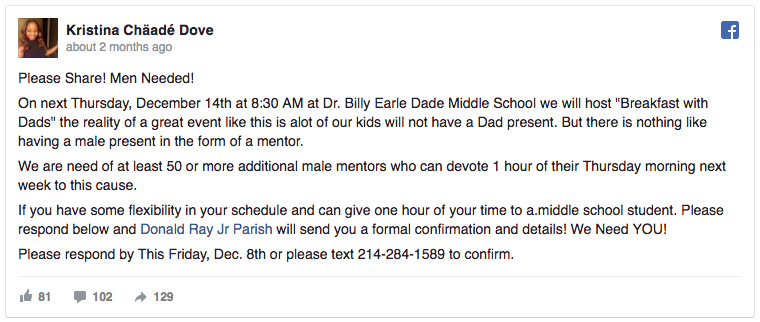
In December 2017, Billy Earl Dade Middle School ran into some difficulty when planning its annual “Breakfast with Dads” event. The school’s community liaison, Ellyn Favors, told the school’s Site Based Decision Making Team that student participation had been low in the past due to young men not having a father/father-figure available to attend the event. Kristina Dove, a community member on the team, decided to post a call for volunteers on Facebook in the hope of finding 50 male mentors to accompany the middle schoolers at the event:

This post was shared by several of her friends, including Stephanie Drenka, a popular blogger and photographer. The post was shared and reshared over and over, more than 125 times by the day of the event. They needed 150 men to sign up. More than 600 men showed up for the event. The event had to be moved from the cafeteria into the gymnasium because of the response. The event was so successful, so powerful, that it was covered by national media and online stories were shared over and over on social media. 

Why was this volunteer recruitment so successful? Based on all that I’ve read:

  • It was a simple way to get involved: just one hour of commitment at the school, with no requirement for anything else.
  • Why their attendance was so important was boiled down to simple, inspiring wording – easy to understand and oh-so-inviting to be a part of.
  • It was so simple to sign up.
  • It was oh-so-simple to share this message, and apparently, everyone on the team did so, to start.
  • The team had strong, trusting connections with key members of the community, so when they shared that message on social media, it reached those key members – who amplified it even more.

Had any one of those bullet points been missing from this equation, I’m not sure the recruitment would have been as successful.

What will happen now?

  • I hope the names and contact info of everyone who signed up is in an excel spreadsheet or database program, for easy reference.
  • I hope a variety of volunteering opportunities are created to entice these men to continue to be involved and accommodate their schedules, opportunities that range from more just-show-up episodic volunteering to more one-on-one, higher responsibility opportunities (and these will, of course, require more training and screening).
  • I hope the school is revisiting its safety policies and ensuring those are being followed.
  • I hope things are being put into place right now so that, in six months and a year from now, all of these activities can be evaluated, and successes can be bragged about and attract much-needed funding for the school so those successes can be amplified.

Congrats to Dade Middle School for getting it right. I’ll aspire to do the same.

Also see:

Have you enabled a Larry Nassar?

Dr. Larry Nassar sexually molested more than 160 young girls. He didn’t drive around in a van and kidnap girls he didn’t know on their way to or from school. He didn’t jump out from behind a tree and grab a girl and run. He wasn’t a stranger to the girls he harmed, nor to their families. Coaches brought girls to Larry Nassar. Parents drove their girls to appointments with him. University officials and Olympic team officials created and supported the environment where Nassar was allowed to do this.

Does that scare you? Good. It should.

Rachael Denhollander, one of the first women to come forward with public accusations against Dr. Nassar, was the last to speak at his sentencing hearing. Her comments are worth noting: “Larry is the most dangerous type of abuser. One who is capable of manipulating his victims through coldly calculated grooming methodologies, presenting the most wholesome and caring external persona as a deliberate means to ensure a steady stream of young children to assault.”

Back in 2011, I wrote a blog called Why don’t they tell? Would they at your org?. It is about how, over the years, more than one person observed Jerry Sandusky, head of the nonprofit organization The Second Mile and former Penn State defensive coordinator, molesting boys, or heard someone say that they had witnessed such. Yet none of those people called the police and none of the people in authority that they told about what had been seen called police. The blog was about how we create environments where, not because of policies but because of culture, we discourage people from asking tough questions or reporting something that has the potential to be profoundly disruptive to everything an organization, a program, or a campaign is trying to do. It’s how, in so many cultures, we are discouraged from even asking questions. The #meetoo movement has confirmed so much of what I said in this blog back in 2011.

graphic by Jayne Cravens representing volunteersIn that blog, I challenged nonprofits, non-governmental agencies, universities, government departments and other mission-based programs – and particularly aid agencies with staff members in the field! – to take a hard look at not just their policies, but their culture. and I asked: Are you never hearing about inappropriate behavior by employees or volunteers at your organization not because nothing is happening, but because people don’t feel comfortable saying anything?

Per this latest case of harm to children, here’s some additional, more practical advice for parents and anyone working with kids in any capacity (coach, church group leader, etc.):

Any adult demanding or frequently asking for one-on-one, unsupervised time with a young person is something to look closely at and ask questions about, no matter that adult’s degree, job, religion or familial relationship. Whether it’s a doctor, a priest, a rabbi, an Iman, a teacher, a coach, a choir teacher, an uncle, an aunt, whatever: think about that one-on-one time, why it’s necessary, if it’s really necessary, if it’s appropriate, and how it makes you or your young person feel. Never let fears of how your questions might be perceived or that you might make someone uncomfortable keep you from asking questions. It’s perfectly reasonable and appropriate to say, before your kid goes on a school trip or sporting event, “Will any of these kids ever be alone, one-on-one, with an adult and, if so, what would the circumstances be?” As a parent, remember that you have EVERY right to say to any person in charge, to any adult in a program, even to a doctor, that you would prefer that one-on-one time not happen. This isn’t about parenting or managing from a place of fear and suspicion; it’s about parenting or managing from a place of “I’m watching and I care.”

One-on-one time between an adult and a child or teen is usually a wonderful, positive thing, something to be encouraged and cultivated in many circumstances. It would be a sadder world without one-on-one time between adults and children. But one-on-one time between an adult and a teen or child shouldn’t happen just because of someone’s title, and shouldn’t happen without questions. Ask questions. Decide your comfort level. Listen to kids – and watch them, because often, their behavior will tell you very quickly that there is a problem.

Also see:

Voluntourism is fighting back

I have voluntourism in my Google Alerts, so that I can get links to press releases, news articles that mention the term. I’m not fond of voluntourism, where volunteers pay large amounts of money to go abroad for a few weeks, or even several weeks, to engage in a short-term activity that will give them a sense of helping people, animals or the environment. I look at this growing industry with great skepticism in terms of actually helping anyone, because it’s focused on the wants of the volunteer – that feel-good, often highly photogenic experience – not the critical local needs of local people or the environment, and there’s little screening of volunteers – most everyone is taken, so long as they can pay. What these foreigners bring through these voluntourism programs is often not skills, experience or capabilities that cannot be found locally – it’s money, and I see no evidence that this money benefits local people – maybe the people that run the program are “helped”, but not those meant to be helped by the volunteers. I don’t think all pay-to-volunteer schemes are horrid, and I don’t think creating a vacation that has a social or environmental “good” goal (transire benefaciendo) is a bad thing, but I think there are a tremendous number of voluntourism programs out there that aren’t really benefitting communities in the developing world – and some are actually causing harm. I push back to questions about and posts prompting voluntourism on Quora and Reddit, and I’ve been pleased to see more and more people doing the same. That push-back must be working, because now I’m also seeing a lot of voluntourism companies aggressively fighting back on the blogosphere, asserting that their programs are worthwhile (but never offering hard data to prove it).

I’ve been happy to see the tide turning against many forms of voluntourism as people realize that work abroad should make local people the number one priority, not the feel-good experience for a foreign volunteer. For instance, Australian NGOs are refusing to place volunteers in orphanages abroad, because of the exploitation of children, potential harm to children, and lack of any data showing such voluntourism helps children at all.

The UK’s International Citizen Service (ICS), which has placed thousands of young people in volunteer roles around the world, is now under scrutiny: Voluntary Service Overseas (VSO) has taken action against ICS and other members of the UK consortium of organizations providing volunteering opportunities over safety concerns. The UK’s Department for International Development (DFID), according to a report by VSO, regarded ICS as a “high-risk programme due to the security and safety issues” involved.  “ICS safeguarding incidents have included death by drowning of two volunteers, sexual assaults, and the detention of volunteers by local police.” Volunteers live and work in countries where they may be exposed to petty and violent crime, political instability, endemic diseases and natural disasters.

There’s even a growing backlash against medical voluntourism, per reporting by Noelle Sullivan, a member of the faculty in global health studies at Northwestern University, who says her research shows that some people volunteering abroad for a few weeks, or several weeks, to engage in medical “help” for people in developing countries “does indeed cause harm.

It must be taking its toll, because I got a link to a press release about how a certain African “foundation” has hired a PR agency “to change the public perception of medical volunteering or voluntourism.” I’m not going to link to the press release – no free publicity here for a for-profit marketing company. But I had a look at the “foundation”‘s web site. The site is mostly about the gorgeous “luxury” accommodations for volunteers on a game reserve, whcih has an onsite gym, an infinity pool, a private patio “for stargazing,” and nearby opportunities for hiking, mountain biking, golfing, weight training, yoga, abseiling, white river rafting, tubing, kloofing, microlighting, helicopter rides, “and hot air ballooning!” The company can hook volunteers up with wildlife photography tours and photography courses, half day trips to an animal rehabilitation center “featured on National Geographic,” and visits for “pampering yourself at the local spas.” I’m surprised there aren’t workshops provided on how to take the perfect “Look how I’m helping these poor people” selfies… Oh, there is a page or two about the medical services volunteers will squeeze into their busy schedule enjoying all that hiking and hot air ballooning.

Update: a blog from 2015, where animal “help” becomes animal “torture”

“The ‘turtle conservation program’ was shut down after the police came (there is a law in Fiji to protect turtles as they are threatened by extinction). A girl made a… ehh… Let’s say critical Facebook post. I think ‘inhuman’ and ‘animal torture’ were some of the words she used… I’m just glad that I got my money back without any problem because I know about 7 people who had to go to court to get some of their money back because the agencies made a lot of great promises without keeping them. What they offer is not really volunteer work, here they call it voluntourism. A lot of money which doesn’t actually help anybody but just finances the international agencies. I got quite disillusioned about volunteering here. I left the volunteer house as soon as possible and went to a resort. The turtles were set free, but they are probably dead because they have been in the tank for too long and weren’t able to survive anymore. I’m so sorry for them.”

Also see:

Governor Bevin & Donald Trump Are Wrong on Community Service Requirements

logoRemember at the start of the year when I warned that 2018 is the time for USA nonprofits to be demanding?

Well, here we go.

Kentucky Governor Matt Bevin and Donald Trump, as well as governors all over the USA, want to require unemployed Medicaid members to volunteer with nonprofit organizations – or, probably, Christian churches – in order to receive those benefits.

This idea was first floated back in Spring 2017. At that time, Danielle Clore, executive director of the Kentucky Nonprofit Network, had a lot to say to Bevin’s office when it asked the group to support his proposal:

The bottom line is this will cost nonprofits money – money and resources we don’t have to spare. It takes professionals to effectively manage volunteers. For the experience to be valuable for both the agency and the individual, volunteer efforts have to be managed. Is it worth the limited and precious resources of a nonprofit to manage a volunteer that is there because ‘they have to be,’ not because they want to be? Nonprofit employees are spread so thin as it is and I feel like a volunteer requirement for anyone not truly committed to the mission of the agency isn’t an effective use of anyone’s time.

I do not typically take people who are ‘required’ to volunteer, because they don’t make good volunteers. Also, 20 hours is A LOT OF TIME. We don’t allow people to volunteer that many hours because at that point they could be considered a part time employee employee, and you have potential legal issues to consider.

Emily Beauregard, executive director of Kentucky Voices for Health, told Kentucky Health News in an interview at that time, “We need to provide them with the support services that they need, but forcing people to volunteer in order to get health care doesn’t make anybody healthier. We know this. There are data to suggest that. In fact, sometimes these stringent requirements put people in a position where they are unable to get care and then they get sick, and they are unable to work.”

I’ve blogged about all this before, in April 2017, when I said that requirements to volunteer are getting out of hand. And I’m calling on all nonprofit centers, all consultants regarding nonprofit management, including volunteer management, and everyone claiming to be advocates for volunteerism to speak out about this.

Here here’s my Facebook post about how I feel:

Nonprofits are not sitting around saying, “I wish several thousand people were forced to volunteer and they would then show up at our offices to do all this work we have just laying around waiting to be done by just any ole’ person that comes through the door.” Bevin and Trump are expecting nonprofits to involve several thousand more people as volunteers – people who are being forced into the act – but without funding all of the increased costs nonprofits are going to have to create more assignments and supervise these people. Nonprofits, don’t do it. Just DON’T. Not without a great deal more money.

Let’s see your statement.

Also see:

Learning From The ‘Not-So-Nice’ Volunteers

graphic by Jayne Cravens representing volunteersI am trying to find and revive some of the most popular articles and commentaries I’ve written over the years that were hosted on other people’s web sites, many of which are now only available on archive.org, and then only if you can remember the URL of the defunct site.

In 2004, I was invited by Mary Merrill to write a column for her December Topic of the Month. My topic was:

Learning From The ‘Not-So-Nice’ Volunteers

The premise: we have a lot to learn from the “not-so-nice volunteers”, the people who are putting their time and energy into defending human rights, addressing social ills, and battling institutions who they feel are attacking their quality of life or an element of their community that they treasure. And we have a lot to learn from the people who manage such volunteers.

I’ve reposted that article on my own site.


More than helping: wanting to make a difference

One of the most common questions on Quora and the Community Service section of Yahoo is regarding what kind of volunteering is “best.” Given the number of these type of questions from teens and 20-somethings on these platforms, I don’t buy the line about millennials not caring about society, not caring about others, etc. They wouldn’t keep asking questions about volunteering if they didn’t care about something more than themselves. But the number of questions, always about what kind of volunteering they should do, which one is “best”, etc., also shows that a lot of people are lost when it comes to knowing what is a meaningful volunteering opportunity and what would be most worthwhile to them.

Too many initiatives have focused on promoting volunteering without giving realistic guidance on how to find volunteering opportunities – not just how to use a database that lists volunteering opportunities, but how to choose which task or role would be best for someone.

I put assistance to people and communities into two categories:

  1. relief/aid/comfort/charity, such as giving food, providing emergency shelter, providing emergency medical aid, chopping wood for people that heat their homes with such in winter, singing for sick kids to cheer them up, making blankets for children in cancer wards, collecting food for a food bank, etc.
  2. development, such as educating people about HIV/AIDS, educating people about organic farming, providing preventative medical care, educating people about the importance of spaying and neutering pets, creating a community garden that provides food, educates about food production and builds community, etc..

Activities in category number one usually don’t change anything long-term. They usually don’t create a widespread or sustainable change — it helps just in an immediate moment. Not that that’s bad – sometimes, often, that’s exactly what’s needed, such as providing a cold weather shelter on a freezing night, or food for an area decimated by a natural disaster.

Activities under the second category are focused on changing things long-term. The activities are meant to change people’s behavior or how people think about something or to help people to not need emergency aid anymore. These are the activities that, I admit, I am MUCH more interested in personally and professionally.

One kind of assistance isn’t necessarily better than the other. Some situations call for approach #1, and some call for approach #2. Also, activities that seem to be short-term charity can actually contribute to longer-term development and transformations. For instance, say you have a program that helps youth explore leadership activities, better understand their community, work together better, reduce conflict with other young people, etc. So you organize charitable activities for the youth, like participating in a Habitat for Humanity build, or cleaning up a beach, or serving food at a homeless shelter. All of those activities are charitable activities that provide immediate, but not lasting, aid – yet, those activities can contribute to long-term changes / transformations for the youth involved.

Several years ago, because of these frequently asked questions from young people about volunteering, particularly Girl Scouts looking for Gold Award ideas, I made a list of Ideas for Leadership Volunteering. It grows regularly as I come across articles about young people making a difference through their own, self-initiated volunteering activities. It’s focused mostly on that second category of community assistance. If you are a young person looking to make a long-lasting impact on your community through volunteering, this is a good place to start. In fact, I have used this list with women in developing countries who are looking for avenues to cultivate their own community leadership skills.

I also have a list of ways for young people to find community service and volunteering.

Other resources I have for people who want to volunteer:

If humans can do it, so can volunteers (who are, BTW, also humans)

graphic by Jayne Cravens representing volunteersWhen should you involve humans in the care and support of vulnerable populations, like children, people with disabilities, women who have been victims of domestic violence, etc., or in high-risk situations, like working with wildlife or fighting fires?

Most people would say humans are essential to all of those scenarios – that care and support cannot be provided in those situations without humans, that emergency response cannot be provided by humans, that addressing the needs of wildlife adversely affected by humans cannot be done without humans. And I would agree. I bet you would too. What’s the alternative – robots? Not yet, robots… not yet…

But what do humans need in order to be able to provide appropriate care and support in those high-responsibility, even high-risk, situations, and to stay safe themselves? Humans need:

  • to be appropriately screened and vetted, with inappropriate humans turned away and appropriate humans brought into the program
  • specific training for these situations – and, perhaps, ongoing training
  • regular, appropriate supervision
  • regular, quality support

You would agree with all of that, right?

Now change the word humans in the aforementioned text the word volunteers. Suddenly, the conversation changes.

Volunteers aren’t appropriate!

Volunteers could endanger the clients!

Volunteers will harm the wildlife!

What’s different? Just one thing: when we were talking about humans before, you were immediately thinking of paid staff. Now that I change the word to volunteers, we’re talking about unpaid staff, and many automatically assume that means untrained, unsupervised people who work whenever they might maybe find some time.

Volunteers mean just one thing: people who aren’t paid a wage, that aren’t given financial compensation for their service hours. That’s it! Volunteers do NOT have to mean untrained, unvetted people, just anyone off the street who says, “I have a good heart! I want to help!”

No one who has not been appropriately vetted, no one who lacks the necessary training, no one who cannot be appropriately supervised and no one who is not regularly supported should be doing any work with vulnerable populations or with wildlife, paid or not. A paycheck has nothing to do with a person’s appropriateness to undertake a role at a nonprofit, NGO, charity, etc.

So, with that said, when should a nonprofit, NGO, charity, school or other mission-based organization involve a paid person instead of an unpaid person? Susan Ellis of Energize says it best, in her book, From the Top Down: The Executive Role in Volunteer Program Success:

Offering a salary gives the agency a pre-determined number of work hours per week, the right to dictate the employee’s work schedule, a certain amount of control over the nature and priorities of the work to be done, and continuity. When you pay a salary, you can require that the person give your organization forty hours a week or whatever number is necessary. Because most people need to earn a living, people can rarely give one agency that much volunteer time per week… (pages 12 – 13).

And, to be fair, people DESERVE to earn a living. I’m looking at you, United Nations agencies that have six-month unpaid internships – volunteer gigs that only well-off young people can undertake…

Volunteers can do high-responsibility, even high-risk activities, and they can fill expert roles. In fact, they actually DO all of these things already, all over the USA and all over the world. What the vast majority volunteers usually cannot do is provide 40 hours a week of service, even 20 hours a week, to an organization, week-after-week – they can’t afford it! Many roles at a nonprofit, non-governmental organization or charity require a person to staff a role full-time, or even part-time, 20 hours a week, week after week – and that means, to keep that role staffed at all times, the agency must pay someone. Many roles at nonprofits, NGOs, charities, schools, etc., require someone to have a great deal of training and experience in order to do the role that needs to be done, and most people that have the training and experience necessary for such roles have such because it is related to their career, their paid work, and they got the certification or degree(s) necessary for such for their paid work.

I don’t believe in involving volunteers to save money – I believe an organization should create volunteering opportunities primarily because they believe a volunteer would be the best person for that particular role, just as an organization reserves certain roles specifically for paid staff, and you make those decisions based on a myriad of criteria. I also believe that one needs to tread carefully when asking an economically challenged community, one with a very high unemployment rate and people struggling to pay for the basic necessities of life, to donate their time to keep a nonprofit afloat.

So, how much time and responsibility may you ask of a volunteer? What’s reasonable?

That is a question that is frequently asked. And there are no easy answers. It can vary from organization to organization, from community to community.

There are communities that are well-served by entirely volunteer fire stations, with enough well-trained, constantly trained volunteers always on-call to respond to any fire or other emergency. But in those same communities there might be a cold-weather shelter for the homeless and the nonprofit running such is struggling to find over-night volunteers to manage the facility for 6-8 hours at a time. Why does one group have a waiting list of people that want to volunteer while another in the same community, with less requirements for training and less of a time commitment each month, struggle?

There can be all sorts of reasons why one organization can easily attract volunteers to high-intensity, high-responsibility, high-commitment roles, and another cannot:

  • One role may look fun, exciting, interesting and even heroic, while another may look difficult, scary, even depressing.
  • One role may look like it could help the volunteer in his or her career or university studies, while another may just look like a lot of work for no pay.
  • One role may look like the challenges would be uplifting, while another may look like it would be disheartening.
  • One role may seem like you get a lot of community recognition, that you are frequently thanked, while another may be rather thankless.
  • One role may look like it would be fun, at least some of the time, while another may look daunting and soul-draining.
  • One organization may be targeting a particular social or economic group that has the financial safety net and family structure (child care) to be able to afford to volunteer, while another organization may be targeting a group that can’t afford to do unpaid work (they are already caregivers, they have child care needs, etc.).

If you are having trouble attracting volunteers, you need to look at a lot of things:

  • Is it easy to know just from looking at your web site what volunteers do, the different roles, the time commitment, the training requirements, and how to sign up?
  • When someone calls or emails about volunteering, or submits an application, do they get an immediate reply regarding next steps? In fact, do they get info at all, or does someone take their name and say someone will get back to them and then, most of the time, no one ever does?
  • Are your next steps for volunteering with your organization something that the volunteer can get started on in a few days? In several weeks? In a few months? The further away the next step, the more likely the volunteer candidate won’t follow through.
  • Do you need to alter the volunteer role so that a volunteer would get more out of it, in terms of training, career-development, university class credit, or personal fulfillment? Is there anything you can do to make the role more fun?
  • Can the people you are trying to recruit as volunteers afford to volunteer – to work for free? Do they have child care responsibilities that are preventing them from helping?
  • Could you make the time commitment less for volunteers? Could you try to recruit more volunteers for shorter shifts, for instance, instead of fewer volunteers for longer shifts?
  • Does the task seem especially intimidating or daunting? Could you make it less so, by reducing the time commitment the volunteer would have to make, or by guaranteeing that there is a seasoned volunteer or employee always with the new volunteer? Or by taking away the tasks in the role that are the most intimidating and giving them to paid staff? Or by better assuring candidates that they will be fully trained before they are put into potentially challenging situations?
  • Are you asking too much from volunteers in terms of a time commitment, training and the responsibilities they will undertake as unpaid staff? Do you need to convert such roles into paid positions, in order to better attract the people that can make the time and emotional commitment to the role?

This is yet another blog that was inspired by my own real-life moments – two, in fact: one from a nonprofit that felt I was being inappropriate for disagreeing with them that their work is too high-risk for volunteers, and another from a situation that is happening in my own community regarding volunteer recruitment. It was supposed to be two blogs – but they seem so closely related, I put them together.

Also see:

Why Should the Poor Volunteer? It’s Time To Re-Think the Answer

graphic by Jayne Cravens representing volunteersIn 2006, I was invited by Mary Merrill to write a column about the ethics around asking poor people and chronically unemployed people – those desperate for funds – to volunteer. It was in response to an article on the United Nations World Volunteer Web.

Below is an archived version of my 2006 article for Mary:

Why Should the Poor Volunteer? It’s Time To Re-Think the Answer

In an article on the World Volunteer Web in December 2005, a university student in Yemen asked, “How can you volunteer if you have no income, no money and are concerned about the means to provide your kids with something on their plates every night? With all due respect to those calling for Yemenis to volunteer, I say, ‘Please be serious!'”

In an article from the BBC, reposted on the same web site, Tom Geoghegan said, “the prospect of unwaged employment might not be so appealing if you’re a cash-strapped school leaver who wants to help mum put food on the table.”

When volunteering is so often presented just one way — as a state-sanctioned free labor activity — these responses are completely justified.

Current promotions of volunteerism, whether in rich or poor countries, are focused primarily on government-endorsed or state-driven activities: the state or large corporations, through their sponsorship of such campaigns, encourage people to work without pay to address community and social needs, the gain being a better community, improved self-esteem for the volunteer, and less money needed to pay for such action, as volunteers aren’t paid. It’s an appallingly-limited view of what volunteering is and its true importance and power, and it’s no wonder that the unemployed and the disenfranchised scoff at such campaigns.

The world and its history are rife with examples of volunteering by the unemployed and disenfranchised to positively affect people and the environment in confrontation to or outside of the state or other power structures. These activities have sometimes empowered the volunteers as full citizens for the first time. Those who organized in the Southern USA in the 1950s and 60s to register voters, to shine a blinding light on social injustice and to stop Jim Crow, the American version of apartheid? They were volunteers, often socially-excluded themselves, working against local power structures, in order to improve American society and to change their own destinies for the better. Local people engaging in campaigns to counter the practice of female genital mutilation or to improve women’s rights, often in direct opposition to community leaders or long-held traditions? Again, volunteers and, often, people who do not enjoy full employment and perhaps, in the case of women, who do not enjoy full rights as citizens. Yet, most volunteerism campaigns and conferences ignore these passionate volunteer campaigners working outside “the system,” whom Mary Merrill calls both “vigilantes” and “entrepreneurs.” Talking about volunteering as a way to challenge the state or other power structures, or to empower people and communities, would probably be quite appealing to that earlier-mentioned Yemeni student, or others who are unemployed and disenfranchised. However, mainstream campaigns continue to promote volunteerism as just a feel-good activity and a way for the state or others to not have to pay people for work — a message that just does not resonate with so many.

There’s also a tendency by such campaigns to equate all community service with volunteerism. However, if a person is paid to provide a service to the community, he or she is no longer a volunteer. That isn’t to say he or she, because of the receipt of money, has less dedication than a volunteer; I’ve certainly encountered UNDP and NGO paid staff members who are every bit as committed and heartfelt in their work as people providing unpaid service. But “volunteer” should mean the person is unpaid, or at least, giving up his or her employment for a significant period of time in order to provide full-time community service. In certain situations, volunteers may be the most appropriate to staff an initiative, while other situations may call for paid staff — and these situations often have nothing to do with whether or not there’s a budget to pay people.

If governments and donors want volunteerism campaigns in poor communities to actually lead to more volunteering, they must radically update their message. They must be prepared to show why volunteers, rather than paid staff, are best for a particular task, beyond that there’s no budget to pay such people. They must show how those whom they are trying to entice to volunteer will benefit directly in terms of potential employment or an improved life and a greater voice. They need to point out that volunteering can give a person a first-hand view of the work of the government or others, and a fact-based perspective and voice to endorse or oppose it. They need to explain that volunteers can also have their own agendas for their service, just as those promoting volunteerism do. They need to say, point blank, that one of the primary benefits of volunteering is that it can create the platform for “ordinary people” to become decision-makers, even leaders, regarding their communities and the environment, and that it can allow a diversity of voices to be heard regarding a diversity of issues. And governments and donors need to put the individuals in charge of defining their own volunteerism goals and activities, and to be prepared for those activities, at least sometimes, to be counter to the volunteerism campaigner’s agendas.

NGOs need to talk about and to volunteers as investors. They need to think of volunteer involvement as a way to build trust among community members and those whose support they need. They must learn how to translate volunteer involvement into long-term and consistent support. Volunteerism should be viewed as a way for local people, including youth, to influence policy-making. And NGOs must be explicit in their message to youth regarding how volunteering can help young people, if they so choose, to pursue their future educational and career endeavors.

VENRO, the Association of German development non-governmental organizations (NGOs), says on its web site that “NGOs are described as the core of democratic civil society. NGOs protest and interfere, they are dedicated to dialogue and cooperation. NGOs reflect the will of socially and politically responsible and committed citizens who, to a large degree, work on a voluntary basis.” It’s a much more powerful view of volunteering that what is being promoted by so many mainstream organizations, and one that would certainly appeal to that university student from Yemen.

It’s a challenging proposition for the mainstream promoters of volunteerism to think and speak so differently. But without meeting this challenge, we will turn generations and groups all over the world off to volunteering. What a tragedy that would be.

Note: Mary Merrill was a consultant regarding volunteer engagement, a dynamic, provocative speaker, a skilled facilitator, and a frequently-cited source by other consultants and volunteerism researchers, including me. Her company was called Merrill Associates, and her web site, merrillassociates.com, is archived at archive.org. Mary served as a consultant to numerous nonprofit organizations, non-governmental organizations, charities and professional associations in the United States, Canada, Russia, Armenia, Venezuela, Mexico, Brazil and the United Kingdom, and consulted with the United Nations Volunteers programme based in Germany. She taught the Institute for Community Leadership and Volunteer Administration at Ohio State University. She coordinated international study abroad projects for Ohio State University Leadership Center and North Carolina State University 4-H. She was editor of the Journal of Volunteer Administration. She was a featured speaker at three World Volunteer Conferences. She was also a licensed social worker. She received the Distinguished Service Award from the International Association for Volunteer Administration, a Lifetime Achievement Award for dedication to Volunteerism in the profession of Volunteer Administration from Volunteer Ohio, and an Award for Excellence from the Volunteer Administrators’ Network of Central Ohio, she was named Peacemaker of the Year by the Interfaith Center for Peace, and received the Walter and Marion English Award from the United Way of Franklin County. She was a graduate of Ohio State University. Mary died in February 19, 2006. She was my dear friend and colleague and mentor, and the resources on her web site, merrillassociates.com, archived at archive.org, are worth your time to read.

Also see:

Letting Fear Prevent Volunteer Involvement is Too Risky

I was honored to guest blog the Energize, Inc. Hot Topic for December. The topic I chose to write about: “Letting Fear Prevent Volunteer Involvement is Too Risky.” If you can’t tell from the title, it’s about how the risks around involving volunteers often aren’t as great as NOT involving them – to NOT involve volunteers puts your organization at risks that I consider far greater than by involving them.

There is a podcast version, in case you would prefer to hear me blabble.