Author Archives: jcravens

About jcravens

Jayne Cravens is an internationally-recognized trainer, researcher and consultant. Her work is focused on communications, volunteer involvement, community engagement, and management for nonprofits, NGOs, and government initiatives. She is a pioneer regarding the research, promotion and practice of virtual volunteering, including virtual teams, microvolunteering and crowdsourcing, and she is a veteran manager of various local and international initiatives. Jayne became active online in 1993, and she created one of the first web sites focused on helping to build the capacity of nonprofits to use the Internet. She has been interviewed for and quoted in articles in The New York Times, The Wall Street Journal and the Associated Press, as well as for reports by CNN, Deutsche Well, the BBC, and various local radio stations, TV stations and blogs. Resources from her web site, coyotecommunications.com, are frequently cited in reports and articles by a variety of organizations, online and in-print. Women's empowerment and women's full access to employment and education options remains a cross-cutting theme in all of her work. Jayne received her BA in Journalism from Western Kentucky University and her Master's degree in Development Management from Open University in the U.K. A native of Kentucky, she has worked for the United Nations, lived in Germany and Afghanistan, and visited more than 30 countries, many of them by motorcycle. She is currently based near Portland, Oregon in the USA.

Misconceptions re: VSO, UNV & Peace Corps

Based on comments I’m reading on Facebook and emails I get, there are some misunderstandings among a lot of people about three major volunteer-sending organizations: VSO, UN Volunteers and even Peace Corps. These misunderstandings lead to frustrations about what these organizations are looking for in candidates, and also leads to some perfect candidates not even considering applying to any of these organizations. I’m going to try to tackle some of these common misconceptions into today’s blog:

I’m going to try to tackle some of these common misconceptions into today’s blog. But please know that none of the following statements are official statements by any of these programs. These are my views, based on my experience working with these organizations and observing their work for more than a decade:

  • Each of these organizations require at least a six-month commitment, and most of their assignments require a two-year commitment. These aren’t programs for “I want a feel good work abroad experience for a few weeks” – these are real humanitarian assignments that require a longer-term commitment than an extended vacation.
  • These organizations are not for unskilled people who want to “try out” humanitarian work. You need to have a great deal of real work experience and/or a Master’s degree to be in any of these programs. The average age of a UN Volunteer was 38 when I worked at HQ a decade ago, and I don’t think it’s gotten any younger. The average age of a Peace Corps volunteer, at the time of this blog’s publishing, is 28, but 7 percent of volunteers are over 50. You need an area of expertise and/or a project you have lead successfully that proves you could do a field assignment – and that project doesn’t have to be something you did outside of your homoe country – in order to be accepted in any of these three programs.
  • UNV, VSO and PeaceCorps are excellent options for seasoned professionals from the for-profit sector that want to apply their skills in the developing world – but you will need much more than just that experience to make the cut and get to be a part of these programs. You need to represent on your application work that you’ve done, paid or as a volunteer, with high-poverty communities, people with low-literacy skills, people that are at-risk for poverty, crime or exploitation, populations different from the one you represent, religiously-conservative communities, etc. These organizations want to know that you have experience that will help you get through the challenges in a developing country, that every circumstance abroad won’t be utterly foreign to you.
  • The application process for each of these organizations is highly competitive and the organizations reject MOST of the people that apply. These organizations want people who have résumés that show experience that proves applicants can do the job that is asked for. While I got a job at UNV HQ in 2001, I actually would NOT have qualified to be an actual UN Volunteer in the field at that time, because I lacked the experience to do so; I could support UN Volunteers, but I’m really not sure I could have been one myself at that time (now, I do feel I’m qualified, and have been accepted into the roster).
  • Demand for volunteers through these programs changes frequently. There may suddenly be a need for people that have a great deal of experience working in government, that can help a country transition after conflict or independence. There may suddenly be a need for civil engineers. And just because someone with HIV/AIDS education for teens, or someone that’s run a vocational program, or someone with experience creating farming CO-OPs isn’t needed today doesn’t mean such won’t be needed in the next two years, so it’s a good idea to apply for these programs now even if they aren’t asking for someone urgently with your particular area of expertise.
  • You might get accepted into the UNV program roster but never get a placement. Placement consideration starts with what skills are needed, and then recruitment or placement staff look at qualifying candidates in terms of a variety of factors, including nationality; if a particular country is funding a particular UNV assignment, they may want the chosen candidate to be from their particular country. It also can take many months between the time you are accepted as a candidate to the time you get a placement (if ever).
  • You will be paid if you are accepted and get a placement in any of these programs. All of these agencies like to stress that these aren’t jobs and you don’t receive a salary, but the reality is: you are paid. Your travel and accommodation expenses will be paid, you get medical insurance, and you will receive a living allowance to meet reasonable living expenses in-country during your assignment. In fact, as a UNV, you get a stipend that is often the same of what a local government worker in the country where you would serve would get. However, most would agree that the stipend is not enough to have money left over to send home, pay debts you have back home, etc.
  • You aren’t limited to the title “Peace Corps Volunteer” or “UN Volunteer.” You will, in fact, have a role that doesn’t have the word “volunteer” in it. You will be a maternal health care nurse, a clinic manager, an ESL teacher for women and children, a fisheries advisor, a communications manager, a public health educator, an IT manager, etc., with a local NGO or government agency in the country where you serve. You will have a specific role, and that’s what should be on your résumé or CV when you complete the assignment – that you did it under a UNV contract or whatever should be in your job description, because that is the contract under which you worked, but that title or role that describes what you did is what’s most important to a potential employer.

If the participants in these programs do receive compensation, what makes them volunteers? As someone who believes volunteer is merely a pay rate, and that it doesn’t have anything to do with level of skills, level of responsibility, motivation or commitment of a person doing that volunteer assignment, it’s a question I’ve struggled with. This is the conclusion I’ve reached: the United Nations, the US State Department, and various other entities that work overseas have different types of worker contracts. And in those agencies, when you call something a “job”, even just a “consultancy”, it comes with certain expectations on the part of the worker in terms of monetary compensation, because the people in these roles are doing this work full time as their careers, for many, many years. It’s how employees and consultants are paying for homes, putting their kids through school, paying family expenses, saving for retirement, etc. The vision of Peace Corps, VSO and UNV, at least on paper, is that the people that are volunteers through their programs aren’t necessarily people who are career humanitarians; they are professionals or highly-skilled people willing to give up six months to two years of their careers and fully compensated work in such to, instead, work as a part of a humanitarian endeavor overseas. Why do these agencies want these people? On paper, they say it’s because these programs can involve people in humanitarian work who aren’t career humanitarians, bringing in much-needed talent and experience that career humanitarians might not have – a bakery owner who goes to Africa for six months to help train local people in food safety and modern baking techniques, for instance. Or a police officer who goes to Afghanistan for six months and trains local police on recognizing and appropriately responding to domestic violence. The reality? I’m sorry to say that, for many agencies, it’s a way to save money; contracts through UNV, VSO and PeaceCorp are far, far cheaper than hiring someone as an employee or consultant outright.

A reminder that none of the aforementioned statements are official statements by any of these programs. These are my views, based on my experience working with these organizations and observing their work for more than a decade.

April 20, 2018 update: Here is a blog by Jasmin Blessing, a UN Volunteer with UN Women in Ecuador. It is a really nice example of what effective volunteering abroad looks like.

Also see:

Isn’t my good heart & desire enough to help abroad?

Using Your Business Skills for Good – Volunteering Your Business Management Skills, to help people starting or running small businesses / micro enterprises, to help people building businesses in high-poverty areas, and to help people entering or re-entering the work force.

How to Get a Job with the United Nations or Other International Humanitarian or Development Organization

Ideas for Funding Your Volunteering Abroad Trip – for those who want short-term volunteering opportunities abroad and who don’t have the high-demand skills needed for VSO, Peace Corps, UN Volunteers, etc.)

Volunteering is NOT a “hobby”

graphic by Jayne Cravens representing volunteersAn actor friend (oh, I have so many) posted on his Facebook account a link to this article, 6 Critical Mistakes That Will Kill Your Theatre Career. It’s a good list, not just for actors. Number four, about being on time, was the one that drove me crazy when I was working in theatre, in marketing and public relations, because when an actor is late, he or she isn’t just holding up the other actors. So I said so.

And then came this comment from one of this other friends:

Agreed, if the actors are being paid.

Oh no, she didn’t!!

And so it began.

Me: Disagree – volunteers, whether actors or otherwise, need to take their roles seriously. If you can’t make the commitment to be on time, and being fully prepared for your role, please don’t apply – let someone who can make the commitment take that role.

Her: Agreed but you’re talking about a hobby, not a career.

Me: I’m a manager of volunteers. I’m a trainer of managers of volunteers. I count on volunteers – the people I train count on them. And NONE of my volunteers, nor those of those I train, would call their commitment a “hobby.” *None*. It’s a real commitment – if you can’t do it, go build boats in a bottle.

ARGH!

Volunteering for nonprofits is not a hobby. It’s not something done in your spare time. It’s not something you do when you maybe sorta might feel like it and might find some time. If you want to volunteer, as an actor or otherwise, you have to make the time. You have to set aside the time. Even for micro volunteering. When you sign up to volunteer, you are making a commitment. The nonprofit organization is counting on you. If you don’t fulfill that commitment, that task doesn’t get done. What are the consequences of that? Maybe the organization has someone else that can do the work – but, usually, not. So that display table at the county fair will have to be shut down – losing potential financial donors, volunteers and other supporters for the organization. The text won’t be translated into Spanish – and the printer will have to be called and asked if he can delay printing for another week or longer, or the Hispanic outreach campaign will have to be delayed. That child you said you would mentor will have to be told “Sorry”, and he or she will further lose faith in adults. Other volunteers that were going to do something with your work as a volunteer will be kept waiting further. Other volunteers will now have even more to do.

Organizations: you have every right to test a volunteer applicant’s commitment, to make absolutely sure they understand the serious nature of their volunteering. Don’t apologize for having a form to fill out, for having a followup interview or orientation that volunteers must attend or view online. If they can’t make those minor commitments before they even start on a task, it’s very likely they won’t complete the task they are given. And doesn’t your organization deserve better? Don’t your clients, audiences and other deserve committed volunteers?

Also see:

If you have benefited from this blog or other parts of my web site or my YouTube videos and would like to support the time that went into researching information, developing material, preparing articles, updating pages, etc. (I receive no funding for this work), here is how you can help.

Junior Achievement & Virtual Volunteering

Just found out about Taking It Digital: New Opportunities for Volunteer Service, a report published by Junior Achievement and the Citi Foundation. It reports on JA’s Digital Volunteer Strategy Initiative in the USA, launched in April 2014 and which develops online educational assets and digital delivery tools for JA’s high school JA Personal Finance® course.

“This report is based on the best practice literature in online volunteering, volunteer management, and online education; a review of a beta set of online project tools; and interviews with JA volunteer managers involved in a recent pilot of the Initiative (Phase II of a two-phase pilot project). The study purpose is to identify issues organizations should consider in taking their volunteer/service programs into the digital realm.”

In the JA’s program, volunteers teach a five-unit course to students in diverse school settings using both on-site and off-site components: after an initial face-to-face visit to the classroom to introduce the course, the volunteer remotely leads several sessions of online lessons, which requires onsite facilitation by the classroom teacher.

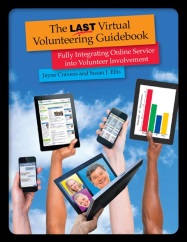
I’m thrilled to know that my book, The Last Virtual Volunteering Guidebook, was used as a resource for this report and its recommendations – and to see so many names of well-known researchers and practitioners regarding virtual volunteering, many of them my colleagues, cited in the detailed report.

This JA digital initiative / virtual volunteering effort is in addition to the Enterprise Without Border E-Mentoring tool, created and is managed by Junior Achievement Young Enterprise Europe (JA-YE Europe). It’s for volunteers from the business sector, teachers and student companies participating in the EwB program and enables its members to create discussion groups, discuss and work on particular projects and topics, and provides information about upcoming on-line webinars, EwB cafés, presentations and enables access to all study materials connected with EwB activities.

Congrats to Junior Achievement for both your initiatives and for being so open in sharing your information, and to Citi Foundation, which joins: Fundacja Orange (the Polish branch) in funding virtual volunteering-related initiatives. Sadly, they seem to be the only two companies currently supporting such innovation with cash.

Also see:

Hey, corporations: time to put your money where your mouth is re: nonprofits & innovation

Me: Fall 2015 Duvall Leader in Residence at University of Kentucky’s CFLD

I’m thrilled to announce that I’ll be in my Old Kentucky Home in October 2015, for two reasons:

logos for u of kentucky programsI’ll be the Fall 2015 Duvall Leader in Residence at the University of Kentucky’s Center for Leadership Development (CFLD), part of UK’s College of Agriculture, Food and Environment, Oct. 26 – 30, in and around Lexington.

The week before, I’ll be in Henderson, on the other side of the state, to be the keynote speaker for a capacity-building event for nonprofits organized by the Kentucky Network for Development, Leadership and Engagement (Kyndle), serving Henderson, McLean, Union and Webster counties in northwestern Kentucky, and the Henderson Community Foundation.

CFLD supports leadership related activities within the UK College of Agriculture, the University of Kentucky campus, the local Lexington community and counties statewide. My visit is sponsored by the W. Norris Duvall Leadership Endowment Fund and the CFLD, and will focus on leadership development and community development and engagement as both relate to the use of online media. I’ll be talking a lot about virtual volunteering, of course, as well as using online tools for communication outreach and engagement,.

As Kentucky is my birthplace, was my home for the first 22 years of my life, is where most of my family resides and is where I will, someday, retire (when I’m not still out traveling the world, as I intend to do), this is a particular thrill and honor. Growing up in Kentucky was, in fact, fundamental to my success at working in international aid and development abroad.

I relish any and all university-based experiences: I have guest lectured many times at the university level. You can see my academic / research work at my profile on academia.edu. Most of the academic articles that have cited my work regarding virtual volunteering are listed at my Google Scholar account. And it is my dream to create &/or teach an entire university course – even better: to be based at a university.

Interested in having me a part of YOUR university? Or to consult for your nonprofit? I have a profile at LinkedIn, as well as details on my own web site about my professional activities. I’m also happy to share my CV with you; email me with your request. If you have any specific questions about my profile, feel free to contact me as well.

Skills & experience, unpaid, are still skills & experience

“A few of our volunteers have been listing their experience with us on their résumés, as though this was paid work, so we’ve asked them to stop doing that.”

She said this to me with a look of I’m sure you understand. I didn’t.

“You mean they listed their role at your organization, the name of your organization, the list of their responsibilities and their accomplishments at your organization?” I asked.

“Yes!” she said, “As though it was a job!”

And I said, “Why is that a problem?”

She said, “Because they were just volunteers! You don’t list that on your résumé!”

Sigh.

As I said in a previous blog, a marketing director is defined by the scope of his or her responsibilities – not a pay rate. Paid or not, you call such a person a marketing director. An executive director is defined by the scope of his or her responsibilities – not a pay rate. Paid or not, you call such a person an executive director.

If a person has a role at your organization, with a title and responsibilities, and that person has met goals / accomplished things as a result of his or her work at your organization, paid or unpaid, that person has EVERY right to put that experience on his or her résumé! The person should also say if the role was part-time (5 hours a week? 10? 20?) and to whom he or she reports/reported (the marketing director? the executive director? the manager of volunteers?). You should do all that for PAID jobs as well.

Should the person say if the role is paid or unpaid on his or her résumé? I keep trying to imagine a scenario where a person should, absolutely, say he or she was/is a volunteer in that role on his or her résumé, and I cannot think of one. Certainly if you are asked how much you were paid for each job, and you are filling out that information for each job, you should be just as transparent, and write $0.

And maybe you want to brag about having been a volunteer, specifically. I was just an employee of the United Nations Volunteers, I never had the honor of serving as a UN Volunteer – I was merely an employee who supported UNVs in the field (I really did say this when I worked at UNV, and it was hilarious to see the reactions from paid staff who worked so hard to tell people, “Oh, no, I’m an employee, I’m not a volunteer!”). If I did have the honor of serving as a UNV, I would make absolutely SURE it was clear on my CV that, indeed, I’d made the cut and been an actual UNV. Of course, that’s my way of thinking – by contrast, a lot of UNVs list their field work title on their CVs (Youth Program Director, HIV/AIDS Community Educator, etc.) and that their employer was UNDP, rather than UNV, to distance themselves as much as possible from the term volunteer – sad, but true.

When I am an employer, I look at experience, skills, training and accomplishments, period. I don’t care if the candidate did anything as a paid employee, a paid contractor or an unpaid volunteer – I want to see what they’ve done and what they can do. Whether they were paid to do it or not is irrelavent to me.

And you?

Also see:

Reddit controversy is a lesson in working with volunteers

redditReddit is a very high-profile online community that has been in the news a lot lately. It’s in the style of an old-fashioned online bulletin board – a very popular, simple, low-graphics platform on the early days of the Internet that I miss very much. On Reddit, members can submit content, such as text posts or direct links, and can vote submissions up or down – voting determines the position of posts on the site’s pages. Content entries are organized by areas of interest called subreddits.

The community membership has created a strong, outspoken, high-intelligent culture that can be, at times, aggressive regarding its belief in free speech, and there are very few rules about the types of content that may be posted. This has led to the creation of several subreddits that have been perceived as offensive, including forums dedicated to jailbait (since banned) and pictures of dead bodies. On the other hand, the Reddit community’s philanthropic efforts are some of my favorites to highlight in my workshops.

Reddit employee Victoria Taylor helped organize citizen-led interviews on Reddit with famous people on the very popular “Ask me Anything” (AMA) subreddit, including interviews with Benedict Cumberbatch (sigh), USA President Obama, Bill Nye, Madonna, and Eric Idle –  and these sessions often ended up landing on the news for some especially funny or outlandish answer given. She was very popular with the volunteer online moderators. But recently, Taylor was fired. Reddit moderators have said they were “blindsided” by Taylor’s firing and that she was “an essential lifeline” for them and Reddit employees. Many Reddit users have demanded answers from Reddit’s interim CEO Ellen Pao regarding why Taylor was dismissed. In protest of her dismissal, moderators on several of the site’s largest subreddits locked users out. Pao is now scrambling to calm hostilities, and says it’s all just a result of miscommunication.

This mutiny by the online moderators is actually an all-too-common problem for organizations that involve large numbers of very dedicated volunteers, online or onsite. Reddit forgot that its volunteers aren’t just free labor; they feel personally invested in this organization, they feel ownership, and while those characteristics make them excellent moderators, it also means that, if they feel taken advantage of or that they aren’t being listened to, they will rebel, very publicly.

Reddit leadership needs to immediately read America Online volunteers : Lessons from an early co-production community, by Hector Postigo, in the International Journal of Cultural Studies 2009. This article analyzes the case of America Online (AOL) volunteers, specifically when company changes resulted in the rise of a labor consciousness among many volunteers, which in turn made the “free distributed workforce” impossible to sustain – and invited intervention by the US Department of Labor. They also need to each buy a copy of The Last Virtual Volunteering Guidebook, and READ IT. And maybe hire Susan Ellis and I to help them fix this mess…

Update, July 7: the Wall Street Journal has also blogged about this issue from a volunteer management perspective. I’ve added a comment on it.

Still don’t like slacktivism… but…

I’m not fond of slacktivism (or slackervism). The word and its variations are a combination of the words slacker and activism. It’s a pejorative term that describes easy activities that make a person feel like they’ve made a difference for a group or a cause, like putting a bumper sticker on your car to “support the troops” or changing your profile photo on Facebook to show support for gay marriage, but the activity is more about making the person doing it feeling like they have contributed – but it doesn’t cost any kind of time, money or sacrifice on the person’s part, and probably doesn’t really affect the cause in any tangible way.

I’ve ranted about slacktivism a lot (see end of this blog for my other pieces on the subject), because I worry that people will choose to post a meme on Twitter that supports a cause they believe in rather than stand outside a grocery store to ask for signatures on a petition, or attend a rally, or staff an information table for a nonprofit at a community event, or donate money, or give substantial time to a political action committee or nonprofit trying to make a difference. I worry they think forwarding a message will end homelessness, stop female genital mutilation, provide mental health care services for veterans, feed hungry people, and on and on. I also I hate when people equate it with virtual volunteering; I have never considered it such, and I still don’t.

I stand by all my previous blogs ranting against slacktivism. But I’m now having trouble with exact definitions of it, because I have experienced, first hand, how posting memes and other messages to Facebook in support of a cause actually has caused someone to change their mind – and even voted differently as a result. There’s no absolute definition of who is and isn’t a volunteer, so I shouldn’t be surprised that the borders of the definition of slactivism have turned out to be so permeable.

I work very hard to keep my political views separate from my professional work. As I’m often in a communications officer position on behalf of a nonprofit, NGO, or government initiative, I often am not allowed to write letters to a newspaper or blog to express a point of view about current political affairs, or even just attend a protest rally. As a frequent consultant to the United Nations, I need to be perceived as politically neutral and respectful to those with whom I’m working, and I work hard to meet that requirement. As a result, many people I work with have no idea just how politically active I have been. None. This comes as a massive shock to my friends who know me outside of work, who know that I’m quite passionate about many issues, and that I’ve been an activist for many causes, long before the Internet, when I’m not in a communications officer position: I’ve worked to register voters, written and edited a newsletter for a group working to promote women’s right to abortion services, and spoken on behalf of political candidates I’m supporting. My friends have seen me VERY angry over various human rights issues, and act out on that anger, and can’t believe I can turn that button off so easily in certain circumstances.

Sometimes, through my activism, I’ve changed minds. Sometimes, my words have caused me to lose friends. I don’t know of an effective activist who hasn’t made people angry, no matter how hard they may have tried not to, no matter how much they’ve stayed away from anything that would seem personally insulting and tried, instead, to stick to education and patience. I’ve had my life threatened or put into danger twice because of my activism. Being an activist comes with costs that can be painful to pay.

Per several shootings in the USA of unarmed black Americans by white police officers, several online campaigns started, such as tagging posts on Twitter and Facebook with #blacklivesmatter. The tag was used by many people who have been on the streets and in community meetings and at political events, spending many hours to bring to light the very real, justifiable fear black Americans – particularly black American men – experience in encounters with the police. The tag was also used by people who’ve never done any of that kind of activism at all, as a way to show their support and outrage. That lead to some arguments online: should people who have not been traditional activists, should people who have never marched or attended meetings or put in the hours for the cause, should people who are white and would never experience the kind of fear and persecution so many black Americans experience regularly, use the tag? And white people using the tag – shouldn’t they do MUCH more, like march, register voters, write their elected officials, donate money to organizations working long-term on these issues, etc.?

Per the recent Supreme Court decision saying that all adults have a right to marry, including couples of the same sex, millions of people changed their Facebook profile photo to show a rainbow filter over the image, as a way of expressing support for the decision. And most of these people who did this are straight and have never done any traditional activism in support of gay rights: they’ve never stood outside a grocery store getting people to sign petitions, they’ve never marched in a rally, they’ve never donated any money to an organization working for gay rights, etc. In fact, they may never have told anyone before that they supported gay rights. That’s lead some posts online deriding straight people for their attempt to be gay allies – including a very angry direct message to me from a friend who seems to think that’s all I’ve done on behalf of gay rights. Others praised “straight allies”.

The underlying messages of these criticisms of white allies for #blacklivesmatter and for straight allies of gay marriage is this: you haven’t suffered for this cause, you haven’t worked for this cause, you haven’t sacrificed for this cause, you aren’t really a part of this cause, you shouldn’t get to celebrate a victory or be counted among those supporting the cause – and using a tag or a photo filter is just slacktivism.

I understand that criticism, I do. I understand what it can feel like when you work hard for something, you sacrifice, you experience hardship, and at a victory, people you’ve never seen alongside you in the trenches are there for the celebrations. I understand what it’s like to be an activist on an issue that is VERY personal to you, and to work with people who are supportive but who cannot experience the issue the way you do – men at an organizing meeting to support abortion rights, people of faith defending their atheist friends – and to wonder, can they ever really understand this? 

But consider that some of those people who have never said a word on Facebook or Twitter or at the family dinner table or even to you about these causes before, and then have then dared to post a meme about Ferguson or Baltimore or Cleveland or anywhere else there has been a shooting of a black American by a white police officer, or have changed their profile to the rainbow filter, have suddenly received very hurtful comments – some of it quite public – from family, friends, neighbors and work colleagues. And some of them have received direct messages from family, friends, neighbors and work colleagues saying, “I’m so glad you posted that. I agree – but I can’t say anything because I’ll make too many people around me angry.” And some of them may have started to changed the mind of someone that a regular, traditional activist NEVER could have reached – a friend, a family member, a neighbor, a work colleague, who is surrounded by only one kind of messaging, and here is someone they know and trust and maybe even love, making this simple, challenging statement in opposition to what they believe. I’ve gotten private messages from three people who said my private, friends-only posts on a personal account on an online social network changed their minds about who to vote for in an upcoming election. I’ve had friends and family members write me private messages saying they can’t be so vocal, but they agree with me – and it’s been shocking who these messages have been from – I never would have guessed those sympathies in many cases. I’ve never had anyone tell me that in those long hours standing at an information booth on a hot day at a community event – though I like to believe it’s happened.

So I’m going to start being a lot kinder about what I brand as slacktivism. I might even be willing to consider it microvolunteering in some instances. But mostly, I’m not going to play the more-activist-than-thou game I see so many playing. The world needs all kinds of activism and activists, and I’m going to welcome them all. 

And I’ll always be thankful for every activist, every ally, for every cause.

See also:

Requests for submissions for ISTR conference

Abstract submissions are now being accepted for the 12th International Society for Third-Sector Research (ISTR) International Conference, being held in Stockholm, Sweden, 28 June – 1 July, 2016. The theme of the conference:

The Third Sector in Transition: Accountability, Transparency, and Social Innovation.

Deadline for submissions is 26 October 2015. Papers on the following topics would be especially welcome:

  • The Third Sector and the Welfare state
  • Civil society and Democracy
  • NGOs and Globalization
  • Accountability and Transparency
  • Social Innovation and Social Enterprise
  • Advocacy and Public Policy
  • Philanthropy and Foundations
  • Volunteerism and Co-production
  • Managing Third Sector Organizations
  • Emerging Areas of Theory and Practice

More info on how to submit.

Managers of volunteers & resistance to diversity

graphic by Jayne Cravens representing volunteersIt never fails: try to have a conversation about diversity and volunteerism, get comments about how such conversations are not needed.

“Thoughtful Thursday” is an online discussion about issues related to the involvement of volunteers. It takes place in the comments section of the blog and on Twitter using the tag #ttvolmgrs.

Two weeks ago, the subject was diversity. The comments section on the blog are a perfect example of how these much-needed conversations in the nonprofit sector frequently turn into:

We don’t need this.
We are doing just fine with the volunteers we have.
Our recruitment has worked for 25 years. No need to change.
We are not going to lower our standards in order to get new volunteers.
Young volunteers just don’t have the commitment that are current volunteers have.

And it’s what frustrates me most about managers of volunteers. Most – yes, I said MOST – are resistant to change. Meanwhile, they wonder why they are having trouble recruiting, or keeping, volunteers.

Harumph.

(not all the comments are negative on the subject – so there’s hope)

Also see:

Internet tools needing improvement

There are a lot of software applications – apps – I use regularly – and some that I’m using less-regularly, because of “improvements” by developers. So many apps are becoming so poorly-designed that they are becoming unusable, yet I read about many of these companies whining about how many users they’ve been losing.

So let me do you a favor, designers: here’s more than a dozen ways that the apps I use regularly – and millions of others use regularly – really, truly could be improved:

  • Flickr – Bring back the narrative slide show view. Yes, most people just look at photos, and look at them on their smart phones. But there are a lot of us who want to see the narrative too – not every photo is self-explanatory.
  • Facebook – So many changes needed:
    • Make adding and removing people from lists as easy as adding and removing people from circles on GooglePlus. Right now, it is SO hard to do. And there’s no “at a glance” way to see who is one which list. I would use Facebook oh-so-much more if the lists were easier to use.
    • Make it possible to put Facebook pages into lists. I would love to be able to put causes I really love, and want to follow, on a list, so I could look just at that list sometimes.
    • Make it possible to delete smart lists from a person’s view of lists – I have a company listed on my account that I have NEVER worked for. I have no idea how it got there, but there’s no way for me to remove it! It looks like I worked there – but I never did.
    • Create a blog space for users the way MySpace used to have. I could create a blog that someone could view WITHOUT being a member of MySpace – but the only way for someone to comment it on it unless they were signed in. You would end up taking market share from Tumblr and Medium and so many blog spaces if you did that.
  • Twitter:
    • Make it possible to view lists I create, as well as the list of accounts I follow and the list of those that follow me, viewable however I want (alphabetical, oldest to newest, etc.)
    • Keep it simple! That’s the beauty of Twitter! Please stop trying to be like Facebook. I connect with people and organizations I really need to know, even get job leads, from Twitter – that NEVER happens on Facebook. You are going to ruin Twitter if you keep “adding” Facebook features.
  • YahooGroups, formerly my favorite app:
    • Please, please, please go back to non-threaded discussions. You’re threaded way of doing things have killed discussions on most of the groups I’m on.
    • Create a fee-based service for users who don’t want ads on their groups, including no ads in emails generated by messages on the group. I will HAPPILY pay that fee! So would many, many thousands of other users!
  • Google
    • regarding GoogleGroups: go look at YahooGroups from 2002 or so – if your interface looked more like that, you’d still massive numbers of users from not only Yahoo, but from various online collaboration web sites as well.
    • GoogleCalendar: Please reconsider your decision to stop sending calendar updates via SMS! I don’t always have great Internet access. And there are LOTS of people that still use feature phones that don’t have apps. We need our SMS reminders!
  • iTunes – STOP BEING STUPID. Instead, start beta-testing your interface with non-software developers, as well as people over 25. I am not a stupid person, and yet, it takes me way too long to figure out how to add a song to a playlist, how to remove one, how to play just one album, and on and on.

Those are my ideas. Get right on that, ‘kay?