Jayne Cravens is an internationally-recognized trainer, researcher and consultant. Her work is focused on communications, volunteer involvement, community engagement, and management for nonprofits, NGOs, and government initiatives. She is a pioneer regarding the research, promotion and practice of virtual volunteering, including virtual teams, microvolunteering and crowdsourcing, and she is a veteran manager of various local and international initiatives. Jayne became active online in 1993, and she created one of the first web sites focused on helping to build the capacity of nonprofits to use the Internet. She has been interviewed for and quoted in articles in The New York Times, The Wall Street Journal and the Associated Press, as well as for reports by CNN, Deutsche Well, the BBC, and various local radio stations, TV stations and blogs. Resources from her web site, coyotecommunications.com, are frequently cited in reports and articles by a variety of organizations, online and in-print. Women's empowerment and women's full access to employment and education options remains a cross-cutting theme in all of her work. Jayne received her BA in Journalism from Western Kentucky University and her Master's degree in Development Management from Open University in the U.K. A native of Kentucky, she has worked for the United Nations, lived in Germany and Afghanistan, and visited more than 30 countries, many of them by motorcycle. She is currently based near Portland, Oregon in the USA.
Verified is a United Nations initiative to encourage people to check the validity of news, advice and information before sharing it. Verified is looking for “Information Volunteers” to sign up to receive a daily Verified briefing and then to share the fact-based advice and information with their networks.
You’re engaging right now in the biggest project of social collaboration the world has seen. Bigger than the moon landing, than the Olympics, than the building of the tallest skyscraper or longest bridge. Billions of people are working together – the doctor on the other side of the country. The parent homeschooling their child. The scientist working on the vaccine. The nurse working around the clock. You, reading this. Working towards one common goal: to look after each other.
In this crisis, sharing trusted and verified information will help keep everyone safe, while misinformation can put lives in danger. If you want to make sure the content you’re sharing helps the world, sign up to receive Verified content, and always look out for the Verified tick.
We’re doing this for each other – for everyone on the biggest team the world has ever seen.
The initiative is available in a variety of languages:
The Points of Light Conference (formerly the Points of Light Foundation Conference) is a large annual conference celebrating and promoting volunteerism in the USA. Representatives from nonprofits, government programs, business, civic leaders, activists and volunteers themselves gather annually to celebrate, collaborate and share knowledge and resources related to volunteering and volunteers.
Traditionally held as an in-person event, the 2020 Points of Light Conference, June 10-12, will be an online experience this year, with a particular focus on sharing information related to volunteering during the COVID-19 pandemic.
It is FREE to attend, but you must register to access the recorded workshops, Q & A sessions, and discussion boards associated with each workshop – including mine, on June 12, regarding virtual volunteering. After June 12, my virtual volunteering workshop, about 36 minutes long, will be available on my YouTube channel.
It happens regularly: people who are seeking paid work, or who have been laid off from jobs, pushing back against volunteer engagement by previous and potential employers.
I am passionate about volunteer engagement as fundamental to both nonprofit and government programs, as fundamental to giving communities an opportunity to see firsthand what’s happening at these organizations and contributing to a civil society as well, but I am also passionate about volunteers NOT being used just to “save money”, and never to replace paid staff that do not have many alternatives for paid work. It’s why I believe any program should have to say WHY they involve volunteers and say, in writing, how every volunteer engagement will lead to something transformative. It’s why I have joined online protesters and said UN Agencies must defend their unpaid “internships”. It’s why I tell every person who asks me for a webinar or to consult on a project, “here are my consulting rates.” I have very strict guidelines for when I will offer my professional services for free – and even then, sometimes, I enter gray areas where I have to really think about the ethics about what I’m doing.
Once again, there is conflict between people who need paid work and the involvement of volunteers (unpaid labor). This time: many freelancers in the United Kingdom believe furloughed workers who are receiving 80% of their salary and are volunteering their time and professional expertise online (virtual volunteering) with charities via sites like Furlonteer.com are taking away much-needed paid work. This BBC article offers more details about this conflict.
My thoughts: I hope that freelancers will direct their very justified anger at FUNDERS – corporations, foundations, government agencies and individuals – who have whined that nonprofits need to “keep overhead low,” who have often refused outright to pay for anything they consider to be overhead, and who don’t believe nonprofits should ever spend money on expertise – not competitive salaries for employees and not decent salaries for consultants. Nonprofits, charities, NGOs, and other mission-based programs are frequently put into the impossible position by funders of delivering critical services without spending what’s needed for that to happen. Further contributing to the pressure to “get people to do it for free!” are programs like the Points of Light Foundation, the Independent Sector and even the United Nations who loudly, proudly promote the value of volunteering by an hourly rate – the amount of money saved because employees or consultants don’t do those tasks and volunteers are unpaid.
On the Furlonteer.com web site are these words: CHARITIES ARE DESPERATE FOR YOUR HELP. Well, WHY is that? Who created the conditions that have made charities desperate for this help? FUNDERS. I am looking at corporations and foundations in particular.
Most of the articles I’ve read on “tips for working with remote staff during COVID-19 lockdowns” have been way more basic than I need, say what should be obvious (at least to me – like the importance of starting meetings on-time and make sure you use your mute button when you aren’t talking) and really don’t offer much insight into this particular way of working. In short, when I read most of these articles, I say “Meh” and move on.
However, Charity Village in Canada shared 8 Tips for Nonprofit Leaders to Better Support Virtual Teams by Maryann Kerr and it’s outstanding. There are really great suggestions here that every nonprofit and government program needs to read and apply to their interactions with remote staff – I hope more than a few folks are brave enough to send the article to managers, including executive directors, who just aren’t getting what working from home during a pandemic is REALLY like and what their expectations of their staff REALLY should be.
In addition, many of these suggestions are applicable to virtual volunteering. Here are my favorite recommendations from the article that I think you need to be thinking about with your volunteers now as they do more service and interactions online:
Be patient and considerate of the specific challenges of your team. This is both a collective and unique experience for each of us. Some will be home alone and lonely. Others may be desperate for a moment of peace. Still others may be caring for elderly family members or a combination of all three.
Speak up and don’t skip the hard stuff. This moment in history asks each of us to dig deep and develop our own innate ability to lead. You do not need to hold a position of leadership to act. Speaking up, on your own behalf, and on behalf of others, is an act of leadership. If you have a concern or question, it is likely shared by others.
Get to know each other on a whole new level. Whether you use Patrick Lencioni’s Personal Histories Exercise or the Clifton Strengths Finder or any number of other team building activities available online and adaptable to a video conference – just do it. Lencioni’s is a favorite because I’ve never seen it fail to improve a team’s understanding of each other. Do team members have hidden talents they’d like to share? A song, a poem, a musical instrument? A piece of artwork or craft they’d like to show? You are suddenly in each other’s homes. Use this as an opportunity to see each other as whole human beings not just workers.
Explore your values as individuals, teams and as an organization. Start with a free Personal Values Assessment and then facilitate a discussion about what is important to you as individuals and how this is reflected in how you will work together. Examine how these compare to your stated values as an organization. How can you ensure you live these values, particularly now?
Again, I want to emphasize those four suggestions are from Maryann Kerr, not me – she gets all the credit!
But I will add that, in a past blog, I myself wrote this in a blog:
Successfully working with people remotely is a very human endeavor that people who are amiable, understanding and thoughtful tend to excel in.
And, indeed, that’s proven to be true yet again as millions of people experience remote work amid chaotic or lonely homes.
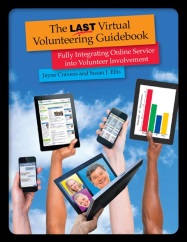
And, of course, for more advice on working with remote volunteers, or using the Internet to support and involve volunteers, check out The Last Virtual Volunteering Guidebook. Tools come and go – but certain community engagement principles never change. you will not find a more detailed guide anywhere for working with online volunteers and using the Internet to support and involve all volunteers – even after home quarantines are over and volunteers start coming back onsite to your workspace. It’s available both as a traditional paperback and as an online book. It’s co-written by myself and Susan Ellis.
If you have benefited from this blog or other parts of my web site and would like to support the time that went into researching information, developing material, preparing articles, updating pages, etc. (I receive no funding for this work), here is how you can help.
A bill in the USA Congress, the Pandemic Response & Opportunity Through National Service Act, would expand AmeriCorps and SeniorCorps to aid in COVID-19 recovery efforts, including growing AmeriCorps to 750,000 positions over a three-year period; boost the AmeriCorps living stipend so that individuals regardless of financial situation can participate; increase the education award to cover up to two years of public university tuition; ramp up Senior Corps teleworking technology, and more. These programs are a part of the Corporation for National and Community Service.
Sanchez Elementary School Online Mentoring Program, an elementary school-based online volunteering program organized in cooperation with the AmeriCorps members serving at this Austin school at the time (1999).
If you have benefited from this blog or other parts of my web site and would like to support the time that went into researching information, developing material, preparing articles, updating pages, etc. (I receive no funding for this work), here is how you can help.
There are people who want to volunteer in difficult or dangerous roles – it’s what they specifically seek out. Over on the Reddit group regarding voluntourism, as I write this blog, there are lots of messages from people, mostly young people, seeking to help on the “front lines” regarding people affected by COVID-19, either because they are ill or because they are isolated and needing help in lockdowns. Many online recruitment sites, like VolunteerMatch, have curated volunteering opportunities posted on their site that related to COVID-19 in some way, due to overwhelming demand from potential volunteers.
Some volunteering is perceived as difficult by potential volunteers and the general public, because of the clients that volunteers will work with or the kind of activities volunteers must undertake. Examples: serving as a Big Brother/Big Sister, mentoring a foster child, assisting adults with developmental disabilities, volunteering in a shelter for women experiencing domestic violence, or staffing a suicide hotline.
Some volunteering is perceived as difficult AND dangerous, such as fire fighting, search and rescue, volunteering with incarcerated people in a jail or prison or volunteering with people who are formerly-incarcerated.
Some volunteering is perceived as controversial, such as providing water stations in the desert for people entering a country illegally and can die from dehydration, or defending a women’s health clinic patients from protesters, or various protest and activism roles.
Difficult, dangerous and/or controversial roles actually appeal to many people who want to volunteer: they feel strongly about the cause, or they want to do something substantial and challenging. But other roles may seem too intimidating to new recruits, like mentoring a young person going through the foster care system, working with young people in the juvenile justice system, working with people with intellectual disabilities, or working with seniors.
How do you recruit for roles that might seem difficult, dangerous, even controversial? How do you recruit for a subject area or role that might provoke an initial reaction of fear among potential volunteers?
If you have benefited from this blog or other parts of my web site and would like to support the time that went into researching information, developing material, preparing articles, updating pages, etc. (I receive no funding for this work), here is how you can help.
WIth movement limited, public gatherings banned and so many people on home quarantine, many nonprofits, non-governmental organizations (NGOs), charities, government programs and other programs focused on helping or enhancing our communities or the environment are on hold. Some offices are closed entirely.
But there are LOTS of simple ways to use this “down” time that will benefit your program and make your program even stronger when physical distancing is no longer required. Many of these activities will help in fundraising efforts later.
Here are 21 ideas. Please add more in the comments:
Make a list of your city, county, regional, state and national elected representatives and their contact info, if you don’t have it handy already. Going forward, you are going to always email these people about public events when your program starts having them again, and you are going to better advocate for your programs and all nonprofits, NGOs and charities as a result. An online volunteer could help you compile this info if you don’t have time.
Make a list of all the off-site places your organization has held events, including meetings, classes and workshops, in the last few years. Put this list on a GoogleDoc or other shared space and ask staff and volunteers to comment on them in terms of what they liked about them, what they didn’t, etc. As a result, you have a robust database of event and meeting sites for the future.
Make an archive of data you have always wanted to have handy: a list of every Executive Director your organization has ever had, or a list of every board member that has ever served, a list of every winner of a Volunteer-of-the-Year award you have given, a list of every major grant your program has ever had, etc. You can use past versions of your web site archived at the Internet Wayback Machine to access past info to the late 1990s (or ask a volunteer to do it). Such archives are great resources for institutional memory, to renew old contacts, to show your credibility, etc.
Look over old versions of your web site at the Internet Wayback Machine and think about pages and resources your program has gotten rid of over the years that might need to be brought back and updated. This is a project multiple people can work on, including online volunteers.
Find out the most-visited page on your web site, other than your home page. And what’s the second most-visited page? The third? What pages aren’t visited much, but should be? What can you do to make sure under-visited pages get noticed? Or should some pages be deleted per lack of interest, because they are so outdated, etc.? Compile this info and work with your web master or a volunteer to improve your site.
Are your policies and procedures up-to-date regarding confidentiality, safety and sexual harassment, including in terms of online activities? Research the policies of similar programs (most will be happy to share them with you if they aren’t online already). Online volunteers can help with research.
Define or revisit your organization or program’s Frequently Asked Questions (FAQs) and their answers. Documenting this helps new employees and volunteers and helps guide our web site design and communications strategies. The best person to define your program’s FAQs is the person who answers the phone and your main email account the most. Ask that person the top 10 – 20 reasons people call or stop by your organization or email your organization. Also ask this person to whom he or she transfers the most calls, and then talk to that person/persons as well, asking him/her/them what the top 10 reasons are that people call or email them.
Research Facebook groups and Reddit communities (subreddits) focused on your geographic area and think about how you could better leverage them in the future to promote your events, share new volunteering opportunities, share any messages meant to influence the public about an issue, etc.
Create an online survey, or more than one: a survey to find out about the level of satisfaction of current volunteers (before lockdowns began) and where things can be improved, a survey of event attendees about what they would like to see in the future offered by your organization, etc.
Create an online discussion group for your current volunteers. You can use GoogleGroups or https://groups.io/ for free. If you already have such an online discussion group, create a question or discussion of the week: How could our web site be better to represent what volunteers do at our organization? What’s the most challenging thing you’ve faced as a volunteer and how did you address that challenge? What’s a skill or talent you have that most people don’t know you have? Share a photo of you “in action” as a volunteer.
Ask volunteers and clients to take a video of themselves on their smartphones or computers, something under one-minute, saying what your program has meant to them, why they think it’s valuable, etc. Tell them you will be using clips from these videos for a compilation video you will post on YouTube. Once you get enough footage, recruit a volunteer to knit these together, adding a title page, fade ins and outs, music, etc.
Do you have raw footage of videos of events or training that aren’t shared with the public – but you wish you could do something with them? You could recruit volunteers to do things with such: make a one-minute or three-minute video with copyright-free music that offers program highlights, or to edit a video down to something that could be shared with the public.
Add robust descriptions to your YouTube videos: name of the video, a summary of what it is, the full name of your organization, names of people featured in the video, a web address for more information, keywords/tags, etc. This will vastly improve the findability of these videos.
Ask volunteers to caption your videos on YouTube so that people with hearing impairments and people who are in an environment where they cannot listen to them can experience them (YouTube will caption these automatically and then a volunteer can fix them).
Ask volunteers to transcribe your program podcasts so people can read them (not everyone wants to listen to them).
Ask volunteers to add alt text on all of your photos and graphics on your web site, making the site more accessible for people with sight impairments.
Get rid of all “read more” and “click here” links on a web site, replacing them with descriptive links, so that the web site is more accessible for people with disabilities (you can ask a volunteer to do it if you don’t have time).
Add appropriate titles in the title HTML for every page on your web site. This will improve Search Engine Optimization, improve accessibility for people with sight impairments, and means when someone types the URL (web address) of a web page into something like Quora, the correct title of the page will automatically show up.
Take a deep dive into expanding virtual volunteering, exploring how to use the Internet to support ALL of your volunteers, including your traditional, onsite volunteers, is via The Last Virtual Volunteering Guidebook, which I wrote with Susan Ellis. It is the most comprehensive, detailed resource available regarding virtual volunteering, and a copy of my book is far cheaper than hiring me to do a workshop!
And a reminder that there has never been a better time for your organization to launch immediate activities and roles for online volunteers. How they could help you with the aforementioned activities should be obvious. Here are even more ideas, from my last blog.
If you have benefited from this blog or other parts of my web site and would like to support the time that went into researching information, developing material, preparing articles, updating pages, etc. (I receive no funding for this work), here is how you can help.
It’s become a frequently asked question of me, since I have worked remotely, from home, for so many, many years, and because I work with so many colleagues, including volunteers, who are also working from home:
What do you use to work remotely with others?
Here’s how I do it – but note that everyone has different preferences and you may find that yours are quite different:
Google Docs / Google Drive has been a fantastic way for me to work with others on word processing documents, slide shows and spreadsheets. This way, it doesn’t matter what software we use for these functions (Microsoft, LibreOffice, whatever). Also, it’s free.
I have used WebEx, Go to Meeting and lots of other video-conferencing platforms – I’ll use whatever the client is paying for – but I love Zoom most: it is super easy for meetings. I like it because it’s so easy to share my screen or for another participants to do so. I can use it on my laptop AND my phone (in case I need to have a meeting when I won’t be at my laptop, which never leaves my house). No matter what you use, keep in mind:
meetings should have an agenda (and you stick to it)
meetings absolutely start and end on time
encourage everyone to keep their video on and to be “present”
do as much as you can to keep it lively and focused – treat participants as an audience
always use a password for access to meetings, so you don’t get “zoom bombed.”
If someone else is paying for access (I can’t afford it otherwise on my own), I love Slack for quick updates and conversations – I think of it as someone stopping by my office and saying, “Got a sec? I have a question.” If I have access to it, leave it on during the workday so people can reach me anytime, but use the “in a meeting” when I need to not be disturbed. I haven’t found a good alternative to Slack, now that YahooIM and AOL Messenger are gone. I refuse to use Facebook messenger – that company already knows way, way too much about me. WhatsApp is owned by Facebook.
If someone else is paying for it (again, I can’t afford it otherwise on my own), I also love Basecamp – Basecamp has been absolutely essential for me to manage large projects, like a recent one where I managed more than 15 projects, each with 3 – 5 volunteers, plus the overall program for these projects, with about 50 different people working on it. There are places to share files, or to link to files shared elsewhere, to group those files into categories, to do chats, and on and on. So much easier to find things there than to go looking for attachments to emails. I wish I could afford it to use all the time on every project I’m working on with others. It’s password-protected. Groups are private (you have to be invited by the owner of the group to join).
For those that can’t afford Basecamp, I recommend Groups.io. I’m experimenting with it myself, as an online discussion group, but it could also be an online collaboration space, including a place to share files – so much easier to find things there than to go looking for attachments to emails. I wish I could afford it to use all the time on every project I’m working on with others. Groups can be private and invite-only.
If I don’t care about security, I use DropBox to share large files with people that I don’t want to attach via email.
I have two Google calendars, one private and one public. I have my calendar set to send me email reminders 24 hours before especially important meetings, and 4 hours and 1 hour before other meetings. It also sends me an on-screen reminder on my laptop 30 minutes before a meeting and an update on my phone. I also use the alarm function on my phone – not affiliated with Google – to remind me of particularly important meetings.
In the last year, I have found short videos to be a really easy way to orient or pitch something to remote staff or potential clients. I use Quicktime to record the video (it’s already on my computer, comes for free with a Mac) to record the video and iMovie to edit it (also free on my laptop). I had no training in either – I taught myself. In 2018, I did a video to encourage about 20 nonprofits I was working with to make a simple, short video of their own for a project I was working on, and it went over WAY better than an email! I got 100% participation, and I think it was because I showed them exactly what I wanted, instead of telling them. Since then, I’ve created several quick online videos, including three specifically because of the onslaught of interest in virtual volunteering because of COVID-19 home quarantines:
NOTE: Don’t be afraid to use video – to train new volunteers, to remind current volunteers of something they need to keep in mind, to talk about anything, really, that can be summarized in a compelling little speech of around 5 minutes. Your sound is as important as the image – you need to be CLEAR and as interesting to someone who would just be listening to the video as also watching it. And, absolutely, close-caption your video (YouTube does this automatically, for free – then you go in and fix what it got wrong).
As for safety and security: I do not like to share any document online that has my social security and/or birthday on it. But sometimes, I just have no choice. In such cases, I prefer to scan the document as a PDF or JPG and send it as an attachment via email. If I have to sign something, I have a printed and I print it out, sign it, then scan it again and send that as a JPG or PDF.
I subscribe to a VPN – a tool that creates a “virtual private network.” A VPN ensures that the information traveling between a connected device (computer, smartphone, tablet) and the VPN’s server is encrypted, making it more secure from hackers, cybercriminals, and data thieves. It’s a great tool if you ever use a public wi-fi network – at a coffee shop, the airport, the library, etc. As an added bonus, usig a VPN, you can also access restricted websites and apps from anywhere in the world – great to get around blocks on a website when you are outside your country (no more “not available in your country” messages). I recommend Hot Spot Shield (the free version has a lot of ads – it’s worth the monthly subscription fee not to have these).
If you have benefited from this blog or other parts of my web site and would like to support the time that went into researching information, developing material, preparing articles, updating pages, etc. (I receive no funding for this work), here is how you can help.
Lots of nonprofits, charities, government programs and others are rapidly re-aligning their volunteer engagement because of COVID-19 and home quarantines:
Converting some programming and volunteer engagement online.
Launching new virtual “home visit” or online mentoring programs.
Mobilizing volunteers to support people in-need because of home quarantine, because of the stress of their professional work in response to the pandemic, etc.
Here are three resources for these new or re-imagined efforts:
(2) After a natural disaster – earthquake, flood, tornado, hurricane, etc. – affected areas can be flooded with spontaneous volunteers. They present a lot of challenges – and even dangers. COVID-19 is presenting a similar flood of spontaneous volunteers. How to deal with that flood of goodwill? These resources on dealing with spontaneous volunteers in natural disasters can offer some guidance.
(3) Theserecommendations regarding volunteers in post-disaster situations (hurricanes, tornadoes, earthquakes, etc.) from Chapter 5: Discussion, Conclusions, and Recommendations, in Disaster Survivors’ Experiences with Disaster Volunteers by Christa Frances Lopez / Christa López Sandelier (it’s her doctoral dissertation for Walden University).
Except:
The data from the findings confirm that disaster survivors had positive and negative interactions with the disaster volunteers. The disaster survivors weighted the positive experiences over the negative experiences. Participant 8 stated that she did not want to talk about the negative experiences, while another was very specific about concerns about the disaster volunteers’ skill levels and fitness for working in the climate in Texas. There were several recommendations for training of disaster volunteers with a clear expression from the research participants that stopping to listen and have clear communication with the disaster survivors was a high priority, as stated by Participant 1, “Listen to the people.” While Participant 3 stated, “just know that the people that you’re working for or they’re in a bad place and you’re there to make it better and always remember, to smile.” Participant 6 mentioned,
It depends on the tenure or the experience of the group coming in. Whereas you have other folks who just have a heart and they show up and mistakes do come out of those, they walk into situations- working on projects that weren’t priorities like trees down in yards when other houses had trees fallen on roofs into bedrooms. And so that kind of misstep of a volunteer coming to do good being directed by the homeowner as opposed to being directed by a group. I saw a lot of that happen because people show up, they don’t know where to go. They end up getting questioned in by a group of neighbors that are out front. Well, there needs to be a leader of each group who has some knowledge of construction or safety.
This emphasized the need for effective volunteer coordination with focus on organization and leadership for the established volunteer groups and the emerging volunteers so that work can be prioritized….
The cultural fit using Campinha-Bacote’s (2002) model of culture competence may be best applied in the future at the volunteer reception centers where coordinators of the volunteers could provide training before the volunteers go into the field to work. This training could involve an intake assessment that asks questions about the volunteer and their reasons and intent for coming to volunteer for that particular disaster. This would help volunteers look inward and fit within the first construct of cultural awareness. The questionnaire could then build upon the next construct of cultural knowledge by asking what the volunteer knows about the community. That could then lead into the topics the volunteer center can focus on for the volunteers’ training before they work in the field. During this training there can be a brief on the culture of the community, such as, what the community was like before the disaster, what is like now, including stages of grief the disaster survivors may be experiencing and other information pertinent to the local community…
As mentioned in the recommendations, using Campinha-Bacote’s (2002) model of culture competence may be best applied in the future at the volunteer reception centers where coordinators of the volunteers could provide training before the volunteers go into the field to work. This training could involve an intake assessment, as well, to assess the volunteer motivation to gauge their culture awareness by looking inward at their own self-awareness as to what motivates them to volunteer. The training could then provide information about the local community norms and provide cultural knowledge to the volunteers so that they can know who they are serving, and thus improve service and cultural integration of the volunteers within the community…
If you are a nonprofit focused on helping the homeless, addressing hunger or nutrition, helping people with a chronic illness or children or seniors, helping people with addiction issues, your services are still hugely in demand and it’s easy for people to see how your nonprofit is relevant during COVID19 and all that it’s bringing to individuals and the community-at-large, like unemployment, social isolation and being homebound without onsite visits. I’ve noticed many nonprofits trying to address domestic violence have done an excellent job at messaging these days, noting that the requirements to stay at home have created a very dangerous scenario for those they try to serve and what they are trying to do to address that. If you represent such a nonprofit, you may even have seen a spike in donations as a result.
But if you are a nonprofit focused on live theater, artwork, dance, history, recycling or some other thing that isn’t directly, obviously related to the consequences of COVID19, it can feel like you are being lost amid all the calls for continuing to support nonprofits and addressing this pandemic.
ALL NONPROFIT ORGANIZATIONS MATTER to SOMEONE, at the very least. If a nonprofit doesn’t matter, it shouldn’t exist.
This is not the time to pause your nonprofit’s communications, wait for things to get better and hope people will remember your nonprofit when we’re through this, or to think that relaunching your public activities once public gatherings can happen again will immediately bring people back to engaging with your program and supporting it financially. Instead, your nonprofit, no matter its focus, needs to be thinking about what messages it can send out on its blog and social media channels, linked from its web site, about its work that will be relevant in these times. It needs to strategize about how to get those messages out and how to invite digital engagement on them as well.
Here are some ideas:
Historical societies and history museums need to be posting about what the culture or community they are focused on did in the past regarding an epidemic, a pandemic or other widespread hardship, with photos, any first-person stories they have on file or accounts by others. Did your city experience the so-called Spanish Flu and, if so, what happened in that time? Share stories of hope, courage, sorry, and with each message, remind people what your organization does to preserve local culture. This doesn’t have to be one major online publication – you can publish just one thing once a week, even twice a week. Always invite feedback on such – some people may have photos and diaries they would like to share with you from that time.
Historical societies should be finding free broadcasts of history-related topics (such as on public television) and encouraging home-based live-watch parties, and for everyone in their own community that’s watching to share thoughts as they watch on a Facebook thread or Tweet chat designed for them to share such. At least some of these quotes will demonstrate the power of learning about history and be great in a grant proposal.
History societies and groups focused on specific ethnic cultures should be sharing how people can get started on their own family history and ancestry projects: how to ask for info from family members, how to record that information (scanning, how to use a smart phone to record, etc.,), options for sharing that information with just family, or with the public, etc.
Community theaters should be posting stories about places and pieces related to any discussion of disease, or noting the ways past epidemics or pandemics have affected live theater in the past. Share these stories with the intent to say, “And live theater SURVIVED!” A group of online volunteers, recruited from your current home-bound volunteers or newly recruited, could help you compile enough information to share something every week – even twice a week. Maybe even every day.
There are art museums that are having a field day with social media during this crisis, such as the Getty, which has asked people to recreate famous painting scenes using whatever they can find in their own house. Check out a few of the Getty’s picks on its Instagram, and don’t forget to take a peek this hashtag. It’s a campaign that’s not only gone viral, it’s reminded people of just how images from art influence our lives and kept that museum relevant.
Operas could post people performing songs in operas, like La Traviata or La bohème, where a character is singing while dying and talk about how the performing arts have never flinched from portraying human suffering, and how that art can help people handle the horrors around them.
All performing arts groups – theaters, operas, dance companies, choirs, etc. – should be finding free broadcasts of performances by ANY group related to whatever art they themselves produce and encouraging home-based live-watch parties, and for everyone in their own community that’s watching to share thoughts as they watch on a Facebook thread or Tweet chat designed for them to share such. At least some of these quotes will demonstrate the power of performing art and be great in a grant proposal.
All arts groups should be posting messages regularly now about the links between producing art and experiencing art and the positive effects on such regarding mental health.
A nonprofit that produces a farmer’s market or artisan market should ask its clients to make short videos about what they are doing now – both challenges they are facing and what they are still producing and ways people might be able to order it online or pay for it in a safe exchange that involves a lot of physical distancing and no close contact whatsoever.
Many animal shelters and rescue agencies have done a brilliant job promoting now as a great time to foster an animal from the shelter, since families and individuals are homebound anyway, and it’s resulted in a windfall of great foster families for many shelters.
If your nonprofit promotes sports, the outdoors or an outdoor activity, this is a time to be interviewing people online who have benefited from your programs over the years, and sharing those stories online, to say, “This is why sports / this activity matters. This is how we have impact.” If you don’t need to do fundraising for activities, you could fundraise for equipment you will use once your operations resume. You could also be sharing with people how to clean and repair whatever equipment is associated with the sport or outdoor activity, or an at-home exercise that could help build strength or balance to help in engaging in that sport or outdoor activity.
Your volunteers would love to come up with their own ideas about what your nonprofit should be saying and doing to stay relevant now. You can bring them all together in a conference call or put one volunteer in charge of gathering their ideas, calling and emailing each one. Emailing is great – but calling someone is even better, in most scenarios. This doesn’t have to be a one-time ask: they should be given multiple opportunities to share their ideas with you, and opportunities to help bring those ideas to fruition.
Always invite feedback on what you are sharing, and track this feedback. You can use this to show the impact of your COVID19-related activities to potential funders.
And a reminder that there has never been a better time for your organization to launch activities and roles for online volunteers. How they could help you with the aforementioned activities should be obvious. Here are even more ideas, from my last blog.
If you have benefited from this blog or other parts of my web site and would like to support the time that went into researching information, developing material, preparing articles, updating pages, etc. (I receive no funding for this work), here is how you can help.