Tag Archives: volunteering

Update on a virtual volunteering scam

I’ve been researching and promoting virtual volunteering since 1995. It’s a subject I feel passionately about. It’s real volunteering. I’ve seen how organizations all over the world, large and small, benefit from online volunteers, and I have accomplished a lot as an online volunteer myself.

So you can imagine how angry I got when I discovered this online volunteering scam back in January 2011: Community Service Help, Inc., which SELLS community service hours. This company charges a fee, and then gives a customer access to videos, which the person doesn’t ever have to actually watch; in return for saying he or she watched the videos, the company writes a letter for the courts, saying the person did community service.

I kept digging about this scam, writing about it again in July 2011, and again in November 2011. My blogging and research resulted in a nasty phone call to my home, as well as numerous comments on my blogs calling me the most vile names you can imagine. If you look in the comments of my blogs, you will also see posts by court representatives who have seen this scam, as well as the mother of someone that was ripped off, who is trying to get their money back.

I have written the Florida State Attorney General’s cyberfraud division, the Consumer Services Department of Miami-Dade County, numerous parole and probation associations, the Corporation for National Service and AL!VE to PLEASE investigate or, at least, take a stand regarding these scam companies – to date, they have done nothing.

Today, I got an email from a TV reporter in Atlanta, Georgia who used my blogs about this scam to create this excellent, DETAILED video about this scam and the people behind it. Thanks Atlanta Fox 5! Of course, after an NBC affiliate in Columbus, Atlanta did a similar, shorter story, the scam company put a tag on its web site noting as featured on NBC news!. So we can only imagine what the scam company will do with this Fox TV piece!

And as I’ve noted before: I’ve been lucky enough to have involved some court-ordered folks as online volunteers – I say “lucky enough” because they have all of them have ended up volunteering for more hours than they were required to do, and been really great volunteers. And, no, I did not charge them!

Also, here’s free information on Finding Online Volunteering / Virtual Volunteering & Home-Based Volunteering with legitimate organizations.

July 6, 2016 update: the web site of the company Community Service Help went away sometime in January 2016, and all posts to its Facebook page are now GONE. More info at this July 2016 blog: Selling community service leads to arrest, conviction

Also see:

What online community service is – and is not

Online volunteer scam goes global

Courts being fooled by online community service scams

My voluntourism-related & ethics-related blogs (and how I define scam)

Magical paychecks

I’m on a lot of online communities, most focused on nonprofits in some way. And recently, on one of them, someone posted this:

I need to have some kind of porn blocker software on the computers at our office, since volunteers have access to the computers.

Sigh.

Yes, that’s right: while employees, because of their paychecks, aren’t at all inclined to do anything inappropriate on work computers, volunteers, who are unpaid, just can’t stay away from online pornography.

Sigh.

I’ve heard people at nonprofit organizations talk about extensive training and supervision for volunteers regarding confidentiality, working with children and working with money, who then balk when I suggest exactly the same training and supervision is needed for paid employees.

Paychecks are NOT magical! A paycheck doesn’t make someone more knowledgeable than a volunteer, more experienced, more trustworthy, more respectable nor safer.

I love a paycheck as much as anyone! But it doesn’t give me super powers.

More about working with volunteers.

Results of survey re volunteer management software

At last! The results of the survey of volunteer management software launched by Rob Jackson (robjacksonconsulting.com) and Jayne Cravens (coyotecommunications.com) — ME — are compiled and ready for release!

In March and April 2012, Rob and I drafted and circulated a survey regarding software used to manage volunteer information. The purpose of the survey was to gather some basic data that might help organizations that involve volunteers to make better-informed decisions when choosing software, and to help software designers to understand the needs of those organizations. We also wanted to get a sense of what organizations were thinking about volunteer management software.

At long last, we’re publishing the results of the survey here (in PDF). It includes an executive summary of our findings, as well as the complete responses to questions and our analysis of such. Rob and I did not have time to analyze all of the comments made in answer to some questions; for all questions, we listed the comments made, but we did not always offer any observations about such, or group the responses into categories.

We welcome the efforts of other researchers to offer their own analysis of the data provided.

Software companies and designers: you can learn a LOT from this report to improve your products and your communications with customers!

Have a comment about the survey? Offer it below, or via UKVPMs.

Thanks to everyone who responded to the survey!


Have you ever changed your mind?

Have you ever changed your mind? Have you ever decided to let go of a long-held opinion and embrace one you had long opposed? Particularly regarding issues that affect your approach in your professional or volunteering work?

I have. A few examples:

  • I thought instant messaging was a useless distraction. A colleague changed my mind.
  • I thought Twitter was a useless distraction. Actually using it, and following people like Howard Sherman and Rob Jackson and Skepchicks, convinced me otherwise.
  • I used to think it was ethically unacceptable, under any and all circumstances, for a for-profit company to involve volunteers. I had railed against it more than once. It took Triumph Motorcycles to change my mind.
  • I don’t like certificates in return for volunteering. I don’t value them. And I thought most other people did too. But a member of my staff was passionate in her conviction to try it. So we tried it. They turned out to be one of the most popular features of the UN’s Online Volunteering service.

I’m open to being wrong, or to admitting I haven’t been fully-informed, or to new facts. I’m open to having my mind changed – through solid facts and examples. I like working to change minds – you have to like it if you are going to work in communications / outreach – but I also have to be as open as I want others to be.

But beware: if you want to change my mind, I need facts, and lots of them!

Okay, now you: share in the comments how you have had your mind changed with regard to your work or volunteering.

Say it! Say it! “MANAGERS OF VOLUNTEERS”

graphic by Jayne Cravens representing volunteersImagine you work with youth. You help a group of youth to develop skills or explore careers or improve their grades or appreciate the arts or practice an art form – whatever. Maybe you are a choir teacher or a Girl Scout leader or a tutoring program coordinator. There’s a big, national conference on working with youth coming up, and you think, great, I am so going to that! I want to get lots of tips to help me be a better leader and supporter of youth!

You arrive at the conference, and the opening speakers are all people who go on and on about how important it is to work with youth. Corporations that fund youth programs are lauded, youth are lauded, parents are lauded, politicians and celebrities that say Youth are great! are lauded – but no one ever mentions the people like you, that actually work with youth, that design and lead these programs and make them happen.

You didn’t come to the conference to be convinced to work with youth; you already work with youth. You know how great working with youth is. You have every intention of continuing to work with youth. You came to the conference to get the knowledge and tools you need to work more effectively with youth. And you were expecting for youth workers such as yourself to at least be mentioned on the first day of the conference.

That would be a really crazy scenario. But it’s how a lot of managers of volunteers feel about current national or international “volunteerism” conferences: these are focused on celebrating volunteerism, and that’s nice, but those that actually work with volunteers, that make that volunteer involvement happen, don’t get mentioned on the first day amid all the celebration of volunteers and the celebrities and politicians that love them.

Volunteers are not free. Volunteers also do not magically appear to build houses or clean up a park or tutor young people. In fact, successful volunteer engagement is absolutely impossible without someone coordinating all of the people and activities, training people, screening people, etc. – that person could be a volunteer himself or herself, it could be a paid person, it could be an employee on loan from a corporation, but make no mistake, that person, that volunteer manager, is real and absolutely essential – and deserves to be named at some point during the opening activities that kick off, say, the National Conference on Volunteering and Service?

After attending five of the national conferences on volunteering in the USA, I stopped attending (I think my last one was in 2004). By my last conference, I was tired of managers of volunteers being ignored amid all the celebrations of celebrities and politicians who think volunteers are so swell and magical, and tired of seeing and presenting the same workshops over and over. I was tired of my ideas for advanced volunteer management topics being rejected – organizers wanted only very basic workshops introducing the concept of virtual volunteering (a practice that by the year 2001 was already more than 30 years old!), if at all, and certainly nothing more advanced than that. I gave up.

It took the 2006 NetSquared conferences to remind me of what a conference for those that work with volunteers could be. Here’s why I loved that conference – it would be so great if those that organize the NCVS conference (which will be in Washington, D.C. yet again!) would read it, think about it, and rise to the challenge of presenting such a conference!

If they did, I would so be there….

Note: this blog is in response to a series of tweets by people associated with the NCVS who were miffed (maybe even outraged?) that the conference’s lack of recognition for those that manage volunteer programs was being talked about online. It’s a shame that, instead of listening and considering, they got defensive, even accusatory (apparently, because I wasn’t there, I’m not supposed to talk about it). It’s not too late to turn this into a win, to consider the criticism and really think about ways to take the conference to the next level – and to ensure volunteer managers are acknowledged. I’d be the first to publicly laud organizers if that happened.

Pioneering in “hacks for good”: Knowbility

Hackathons, hacks for good, hackfests or codefests are quite the buzz words these days.

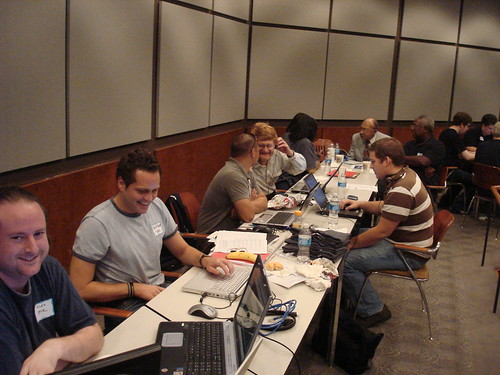
There are a lot of new initiatives getting a lot of attention for mobilizing people with high tech skills to help various causes at individual events: these initiatives bring these people together to spend the day, or maybe a few days in a week, at computers, usually in one big room, with everyone using their skills to do good, eat some good food, take lots of fun photos of everyone in action, and celebrate the great work at the end of the day.

Good stuff. But one of the first organizations to do this, Knowbility, gets lost amongst the much better-funded, higher profile newcomer groups, and it’s such a shame, because more people really should get to know Knowbility!

AIR Houston 2007

Knowbility is a national nonprofit organization based in Austin, Texas that creates technology programs that support independent living for people with disabilities, including veterans. Knowbility’s signature event is its Accessibility Internet Rally (AIR) – a hackathon that brings together teams of web designers to learn about web design accessibility standards, and then to apply those standards in a competition to create web sites for nonprofit organizations. The result of an AIR event isn’t just a fun day and new web sites; all participants walk away with an understanding of web design accessibility standards they didn’t have before that they can apply to their daily professional work, and the volunteer teams, most of them from the corporate sector, learn about the unique work of nonprofit organizations, creating opportunities for better partnerships in the future.

Knowbility’s activities have earned all sorts of awards and recognition – like the Peter F. Drucker Foundation Recognition for Nonprofit Innovation. On September 21, 2000, the White House issued a press release to highlight programs across the country that are helping to bridge the digital divide for people with disabilities and Knowbility’s AIR event in Colorado was mentioned by President Clinton as a new and noteworthy initiative. And I’ll never forget when they got mentioned at the end of Oprah’s talk show, resulting in an onslaught of emails and phone calls and oh-so-much excitement.

Knowbility earns more than 60% of its revenue through fee-for-service offerings. But that means it still relies heavily on grants and donations. Knowbility is worth your financial support. I really want this organization to continue – more than that, I actually want this organization to launch more AIR events and other activities all over the USA, and beyond! Knowbility is worth your investment.

And if you have ever been involved with Knowbility in any way, consider blogging about your expereince, talking about it on your Facebook status update or Twitter feed or Google Plus profile or other social media profile, and linking to the donation page.

Here are some other blogs I’ve written about Knowbility:

Hackathons for good? That’s volunteering!

Volunteer online & make web sites accessible

Volunteer online with TechSoup

I’m doing some work with TechSoup, a nonprofit based in San Francisco, and I’m recruiting online volunteers to help in two roles:

Wiki Contributor/Editor – online opportunity
This is in support of a wiki regarding Online Community Engagement. The goal of the wiki is to provide essential information and links related to online community engagement, particularly regarding the cultivation of communities of practice / knowledge networks. Please visit the wiki to learn more. We’re looking for one – three online volunteers ready to help with proofreading (correction of spelling, checking links, etc.) and adding resources. Volunteers should have excellent writing skills, be an expert at finding resources online, and be ready to see a task through to its completion.

Online Community Forum Subject Expert
Offer advice to nonprofits via the TechSoup online community forum regarding software use, database choices, using tech tools to engage and support clients, remote staff and volunteers, FOSS options, accessibility, building staff capacities, community tech center management, IT security – whatever your area of tech expertise! Frequent community forum participants may be invited to become community moderators, committing for at least three months (with possibility of renewal) to ensuring various forum branches have fresh information every week. Volunteers should have excellent writing skills and an understanding of how nonprofits use at least some aspect of computer or Internet tools.

These are virtual opportunities, and it’s not just for two volunteers – multiple volunteers can help in each of these roles.

Want to apply? In addition to the requirements already stated, you should also have a good understanding of how people and organizations communicate online, have excellent, reliable Internet access, commit to at least two hours a week (10 hours a month), and commit to at least three months in this role.

To apply, click on the volunteer role title and express your interest (via VolunteerMatch).

I’m happy to sign off on any paperwork a volunteer might need for a class. And if you want to call it an internship, I’ll be happy to call it such.

So, why have these roles been reserved for volunteers? Why do I want volunteers to help in these tasks?

  • Fresh ideas from volunteers – there’s just nothing like them. They are unfettered ideas. And such ideas are needed!
  • More involvement of volunteers means more opportunities for people and organizations to participate in decision-making – and this can create more ownership by the community TechSoup seeks to serve.
  • It provides opportunities for professional development; many people are looking for activities that will look great on their résumés, or for a university-level class that requires a practicum. This is a way to help a few folks in that quest – just as many of us have been helped along the way.

Here’s more about justifications for involving volunteers – something I think any organization to do before recruiting volunteers.

When to NOT pay interns

A marketing director is defined by the scope of his or her responsibilities – not a pay rate. Paid or not, you call such a person a marketing director.

An executive director is defined by the scope of his or her responsibilities – not a pay rate. Paid or not, you call such a person an executive director.

A firefighter is defined by the scope of his or her responsibilities and training – not a pay rate. Volunteers can be – and often are – firefighters, despite what the union of professional firefighters wants you to believe.

Often, the term volunteer really is just a pay rate, not a job title. If someone has responsibilities on behalf of an organization, but isn’t paid, he or she is a volunteer. Yet a lot of people have a problem with that label as a classification, like these interns who are upset about not being paid. Call them volunteers, and they have a minor freak out. But that’s what they are – they are volunteers, because they aren’t paid.

The debate should be this: SHOULD interns be volunteers?

What these unpaid interns that are so upset about being labeled volunteers don’t seem to get is that I’m actually on their side: I think they should be paid. They should be employees or short-term consultants, no question. Why? Because

  • the organizations they work for do not have a mission statement for their involvement of unpaid staff (volunteers),
  • the organizations do not have, in writing, why they reserves certain positions and tasks and responsibilities specifically for volunteers rather than employees or paid consultants,
  • the organizations say they don’t pay volunteers because they “can’t afford to” – and as you know, those are fighting words when it comes to saying why you involve volunteers.

May internships be unpaid? Sure! But there must be a stated reason that is not “because we don’t have money to pay them.” That’s just pure exploitation, period.

I worked at a certain very large international NGO that shall remain nameless that was involving unpaid interns in large numbers – and I felt it was incredibly exploitative: nothing was in writing, and people held unpaid internships for months and months for no dicernable reason other than that they were free labor and so desperate for the experience that they made no demands. I didn’t have the power to change the intern policy throughout the organization, but I did for my own department. And here’s the parameters I established that all staff in our department had to adhere to regarding involving unpaid interns:

  • An internship had to have a primary focus on giving the intern a learning experience, not  getting tasks done. Therefore:
    • There had to be a written job description that reflected this primary purpose of the internship.
    • The intern was invited to all agency-wide staff meetings, all staff meetings for just our department, and encouraged to ask to attend staff meetings for other departments, to learn about work across the agency. Staff were encouraged to take interns with them to meetings or events whenever possible, as appropriate.
    • The intern also had one project that was uniquely his or hers, that he or she was responsible for and could put on his or her résumé (for instance, conducting a survey, or evaluating some process and making recommendations for improvement).
    • The intern received job coaching and job search help by other staff members.
  • A person chosen for the internship had to be able to say why they wanted to enter into a profession related to our agency’s work, and say what they had done up to that point, in terms of education, volunteer work and paid work, to pursue that career choice.
  • A person could hold an internship only for up to six months. They absolutely could not hold it beyond six months, no exceptions. An intern could NOT return to our department as an intern again, ever. That reduced the chance of a person being exploited as free labor; it forced rotation in what was supposed to be a role reserved for people learning about our work, not the opportunity for someone to have an unpaid assistant indefinitely.
  • Ideally, the intern that was leaving would overlap with the intern that was coming in by one week, so that the departing intern could get experience training someone, documenting his or her responsibilities, etc.
  • When the intern left, he or she was interviewed about his or her experience as an intern from the point of view of getting the learning and professional development he or she was looking for, and this was used to continually improve internship involvement and to show if interns were getting what our internship promised: a learning experience.

The primary task we reserved for interns was answering the many, many emails that came in regarding an online program by our agency. We found that interns really were the best people for this task: in contrast to giving this task to employees, interns brought freshness and enthusiasm to responses that really shown through. They quickly saw patterns in questions or comments that a burned out staff person might not see, leading to adjustments to web site information and other communications. Also, in my opinion, because the interns were volunteers, they assumed a much stronger customer-advocate point-of-view regarding the people emailing with questions or comments than employees did; the agency could have a real seige-mentality outlook when dealing with anyone outside the organization, while the interns had a mentality of being advocates for those outside the organization.

As I mentioned, I also came up with tasks specifically for an intern to own. It might be an internal staff survey, a customer/client survey, a research project, an evaluation/analysis project, production of a report or online resource, etc. Every intern walked away something that was his or hers, a project that he or her directed or managed or lead, and that employees and other interns contributed to. That gave interns the management experience so many were desperate for.

The problem with having these internships as unpaid: it meant that anyone who couldn’t afford to move to our geographic area and work at least 20 hours a week, unpaid, couldn’t be an intern. That excluded a lot of qualified people. It meant all of our interns were from the USA or Europe. It meant qualified people who couldn’t afford to volunteer (work unpaid) couldn’t be interns. I tried creating online internships specifically for these people, but sadly, we never got qualified candidates to apply for those – though I’ve wondered if there was just too much skepticism about an online internship being a real internship – perhaps it would be easier now.

One last note: yes, I’ve been an intern. I had a summer-long internship at a for-profit newspaper between my sophomore and junior year at university, and I was paid – and it met almost all of the parameters I think an internship should have, paid or not, that I’ve outlined above. I had a year-long internship during senior at my university, at a nonprofit arts center, and I was paid and, again, the role met almost all of the parameters I think an internship should have, paid or not, that I’ve outlined above. My last internship was a summer-long gig after I graduated, at a nonprofit theater, and I was not paid – but, indeed, the role met almost all of the parameters I think an internship should have, paid or not, that I’ve outlined above. None of those internships guaranteed me eventual employment, but they all did end up helping me get the experience and networks I needed for eventual full-time employment. All three organizations, including the for-profit company, looked at their intern involvement as a way of giving back, of cultivating young people into specific professions.

The newspaper paid me because it had to; as a for-profit business, it couldn’t involve unpaid staff. The nonprofit arts organization paid me because they could; they got a grant from the state to do so. The theater didn’t pay me because felt they were offering young people free education and a potential job connection network that aspiring actors, production staff and administration staff couldn’t buy if they had wanted to – not kidding! There was also this you-have-to-survive-this-trial-by-fire-to-work-in-theater attitude that those of us who did survive such wore like a badge of honor. I look back on that experience and, as much as I want to say I was exploited… I do feel like I got experience and connections I could never have gotten otherwise, that the organization really did do me a favor.

Also see:

This article in the New York Times about interns.

Internship Programs Under The Fair Labor Standards Act (USA)
This PDF fact sheet provides general information to help determine whether interns must be paid the minimum wage and overtime under the Fair Labor Standards Act in the USA

Social Inequity and the Unpaid Intern

The blog unfairinternships.wordpress.com

Don’t know Linda Graff? You’re in trouble!

Linda Graff is a volunteer management trainer, with a specialization regarding risk management in engaging volunteers.

Linda is retiring, and Andy Fryer has done an interview with her that talks about her incredible contributions to our knowledge about effective volunteer engagement. It’s worth your time to read the interview.

Readers are invited to comment, and my comment says, in part:

I can’t count how many times I have run to my risk management books by Linda to be able to make a point or even win an argument – and I pretty much dismiss any volunteer management expert who doesn’t have one of her books on the shelf or doesn’t seem to know who she is (blasphemy!).

Every nonprofit organization/mission-based organization needs at least one Linda Graff book on the bookshelf – and staff need to consult such regularly. My recommendation is Beyond Police Checks. It’s North America-specific, but the advice is applicable to any country.

It’s a loss for our sector that Linda is retiring, but I know that she now gets to spend much more time fishing, and that makes me happy.

Fear of Wrestling

You probably won’t hear any well-known social media guru talking about it, you probably won’t hear about it in any social media workshop (except mine, of course), but do you know who is getting the MOST out of social media when it comes to community engagement?

Wrestlers.

Check out 110 Trending Topics in 5 Hours: How WWE Wrestlemania Body-Slammed Social Media:

Behind strong pushes on Twitter and YouTube, WWE Wrestlemania XXVIII laid the smack down on social media last weekend, teaching a digital engagement lesson to the sports entertainment world.

Heck, Wrestlemania taught a digital engagement lesson to the nonprofit world, to ANY world, if those sectors will listen. Also see: How the WWE Is Making WrestleMania More Social Than Ever.

But will you click on those links? Or are you already lifting up your nose at the mere mention of the word wrestling?

Professional wrestling – or, as my people like to call it, rasslin’ – is unbelievably popular world wide. I’ve been stunned at how many wrestling shirts I’ve seen all over the world, including in Kabul, Afghanistan. In Kabul, there are (or, at least, in 2007, there were) gyms in the city that had the images of wrestlers from Wrestlemania in front of their businesses to draw people in (don’t sue, Wrestlemania, just don’t). I couldn’t understand why USAID wasn’t employing stars from Wrestlemania to create public service announcements for Afghans about whatever it is we’re trying to get Afghans to do (support women in microenterprises, support girls going to school, grow wheat instead of poppies, drive on the right side of the road, employ proper water sanitation practices, etc.). I’m totally serious, USAID!

But we cringe at the thought of… sniff… wrestlers being involved in anything noble or high-minded or community-focused like that.

I worked with People Magazine once upon a time to do a pilot online mentoring program with kids in Washington, D.C. – and the People folks wanted celebrities to be the online mentors. At a classroom we visited in the basement of a school (where it was easily over 100 degrees on that stifling hot day), there were probably five kids wearing Wrestlemania t-shirts. I talked to the kids while the rest of our visiting party stood across the room, as far away from the students as possible, and when I asked the students what kind of celebrities they admired, they didn’t name rap stars – they named wrestlers. I was thinking, hey great, we’re getting wrestlers for these kids as online mentors! Later that afternoon, in our followup planning meeting in an air-conditioned room of a then dominant Internet provider in Virginia, a room so cold I needed a sweater, People Magazine staff balked at the idea of wrestlers. They said they were thinking of celebrities such as Martha Stewart and Charleton Heston as possible mentors for these teens. I kid you not – that’s the two people they named in that meeting as examples of proper online mentors for inner-city teens.

It’s worth noting that the first virtual volunteering by a celebrity I have been able to find has been by…  A RETIRED WRESTLER. Mick Foley is a an online volunteer with RAINN (Rape, Abuse & Incest National Network), the largest anti-sexual assault organization in the USA. He talked about his experience as an online volunteer on a November 2010 episode of The Daily Show with John Stewart. In a RAINN web video, Foley says, “I cannot think of a better way to spend a few hours a week than helping someone who needs RAINN’s services.” Learn more about volunteering for RAINN’s Online Hotline.

(Yes, I just burned a bridge with People Magazine. So much for my bid to be one of their most beautiful people. Ah, well.)

Let’s be clear: I actually don’t watch wrestling. Well, now, anyway – when I was 8, I loved watching Bill “Superstar” Dundee on TV. I also loved roller derby in those days. But, indeed, I have moved on. I could not name a modern-day wrestler. I’m not as hip as you might think.

But I haven’t become too sophisticated to say, way to go, Wrestlemania. I’ll happily learn from Wrestlemania and wrestlers when it comes to virtual volunteering, online mentoring, and online community engagement, I’d love to invite your participation in any community engagement activity I’m a part of, and I’ll even use examples of your online activities in my workshops – even while other social media experts and nonprofit management trainers rolls their eyes and cringe.

But I still might call it rasslin’.

Consulting services by Jayne Cravens.