Tag Archives: volunteering

20 Years Ago: The Virtual Volunteering Project

vvlogoThe Virtual Volunteering Project officially launched 20 years ago this month. It was the first attempt by anyone, anywhere, to research online volunteer service and document what works, and what doesn’t. I directed the initiative at its launch – and now, two decades later, I’m in a mood to reflect.

The Virtual Volunteering Project was the brainchild of Steve Glikbarg and Cindy Shove, co-founders of Impact Online (what became VolunteerMatch). In fact, Glikbarg probably originally coined the phrase virtual volunteering, back in the mid or even early 1990s. In its first two years, the Virtual Volunteering Project was funded primarily with the support of the James Irvine Foundation. Additional support in this first phase of the Project came from the David and Lucile Packard Foundation, the Morino Institute and the Mitsubishi Electric America Foundation. The Charles A. Dana Center, a research institute at the University of Texas at Austin, hosted the Project for most of its life.

How did I start on the road to becoming a virtual volunteering expert? In 1995, while working at Joint Venture: Silicon Valley, the two volunteer interns I’d taken on to build web sites for all of the initiatives we were managing said they would prefer to build the sites on their own computers back on campus, rather than at our office, because their computers were better and it was more convenient for them. They would bring their work to me on disks when they were finished. What a great idea! It worked out very well – they got to work on their own schedule, from their homes, on better computers, and I got what I needed. So I offered the option of working remotely part of the time, even most of the time, to every volunteer I recruited after that at Joint Venture. The next year, Cindy contacted me about running a new virtual volunteering initiative she and Steve had just gotten funded. “What’s ‘virtual volunteering?'” I asked. “It’s what you’ve been doing with your volunteers and talking about on USENET!” she replied.

The Virtual Volunteering Project officially launched in December 1996. It was quite rough at first; the vast majority of the programs that involved volunteers donating some or all of their time online never used the phrase virtual volunteering. In fact, that’s still true today! I remember thinking in those first several weeks that most online volunteers would be 20 something men living in Silicon Valley; imagine my surprise to find out, rather quickly, that most online volunteers were women living all over the USA – and beyond! I was also stunned at how quickly I found more than 100 virtual volunteering initiatives, most of which didn’t know about each other. With the help of online and onsite volunteers myself, I researched virtual volunteering activities, created and continually updated web pages about it, and marketed what I was learning, via both traditional press releases and frequent posts to various online discussion groups. I also involved online volunteers myself – more than 300 over more than four years. As a result, I was invited to speak at a lot of conferences and was quoted in a lot of traditional press, like The Wall Street Journal and The New York Times.

I left the Virtual Volunteering Project in Janaury 2001, to prepare for my move to Germany to work for the United Nations to run the virtual volunteering component of NetAid, which became the stand-alone Online Volunteering service. I got that UN job because of my online activities, including participation in various online communities. In subsequent UN and international work, even when the focus isn’t virtual volunteering but, say, communications, I’ve found a way to inject at least a little virtual volunteering capacity building and involvement into the work.

Now, it’s 20 years after the launch of the Virtual Volunteering Project, which is archived here. Not much has changed in terms of best practices in virtual volunteering, the practices that make virtual volunteering effective for nonprofits, NGOs, government programs, schools and more, though there’s lots of new jargon now in the mix: micro volunteering, crowdsourcing, digital volunteering, the Cloud, etc.

vvbooklittle The Last Virtual Volunteering Guidebook, by Susan J. Ellis and myself, is our attempt to document all these best practices over the more than three decades virtual volunteering has been happening, in a comprehensive, detailed way, so that the collective knowledge can be used with the latest digital engagement initiatives to help people volunteer, advocate for causes they care about, connect with communities and make a difference. It’s a tool primarily for organizations, but there’s also information for online volunteers themselves. It’s available both in traditional print form and in digital version. Thanks to everyone who has purchased it so far! Bonus points if you can find the sci fi/fan girl references in the book…

Also see:

Early History of Nonprofits & the Internet

Al Gore Campaign Pioneered Virtual Volunteering

Lessons on effective, valuable online communities – from the 1990s

Online volunteers created a music festival in St. Louis

Updated: research regarding virtual volunteering

How did volunteers impact the 2016 USA Presidential election?

social cohesionIn 2012, I knew that President Obama was going to be re-elected because of the number of people volunteering for his campaign was far, far more than the Mitt Romney campaign. And I was right.

Four years later, I thought, like most everyone, that Secretary Hillary Clinton was going to win because, like President Obama, she had a far superior official deployment of volunteers, and management of such, than the Donald Trump campaign. She did, indeed, win the popular vote, garnering more than two million more votes than Trump and also receiving more votes than any person in the history of the USA for President except for President Obama. But she lost the election because of the USA’s archaic electoral college rules. Even with that popular vote win, however, the race was far, far closer than I ever expected, given the massive difference in volunteer numbers for the two campaigns.

PBS profiled the gap in the number of Trump volunteers versus those of the Clinton campaign in August, noting “the Trump campaign faces a jaw-dropping gap in the ground game: Hillary Clinton currently has more than three times the number of campaign offices in critical states than does Donald Trump.” As of Aug. 30, Clinton had 291 offices in 15 battleground states, compared to just 88 for Trump. Clinton was using a refined version of the data-driven, on-the-ground volunteering machine that won two elections for Barack Obama. “Trump, on the other hand, insists he does not need traditional campaign tactics to win the election, pointing to his overwhelming nomination victory achieved with a relatively small team and little spending.”

Then, in early November, FoxNews.com noted that, while Trump had far, far fewer official offices and official volunteers than Clinton, he had people acting entirely independently on behalf of his campaign, “an army of volunteers who began boosting his ground game, in some cases, before the professionals got heavily involved.” The outlet “talked to volunteers in five western states who were among Trump’s main source of on-the-ground support at a time when neither the Trump campaign nor the RNC had dedicated staff.” These volunteers were calling friends, hosting campaign parties, posting signs, sharing information on social media and registering voters, entirely on their own, with no official direction.

Volunteers who officially signed up for Donald Trump’s campaign, to help with phone banking, had to sign a lengthy, jargon-filled nondisclosure agreement that would prevent them from saying anything bad about the GOP nominee, his family, companies or products for the rest of their lives. You can see the entire contract here and highlights of the most outrageous parts of the agreement here. By contrast, Hillary Clinton’s campaign didn’t require phone bank volunteers to sign any sort of agreement – which was probably a big factor in her having far more official volunteers. And also by contrast, unofficial volunteers for Trump also never signed any agreement, and there was no organization counting them in the official volunteer rolls – they took their campaign action ideas from each other, not the campaign.

The reality is that this election was not won by volunteers nor volunteer management. In fact, a headline of one of my earlier blogs, Volunteers are more important than social media in Presidential elections, has been proven wrong by this election, as my blog before the one you are reading now details. Social media DID win this election. It proved an ideal vehicle for promoting misinformation and generating fear and excitement that turned into action. As I noted in my last blog, BuzzFeed reported that fake news stories about the USA Presidential election this year generated more engagement on Facebook than the top election stories from 19 major news outlets COMBINED – that included major news outlets such as The New York Times, The Washington Post, CNN, and NBC News, and on and on. And the majority of these fake news stories did NOT come from any campaign operatives; rather, they came from a man in Los Angeles who originally built fake news sites as a way to expose the extreme right, a plan that most certainly did NOT work. And these fake stories, most of which promoted Trump for President and made false claims regarding Hillary Clinton, were shared by millions of people via social media – independent, passionate volunteers who believed them.

What does this mean for the future of volunteer engagement in Presidential elections? Please share your thoughts in the comments below.

Also see:

Al Gore Campaign Pioneered Virtual Volunteering

Update:
Donald Trump might be more popular than you think, from Politico, Feb. 2, 2017

2017 National Summit on Volunteer Engagement Leadership

The Minnesota Association for Volunteer Administration (MAVA) is going to host the first national conference in the USA in more than a decade for people in charge of supporting and involving volunteers. The 2017 National Summit on Volunteer Engagement Leadership will be
July 26 – 28, 2017 in St. Paul, Minnesota. If you want to present at the conference (presenters are NOT paid), your proposal is due November 30, 2016. Please review the Request for Proposal Instructions before submitting a proposal.

Registration to attend the conference will open February 1, 2017.

It’s great that someone is attempting to have a national conference for managers of volunteers – it hasn’t happened in the USA since 2005. Back in 2006, the Association for Volunteer Administration (AVA), the national association of managers of volunteers, went under, due to financial mismanagement. With it went the annual national conference, the largest event in the world focused on the people and systems needed to support and involve volunteers, and event that helped elevate conversations about volunteerism beyond people-that-work-for-free-are-so-nice. The loss of AVA and its annual conference hurt not just managers of volunteers, but all volunteerism – there was no one who was championing the people in charge of creating tasks for volunteers and supporting volunteers in those tasks, and there was no one advocating for the resources those people need to do those jobs. I believe it’s why it’s been so hard to refute claims that the best way to measure volunteer value is by giving a monetary value to service hours, and why, in this era where everything is about community engagement, managers of volunteers at nonprofits have been largely left out of the conversation.

I would love to attend but, unfortunately, I don’t have the funds. If you would like to sponsor part or all of my flight or accommodation costs, please contact me ASAP at jc@coyotecommunications.com (as the deadline for presentation proposals is Nov. 30, I need ot hear from you before then!).

And on a side note: if someone doesn’t update the Wikipedia page for the Association for Leaders in Volunteer Engagement (ALIVE) with citations OTHER than the ALIVE web site, the page is going to get deleted. I’ve donated a LOT of time to updating volunteering-associated pages on Wikipedia – it’s time for others to step in.

Al Gore Campaign Pioneered Virtual Volunteering

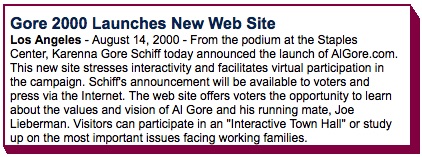
algoreweblaunch
Back in 2000, when Al Gore ran for President of the USA, his campaign championed virtual volunteering, including microvolunteering, by recruiting online volunteers to help online with his election efforts. I was getting ready to leave the Virtual Volunteering Project at the time, to work for UNDP/UNV in Germany, and was not able to document these pioneering efforts at the time. I remembered this effort recently, per the current (and seemingly never-ending) Presidential campaign in the USA, and went digging on archive.org to find the original materials from that campaign regarding this work with online volunteers. They are worth looking at – they are still an excellent example of how to clarify expectations for a virtual volunteering role, something I emphasize again and again in The Last Virtual Volunteering Guidebook. They also show that virtual volunteering, including microvlunteering, is NOT a new idea.

He even had an “app” for people with personal digital assistants (PDAs), the precursor to the smart phone.

Somewhere on the archived Gore-for-President site is also a mention of either online volunteering or virtual volunteering, but I can’t find it anymore…

And by the way: Al Gore never claimed he invented the Internet. But he was most certainly one of the visionaries responsible for helping to bring it into being, by fostering its development in a legislative sense.

cover of Virtual Volunteering book with hands raising up various Internet connected devicesFor the present day: the Last Virtual Volunteering Guidebook: Fully Integrating Online Service Into Volunteer Involvement can help your nonprofit, NGO, charity, government program or other group introduce virtual volunteering, expand your virtual volunteering, and improve how you use the Internet to support ALL volunteers. These can can be volunteers in short-term, “microvolunteering” tasks or longer-term, more high-responsibility roles, and everything in between. These can be volunteers who do some or most of their service onsite, at your organization or volunteers who do most or all of their service remotely, rarely or ever onsite and in-person with you. This is the most comprehensive resource anywhere on working with online volunteers, and on using the Internet to support ALL volunteers, including those you might not think of as “online” volunteers.

If you have benefited from this blog or other parts of my web site and would like to support the time that went into researching information, developing material, preparing articles, updating pages, etc. (I receive no funding for this work), here is how you can help.

Also see:

Research Explaining How Websites Encourage Volunteering & Philanthropy

graphic by Jayne Cravens representing volunteersMost practitioners in volunteer management and community engagement don’t have time to review academic literature to see if there might be information that’s helpful in their work – and even if they do have time, academic language can be inaccessible for non-academics. I try to read as much as I can and then summarize and pass on the information that can help practitioners in their work, or even just give them ammunition for a project or funding proposal.

Below are links to two academic papers that are worth at least a skim by anyone trying to use web sites to encourage philanthropy, including volunteering. The reference lists at the end of each papers are gold mines of research for further reading:

Persuasion in Prosocial Domains: Explaining the Persuasive Affordances of Volunteering
by Peter Slattery, Patrick Finnegan and Lesley Land, all three of the Australian School of Business, UNSW Australia, and Richard Vidgen of Hull University Business School, University of Hull, UK. Presented at the Twenty Second European Conference on Information Systems, Tel Aviv, 2014.

Abstract: As technology becomes increasingly pervasive and invasive, it increasingly facilitates and instigates behaviour. Prosocial behaviours, such as volunteering, activism and philanthropy, are activities that are considered to be particularly beneficial to others. Prosocial behaviours are important within IS as: (i) they are encouraged by IS stakeholders including volunteering organisations and charities, and; (ii) they contribute to tackling social issues. However, while information technology is poised to become increasingly important for facilitating prosocial behaviour, little is known about how digital artefacts can encourage it. To address this research gap, this study seeks to explain how website features persuade in prosocial online contexts. The study uses the Repertory Grid Technique (RGT) to examine individuals’ experiences of persuasion on live volunteering websites. The analysis reveals that ease of use, trust, and creating positive emotion are important factors in persuading users to volunteer.

Examining How Perceptions of Websites Encourage Prosocial Behaviour
by Peter Slattery, Patrick Finnegan and Richard Vidgen of Australian School of Business, UNSW Australia. Presented at the Thirty Seventh International Conference on Information Systems, Dublin 2016.

Abstract: Organisations are increasingly reliant on information and communications technology (ICT) to encourage prosocial behaviour (i.e., volunteering, philanthropy and activism). However, little is known about how to use ICT to encourage prosocial behaviour. Given this research gap, the objective of this study is to outline and test a research model that assesses the role of specific perceptions of websites in encouraging prosocial behaviour. To do this, we review the literature to derive a theoretical model of relevant perceptions. We then test the extent to which this model can predict participants’ volunteering and philanthropic behaviour subsequent to their usage of a website that encourages prosocial behaviour. The findings are expected to contribute by (i) giving insights into how perceptions of websites encourage prosocial behaviour, (ii) explaining the roles of negative and positive affect in ICT domains, and (iii) developing a “persuasiveness of website scale” to help IS researchers to measure this construct.

In addition, Mr. Slattery’s 2016 PhD thesis is Explaining How Websites Are Used to Encourage Volunteering and Philanthropy. The thesis restricted from public access until March 2018, but some of its research is repeated in the aforementioned papers.

Also see this list of research and evaluations of virtual volunteering, as a practice in general or focused on specific projects, on the Virtual Volunteering wiki.

Some Truths About Volunteer Retention

graphic by Jayne Cravens representing volunteersI’ve been trying to draft a blog about volunteer retention… and then read the latest update from Susan Ellis and Energize, Inc. and her article said it better than I can say it myself. This is reposted online with permission from Susan:

SOME TRUTHS ABOUT VOLUNTEER RETENTION

Schools used to focus on the 3 Rs (reading, ‘riting, and ‘rithmetic), but in volunteer management we have the 2 Rs: recruitment and retention. I can’t tell you how often I’ve been asked to speak on both in a single session! Apart from this request minimizing what it takes to do all the critical tasks of volunteer management, the real problem is that recruitment and retention do not mirror each other.

You can do activities to recruit volunteers, interview them, train them, etc. But you cannot spend Tuesday mornings “retaining” them. Retention happens when everything else is going right. It is an outcome, not a task.

One of the problems with retention is defining it. People often ask me what a “good rate” of retention is, as though there is some external standard for all volunteer programs. Of course there is no such thing.

The desire to measure effective retention is tied to the fervent wish that volunteers might stay forever! Turnover has to be anticipated and planned for (and I might mention that there is lots of turnover among employees, too). How realistic are your expectations for the length of time volunteers will remain with your organization?

Some volunteers leave because things have changed in their own lives…and you had nothing to do with it. People get married, have babies, move away, change jobs, become ill – that’s life. The only thing you can do is leave the door open for a possible return. A volunteer who is forced to leave for external reasons may be willing to remain involved as a trainer of new volunteers, as an on-call substitute in a pinch, or at least as a reader of your newsletter. If the person is moving to another city, might you refer them to a counterpart program in the new location?

Here are some thoughts to ponder:

  • Retention can only be defined in relation to the commitment made by each volunteer at the start of service. So your recordkeeping system should show the amount of time the volunteer promised during the interview and then, if the person stays to that point, you have “retained” them! Anything afterwards is additional.
  • Do you clearly state the minimum commitment that is needed from a volunteer to make the training period worthwhile or to be able to make a difference to the client or cause? (This may be a different amount of time for each volunteer position.) Then, when you interview applicants, do you discuss anticipated length of stay? If neither of these things happen, how can you possibly know what volunteers intend to do in terms of longevity?
  • If a lot of volunteers leave in the first months of their work, it’s a symptom that what they expected and what they experienced did not match. Recruiting and interviewing are the start of the retention process!
  • Is there a pattern to when and from where volunteers drop off? Does one unit seem to keep people happy for a long time while another unit has a revolving door of new recruits? Analyze why and problem solve the situation.
  • Who is staying? Are you keeping long-time volunteers or the best volunteers? These may not be the same people! Again, assess what is going on. If newer recruits or people with top skills seem to become disenchanted with the program, why? How can you re-commit them?

The list of reasons why people volunteer in the first place is very long. After time, however, the reasons volunteers remain committed to your organization distills down to four factors:

  • The work they are doing is visibly meaningful
  • They feel appreciated for their service
  • They continue to learn and grow
  • They enjoy it
  • Quite simple, really – and the outcome of a welcoming, well-run volunteer program.

This outstanding blog content comes from Susan J. Ellis, President of Energize, Inc. More of Susan’s wisdom via her amazing books and services. It is HIGHLY recommended you subscribe to Energize Inc.’s FREE Monthly Volunteer Management E-mail Update for more great stuff!

Volunteering & social cohesion in a post Brexit world

social cohesionOn 15 September, the National Council for Voluntary Organisations (NCVO) National Volunteering Forum met in Manchester, England to talk about the potential implications of Brexit for volunteering, and to discuss evidence and real life examples demonstrating the role that volunteering can play in improving social cohesion. The slides from the event are shared online, and the associated tweets, here.

The tweets are SO worth reading, a mix of comments said at the forum and comments from people following online. GREAT questions and comments that will give you pause, because you shouldn’t think of obstacles to social cohesion as just a British phenomena: all over Europe, as well as the USA, Pakistan, India, Afghanistan, Mexico, and on and on, societies are struggling with divided socio-political landscapes. Emotions are running high, driving nationalist movements and, often, racist and xenophobia movements as well. In many places, neighbors aren’t talking to neighbors because of differences in politics, religion, language, values and more.

As I note in my paper “Internet-mediated Volunteering in the EU: Its history, prevalence, and approaches and how it relates to employability and social inclusion” for the European Commission in 2014, researchers for vInspired, in exploring the contribution of volunteering to employability for young people, found that volunteering contributed to young people’s feeling of social inclusion:

  • Volunteering helped young people to develop their networks and mix with a more diverse social group. It also increased their ability to work within and across authority structures. This suggests that providing volunteering opportunities to a wide range of young people will help to break-down social barriers and lead to greater community cohesion and personal well- being.
  • The positive contribution made by young people to the organisations and communities with which they were involved, helped to overcome the negative stereotypes often applied to them, and improved perceptions of young people amongst adults such as staff, volunteers and service users.
  • Many young people are currently in a precarious economic position with the high level of youth unemployment, and some commentators are warning of a lost generation. Helping young people to stay connected to society and their communities, to develop leadership and employability skills that will shape their future, is one of the most urgent and critical tasks of the next decade.

As I note in that paper, this and other research demonstrates that volunteering can play a crucial role in building the personal resilience and capabilities that young people need to prosper in the work place and in society in general.

However, garnering those benefits from volunteering, as well as using it to encourage social cohesion, multi-cultural understanding, reconciliation, etc., is a tall order giving the current landscape in many countries:

  • War and dire economic circumstances are driving immigration at a historic rate, with desperate people seeking to migrate to more peaceful, prosperous countries, straining resources and emotions of those living in areas immigrants want to travel through or to.
  • Different ethnic, socio-economic and religious groups, among others, are clashing over everything from perceived threats to their culture and values to police relations to access to jobs to perceptions of crime rates and quality of life compared to the past.
  • Certain people are being excluded from participating fully in the societies where they reside, or from receiving the same employment, educational, societal and other benefits others in that society may receive. These people feel they are marginalized, that they have limited access to decision-making bodies, various institutions and employment.
  • Some people’s religious and ethical values clash with public social and working life, where others that have different ethical values also socialize and work. Not everyone embraces ideas of free expression, equality for all humans in all aspects of life (employment, education, marriage, etc.), democracy, non-traditional roles for women, and the value of diversity and inclusiveness. When these people are living in a society that insists on these values, by practice and laws, hostilities can arise, with ideas of tolerance and multicultural understanding clashing with deeply held beliefs and legal practices regarding human rights.
  • Change is rampant and is frightening to many people, particularly when economic situations are fragile, or perceived as such. People are hearing different languages than the one they have grown up with, they are seeing people dressing in a way that’s different than what they believe should be the cultural norm, and technology is rapidly changing employment, education and how services are delivered. The popularity of a restaurant serving food that isn’t perceived as indigenous or is perceived as being from a country local people don’t like, a poster in a church that isn’t in the official or unofficial national language,  a woman not wearing what local people believe she should be wearing – all of these acts can be perceived by a community as a threat to their local culture and values, and lead to hostilities.

The result of all of this is people feeling more and more powerless over the decisions and forces that affect their day to day lives. Fear and uncertainty is sweeping many communities, misinformation is rampant, and everything in the environment feels politicized. Many communities are becoming more segregated, with people choosing to live and socialize with people they perceive as like them in terms of culture and values, and choosing to stay away from festivals, neighborhoods, even restaurants where they believe a different culture prevails.

Can volunteering help bridge divides, increase understanding, reduce hostilities and nurture respect and social cohesion? Certainly there are organizations and researchers that think so:

What’s lacking is research showing that these efforts have, indeed, lead to multi-cultural understanding, a lessening of hostilities, etc. 

In my paper about Internet-mediated volunteering in EU countries, I identified challenges to promoting online volunteering as a pathway to social inclusion, and I believe it is, in fact, the biggest challenge for ANY volunteering as a pathway to social inclusion: resistance to including social inclusion goals into current volunteer engagement at an organization. In other words, most managers of volunteers don’t want to make social inclusion a part of their goals for volunteer engagement. Most organizations that involve volunteers have no stated reason relating to contributing to greater social inclusion for volunteers. They may not see the benefits of adapting their volunteer engagement to contribute to such. They may not have the expertise in how to do this. And they may not have the resources needed to build their expertise to do this. Agencies may resist adapting volunteer engagement schemes to include a social inclusion element, for fear of it draining resources or focus from their primary missions which may have nothing to do with social inclusion. In short: any effort to leverage volunteering as a path to greater social cohesion has to include money to pay for training of those in charge of volunteering engagement at various agencies. Otherwise, such efforts will, every likely, be doomed to failure.

Also see:

Managers of volunteers & resistance to diversity – my blog about comments that are generated when a discussion breaks out about diversifying volunteering ranks.

This lesson plan from the University of Nebraska Extension office, “Engaging Intergenerational Volunteers“, offers practical tips on having volunteers from a variety of age groups working together, as does this how-to guide from Bridges Together.

The Victoria Volunteering Portal (Australia) offers an excellent free guide on encouraging diversity among volunteer ranks.

I also offer my own free guide on Recruiting Local Volunteers To Increase Diversity Among the Ranks.

Song of frustration re: volunteering

handstopDave Carroll became famous for writing a song and making a video about United Airlines smashing his guitar and not taking responsibility for it. The video went viral, Mr. Carroll not only appeared on various media outlets as a result, including CNN and The View, not only did United give him the financial settlement and apology he’d been demanding for months, he also became a paid speaker for various conferences and retreats, talking about “inhuman customer-service policies” and their unseen costs: loss of customer trust (and, therefore, customers), brand destruction, and more.

In February of this year, after he tried to volunteer at his son’s school, Mr. Carroll produced another song and video, this one about his frustration at trying to volunteer at his son’s school. It’s called “There’s Got to Be a Better Way.” You can watch the entire video, where Mr. Carroll makes fun of the volunteer screening at length, or just jump to the song about the experience at the 5:56 mark.

IMO, the video and song are a PERFECT example of thoughtless volunteer screening, where nonprofit and public sector organizations are interested just in checking a box rather than doing MEANINGFUL, effective screening of someone to work with kids.

I am so tired of seeing the question on discussion groups for managers of volunteers: “Where can I get a cheap criminal background check for potential volunteers?” or “How do I get a discount at the police station for police to do background checks of potential volunteers.” These people are looking for a box to check, rather than creating a culture that keeps everyone safe. Instead, read Screening Volunteers to Prevent Child Sexual Abuse: A Community Guide for Youth Organizations (it’s free to download) and use its very effective ways for screening out inappropriate candidates and creating a culture of safety. Combine it with Beyond Police Checks: The Definitive Volunteer & Employee Screening Guidebook by Linda Graff, available from Energize, Inc. (but not for free), and you’ve got a solid, more-than-basic understanding of risk management in volunteer engagement activities, and know how to better assure safety without driving away quality volunteering candidates. You also will understand how mindlessly enforcing protocols, without thinking about their purpose, doesn’t keep anyone safe.

Also see these related blogs:

Screening applicants by reviewing their online activities

Safety in virtual volunteering

Keeping volunteers safe – & keeping everyone safe with volunteers

That moment when you totally change your mind about volunteer engagement

wizardAn email I received a few days ago. I’ve changed it a bit to hide the identity of the author:

I want to thank you, sincerely, for challenging me to think about my understanding of volunteering. You really got me thinking. I had a 3.5 hour drive ahead of me last night, and the discussions around mandated community service and volunteerism kept rolling around in my mind. In my current role, I haven’t really had to think about court mandated service as volunteering and from personal experience, I don’t know if those mandated, would consider themselves volunteers? I am trying to resolve this, for my own benefit at this stage, and I am finding it quite difficult! I intend on mulling this over a bit more. I trying to consider the benefits/detriment of either belief…. Challenged? Yes!

I love making people uncomfortable about volunteer engagement. I love challenging oh-so-solid notions about who is and isn’t a volunteer, the value of volunteering, and why people volunteer. Why? Because volunteer engagement is so much bigger than just, “We’ve got work to do. Let’s get some good-hearted people to do it for free!”, and I so want this mentality to change!

The results of this? I’ve made people angry. I’ve made people tear up. Some people have double-downed on their oh-so-rigid definitions. But most, while challenged, have also been inspired. They don’t all come to the exact same conclusions as me regarding volunteer engagement and its value, but they definitely broaden their original ideas.

I remember my big ah ha moment regarding volunteer engagement, via an event by Triumph motorcycles. And my blog, Should the NFL involve volunteers for the Super Bowl?, talks further about why I changed my mind about volunteers supporting for-profit settings, in certain situations.

Want me to challenge your organization? Complete details about my consulting services.

Also see:

Have you ever changed your mind?

Volunteer manager Fight Club

Missed opportunity with #volunteers: “No one ever asked me for my name. They didn’t have a sign in sheet.”

Promises & Pitfalls of Global Health Volunteering

Dr. Judith Lasker, a professor at Lehigh University, published Hoping to Help: The Promises and Pitfalls of Global Health Volunteering” in January 2016. I have not read it. According to The New York Times review of the book, Dr. Lasker presents data from a few hundred programs that coordinate mostly short-term assignments (lasting weeks rather than months), gleaned from several surveys, dozens of interviews and some brief trips of her own. She did not look at large organizations like Doctors Without Borders , which are organized differently and generally do not use unpaid volunteers or, if they do, require much longer commitments for assignments.

“There is little evidence that short-term volunteer trips produce the kinds of transformational changes that are often promised,” Dr. Lasker finds. Of course, not all short-term volunteering is the same, but Dr. Lasker says the criticisms must be taken seriously, and that the most frequently published critiques have appeared in medical journals, which address the ethical problem of allowing medical students to work far beyond their training in communities with few resources. I would love to see some of these academic articles!

Sadly, few of these programs have been evaluated in terms of their impact on the communities where they serve. While the impact of surgical programs can be obvious and dramatic, efforts at screening for disease and disease prevention are often far less so. A representative of one program memorably told Dr. Lasker that they “just know” their work makes a difference, while a sizable minority of programs attempt no formal analysis of their achievements. Lasker asked for such and was in for a shock: “I did not expect how often the evaluation question seems to take people by surprise.” According to the Times, more than one of Dr. Lasker’s sources mused that the most beneficial aspect of the volunteer effort might be the cash infused into a community from the fees volunteers usually pay.

In addition, this short-term volunteering can lead to LESS understanding by volunteers of poverty. In an interview about the book, she notes that some participants come back with what she calls “bad learning,” and saying: “Poor people are so happy; they smiled, and sang and danced, and they don’t mind being poor”, stereotypes about poverty “based on spending a week where you don’t understand the language and where you only talk to people through translators.” (Also see: Extreme poverty is not beautiful)

“The developing world has become a playground for the redemption of privileged souls looking to atone for global injustices by escaping the vacuity of modernity and globalization.”

Dr. Lasker says, “Ultimately, my goal is not to advocate for all volunteering or to call for its dismantling. Rather, I hope to contribute to making it more effective and valuable to all concerned.” I feel exactly the same when I write about such.

Also see this story about lessons from the book Dr. Lasker teachers in one of her classes. And this blog by Dr. Lasker, “Orphanage visits–are they ever okay?”

And also see my own blogs on similar subjects: