Tag Archives: tech4good

Finding out how many orgs are involving online volunteers

A followup to my last blog, where I whined that so many organizations charged with measuring volunteering in a region or country refuse to ask any questions related to virtual volunteering.

As I’ve said many times: when I do workshops on virtual volunteering, and describe all the different aspects of what online volunteering looks like, including microvolunteering, someone always raises a hand or comes up to me afterwards to say, “My organization has online volunteers and I didn’t even know it!” or “I’m an online volunteer and I didn’t know it!”

If you ask organizations, “Do you have virtual volunteering / microvolunteering at your organization?” most will say “No.” But if you ask the question differently, the answer is often “Yes!”

How would YOU ask the question of organizations to find out if they were engaging volunteers online?

Here’s one idea:

In the last 12 months, did any volunteers helping your organization work in whole or in-part offsite on behalf of your organization, and use their own computers, smart phones, notebooks (Internet-enabled devices) from their home, work or elsewhere offsite, to provide updates on their volunteering, or the results of their volunteering?

What is your idea for ONE question? Please post it in the comments.

Challenges to getting answers:

  • There’s rarely just one person at an organization involving volunteers; often, several employees or key volunteers are involving volunteers, but there may not be one person tracking all of this involvement. So if you ask this question of just one person at the organization, you might not get an accurate answer.
  • The word volunteer is contested. People will say, “Oh, we don’t have volunteers. We have pro bono consultants, we have unpaid interns, we have executives online, we have board members, but we do not have volunteers.” That means someone who is advising your HR manager regarding the latest legislation that might affect hiring or your overworked marketing person regarding social media, and offering this advice unpaid, from the comfort of his or her  home or office or a coffee shop, won’t be counted as an online volunteer – even though they are. In fact, I talked to the manager of an online tutoring program who brought together students and what she called “subject matter experts” (SMES) together online for school assignments, but because it never dawned on her that the SMES were volunteers (unpaid, donating their service to a cause they believed in), she had no idea she was managing a volunteer program, let alone a virtual volunteering program.

This is not easy. I’ve been researching virtual volunteering since 1996 and, geesh, it’s still not easy! When does it get easier?!

Volunteer online ever? I’d love your photo!

jayne at computer 2002Do you help, or have you ever helped, a nonprofit organization, non-governmental organization (NGO), grassroots organization, school, or other civil society organization (CSO) via a computer or smart phone, as a volunteer (that means unpaid, NOT as a paid employee or paid consultant)?

Maybe you volunteered onsite as well, but at least sometimes, you also volunteered offsite, designing a database or graphic or web site, editing a document, translating text, offering professional advice, moderating an online discussion group, tagging photos or mentoring someone.

Maybe it was called virtual volunteering. Or online mentoring. Or cyber service. Or microvolunteering. Or crowd-sourcing. Or cloud computing volunteering. Or Internet-mediated service.

Or maybe it was just called volunteering, plain and simple.

Whatever it was – or wasn’t – called, I want your photo! Why? I want to feature such photos at this Flickr Group, “Online Volunteers.”

Photos of yourself with a computer or tablet or smart phone would be great, but so would a photo of you with your dog. Or your kids. What’s most important is that you don’t just submit a photo; you also should describe what you do as an online volunteer, including either the name or a description of the organization(s) you support.

ALSO, please tag your photo “online volunteer” (use quotes in the tagging process).

Submit the photos directly to the Flickr group for online volunteers– which means you will need a Yahoo ID. If you don’t already have such, and don’t want one, you can send ONE photo to me, via email, however, please clearly note in your email who you are, why you are sending the photo, etc.; blank emails, or those with sketchy descriptions, will be discarded without viewing (to protect myself from computer viruses). Photos that don’t clearly represent online volunteers will be rejected – that’s why your description is SO important.

Please share this message to volunteers you work with, or anyone you think might be interested.

Goal: to show the diversity of online volunteers out there. The practice of online volunteering is more than 30 years old. I want to show just what a HUGE group of people volunteer online, and have been doing so for a long while now!

Looking forward to your photos!

Ugh – Slacktivism (I still don’t like it)

UNICEF Sweden has an image that’s floating around the Internet and causing quite a stir:

“Like us on Facebook, and we will vaccinate zero children against polio. We have nothing against likes, but vaccine costs money…”

It’s part of a fundraising and awareness campaign by UNICEF Sweden that includes this video  (subtitled in English). The point is a powerful one: “liking” something on Facebook, or sharing a status update, or retweeting something, often has no impact at all beyond a momentary “Oh, that’s sad” moment for the viewer. By itself, it does NOT create any real impact.

Danny Brown, a blogger and author, doesn’t like the campaign; he thinks slacktivism or slackervism campaigns – where a person is encouraged to “like” something on Facebook and feel like he or she has made a difference – are terrific.

As I’ve said before, I LOATHE slacktivism. As a consultant and researcher that works with nonprofits every day regarding community engagement and fundraising, I see again and again just what little return on investment the vast majority of nonprofits get for investing in such campaigns. I also see the endless posts by young people on YahooAnswers who believe this is all they have to do – like something or click on something – to make a difference, and don’t understand why they have to actually volunteer or donate something to actually support a cause. These campaigns imply that actually donating money, volunteering, writing a letter to a politician or turning out for a demonstration aren’t really necessary – just click “like” and we’ll solve domestic violence, homelessness, hunger animal abuse, and on and on! It’s a misconception that is growing – and it’s creating generations of people who don’t see the point of actually investing time or money.

I note in detail in this blog from 2010 why slacktivism does NOT generate donations or increased awareness for most nonprofits or causes – and the blog also notes nonprofits CAN (and do) use Facebook, Twitter and other social networking sites to create a real social marketing/health marketing campaign, with real impact (changed behavior, new awareness, etc.) – so I won’t repeat myself here.

And for those who want to accuse me of being a Luddite, or implying that the Internet isn’t an effective way to donate time and talent to a nonprofit, NGO, charity, etc. – I’ve been promoting virtual volunteering since the mid-1990s. Online action can have HUGE impact for a mission-based organization. But it takes more than just a “like” on Facebook. 

Also see: what ROI for online action really looks like.

Looking for EU charities & NGOs to offer feedback

I’m looking for employees, consultants and volunteers at charities and NGOs based in the European Union to comment on any or all of the following three (3) subjects, based on their own observations or experience. Various people at one organization can comment, since different people at any one organization may have different perspectives. The identity of anyone who responds, and that of any organization a respondent represents, will be kept anonymous in any published material that might include that person’s comments unless that person gives express written consent otherwise.

If you are an employee, consultant or volunteer at a charity or NGO based in the EU, I welcome you to comment on any or all of the following three subjects, in a direct email to me at jc@coyotecommunications.com or, if you want your identity and comments to be fully public, in the comments section of this blog:

(1) The lack of widely-available online volunteering work in the EU, compared to, say, the USA, may include:

  • lack of support at charities, NGOs and other organizations for the engagement of volunteers (online or off); support includes staffing, knowledge and funding
  • lack of understanding regarding the value of volunteer engagement, in general (not just online) for a charity or NGO
  • lack of awareness or understanding regarding online volunteering
  • lack of availability of online tools at charities, NGOs and other organizations for the engagement of online volunteers (many organizations have prohibitions instituted by senior management or the IT department with regard to using social media, VOiP technologies like Skype, or cloud-based platforms)

Do you agree? Disagree? Have comments?

(2) For organizations based in the EU that are involving volunteers online in any way (this can include volunteers from outside the EU):

  • Why did your organization start involving volunteers online?
  • What did you have to do or change at your organization to start involving volunteers online?
  • How have you evaluated the impact of the work of online volunteers at your organization (and if you have not evaluated the impact, why not?)
  • Have any of the volunteers who have contributed to your organization somehow online said that their online volunteering experience lead to paid work, to their greater employability or to career advancement?

(3) Obstacles to leveraging online volunteering work into greater employability/career advancement in the EU may include:

  • lack of available online volunteering work
  • lack of awareness of this type of volunteering among those seeking/needing employment
  • perceptions among potential employers regarding the value of volunteering, online or onsite, for application to paid work (“it’s just volunteering” or “you were just volunteering, rather than really working”)

Do you agree? Do you think these factors might affect this as well:

  • lack of computer or Internet access?
  • lack of basic skills needed to engage as a volunteer online?
  • lack of literacy?

If you are based in the EU and work for an organization based in the EU, as a paid employee, consultant or volunteer, and this organization involves volunteers online in any way, and you have any comments or questions on the aforementioned three subjects, I would welcome your response. The identity of anyone who responds, and that of any organization a respondent represents, will be kept anonymous in any published material that might include that person’s comments unless that person gives express written consent otherwise. If you are an employee, consultant or volunteer at a charity or NGO based in the EU, I welcome you to comment on any or all of the following three subjects, in a direct email to me at jc@coyotecommunications.com or, if you want your identity and comments to be fully public, in the comments section of this blog.

Why am I asking? Because I am working on a research project for the EU for the next several weeks. The project is called the ICT4EMPL Future Work project, and I am contacting various organizations based in the EU, or that have offices in the EU, and that I know, or strongly suspect, involve online volunteers. I define online volunteers as people who do some or all of their volunteering (unpaid service) for an organization via the Internet, via a computer, smart phone or tablet they are using from home, work, school, or elsewhere offsite from the organization. The online volunteers that your organization involves do not all have to be in the EU.

My part of this research is to explore the state of play of internet-mediated volunteering: virtual volunteering, microvolunteering, crowd-sourced labour, crowdfunding, internet-mediated volunteering, internet-mediated work exchange (timebanks and complementary currency), etc., with regard to developing entrepreneurship and self employment, skills and social inclusion, and transition from education to employment for young people in the European Union.

I have a wiki that details this research project.

To stay updated about this project:

Crowdsourcing & Microvolunteering: still not new, still takes a lot of work

Egads, another breathless story about crowdsourcing, one that says it’s new (it’s not) and that it’s all about doing work that nonprofits don’t have paid employees to do. Argh!

I’m not against crowdsourcing or microvolunteering or whatever we’re calling it these days. As I’ve said for many years, these can be very effective forms of virtual volunteering – perhaps not so much in getting critical work done for an organization, but, rather, for getting more people engaged with an organization such that they might be moved to volunteer more, in more substantial ways, to give a financial gift, and to tell their friends about their positive experience with the nonprofit.

My beef with the crowdsourcing bandwagon is three-fold:

  1. It’s not a new practice. Not at all. It’s the oldest forms of virtual volunteering, a practice that’s been around for more than 30 years. USENET newsgroup were my favorite place to find and post crowdsource opportunities for nonprofits and causes I supported back in the mid-1990s.
  2. Creating crowdsourcing opportunities, or microvolunteering tasks, or microtasks, or whatever we want to call them for volunteers (I called them “byte-sized” opportunities back in the 1990s – the name didn’t catch on), takes a LOT of work:
      • You (the nonprofit) have to create meaningful assignments that can be done in just a few seconds or minutes by dozens, even hundreds, of people – not just busy work that isn’t really going to have any value to the organization nor to the volunteer. As anyone that works at a nonprofit knows, that’s easier said than done!
      • You have to come up with some way to track what volunteers are contributing to the project, so you can review what’s been submitted in a timely manner and leverage such, as well as so volunteers can be thanked and further encouraged to engage with the organization.
      • You have to come up with some way to measure the impact of the project, beyond number of volunteers that participated, if you want to justify spending the time and resources to engage in this form of virtual volunteering.

    For instance, say you want volunteers to tag photos on Flickr: someone from the organization has to upload the photos, has to create written guidelines for how the photos are to be tagged in an easy-to-understand way, has to look over how volunteers are tagging the photos to make sure such is being done appropriately (and to delete those tags which aren’t appropriate), and has to track all of the volunteers that contributed so they can be thanked and invited to participate in something else, or to otherwise support the organization. The vast majority of nonprofits I know of do NOT have the resources to do that!

  3. Crowdsourcing often DOESN’T work. Nonprofits tend not to blog about failures. Yet, I hear from them after workshops frequently, telling me how their attempts to engage people in microvolunteering has failed: few people submitted logo ideas, or voted in the contest that might help them get funding, or provided advice on that tech question the nonprofit had. Those breathless media stories convinced them that hundreds, even thousands, would turn out online to help – and few, if any, actually did.

I created several crowdsourcing opportunities when I directed the Virtual Volunteering Project. One of my favorites was asking people to come up with tag lines for virtual volunteering itself – anyone could email in a slogan idea, and dozens of people did (that’s right – WE came up with “volunteer in your pajamas” – or pyjamas – YEARS before anyone else did!). But I didn’t do it because I really needed help getting a tag line; rather, I did it to get lots of people excited about the Virtual Volunteering Project, to get as many people involved in an online activity as I could on the project’s behalf, in order to encourage more people to work on more substantial activities with us and other organizations as online volunteers, and to get more people talking about virtual volunteering. And make no mistake: it took a lot of work on my part to make this successful: I had to think about where and how I was going to communicate the campaign, what the wording of the message would be, and how I would track and respond to submissions. It didn’t take tons of time – but it did take time, at least a few hours.

A misconception about microvolunteering — and, indeed, about all volunteering, not just virtual volunteering — is that the goal is to get work done, or to get work done for free. These are old paradigms regarding volunteering that so many of us have worked for a very long time to move away from. Volunteering is about so much more: it’s about building relationships with the community, increasing the number of people advocating for your organization and even supporting it financially, demonstrating transparency, and even targeting specific demographics for involvement in your work.

So, by all means, yes, let’s get excited about crowdsourcing, microvolunteering, and all other forms of virtual volunteering. Let’s keep talking about it. But let’s also stay realistic: it takes a LOT of time and expertise on the part of the nonprofit or other mission-based organization to create successful crowdsourcing opportunities. Let’s do a better job of detailing what it takes to create these type of opportunities, so organizations really can leverage crowdsourcing – rather than breaking hearts.

Also see:

volunteering in the digital age – cool, but not new

The timeless act of volunteering in the service of others has taken on new dimensions in today’s digital age. Anyone with an Internet connection or a mobile phone can make a difference.
– United Nations Secretary-General Ban Ki-moon
5 December 2012, International Volunteer Day for Economic and Social Development Day

“New” is, of course, relative…

In 2001, I wrote about how people were using handheld technologies in community service, environmental and activist work, citing examples that went back to the 1990s (when we called them “PDAs” instead of “smart”). And, of course, the practice of virtual volunteering is more than 30 years old – as old as the Internet, and starting long before there was a World Wide Web (in fact, Tim Berners-Lee said in an October 2001 event with UN Volunteers that online volunteers played an essential role in his development of the Web).

But I’m glad, nonetheless, to see the head of the UN acknowledging virtual volunteering. His predecessor, Kofi Annan, certainly knew it was a force to be acknowledged and supported. Hope that recognition and promotion of volunteering, online or off, onsite or remotely, continues!

Volunteering in the digital age – it’s not new, but it’s most definitely cool, and worth continuing to talk about.

Also see:

Myths About Online Volunteering (Virtual Volunteering)

Micro-Volunteering and Crowd-Sourcing: Not-So-New Trends in Virtual Volunteering/Online Volunteering

Make All Volunteering as Accessible as Possible

Recognizing Online Volunteers & Using the Internet to Honor ALL Volunteers


What mobile apps do you promote to clients, volunteers, supporters, staff?

The Center’s Internet & American Life Project tweeted out a link to a list of health-related mobile apps people have on their phones
(http://pewrsr.ch/UnJyt5).


It prompts me to ask this question: what mobile apps does your nonprofit, NGO, library, school or other mission-based organization encourage clients, volunteers, supporters, and/or staff to use? Or just simply recommend – and do you recommend it as a part of the goals of your mission or as a way to improve productivity/better communication with volunteers and staff?


For instance,

  • A nonprofit that promotes healthy habits/change of lifestyle to improve health might encourage use of the apps from the Pew list to its clients.
  • A nonprofit promoting alternatives to car travel might encourage the use of apps related to bus schedules or bike routes.
  • A homeless shelter might encourage use of apps related to bus schedules or health as well (a lot of people in the USA living on the streets have feature phones – such a phone from Tracfone costs just $20)
  • An agricultural-related initiative, such as a community garden or grow-your-own food program, promoting weather-related apps that might be particularly helpful to its constituents
  • A nonprofit live theatre might use or promote the use of the kinds of apps listed here:
    http://www.dialaphone.co.uk/blog/2010/11/06/top-10-theatre-mobile-apps/

What mobile apps might an organization with hundreds or thousands of volunteers, an organization that works with wildlife, an initiative promoting positive activities for girls, an animal shelter, a library, or any other nonprofit, NGO, library, school or government initiative want to promote to volunteers, staff, clients, or supporters?


You can answer here, but I’d really love it if you would answer over on TechSoup, where I originally asked this question:
http://forums.techsoup.org/cs/community/f/13/p/36558/124520.aspx

What did you learn today? Or this week?

Are you an employee, a consultant or a volunteer at/with a nonprofit, library, NGO, school, government agency, charity or other mission-based organization?

Then these questions are for you:

What did you learn today, or this week, or recently, about computer or Internet/networked tech while working with or for a that mission-based organization? Or some other thing you learned about tech that would be helpful to others? And per this learning, what else do you need to know?

It could be:

“I learned to do this cool thing with Outlook – I can now…”

or

“I learned that I really don’t like such-and-such feature on LinkedIn. Here’s why…”

or

“I learned that washing my LG 500 feature phone in the washing machine leads to it no longer working” (Yes, that’s me).

I would really love it if you would answer that question here on the TechSoup Community Forum.

Registration on TechSoup is required in order to respond, but registration is free. And by registering, you can participate in TechSoup community activities in the future! Come on, let’s hear from ya!

Pioneering in “hacks for good”: Knowbility

Hackathons, hacks for good, hackfests or codefests are quite the buzz words these days.

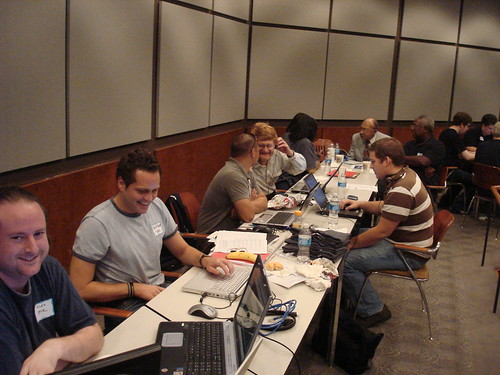
There are a lot of new initiatives getting a lot of attention for mobilizing people with high tech skills to help various causes at individual events: these initiatives bring these people together to spend the day, or maybe a few days in a week, at computers, usually in one big room, with everyone using their skills to do good, eat some good food, take lots of fun photos of everyone in action, and celebrate the great work at the end of the day.

Good stuff. But one of the first organizations to do this, Knowbility, gets lost amongst the much better-funded, higher profile newcomer groups, and it’s such a shame, because more people really should get to know Knowbility!

AIR Houston 2007

Knowbility is a national nonprofit organization based in Austin, Texas that creates technology programs that support independent living for people with disabilities, including veterans. Knowbility’s signature event is its Accessibility Internet Rally (AIR) – a hackathon that brings together teams of web designers to learn about web design accessibility standards, and then to apply those standards in a competition to create web sites for nonprofit organizations. The result of an AIR event isn’t just a fun day and new web sites; all participants walk away with an understanding of web design accessibility standards they didn’t have before that they can apply to their daily professional work, and the volunteer teams, most of them from the corporate sector, learn about the unique work of nonprofit organizations, creating opportunities for better partnerships in the future.

Knowbility’s activities have earned all sorts of awards and recognition – like the Peter F. Drucker Foundation Recognition for Nonprofit Innovation. On September 21, 2000, the White House issued a press release to highlight programs across the country that are helping to bridge the digital divide for people with disabilities and Knowbility’s AIR event in Colorado was mentioned by President Clinton as a new and noteworthy initiative. And I’ll never forget when they got mentioned at the end of Oprah’s talk show, resulting in an onslaught of emails and phone calls and oh-so-much excitement.

Knowbility earns more than 60% of its revenue through fee-for-service offerings. But that means it still relies heavily on grants and donations. Knowbility is worth your financial support. I really want this organization to continue – more than that, I actually want this organization to launch more AIR events and other activities all over the USA, and beyond! Knowbility is worth your investment.

And if you have ever been involved with Knowbility in any way, consider blogging about your expereince, talking about it on your Facebook status update or Twitter feed or Google Plus profile or other social media profile, and linking to the donation page.

Here are some other blogs I’ve written about Knowbility:

Hackathons for good? That’s volunteering!

Volunteer online & make web sites accessible

Nonprofits & volunteers – time to brag on Techsoup!

There are a LOT of opportunities right now on TechSoup for nonprofit employees and volunteers to share experiences and offer advice. Here are some recent questions and topics oh-so-ripe for your comment:

Nonprofit looking for Best Practices for Gathering Emails, other Info from New Donors.

Nonprofits, libraries, universities, others using Moodle? There’s someone looking for advice from you!

How does your nonprofit, library, other mission-based organization deal with “bad” tech etiquette?

What’s your experience with ICTs for rural economic development?

A small nonprofit maritime museum books sailing trips – & needs software advice for reservations

Are you a nonprofit or volunteer using Ubuntu Linux?

Nonprofit that collects veterinary medical supplies seeks inventory management software for Mac.

Firing a volunteer over insulting musings on Facebook re: a nonprofit or library?

Software for Substance Abuse and Mental Health Treatment?

Nonprofits & libraries: are employees, #volunteers using Google Drive, iCloud, Dropbox, other cloud apps? Share!

Nonprofit with network question: Some entries in NPS logs are in Hex others in plain text. Help?

SMS Engagement for civil society, the humanitarian sector, nonprofits, government programs – your experience?