Tag Archives: outreach

Marketing staff: either help promote volunteer engagement or GET OUT OF THE WAY

logoMy blog today is actually for public relations and marketing staff at nonprofits, rather than those managers of volunteer programs. And my message is this: either help promote your organization’s volunteer engagement OR GET OUT OF THE WAY. I talk to people managing their organization’s volunteer engagement activities – recruiting volunteers, supporting those volunteers, creating the majority of opportunities for those volunteers, helping other staff engage with those volunteers in their work, etc. – and among the many complaints I hear about challenges to their success is this one: the public relations and marketing staff won’t support me. Those leading volunteer engagement at your organization need a variety of support from marketing and public relations staff:
  • in using the organization’s Facebook page, blog, web site and other online activities to recruit volunteers and tout the accomplishments of such
  • in reaching out to the media about what volunteers are doing
  • in connecting media to those working with volunteers at the organization when the media says they want to do a story about volunteerism
  • in understanding when volunteers are doing something particularly special or innovative, or staff working with such are, such that it would be worthy of external attention (or internal attention, for that matter)
  • in including information about the organization’s volunteer engagement in all traditional publications, including paper newsletters and annual reports
  • in talking about volunteer engagement as more than just the monetary value of volunteer hours
Yet, I hear from staff again and again that the outreach staff won’t create a link on the home page to information on volunteering (though they will regarding donating money, no problem!), that they won’t include any volunteer-related messages on Facebook, that they won’t use any photos from a recent volunteer engagement event in outreach materials, and that they will include information about volunteerism in the annual report only regarding the monetary value of the volunteer time given. Public relations and marketing staff: if you are not going to create a detailed strategy for supporting your organization’s engagement of volunteers through all of your various outreach methods, then let the manager of that engagement do it him or herself, and stay out of the way as they execute that strategy. If you aren’t going to include information about volunteer recruitment and accomplishment in social media channels as often as you do about fundraising campaigns, then say nothing as staff in charge of managing volunteers at your organization create their own blogs, web sites, Facebook pages, Twitter accounts and Instagram or Flickr accounts to share the information they want out. What would be FAR better than forcing managers of volunteers to do marketing and public relations on their own? If you, public relations and marketing staff, sat down with the staff that work with volunteers at your organization and said, “How can I support you? Tell me what you’re doing. Let’s meet once a month and talk about it.” What you might find is that, instead of additional work, you get much-needed information to raise your organization’s profile online and in the media. Maybe volunteers are taking amazing photos of your organization’s work that you could use in a variety of ways. Perhaps there is a really marvelous story waiting for you to discover: maybe your organization is engaging in virtual volunteering in some really innovative ways, or is involving someone as an online volunteer who could never do so onsite. Maybe some hot current trend, like micro volunteering, is happening at your organization but you don’t even know it. Maybe volunteer engagement has helped your organization engage with communities or demographics you never would have reached otherwise. An organization that involves volunteers can be seen as more transparent and open to the community than one that doesn’t – are you leveraging that image properly in your outreach work? No more excuses, public relations and marketing staff: support your staff that recruit and engage with volunteers – or get out of the way and let them do their own publicity themselves. This message brought to you by: Grumpy Jayne.
If you have benefited from this blog or other parts of my web site and would like to support the time that went into researching information, developing material, preparing articles, updating pages, etc. (I receive no funding for this work), here is how you can help.

I can still inspire old school

Months ago, I did a Volunteer Engagement 101 Workshop in Portland. Here’s feedback from such – which shows I can still inspire old-school action regarding volunteer engagement (not just the cutting edge Internet stuff):

I recently attended your volunteer management training for AmeriCorps
members in Portland…

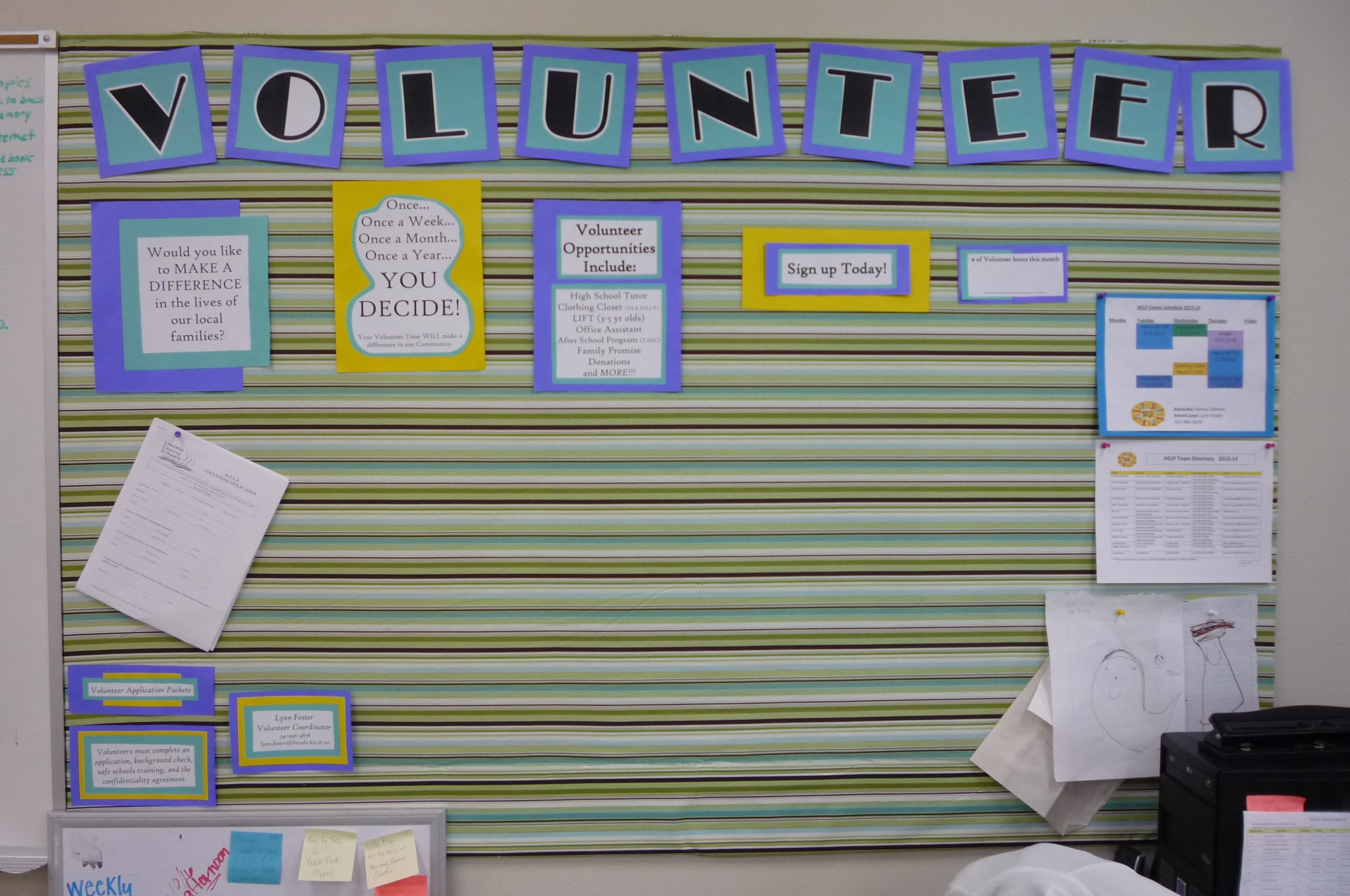
Before Photo Vol BoardI just wanted to email you some before and after photos of my bulletin board at work. This bulletin board sat empty for the first almost 2 months of my service.

It wasn’t until your presentation that I knew exactly what I needed to do. I needed to let everyone know that walks through our doors who to contact if they’d like to volunteer, how to sign up to volunteer, and what vol opportunities we have.

After Photo Vol BoardSo, I took this information and created a large volunteer board. It’s very large and it’s one of the first things people see when they walk in our doors. It’s a work in progress but I wanted to share. Thanks for sharing your time and knowledge with us! You were very inspirational and informational!!

Thanks again,

Lynn Foster, North HELP Center, Volunteer & Resource Specialist, AmeriCorps OSSC

I try. I really do.

coyote1


How do international NGOs use Twitter?

In the latest installment of the award-winning Twiplomacy study, global public relations and communications firm Burson-Marsteller looks at how international organisations use Twitter to promote their stories and how they engage with their followers. In November 2013, Burson-Marsteller analysed the 223 Twitter accounts of 101 international organisations and non-profit organizations. Over the past six years, all leading international organisations have set up at least one institutional Twitter account, and half of the 101 organisations analysed in this study have created a personal account for the head of the organization.

This is a terrific report. It not only looks at retweets, but also how many of these organizations are on other tweeters’ lists. I also like that the study looked at executive director’s tweets, not just the organizations, and that how often they interacted with others on Twitter was analyzed.

A great way to learn how success on Twitter can look – lessons for even small organizations, not just large, international ones.

TechSoup Digital Storytelling Challenge – Details Released

Beginning April 2, nonprofits, libraries and other mission-based organizations can participate in TechSoup’s interactive trainings to learn valuable production techniques for create your own video or audio story to share online – which you can use to then create your own story to enter the TechSoup Digital Storytelling challenge.

2013 Digital Storytelling Challenge Timeline

April 2: Digital Storytelling Launch / Submissions OPEN

April 4: Webinar: Creating a Culture of Storytelling (register)
April 9: Tweet Chat: Storytelling with Data
April 11: Webinar: How to Use Your Digital Story
April 16: Tweet Chat: Storytelling Around the World
April 17: Google+ Hangout: Meet the Judges!
April 18: Webinar: Digital Storytelling Tools and Methods
April 23: Tweet Chat: Storytelling and Social Sharing
April 24: Google+ Hangout: Winners’ Circle!

April 30: Submissions close at 11:59 p.m. Pacific time

May 1 – 15: Community and expert judging

May 28: Awards Gala live in San Francisco and streaming online!

How to Enter

  1. Create a short video (90 seconds max) or a five-imageslide show
  2. Upload video to YouTube or slide show to Flickr
  3. Submit to TechSoup by 11:59 p.m. Pacific time on April 30

Here’s complete details on the challenge and how to enter.

And if you want to discuss digital storytelling for nonprofits, libraries, schools, NGOs and other mission-based folks, join in the Digital Storytelling branch of the TechSoup Online Community Forum.

No, I won’t post your jargon.

You wrote and wanted me to publish about your BIG ANNOUNCEMENT on my blog. And I didn’t respond yet. Let me do it here, now, on my blog:

I’m not going to post about your BIG ANNOUNCEMENT.

Most of the time, I’m not going to post about your BIG ANNOUNCEMENT because it’s just not that big. It doesn’t rock my world. I don’t see how it will rock the world of my blog readers. It might be marginally interesting, but unless it fits perfectly with the focus of my blog and it makes me at least a little bit giddy, I’m not using my blog to promote it.

But in addition to your BIG ANNOUNCEMENT not being that big, it’s also often full of jargon. And I loathe jargon. Like:

  • enterprise-class, software-as-a-service pre-arrival solution
  • two-tier enterprise resource planning
  • centralized equivalency determination information
  • a world-class eco-system of innovative, on-demand, customizable capacity-building resource programs
  • crowd-sourced on-demand microvolunteering

It’s bullying-by-jargon. It’s exclusionary. And in your effort to show off your jargon hipness, you are turning potential supporters AWAY.

Please, by all means, introduce the world to new words and concepts. English is a growing language. The definition of network in my beloved 1943 Webster’s Dictionary isn’t what the definition of that word is now, and that doesn’t bother me – it’s a good thing.

But why hide your BIG ANNOUNCEMENT behind jargon? Don’t write to impress me, or anyone else, with your command of the latest corporate marketing terms; write to be understood. Do that with language that welcomes me, that I can understand immediately, without having to use Wikipedia to figure out what you’re actually trying to say. Do that with language that will still be understood (and used) in five years.

If you use Microsoft Word, you may have seen the ‘Flesch reading ease’ score. Use it when you are wondering just how understandable a sentence or paragraph might be. It’s no magic formula – think of it as a rough estimate regarding how well you are writing, in terms of being understandable.

Also see this free guide: ‘How to write in plain English‘. It’s for a British audience, so the spellings won’t be quite the same as they are in the USA, but the principles are universal.

Nonprofits *are* job creators!

Recently, I heard a man on the TV ranting about why people without private sector experience are bad to serve in government offices. “They’ve never balanced a budget, created a job or had to struggle to make payroll!” he said.

And my head exploded. KAPOW.

When you are working in government, or a nonprofit, balancing budgets and struggling to make payroll is often MOST of what you do!

In the nonprofit and public sectors, the pressure to balance a budget – one that has often been cut drastically with no input from you, the person expected to balance that budget – is far greater than the for-profit/business world. And the struggle to make payroll is something I’ve seen far too often in nonprofit organizations, often because a corporation has slashed its own budgets and cut funding to the organization or initiative that had been promised for months, or a government agency suddenly had its budget cut and, therefore, had to cut the budget of nonprofits it was supporting.

And nonprofit organizations are job creators. Funding nonprofits, which are focused on improving or preserving communities for EVERYONE, are not only job creators, but also, the people that make communities places where people actually want to live and work – which helps those that start businesses. Nonprofits:

  • help improve education (which creates better workers),
  • help preserve and improve environmental health (which helps organic farmers and fishermen have better products)
  • help improve children’s health (which allows parents to have the time to work instead of caring for sick children – time, perhaps, even to start businesses)
  • help promote bicycle use (which helps create more business for bicycle shops, creates more ways for workers to get to their jobs, contributes to a healthier workforce, and creates more parking spaces for cars)
  • build and promote community gardens (which helps those that sell gardening implements and other supplies)
  • fund and manager arts organizations (which create jobs for actors, production staff and administration staff, as well as enhancing the community and making it more attractive to employers to locate businesses there)
  • build, sustain and grow universities and colleges (which train people in various areas of expertise – and these people become workers, even job creators, themselves)

and on and on.

The amount of misinformation being promoted by so many pundits and even elected officials in the USA regarding the realities of the third sector is startling, disheartening and destructive. I have worked primarily in the nonprofit and government sectors, and in those sectors, I most certainly HAVE had to balance budgets, create jobs and struggle to make payroll. In fact, I have had to be far, far more creative with resources and efficient in the use of time and resources than I have ever had to be in a for-profit setting. By contrast, most people I’ve known who have worked primarily in the corporate sector have little understanding of how to do a lot with a limited amount of resources: they can’t believe most nonprofits don’t have fully staff IT departments or the latest computer technologies, and are stunned that volunteers are, in fact, not free at all.

Nonprofits and government agencies have GOT to do a better job of talking about what they accomplish, what it takes to make those accomplishments possible, and how they make those accomplishments happen. Every nonprofit has an obligation to show their transparency and credibility, and to teach the media and general public about the resources and expertise needed to address critical human and environmental needs. The Internet has made it oh-so-easy to do that!

Also see:

theater as a community development/education tool – it takes more than artists

It’s been a few years now since, for my Master’s degree, I embarked on a year-long investigation of the non-artistic elements necessary for success in “Theater as a Tool for Development” initiatives. It’s a subject that remains a very big interest for me. I wish I had the time and resources to research it further!

There are numerous organizations using theater techniques as part of their community development / education activities all over the world – for instance, to educate children about a health issue – and there are also numerous initiatives, publications, web sites and individuals that promote and chronicle successes regarding live, in-person performance as an effective tool for development. Even in our current age saturated with multi-media, live, in-person performance/TfD is a popular and effective tool for education, outreach and capacity-building regarding a variety of development issues, such as HIV/AIDS prevention, domestic violence, evolving gender roles, or good sanitation practices

However, there is little information on what has to be in place before these techniques are used, excluding performer training, to better ensure that these techniques will be well-received by an audience/participants, and to better ensure that the desired outcomes will be generated. My research was meant to fill in a bit of that gap. And my conclusion? Without deliberate, thoughtful cultivation of support for and trust in such an initiative among staff at the lead agency, among partner organizations, and among those for whom the theater-for-development techniques will be used, and without clear definitions of what everyone expects from TfD activities, such efforts will fail, no matter how experienced or enthusiastic your artistic staff is. In fact, in one case I studied, not doing this groundwork before hand turned out to be deadly.

My project included a review of key literature on TfD, and semi-structured interviews with 12 TfD practitioners. You can read online:

If you have undertaken similar research – not about theater as a tool for development, but specifically what needs to happen before such activities take place in order for them to be successful, give me a shout.

Why Your Organization Probably Doesn’t Need A Facebook Page

An excellent blog: Why Your Company Probably Doesn’t Need A Facebook Page

I completely agree. And I think it’s true for many nonprofits, NGOs, community agenices and other organizations as well.

Shocked? Don’t be. Facebook is a great, appropriate outreach / engagement tool for many organizations – and a complete waste of time for others, as this blog explores.

Consider this: maybe all of your volunteers are on Facebook – but they don’t want to mix their Facebook activities with their volunteering. Offline, I don’t always feel comfortable talking about what I do as a volunteer at work with colleagues, or when I’m socializing with friends – perhaps I feel the same way online.

Having a booth at the local county fair might be a great way to create awareness about whatever issue your nonprofit is concerned with, or as a way to recruit volunteers – and might be a complete waste of time for others.

Same for putting an ad in the local newspaper.

Same for doing a PSA on a local radio station.

Same for putting a billboard up on a highway.

How do you know which outreach or engagement tool is right for your organization? Through knowing your potential audiences, through observing online activities by other organizations similar to your organization or also serving a similar community, and through asking your current clients, donors and volunteers how they heard about your organization and how they do or don’t want to use social media with your organization. Through experimenting. Through trial and error.

That said, if you are on Facebook, and want to use Facebook as a way to learn about effective volunteer / community engagement, about nonprofit / NGO management, about aid and development, or about my work, I would love for you to like my Facebook page. But it’s worth noting that a LOT of my friends haven’t done this, because they don’t like mixing work and fun (and they see their Facebook activities as purely for fun).

And if you are on Twitter, and want to use it for those similar reasons, I would love for you to follow me on Twitter. But, again, a LOT of my friends haven’t done this, because they don’t like mixing work and fun (and they see their Twitter activities as purely for fun).

January 5, 2017 update

I still believe 90% of this blog – and the blogs I link to in this blog. My only change is this: your nonprofit does need a page on Facebook, just to “own” your organization’s online real estate – the name of your organization on Facebook. This will mean people can find you on Facebook –  yes, they are probably looking for you, and are angry when they cannot find you – and it will also prevent someone else from creating a page for your organization without your knowledge. But if you aren’t going to publish a status update on Facebook at least once a week, if you aren’t going to mark “like” on every single comment made on your status updates, if you aren’t going to respond to questions and criticisms made on your status updates, then say so: publish a status update that says your organization does not regularly update its Facebook status update, and the best way to know what your organization is up to is… what? Check the web site regularly? Follow you on Twitter instead? Also, publish your email address in that one-and-only status update, and note that it’s the best way to reach you. Finally, set your privacy settings so that no one can post on your Facebook page, and so that if anyone mentions your organization on their own Facebook status update it doesn’t show up on your page.

learning from a campaign that went viral

Sweeping the Internet this week: a viral video campaign by Invisible Children to make Joseph Kony, a terrorist leader in Uganda, a household name, and thereby get the media and politicans to pay attention. Viewership is through the roof, #KONY2012 is trending on Twitter, and the press is all over it. Even Lord Voldemort is on board:

voldemort protests kony

The video is here; jump to 10:30 on the video if you want to get to the heart of the video, and watch until 27:00, to get a sense of what the campaign is trying to achieve and how it will do so, without having to watch the whole thing – it’s 16 or so minutes of your life worth spending, both to learn about an important human rights campaign and to see how to make a campaign go viral.

This is already a wildly successful activism / digital story-telling campaign – but it’s not a campaign that can be easily replicated by *most* nonprofits.

Here’s why it is working:

  • it’s an easy-to-understand cause
  • it’s a cause that gets an immediate emotional-response by anyone who watches the video
  • it’s a slickly produced video – very well edited, compelling imagery, excellent script
  • it offers both simple and ambitious ways to get involved: at the very least, you can like the Invisible Children Facebook page, share the video with your online social network, and help get the word out further. At the other end of the spectrum, you can organize an event on April 20, per Invisible Children’s guidelines for such, garnering press coverage and participation on a local level for an international issue.
  • it builds up to a specific day – April 20
  • it has a wide range of items for sale for activists to wear and display on April 20, which will help publicize the event and help make participants easy to identify the day of the event, and the sale of those items helps fund the campaign
  • there are Invisible Children staff engaging with people on Twitter and Facebook for hours at a time – not just tweeting one link to a press release and hoping it catches on
  • it has an easy-to-remember Twitter tag that isn’t in use by anyone else: #KONY2012

It’s having that specific day of action and a video that creates in-depth awareness about a specific issue that, IMO, makes this go well beyond slacktivism/slackervism.

What did it take for this campaign to be successful:

  • money. Yes, I’m sure a lot of things were donated and a lot of expertise was give pro bono, but it still took money to pay for people and their time and knowledge to make this happen.
  • wide-ranging, deep relationships with key people (media, corporations, celebrities, politicians, communications strategists). These relationships took many months, even years, to cultivate – more than some tweets and email.
  • a very detailed, well-thought-out strategic plan. Somewhere, this plan is in writing, no matter how spontaneous the feeling this campaign is conveying.
  • a LOT of people to undertake the necessary outreach activities via traditional and online media. This isn’t just sending press releases; this is also engaging with people on Twitter and the phone for hours at a time. It took people to design the web site, to design the materials, to distribute those materials, to talk to the press – and it took those people MANY hours of work to do so, and it’s taking even more time to respond to all of the press and critics now focusing on the effort.

But while there is a lot to learn from this campaign for nonprofits and NGOs, this is not the campaign most should aspire to.

  • Most nonprofits and NGOs do NOT have the resources to make something like this happen – and never will.
  • Your nonprofit is probably engaged in something that’s only local, or that is a more complex issue to explain, and that doesn’t garner an immediate emotional response.
  • Your nonprofit might not be able to survive the incredible attention and scrutiny that a campaign like this would bring.

That doesn’t mean your nonprofit is less worthwhile than Invisible Children – it just means that having a video go viral nationally or internationally might not-at-all be what is best for YOUR nonprofit.

As you read about this campaign and see it get so much attention, think about what you really want from donors, volunteers, the press, politicians, clients and the general public regarding your organization.

Think about local celebrities, local policy makers, local leaders (both official ones, like elected officials, and unofficial ones, like prominent business people or local leaders of religious communities) and local activists – what do you want them to say about your organization, and how might you get them to?

Also see this TechSoup resource on Digital Storytelling.

Another lesson to learn from this campaign: don’t spam celebrities. I’ve seen a lot of celebrity Twitter feeds over-run with tweets from people begging for that person to follow or mention this or that nonprofit or cause. George Clooney probably gets 100 of those tweets in just one day! Don’t make George Clooney dislike your organization because you keep tweeting him, begging for a mention.

One of the things that has been amusing to see is the stampede of smug aid workers and other smugsters to condemn the campaign – the theme of the pushback falls into four categories:

Here’s why a lot of these criticisms are bogus:

Americans are some of the most globally-unaware people on the planet. I moved back to the USA in 2009 and have heard things every day by neighbors, people I volunteer with and people on TV that have reminded me of this every day. And this ignorance about the world leads to some profoundly ridiculous statements and actions by my fellow Americans. Maybe this campaign will help make a few people, particularly young people, aware of the world beyond the borders of the USA. BandAid/LiveAid did that for me once-upon-a-time – don’t laugh, but it did. I was a teenager in Kentucky as ignorant as a box of hammers. That record and that concert set me on a path for a lifetime.

Also, in the USA, no human rights movement has ever succeeded without a lot of outside pressure and support – and anyone who thinks apartheid was removed as an official policy in South Africa only because of pressure and evolution from within South Africa isn’t paying attention.

Some of the arguments I’ve heard about why the USA should not be focused on Uganda are the same arguments I’ve heard from China and Russia about why the world needs to not “interfere” with Syria.

Compassion for one thing breeds compassion for other things. No one – NO ONE – is saying, “Don’t be focused on local issues – instead, care about what’s happening in Uganda!” As this campaign ends, the people that have gotten caught up in it, particularly young people, are going to have a taste for advocacy and wanting to make a difference. If your local nonprofit is jealous, then start thinking now about how you are going to leverage what’s happening. Is there going to be an anti-Kony event at your local schools or in your local community? Then start designing the handbills you are going to give out at anti-Kony-related events to tell those energized young people about your local cause and how and why they can get involved.

By all means, offer legitimate criticisms of this campaign and Invisible Children. But some people are trying to kill this campaign – and I question their motivations in doing so.

Also see:

Use Your Web Site to Show Your Accountability and To Teach Others About the Nonprofit / NGO / Charity Sector

How to Make a Difference Internationally/Globally/in Another Country Without Going Abroad

Ideas for Leadership Volunteering Activities to make a difference locally

Advice for volunteering abroad (volunteering internationally)

Can potential volunteers find you?

How Easy Is It to Find This Online: Your Organization’s Volunteering Opportunities?

Let’s find out…

Go to Google or Bing.

Type in the name of your city (and, perhaps, your state too, if there are many cities in your country with the same name) and the word volunteer. Or the words volunteers.

For instance:

Portland Oregon volunteers
Henderson Kentucky volunteers
Austin Texas volunteering

Or add a keyword (or words) related to your organization:

Portland Oregon animal shelter volunteers
Henderson Kentucky children volunteers
Austin Texas computer volunteering

What comes up? Does YOUR organization show up in the first page of results? On the second page of results? If it doesn’t, look at your web site: does your web site use the name of your city and state and the word volunteer on the home page, on the page about supporting your organization, on the page about volunteering with your organization, etc.?

Also try this with Twitter: type in the name of your city and the word volunteers into the search function. What comes up? Are people looking for volunteering opportunities (meaning you should contact them!)? Does anything your organization has tweeted recently come up?

In short – how easy is it for people using the Internet to find volunteering opportunities at your organization? If it’s not easy, then is it any wonder you are having trouble recruiting volunteers?

Also see:

REQUIRED Volunteer Information on Your Web Site

Your flow chart for volunteers
(example of an effective volunteer in-take process)