Tag Archives: management

Why I’m not outraged at the IRS

Each year, the IRS reviews as many as 60,000 applications from groups that want to be classified as tax-exempt.

501(c)(4) tax-exempt status is a different nonprofit category than organizations like homeless shelters, arts groups, animal groups, etc. The (c)(4) status allows advocacy groups to avoid federal taxes, just like 501(c)(3) orgs, but the status doesn’t render donations to the groups tax deductible. The primary focus of their efforts must be promoting social welfare – and that can include lobbying and advocating for issues and legislation, but not outright political-campaign activity. Also, these groups do not have to disclose the identities of their donors unless they are under investigation.

The U.S. Supreme Court’s January 2010 “Citizens United” ruling lead to a torrent of new 501(c)4 groups: the number of applications sent to the IRS by those seeking 501(c)4 status rose to 3,400 in 2012 from 1,500 in 2010. MOST of these applications were from conservative groups. And many of these organizations flout the law in terms of not being involved in political-campaign activity – if you saw the whole process where Stephen Colbert oh-so-easily formed his own 501(c)(4) organization, you know what I mean.

So what was the “extra scrutiny” by the IRS? Good luck trying to find out specifics beyond the phrase “extra scrutiny” again and again. It took me an hour on Internet searches to find out enough to make this list of what the “extra scrutiny” was:

  • more details on what “social welfare” activities the organizations were undertaking
  • speakers they had hosted in meetings
  • fliers to promote events
  • list of volunteers
  • roles/works of volunteers
  • lists of members
  • list of donors
  • positions on political issues the organization was advocating

Some groups have claimed they were asked who was commenting on the group’s Facebook page, but I can’t find any confirmation of this claim.

Of course, this “extra scrutiny” is a fraction of what many of these same people outraged at the IRS were demanding regarding the now defunct nonprofit group ACORN. It’s the same scrutiny these conservatives were screaming about wanting for arts organizations back in the 1990s, in their attempt to eliminate all government funding for arts organizations. And probably most importantly: no organization was prevented from engaging in the activities it wanted to, not even those with pending status. None. Zilch.

This scrutiny is not only what I have been asked for in every nonprofit and government-related job I have held in the last 15 years (yes, I have been asked by a government agency to provide a list of paid staff and volunteers – they wanted to see if our arts organization was involving “enough” volunteers”); these are details I have long encouraged nonprofits to provide on their web sites, to show transparency and credibility.

So, I’ll be by usual blunt self: any nonprofit organization, no matter what their designation, that can’t easily provide details on its programs – who, what, where, when – as well as information the number and role of volunteers and information on any activities that might be considered political advocacy, shouldn’t be a nonprofit. And if that organization is a political group, it should have to provide a public list of all financial donors. Period.

But, no, I’m not going to provide a list of volunteers. Their roles and accomplishments, yes, but not a list of volunteers.

In fact, let’s get rid of (c)(4) nonprofits status altogether. You want to form an organization that engages in political activities? Form a PAC

My sources:

http://www.politico.com/story/2013/05/israel-related-groups-also-pointed-to-irs-scrutiny-91298.html#ixzz2TSsJpVJ1

http://www.reuters.com/article/2013/05/14/us-usa-tax-irs-idUSBRE94B08I20130514

http://www.southcarolinaradionetwork.com/2013/05/15/at-least-2-sc-tea-party-groups-say-they-were-singled-out-by-irs/

http://www.coyotecommunications.com/outreach/scrutiny.html

http://www.salon.com/2013/05/14/when_the_irs_targeted_liberals/singleton/

Free online courses for relief & development workers

Last Mile Learning provides free, contextualized learning resources to professionals working in the development and relief sectors. Last Mile Learning is an initiative of LINGOs, a non-profit organization that promotes sustainable global development by building the capacity of the people delivering programs around the world. The Last Mile Learning facilitator resources are free and open source.

Each course in the Last Mile Learning includes a set of curricular materials that can be used by facilitators to lead face-to-face workshops or facilitated on-line training events (in both blended asynchronous or blended synchronous formats).

Courses relate to:

People Management
Project Management
Coaching Projects in the Development Sector
Harassment Prevention Project Identification and Design
Selection Interviewing Project Set Up
Delegation Project Planning
Performance Management Project Implentation
Managing through Meaningful Conversations Project Monitoring, Evaluation and Control
End of Project Transition

I’m quite excited about this initiative and these materials. I haven’t checked the materials out fully, but I’ve worked with LINGOS and know it’s a credible organization.

If you complete a course:

  • blog about it
  • share that you did so on your CV and LinkedIn profile
  • share it on your social networks (Twitter, Facebook, etc.)
  • make sure your employer knows, if you think they would want to know that you are engaged in professional development activities

Without a Champion, Your Initiative Won’t Survive

In 1994 or so, while working with various community initiatives in San José, California, I was introduced to a concept I hadn’t heard before: that any project, initiative or program must have a champion in order to be sustainable and have real impact: a person who will advocate for that project or program with colleagues and potential supporters, that will fight for that project or program, that will argue for it, and that will be seen, through their actions, not just words, as a person absolutely committed to such. Without a champion, a project, initiative or program fails.

Over the last 20 years, I’ve seen this concept proven true again and again.

I’m not talking about causes – it goes without saying that a cause needs a champion. I’m talking about a project or program – it could be the introduction of a new database system, a reform of your human resources department, a program to bring theatre activities to classrooms, an HIV education program, an online discussion forum, an anti-bullying initiative, etc.

I have watched well-funded initiatives with a full team of staff fail because there was no champion. There might have been someone designated to be in charge of the initiative, or funded to work on such, but he or she wasn’t a champion, as I have defined it; rather, the person did basic things regarding the job – answering emails, generating reports, building a web site, supervising staff working on such, etc. – but nothing beyond that. The person might say he or she is committed to the project’s success, but the actions that demonstrate that kind of commitment aren’t there – the person rarely attends meetings or events regarding the project, he or she doesn’t participate in the project in some obvious, very visible way, the person doesn’t bring up the project frequently in meetings or presentations, he or she doesn’t push for an online or traditional marketing strategy to promote such, the person doesn’t link the project to other initiatives at the organization, etc. After a few months or a year or even a few years, when the money runs out, the person or team that worked on the project shrugs and says, oh well, sorry that didn’t work out. And the project ends and is forgotten.

I have seen fledgling, under-funded initiatives thrive because there was a champion – an employee, a volunteer, or a funder. I heard that person, that champion, talking about the initiative to others, frequently, I saw that person seeking out participation from others – other employees or volunteers, senior staff, clients, members, donors, the press, other organizations. I saw the importance of the program through that person’s actions. There was an obvious commitment to success for that program that could be seen just by watching that champion. The champion may not be the person working full-time on the project – it could be a senior staff person or other leader/decision-maker at the organization who ensures, through staffing and budget allocations and organizational strategies, that the project is going to happen, is going to be successful, and is seen as essential by the entire organization.

Consultants can’t be champions. They can be be essential contributors, they can undertake activities that are fundamental to a program’s success, and they can feel passion for a program or project. But, ultimately, they cannot be the project’s champion – they are short-term, part-time workers. They will be gone when the money runs out – and they may be heart-broken at not being able to participate in the project anymore, even weep for it (I have!). This isn’t a question of the value of consultants – there is NO question that consultants often play an essential role to a project or program’s success. But if there is no champion at the organization among staff – particularly staff that are in decision-making/leadership roles – it doesn’t matter how much a consultant cares or how hard he or she works: that project will fail.

There can be more than one champion for a project; the most sustainable projects and programs have more than one. Think of a nonprofit theatre; when you talk about the performances such an organization undertakes with any staff member, you will find champions throughout the organization. You will find people in almost every department that, if the entire executive staff left and the budget were cut in half, would step up to ensure that organization continues to produce performances. But that in-school outreach program the theatre undertakes might have just one or two true champions, and after 20 years of success, if those people leave and are not replaced with champions, the marketing and fundraising departments may suddenly start questioning whether or not that program should continue.

Not everyone working on the project has to be a champion. The web master doesn’t have to be a champion for the project. The administrative assistant doesn’t have to be. The database designer does’t have to be. Most of the staff on the project doesn’t have to be. But there MUST be a champion, someone internal, that is pushing the organization regarding the project, or it WILL fail.

When you want to start a project, program or initiative, or you start working on such, you can predict the success of such based on identifying the champion. If you can’t identify such – and if you cannot be such – then that project will be short-lived. I guarantee it. And when you are a consultant working on such, it’s particularly frustrating. And if you’re like me, you weep a lot.

What do NGOs understand that USA nonprofits don’t?

Last week, I got to be a part of the program for a group visiting Portland through the US State Department’s International Visitor Leadership Program (IVLP). It was the fourth time I’ve gotten to be a part of the program over the years – the first time was in Austin, Texas, back in the 1990s. This time, visitors were from Egypt, Afghanistan, Liberia, Tunisia, Latvia, Greece, Mexico, El Salvador, Morocco, South Africa, Cameroon, the Philippines, Ethiopia, and more.

Talking with leaders of NGOs from all over the world is incredibly energizing – for me, it feels like coming home. Many are stunned that I’ve been to their countries – or that I even know where their countries are, what language they speak there, etc., in contrast to so many people in the USA. I’m sorry to sound the snob, but my fellow citizens are notorious worldwide for our ignorance about the rest of the planet, and not even having a passport, and I’m proud to be in contrast to that stereotype.

(just last week, I had to explain to a very close friend what the European Union was – she’s a very intelligent person, but if none of the news outlets ever mention the EU, how would she know what it is?).

This time with the IVLP, I was part of a small group of members from the Northwest Oregon Volunteer Administrators Association (NOVAA); instead of a traditional workshop, we divided up and each spent time with three people, for 20 minutes, talking about volunteer engagement, and would switch to a new group every 20 minutes. It allowed me to get one-on-one time with more than half the NGO representatives, and that’s always delightful. Many of the problems they face regarding volunteer engagement are the same as anywhere: trouble mainitaining volunteer motivation, volunteers not finishing assignments, too many volunteers one day and not enough another, etc. I hope they found my references helpful – hard to address everything in just 20 minutes!

One moment for me that I particularly loved: how integral social media is for many of these NGOs in working with volunteers. I loved hearing about all the ways they recruit, interact with and support volunteers using various social media tools, reaching volunteers via their phones as much, if not more, than via their computers – all said that, for the most part, email is dead for their young volunteers (people under 40) altogether. These NGOs haven’t needed workshops or conferences to convince them these tools are valuable; they’ve seen their value immediately. When I told them just how many nonprofits here in the USA refuse to use Facebook, Twitter, or other social media tools to work with volunteers, about how, if nonprofits here do decide to use such, they often give social media responsibilities to interns and senior management stays away from such, and how often I’ve had hostile reactions to the tech practices that these NGOs, by contrast, have fully embraced, they were floored. And they laughed. A lot. And when I told them that, in Oregon, in the supposedly oh-so-tech-savvy Portland area, I have had women younger than me say, “Oh, I don’t have email, so send that to my husband’s/daughter’s address, and he/she will print it out for me to read,” their jaws dropped.

True, many of these NGOs aren’t recruiting ethnic minorities, religious minorities and other marginalized groups as volunteers in their countries – and don’t see why they should have to make volunteering more accessible to such. They don’t see who they might be leaving out as volunteers by totally abandoning offline recruitment and support methods. In short, their volunteer engagement is not perfect and needs to further modernized, especially in terms of being inclusive – but what they are doing in terms of leveraging networked technologies in recruiting, involving and supporting volunteers is far, far ahead of what most nonprofits are doing in the USA. And all I can say is: WELL DONE. And keep teaching me!

Another big emphasis for these NGOs in particular is involving young people as volunteers – young people who are unemployed or under-employed, people under 40 with some education but who cannot find jobs. These NGOs see volunteer engagement with young people as a way not only to build the skills of those young people so that they can get jobs – or even start their own businesses – but also to give these young people a sense of civic responsibility and community connection beyond protesting in the streets. I was happy to help address some of these ideas in my very limited conversations, and welcomed their online inquiries so I can send them to further resources.

And, finally, I apologize to the guys from West Africa who were offended I hadn’t been to any of their countries yet (I’m trying!), and if the guy from the Philippines does not send me the photo he took of myself and the guy from Afghanistan wearing the cowboy that he bought in Texas, with both of us making the “hook ’em horns” sign, I will be DEVASTATED.

POSTSCRIPT: Not devastated.

For more information about my training.

Also see:

Hire me in 2013 – let me help make your organization even better!

Blunt headline, I know, but it gets the point across: I’m available as a trainer for your organization or conference, or for short-term consulting, for long-term consulting, and, for the perfect opportunity, full-time employment in 2013!

As a consultant, I specialize in training, advising, capacity-building services and strategy development for not-for-profit organizations (NPOs), non-governmental organizations (NGOs), civil society, grass roots organizations, and public sector agencies, including government offices and educational institutions (altogether, these organizations comprise the mission-based sector).

Capacity-building is always central to any training or consulting work I do. Capacity-building means giving people the skills, information and other resources to most effectively and efficiently address the organization’s mission, and to help the organization be attractive to new and continuing support from donors, volunteers, community leaders and the general public. My training and consulting goal is to build the capacities of employees, consultants and volunteers to successfully engage in communications and community involvement efforts long after I have moved on.

My consulting services are detailed here. I can deliver both onsite and online services. Also, I love to travel (especially internationally!).

In 2013, I would love to create or co-create an entire course as a part-time or full-time instructor at a college university within any program training nonprofit managers, social workers, MBA students, aid and humanitarian workers, etc. I am most interested, and, I think, most qualified, to teach courses relating to:

  • public relations (basic public relations functions, outreach to particular audiences, crisis communications, how to address misinformation / misunderstandings, how to deal with public criticism, etc.)
  • strategic communications (systematic planning and utilization of a variety of information flows, internal and external to an organization or program, to deliver a message and build credibility or a brand)
  • cross-platform media and electronic media (using traditional print, synchronous and asynchronous online / digital communications, and emerging digital technologies effectively, and integrating the use of all information flows)
  • public speaking
  • community engagement (involving community members as volunteers, from program supporters to advisers, and creating ways for the community to see the work of an organization firsthand)

Would I consider giving up the consulting life and working just one job, either as a full-time consultant for a year or a full-time, regular employee? Yes! In that regard, I am looking for opportunities to:

  • manage/direct a program at a nonprofit, university or government agency.

or

  • direct the marketing, public relations or other communications activities for a major project or program at a nonprofit, university or government agency – a corporation that matches my professional values.

I have a profile at LinkedIn, as well as details on my own web site about my professional activities. I’m also happy to share my CV with you; email me with your request. If you have any specific questions about my profile, feel free to contact me as well. References available upon request as well!

Looking forward to hearing from you! Questions welcomed!

Striking a chord in 2012

My most popular blogs in 2012, based on visitor numbers, were all focused the points of view of volunteers:

  • I’m a Frustrated Volunteer, my confession at just how many of my blogs from the points of view of people that were trying to volunteer and weren’t able to were actually about my own attempts to volunteer since moving back to the USA in 2009. Got a lot of comments as well.
  • A missed opportunity with volunteers, which included this quote from a colleague (not me this time!!) about her volunteering experience at an un-named organization: “No one ever asked me for my name. They didn’t have a sign in sheet. They didn’t capture any of my information. And I have no idea what all this work that I did means to them.”
  • I’m a volunteer & you should just be GRATEFUL I’m here!, which quoted entitlement volunteers, those folks who think organizations should take ANY volunteer and whatever that volunteer offers, and simply be grateful for what they get, should not have standards, quality control or performance measurements when it comes to volunteers, and that to demand quality from volunteers is insulting.

I expected some defensive comments on these blogs, about how over-worked managers of volunteers are, about how they can’t be expected to respond somehow to every person that wants to volunteer or to ask volunteers about their experience, etc. That’s what usually happens when I try to talk about these subjects on online discussion groups for managers of volunteers. That didn’t happen (progress!), but the visitor numbers show that these blogs really did strike a chord!

Being a volunteer – or trying to volunteer – and talking to others volunteering or trying to volunteer, has taught me more about the essentials of volunteer engagement than any book, article or workshop!

I’m quite surprised that the blogs regarding the results of the volunteer management software survey that Rob Jackson (robjacksonconsulting.com) and I did this year didn’t get much more attention than they did – I fully expected the blogs about this survey to be the most popular of the year, but they weren’t! The purpose of the survey was to gather some basic data that might help organizations that involve volunteers to make better-informed decisions when choosing software, and to help software designers to understand the needs of those organizations. We also wanted to get a sense of what organizations were thinking about volunteer management software. I think we more than met those expectations! In addition to the main blog announcing the results in July 2012, there was also a blog about What’s so fabulous about software tools for volunteer management?, a blog about just how much managers of volunteers love spreadsheets, and a blog about What do volunteers do? The answer may surprise you, as reported by survey respondents, that turned out to be much more wide ranging than many volunteer management consultants and books would have you believe. In short, our survey provided a lot of in-depth information about not just software, but volunteer engagement in general.

In case you missed a blog this year: I’m retweeting two or three of my blogs a few times a week between now and the end of the year (follow jcravens42 for more!), and I’ve created this index of all my my blogs (indexed by date).

2012 isn’t over – I’ll be writing a few more entries in the waning days of the year. Stay tuned!


Volunteer Engagement the Roller Derby Way

logoSunday, I did an intensive, advanced training (as opposed to an introductory/basic training) for representatives from the roller derby leagues in Portland (the Rose City Rollers) and Seattle (Rat City Rollers) regarding volunteer management. These leagues involve several hundred volunteers – and have done so, quite effectively, for a few years now. Volunteers don’t just help at games; women’s roller derby has a particular focus on empowering women and girls, and most meets include fundraising components for a charity, which means volunteers are engaged in a huge range of activities.

But the rapid growth of these leagues – which shows no signs of abating – means that they don’t always have the procedures and policies in place to handle volunteer management challenges as they arise, or even how to identify issues long before they become bigger problems for the organizations. I hope that my training helped them to be able to access the resources they need to deal with specialized volunteer recruitment, board recruitment, volunteer conflict, keeping volunteers motivated, tracking volunteer information and contributions, and anticipate and address issues regarding volunteer engagement long before such becomes a program killer.

But with a staff made up of paid employees and volunteers, most of whom have NO training in working with volunteers, these leagues have done a remarkable job of engaging volunteers already.

What are people at these roller derby organizations doing that many traditional organizations that involve volunteers are not?

  • They have organizational-wide commitments to volunteers being satisfied with their experiences. Supporting and honoring volunteers is EVERYONE’S job. It never dawned on them that this should be just one person’s job at an organization, or that an employee could refuse to work with volunteers.
  • All staff work with volunteers. ALL STAFF. That means all staff — every paid person and all volunteers — create assignments for volunteers and/or work with volunteers. That means, even though there were just two organizations represented at this training, I wasn’t speaking to just two people: the designated volunteer coordinators. Instead, I was also talking to paid staff, volunteer staff, players, event volunteers, committee chairs, skating officials and on and on.
  • It never dawned on them to value volunteers purely by an hourly monetary amount, and some of them were actually offended by the idea. They acknowledge that it’s sometimes necessary for a grant application, but otherwise, they have much better reasons for saying they involve volunteers, and why volunteers are necessary to the organization.
  • They use every Internet tool and software tool they can find to work with and support volunteers – the value of such is obvious to them, with no need for a virtual volunteering workshop to convince them (as is with most traditional organizations).
  • Volunteers go to the same meetings as employees, and take leadership roles in coordinating events, reaching out to sponsors, selling merchandise, and representing the organization. You can’t tell who is or isn’t a volunteer just by a person’s title!
  • They didn’t blink over the phrase, “If a task can be done by a human, it can be done by a volunteer.” When I use that statement in a training for traditional organizations, there is often an uproar (which is why I use it – how I love stirring things up!). The Roller Derby reps reaction: “yes, and?”
  • They don’t look for ways to thank volunteers with regards to mugs and pins, or posters that say things like, “Volunteers are our angels!” They know what their volunteers want: real, sincere appreciation that permeates the organization, that doesn’t happen just on a volunteer appreciation luncheon that, at many other organizations, the board nor the Executive Director would even bother attending.
  • While they want to be great at handling conflict among staff, including volunteers, they completely accept that conflict and criticisms happen and have no fear of such (most orgs I work with want to know how to prevent all conflict and criticism).
  • They embrace the idea of most volunteers joining up because they want to have fun. They don’t think that’s a bad idea for volunteering.
  • They have an organization that welcomes people of all ages and all walks of life, and these organizations could probably lead their own workshop on how to creating a welcoming environment for teen volunteers, LGBT volunteers, low-income volunteers, homeless volunteers, volunteers with disabilities and various other groups that are under-represented at so many other organizations. It’s a workshop I would LOVE to attend!
  • Not once did I ever hear, “Oh, we’re not allowed to do that.” I hear that at least twice during presentations to other organizations. Not that these organizations don’t know and follow rules, like how to screen and supervise volunteers that will work with teens – but when it comes to ideas about new ways to work with volunteers, they never come from a place of fear.
  • They laughed heartily at my story of a certain online discussion group for volunteer managers in the USA that shall remain nameless having constant discussions about where to find examples of forms and policies (“Don’t they know how to use Google?”) or how to ban volunteers that have tattoos (I can’t repeat what was said re: this).

I got this gig because I did a presentation earlier this year for the Northwest Oregon Volunteer Administrators Association (NOVAA) on trends in volunteer engagement. NOVAA serves the greater Portland metropolitan area, including Vancouver, Washington. Afterwards, a woman came up, handed me a card, lauded me for my presentation and said, “You are soooo roller derby.”

As I learned from attending two match nights, roller derby players leave everything on the track during a game, and I left everything in that conference room for this training on Sunday; I have never been more exhausted after a training, so determined was I to win these folks over and point them to the resources they need to be even more successful at engaging with volunteers. And one of my favorite comments afterwards was this:

“Srsly, this was awesome. I have a very low tolerance for BS facilitated meetings about hypothetical nonsense. This was none of that.”

Almost made me want to cry… a high compliment, indeed.

If you are putting together a volunteer management conference, listen up: I’m happy to train, and I really hope you will invite me to do so. But invite someone from a roller derby league too – I recommend the Portland league in particular, of course. Because it’s long overdue for these conferences to get a shake up. And I think roller derby may be just the org to do it!

I have seen the future of volunteer engagement and IT’S ROLLER DERBY.

Here’s a photo on Facebook that sums up just what an amazing experience matches can be, btw.

Support Your Local Online Discussion Manager!

logoI’ve dealt with a LOT of debates and conflict on a variety in online discussion groups, and that vast experience lead to creating this resource on how to deal with such, especially for nonprofits, NGOs, government agencies and other mission-based folks. It’s one of the most popular pages on my web site.

Recently, an experience made me realize there was a crucial piece of advice missing on that resource. Here it is:

Support Your Local Online Discussion Manager!

When you, the Executive Director or Marketing Manager or Program Director, see your online discussion manager facilitating an online debate about something your organization is or isn’t doing, the temptation may be for you, the senior person, to jump in and start posting.

That may or may not be a good idea.

It’s a good idea if there is something you need to clarify that you can say better than your online discussion manager, particularly if it might relieve pressure on that person and allow him or her to move the discussion forward. It’s also a good idea if you see the manager under fire – it can be wonderfully motivating for an online community manager that is bruised from an online virtual debate to see your public support for him or her, and it can help for discussion group members see your faith in that person.

However, it’s a bad idea if you are seen as “taking over;” your posting to the discussion can disempower your online discussion manager, reducing his or her importance to the community. Why should the community look to that person as their liaison with the organization online, when you’ve made it clear that YOU are higher up and in-charge, and you took over the discussion?

If you think there is a different way to handle an online situation than your online discussion manager is doing, talk with that person FIRST, and if at all possible, have the discussion  manager continue to be the lead in facilitating the discussion. If you must post something, be sure to add verbiage that shows you still have faith and trust in your online discussion manager, and that you fully support that person.

Read more about how to deal with online criticism / conflict.

February 2, 2021 update:

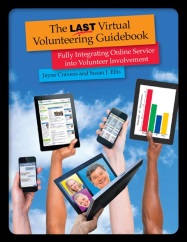
The Last Virtual Volunteering Guidebook: Fully Integrating Online Service Into Volunteer Involvement can help you better work with people online, including the manager of your online community, whether or not that person is a volunteer (unpaid). The book talks about building a supportive environment online for your team, how to be clear on roles and tasks, supervising remote staff and more. Also, this is the most comprehensive resource anywhere on working with online volunteers, and on using the Internet to support ALL volunteers, including those you might not think of as “online” volunteers. If you have an online community for any group – volunteers, clients, staff – you will find this book hepful.

If you have benefited from this blog or other parts of my web site and would like to support the time that went into researching information, developing material, preparing articles, updating pages, etc. (I receive no funding for this work), here is how you can help.

Join me on Twitter Oct. 23 for a tweetchat!

On Tuesday, Oct. 23, from 1-2 p.m. New York City time (10 a.m. Oregon time), I’ll be leading the tweetchat on Twitter.

The tweetchat is focused on building and sustaining online communities for nonprofits, charities, schools, government programs and other mission-based initiatives, though some corporate folks frequently show up and share.

The focus of the chat tomorrow will be on cultivating leaders in online communities. A lively, information-rich online community rarely happens because of just one person answering questions, inviting and welcoming new members, facilitating discussions, regularly introducing new topics, etc. Rather, they happen because of a number of people taking on these roles, officially and unofficially. But how do you cultivate and keep such online leaders?

Participating in the tweetchat is simple: you log into Twitter, and then you click on the link or do a search on the term #commbuild on Twitter. All messages with the #commbuild tag will appear. Keep reloading the tweets and you will see all new messages. To respond, just choose a message and click on “Reply”. Be sure to put the tag #commbuild in your message, however, so everyone else can see it too!

The questions I’m going to be asking on this Tweetchat (subject to change!):

Q1 What is an online community leader, from your POV? Define who that would be. 
Q2 How do you recognize some1 emerging as an online community leader?
Q3 When do you move some1 from unofficial leadership to official (written task description, dates of commitment, etc.)
Q4 Have you ever made some1 an official community leader (facilitator, chat host, etc.) & regretted it? What happened/why?
Q5 Have some1 ever asked to be made an official community leader & you have had to say no? What happened/why?
Q6 Should community leaders have term expiration dates, or do you just keep them as long as they are around?
Q7 How do you recognize/reward community leaders for their contributions?

In addition to this being a terrific learning experience regarding how to cultivate community leaders in online communities, it’s also a great learning experience if you are new to Twitter or to tweetchats.

More about the #commbuild tweetchat events.

Managers of volunteers love spreadsheets

In a recent survey of nonprofits, NGOs, and other mission-based organizations regarding the online tools they use to support volunteers and track their information, Rob Jackson and I found that:

  • the most-used tool reported tool used by those surveyed to track and manage volunteers was spreadsheets – that could be Microsoft Excel, OpenOffice, GoogleDocs, or any other  spreadsheet program

The results of the survey are here (in PDF). Rob and I didn’t ask what these organizations were using spreadsheets for, specifically. I would guess:

  • to more easily produce graphs/charts with data generated with the volunteer management software
  • to more easily produce some kind of report (a list of volunteers that will attend an event on Sunday, with their full and last names, email and phone number)

It’s something that software designers need to consider: software needs to at least export selected data easily into a format that can be read by a spreadsheet.

Here’s a question I wished we’d ask on this survey:

What does software – whether on computers or your smart phone – allow you to do now regarding supporting and tracking volunteers, that is absolutely fabulous: how does it save your organization money, how does it help you be more responsive to volunteers, how does it free up your time to do other things (and what are those other things you do?), how does it help you show volunteer impact, and on and on.

So – why not answer that question now over on TechSoup?!

Be sure to say what software you use, whether it’s a specific volunteer management software or a spreadsheet (Excel, Google Docs, OpenOffice, whatever).

You have to register in order to be able to post to the TechSoup community, but registration is free, and it will allow you to