Tag Archives: management

Seen a drop in volunteers? Quit blaming the pandemic & fix the problems.

graphic by Jayne Cravens representing volunteers doing service

Articles are everywhere saying nonprofits and government programs have seen a severe drop in volunteers since the start of the pandemic. Many imply that a growing number of people don’t want to volunteer and that’s fueling the drop in volunteer numbers.

It’s absolutely true that there’s been a drop in the number of volunteers at many organizations all over the world, not just in the USA. But the implication that people, especially people under 50, don’t want to volunteer is BOLLOCKS.

This drop in volunteer numbers has been coming on for a long while, but the pandemic sped things up. So many nonprofits have been seeing their volunteers get older and older, even dying off, but new, younger volunteers not replacing those that leave. Why?

Spend a week on Reddit, especially the volunteer subreddit, and you will see young people repeatedly posting messages that they want to volunteer, but don’t know where to look, or don’t know what’s available, or don’t know how to express interest, or have been trying and not getting responses to their applications. Many don’t know how volunteering really works – they ask if volunteers get paid, or are shocked that they have to go through training for certain roles. Most seem to think nonprofits do work that anyone that just walks through the door can do, right away.

There’s also a change in what volunteers want. Many don’t just want to do work for free for you; they want to feel like they are making a difference, or they want to have an interesting experience, or they want to develop skills for their career, or they want to have fun. None of those are bad reasons to volunteer. And the pandemic has changed how people value time and personal interactions: they now have a much lower tolerance for having their time wasted. One of the things I keep hearing is that people now want experiences, not things – that includes meaningful, enjoyable volunteering.

One of the most popular blogs I have ever written is Diagnosing the causes of volunteer recruitment problems. If you have seen a drop in the number of volunteers you involve, you need to go read it. And as I say in that blog:

What worked to recruit volunteers 30 years ago doesn’t work now; if you are having trouble recruiting volunteers, it’s overdue for you to take a hard, in-depth look at both how you recruit, what your in-take process is like, and the volunteer opportunities you have available.

No more but we’ve always done it this way. STOP IT! Times have changed. AND they will keep changing. Either change how you talk about volunteers, support volunteers, engage volunteers and recruit volunteers or stop complaining!

Also see:

If you have benefited from this blog, my other blogs, or other parts of my web site and would like to support the time that went into researching information, developing material, preparing articles, updating pages, etc. (I receive no funding for this work), here is how you can help

Finally – a FUN, worthwhile volunteering experience!

My name tag from my day of volunteering.

One of the things that differentiates me from other consultants and trainers regarding volunteer engagement is that I don’t just read and research and present: I also manage volunteers and I regularly volunteer myself. So much of my training advice, web pages and blogs have come from these first-hand volunteering experiences.

Every volunteer has a different “want” out of a volunteering gig, to make it worthwhile for them. For me, as a volunteer, it’s that:

  • I’m on-boarded quickly.
  • My time when I’m in training or actually volunteering is respected / isn’t wasted.
  • I feel like I’m actually doing something worthwhile as a volunteer for those served by the organization or the “cause” (I don’t do the work and wonder why it matters).
  • I feel supported in the volunteer role, I’ve been giving the prep I need for the role (I don’t feel like I’m foundering/set up for failure).
  • I feel like everyone wants everyone else to succeed, people don’t try to play “gotcha” with each other, there are not any ugly hidden agendas going on, there’s no delight in someone making a mistake, etc.

If I get even more out of it – if I have fun, if I get skills I can use in my job, etc. – that’s great too, but those four points are what are essential for me. And rarely do I undertake a volunteering gig that hits all those four points.

Helping at a blood drive in August hit all four of those points.

I’ve been promoting Red Cross volunteering for people who want to get started volunteering for many years – but I decided it was overdue for me to give it a try myself. So I went to the web site, read up on opportunities, and signed up for a few roles I thought I had time for and that looked interesting to me. None of the online volunteering I was interested in is available right now (they have enough volunteers for those tasks), but they really need people to help at blood drive events, and my commitment would be just one shift a month, so I signed up.

Filling out the initial application took a while – the Red Cross requires a lot of information in the volunteer application. But I think that’s a good thing: it screens out people who can’t make a commitment to reading information, filling out a form correctly, etc. – something any volunteer with the Red Cross will need to do in any assignment.

Then I did a phone interview with a volunteer that’s in charge of screening, then watched a video on YouTube, and then went through a live online training with a veteran “blood donor ambassador” – the name for volunteers who help sign in people at blood drives, make sure they get snacks and a rest afterward, etc. And all of that time is logged on my account already as volunteering time – I didn’t have to do anything.

We are a one-car family, and that means, most of the time, I do not have access to a car. I was able to sign up to help at a blood drive a short, direct bus ride from my home, in a nearby town. I had signed up for my first gig within minutes of my interview, and it was just two weeks away from that date.

I showed up at the event, 30 minutes early (as the video explained), and it turned out that I was the only volunteer ambassador there – meaning I was checking everyone in. I was very nervous since I thought I would get to “shadow” someone. Instead, it was all me – the site manager showed me how to check donors in, and the first donors, all veteran blood donors, also helped me (I think they loved being the experts to guide the newbie). And for the rest of the day, that’s what I did: donors showed their ID, I scanned it with a scanner, I checked off their name, I gave them a nametag, they had a seat and then got called up for the donation.

It was easy, it was interesting (nice to chat with people, interesting to watch how they go through the different stations of donating), and there was about 30 minutes when no one was scheduled and I was able to eat the lunch I brought.

If you are squeamish, don’t worry – you don’t ever have to see any blood, since you are facing away from the donor tables. And if anyone were to throw up, it’s NOT your job to clean it up (no one threw up, BTW, but we did have one guy faint).

If another volunteer had shown up, one of us would have been at the registration table and one of us would have been at the snack table, chatting with people who had just given blood, to make sure they were okay and ready to leave after 10 minutes or so. Had it been a larger event, there would have been two people registering and two people at the snack table.

If you are looking for an easy, interesting volunteering gig, I highly recommend you sign up to be a blood donor ambassador. You get to pick which event(s) you help at. It gives you insight into how the Red Cross works (the Red Cross does a lot more than blood drives). And you can sign up for as many blood drives as you want – if there is one every day in your area (which there is in the Portland, Oregon area), you could easily get 25 hours, maybe even more, of volunteering in a week, if you can volunteer on weekdays (more if you can do weekends too). I highly recommend this for people that are required to do community service – you may have three weeks from the time of sign up until you start, but you can get hours in quickly if you have time during the day.

In addition to Blood Donor Ambassadors, the American Red Cross needs:

  • Blood Transportation Specialists
  • Disaster Action Team members
  • Shelter Services staff members (being a blood donor ambassador is a good way to see what the intake process is like for emergency shelters)
  • Disaster Health Services Team (if you are a licensed healthcare provider)
  • Administrative help

If you dream of being deployed to disaster zones elsewhere, you first have to have deep experience as a part of your own local Red Cross in your own area (disaster action teams, shelter staff teams especially).

And if you are with an initiative that’s struggling to attract volunteers – what is the Red Cross doing that YOU should be doing regarding volunteer management? Note that I didn’t deal with any paid staff as I went through the onboarding process – my screeners and trainers were volunteers themselves!

Also see:

UPDATE:

A few months ago, I decided to test my own advice that I have posted on the subreddit regarding volunteering many times, that if you volunteer locally with the American Red Cross, you might get asked to deploy to a disaster somewhere else in the USA.

Welp – that’s exactly what’s just happened: I just got an email sent to all volunteers:

As Hurricane Ian hit Florida with dangerous winds, rain and storm surges, Cascades Region is in alert and standby modes in preparation of volunteer deployments. As we monitor the situation we look to current Red Crossers to train in both deployable and local volunteer roles to continue supporting the mission and our impacted communities.

And there’s a link to something called the Deployment Interest Form, and more info about information events (2 virtual, 3 in-person) to share deployment processes and training.

Folks, it really, really does work: volunteer LOCALLY with your American Red Cross chapter, in any capacity, and you will get info on trainings for disaster response, and if you complete that training, you may get invited to deploy to a disaster zone to help.

And in the USA, you start by filling out this form.

https://www.redcross.org/volunteer/become-a-volunteer.html

The crisis in Florida and the East Coast caused by this latest hurricane will go on for MONTHS. You could be a part of the response! Fill out the form, get the training you need – ASAP.

Do your volunteers feel psychologically safe?

Google researchers, the People Analytics team, studied the qualifies of effective teams at Google. Code-named Project Aristotle – a tribute to Aristotle’s quote, “the whole is greater than the sum of its parts” (as the Google researchers believed employees can do more working together than alone) – the goal was to answer the question: What makes a team effective at Google?

Research from Google’s Project Aristotle found that the most important dynamic of a successful team is members feeling psychologically safe. This occurs in environments where no one else will embarrass or punish others for admitting a mistake, asking a question, or offering a new idea.

Reading this was like a punch in the gut for me. For any job that hasn’t worked out, that I couldn’t wait to leave, this was always the primary problem I faced with supervisors.

I hope that all managers of people that see this do a deep, honest examination of the culture of their own departments and companies with regard to this kind of fear-based way of working. But I hope managers of volunteers look at the culture around volunteer service as well. And I hope you won’t get defensive if the evidence you gather points to toxicity in your program or your entire organization.

Also see:

If you have benefited from this blog, my other blogs, or other parts of my web site and would like to support the time that went into researching information, developing material, preparing articles, updating pages, etc. (I receive no funding for this work), here is how you can help

Either be committed to quality or quit involving volunteers.

graphic by Jayne Cravens representing volunteers

I will always be fascinated by people at nonprofits, employees or volunteers, who will write a LONG post to an online forum about their lack of staffing for all that needs to be done or a safety issue regarding volunteers and clients, & when they read recommendations about how to address such, reply, Oh, yuck, bureaucracy… we’re non-traditional! We’re dynamic and nimble and get things done and rules are such a drag!

Being a dynamic, nimble startup nonprofit that GETS THINGS DONE! with NO RULES is lots of fun until volunteers start harassing clients or the executive director cries every night under all the stress and core volunteers quit because they just can’t anymore – and they aren’t replaced because the word is out about just how overwhelming volunteering can be.

Planning, policies and structure are NOT BAD THINGS. And they do NOT mean your organization can’t be dynamic and nimble and use all the latest jargon.

Put the mission of your program first, put your clients first, commit to quality, and remember that sometimes the reason for traditional ways of doing things is because traditional ways of doing things can WORK.

If you don’t have time to learn and apply the essentials, you’re being reckless with both volunteers and those they serve.

  • Foundations of Volunteer Engagement: Before you recruit volunteers, these are fundamental pieces that MUST be in place. If you choose not to do these and, instead, start recruiting volunteers right away, you are setting up your organization and those volunteers up for failure.
  • Support for Volunteers/Management of Volunteers & Safety Considerations: All of the resources I have regarding the support for and management of volunteers, as well as safety in engaging volunteers, are on one page because I believe they are inextricably linked – it’s impossible to separate these two issues. Also, I believe that these MUST be explored and drafted BEFORE you start recruiting volunteers.
  • Creating Roles & Tasks for Volunteers: A key to retaining volunteers is having roles and tasks well-defined and IN WRITING, so that expectations are clear. This is yet another step to undertake BEFORE you start recruiting volunteers – and if you don’t, don’t be surprised when you can’t keep volunteers and your volunteer engagement flounders.
  • Ethics in Volunteerism & Court-Ordered Community Service: If your organizations involves volunteers, you should also be thinking regularly about the ethics of such. Involving people who are not financially compensated for work that they do carries with it regular questions and criticisms. Exploring ethics in volunteerism has not won me many friends. Exploring ethics in volunteerism can help you avoid public relations disasters later.
  • Harumph.

Note: I will be quite hard to reach from Monday, June 20 through Wednesday, June 29. I will be checking email and social media only sporadically in that time.

The key to retaining volunteers

Please, no more workshops called how to recruit and retain volunteers. Not unless each is about six hours long. Because to recruit volunteers is one function, but to retain volunteers – to keep volunteers beyond just a few days or weeks, to prevent sudden and frequent turnover – requires doing well in all aspects of effective volunteer engagement, and those aspects can’t be taught in an hour or two.

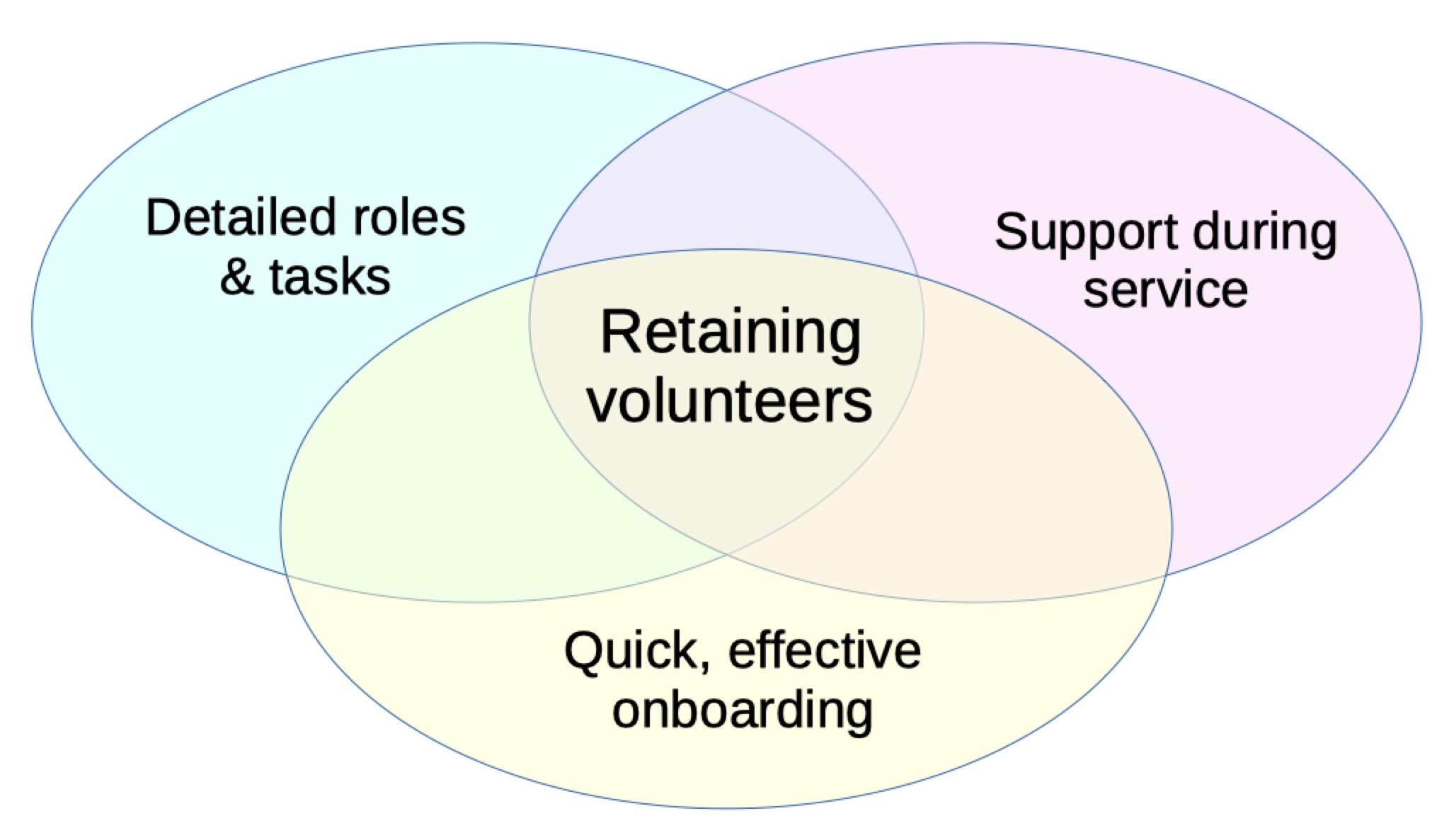
This graphic represents what I mean: if you have clear roles and tasks for volunteers, in writing, if you quickly onboard volunteers and ensure they are prepared for the role or task they will take on, and if you have excellent, appropriate support for volunteers during their service, you will retain volunteers:

And I believe that all of those functions frequently and regularly intersect – you cannot think of them as entirely separate activities.

If you aren’t retaining volunteers, if volunteers are leaving before they even start a task, or they are leaving soon after joining, the reasons probably lie in one of these three areas:

  1. they signed up to help but there was a big gap between that time and when you held your first meeting with them or got them started on a task,
  2. they did not have realistic expectations or understand what you expected because roles and tasks weren’t in writing, or
  3. they did not feel adequately supported or prepared for the volunteering role.

Another big reason for volunteers leaving is that they do not feel appreciated or that their service doesn’t seem to really be of value. I count that under support for volunteers, but you could certainly do an entire workshop just on that aspect of effective volunteer engagement (I certainly could).

Of course, the only way to know for sure is to ASK VOLUNTEERS WHO LEFT.

Also see diagnosing the causes of volunteer recruitment problems.

The principles of effective volunteer engagement, including identifying appropriate roles and putting them in writing, onboarding volunteers quickly and providing appropriate and regular support for volunteers are the basis for the recommendations detailed in The Last Virtual Volunteering Guidebook: Fully Integrating Online Service Into Volunteer Involvement. This is the most comprehensive resource anywhere on working with online volunteers, and on using the Internet to support ALL volunteers, including those you might not think of as “online” volunteers.

If you have benefited from this blog or other parts of my web site or my YouTube videos and would like to support the time that went into researching information, developing material, preparing articles, updating pages, etc. (I receive no funding for this work), here is how you can help.

What funding volunteer engagement looks like

image of a panel discussion

A week ago was Valentine’s Day in the USA, and it’s not too late to talk about LOVE for the people at your program that support volunteers, and a great way to show them some love is to pay for what’s needed to fund effective volunteer engagement!

I talk a lot about funding volunteer engagement, how if communities – including corporations, foundations and governments – want for more people to volunteer, and want more nonprofits and community programs to involve volunteers, they are going to have to pay for it, in cash. What would funders be paying for to increase community engagement, to increase volunteerism?

  • Salaries for part-time or full-time managers of volunteers.
  • Training for ALL staff in effective volunteer engagement (not just the person in charge of volunteer engagement), like how to create meaningful, appropriate assignments, how to appropriately support vounteers, how to report safety and quality concerns, etc.
  • Training for the person in charge of volunteer engagement in skills that could help in better support and recruit volunteers, like basic video or audio editing skills, so they can produce simple YouTube videos, podcasts, etc., or classes in another language, such as Spanish, or classes in facilitation, conflict management, DEI (diversity, equity and inclusion), etc.
  • Subscriptions to services that have the information and news they need, like Engage.
  • Books – yes, BOOKS. Like mine, The Last Virtual Volunteering Guidebook.
  • Volunteer management software, computers, smart phones, video conferencing software (free versions often don’t provide a manager of volunteers all they need to effectively work with volunteers), etc.
  • Registration fees and travel expenses for staff to attend conferences that provide speakers and learning experiences that can help improve volunteer engagement.
  • Renting meeting or event spaces for volunteer-related activities.
  • Funds for volunteer recognition: gift cards, swag, etc.

All of the above is the “overhead’ that too many corporations and foundations refuse to fund. When I say volunteers are NOT free, these are the expenses I mean. Let me say it once again: if communities, corporations, foundations and governments want more people to volunteer, and want more nonprofits and community programs to involve volunteers, they are going to have to pay for it, in cash.

Also see:

If you have benefited from this blog, my other blogs, or other parts of my web site and would like to support the time that went into researching information, developing material, preparing articles, updating pages, etc. (I receive no funding for this work), here is how you can help

Nine plus four emerging volunteer engagement trends (a VERY different list than you will read elsewhere)

graphic by Jayne Cravens representing volunteers

Lots of people public predictions of upcoming trends in volunteer engagement – and often, these are people who are not managers of volunteers nor researchers regarding volunteerism. Their lists are things like People want micro tasks! – something many have said year after year, and something that, in practice, never seems to be what people are actually looking for, no matter what they might say in surveys. In other words, most of the lists seem to be focus on a casual, perfunctory view of volunteer engagement, not one based on reality, on actual experience.

Below is MY list of growing trends in volunteer management. It’s based on:

  • what I’ve seen on online communities like the volunteer subreddit and various other regionally-based subreddits, as well as on Twitter and on TechSoup,
  • what I’ve seen in the comments on Facebook posts by various nonprofits requesting volunteers,
  • what I’ve seen in emails and DMs sent to me (people like to share things with me, which I very much appreciate),
  • conversations with oh-so-many volunteers, wanna-be volunteers, and managers of volunteers,
  • my own work with volunteers and in volunteer management.

And after my own list, I post four more points from another organization that I agree with very much (hence why I called my blog “Nine plus four emerging volunteer engagement trends.”

  1. People want to know why a position is unpaid & don’t always like the answer.

Especially for positions that require particular skills, like web development, video editing, graphic design, translation, online community management, accounting/financial management or social media management, people want to know why the role is unpaid instead of a paid position – and “we can’t afford to pay someone” is NOT the answer they accept. They are also pushing back against unpaid internships at nonprofits. Also, labor unions, professional associations and people with disabilities are asking why people who are experts in something are being asked to donate their services, without being paid for their time (groups that are experiencing high unemployment are particularly angry).

Most organizations don’t have a mission statement for their volunteer engagement, one that could help guide the organization on when a role should or should not be an unpaid role. Most organizations also haven’t thought about ethical issues, like the inappropriateness and disrespect to people with hearing issues of having a student studying American Sign Language trying to interpret a live event rather than someone with this particular skillset and credentials, specifically.

The result of this trend if it’s not addressed properly: a continuing backlash against ALL volunteering.

2. People want much more support as volunteers.

Especially true of public-facing volunteers, like members of school boards and people expected to support youth or at-risk populations. These volunteers are being asked to recognize and report child abuse, deal with extremely angry parents and navigate potentially violent situations. They need specific training on these issues and they need continued support regarding such – and that training and support costs money that most governments and corporations balk at funding.

The result of this trend if it’s not addressed properly: fewer people volunteering for community, city and county government advisory boards, more people with specific political agendas doing so. Fewer people volunteering for critical volunteering roles with children, or with people who might be experiencing mental health issues, meaning many programs, like youth sports leagues or programs to support homeless people, have to be canceled.

3. Volunteers want to know why their service matters.

A mug, a t-shirt, a thank you event via zoom – it’s just not enough of a “thank you” to volunteers, not anymore, and maybe it never was. Volunteers want to know WHY their service mattered. That does not mean saying the monetary value of their hours. It does not mean saying platitudes like, “We just couldn’t function without you!” Rather, it means talking regularly on social media, in the organization’s non-volunteer-focused events, and in board meetings about how what volunteers did made some kind of difference regarding the organization’s mission. It means integrating talk about the value of volunteers – and NOT monetary value – into all communications by the organization, public and internal.

4. Volunteers want to have fun, and/or an enlightening experience.

So many organizations that involve volunteers have forgotten that volunteers aren’t just laborers working for free, who show up, do what needs to be done and leave. For instance, firehouses that involve volunteer first responders seem to have forgotten the social aspects that many people seek through volunteering, and that interacting with fellow first responders outside of official duties – a sporting event, a picnic, a campout, a training or event not related specifically to their service, etc. – can help everyone recognize strengths in each other they may not have seen otherwise, further build a sense of team, and further build a connection to the community they serve.

Focusing on activities and events that are fun and that further build a sense of team and a stronger commitment to an organization and its cause is not just a good thing to do for volunteer recruitment and retainment: societies are becoming increasingly polarized. We all need to care about each other and our overall communities more, and that kind of caring comes from being around a diversity of people in contexts outside of professional work and standing in lines to buy something.

I was on a board for a nonprofit that gives away grants to arts organizations. I thought this would be a great experience to celebrate and learn about the arts in my community, but for most of the time, it’s been just work. A TON of work. In one year, I received more than 1000 emails just from fellow board members. After three years, I left, because there’s no fun. There’s no enlightenment. I was getting resentful about the arts instead of being inspired by them. The county government our organizations supported also was silent about our hours and hours of work.

5. People want “heart” from volunteering

I’ve struggled with the word to use here – personal doesn’t feel quite right. So I went with heart. What I mean is this: I think many people are just so, so hungry for very human experiences, where they hear voices, look into people’s eyes, feel like they are having a sincere, human interaction. They want to feel like they are in a community. Once it is safe to do so, people are going to fill concert halls, theaters, crafts classes, dance classes, sports events – I know this is happening in some places already, despite it spreading the deadly novel coronavirus every time, but in other places, where the culture is one more focused on personal safety and community, it’s not. Once hospitalizations finally go down, after years of a global pandemic, very personal experiences are going to be like a balm for the soul. No, that does NOT mean virtual volunteering is going away. Let me say it again: virtual volunteering can be a highly personal, even emotional experience.

Volunteers, more and more, are wanting to feel connected to other humans, and they want their volunteering service to provide some of that.

6. Managers of volunteers must master tech tools.

Not all of the tools – that’s impossible – but definitely social media (and not just Facebook), online community platforms and volunteer management software – beyond spreadsheets. The managers of volunteers that prosper – that are able to recruit and engage a diversity of volunteers in a diversity of projects and are valued within their organizations – will understand basic web design and be able to update the text on a web page, be able to edit a simple video and share it on YouTube and know how the audio software works on their laptop or phone so they can record things – like a conversation for a podcast.

7. An increasing number of traditional volunteering programs that refuse to evolve will disappear.

The town where I live no longer has an Optimist Club. Most of the remaining service clubs in town have seen dramatic drops in membership. Why? Those service clubs refuse to change: they don’t have social media channels or, if they do, they don’t update them regularly with event information, recognition of volunteers, information about how to volunteer, etc. They don’t post to the subreddit for their town. They don’t reach out to new residents. Their web site, if they have one, hasn’t been updated in years. They don’t invite the members of the high school Key Club or anyone from the high school or university newspaper to their events. They over-rely on Facebook as a way to advertise activities – and even then, don’t use it very well.

People under 40 really want to volunteer – just spend a few minutes on Reddit and you will see just how hungry young people are to volunteer. But they don’t know about service clubs, so they try to start their own. They don’t know about Meals on Wheels – that’s why they all tried to start their own meal and grocery delivery programs when the COVID-19 pandemic started. They don’t know about existing mentoring and tutoring programs, like Junior Achievement – so they try to start their own.

If your nonprofit is struggling to attract members, program participants or volunteers, here’s my challenge to you: try to find your information about such online, via a search engine or on Facebook, WITHOUT using your program’s name. Try to find it just using the name of your city and the word volunteer or community service, for instance. Here’s more on diagnosing the causes of volunteer recruitment problems (one of the most popular blogs I’ve ever written).

8. Trying to please corporate donors will further hurt volunteerism

Corporations say we want more microvolunteering, so nonprofits pour resources into creating micro tasks, something inefficient, time-consuming, and often more about creating busywork than getting things done that a nonprofit actually needs done. Also, corporations want a monetary value for volunteer time, so organizations will continue to focus on that, which will create more hostility with labor unions and the unemployed, who see it as more fuel for their argument that volunteer engagement is an effort to cut costs by cutting paid positions.

The pushback against corporations who say this is what they want is so overdue. Nonprofits have got to start saying “no” to corporations demanding volunteer engagement that is, in fact, creating conflict and more, and unnecessary, work for nonprofits.

9. Virtual volunteering will continue to become so mainstream that we stop talking about it.

Online roles and tasks for volunteers have not been unusual nor innovative for a few years now. Virtual volunteering was already widespread long before the COVID-19 global pandemic, and calling an online role virtual volunteering often isn’t even done anymore – it’s simply volunteering. Not that there isn’t going to continue to be a need to talk about creating virtual volunteering roles, managing virtual teams, supporting online volunteers, etc. – just as there is always going to be a need to talk about other volunteering modalities, like creating volunteering roles for families or corporate groups, and how best to support those groups. But that hard wall so many put up in talking about virtual volunteering as something entirely separate from traditional, onsite volunteering – that’s long been crumbling.

On a related note: back in 2017, the UK-based Association of Volunteer Managers published a blog, Ten Ten: How Does The Next Decade Look For Volunteering. These four points stood out to me then and still stand out to me now, four years later, because I think this is absolutely where volunteer engagement is going – or, at least, where it MUST go:

  • The potential for volunteering will go on growing. Whether its volunteers in schools, welcoming refugees, campaigning against government cuts, or helping neighbours, we haven’t begun to reach saturation in the ways that volunteering can change society.

It’s absolutely true: we haven’t begun to reach anywhere near the saturation in the ways, the potential in the ways, that volunteering can be leveraged to improve our world. When I talk about all of the ways organizations are involving just online volunteers, I watch people’s eyebrows raise – they start to realize just how much more volunteers could be doing at their organizations. And when I talk about volunteers engaged in delivering mission-based programming, I have seen mouths start to gape as it dawns on people that volunteers are so much more than people who get tasks done.

  • Volunteer managers will have specialisms just like fundraisers do. There are over 15 types of fundraising expertise. Expect volunteering management to become more and more specialist as it matures, just as fundraising has.

This is already happening, as predicted! There are volunteer managers who specialize in one-time, just-show-up group volunteering events, those who specialize in hack-a-thons and edit-a-thons, those who specialize in online transcription-based projects mobilizing hundreds of volunteers at once, those who specialize in volunteers as mentors for at-risk youth, those who specialize in volunteer activities for teens or for seniors or for immigrants or for people on parole or are incarcerated, and on and on.

  • Intertwining specific audiences by demographics (eg working parents) and product (eg micro-volunteering) will be the breakfast of volunteering champions. In other words, the best organisations will understand exactly who their volunteers are, or could be, and create the volunteering products to encourage, entice and engage them ever more into giving their time.

A thousand times this! Those who manage programs for volunteer engagement will be at the table with those that manage fundraising, those that manage marketing, those that manage program, and the HR Director (because HR and volunteer engagement are NOT the same thing!).

I would word this point differently. It says originally:

  • The most far-sighted charities will invest in volunteer recruitment the way they do donor recruitment. Typically they may invest several hundred pounds in donor recruitment and the total budget may amount to millions of pounds in the biggest charities. I wonder how many volunteer managers even have a recruitment budget.

Change it to this and it’s accurate:

The most far-sighted charities will invest in volunteer engagement the way they do donor recruitment. Typically they may invest several hundred pounds in donor recruitment and the total budget may amount to millions of pounds in the biggest charities. I wonder how many volunteer managers even have a budget for every aspect of their volunteer engagement, from recruitment to support to recognition to results-tracking?

And those are my predictions about trends in volunteerism. What are yours?

If you have benefited from this blog or other parts of my web site and would like to support the time that went into researching information, developing material, preparing articles, updating pages, etc. (I receive no funding for this work), here is how you can help.

Me as a volunteer? More frustrated than ever.

I’m a consultant regarding volunteer engagement (among other things). And one of the ways I keep my skills sharp and I keep learning and evolving, is by volunteering myself, both online and in traditional, face-to-face assignments.

In October 2011, I wrote a blog called How to get rid of volunteers, based on a really bad experience I had as a volunteer.

In February 2012, I wrote a blog called I’m a Frustrated Volunteer., based on more bad experiences as a volunteer.

In May 2018, I wrote a blog called Still trying to volunteer, still frustrated, based on even more bad experiences I’ve had as a volunteer.

And now, in 2021… I’m still here and still frustrated. The upside is that it helps me to keep creating what I think are practical, highly-relevant guidance for successfully engaging volunteers. The downside is… I don’t like being repeatedly frustrated, and it’s a reminder that volunteering is NOT always the uplifting, inspiring experience so many say it is.

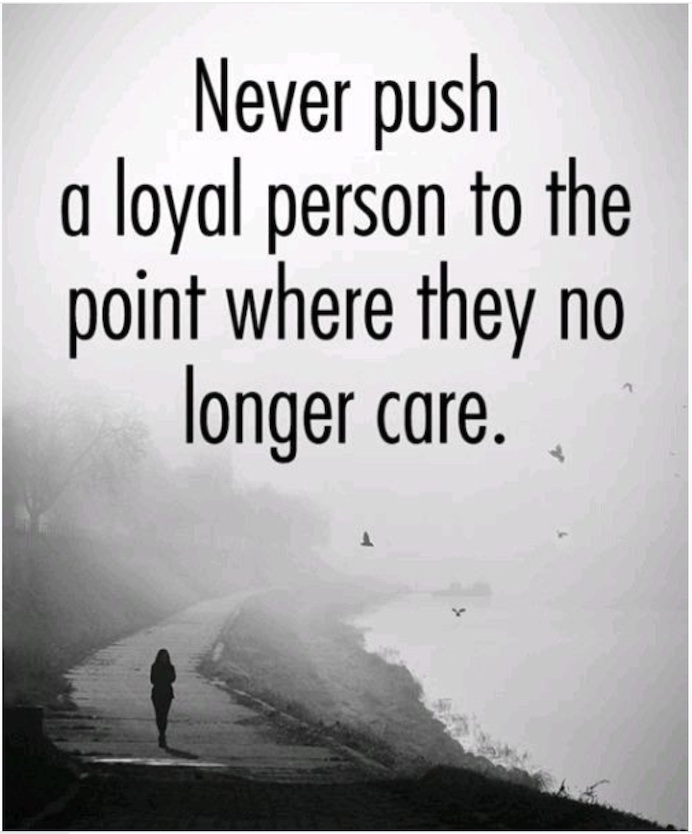
I saw this meme and it hit so close to home regarding my own volunteering experiences in 2021 I almost burst into tears.

Never push a loyal person to the point where they no longer care.

When I express interest in volunteering with a nonprofit or program, I’m excited. I’m energized. I’m inspired. I’m highly motivated. I’m ready to help regarding a cause that I’m feeling strongly about. And very often, I’m hoping for a long-term experience. I’m hoping to volunteer for months, maybe even years, not just a few times. I’m hoping to enjoy myself.

Too often, I leave a volunteering experience that I’ve wanted to be a long-haul after a year or less, feeling overwhelmed, taken advantage of, ignored and/or under-appreciated. And I haven’t enjoyed myself. At all.

As I read the message in that image, I immediately thought not just about my own experiences as a volunteer, but also how many programs have lost fantastic volunteers because of not being clear about expectations, or changing those expectations, or asking too much of a volunteer’s time, or not welcoming and showing appreciation for a new, enthused, passionate volunteer, or otherwise “pushing.”

For this latest experience, I joined a county advisory board regarding the arts. It was a really nice experience the first year, though quarterly meetings were always in-person and held in places that were extremely difficult to get to via public transport (that’s how I get around weekdays, pre-COVID). The second year of my volunteering service was dominated by the global pandemic, and suddenly, we were allowed to do something our host organization assured us was absolutely impossible and not allowed: have meetings online. At the end of 2020, I was asked if I would consider being chair and thought, hey, what the heck, I should step up and do this for one year.

At my first meeting as chair, the bomb was dropped: our government host organization was dropping our board as a responsibility and we would move under the fiscal sponsorship of a nonprofit. At that first meeting, it was said several times, “Things won’t really be changing.” That proved to be a gross misstatement: my required time commitment skyrocketed as I realized a whole host of new processes would have to be researched, developed, proposed and voted on by the board members in a very, very tight timeframe. I went from meetings once a quarter to two or three times a month, and dozens of emails a week – sometimes dozens of emails in one day. Lots of steps in the transition hadn’t been identified by the previous host and the new host, and as I asked questions for clarification, more and more work to do got revealed. I was no longer a part of an advisory group; I was a full-fledged board member of a brand new nonprofit that the board had not asked to be a part of. And I was the chair. And that is NOT what I signed up for when I agreed to volunteer.

My passion wained quickly. My excitement evaporated. My energy and motivation have been squashed.

How did this happen? The people who created this substantial change:

  • did not consult with the volunteers who would be told to take on the responsibility.
  • were in denial that it was a substantial change.
  • have not taken a volunteer management 101 workshop or read any of Susan Ellis’ books.

Yes, I’m still a frustrated volunteer. I still haven’t found a volunteering experience since returning to the USA that’s been what I’m looking for. I still haven’t really had fun volunteering since 2009. But I’m so happy to have yet another experience that will help me as a consultant regarding volunteer management.

Other blogs inspired by my volunteering:

If you have benefited from this blog or other parts of my web site or my YouTube videos and would like to support the time that went into researching information, developing material, preparing articles, updating pages, etc. (I receive no funding for this work), here is how you can help

Infuriating statements about volunteering

graphic by Jayne Cravens representing volunteers

When it comes to talking about volunteer engagement, I am just not at all about bunnies and fluff and warm fuzzies and hugs. I don’t like talking about volunteers as nice but, rather, as necessary, for a whole range of reasons that have nothing to do with money. I think talking about volunteers in terms of warm fuzzies devalues both what volunteers do and what the nonprofits and other programs they support do.

I also cringe over the idea of entitlement regarding volunteers: those people who believe that their desire to do a certain kind of volunteering should be all they need to get to do that volunteering, regardless of what people actually need.

I admit it: I’m not very kind in response to such people. Especially lately.

There are statements and attitudes about volunteering that make my blood boil. They contribute to volunteer engagement not being taken seriously and not being financially supported, and in some cases, to a patriarchal, colonialist view of volunteering, and excuse for volunteers for having that view.

Here are some of those statements that send me over the edge:

  • Volunteering is great, but it’s not serious, like a job. Volunteers can never do something as well as someone that’s paid to do that thing. they can never be experts.
  • People can volunteer whenever they might have some time and solve homelessness, create economic opportunities leading to equity, stop climate change, and solve other serious social and environmental issues. Volunteering is something you do when you don’t really have anything else to do or when you feel like doing it.
  • I feel like I would be good at counseling people, because I do it with friends / at my bartending job, so I should get to counsel people as a volunteer, but I don’t want to have to go through a bunch of training.
  • I like animals, so I should get to volunteer with wildlife, like elephants and baby orphaned tigers.
  • My company’s employees want to work with kids, so the local school should let us host a pizza party for the sixth graders this Friday, from noon to 1.
  • People in poor communities wish people with really “good hearts” from other places will come to their communities and do things local people would like to do themselves: build schools, care for orphaned children, build wells, care for wildlife, etc. And those people in those poor communities want to give these foreign volunteers free housing and these people are so grateful that these volunteers come there, even for just a week or two.
  • Volunteers are cost-free.

I read comments like these all the time on Quora and Reddit. Here’s a perfect example of such. I’ve edited for brevity (the original post is much longer):

I am curious if working for nonprofits or volunteering can become be lucrative at all. I wish I could just live off tips or donations from people that I’ve made their lives better.

I spend a lot of time just talking to people about their problems. Genuinely listening and focusing on them, trying to guide or nurture towards where they are looking to grow, or nudge them towards solutions that are just out of reach. I spend a few minutes a day just answering posts in FB vent groups or lonely people. Just generally check in with people and see how I can make their day better.

I always liked the sense of freedom from volunteering. Especially in a situation where you can work as much or as little as you want. Come in whenever, or on a loose schedule, etc.

Is there low pressure, humanistic jobs, volunteer work, or non profit work that would support a minimalist lifestyle but provide enough to not stagnate? I’m not afraid of labor, but would want to do it on my own terms.

The privilege in this post… the vanity… the stereotypes about not just volunteering but about the help people in crisis need, that it’s all something you can do whenever you might feel like it, and just do it, ’cause, you know, you have a good heart and you really “get” people… yes, my blood is boiling.

While I absolutely believe volunteering can be fun, that it can be informal, and that it can be episodic (one-time event, no further obligation), I also believe volunteering should be something that has some sort of actual impact for the organization, that it should serve the organization and its mission primirarily, and that it shouldn’t be mainly about giving a volunteer a feel-good “look, I helped!” experience. While I believe volunteers can have great ideas about what volunteers should do – virtual volunteering has been driven mostly by volunteers, in fact – I also believe that the final say regarding volunteer engagement is always what the organization and its clients need.

I also believe volunteering, even for just a few hours, is a real commitment, because the issues addressed by volunteer are real, sometimes even urgent, issues. Come in whenever you might feel like it? I would fire volunteers for that. It’s profoundly disrespectful to the causes nonprofits attempt to address.

The work of nonprofits is serious. That work addresses homelessness, it helps the environment, it helps people experiencing domestic violence, it helps communities with a range of quality of life issues, it helps people recover from disasters and on and on. It is not for “whenever I might feel like it because, you know, freedom!” Volunteering is not for the cavalier. It’s not for photos for your Instagram page.

My advice to the person I quoted above? Maybe doing some episodic volunteering, like cleaning up a beach – but, you know, only if you might maybe feel like it.

I’m tired.

Also see:

If you have benefited from this blog or other parts of my web site or my YouTube videos and would like to support the time that went into researching information, developing material, preparing articles, updating pages, etc. (I receive no funding for this work), here is how you can help

Yes, virtual volunteering will continue after the pandemic

I keep seeing this comment in blogs and articles and tweets:

“Will virtual volunteering continue after the pandemic is over?”

Of course, it will. Just as virtual volunteering was happening BEFORE the pandemic, at THOUSANDS of organizations. Why in the world wouldn’t it continue?

Maybe my latest video will stop this question from being asked… though probably not. FYI, the video is just four minutes long.

And for a free, basic orientation in virtual volunteering, you can watch these free videos on my YouTube channel – altogether, less than an hour:

Altogether, these videos cover developing initial online roles and activities for volunteers, how to rapidly engage online volunteers, how to expand virtual volunteering, how to adjust policies, how to address safety and confidentiality, the importance of keeping a human touch in interactions, addressing the most common questions and resistance to virtual volunteering and much, much more. You have my permission to show them at any conference or workshop or class you might be doing regarding virtual volunteering.

For some more advanced topics regarding virtual volunteering:

Also see:

If your program wants to better use online tools to support all of your volunteers, including those providing service onsite, or if your program wants to create a robust virtual volunteering scheme, such as an online mentoring program or online volunteer engagement as skills-building or other extension of your mission , check out the Last Virtual Volunteering Guidebook: Fully Integrating Online Service Into Volunteer Involvement. The book can help you fully explore the reality of remote volunteer engagement, in terms of policy and procedures, to ensure success. This book was helpful long before the global pandemic spurred so many organizations to, at last, embrace virtual volunteering. This is the most comprehensive resource anywhere on working with online volunteers, and on using the Internet to support ALL volunteers, including those you might not think of as “online” volunteers.

If you have benefited from this blog or other parts of my web site or my YouTube videos and would like to support the time that went into researching information, developing material, preparing articles, updating pages, etc. (I receive no funding for this work), here is how you can help