two exceptional resources re: donor cultivation

There are two sites that I think are exceptional in talking about donor cultivation and building meaningful, ethical relationships with donors that lead to long-term support. These two resources can help move your program’s mindset away from “Where is that magical list of people/corporations/foundations that might donate to my organization” – which, by the way, does not exist – and, instead, move to creating much more effective, ongoing strategies for attracting support and new supporters. Taking time to read these free blogs once a week is as good as attending any conference or workshop regarding fundraising for nonprofits, non-governmental organizations (NGOs), charities, schools, community projects, etc.

One site is made up of excellent communications / outreach resources from Philanthropy Without Borders regarding donor site visits, empathy and ethics in fundraising and how to make the “big ask” during a site visit. Two of my favorite articles:

Another terrific resource: blogs by blogs by Mary Cahalane (Hands-On Fundraising). Mary has been a very successful fundraiser and believes strongly on cultivating relationships with donors, not just asking for money. She talks a lot about making emotional connections with donors and other supporters and about ethics in managing fundraising staff.

  • Mary also offers this gem from her Ultimate Guide on Donor Experience: We need to avoid focusing on the quick transactions and the shiny objects that are cropping up and begging for our attention. Without proper stewardship of both our donors and the data that represents them, we will never be able to perform our responsibilities and deliver on the promise of our mission.

Also see:F

Dealing with customers with diminished mental capacities

No matter what business you are in, you encounter people with diminished mental capacities caused by dementia, a brain injury, even Schizophrenia. They may be job applicants, they may be applicants to volunteer, they may be attendees to a public event, they may have paid to be a part of a service you have offered, such as a class or a hackathon.

In thinking about customers and clients and public spaces, including online spaces, nonprofits, NGOs, charities, libraries and others need to consider how to balance the priorities of the program and the needs of other clients and customers with the rights of a person with diminished mental capacities who, just like any member of the public, has a right to attend any public events, speak with you in public, come into your lobby to make inquiries, apply to volunteer, apply for a job, comment on your blog, blog about your organization, etc. For me, the boundary is if and when the behavior of someone, for whatever reason, becomes disruptive or they violate the decorum or rules of onsite or online interactions – and that’s a boundary for EVERYONE, regardless of their mental capacities.

I’ve worked in and with nonprofits, in and with agencies focused on international humanitarian work and with people who want to work in these sectors for more than 30 years – I started when I was still at university. This kind of work regularly attracts people who say they want to be considered for work or funding, or want to participate in a program, but who are not capable of such and also have significantly diminished mental capacities.

It’s not always obvious during a first encounter, when the person attends an event and begins asking a question, or calls to set up an appointment, or writes an email asking for information about consulting fees, or even applies for a role: the person may be quite well-spoken, may have a university degree, may be well-read and may have a credible, professional background in a particular field – or seem to. But further conversations reveal the mental issues: a belief that they are freelancing for a major media outlet, a belief that they are in regular contact with heads of state, a belief that a legitimate, credible group has somehow endorsed the work this person wants to do (when, in fact, the group has NO formal affiliation with the person, and either has never heard of the person or actually wants to distance themselves from the person as much as possible), a belief that a certificate of appreciation for attending an event is actually a major, prestigious award, a belief that those they encounter are working for a secret government agency that spies on them, and on and on.

I’ve encountered such people regularly in my work, people who believe they are journalists and asking for interviews with senior staff or high-profile politicians or with celebrities participating in our organization. Or claiming to be experienced humanitarian workers. Or asserting that they have formal connections with a variety of high-profile organizations and government officials. Or claiming that they have a nonprofit or NGO, or are starting such. Or claiming to be the spokesperson for a particular indigenous community or minority group. Or just walking into a conference and then into a workshop and asking questions and joining break-out groups, despite not being registered and having no formal affiliation with any of the subject matter of the conference or workshop. When I realize that the person isn’t who they believe they are or isn’t supposed to be at the conference or event, myself or others are often deeply engaged in a conversation with them – or they are so deeply ingrained in the moment that it might cause a disruption at the event to ask them to leave.

I once attended a conference as the keynote speaker and only after arriving at the venue did I realize, along with other speakers, that the organizer herself was someone of diminished capacity who had put herself deeply into debt renting space and paying for accommodations and travel for speakers and presenters and actually had NO formal affiliation with the organization she had claimed was sponsoring the event. It was a painful experience for everyone, and I learned the importance of always confirming that someone who makes any offer to me regarding a speaking engagement, consultation or interview really is with the agency they claim to be with.

Another time, I accepted payment for career consulting from someone who, according to her résumé and LinkedIn profile, had an excellent academic background and rich professional history that would make her a good candidate for humanitarian work. After several email exchanges, she said that the CIA regularly tracks her communications and she feared I was working for the agency, among other theories. A Google search of old web sites and newspaper articles showed that she really did have the professional background she had claimed, but at some point, her career had just stopped, during a time when she claimed to have gone back to university for another degree, and there were no more listings for her after a certain date on the Internet. I ended up returning her money, wishing her well, saying that I thought it was best we no longer have communications and blocking her email address so that I no longer received communications from her.

More recently, I volunteered with a local citizens’ advisory group that helps local artistic groups and artists with publicity, grant writing and networking. I encountered an elderly woman who wanted advice on proposal writing and had signed up to get assistance via this group. As we talked, I slowly realized she was someone of diminished capacity: she said she wanted to start a nonprofit, but she was vague on what its mission would be, she had no letters of endorsement from those she claimed her nonprofit would help, she has no board of directors, she couldn’t verbalize any concrete goals or steps and she seemed confused at my questions. She continually talked about how she needed office space so she could do her work – work she couldn’t really describe. She also had some unfortunate, quite racist things to say about the people she wanted to help. After some checking later with others, I found out that, indeed, decades ago, she really did have an extensive, international arts background. She definitely knows about nonprofits in general, and how to find the events this advisory group puts on. But her ideas for her nonprofit were unrealistic: she believes there’s a magical grant that will give her office space and office equipment, even though she still isn’t sure exactly what it is her nonprofit will do, and believes artists will become a part of her program, even though she doesn’t know any personally.

I am not a doctor, a counselor, a therapist, a psychologist or a psychiatrist, and I do not want to imply I am in any way. I do know that there are several health factors that can affect a person’s already-diminished mental and emotional capacity, such as age, fatigue and hearing and vision loss. There are other factors as well, such as a particularly traumatic event, grief or depression. I also know that people with mental illness can come from any racial group, any cultural tradition, any economic level or any level of intellectual capacity (they can have legitimate PhDs). While I am not in any business to help people with emotional or mental challenges, I do know that I am going to encounter people facing such challenges in my work – and during activities on my personal time as well – and I need to be prepared for such.

When I have encountered these situations onsite, my approach has been to remember that this person has a right to attend public events, speak with me in public, ask for a meeting, apply to volunteer, etc. (unless it’s a paid conference or ticketed event- just like anyone who didn’t pay to be there, they will be asked to leave and escorted out if necessary). So long as he or she isn’t profoundly disruptive, doesn’t become insulting and won’t monopolize my time or the time of others at the public event or in the public space, I’ll interact with that person, just as I would with anyone. I have ended up involving people with diminished mental capacities as online volunteers: while I knew they had challenges, per things they said on their application and some of our email interactions, I could also see their capabilities, and I was able to find tasks they could do as volunteers – they were never disruptive and one such person in particular was one of the highlights of my early days working with online volunteers.

In situations dealing with people I suspect have some diminished capacities, I sometimes need to be more explicit about setting and sticking to strict boundaries, such as the time I have available for the meeting, or noting that it’s time for someone else to ask a question and that our workshop does not allow anyone to monopolize workshop discussions. I work to be clear and consistent in what I am saying, staying respectful even as I am being blunt: “I appreciate your goals, however, I have spent 20 minutes speaking with you and now this conversation will need to end. I will walk with you to the front door and then you will have to leave, so that I may do the work I have scheduled for today.” Or “Thank you for your comments, but I’m going to have to stop you now, because other people in this workshop need to be able to speak.” I do not encourage any medical or mental health treatment to the person, but I may ask if there is a family member or someone else I can call to transport the person elsewhere, especially if that person becomes tearful or distressed or seems incapable of removing themselves from the premises. If the person has paid money to attend an event or for consultation time, or has made a financial donation, I do all I can to refund that money as immediately as possible.

If the person does become disruptive, such as refusing to stop talking during a workshop, or is trespassing, I will be more blunt. This happened at a conference in Portland, by a person who had wandered into a conference workshop I was leading. I told the person, in front of all the other workshop attendees, as the person rambled on and on, “You will have to stop talking now and you will need to leave. I will call security immediately if you do not.” The person did leave immediately.

I also make sure co-workers are aware of what is happening and make sure everything that happens is documented in some way. Sometimes, this is just an email to another organizer detailing what happened, what action I took, and suggestions for avoidance and, if that doesn’t work, for future encounters. I make sure all staff know what to do if this person attempts to purchase an event ticket, make a donation, register for an event, etc.

Psychology Today has an excellent article, “Communicating with People with Mental Illness: The Public’s Guide” that has a detailed list of strategies for communicating effectively with people with mental illness. The article was posted Oct 19, 2010. The suggestions include:

  • Be respectful to the person. When someone feels respected and heard, they are more likely to return respect and consider what you have to say.
  • If they are experiencing events like hallucinations, be aware that the hallucinations or the delusions they experience are their reality. You will not be able to talk them out of their reality. They experience the hallucinations or delusional thoughts as real and are motivated by them. Communicate that you understand that they experience those events. Do not pretend that your experience them.
  • Some people with paranoia may be frightened, so be aware that they may need more body space than you.
  • Do not assume that they are not smart and will believe anything you tell them.
  • Mental illness has nothing to do with the person’s intelligence level. Do not lie to them, as it will usually break any rapport you might want to establish.
  • Try to limit your interventions to relatively short periods of time, but realize that taking time to try to communicate effectively with the person may save you a lot of time in the long run and help someone in the process.
  • Listen to the person and try to understand what he/she is communicating. Often, if you do not turn off your communicating skills, you will be able to understand. Find out what reality-based needs you can meet.
  • If needed, set limits with the person as you would others. For example, “I only have five minutes to talk to you” or “If you scream, I will not be able to talk to you.”

When you realize you are dealing with someone online with diminished capacities, it can be much more difficult: being online may constitute a substantial part of that person’s time every day, and they may rely on online activities to feel included or important, to make their imaginary nonprofit seem legitimate, etc. It’s much easier for any person to appear credible online. Your program should know what to do if they start to suspect they are having such an interaction:

  • Tell your staff that they need to let their supervisor know if they suspect someone they are interacting with online, or someone writing about your organization online, might have mental or emotional challenges, and let staff know the rest of these guidelines (and make sure they understand them).
  • Do NOT say in any public forum or on any social media channel, or to the person, ever, that you think the person is mentally ill, emotionally challenged, etc.
  • If interactions with any person online are disruptive to your business, or you think at any point someone from law enforcement, a judicial body or the person’s family may need to see these exchanges, or you are going to have to cut off communications with this person because of their behavior, screen capture all communications that illustrate how the person is disruptive and save these for future reference.
  • If you are worried in any way about this person escalating their communications and actions to the point of being disruptive or dangerous, have a staff member search online to see if this person has caused issues for other organizations. Searching for the person’s name on Google and Duck Duck Go, as well as on YouTube, will probably be enough to reveal such, but you may need to add words to that search – just the word complaint or words that the person uses frequently in their online interactions with you can lead to the specific information you need to see that you are not the first program targeted. Screen capture any examples you find of this person behaving this way with others (and don’t be surprised to find that you aren’t the first target of this person’s fascination or ire). You may want to discreetly reach out to those earlier targeted organizations and individuals, to see how they handled being targeted by this person and if the situation died down, was resolved, etc.
  • It may be best to not respond at all to blogs they write about your program, or what they write on their own social media channels about your program – but you need to screen capture those references to your organization and your staff for future reference.
  • It may be best to stop engaging with the person – not to reply to their emails, not to reply to their online comments, etc. You need to save those communications for future reference, if needed. You may want to simply stop replying without explanation or you may want to say, “We appreciate the time you have taken to share your viewpoints about our work. We have responded as much as we think is needed and, In the interest of staying focused on our work, we are going to stop replying to your emails.”
  • It may be best to block the person from your online community, not publish the person’s comments on your blog, remove comments from the person on your Facebook page, etc. You may need to go even further and block the person entirely on social media channels so that they cannot see your posts – but know that they can simple create a new account and view your public information from that new account. Know that blocking someone entirely might escalate the person’s hostilities or anger, as they will be able to see that you have blocked them.
  • You may need to let your entire staff and all of your volunteers know about the situation, if they are seeing this person’s posts on social media, on a blog the person owns, on other organization’s blogs, etc. Be very careful in your communications with staff regarding your choice of words to describe the person. An example of how you could communicate this situation in a meeting, “Some of you have noticed that there is a person producing videos about our organization where he says that our Executive Director is engaged in illegal behavior. We are aware of these posts. We ask you to please never interact with this person online, never comment on anything this person says online, and please do not to have any conversations with anyone about this person online. If you see this person doing something online that relates to our organization, please notify such-and-such. If you are worried in any way about this situation, please notify such-and-such.”
  • Once interactions get to the point of screen captures, muting or blocking, notify at least one board member and, if it’s not that person, your nonprofit’s legal counsel, about what is happening. The likelihood of this escalating to legal action is minuscule, but you do need to cover your bases.

Hootsuite has an excellent blog about dealing with online “trolls” – people who “deliberately provoke others online. By saying inflammatory and offensive things. They live to make people upset and angry.” I think that most such people are dealing with diminished mental and emotional capacities. One section of the blog asks, “Troll or upset customer” and notes that it can be hard to tell, as “Both might appear irked, perhaps even furious or enraged.” The blog’s advice:

  • Stay calm. Look at the substance of their words. That’s usually the tell-tale.
  • Listen and think about their motivation. Do they appear frustrated, stating a seemingly authentic claim about your business, product or service?
  • Do they seek truth?
  • Or… do they sound outraged, seething and trying to incite rage in your brand or in other users?If so, you’ve got yourself a live, social media troll—an internet misfit, in the digital flesh.
  • For the un-delighted customer, listen to them. They want to be heard. If you address and resolve their issue, they’ll be satisfied and those unhappy messages will cease.
  • But not the online troll. They won’t stop until they’re forced out or get bored.
  • Trolls aren’t looking for resolution. They want to engage in battle, one that nobody can win.

To be clear, while I do think trolls are people with diminished mental and intellectual capacities, I don’t think all people with diminished mental or intellectual capacities are trolls.

The situations I have had talking with people with diminished mental capacities have not turned dangerous or litigious for me (yet), but I always have that potential in mind, however unlikely. I am also thinking about the safety of myself and others at the facility or within the organization where I am working. The importance of having other people around during onsite conversations and encounters, and having screen captures of online encounters that your board, other staff or legal advisors could reference if needed, cannot be stressed enough.

If I see the person somewhat regularly, know them by name, etc., and I perceive a progression of behaviors that I believe could lead to violence, such as yelling or crying, I will contact a family member or friend the person has identified to me to come help in the situation. I would call the police if the situation had the potential to become dangerous for anyone, including the person I’m talking with.

One thing I do NOT do is “kick the can down the road” – as in suggest to the person that the person go to another nonprofit or consultant because it is my hope that this will take the person’s attention off of me. I may recommend another organization if I think the experience might help the person understand that, for instance, they will not be able to get funding for a nonprofit they are dreaming of building, or that they are not going to get support to go to another country to do work they’ve always dreamed of.

If your nonprofit has a mission to work with people with diminished mental capacities, such as people who are experiencing dementia, I have a suggestion for a funding source: offer short courses for businesses, government offices and nonprofits in recognizing customers, clients, volunteers and staff who may have such issues. We need this training!

Also see:

If you have benefited from this blog or other parts of my web site and would like to support the time that went into researching information, developing material, preparing articles, updating pages, etc. (I receive no funding for this work), here is how you can help

The opposite of poverty porn: erasing clients from storytelling

Earlier this year, I wrote a blog about poverty porn and other kinds of exploitative marketing by many nonprofits, where graphic photos and videos of people in desperate situations or images of people with disabilities are used to make the viewer so upset or emotional as to garner donations, or to make someone delivering services on behalf of that nonprofit look exceptionally compassionate and heroic.

But on the other side of that marketing no-no are nonprofits that make their outreach stories more about what their staff is doing and about their leadership than about those that are served or the cause at hand. You want to tell compelling stories about your organization’s without trivializing people’s lives, absolutely, but you also don’t want to mostly or entirely erase those you are serving from the narrative.

Examples I’ve encountered in the just the last three months of nonprofit marketing that erases clients – or pushes them out of the focus:

  • An arts group that says it promotes the art and artistry of indigenous people, but has no photos or testimonials of these artists on its web site (just clip art of indigenous people the organization has never met), nor does it have any indigenous people on its board or in positions of leadership.
  • A homeless coalition that uses social media to feature photos and commentary about its founders, but offers no testimonials, commentary or images from those the coalition is supposed to serve.
  • Any number of nonprofits and NGOs that have far more stories and photos about the founder of the organization and what he or she is doing and thinking than they have about those being served – including photos where the founder is NOT pictured, or stories where the founder is NOT quoted.

Unlike marketing for businesses, which is pretty much about selling more and more of a product and making as much money as possible, communications for nonprofits, charities and other mission-based organizations requires addressing a variety of needs:

  • getting people to attend events or to participate in activities,
  • attracting new donors and volunteers,
  • giving current donors and volunteers a feeling of satisfaction about what they have donated,
  • allaying fears about the clients served or the cause that’s being promoted,
  • promoting behavior change (encouraging people not to litter, to recycle, to use condoms, to not use certain words, etc.),
  • addressing misunderstandings and crises,
  • and on and on.

In fact, at nonprofit organizations, the people working to attract donations may have a message that is in conflict with the people who are delivering the program – the fundraisers want to evoke an emotional reaction that attracts donors while program managers may feel that the messaging reduces those served to stereotypes. It can be a delicate balance.

So, let’s go back to those aforementioned cases and talk about what it should look like instead:

  • The staff of the organization that promotes indigenous artisans should have ongoing conversations with those artisans about how they want to be supported, how they want to participate in decision-making, how they want to be pictured and how they want their work presented online and in print.
  • The staff at an organization that helps people experiencing homeless, or people with disabilities, or people who have experienced a trauma, should have ongoing conversations with those clients about how they might want to be pictured and talked about online and in print. They should be talking with clients about the goals of the messages in brochures, on the web site, on social media, in slide show presentations: what is it the nonprofit wants to show, and how might images help?
  • Be careful about Executive Director over-exposure in messaging. If the nonprofit leader is the face of the organization and the primary reason people donate, make sure that this messaging is balanced with strong messaging about the impact the organization is having on the community or cause it serves, messaging so strong that the organization could survive the Executive Director’s departure or negative publicity regarding that person (unless, of course, your board is comfortable with the idea of the organization folding with the departure of the Executive Director and, indeed, there are boards that are absolutely fine with this setup – as am I regarding certain charities).

Of course, it’s not easy to feature all clients in marketing and public relations materials: there are charities that support foster kids, for instance, that use child and teen models rather than actual foster children in photos and videos, in order to protect the identities of clients. Something that is “exploitative” or a stereotype can be in the eye of the beholder. The best strategy: consult with your clients. Talking to them about what you want to portray, how images will be used, etc., can lead to more buy-in from those you are trying to serve for your efforts, can build more trust for program delivery, can help prevent misunderstandings down the road, and can even lead to great ideas for marketing and public relations you may never have thought of.

There are some good resources regarding ethics and photography in humanitarian work that have advice that can be applied for nonprofits working with vulnerable populations (people who are homeless, people experiencing addiction, people who have experienced domestic violence, foster children, people with disabilities, etc.) in their own countries, including:

I would love to hear from others about how they maintain this balance in their representation of vulnerable populations in public relations and marketing materials.

Also see:

If you have benefited from this blog or other parts of my web site and would like to support the time that went into researching information, developing material, preparing articles, updating pages, etc. (I receive no funding for this work), here is how you can help

Why & how to make volunteering as accessible as possible

graphic by Jayne Cravens representing volunteers

If your nonprofit, school, government program, charity or other mission-based initaitive wants access to the greatest amount of talent and resources that volunteers can possibly bring to your program, you have to make all volunteering as accessible as possible. That means looking for ways to accommodate a myriad of people who have different abilities, needs, personality types and work styles.

Accessibility and diversity are about accommodating everyone, not just people with disabilities or people who are from minority groups. You want to make volunteering as welcoming to the widest number of people possible. – Volunteer expert Susan Ellis

There may be a fantastic web designer out there who would love to volunteer at your organization, but who also isn’t very talkative and doesn’t make much eye-contact and, therefore, might be seen by some as unfriendly. Is your screening process such that you would still welcome this candidate into your organization?

There may be a fantastic person with the talents, skills and time to run your new volunteer orientations, but she doesn’t have a car. Do you have clear guidelines on your web site on how to get to your agency by mass transit? 

There may be a fantastic writer out there who could tell stories about your organization in such a way as to move new donors to open their pocketbooks and new volunteers to sign up to help, but who also legally blind. Is your web site accessible so that that fantastic writer can read your web site and blog and online newsletter with an accessibility screen reader?

There may be a fantastic graphic designer out there who could do amazing work for your organization online and in your print material, but who also uses a wheelchair for mobility, or has no transportation to get to your work site. Could that volunteer with the mobility issues get through your front door for an interview? Would you be willing to have your mandatory interview online via Skype? Would you be willing to accommodate the volunteer through virtual volunteering?

Do you have a diversity of tasks – some that can be done by someone sitting at a desk, others that require a lot of movement, maybe even carrying things and walking a lot? Some that don’t require a volunteer to interact much with others and some that require a volunteer to regularly interact and help others? Some that put volunteers together as a group? Some that allow volunteers to provide service for a few hours on a Saturday, without any ongoing commitment? Leadership roles? Some that require expertise, some that don’t require any? Some that can be done during regular work hours and some that can be done on evenings or weekends?

I’ve launched a new resource to help you understand the advantages for your program in making your volunteer engagement as accessible as possible and how to do it. The resource covers task design, ethics in internship design, accessibility for people with disabilities, messaging, language use and more.

Of course, not every volunteer role can accommodate everyone: a role may absolutely require a person with a clear, understandable speaking voice. Or may require someone that can carry a certain amount of weight and walk a certain distance. Or to interact regularly with other people. Or may require structural changes to a building that are too expensive for your program to afford. Or may require a volunteer to be calm and thoughtful in highly stressful situations and to be able to manage the anxiety that can arise from such work. But thinking about ways to accommodate a variety of people at your organization as volunteers will give your program access to an amazing range of talent, skills, energy and knowledge you will miss out on otherwise.

And one more thing: nonprofits, NGOs, charities and others MUST take a leadership role in creating community cohesion, in the face of the rise of violent extremism all over the world, including the USA, and the increasing belief in demonizing the “other” – people of a particular religion (or no religion at all), people of a particular ethnicity, immigrants, people with mental illness and more. It’s a bold, vital statement to make your program’s volunteer engagement as inclusive as possible, as representative of everyone in your community as possible. It’s a practice and state that affirms to everyone – board members, consultants, EVERYONE – that your organization makes inclusion and accessibility a priority.

Also see:

If you have benefited from this blog or other parts of my web site or my YouTube videos and would like to support the time that went into researching information, developing material, preparing articles, updating pages, etc. (I receive no funding for this work), here is how you can help

Your favorite non-English resources re: volunteerism or nonprofits?

I asked this back in 2011, but it’s time to ask it again:

I would like to know YOUR favorite online resources regarding volunteerism / volunteers (especially the support and management of such), nonprofits or NGOs (non-governmental organizations), including Tweeters, in languages OTHER than English.

Spanish, French or German are most desired, but any language – Arabic, Persian Farsi / Dari / Tajik /, Hindi, whatever – would be welcomed.

In short, I’m looking for the Spanish, French, German, Arabic and other non-USA, non-English-language versions of Energize, Inc., of VolunteerMatch, of resources for those that manage volunteers like what I have on my web site, etc.

Please send the name of the resource, the URL of the resource, and a summary of what the resource is – does it focus on volunteer management? On nonprofits / NGOs / charities using the Internet? Or helping organizations recruit volunteers? Or fundraising / resource mobilization? Or any aspect of management? Is it a web site? A database? A Twitter feed?

I have some of these resources already, but I would like to have more. Plus, mine need updating:

I will share what I’ve compiled already and what’s submitted – and is what I’m looking for – on my web site, and announce the page here on my blog, as well as my Twitter feed and my Facebook page.

If you have benefited from this blog or other parts of my web site and would like to support the time that went into researching information, developing material, preparing articles, updating pages, etc. (I receive no funding for this work), here is how you can help.
Tools for project managers with remote teams

This article from International Center for Journalists is focused on journalists and editors working with journalists and other contributors remotely, but much of its advice is applicable for nonprofits working with remote staff and remote volunteers (virtual volunteering) – or working with staff you see face-to-face but you need to work with online as well. The article is written by the project manager of Chicas Poderosas, a community of women in media spread across 18 countries in Latin America. 

For instance, when brainstorming a story or a project with your team, she uses remote visual boards like Jamboard. “Jamboard has virtual post it notes, and allows your team to simultaneously create text boxes, write comments and even draw.” Has anyone else used it? What do you think of it?

To keep track of the individual activities in the chart, she uses Trello. Each task is its own card, which can be assigned to a team member, and can include deadlines and alerts. Trello has integrations with other tools such as Google Drive. “In our Chicas Poderosas weekly calls, we update the Trello board, checking up on what each Chica did, and we create and take ownership of new tasks for the next week.” 

She also has good, not-techtool-specific advice like: 

The best tool is not the latest, or the most complex and automated. The best tool is always the one that is more natural for your team, the project and any other involved stakeholders.

If you do find a new tool that you want to implement, always take the time to schedule on-boarding sessions so that your team can practice using it, ask questions and share their challenges. 

Do you use any of the tools she mentions? Do you have other ideas?

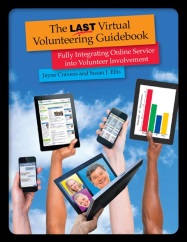
And if you want to explore how to involve and support volunteers, whether those volunteers are around the corner or around the world, check out my book with Susan Ellis, The Last Virtual Volunteering Guidebook. The book is the result of more than 20 years of research and experience regarding virtual volunteering, including online micro volunteering, crowdsourcing, digital volunteering, online mentoring and all the various manifestations of online service. It’s packed with examples from a variety of organizations and details on how virtual volunteering works, how challenges are overcome, and how success is measured. It includes

  • Detailed advice on virtual volunteering assignment, including one-time “Byte-Sized” tasks (micro-volunteering / microtasks), longer-term, higher-responsibility roles and virtual team assignments.
  • A thorough look at various practices for screening and matching volunteers to assignments, with an eye to getting the most capable volunteers into your volunteering ranks and preventing incomplete assignments or burdensome management tasks
  • How to make online volunteer roles accessible and welcoming for a variety, diversity of people

Susan and I wrote The Last Virtual Volunteering Guidebook in such a way that it would be timeless – as timeless as a book about using computers, laptops, smart phones and other networked devices could be. It is USA-centric but it offers a lot of international perspectives as well.

There’s also a chapter just for online volunteers themselves, which organizations can also use in creating their own materials for online volunteers.

If you read the book, I would so appreciate it if you could write and post a review of it on the AmazonBarnes and Noble and Good Reads web sites (you can write the same review on all three sites).

UN Digital Cooperation report released

The age of digital interdependence: Report of the UN Secretary-General’s High-level Panel on Digital Cooperation has just been released. 

In July 2018 the Secretary-General of the United Nations (UN) appointed a panel to consider the question of “digital cooperation” – the ways we work together to address the social, ethical, legal and economic impact of digital technologies in order to maximize their benefits and minimize their harm. The Secretary-General asked the panel to consider how digital cooperation can contribute to the achievement of the Sustainable Development Goals (SDGs) – the ambitious agenda to protect people and the planet endorsed by 193 UN member states in 2015. He also asked the panel to consider models of digital cooperation to advance the debate surrounding governance in the digital sphere.

The Co-Chairs of the panel are Melinda Gates (USA), representing the Bill & Melinda Gates Foundation, and Jack Ma (China), Executive Chairman of the Alibaba Group. Ex officio members are Amandeep Singh Gill (India) and Jovan Kurbalija (Serbia) of the Secretariat of the High-level Panel on Digital Cooperation. Members of the panel that contributed to the report include:

  • Mohammed Abdullah Al Gergawi (UAE), Minister of Cabinet Affairs and the Future, UAE
  • Yuichiro Anzai (Japan), Senior Advisor and Director of Center for Science Information Analysis, Japan Society for the Promotion of Science
  • Nikolai Astrup (Norway), Former Minister of International Development, now Minister of Digitalisation, Norway
  • Vinton Cerf (USA), Vice President and Chief Internet Evangelist, Google
  • Fadi Chehadé (USA), Chairman, Chehadé & Company
  • Sophie Soowon Eom (Republic of Korea), Founder of Adriel AI and Solidware
  • Isabel Guerrero Pulgar (Chile), Executive Director, IMAGO Global Grassroots and Lecturer, Harvard Kennedy School
  • Marina Kaljurand (Estonia), Chair of the Global Commission on the Stability of Cyberspace
  • Bogolo Kenewendo (Botswana), Minister of Investment, Trade and Industry, Botswana
  • Marina Kolesnik (Russian Federation), senior executive, entrepreneur and WEF Young Global Leader
  • Doris Leuthard (Switzerland), former President and Federal Councillor of the Swiss Confederation, Switzerland
  • Cathy Mulligan (United Kingdom), Visiting Researcher, Imperial College London and Chief Technology Officer of GovTech Labs at University College London
  • Akaliza Keza Ntwari (Rwanda), ICT advocate and entrepreneur
  • Edson Prestes (Brazil), Professor, Institute of Informatics, Federal University of Rio Grande do Sul
  • Kira Radinsky (Israel), Director of Data Science, eBay
  • Nanjira Sambuli (Kenya), Senior Policy Manager, World Wide Web Foundation
  • Dhananjayan Sriskandarajah (Australia), Chief Executive, Oxfam GB
  • Jean Tirole (France), Chairman of the Toulouse School of Economics and the Institute for Advanced Study in Toulouse

From the report:

Our dynamic digital world urgently needs improved digital cooperation and that we live in an age of digital interdependence. Such cooperation must be grounded in common human values – such as inclusiveness, respect, human-centredness, human rights, international law, transparency and sustainability. In periods of rapid change and uncertainty such as today, these shared values must be a common light which helps guide us… 

We need to bring far more diverse voices to the table, particularly from developing countries and traditionally marginalised groups, such as women, youth, indigenous people, rural populations and older people…  

The resulting report focuses on three broad sets of interlocking issues, each of which is discussed in one subsequent chapter: 

  • Leaving No One Behind argues that digital technologies will help progress towards the full sweep of the SDGs only if we think more broadly than the important issue of access to the internet and digital technologies
     
  • Individuals, Societies and Digital Technologies underscores the fact that universal human rights apply equally online as offline, but that there is an urgent need to examine how time-honored human rights frameworks and conventions should guide digital cooperation and digital technology.
     
  • Mechanisms for Global Digital Cooperation analyses gaps in the current mechanisms of global digital cooperation, identifies the functions of global digital cooperation needed to address them, and outlines three sets of modalities on how to improve our global digital cooperation architecture – which build on existing structures and arrangements in ways consistent with our shared values and principles.

Some of my observations about the report:

  • I like the three broad sets of interlocking issues.
     
  • I was very pleased to see so much emphasis on countering misinformation and on the need to use online tools to build trust and social cohesion.
     
  • The date of the publication is nowhere to be found on the report. I think it was published in June 2019. 
     
  • The term non-governmental organization (NGO) is never mentioned in the report. Not once.
     
  • Activists nor activism is never mentioned in the report. None once.
     
  • The phrase civil society is used. Does that include the work of NGOs, or activists, including those opposed to government or promoting alternative strategies to those being promoted by more mainstream international NGOs, all of whom mobilize people to engage online as consumers, clients, campaigners, supporters, proponents, opponents of activities by corporations/businesses and the government?
     
  • People with disabilities and their unique needs regarding access digital technologies are lumped in with other marginalized groups, which ignores the unique needs of people different kinds of sight impairments, people with hearing impairments, people with different mobility issues, and a range of other physical and intellectual challenges that people creating online tools do not design for. And there’s no mention that improving accessibility for people with disabilities improves access for EVERYONE. The scant references, lumped in with other marginalized groups, are easy to find: just look for the word “disabilities.” This would have been remedied if the panel had included Sharron Rush (USA), of Knowbility or anyone from the World Wide Web Consortium (W3C).

For the next year or two, this report will be used to justify what any UN initiative does regarding ICT4D – and used to dissuade other proposals, like supporting the needs of human rights activists online, or initiatives that make a centerpiece of promoting accessible web design. And given those ommissions, it’s a mixed bag – a followup is most definitely needed to address this. 

See a list of all United Nations Tech4Good / ICT4D Initiatives to date (yes, I track them, since I was involved with two of them, United Nations Technology Service (UNITeS). and the UN’s Online Volunteering service (formerly NetAid).

Here is the panel’s official web site. You can also follow the initiative on Twitter @UNSGdigicoop.

Also see:

Hosting International Volunteers: A Where-To-Start Guide For Local Organizations

I’m seeing more and more local organizations – non-governmental organizations (NGOs), charities, schools – in developing countries posting on sites like Reddit, asking foreign volunteers to travel to their countries and volunteer. These NGOs and others offer no information on whether or not its legal for foreigners to come to the country and volunteer, no information on what they will do to ensure volunteers will be safe, no information on what screening they do of volunteers to ensure safety of volunteers – they just post, “Hey, we help orphans / wildlife / women, and you can come here and help us.”

It’s troubling.

The reality is that it is not ethical nor appropriate for any NGO to recruit foreign volunteers unless they are already involving LOCAL volunteers and have the full endorsement of local people for the work they do, and it is inappropriate for them to recruit foreign volunteers unless they have complete information on assignments, safety, screening, quality control and more.

That said, some NGOs have a legitimate need for foreign volunteers, and this page on my web site is meant to help.

Hosting International Volunteers: A Where-To-Start Guide For Local Organizations provides detailed suggestions for NGOs in developing countries interested in gaining access to foreign volunteers. This is a “getting started” guide, NOT a comprehensive guide: it’s impossible within the boundaries of a simple web page to detail all an organization needs to do to host volunteers from other countries.

Also see:

If you have benefited from this blog or other parts of my web site and would like to support the time that went into researching information, developing material, preparing articles, updating pages, etc. (I receive no funding for this work), here is how you can help

Special offer: discounted trainings

logo

If your group (association, university class, etc.) is in the USA and the group you may want to receive one of my trainings is an audience that will be at least one third African American, Latino and/or American Indian/Native American, I will give you a special, reduced rate for an online or onsite training. This is per my commitment to helping African American, Latino and American Indian/Native American managers in nonprofits, civic organizations, government programs and schools in particular to build their capacities regarding communications and/or volunteer engagement, and to cultivate far more trainers and consultants and leadership from these communities.

Please contact me for more information about my special rates for your audience.

Here are some of my trainings on YouTube.

You can read more about my consulting services and the list of University-Level Instruction – Course Options that I am interested in teaching, in-person or online.

Harms caused by persuasive technologies – what your nonprofit needs to know

Nonprofits, non-governmental organizations (NGOs), charities, government agencies, schools and other mission-based organizations, no matter what that mission is, needs to be aware of persuasive technologies and how that tech is being used to gather data and use it to target people to get them to buy or do something. You should even consider how you can educate your board, your other volunteers and your clients about persuasive tech and they can better recognize such.

This is from a recent email newsletter of the Center for Humane Technology:

We are as concerned as you are about the harms caused by persuasive technologies. A key lever in our theory of change at the Center for Humane Technology is applying pressure on technology companies by educating policy-makers. When government officials understand the harms more deeply, they can create guardrails to protect society.

On June 25, Tristan Harris, a co-founder of the Center for Humane Technology, testified on Capitol Hill in the U.S. Senate Commerce subcommittee hearing, “Optimizing for Engagement: Understanding the Use of Persuasive Technology on Internet Platforms” with Rashida Richardson (AI Now Institute), Maggie Stanphill (Google, Inc.) and Dr. Stephen Wolfram (Wolfram Research). Tristan’s opening statement argued that persuasive technology platforms have pretended to be in an equal relationship with users, while actually holding the upper hand in an asymmetric relationship. Paired with an extractive business model that is based on predicting and controlling people’s choices in the name of maximizing engagement, this inevitably causes serious harm. Algorithms like YouTube recommendations suggest increasingly extreme, outrageous videos to keep us glued to tech sites. In the hearing Tristan said, “Because YouTube wants to maximize watch time, it tilts the entire ant colony of humanity towards crazytown.” 

While many people feel they are opting in as an equal, in reality, algorithms hold asymmetric power over us — they know more about us than we know about ourselves — even predicting when we are going to quit our jobs or are pregnant. As platforms gain the upper hand over the limits of human brains and society, they cannot be allowed to have an extractive relationship but a “Duty of Care” or a “Fiduciary” relationship.

To learn more, check out CHT’s testimony, watch Tristan’s comments (17 min video) and read this Gizmodo article, “This is How You’re Being Manipulated.”

The Gizmodo article does a great job of showing that, the longer you spend in these social media ecosystems, “just scrolling”, the more machine learning systems learn about you. They build a profile of you, based on what you are looking at, what you have “liked,” what your friends have liked, etc. Think of that profile as an avatar – as, Tristan Harris, the executive director of the Center for Humane Technology, puts it, “a voodoo doll-like version of you inside of a Google server. And that avatar, based on all the clicks and likes and everything you ever made—those are like your hair clippings and toenail clippings and nail filings that make the avatar look and act more and more like you—so that inside of a Google server they can simulate more and more possibilities about ‘if I prick you with this video, if I prick you with this video, how long would you stay?’ And the business model is simply what maximized watch time…”

“Without any of your data I can predict increasing features about you using AI… All I have to do is look at your mouse movements and click patterns […] based on tweet text alone we can know your political affiliation with about 80-percent accuracy. [A] computer can calculate that you’re homosexual before you might know you’re homosexual. They can predict with 95-percent accuracy that you’re going to quit your job, according to an IBM study. They can predict that you’re pregnant.

Lawmakers weighed in on the issues as well:  

  • Sen. Schatz (D-Hawaii) “Companies are letting algorithms run wild and only using humans to clean up the mess. Algorithms are amoral. Companies designed them to optimize for engagement as their highest priority, and in doing so eliminated human judgment as part of their business model.”
  • Sen. Thune (R-South Dakota) “The powerful mechanisms behind these platforms meant to enhance engagement also have the ability, or at least the potential, to influence the thoughts and behaviors of literally billions of people.”
  • Sen. Tester (D-Montana) “I’m probably going to be dead and gone—and I’m probably thankful for it—when all this s— comes to fruition, because I think that, this scares me to death.”

So… what can you do?

  • Consider creating a workshop jointly with other agencies to educate volunteers and clients about how social media is used to gather information about them and their children, and how that technology is designed to encourage them into action and beliefs in ways they may never have realized.
  • Write your elected national representatives and tell them you believe these companies should be required, by legislation, to do a better job of talking about how they target users to keep them engaged.
  • Create a written social media policy that makes a commitment to never “like” or share any information on social media that does not fit absolutely into the mission of your organization and that cannot be verified. Know what your social media manager is doing (watch, don’t just ask). If a board member or prominent volunteer asks you to share something via the organization’s social media account that you feel does not meet that criteria, be prepared to explain to that board member why you will NOT be sharing such.
  • Create a page on a private GoogleDoc or a public web page that has a list of links to the Facebook pages you want to check in regularly regarding news and updates instead of liking those pages on Facebook (I have a private page where I have listed the Facebook pages of all of the city and county governments of my area, political groups I support, nonprofits I want to keep an eye on, sports teams I like, etc.). Any time you want to get an update, you just go to that page you’ve created and click on the link of any group or office you are interested in. Unlike every Facebook page except those you want to publicly, officially endorse by doing so. The result: you are more likely to get the updates you want from the groups you most want, because you aren’t relying on Facebook to show such in your timeline.
  • Get rid of your Facebook group for volunteers, clients, etc. Facebook data mines every post made to these groups, even if you set the account to private. Also, not everyone wants to use Facebook, because of its data-mining/profile-building and selling practices. Free alternatives include YahooGroups, Groups.io, and MeWe. Or consider making the investment for a completely private platform to create an online space for working with your volunteers or clients – my favorite is Basecamp.
  • Be flexible about how you communicate directly with volunteers and clients online and be ready to use whatever tool they seem most engaged in – and be ready to change as they change. That may mean using WhatsApp for a year or two to send direct messages to volunteers or clients and then switching to Telegram because that’s what your volunteers or clients are switching to.
  • Keep using Facebook if its proven to be a good way to get your message out and engage with others, but never use it as your only avenue for online outreach: your web site should be always up-to-date, you should post to Twitter and create content for YouTube, and you should post information, as appropriate, to online communities on other platforms, like Reddit and even Craigslist. I find places to potential new places online to post information by asking clients or volunteers where they are getting ANY information.

Also see:

If you have benefited from this blog or other parts of my web site and would like to support the time that went into researching information, developing material, preparing articles, updating pages, etc. (I receive no funding for this work), here is how you can help