Category Archives: Community / Volunteer Engagement

Remote work makes who does & doesn’t actually do work way more obvious

For many years, in promoting virtual volunteering, I’ve talked about how it’s very hard to fake it when you volunteer online: if you say you have web design skills, and I get you started on a project, I find out very quickly if you really do have web design skills or not. If you say that you can translate something from English to Spanish because of your language fluency, I find out very quickly if that’s true or not. With online volunteers, I’m experiencing people based on their work and productivity almost immediately.

By contrast, I have been fooled many times by onsite volunteers: they come in on time, they are oh-so-nice, I see them onsite, walking in the halls or sitting at a desk, we chat here and there, and I just assume they are doing what they are supposed to be doing. I mean, they are THERE, right? I can see them and, therefore, they are volunteering, right? And later, I find out they haven’t done most, or any, of what they signed up to do, or they haven’t been doing it well.

That isn’t to say that I prefer online volunteers to onsite volunteers, but it certainly has changed how I manage people, volunteer and employee alike, onsite or online: I require onsite staff I am managing to check-in and report on what they are doing as often as online volunteers, and in the same way: in writing, via email or an online system I’ve set up. I want to know very quickly if a volunteer or employee is doing what they’ve signed up to do, what I NEED them to do. Weekly or bi-weekly check-ins are a must – it can be as simple as an email, but I have to have an update, something more than “I’m working on that.” And I do the same: my direct reports know what I’m working on as well, what is challenging me, what my priorities are, what my deadlines are, etc.

I’ve also said many times that organizations that start employing virtual volunteering – using the Internet to support and engage volunteers – may find out, as a result, that their manager of volunteers isn’t a very good manager. That person may have also have been judged by being seen walking in the halls, talking to volunteers and sitting at a desk, and always having a smile for everyone, rather than on abilities to create tasks and roles for volunteers, guiding staff who work with volunteers, tracking successes with volunteers, identifying challenges and addressing them, etc.

Similar thoughts can be found in this essay in The Atlantic by Ed Zitron. He’s writing about how companies need to let go of the idea that employees and consultants need to always be onsite:

Remote work lays bare many brutal inefficiencies and problems that executives don’t want to deal with because they reflect poorly on leaders and those they’ve hired. Remote work empowers those who produce and disempowers those who have succeeded by being excellent diplomats and poor workers, along with those who have succeeded by always finding someone to blame for their failures. It removes the ability to seem productive (by sitting at your desk looking stressed or always being on the phone), and also, crucially, may reveal how many bosses and managers simply don’t contribute to the bottom line… I have known so many people within my industry (and in others) who have built careers on “playing nice” rather than on producing something. I have seen examples within companies I’ve worked with of people who have clearly stuck around because they’re well liked versus productive…Remote work makes who does and doesn’t actually do work way more obvious.

How nice to see the corporate world once again catching up with the nonprofit world (grin).

I’m never going to want to entirely stop working with people in same place, at the same time. I do think there are some things that can happen in an office that just cannot happen remotely. An example: at a nonprofit that produced an event with more than 150 online volunteers in an eight-week period, the night before the launch, myself and another staff member sat at the same table, in the same place and time in Austin, Texas, with our laptops, a massive whiteboard and some yummy snacks, rapidly putting together all of the things that had to be in place. It was hours of frantic, at-times stressful, incredibly energizing work, and there’s an efficiency and clarity in having the person right there, at the table across from you, reacting in real-time, that can never be matched by Slack or Zoom. By the time we were finished from this marathon work session, we were mentally spent but oh-so-celebratory, and we broke out our favorite live musical moments on YouTube and all sang along at the top of our lungs. That wouldn’t have been at all the same at home. It wouldn’t have been as productive or as fun. But I carried that experience, and the onsite event launch, back with me when I returned to my home office in Oregon, and it fueled my remote work for the next several weeks. I felt oh-so-close to co-workers I’d spent those intense days with. Our incredible productivity and teamwork continued for the eight weeks of the project when we all went back to working remotely, and we were a stronger team for that onsite, face-to-face experience, no question – but working remotely after that was not just fine, but much more appropriate for the bulk of the project.

I was the chair of a board of directors last year, for a program that gives away small grants to nonprofits. We asked the county government agency a few times three years ago if we could have at least some meetings remotely, and were told, absolutely, NO. When the pandemic came along, suddenly, that thing we were not allowed to do, that could not be done, was permissible and possible. And I think our board meetings have been much more efficient as a result, with much better attendance, and much more productive. Do I want to get together face-to-face eventually? Sometimes, yes. But there’s no question: the norm for these board meetings should be online.

cover of Virtual Volunteering book with hands raising up various Internet connected devices

If you are a manager of volunteers and you want a better way to support and engage all of your volunteers, even if all of their service is onsite at your organization, The Last Virtual Volunteering Guidebook is worth your time. And if you want to create more tasks and roles for volunteers online – and you should, no matter the focus of your organization, even if your volunteers do things that must be done onsite, like care for animals in a shelter, repair roofs on homes where elderly people live, plant trees, whatever – this is the book for you. It’s available both as a traditional print publication and as a digital book.

If you have benefited from this blog or other parts of my web site and would like to support the time that went into researching information, developing material, preparing articles, updating pages, etc. (I receive no funding for this work), here is how you can help.

Nine plus four emerging volunteer engagement trends (a VERY different list than you will read elsewhere)

graphic by Jayne Cravens representing volunteers

Lots of people public predictions of upcoming trends in volunteer engagement – and often, these are people who are not managers of volunteers nor researchers regarding volunteerism. Their lists are things like People want micro tasks! – something many have said year after year, and something that, in practice, never seems to be what people are actually looking for, no matter what they might say in surveys. In other words, most of the lists seem to be focus on a casual, perfunctory view of volunteer engagement, not one based on reality, on actual experience.

Below is MY list of growing trends in volunteer management. It’s based on:

  • what I’ve seen on online communities like the volunteer subreddit and various other regionally-based subreddits, as well as on Twitter and on TechSoup,
  • what I’ve seen in the comments on Facebook posts by various nonprofits requesting volunteers,
  • what I’ve seen in emails and DMs sent to me (people like to share things with me, which I very much appreciate),
  • conversations with oh-so-many volunteers, wanna-be volunteers, and managers of volunteers,
  • my own work with volunteers and in volunteer management.

And after my own list, I post four more points from another organization that I agree with very much (hence why I called my blog “Nine plus four emerging volunteer engagement trends.”

  1. People want to know why a position is unpaid & don’t always like the answer.

Especially for positions that require particular skills, like web development, video editing, graphic design, translation, online community management, accounting/financial management or social media management, people want to know why the role is unpaid instead of a paid position – and “we can’t afford to pay someone” is NOT the answer they accept. They are also pushing back against unpaid internships at nonprofits. Also, labor unions, professional associations and people with disabilities are asking why people who are experts in something are being asked to donate their services, without being paid for their time (groups that are experiencing high unemployment are particularly angry).

Most organizations don’t have a mission statement for their volunteer engagement, one that could help guide the organization on when a role should or should not be an unpaid role. Most organizations also haven’t thought about ethical issues, like the inappropriateness and disrespect to people with hearing issues of having a student studying American Sign Language trying to interpret a live event rather than someone with this particular skillset and credentials, specifically.

The result of this trend if it’s not addressed properly: a continuing backlash against ALL volunteering.

2. People want much more support as volunteers.

Especially true of public-facing volunteers, like members of school boards and people expected to support youth or at-risk populations. These volunteers are being asked to recognize and report child abuse, deal with extremely angry parents and navigate potentially violent situations. They need specific training on these issues and they need continued support regarding such – and that training and support costs money that most governments and corporations balk at funding.

The result of this trend if it’s not addressed properly: fewer people volunteering for community, city and county government advisory boards, more people with specific political agendas doing so. Fewer people volunteering for critical volunteering roles with children, or with people who might be experiencing mental health issues, meaning many programs, like youth sports leagues or programs to support homeless people, have to be canceled.

3. Volunteers want to know why their service matters.

A mug, a t-shirt, a thank you event via zoom – it’s just not enough of a “thank you” to volunteers, not anymore, and maybe it never was. Volunteers want to know WHY their service mattered. That does not mean saying the monetary value of their hours. It does not mean saying platitudes like, “We just couldn’t function without you!” Rather, it means talking regularly on social media, in the organization’s non-volunteer-focused events, and in board meetings about how what volunteers did made some kind of difference regarding the organization’s mission. It means integrating talk about the value of volunteers – and NOT monetary value – into all communications by the organization, public and internal.

4. Volunteers want to have fun, and/or an enlightening experience.

So many organizations that involve volunteers have forgotten that volunteers aren’t just laborers working for free, who show up, do what needs to be done and leave. For instance, firehouses that involve volunteer first responders seem to have forgotten the social aspects that many people seek through volunteering, and that interacting with fellow first responders outside of official duties – a sporting event, a picnic, a campout, a training or event not related specifically to their service, etc. – can help everyone recognize strengths in each other they may not have seen otherwise, further build a sense of team, and further build a connection to the community they serve.

Focusing on activities and events that are fun and that further build a sense of team and a stronger commitment to an organization and its cause is not just a good thing to do for volunteer recruitment and retainment: societies are becoming increasingly polarized. We all need to care about each other and our overall communities more, and that kind of caring comes from being around a diversity of people in contexts outside of professional work and standing in lines to buy something.

I was on a board for a nonprofit that gives away grants to arts organizations. I thought this would be a great experience to celebrate and learn about the arts in my community, but for most of the time, it’s been just work. A TON of work. In one year, I received more than 1000 emails just from fellow board members. After three years, I left, because there’s no fun. There’s no enlightenment. I was getting resentful about the arts instead of being inspired by them. The county government our organizations supported also was silent about our hours and hours of work.

5. People want “heart” from volunteering

I’ve struggled with the word to use here – personal doesn’t feel quite right. So I went with heart. What I mean is this: I think many people are just so, so hungry for very human experiences, where they hear voices, look into people’s eyes, feel like they are having a sincere, human interaction. They want to feel like they are in a community. Once it is safe to do so, people are going to fill concert halls, theaters, crafts classes, dance classes, sports events – I know this is happening in some places already, despite it spreading the deadly novel coronavirus every time, but in other places, where the culture is one more focused on personal safety and community, it’s not. Once hospitalizations finally go down, after years of a global pandemic, very personal experiences are going to be like a balm for the soul. No, that does NOT mean virtual volunteering is going away. Let me say it again: virtual volunteering can be a highly personal, even emotional experience.

Volunteers, more and more, are wanting to feel connected to other humans, and they want their volunteering service to provide some of that.

6. Managers of volunteers must master tech tools.

Not all of the tools – that’s impossible – but definitely social media (and not just Facebook), online community platforms and volunteer management software – beyond spreadsheets. The managers of volunteers that prosper – that are able to recruit and engage a diversity of volunteers in a diversity of projects and are valued within their organizations – will understand basic web design and be able to update the text on a web page, be able to edit a simple video and share it on YouTube and know how the audio software works on their laptop or phone so they can record things – like a conversation for a podcast.

7. An increasing number of traditional volunteering programs that refuse to evolve will disappear.

The town where I live no longer has an Optimist Club. Most of the remaining service clubs in town have seen dramatic drops in membership. Why? Those service clubs refuse to change: they don’t have social media channels or, if they do, they don’t update them regularly with event information, recognition of volunteers, information about how to volunteer, etc. They don’t post to the subreddit for their town. They don’t reach out to new residents. Their web site, if they have one, hasn’t been updated in years. They don’t invite the members of the high school Key Club or anyone from the high school or university newspaper to their events. They over-rely on Facebook as a way to advertise activities – and even then, don’t use it very well.

People under 40 really want to volunteer – just spend a few minutes on Reddit and you will see just how hungry young people are to volunteer. But they don’t know about service clubs, so they try to start their own. They don’t know about Meals on Wheels – that’s why they all tried to start their own meal and grocery delivery programs when the COVID-19 pandemic started. They don’t know about existing mentoring and tutoring programs, like Junior Achievement – so they try to start their own.

If your nonprofit is struggling to attract members, program participants or volunteers, here’s my challenge to you: try to find your information about such online, via a search engine or on Facebook, WITHOUT using your program’s name. Try to find it just using the name of your city and the word volunteer or community service, for instance. Here’s more on diagnosing the causes of volunteer recruitment problems (one of the most popular blogs I’ve ever written).

8. Trying to please corporate donors will further hurt volunteerism

Corporations say we want more microvolunteering, so nonprofits pour resources into creating micro tasks, something inefficient, time-consuming, and often more about creating busywork than getting things done that a nonprofit actually needs done. Also, corporations want a monetary value for volunteer time, so organizations will continue to focus on that, which will create more hostility with labor unions and the unemployed, who see it as more fuel for their argument that volunteer engagement is an effort to cut costs by cutting paid positions.

The pushback against corporations who say this is what they want is so overdue. Nonprofits have got to start saying “no” to corporations demanding volunteer engagement that is, in fact, creating conflict and more, and unnecessary, work for nonprofits.

9. Virtual volunteering will continue to become so mainstream that we stop talking about it.

Online roles and tasks for volunteers have not been unusual nor innovative for a few years now. Virtual volunteering was already widespread long before the COVID-19 global pandemic, and calling an online role virtual volunteering often isn’t even done anymore – it’s simply volunteering. Not that there isn’t going to continue to be a need to talk about creating virtual volunteering roles, managing virtual teams, supporting online volunteers, etc. – just as there is always going to be a need to talk about other volunteering modalities, like creating volunteering roles for families or corporate groups, and how best to support those groups. But that hard wall so many put up in talking about virtual volunteering as something entirely separate from traditional, onsite volunteering – that’s long been crumbling.

On a related note: back in 2017, the UK-based Association of Volunteer Managers published a blog, Ten Ten: How Does The Next Decade Look For Volunteering. These four points stood out to me then and still stand out to me now, four years later, because I think this is absolutely where volunteer engagement is going – or, at least, where it MUST go:

  • The potential for volunteering will go on growing. Whether its volunteers in schools, welcoming refugees, campaigning against government cuts, or helping neighbours, we haven’t begun to reach saturation in the ways that volunteering can change society.

It’s absolutely true: we haven’t begun to reach anywhere near the saturation in the ways, the potential in the ways, that volunteering can be leveraged to improve our world. When I talk about all of the ways organizations are involving just online volunteers, I watch people’s eyebrows raise – they start to realize just how much more volunteers could be doing at their organizations. And when I talk about volunteers engaged in delivering mission-based programming, I have seen mouths start to gape as it dawns on people that volunteers are so much more than people who get tasks done.

  • Volunteer managers will have specialisms just like fundraisers do. There are over 15 types of fundraising expertise. Expect volunteering management to become more and more specialist as it matures, just as fundraising has.

This is already happening, as predicted! There are volunteer managers who specialize in one-time, just-show-up group volunteering events, those who specialize in hack-a-thons and edit-a-thons, those who specialize in online transcription-based projects mobilizing hundreds of volunteers at once, those who specialize in volunteers as mentors for at-risk youth, those who specialize in volunteer activities for teens or for seniors or for immigrants or for people on parole or are incarcerated, and on and on.

  • Intertwining specific audiences by demographics (eg working parents) and product (eg micro-volunteering) will be the breakfast of volunteering champions. In other words, the best organisations will understand exactly who their volunteers are, or could be, and create the volunteering products to encourage, entice and engage them ever more into giving their time.

A thousand times this! Those who manage programs for volunteer engagement will be at the table with those that manage fundraising, those that manage marketing, those that manage program, and the HR Director (because HR and volunteer engagement are NOT the same thing!).

I would word this point differently. It says originally:

  • The most far-sighted charities will invest in volunteer recruitment the way they do donor recruitment. Typically they may invest several hundred pounds in donor recruitment and the total budget may amount to millions of pounds in the biggest charities. I wonder how many volunteer managers even have a recruitment budget.

Change it to this and it’s accurate:

The most far-sighted charities will invest in volunteer engagement the way they do donor recruitment. Typically they may invest several hundred pounds in donor recruitment and the total budget may amount to millions of pounds in the biggest charities. I wonder how many volunteer managers even have a budget for every aspect of their volunteer engagement, from recruitment to support to recognition to results-tracking?

And those are my predictions about trends in volunteerism. What are yours?

If you have benefited from this blog or other parts of my web site and would like to support the time that went into researching information, developing material, preparing articles, updating pages, etc. (I receive no funding for this work), here is how you can help.

Fun way to recognize a year’s worth of participation

Reddit Logo

I’m a Reddit user, and in addition to being a part of a LOT of Reddit communities, I also moderate four subreddits, as a volunteer: one regarding volunteerism, one regarding inclusion, a subreddit to discuss community service, and the TechSoup subreddit. I’ve also joined a LOT of Reddit communities and spend way too much time reading them (and sometimes commenting).

So I was one of many reddit users that got a customized slide show “year in review” that Reddit sends to users (community members). And it’s a super fun way to recognize program participants.

Among the slides is one that shows that, in 2021, I scrolled the length of 35,495 bananas lying end-to-end:

A slide noting that in 2021, I scrolled the length of 35,494 bananas lying end-to-end, and proclaiing "The amount you scrolled is bananas."

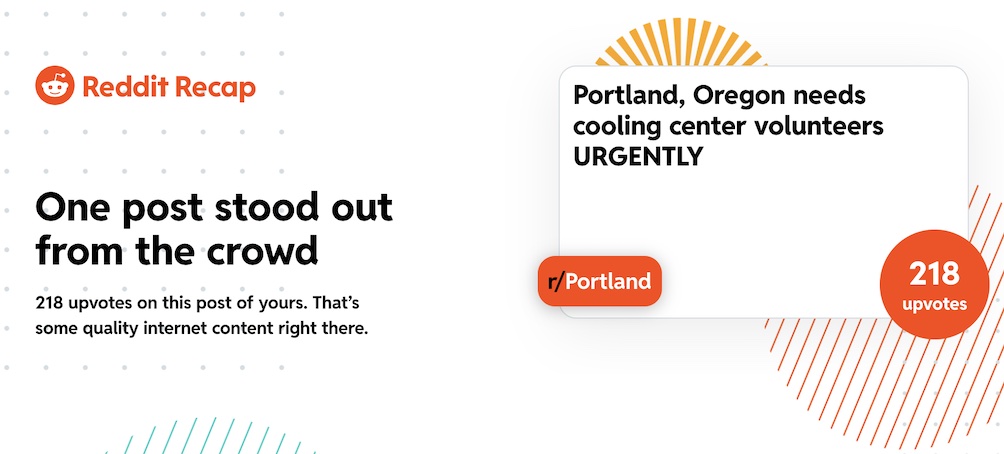
There’s also a slide showing my most popular post in 2021 – it was to a subreddit I don’t frequent, the one for Portland, Oregon, and was how volunteers were urgently needed at cooling stations set up to help people deal with our 116 degree days (it got 218 “up votes”):

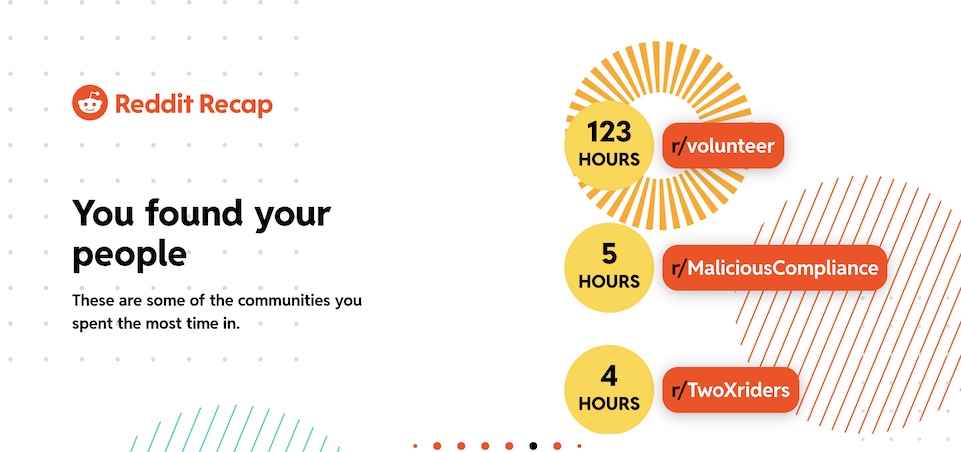
There was also a slide that showed how many hours I spent in 2021 in various subreddits – yes, I really did spend 123 hours, at LEAST, in the volunteers subreddit. The TwoXriders subreddit noted is for women motorcyclists, in case you were wondering, and the Malicious Compliance subreddit – that you will have to check out yourself:

There’s also a slide showing how many new communities I joined in 2021, how many user awards I got, and how many karma points (as Reddit calls it, fake Internet points) I got (pictured below):

What a fun way to recognize participation! Good ideas for honoring program participants and volunteers as well.

And note: they never said, “Your volunteering hours were the equivalent of this much money!” Because that’s a really, really bad idea.

Also see:

If you have benefited from this blog or other parts of my web site and would like to support the time that went into researching information, developing material, preparing articles, updating pages, etc. (I receive no funding for this work), here is how you can help.

25 years ago: launch of the Virtual Volunteering Project

25 years ago, give or take a week or two, I started my first day as director of the Virtual Volunteering Project, a then-new initiative that had been founded by a nonprofit organization, Impact Online (Impact Online was later absorbed by VolunteerMatch).

More than a year before the launch of the Virtual Volunteering Project, Impact Online had begun promoting the idea of virtual volunteering, a phrase that was probably first used by one of Impact Online’s co-founders, Steve Glikbarg. In early 1996, Impact Online received a grant from the James Irvine Foundation to launch an initiative to research the practice of virtual volunteering and to promote the practice to nonprofit organizations in the USA. This new initiative was dubbed the Virtual Volunteering Project.

The New York Times, on 13 May 1996, published Taking in the Sites; Now, It’s Philanthropy Surfing on the Internet, an article about the proliferation of web sites that facilitated online giving or online volunteering in some way. The article included this part:

One nonprofit group, Impact Online, was created to help charities use the Web. The group, in Palo Alto, Calif., uses its site to match what it calls ‘virtual volunteers’ with organizations that need them, and has begun a data base of group logos and missions.

This might be the first use of the term virtual volunteers in a newspaper, but any article about Project Gutenberg in the 1990s would also be about virtual volunteering, even if it doesn’t use the term (I believe that Project Gutenberg is the first initiative created specifically to involve online volunteers). 

After a few months of preparation and drafting web pages, I launched the first Virtual Volunteering Project web site in early 1997. After one year, I moved the Virtual Volunteering Project, and its funding, to the Charles A. Dana Center at The University of Texas at Austin, and Impact Online became fully absorbed by VolunteerMatch and discontinued its promotion of virtual volunteering (at least for several years).

My first two years of the Virtual Volunteering Project were spent reviewing and adapting telecommuting manuals and existing volunteer management recommendations to apply to virtual volunteering, as well as identifying organizations that were already involving online volunteers. When I started the project, I thought there were just a handful of initiatives involving online volunteers, but I was wrong: in less than a year, I had found almost 100 organizations involving online volunteers, and I had to eventually stop listing every initiative I found on the VV Project web site because there were just too many!

I also spent a lot of time in 1998, 1999 and 2000 presenting at conferences around the USA, trying to convince nonprofits that virtual volunteering was a viable, worthwhile practice and already well established at a good number of agencies. The amount of skepticism and even hostility I encountered regarding virtual volunteering in the late 1990s was, at times, overwhelming. In particular, established organizations like United Way agencies and volunteer centers were quite hostile to virtually volunteering. I did a workshop about virtual volunteering for the Corporation for National Service and Points of Light Foundation in 1997 and when I called them in 1998 to ask about presenting at their upcoming conference, the response was, “Oh, but you did that last year.”

World-renowned volunteer management expert Susan Ellis was key in getting me in front of nonprofits who needed to hear about virtual volunteering. Susan was unflinching in her support for the concept and her chastisement of traditional organizations balking at the idea of working with volunteers online was crucial in getting people to let go of outdated ideas about what volunteering could look like.

The Virtual Volunteering Project used research about organizations leveraging virtual volunteering, as well as testimonials from online volunteers themselves, to continually create and refine guidelines for engaging and supporting online volunteers. And I made a point of creating meaningful roles and activities for online volunteers to help the Project, so I could gain more experience supporting online volunteers myself. Those online volunteers were vital to the project, not only for their service, but their testing of methodologies and their feedback.

I’m also very proud that from the moment of the project’s launch, we had a commitment to showing how virtual volunteering could create more inclusion for people with disabilities in volunteering – and I have a conference in 1994 in San Diego by Computer Professionals For Social Responsibility (CPSR) – and speaker Deborah Kaplan specifically, for awakening me to that possibility long before I heard the term virtual volunteering.

You can see the 1998 version of the Virtual Volunteering Project web site by searching for http://www.impactonline.org/vv/ at the Internet WayBack machine, choosing archived web sites, and clicking on 1998. You can also see the last version of the Virtual Volunteering Project web site here, from 2001.

I left the Virtual Volunteering Project in January 2001, to work for the United Nations Volunteers program at its headquarters in Bonn, Germany, to revamp NetAid, the UN’s online volunteering matching service, and to help manage a new initiative, the United Nations Information Technology Service (UNITeS). The Virtual Volunteering Project folded soon after – there just wasn’t interest anymore in funding it.

If you were a volunteer with the Virtual Volunteering Project, or attended a workshop on VV back in the 90s, or just talked with me back in those days, I hope you will comment below and talk about how virtual volunteering has been a part of your life.

cover of Virtual Volunteering book with hands raising up various Internet connected devices

If you want to learn about virtual volunteering in-depth – how to create a range of assignments to appeal to many different people, from micro volunteering to online mentoring, how to use online tools to support and engage ALL volunteers, including those that provide onsite service, and to dig far deeper into the factors for success in keeping virtual volunteering a worthwhile endeavor for everyone involved – you will not find a more detailed guide anywhere than The Last Virtual Volunteering Guidebook. It’s available both as a traditional print publication and as a digital book.

If you have benefited from this blog or other parts of my web site and would like to support the time that went into researching information, developing material, preparing articles, updating pages, etc. (I receive no funding for this work), here is how you can help.

Also see:

Recruit a volunteer or two to initially screen & help onboard new volunteers (volunteer screeners)

One of the biggest complaints by people that want to volunteer is this: when they express interest in volunteering with a nonprofit, NGO, school, or any community initiative, whether they submit an email, submit an online application, use something like VolunteerMatch or call, they may never get a response, or by the time they do get a response, many weeks or months later, they aren’t available anymore.

On the other side of the equation, lots of people would like to volunteer in a more substantial role than a micro task: they want to really feel like they are making a difference, and they are ready to commit a regular amount of time each week to do that. But they would like to do that from home (virtual volunteering).

A great way to both better serve people that want to volunteer with you and to appeal to those folks looking for a way to volunteer online/remotely in a substantial role is to create a volunteer screening role for a volunteer – or a team of volunteers.

Volunteer screeners:

  • Respond to all applicants immediately, to each person who sends an email or an application to express interest. The volunteer screener responds to that email within 48 hours (two business days), asking the person to fill out the application (if the potential volunteers hasn’t already), and asking for additional information, if needed; asking a few follow-up questions via email is a great way to screen out people who aren’t ready to volunteer with you – if they don’t reply, it means they weren’t ready to volunteer.

Screeners can ask simple questions to an applicant, via a phone call, an email or a video meeting that helps the screeners gauge if those applicants really understand what the organization is all about, the basic requirements of all volunteer roles, the variety of volunteer roles, etc. The organization can give the screener the final say on whether or not the applicant goes to the next step (the orientation, which can be online, or the training for a particular role) or, the organization can give that power solely to the manager of volunteers, who reads through the profile/evaluation written by the screener and makes the decision (but that manager has to move FAST – lack of response, or a slow response, will result in the volunteer applicant moving on – and feeling like their time so far was wasted).

Screening volunteers should:

  • Have a solid understanding of the organization and its opportunities for volunteering, and be able to answer the question, “Why does this organization involve volunteers?”
  • Be enthusiastic about the programs of the nonprofit.
  • Be able to promptly, immediately input information in a database of volunteer applicant inforamation, even if that database is just a shared spreadsheet.
  • Have excellent written communication skills – ability to express ideas and facts clearly – and, perhaps, to also be able to have excellent speaking skills. They may also need excellent online speaking/presentation skills as well.
  • Comfortable promptly emailing with, texting with and making phone calls or video calls to applicants.

To get your screeners to that point, you should have a training and a mock interview or screening session, where they get to try out their skills and have a feeling for what interactions with volunteers can be like. And, absolutely, that training can be entirely online.

The organization always needs to know where any volunteer applicant is in the process, the date of that person’s application, the date the applicant was initially screened, etc., so they can know if volunteer applicants are being onboarded quickly. Having applicant information inputted into a shared database is crucial. I’m a board member and in charge of onboarding new applications, and I use a spreadsheet on Google Drive, with the names of every applicant, the date they applied, the date of their interview, if they were going forward after the interview or withdrawing, if they suddenly went incommunicado, etc., and share it with all the other board members, who can view it at any time.

Did you notice that I just described a virtual volunteering role?

cover of Virtual Volunteering book with hands raising up various Internet connected devices

And if you want to learn how to avoid the common pitfalls in virtual volunteering and to dig far deeper into the factors for success in creating assignments for online volunteers, supporting online volunteers, and keeping virtual volunteering a worthwhile endeavor for everyone involved, you will not find a more detailed guide anywhere than The Last Virtual Volunteering Guidebook. It’s based on many years of experience, from a variety of organizations. It’s available both as a traditional print publication and as a digital book.

If you have benefited from this blog or other parts of my web site and would like to support the time that went into researching information, developing material, preparing articles, updating pages, etc. (I receive no funding for this work), here is how you can help.

List volunteering on your job history? Maybe, maybe not.

graphic by Jayne Cravens representing volunteers

I hear a lot of consultants and organizations that promote volunteerism and volunteer engagement say that you absolutely should put volunteering experience on your résumé, period. But consider this: a 2007 study found that a job applicant that noted she was a “PTA coordinator” on her resume – a volunteer – was 79% less likely to be recommended for hire compared to an equally qualified woman without children. I found this statistic via “Getting a Job: Is There a Motherhood Penalty?,” Shelley J. Correll, Stephen Bernard, and In Paik, in the American Journal of Sociology 112, no. 5 (2007): 1297-1339.

Someone who has been a coordinator of a parent-teacher association very likely:

  • Knows how to manage large amounts of email.
  • Has experience managing a team online and onsite, including identifying tasks, delegating tasks, managing various individual team members, accommodating different learning and work styles, etc.
  • Has a great deal of experience in conflict management and customer service.
  • Knows how to juggle priorities.
  • Knows how to negotiate.
  • Probably has a lot of event management experience.
  • And if they did this during the pandemic, knows how to coordinate online meetings.

Yet, all some employers will see is: she has kids and she makes her kids a priority and that might mean she’s distracted on the job or absent. And I bet it’s not the same for a man who puts this on his CV – I bet for him, it’s: wow, what a caring multi-tasker!

Then there’s my own experience: some of my best marketing and public relations experience has been as a volunteer. I have had some substantial accomplishments regarding my outreach activities for a couple of nonprofits in particular. I list these experiences right alongside my paid work – why shouldn’t I? It’s exactly the same work, but some roles were paid, others weren’t. I had one interview become shocked and even outraged when, during our interview, she realized I had treated these unpaid roles with the same importance as unpaid roles, and said, “Wait, these just volunteer roles?” Needless to say, I didn’t get that job. By contrast, in interviewing for my very first job with the United Nations, one of the things the interview panel was particularly impressed with was my volunteering regarding marketing and public relations for the California Abortion Rights Action League – they liked the work experience AND they liked that I had done it as a community volunteer. That volunteering role was crucial to me getting that first UN job, no question.

For the most part, I do believe in sharing volunteering experience on your résumé if such demonstrates skills you think make you, potentially, a more attractive candidate for employment. Experience working with communities different from your own, or experience leading a team, or volunteering that’s given you training to handle stressful or emergency situations are all things that will get a potential employer’s attention. When I’m a hiring manager, I give as much weight to such volunteering as I give to paid work – I don’t care if you got paid to be in a leadership position as much as your having been in that leadership position.

But volunteering experience can also show your age – like volunteering activities with a group dominated by or exclusively for people over 55. I say this as someone both in her 50s and who has heard it from co-workers for decades: people over 45, especially in the USA, are discriminated against for employment because of their age. Be careful in showing it.

If you are a woman, you have to think carefully about what volunteering you share and how you frame it when looking for paid work. I, personally, would see being a Girl Scout leader as a HUGE plus, knowing just how much financial management, conflict resolution, excellent communications skills and customer service is required in dealing with both the girls and their parents. Others might see it as, “Oh, she’s a mom, her kids are going to interfere with her job.” I’m not at all saying not to put it on your résumé, but think carefully how to frame it – show how it makes you a more attractive candidate.

Always note in a role you undertook as a volunteer if it was, in whole or in part, virtual volunteering – where you did some or all of your service online. Note what you did and what you accomplished and, absolutely, use that phrase: virtual volunteering. I have heard it over and over from various folks: in a job interview, at some point, someone on the interview panel says, “Tell me more about this virtual volunteering stuff.” They use that exact phrase, virtual volunteering, when speaking to candidates, and are intrigued by it. It got the employer’s attention, and it made them have a closer look at that candidate’s professional qualifications. Also note what software tools you used as a part of that virtual volunteering role – being a Zoom video conference aficionado will get you far these days!

Have you ever gotten an interview in part because of your volunteering experience? Do you think you have been passed over as a candidate because of a volunteering experience you listed on your application? Do you completely disagree with this blog? Share your thoughts below.

If you have benefited from this blog or other parts of my web site and would like to support the time that went into researching information, developing material, preparing articles, updating pages, etc. (I receive no funding for this work), here is how you can help.

GirlGuiding Attempt at Inclusion Raises Ire of Many

graphic by Jayne Cravens representing volunteers

Last week, I blogged about the controversy at the Art Institute of Chicago per their dismissing their entire volunteer docent membership and their plans to replace the volunteers with paid staff, in pursuit of a more diverse corps of museum guides to interact with the public.

GirlGuiding in the United Kingdom, the UK’s version of the Girl Scouts, has also incurred the wrath of many for one of its efforts at volunteer inclusion: on October 28th, the organization sent out a tweet that ended with, a shout-out to all of our asexual volunteers and members – thank you for everything you do in Girlguiding.

More than 2000 people liked the tweet. But the tweets-of-outrage were swift and many: the complaints focused on a belief that GirlGuiding was sexualising children with such messaging. One response that was representative of most of the negative responses: Why do your guides need to know whether your volunteers have a presence or absence of sexual desire? A nonprofit in the UK, Safe Schools Alliance UK, which has worked against allowing children to use the bathroom that corresponds with the gender with which they identify and works against bans on gay conversion therapy, is pushing back hard against the GirlGuide messaging. This group promotes its agenda as part of responsible safeguarding, the term used in the UK and Ireland regarding measures to protect the health, well-being and human rights of individuals, especially children and vulnerable adults, better ensuring they live free from abuse, harm and neglect.

I offer this info on this controversy for two reasons:

  1. Creating and launching efforts in support of the diversity of volunteers your organization has, or wants, and in support of accommodation of that diversity, will always attract complaints, immediately or eventually. There may be just a few, there may be many. Some of the complaints will be sincere and from individuals not a part of any “movement” or organization, and some of the complaints will be from volunteers and paid staff of very well-organized groups. Either way, your organization needs to have thought about how to answer questions and comments like why are you doing this and why is this necessary and this puts young people in danger.
  2. People asking the question or making the comment aren’t all obtuse or rigid. Don’t assume everyone complaining is so when you craft replies. Provide a response that comes from the point of view of this person just needs more and better information in order to support this statement or decision. Will such a response convince everyone? No. But your reply is being seen by people who aren’t entirely sure how they feel about the situation. Perceived arrogance on your part can drive those people who are on the fence into the arms of people and organizations who are only too happy to provide carefully word-smithed, detailed responses to frame their point of view.

My perspective: I adore GirlGuides and Girl Scouts of the USA. I deeply admire the commitment of both to ensuring all girls feel they can be a part of their activities. This isn’t the first time they’ve done something that’s lead to controversy. But no one – NO ONE – can say the GirlGuides and Girl Scouts don’t put safeguarding at the top of their list of priorities.

I also know that change can be painful – not just for others, but also for me. Work regarding inclusion and diversity is not easy, because many societal norms are deeply held, and cherished beliefs are challenged by conversations around inclusion and diversity – and that’s uncomfortable. It’s easy for a person to feel attacked during such conversations. I’ve seen diversity and inclusion experts be angered at the idea that they need for their own web sites to meet accessibility standards so that people with disabilities and using assistive technologies can access their online information – in their talks about inclusion, they were focused on ethnic and cultural groups, not people with disabilities, and the realization is embarrassing and painful.

I assure you that, eventually, even if you consider yourself an advocate for inclusion and diversity, you will have a moment where your own deeply held principles are challenged, and you will feel anger and you will be incredulous. Maybe you will decide to hold on to those principles – I’m not here to say you should or shouldn’t. But remember that feeling the next time you are facing it from someone else.

We’re all on a journey. That includes me.

One last thing: a chastisement to all of the organizations and consultants touting themselves as volunteer engagement experts and as the leaders of conversations on volunteerism who are silent on this and other controversies in volunteer engagement. I challenged you to comment on organizations that charge big money from volunteers, to comment on organizations that say if a person that has been assigned community service will pay a fee, the organization will give them a letter saying they did the hours required by the court which assigned that community service, to weigh in regarding governments wanting to require welfare recipients to volunteer in order to receive benefits and to comment about the situation at the Chicago museum – so far, you haven’t. In addition to having upbeat conversations about how managers of volunteers can build their brand or raise their profiles in their organizations or get a hug for International Volunteer Manager’s Day, we need to be having these very difficult conversations and controversial subjects. In fact, we should be leading the conversations.

And I love how the corporate world, which always has oh-so-much to say about how nonprofits should operate, are oh-so-silent during these conversations as well.

Also see:

Art Institute of Chicago docent program is no more – a painful change, but is it required for better inclusion?

image of a panel discussion

The entire membership of the Art Institute of Chicago docent program, all volunteers, are being let go by the museum in an effort to entirely revamp how art education for museum visitors is staffed and to make such staffing much more diverse.

It is a move that has hurt long-time volunteers and outraged right-wing media, but many say it’s the only way to dismantle a system that, intentionally or not, is designed to exclude many people from participating.

On Sept. 3, Veronica Stein, the AIC’s executive director of learning and public engagement, emailed 82 active docents, telling them the program’s current iteration would be coming to an end. Stein told the Wall Street Journal that the museum must move “in a way that allows community members of all income levels to participate, responds to issues of class and income equity, and does not require financial flexibility.” In the letter, Stein said the museum “had a responsibility to rebuild the volunteer educator program in a way that allows community members of all income levels to participate, responds to issues of equity, and does not require financial flexibility to participate.” The AIC told USA TODAY that the pause is part of a “multi-year transition” to a “hybrid model that incorporates paid and volunteer educators.”

“Rather than refresh our current program, systems, and processes, we feel that now is the time to rebuild our program from the ground up,” Stein said in the letter, noting that current docents would be invited to apply for the paid positions.

While the elimination of docents struck many as sudden, it had actually been in the works for years, according to artnet news: the AIC stopped training new docents in 2012, and has been discussing internally how to restructure the program since 2019.

The institute’s docent council sent a letter Sept. 13 protesting the pause of the program. The letter described the docents’ expertise, noting that volunteers had trained twice a week for 18 months, done five years of research and writing, and participated in monthly and biweekly trainings. “For more than 60 years, volunteer docents enthusiastically have devoted countless hours and personal resources to facilitate audience engagement in knowledgeable, relevant, and sensitive ways,” the letter said.

Gigi Vaffis, president of the AIC’s docent council, told USA TODAY that she and other docents felt blindsided by the decision and weren’t included in the decision-making. Even now, she said there are few details about what the AIC’s multi-year plan will look like.

Docent programs have long been mainstays of major museums. Docents are all volunteers and are beloved by museum visitors. Becoming a docent can be quite competitive: not everyone who applies is accepted, and docents that get into the program stay for years, even decades. And involving volunteers is a sign a nonprofit wants the community to be a part of the organization – not just as donors or clients but also as people delivering services. But docent ranks at museums are often skewed toward a certain demographic: wealthy white women. The intention of the Chicago Institute is to dismantle this traditionally very rigid system that, intentionally or not, is designed to include/favor one, very privileged group and to exclude others.

Museum equity consultants have long advocated for transitioning volunteer positions at museums to paid roles, to encourage more diversity, allowing people who could never afford to give the time current docents give without pay. Monica Williams, executive producer of The Equity Project, a Colorado-based equity, inclusion and diversity consulting firm, who is NOT involved with the Art Institute, said this shift will open the doors for people who cannot afford to work on weekdays or do a significant amount of unpaid work. If docent programs switch to paid positions, she said it will help museums move away from “a particular demographic of mostly white and wealthy.”

Mike Murawski, a museum consultant and author of “Museums as Agents of Change,” said in the USA Today article that there has long been a tension between equity efforts and volunteer programs. When the Smithsonian’s Hirshhorn Museum ended its docent program in 2014 in favor of an initiative for younger volunteers who often work for college credit, Murawski said there was an uproar with many saying the museum might as well close. But now, he said. “they’re doing just fine.” Murawski is one of many museum consultants that says the way forward is not about making changes to programs, but to completely dismantle them and start over, and that docent programs often have “long-standing legacies of how things are supposed to be” that can make them difficult to adapt. 

A side note: the Chicago Tribune, a once-great newspaper which was recently bought by Alden Global Capital, a secretive hedge fund that gutted the staff at the newspaper, wrote an outrageous editorial that had this jaw-dropping and completely misleading statement:

Volunteers are out of fashion in progressive circles, where they tend to be dismissed as rich white people with time on their hands, outmoded ways of thinking and walking impediments to equity and inclusion. Meaningful change, it is often said, now demands they be replaced with paid employees.

This is just flatly not true and the Tribune should be ashamed of itself.

As for me and my opinion: I don’t think programs should always be overly-cautious and ever-fearful of upsetting current, long-term volunteers – quite frankly, I think some long-term volunteers can have an entitled attitude that can discourage, even kill, much-needed changes and innovations. But I also feel like there was a better way to handle this transition. Absolutely, there are MANY systems related to nonprofits, including volunteer engagement, that have been exclusionary. But couldn’t current volunteers, who have invested a great deal of time in their roles, have been involved in the decision-making process, and perhaps, even bought into it? Also, will there still be a way for people to volunteer for the Art Institute – will there still be a community engagement component that isn’t donating funds or attending events?

If you have an example of a museum that significantly revamped its volunteering program so that it was vastly more diverse, but without having to fire the entire volunteer corps, please note such in the comments. Also note if it continued to have a volunteer program of some kind.

With all that said – what do you think?

October 17 update: the Art Institute of Chicago is, apparently, STILL not involving volunteers at all. Below is a screen capture from its volunteer page that notes “the volunteer program is temporarily on pause, and we are not accepting applications at this time.”

Also see:

What too many are getting wrong about virtual volunteering these days

Two figures created to look like petroglyphs, one using a smart phone and one using a desktop computer.

Despite virtual volunteering being a widespread practice long before the COVID-19 global pandemic, undertaken by thousands of nonprofits, NGOs, government agencies, community groups and more all over the world for more than three decades, a lot of new virtual volunteering “experts” have recently emerged, touting guidelines for setting up a virtual volunteering program, often one specifically for corporate employees to be a part of as a part of their employer’s corporate social responsibility / philanthropic efforts.

I welcome more research regarding virtual volunteering and more stories and presentations from practitioners – people actually engaged in volunteering online or in supporting online volunteers – like this outstanding webinar from the US Federal Communications Commission (FCC) which featured representatives from five of the most popular virtual volunteering schemes in the world. But the recommendations being pushed by a lot of new “experts” recently is steering programs in directions that are going to result in frustration and, potentially, failure.

Here’s five common mistakes I’m seeing in promoting or setting up virtual volunteering recently:

That virtual volunteering new. No, it’s not new. And the consequence of approaching it as new is that new programs ignore the lessons learned and end up making easily-avoidable and program-killing mistakes. They end up causing more frustration than positive results.

That the first step is to set up some kind of platform for matching or collaboration. This is, in fact, one of the last steps, if it’s needed at all. There are a myriad of things to do first, like working with the nonprofits and other programs expected to create tasks and roles for volunteers to ensure this will actually be worth their while, gathering data to show this volunteer engagement is needed, identifying a robust number of tasks and roles volunteers can choose from, creating a process to support volunteers, address their concerns quickly, etc., and measurements for success. This is a lesson I’ve learned over and over and talk about in detail regarding revamping NetAid, which became the UN’s Online Volunteering service.

That safety is automatically built into virtual volunteering. It’s true that virtual volunteering prevents the transmission of the novel coronavirus, but it absolutely still has risks: children and vulnerable populations need to be protected from predatory or exploitative behavior, participants shouldn’t be set up for failure or an unreasonable amount of stress or anxiety, participants should be vetted so they take their roles seriously and don’t end up disappointing the people who were supposed to benefit from the program, etc. Here’s more about safety in virtual volunteering.

That creating worthwhile micro-tasks for volunteers is easy – or that it’s the most desirable virtual volunteering. Creating worthwhile micro-tasks for volunteers is very difficult, and often, what volunteers want is to engage in a meaningful role with a high-degree of responsibility, one that will make a big impact on “the cause.”

Impactful virtual volunteering is more than “making cards for the sick/elderly”. Cards can be nice. But these kinds of programs are more about making volunteers feel like they are doing something than really serving the elderly.

If you are looking to launch virtual volunteering at your nonprofit, NGO or other community-focused organization, begin with this simple primer: How to Immediately Introduce Virtual Volunteering at Your Program.

cover of Virtual Volunteering book with hands raising up various Internet connected devices

And if you want to learn how to avoid the common pitfalls in virtual volunteering and to dig far deeper into the factors for success in creating assignments for online volunteers, supporting online volunteers, and keeping virtual volunteering a worthwhile endeavor for everyone involved, you will not find a more detailed guide anywhere than The Last Virtual Volunteering Guidebook. It’s based on many years of experience, from a variety of organizations. It’s available both as a traditional print publication and as a digital book.

If you have benefited from this blog or other parts of my web site and would like to support the time that went into researching information, developing material, preparing articles, updating pages, etc. (I receive no funding for this work), here is how you can help.
United Nations Volunteers says, when it comes to onsite & online, “They are ALL volunteers”

My, my, how times have changed…

United Nations Logo

When I worked at the United Nations Volunteers (UNV) programme from 2001 to mid-February 2005, one of my duties was directing the Online Volunteering service, the platform that UNV had co-created with NetAid for nonprofits serving the developing world to recruit and engage online volunteers. Near the end of my time at UNV, the new communications manager would not support any of the wildly successful online volunteering program’s communications needs: she would not include information in the quarterly UNV newsletter, she would not pitch stories to the press related to online volunteers and she would not include promoting of the online volunteering platform in any of her strategies. We had a meeting for our entire departments’ staff so I could ask why, and her reply was, “I was hired to promote UNV, not the online volunteering program.” My response: “Gee, UNV is my employer, so I assume the online volunteering program was a part of UNV.” The meeting went downhill from there.

Even before she joined UNV, it was a constant struggle to get UNV staff, both at HQ and in the field, to think about online volunteers as a part of UNV’s mission, despite the full support of the then head of UNV, Sharon Capeling-Alakija:

  • The head of the department responsible for recruiting onsite UN Volunteers and managing their applications successfully petitioned to create an unwritten policy that only onsite volunteers could be called “UN Volunteers”, not online volunteers recruited and engaged through the online platform, even if they were supporting UN initiatives. She also refused all of my attempts to walk her through the online volunteering platform and to potentially integrate some of its features into UNV’s overall application system (she had only VERY reluctantly agreed to the creating of an online application system for onsite UN Volunteers – she preferred postal mail and faxing).
  • A survey of all UNV HQ staff found that, in the three years following the site coming under the sole management of UNV, the vast majority had never logged into the online volunteering platform. This was despite frequent internal presentations about online volunteering.
  • Presentations to UNV program managers, who were responsible for overseeing the creation of UNV assignments and managing those UNVs in the field, would provide examples of what online volunteers were actually doing, yet, the response from the majority of participants would always be, “I just don’t see how those roles can be done by online volunteers.”
  • In my last four weeks at UNV, the new head of UNV noted to me that the online volunteering service would be eliminated unless a funder was found, because he didn’t think it was that important – and given that he successfully eliminated the United Nations Information Technology Service (UNITeS), I was pretty sure that virtual volunteering within UNV was doomed.

And here we are, almost 20 years later, and UNV has launched a Unified Volunteering Platform and Unified Conditions of Service. This new Unified Volunteering Platform (UVP) has brought together UNV’s onsite UNV assignment recruitment and the UN’s Online Volunteering Platform (OV) – that means www.onlinevolunteering.org no longer exists as a distinct entity. Via this new unified platform, organizations can request services of both onsite and online volunteers, and candidates can apply for both onsite UN Volunteer assignments and online assignments. It is the single-entry point for all UNV partners – from candidates for onsite and online volunteering to donors, funding partners and UNV personnel and partner organizations.

I love that UNV now, at last, sees its online volunteering engagement as part of its overall volunteer engagement. I would love to know how it happened! But this change, this unified platform, comes at a big cost: UNV no longer allows any nonprofit or NGO that’s working on behalf of the developing world to recruit online volunteers via its platform. The only organizations allowed to use the platform to recruit online volunteers are “eligible partners”: UN entities (UNICEF, UNDP, UNESCO, etc.), those with accreditation with the Economic and Social Council (ECOSOC), or an organization working with a UN Country Team as an implementing partner. That means small NGOs who don’t have a formal partnership with UNV or aren’t working with a UNV in the field are now locked out of the platform for recruiting online volunteers.

The other downside: all those great lessons about how to work with online volunteers that the online volunteering service is now much harder to find, since it no longer exists on any UNV web site (I’ve done my best to salvage them here, since I wrote most of them).

But even with those costs, ultimately, it’s the right decision, because it means UNV now makes it clear that ALL of the volunteering it facilitates, including online volunteering, must be in support of the goals of communities in developing countries, and must have real impact – it must put the needs of the communities first. It further distances UN Volunteers, including online volunteers, from voluntourism or vanity volunteering.

What will happen to the domain onlinevolunteering.org? Not sure. For now, it points to UNV’s new unified platform. But UN agencies are notorious for not keeping URLs it no longer uses as its primary address (like unvolunteers.org, which now goes nowhere) or for programs that have sunsetted, no matter how popular, like all the many sites associated with International Year of Volunteers in 2001, or worldvolunteerweb.org. So if you have a virtual volunteering initiative, you should keep an eye on the onlinevolunteering.org URL for when UNV inevitably abandons it.

My other UNV-related blogs:

cover of Virtual Volunteering book with hands raising up various Internet connected devices

If you want to dig far deeper into the factors for success in creating assignments for online volunteers, supporting online volunteers, and keeping virtual volunteering a worthwhile endeavor for everyone involved, you will not find a more detailed guide anywhere than The Last Virtual Volunteering Guidebook. It’s available both as a traditional print publication and as a digital book. UNV’s Online Volunteering Service is referred to frequently in the book, and some of its star online volunteers are featured.

If you have benefited from this blog or other parts of my web site and would like to support the time that went into researching information, developing material, preparing articles, updating pages, etc. (I receive no funding for this work), here is how you can help.