Tag Archives: volunteering

Is trauma while volunteering abroad inevitable?

graphic representing volunteers performing various service activities.

On one of the many online communities I’m on, one for people interested in serving as Peace Corps members, someone wrote about wanting to serve but also wanting to know what resources there would be “given the unfortunate, yet seemingly inevitable, traumatic experiences” a volunteer is probably going to face.

One of the responses was particularly excellent:

I want to challenge one point: trauma is not inevitable. It’s a dangerous framing to prospective service and sets up a self-fulfilling prophecy. Service is stressful, but it is not always traumatic.

I really liked this response, and the rest of it. I see a lot of people who want to work or volunteer abroad, in developing or post-conflict countries, in humanitarian initiatives, and they say things implying that the worst trauma-inducing events – assault, theft, sexual exploitation, life-altering injury, intense hostility from locals, witnessing violence or extreme, dire poverty – is inevitable.

None of that is inevitable in working or volunteering abroad in humanitarian efforts. It’s not inevitable working or volunteering in your own country. Could any of those circumstances happen to you? Yes – abroad or at home. Does any of that happen? Yes – abroad or at home. But none of it is inevitable.

I do believe in being prepared for The Worst – at home or abroad. It’s why, on the section of my web site about travel, I talk about always having a plan: what would you do if faced with the absolute worst circumstances, and the aftermath, while abroad? Do you know exactly who should call and where you should go if you are in danger or have experienced trauma? As someone who has frequently traveled abroad to not-so-stable countries, I have plans, even for being kidnapped, and have discussed them with loved ones. The likelihood of ever needing to employ those plans is small, but it gives me comfort to know I have a plan.

What’s much more likely when serving abroad: feelings of loneliness and isolation. Feeling that you don’t have an outlet or escape to take a mental health break. I had an Afghan colleague say, “It must be so hard for you here. I have my family to go home to each night. You have nothing.” It was a gut punch because it was true! It was one of the reasons I started going to a coffee shop frequented by expats every Friday: I was spending WAY too much time alone outside of work hours.

What is also much more common is a feeling of helplessness or disillusionment with your service. Realizing that one person really can’t change the world, and that your work may not actually transform the lives of anyone significantly, is not just humbling, it can make you question everything you think about yourself, the work of humanitarians, and, well, all of humanity. It’s a reality check many people that want to work or volunteer abroad aren’t prepared for.

As noted by that aforementioned Reddit poster:

Peace Corps volunteers have to be resilient and develop those self-management tools during service. That is a fundamental requirement when living remotely with limited resources.

This is true of anyone that wants to serve away from home, and especially in another country, even one that is quite peaceful and stable.

The responder goes on to say:

The best thing to do is discover and train your resilience today: Learn coping mechanisms. Develop healthy habits. Be disciplined with your time. Learn to accept what you cannot change and be content with what you can. Set boundaries. Exercise. Learn to maintain a positive attitude. Be selfless. Arguably, this is the most important thing. Service is going to be a path you’ll have to walk alone. It is demanding and mentally challenging, but you have to be strong.

And I second all of this! If you really want to be effective working or volunteering abroad in humanitarian contexts, you can’t assume you have these skills; you have to take a hard look at yourself and how you cope now with stress, strife, frustrations and, indeed, trauma.

Also see:

If you have benefited from this blog, my other blogs, or other parts of my web site and would like to support the time that went into researching information, developing material, preparing articles, updating pages, etc. (I receive no funding for this work), here is how you can help

You can volunteer to address the critical needs of refugees IN YOUR OWN COMMUNITY

Four human figures hold hands and lean back, none of them falling because they are all holding each other.

The Earth is experiencing unprecedented numbers of refugees and asylum seekers – people who have left their countries of birth, desperate to escape dire economic and environmental circumstances or threats to themselves and their families. They are looking to find a new home in another, more stable country. There are also record numbers of internally-displaced people (IDP) – people in the same situation, fleeing their homes but staying within their country of nationality.

Once a refugee, asylum seeker or IDP reaches a place of sanctuary, their struggles are far from over: they need permanent, affordable housing, the adults need jobs, the children need to be enrolled in school, the entire family needs language instruction in the local language, they need to know how to access health care (including dental care), they need to know how to access things like playing soccer at school or in a local league, when shops are closed for various holidays they may not be aware of, how to open a bank account, how to use mass transit, how the garbage system works, and on and on and on. It’s a huge amount of help that’s required.

Nonprofits, government programs and systems designed to help refugees are overwhelmed. In the USA, refugees and asylum seekers receive most of the help they need from VOLUNTEERS – people who are donating their time to help, time that competes with work and family requirements. And there are not enough volunteers to help address all the needs that refugees have, not in the USA and not in most other countries.

Before you start pursuing a volunteering gig abroad to help refugees, I beg you to look for opportunities in your own community. I live in a small town in Oregon and have discovered volunteering opportunities all around me to help refugees from Sudan, Afghanistan, Ukraine, Somalia and more. I have seen similar opportunities not too far from my hometown in Western Kentucky to help Afghan refugees.

I’m volunteering to help a family that is just around the corner from me. I’m volunteering through Portland Refugee Support Group. So far, I’ve:

  • found information already in Arabic from various government offices.
  • helped the children 16 and over, only two of whom speaks English, apply for jobs (three have found employment).
  • helped the oldest child, who is 20, find free English classes.
  • explained how to try out for the high school soccer team for the 16-year-old interested in such.
  • explained how Thanksgiving and Christmas affect store closings, bank closings and traffic.
  • taken the mom to the Halal groceries.
  • read through their postal mail and explained what they are receiving.
  • explained how the green card and citizenship process works (the official web site of the US government has complete details, plus I helped a family member of my own get a green card).
  • recruited two other volunteers to help (and I’m working on more).

Google Translate has been essential in communicating with most of the family members, but I can translate only two or three sentences at a time using that tool. Through my Reddit activities, I connected with a young woman abroad who is fluent in Arabic and wanted to volunteer as a translator – she translates large amounts of text for me, like explaining how the garbage bill works.

Other volunteers have helped with jobs research and interviews, as well as transportation, filling out government program applications, moving items, even getting a Christmas tree. One volunteer just drives the mom to the grocery once a month, nothing else – and that’s GREAT!

You can volunteer as much or as little as you want to – you don’t have to volunteer every day or even every week. You can volunteer just once a month. But you need to help on an ongoing basis. And when you sign up, you will need to go through a criminal background check and a short training – and the training will probably be online.

How do you find opportunities to work with refugees and asylum seekers near you? You go to Google and type in the name of your city, or the nearest big city, and the phrase help refugees and nonprofit (that’s how I signed up to volunteer where I live). You might find such opportunities on VolunteerMatch as well.

I signed up initially just to help with recruitment of more volunteers. I had no intention of working with refugees directly, because I live far from the center of the nearest metropolitan area, and most of the refugees live far from me. But after just two months, it turned out there was a refugee family right around the corner from me, and my help was welcomed.

I recommend volunteering through an existing nonprofit that helps refugees. But if you are ready to take on a lot more responsibility, including fundraising, and you are in the USA, note that, the Department of State, in collaboration with the Department of Health and Human Services, has created the Welcome Corps, a new private sponsorship program that empowers everyday Americans to play a leading role in welcoming refugees arriving through the U.S. Refugee Admissions Program (USRAP) and supporting their resettlement and integration as they build new lives in the United States. Groups of at least five individual American citizens or permanent resident adults will be able to apply to the Welcome Corps to privately sponsor the resettlement of refugees in the United States. Private sponsors, as volunteers, will be responsible for independently raising funds and directly providing essential assistance to refugees for their first 90 days in their new community. This assistance includes helping refugees find housing and employment, enrolling children in school, and connecting refugees to essential services in the community. Sponsors must raise a minimum of $2,275 in cash and in-kind contributions per refugee newcomer being welcomed. This is used to secure and furnish housing and provide for the refugee’s initial basic needs.

As for me, speaking as a volunteer through PRSG helping one family here in the town were I live, as a part of a team of three volunteers: it hasn’t been easy and sometimes, it’s been quite stressful. They need an enormous amount of help, far more than we can give. And the more successful I’ve been as a volunteer, the more I’ve been asked to do. It’s been essential for me to be realistic about the time I really can give and to set boundaries, and to recruit other volunteers to help.

If you are volunteering with refugees in the USA, or want to, you might find this resource helpful: Helping Refugees In Your Own Country. It’s USA-centric, but is adaptable to other countries. It outlines exactly the kind of help refugees need that you, as a neighbor, can realistically help with.

If you have benefited from this blog, my other blogs, or other parts of my web site and would like to support the time that went into researching information, developing material, preparing articles, updating pages, etc. (I receive no funding for this work), here is how you can help

Most popular blogs of 2022

logo

We’ve celebrated another trip around the sun, and that means it’s time to look at what were my most popular blogs of 2022 – and to try to figure out why. It’s an exercise I do not so much for YOU, my readers, but for me. It’s the kind of self-analysis every nonprofit, NGO, government agency, or consultant for such should do.

There are eight blogs here that had enough readers (clicks) to qualify for being “popular”, in my opinion. And here they are.

Nine plus four emerging volunteer engagement trends (a VERY different list than you will read elsewhere) is not only the most popular blog I wrote in 2022, it is also in the top 20 of the most popular blogs I have EVER written. I was really surprised at how many people retweeted it.

The key to retaining volunteers. Another blog that got a LOT of retweets. It’s worth noting that Twitter has always been the most popular driver of people to my blogs – way more than Facebook or LinkedIn. That’s why I can’t quit it… yet.

What funding volunteer engagement looks like. A really popular blog – but I thought it would be even more so.

Seen a drop in volunteers? Quit blaming the pandemic & fix the problems. This blog struck quite a nerve, based on retweets.

How are you supporting the mental health needs of your volunteers? This blog, published in July 2022, saw a surge in popularity late in the year. Not sure why – I can’t see that someone has reposted it. But thank you to whoever did so.

How to connect & engage with volunteers remotely – even when those volunteers work onsite. More and more nonprofits are realizing that the Internet is an essential tool for supporting ALL volunteers, including those that you see onsite most of the time.

Either be committed to quality or quit involving volunteers. A blog I worked on for months and based on SO many conversations with nonprofits, schools and community programs that recruit volunteers, as well as my own experience trying to volunteer.

When IT staff isn’t providing proper support for volunteer engagement. Another blog I drafted over months. I’ve wanted to write it for years. I wish IT staff wasn’t an obstacle for managers of volunteers but, sadly, too often they are.

A couple of months, I’ve been blogging every other week, rather than every week. I’ve had a lot of other projects going on that need my energy and time, and cutting back on blogging let me do those other projects too. But for the first four months of 2023 at least, I’ll be back to blogging every week for a while, because those other projects have given me OH so much more to say! Let’s see how long that lasts.

Happy 2023! Hope yours is off to a great start.

If you have benefited from any of my blogs or other parts of my web site and would like to support the time that went into researching information, developing material, preparing articles, updating pages, etc. (I receive no funding for this work), here is how you can help.

cover of Virtual Volunteering book with hands raising up various Internet connected devices

Also, I have exactly 18 copies of The Last Virtual Volunteering Guidebook. And when they are gone, they are gone – as in, you will have to pay a LOT more by ordering them from Amazon. If you want to learn how to leverage online tools to communicate with and support volunteers, whether those volunteers are mostly online (virtual volunteering) or they provide service mostly onsite at your organization, and to dig deep into the factors for success in supporting online volunteers and keeping virtual volunteering a worthwhile endeavor for everyone involved, you will not find a more detailed guide anywhere than The Last Virtual Volunteering Guidebook. It’s based on many years of experience, from a variety of organizations. It’s available both as a traditional print publication and as a digital book.

Expectations for volunteering by the volunteer – too much?

graphic representing volunteers

Volunteering is promoted as something that will give volunteers significant personal fulfillment, that will make them feel like they’ve made a real difference, that will make volunteers feel like superheros, and on and on. And many people expect their volunteering experience to make them feel like they have changed a person’s life forever, or that it will be so impressive that it will get them a full scholarship for university and into the university they most want to attend, or that it will cure any mental or emotional issue they are facing.

Here’s a tweet that’s a good example of how a lot of people and organizations talk about volunteering:

How volunteering can help you?

  • It fixes your mental health.
  • It gives you a purpose.
  • It kills your self-doubts, anxiety.
  • It improves your social skills.

The reality is that volunteering can amplify mental health issues. It can exacerbate self-doubt and anxiety and even loneliness. It can contribute to uncertainty if volunteering doesn’t go well – and very often, volunteering doesn’t always go well. Volunteering can, in fact, leave you feeling like a failure.

I’ve read a litany of online comments from people who tried of volunteer and don’t have the magical, perfect healing experience so many promise. And I so I must ask: are we overselling volunteering?

A recent post to a community for Peace Corps members – and those that wish to be such – reminded me of how not every volunteer gets the feelings so many recruitment messages promise, or how many volunteers don’t have their expectations met. This person has also seen many comments by frustrated Peace Corps members who did not get the amazing experience implied in recruitment messages:

I often come across posts online from returnees talking about how applicants need to expect to accomplish nothing or the bare minimum throughout the 2 years. Why is this? I understand there are complications regarding “making a difference” in some developing countries, but surely the majority of volunteers accomplish fairly impressive things?

And that certainly does happen: you can work as an employee for years at a nonprofit helping to address poverty in one community and never feel like you’ve really made a difference. But now, let’s stick to talking about volunteers (I’ll address the other issue in another blog).

When volunteering disappoints someone, it can lead to disillusionment with volunteering, frustration, even anger. Volunteering activities can also augment a person’s many negative feelings: as I’ve noted elsewhere, volunteering, when it’s not a good experience, can make feelings of depression or failure even worse.

A comment on a recent blog of mine seems to feel similarly about better preparing people for what volunteering really is.

I’d love to see the overarching organizations like state offices of volunteerism Americorps, Points of light, etc. Spread (the) word about (the) basics of being a volunteer. How to be a good volunteer. What to expect.

I agree: these organizations promoting volunteering, encouraging people to volunteer, need to ALSO be telling people that the commitment is REAL, that they need to take it seriously, that if they sign up they need to show up, that most rules that volunteers must follow are there for very good reasons, that training is just as important as the service itself, etc. And they need to make sure people understand that there will be moments of frustration and boredom – and that their volunteer service may be met with hostility from other volunteers, clients and community members.

Absolutely, let recruits know about the benefits of volunteering they could experience. They may, indeed, have a transformative experience. They may get skills that will help them in paid work. They may get knowledge and experience to help them in their career goals. They may see that they really have made a difference in someone’s life. But they also need to be prepared for when volunteering tasks seem boring, or not impactful, or just something to do so they look busy, or not really helping at all. They need to be frequently reminded of the “bigger picture” and how this seemingly unimportant task contributes to the large cause and impacts they may never see firsthand. That will keep volunteers engaged – and keep their expectations in check.

Also see:

If you have benefited from this blog, my other blogs, or other parts of my web site and would like to support the time that went into researching information, developing material, preparing articles, updating pages, etc. (I receive no funding for this work), here is how you can help

Seen a drop in volunteers? Quit blaming the pandemic & fix the problems.

graphic by Jayne Cravens representing volunteers doing service

Articles are everywhere saying nonprofits and government programs have seen a severe drop in volunteers since the start of the pandemic. Many imply that a growing number of people don’t want to volunteer and that’s fueling the drop in volunteer numbers.

It’s absolutely true that there’s been a drop in the number of volunteers at many organizations all over the world, not just in the USA. But the implication that people, especially people under 50, don’t want to volunteer is BOLLOCKS.

This drop in volunteer numbers has been coming on for a long while, but the pandemic sped things up. So many nonprofits have been seeing their volunteers get older and older, even dying off, but new, younger volunteers not replacing those that leave. Why?

Spend a week on Reddit, especially the volunteer subreddit, and you will see young people repeatedly posting messages that they want to volunteer, but don’t know where to look, or don’t know what’s available, or don’t know how to express interest, or have been trying and not getting responses to their applications. Many don’t know how volunteering really works – they ask if volunteers get paid, or are shocked that they have to go through training for certain roles. Most seem to think nonprofits do work that anyone that just walks through the door can do, right away.

There’s also a change in what volunteers want. Many don’t just want to do work for free for you; they want to feel like they are making a difference, or they want to have an interesting experience, or they want to develop skills for their career, or they want to have fun. None of those are bad reasons to volunteer. And the pandemic has changed how people value time and personal interactions: they now have a much lower tolerance for having their time wasted. One of the things I keep hearing is that people now want experiences, not things – that includes meaningful, enjoyable volunteering.

One of the most popular blogs I have ever written is Diagnosing the causes of volunteer recruitment problems. If you have seen a drop in the number of volunteers you involve, you need to go read it. And as I say in that blog:

What worked to recruit volunteers 30 years ago doesn’t work now; if you are having trouble recruiting volunteers, it’s overdue for you to take a hard, in-depth look at both how you recruit, what your in-take process is like, and the volunteer opportunities you have available.

No more but we’ve always done it this way. STOP IT! Times have changed. AND they will keep changing. Either change how you talk about volunteers, support volunteers, engage volunteers and recruit volunteers or stop complaining!

Also see:

If you have benefited from this blog, my other blogs, or other parts of my web site and would like to support the time that went into researching information, developing material, preparing articles, updating pages, etc. (I receive no funding for this work), here is how you can help

Something missing on your web site?

I go onto Quora regularly to answer questions about volunteer engagement, nonprofit management and anything else I think I might be able to help with. It’s part of my own personal campaign to address misinformation and create better understanding about mission-based orgnaizations.

I saw this question and I think it speaks volumes:

In other words, why do most nonprofit web sites want your money but now your time as a volunteer?

Think about the message that sends to the community and to your current volunteers!

On that note, two resources worth visiting if you never have – and revisiting if you haven’t in a while:

The Information About & For Volunteers You Should Have on Your Web Site

Don’t Just Ask for Money!

If you have benefited from this blog, my other blogs, or other parts of my web site and would like to support the time that went into researching information, developing material, preparing articles, updating pages, etc. (I receive no funding for this work), here is how you can help

It’s time for a new assessment of virtual volunteering in Europe (& elsewhere) – who will do it?

Back in 2012 and 2013, I was one of many researchers in the ICT4EMPL Future Work project, focused on the countries of the European Union and funded by the European Commission. The overall project aimed to inform policy regarding “new forms of work” and pathways to employability that involved online technologies. For this project, I researched and mapped the prevalence of virtual volunteering in Europe and explored how virtual volunteering could support people’s employabilityHere my complete final paper. And here is the Wiki I created for the project.

It is time for a new effort to research and map the prevalence of virtual volunteering in Europe. Because now, more than 10 years later, I’m sure the conclusions I found about virtual volunteering in Europe have changed, and it would be great to see what’s the same, what’s evolved, what’s reversed and what new insights have emerged – and see how this compares with past research.

Some of those conclusions from 10 years ago about virtual volunteering in Europe:

  • Organizations using the Internet to support volunteers, or that had roles and tasks for online volunteers, usually never used the term virtual volunteering. For instance, Germany hosted the FIFA World Cup in 2006 and recruited, trained and supported hundreds of volunteers all across Germany to help with the event; no doubt the Internet played an important role in the screening, training and support for volunteers, however, I could find no reference to activities related to Internet-mediated volunteering for the World Cup (and they also never responded to my emails).
  • Services where charities could recruit traditional volunteers might have talked about virtual volunteering 10 years ago, yet often did not allow for searches of just online roles and tasks opportunities on their platforms.
  • Online volunteering schemes come and go; for instance, while Samaritans was profiled for its involvement of online volunteers in the 1990s, as of the time of this paper’s writing, the web site did not note this past involvement, and a page on the site said that such an online program was “coming in the future.” Virtual volunteering activities were cited at a dozen European organizations in the paper – are they still happening?
  • 10 years ago, there was no organization tracking the practice in Europe – or in any country outside of Europe, for that matter. Has that changed?
  • The research 10 years ago found at least 60 specific examples of organizations in the EU involving online volunteers, or involving online volunteers in the EU. The number of online volunteering opportunities, using a search of the services, was more than 1000, in total. And the research noted that Wikipedia already had contributors from every European country at that time. Excluding Wikipedia, a conclusion can be drawn from the research cited in this paper that there are at least a few thousand online volunteering opportunities available from organisations in Europe.
  • Spain was, by far, the country with the most virtual volunteering roles and tasks for volunteers, across a few hundred NGOs, and had a deeper history regarding digital volunteering than any other European country, by far. The UK, which was in the EU at the time, came in a distant second.
  • Far in the distance in terms of virtual volunteering, and well behind rates in Eastern European countries, was France – in fact, the lack of virtual volunteering materials in French was particularly shocking to me. I could find NO such materials in Europe – the few I found were in Canada. I so hope that’s changed in 10 years!

If you are looking for a research project idea, I highly recommend you take a stab at researching and mapping the prevalence of virtual volunteering in Europe – or even just one country in Europe. Or break entirely new ground: India? Certain countries in Africa? I will be happy to turn over all of my materials to you to help you in your research. I’m also happy to write a letter of endorsement if you want to shop this project around for funding. Contact me and let me know your full name, share your LinkedIn profile or another online profile where I can see your professional connections and research to date, let me know the kind of research you have in mind, etc.

Why am I not interested in doing this research myself? Both because I lack any funding to do this and also, I would really like to read someone else’s research!

If you are doing any research regarding virtual volunteering, or if your agency or organization is considering virtual volunteering as a path to helping people become more employable, check out the Last Virtual Volunteering Guidebook: Fully Integrating Online Service Into Volunteer Involvement. This is the most comprehensive resource anywhere on working with online volunteers, and on using the Internet to support ALL volunteers, including those you might not think of as “online” volunteers.

Also see:

If you have benefited from this blog or other parts of my web site or my YouTube videos and would like to support the time that went into researching information, developing material, preparing articles, updating pages, etc. (I receive no funding for this work), here is how you can help

The delicate challenge of warning volunteers & others going abroad about racism or sexism they may experience.

I have been uncomfortable for many years with the lack of guidance about the specific discrimination black volunteers and black professional humanitarian workers face when they go abroad. I’ve seen the discrimination, firsthand: at airports, in restaurants, in shops and even on the streets in countries all over the world without many black residents – including Germany and Afghanistan. And I’ve heard so many first-hand horror stories from humanitarian colleagues about what they’ve experienced. Yet, when I’ve tried to find guidance on how to be an ally or guidance for people experiencing discrimination, I’ve found nothing.

So I was impressed that the Peace Corps starkly and specifically acknowledged this situation and was frank about just how much harder it can be for black volunteers – specifically for Ukraine, but the reality is that this warning would be valid for a variety of countries where the Peace Corps has, or used to, place members, including Russia. The Peace Corps recommends that the Black volunteers react to racism in various ways depending on the situation, choosing to “remove themselves” from the situation for their own safety, get help from other volunteers or staff, or practice and explore self-care or coping strategies. It’s similar to the recommendations for women humanitarian workers – or women travelers: when you are in a country where you may not be respected, you’ve got to be prepared to deal with ugly comments and ugly situations and you won’t have the resources you have in the USA (not that law enforcement in my country always takes a woman’s safety concerns seriously, but I digress).

This article in the Atlanta Black Star says “Some have rebuked the Peace Corps for not doing more to protect Black volunteers.” One person tweeted that the Peace Corps shouldn’t send black Americans “to a place like this where you know they’ll be racially abused” and claimed that the Peace Corps was placing “the burden of educating racists” on the shoulders of Black members.

I think it would be a terrible shame if the Peace Corps didn’t send black Americans to Ukraine or anywhere in Eastern Europe or Asia or anywhere else where there is not a large black population, or if the United Nations didn’t send black African professional humanitarians to Afghanistan or elsewhere in Asia and on and on. Absolutely, people need to be safe, and there has to be a consideration for what specific challenges an African, a woman, a trans person, a person of a particular nationality, and others may face in various countries – and it may mean not sending a great candidate somewhere because the security situation is just too tenuous for the person, specifically. But while the Peace Corps’ primary mission is to empower communities in underserved parts of the work, the corps is also intended to promote mutual understanding between citizens of the USA and foreign peoples. Black Americans are a part of the rich fabric that makes up the USA. You cannot understand this country without experiencing its very specific forms of black culture.

I’m going to continue to do all I can, including abroad, to be an ally. I stumble, sometimes I flounder, often I misstep, but I’m going to keep trying. And I hope everyone else will too, not only for Black Americans but for any person who might be targeted for insults, harassment, abuse or violence.

I’m also going to continue to try to encourage people, especially women, to travel abroad, while also offering realistic safety recommendations (and I’ve been criticized for my recommendations by women travelers who say they have never experienced any problems and I’m being alarmist. Sigh.).

When your perceived race, sexual identity, religion or nationality can put you in danger in a region, you have every right to know of the specific dangers you might face, and you have every right to reconsider going to that region. And when you feel insulted anywhere, you have every right to choose how you are going to react, based on what you think is the appropriate thing to do.

I know if I made a list of everything that has been said to me by local people where I’m living or working, targeting me as a woman or as an American, I would scare a lot of folks from traveling abroad. Sometimes, I have pushed back: I’ve sometimes expressed anger, I’ve sometimes expressed hurt feelings, and I’ve sometimes just walked away – it depends on how safe I feel and what I think the consequences might be. It’s all my choice to make. I hope that my reactions have sometimes helped to change some local people’s minds – but I can only do so much.

What do you think of its advisory to applicants about racism they may face? Share your thoughts in the comments.

For those who think the Peace Corps, or any other volunteering abroad or humanitarian agency, should “do more” to “protect” black volunteers & humanitarian workers, what would that look like? Share your thoughts in the comments.

If you have benefited from this blog or other parts of my web site or my YouTube videos and would like to support the time that went into researching information, developing material, preparing articles, updating pages, etc. (I receive no funding for this work), here is how you can help.

The key to retaining volunteers

Please, no more workshops called how to recruit and retain volunteers. Not unless each is about six hours long. Because to recruit volunteers is one function, but to retain volunteers – to keep volunteers beyond just a few days or weeks, to prevent sudden and frequent turnover – requires doing well in all aspects of effective volunteer engagement, and those aspects can’t be taught in an hour or two.

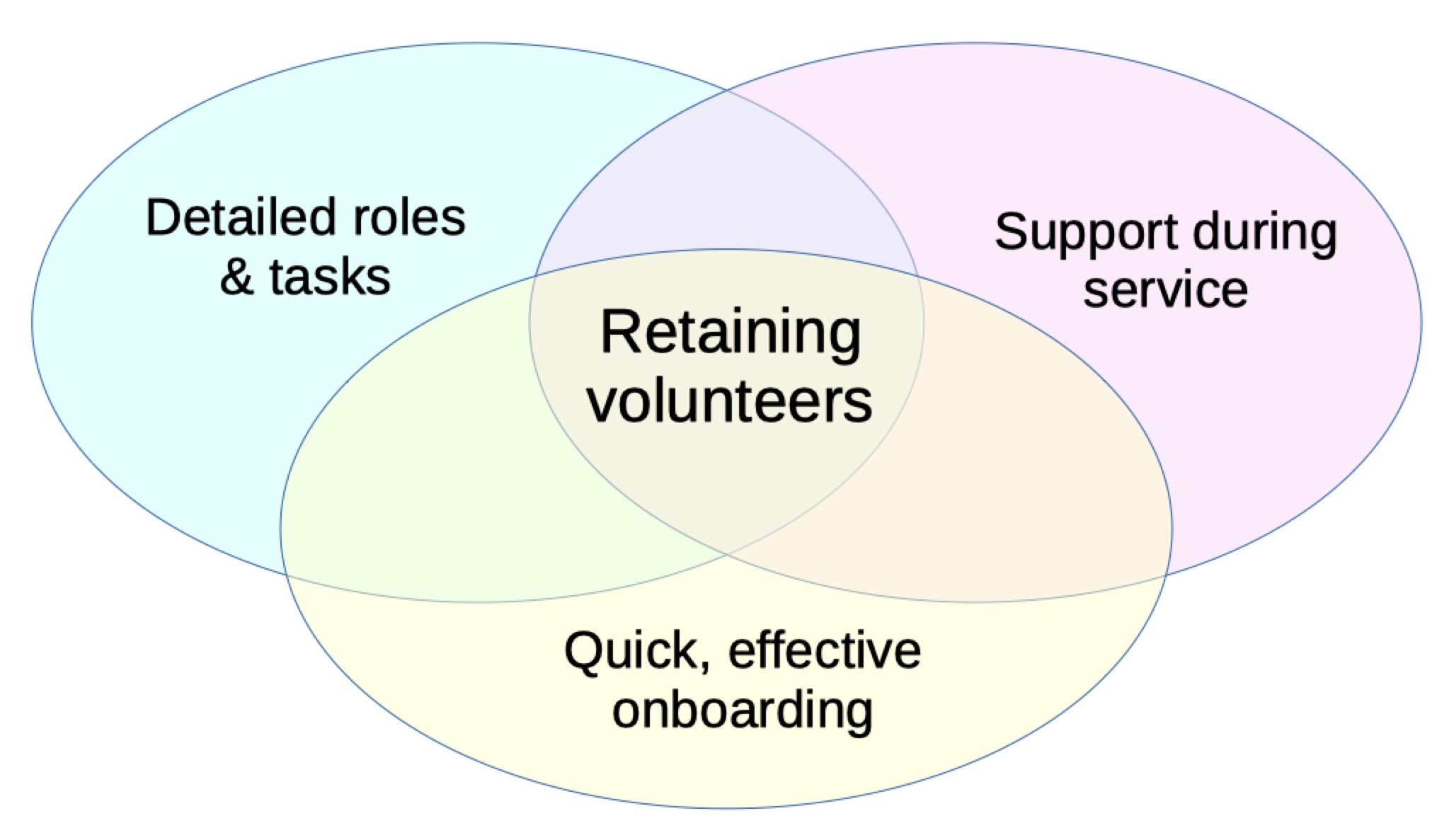
This graphic represents what I mean: if you have clear roles and tasks for volunteers, in writing, if you quickly onboard volunteers and ensure they are prepared for the role or task they will take on, and if you have excellent, appropriate support for volunteers during their service, you will retain volunteers:

And I believe that all of those functions frequently and regularly intersect – you cannot think of them as entirely separate activities.

If you aren’t retaining volunteers, if volunteers are leaving before they even start a task, or they are leaving soon after joining, the reasons probably lie in one of these three areas:

  1. they signed up to help but there was a big gap between that time and when you held your first meeting with them or got them started on a task,
  2. they did not have realistic expectations or understand what you expected because roles and tasks weren’t in writing, or
  3. they did not feel adequately supported or prepared for the volunteering role.

Another big reason for volunteers leaving is that they do not feel appreciated or that their service doesn’t seem to really be of value. I count that under support for volunteers, but you could certainly do an entire workshop just on that aspect of effective volunteer engagement (I certainly could).

Of course, the only way to know for sure is to ASK VOLUNTEERS WHO LEFT.

Also see diagnosing the causes of volunteer recruitment problems.

The principles of effective volunteer engagement, including identifying appropriate roles and putting them in writing, onboarding volunteers quickly and providing appropriate and regular support for volunteers are the basis for the recommendations detailed in The Last Virtual Volunteering Guidebook: Fully Integrating Online Service Into Volunteer Involvement. This is the most comprehensive resource anywhere on working with online volunteers, and on using the Internet to support ALL volunteers, including those you might not think of as “online” volunteers.

If you have benefited from this blog or other parts of my web site or my YouTube videos and would like to support the time that went into researching information, developing material, preparing articles, updating pages, etc. (I receive no funding for this work), here is how you can help.

Who needs a Volunteer Centre when we have the internet? (answer: we do)

Rob Jackson is a volunteer engagement consultant based in the United Kingdom. Rob was a manager of volunteers himself for many years, and his training and writing is based in reality and practicality. We met online back in the 1990s when he started UKVPMs, an online community for managers of volunteers in the UK, and have been colleagues (and good friends) ever since.

Rob wrote this on his Facebook page, and with permission, I’m reprinting it here on my blog:

image of a panel discussion

It’s time for a new way to think about local volunteering infrastructure.

In recent months I’ve read stories of how lockdown volunteering was especially effective where local groups (formal and informal) were connected to their local volunteering infrastructure organisations (Volunteer Centres).

This comes as no surprise to me. For six years I worked closely with Volunteer Centres as part of the team at Volunteering England. I’ve been a trustee of two Volunteer Centres in my time. I know their value and importance.

Yet too often local infrastructure is seen as either an encumbrance or an irrelevance. Why fund a Volunteer Centre when people can volunteer without them? Surely technology can do the work of a Volunteer Centre better than a human? Who needs a Volunteer Centre when we have the internet?

These arguments miss a crucial point. Volunteering infrastructure isn’t a building or office, a snazzy website or matching software.

Volunteering infrastructure is people. It is connections. It is relationships.

Cuts to Volunteer Centres may realise a quick financial saving, but it’s far more expensive to have to rebuild them down the line.

Volunteering infrastructure is a valuable investment in the underlying and enabling fabric of a thriving, vibrant local community.

It’s time we saw it that way and supported it properly.

Perfectly said, Rob. And not just for the UK. You can comment here, but please also comment on Rob’s original post if you are on Facebook.

If you have benefited from this blog, my other blogs, or other parts of my web site and would like to support the time that went into researching information, developing material, preparing articles, updating pages, etc. (I receive no funding for this work), here is how you can help