Tag Archives: roles

How to get a variety of staff to create roles for volunteers.

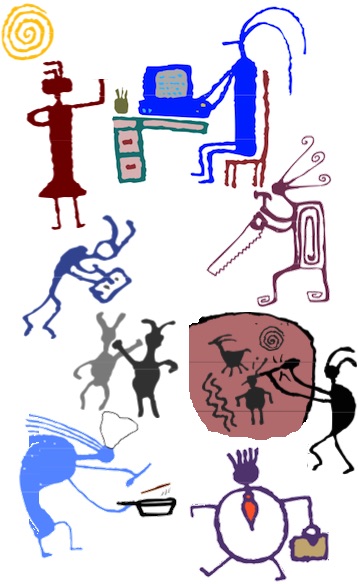
graphic representing volunteers at work

It’s controversial to say, but here it is: I believe that creating volunteering roles is NOT the primary responsibility of the manager of volunteers and that most volunteers should not be working just the manager of volunteers.

And working from this premise, it’s impossible for the manager of volunteers to create most of the roles for volunteers; it takes program staff and even administration staff, a mix of employees and leadership volunteers, to be the primary generators of volunteer roles.

Consider a community theater that produces live performances: a manager of volunteers at such a nonprofit wouldn’t recruit volunteers to help build sets without first talking to the person in charge of set building and that person defining what volunteers will do. Such a manager at a nonprofit animal shelter wouldn’t recruit volunteers to show up to walk dogs without first talking to the shelter manager and working out what training needs to happen, as well as a schedule.

And if these other staff members, whether employees or volunteers, don’t want to involve volunteers, the work of the manager of volunteers is, quite frankly, doomed to failure.

Now, here’s the kicker: how do you encourage, or even require, staff to involve volunteers in their work?

In more than 25 years of working with volunteers and researching volunteerism, I’ve seen what works and what doesn’t. I finally decided to write it all down – and now I have updated the resource on my web site about how to create volunteering roles to include advice on what it takes to get staff to involve volunteers in their work. Have a look and, if you have more advice, offer it in the comments on this blog or email me directly.

If you have benefited from this blog, my other blogs, or other parts of my web site and would like to support the time that went into researching information, developing material, preparing articles, updating pages, etc. (I receive no funding for this work), here is how you can help

What do volunteers do? The answer may surprise you

graphic by Jayne Cravens representing volunteersLast week, Rob Jackson and I published the results of a survey (in PDF) regarding software used by nonprofits, NGOs, charities, schools, government agencies and others to manage volunteer information. The purpose of the survey was to gather some basic data that might help organizations that involve volunteers to make better-informed decisions when choosing software, and to help software designers to understand the needs of those organizations.

But we learned some things that had nothing to do with software.

We asked a lot of questions that didn’t related directly to software, like about how many volunteers these organizations managed, as well as what volunteers did.

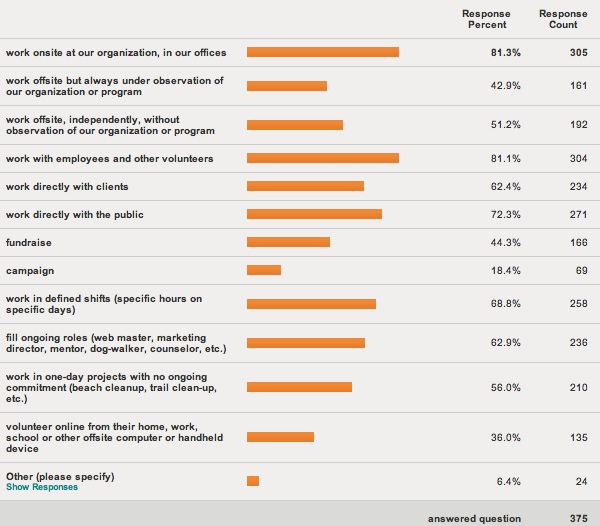
We expected the percentage of volunteers that worked onsite to be huge. We were very surprised, and pleased, to find, instead, that so many organizations that responded to our survey involved volunteers that:

  • worked offsite, with no direct supervision by staff
  • worked directly with clients
  • worked directly with the general public
  • worked online from their home, work, school or other offsite computer or handheld device
    (virtual volunteering, including microvolunteering)
  • engaged in on-off activities, like a beach cleanup – otherwise known as episodic volunteering

You can see the breakdown for yourself here:

chart grouping responses

We believe this diversity of responses is enough to bust the long-held stereotype that most volunteers work only onsite, directly under staff supervision, or that the vast majority of volunteers undertake long-term responsibilities, and that episodic volunteering or microvolunteering is a radical new, untested concept.

May we say goodbye to those stereotypes at long last? There’s no one way to involve volunteers – there never has been! Let’s recognize the reality of the diversity of ways volunteers are supporting organizations!

See the rest of the results of our survey (in PDF).