Tag Archives: immigrants

may non-citizens & non-green card holders volunteer in the USA? exploring the complicated answer

Someone who manages the volunteer program at a public library here in Oregon wrote me. She said:

Images, in the style of petroglyphs, of people doing various activities, like writing or construction.

I’m looking for input from the field about accepting the non working spouse/family member of an H1B Visa holder, as a volunteer. Because these people do not have social security numbers, our background check process can’t accept them. This is counter to our library mission “For Everyone” and seems to run counter to our sanctuary city status. HR/RISK says it’s an issue largely due to our city’s insurance coverage. I say, I’ve mitigated the Risk and volunteers are not in a position that places them one on one with any patron, staff, or other volunteer. I have also run across information that seems to indicate visa holding people may put their visa status at risk by volunteering. Wondering if you have any words of wisdom I can use to advocate for being able to include these folks who wish to share their time and talent with us, but can’t pass a standard background check. (Don’t get me started on background checks).

I’m going to share the advice I gave her here, edited to protect her identity and organization. Perhaps this might help others.

And I have to start with a disclaimer: I’m not a lawyer, I don’t have a law degree, and so none of this can be considered legal advice. 

In short: I think it’s absolutely fine to involve an HB1 Visa holder, and even someone here on a tourist visa, in volunteering at a nonprofit organization. But stay away from anything that could be seen as an unpaid internship (ongoing role), even for a student. And it gets even trickier with tourist visas.

Let’s get into the details:

How long has the person that does not have a social security number been in the USA? And in that time they have been in the USA, have they been in the same county and state? So, for instance, if the person has been in the same county for a year or more, then there should be a way to do a criminal background check with the sheriff’s department for the time they have lived here. The local police certainly have no problem arresting people without a social security number… but any check with local law enforcement would be for only the time the person has lived in that state. 

Another option depends on what country the person is from. With online volunteers in mentoring programs, I have asked international participants to provide a letter from their local police in the country where they live to say that they are a person in “good standing” – also called a “certificate of good conduct.” Depending on what country they are from, they may be able to get this through their embassy or consulate here, for the area where they lived previously. No police in any country in Europe had any problem supplying such. But I’ve never had to do it for anyone outside of Europe.

Here’s a UK resource that touches on this.

I also think asking for professional and academic references, and following up on those, is a good idea – no matter what country they are in. I did that as well and I’m happy to provide you with the questions I asked them.    

All that said… you should check with other libraries: maybe someone in the New York City or Chicago public library system, Atlanta, etc. And let me know what they say!

“I say, I’ve mitigated the Risk and volunteers are not in a position that places them one on one with any patron, staff, or other volunteer.”

RIGHT?!?! That should be enough! ARGH!!!

“I have also run across information that seems to indicate visa holding people may put their visa status at risk by volunteering.”

Here’s a resource from Dartmouth that can help.

And one from the US Department of Labor, which says “Individuals who volunteer or donate their services, usually on a part-time basis, for public service, religious or humanitarian objectives, not as employees and without contemplation of pay, are not considered employees of the religious, charitable or similar non-profit organizations that receive their service.”

and this also from the US Department of Labor, regarding unpaid internships (a no-no for people without work visas).

I read all of this as it being absolutely fine to involve this couple in volunteering. 

Volunteering can turn into a problem for foreigners in the USA, or trying to come to the USA, on a tourist visa, or “volunteering” (working for free) for a family or for-profit company, even via Workaway or whatever.

For instance, Australian traveler Madolline Gourley visited the USA multiple times over several years to cat-sit in exchange for free accommodation – she was never paid money. But this year, she was stopped while transiting through Hawaii to Canada. Officials at a USA airport determined that what she was doing amounted to unauthorized work. She was detained for hours, her visa waiver was revoked, and she was ultimately deported.

Rebecca Burke,, a graphic artist from Monmouthshire in England, was trying to cross into the state of Washington from Canada when she was refused entry. She was planning to stay with a host family where she would carry out domestic chores in exchange for accommodation. Canadian officials told she should have applied for a working visa, instead of a tourist visa. So she went back to Canada, applied for what she thought was the right visa, and then tried again. But when she tried to re-enter the US she was handcuffed and put in a cell before being taken to Tacoma Northwest detention facility in Washington state.

(Workaway warns users that they “will need the correct visa for any country that you visit”, and that it is the user’s responsibility to get one, but it doesn’t stipulate what the correct visa is for the kind of arrangements it facilitates in any given country. )

But what about people who are going to volunteer for an organization – not pet sit or house sit or garden or whatever in exchange for free housing?

That can be complicated as well.

A group of church volunteers from Canada heading south to do relief work in 2017 in New Jersey were denied entry to the USA for fear they would take American construction jobs. The 12-person contingent from Hamilton’s Rehoboth United Reformed Church intended to spend March break cleaning up and rehabilitating neighbourhoods affected by Hurricane Sandy.

U.S. border law says Canadians do not require a visa to enter the country for volunteer work, as long as they can provide proof that their work will not be compensated. The group was told they had failed to have a letter sent from the host church “paroling” them into the country. The border patrol officer told the group he would grant an exception and let them through if the host church managed to fax or email a letter right away.

When the first letter was deemed “not specific enough” by a border patrol officer, the group asked the New Jersey host church send another, being careful not to make any specific reference to construction. 

“In general, mission teams do team-building, tour mercy ministries of the church (food pantries, re-entry programs, thrift shops, etc) and assist with neighbourhood cleanup projects,” said the second letter. It was this last part that was interpreted as “work for hire,” says Hoeksema. Officers denied them entry after they had been stopped for more than two hours. The group was told that, as foreigners, they would be taking American jobs, and that there was no pressing need for relief work anyway this long after Hurricane Sandy hit the region in 2012.

A U.S. border spokesperson said the refusal came down to documentation. The official said groups doing humanitarian work need to provide documentation in advance from the municipality where the work is to be done stating what they will be doing.

Canadian media outlets reported also in 2017 that four Canadian senior citizens on their way to volunteer as ushers a performance of The Color Purple at the Fisher Theater in Detroit were detained, photographed, fingerprinted and eventually denied entry to the USA because non-American volunteers are only allowed to participate in religious or nonprofit events. The women, who had been volunteering for years at the theater, said they never had a problem before. The then USA Customs and Border Patrol Chief Ken Hammond told the Detroit Free Press that he can’t discuss individual cases for privacy reasons, but he referenced the Immigration and Nationality Act, stating that aliens volunteering in a program that benefits USA communities must establish that they are members of and are committed to “a particular recognized religious or nonprofit charitable organization.” 

The Fisher Theater is a FOR-profit (commercial) theater. Had it been a nonprofit theater, even with a for-profit Broadway touring show playing, they PROBABLY wouldn’t have been turned away at the border if they had been carrying a letter from the theater with their 501 c 3 number and a statement that this was a nonprofit organization, stated their mission, and they reserve usher roles specifically for volunteers as a part of their commitment to ensure the arts are accessible to more people.  

I have been telling people from other countries who are coming to the USA on a tourist visa but who might volunteer while here to say to the border enforcement folks that they are coming here as a tourist and to be absolutely open about all the places they plan to visit, and even say “I plan on attending the WHATEVEREVENT (cycling event, running event, motorcycle rally, etc.)”, but do NOT volunteer the information that they will be volunteering. Just emphasize how much they love cycling or running or motorcycling. And to make sure they do NOT have a post on social media saying, “Hey, I’m going to the USA to volunteer at the WHATEVEREVENT!” Carrying a letter from the organization where you are going to volunteer, stating that the organization is a 501 c 3 nonprofit, stating that the role you are doing is one they reserve specifically for volunteers, and with a statement as to WHY they do that (eg “we believe volunteer engagement is a way for people who care about such-and-such to be involved in this cause that they care about in a way that is more intimate and meaningful than merely attending the event”) can be helpful if you need to say that, as part of your traveling, you will be volunteering.

I am not encouraging anyone to do something illegal per the advice in that previous paragraph. But border agents in the USA make mistakes and currently are looking for ANY reason to turn foreigners away, or even arrest people trying to come into the country, including the wrong reason.

I’ve been telling people that are from other countries that are coming here to blog about their trip to either not come at all (there’s a pretty famous motorcycle blogger, Itchy Boots, who cancelled her US trip to promote her book because of the nonsense at the US border) or to NOT mention their YouTube channel or blogging when they are interviewed – emphasize you’re touring the US as a backpacker or whatever, period. 

— end —

Also see Welcoming Immigrants as Volunteers to your Nonprofit.

If you have other advice, please share it. Please cite sources – no “I think I heard that…”

If you have benefited from this blog or other parts of my web site and would like to support the time that went into researching information, developing material, preparing articles, updating pages, etc. (I receive no funding for this work), here is how you can help

Welcoming immigrants as volunteers at your organization

Disclaimer: this is not legal advice. I am not a lawyer. Any activity incurs risk. The author (me) assumes no responsibility for the use of information contained within this document.

December 17 2025 update: Note at the end of this blog information on how to protect volunteers from ICE raids. 

May 2022 update: This is from an Afghan refugee I know in Australia:

Hello Jayne, I am so happy as the past Saturday i was able to do a one day volunteering job for the election day. It was a nice experience and i also took my eldest niece with me. She was so happy and told me that she would love to do volunteering in the future as well. I couldn’t wait and wanted to write you. 

Original blog:

graphic by Jayne Cravens representing volunteers Volunteer engagement is so much more than getting work done: it allows the community to see, first hand, what a nonprofit or other mission-based organization or program does, it allows a nonprofit or government program to cultivate relationships with certain demographic groups it might not otherwise, it creates stronger ties between a program and the community, and it can contribute to community cohesion, bringing together different segments of a population in a setting that can help build relationships and understanding.

All of these reasons for engaging volunteers are why it’s a good idea for mission-based programs to explore ways to welcome residents who are immigrants as volunteers. You are missing out on a tremendous amount of talent and energy if you are excluding immigrants as volunteers, and such exclusion contributes to community divisions.

Immigrants might be long-term residents of a neighborhood or community, but they can feel on the margins of such, for a range of reasons. They often have children in the local school system, work in a local job, attend a local community of faith, pay taxes, are affected by the same social, political, economic and environmental issues as other residents, etc., but may not feel included or welcomed to volunteer in their communities. Just like other people, immigrants care about children, the environment, people with disabilities, safety, local prosperity, animals and more in the places where they live.

There is no law preventing an immigrant from volunteering with nonprofit organizations in the USA, and most local government agencies, including public schools, also aren’t prohibited by law from involving immigrants as volunteers. This is in contrast to federal agencies, where there are some prohibitions (more on that later).

Here are ways to make your organization more welcoming for immigrants living in your community. Note that this is USA-specific information, and, again, note that rules regarding volunteer screening and engagement can be different for nonprofit organizations versus federal agencies:

If your nonprofit organization or local government agency currently says on its web site or in other material that a volunteer must be a citizen of the USA, reconsider that requirement. Such a requirement excludes green card holders – legal permanent residents – among others. Why would you exclude green card holders from volunteering as, say, volunteer firefighters or tutors in the local school system? Think carefully about why you have certain citizenship or legal residency requirements for volunteers, and unless you can come up with a specific reason for this requirement – for instance, some roles require a multi-state criminal background check because the volunteer would be working with children or other vulnerable populations – consider changing that protocol.

According to this web site from the USA National Park Service, citizens of countries other than the USA are eligible to participate in federally-sponsored volunteer programs only if they are accepted for one of the Exchange Visitor Program categories through a designated sponsoring organization that is certified by the U.S. Department of State. Individuals who are not USA citizens but reside in here may volunteer with a federal agency if they are a lawful permanent residents (green card holders); or if they are non-immigrant aliens with F-1 or J-1 visa status, who are bona fide students residing in the USA to pursue a course of study at a recognized, approved institution of education. Again, these are rules for volunteering with federal agencies, NOT with local government agencies, like public schools, nor with nonprofit organizations.

Also, note that the US military allows certain undocumented immigrants to serve.

If your organization requires volunteers to provide documentation to prove their identity, then state on your web site and in orientations for new volunteers that, at least for some volunteering roles, this could be a driver’s license or passport from any country, not just the USA. You could also ask for a consular identification card, which is issued by some governments to their citizens who are living in foreign countries (they are not certifications of legal residence within foreign countries). If you require proof of a local residence and a local mailing address, ask for a utility bill or housing lease. You can also ask for references from employers or officials of the person’s community of faith. It is possible to do criminal background checks on immigrants without social security numbers: even with just a person’s name and date of birth, many county and state criminal databases will indicate if any applicant has had any prior arrests or convictions. Make it clear to applicants if you are going to do this with their information (submit it to local law enforcement). You may want to check with the law enforcement agency that does your criminal background checks to ask them about their policy for working with U.S. Immigration and Customs Enforcement (ICE); many law enforcement agencies will not turn over any information to ICE without a court order, and if they have this stated policy (these days, it will be on their web site if they have this policy), you can let your volunteer applicants know.

Some organizations, such as public schools, require that volunteers provide social security numbers so that a particular type of criminal background check can be conducted, and in many cases, that requirement cannot change because it is required by a state law. But what can change is volunteer roles that are offered. Could you create volunteer roles that don’t require a criminal background check, because a volunteer is never alone with children or other vulnerable populations? For instance, nonprofits that do beach cleanups don’t do criminal background checks of the participating volunteers, nor ask for their social security numbers. Habitat for Humanity does not ask for this information for volunteers participating in house building. Nonprofit theaters and performing arts centers rarely do criminal background checks on volunteer ushers, who show people to their seats before a performance. Could you create such volunteering tasks that don’t require criminal background checks, because the volunteers are always in groups, never one-on-one with a volunteer, client, member of the public, etc.? For instance, in a public school, you could set the rule that only volunteers with a social security number and valid state ID would be allowed unsupervised access to children, for such activities as tutoring and to chaperone field trips, but allow other volunteers without social security numbers (but are vetted in other ways) to create murals or help at in-classroom parties.

(and remember that keeping children and other vulnerable populations safe requires MUCH more than a criminal background check – see this resource for more information)

No matter what form of identification you ask for, state clearly on your web site and in your orientation for new volunteers that you will not sell, trade or give this information to any other agency, that only your human resources staff and head of the organization will have access to this information (no other staff should be able to go through volunteer – or paid staff – files), and that you will not give these records to any law enforcement agency without a court order. Also clearly state that you will not voluntarily release personally identifiable data or information to any law enforcement agency, and will not release information that may be used to ascertain an individual’s religion, ethnicity or race, unless for a law enforcement purpose unrelated to the enforcement of a civil immigration law and only with a court order – or with the volunteer’s permission. Explain your photo release policy carefully, and give all volunteers the right to ask that a photo of themselves be removed from your web site.

Note in your communications with new volunteer applicants that no staff member at your organization shall grant ICE or border patrol agents access to your facilities for investigative interviews or other investigative purposes without a court order. You may want to put this statement on your web site as well.

Except when compelled by a law or a specific written policy, there’s no reason for an organization to inquire into the immigration or citizenship status of anyone. Talk to all employees, consultants and volunteers about what they should and should not ask of each other – not just immigration status, but also things like income, property holdings, health conditions (“Are you disabled?!”), etc.

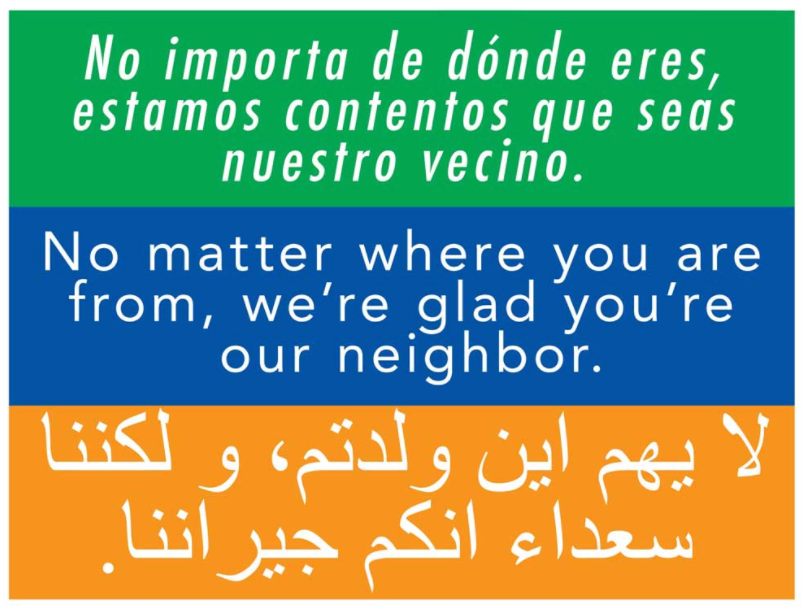
Consider posting a sign such as the one below at your entrance and in your lobby, to make it clear you welcome all people to inquire about volunteering, about client services, etc.:


A group of volunteers supporting the Charlotte-Mecklenburg Schools in North Carolina was assigned to find a way undocumented immigrant parents could volunteer in their schools. This article is about their struggle and this article is about what they finally ended up doing.

My only other caution regarding involving immigrants as volunteers would be involving such in unpaid internships. An unpaid internship is volunteering, just as virtual volunteering, skilled volunteering, pro bono services, microvolunteering, episodic volunteering, group volunteering and all the other forms of donated, unpaid service are. But internships are full-time experiences and meant specifically to give someone on-the-job training for eventual paid work. The US Department of Labor is concerned both with the protection of jobs for United States citizens, and views internships as jobs, even those at nonprofits.

On a different note: A federal judge granted class-action status to a lawsuit filed in 2014 claiming thousands of detained immigrants were forced to work for $1 a day or nothing at all while in custody of ICE at Denver Contract Detention Facility. The forced labor could be considered a violation of federal anti-slavery laws, according to the Washington PostJaqueline Stevens, head of Northwestern University’s Deportation Research Clinic, said the Denver facility violated the federal standards of volunteer work programs in which many detainees are required to participate. Stevens’ research prompted the original lawsuit. “Just slapping the word ‘volunteer’ in front of ‘work program’ doesn’t exempt the prison firm from paying legally mandated wages any more than McDonald’s can use ‘volunteer’ senior citizens and pay them Big Macs,” Stevens told the Washington Post.

October 14, 2017 addition: If your nonprofit organization says a prayer before meetings or events, says the Pledge of Allegiance to the USA flag, has trainings where recruits run behind a USA flag and chant, etc., and you want to be a more welcoming organization to both immigrants and people of a variety of religious and non-religious practices and political beliefs, you should reconsider those activities as official parts of your organization’s activities. If you are a religiously-affiliated organization, and state this as a part of your mission, then religious practices as a part of your organization’s activities are to be expected. If your organization is focused on patriotism or loyalty to the USA, and state this as a part of your mission, then nationalistic practices as a part of your organization’s activities are to be expected (remember:the US military allows certain undocumented immigrants to serve, and those service men and women most certainly run behind a USA flag – and know that expectation going in!). But if you don’t have such statements in your mission statement, and if you want to be a welcoming organization to a diversity of people, you need to rethink these religious and nationalistic activities – they might feel affirming to you and might give you pride regarding your own religion, beliefs or country affiliation, but they might feel exclusionary, uncomfortable – even xenophobia – to others, such as people who are from other countries and, while legal residents of the USA, aren’t citizens, people who are of a religion that disallows such ceremonial activities, people who are of a religion different than that from which the prayer comes, people who are not religious, people who have had negative experiences with nationalistic agendas, and on and on. See Making certain volunteers feel unwelcomed because of your language and Do you welcome people with your language? for more on the subject of being welcoming organization.

December 17, 2025 addition: In the USA, it is imperative that you keep immigrant volunteers, clients and employees safe from Immigration and Customs Enforcement (ICE), which has been documented frequently abducting people, many of whom have no criminal records and many of whom are in the USA legally. Among the things you can do: (1) Be aware that volunteers who are immigrants may need to cancel their volunteering shift within minutes of it starting, in order to stay safe. (2) Remove names and photos of volunteers who are immigrants from social media and your web site if you think there is any chance whatsoever of the information being used by ICE. (3) Encourage volunteers who are immigrants to check in with their families frequently, such as every time they leave any location and when they arrive at any location. (4) Have emergency contact information for all volunteers. (5) Have sections of your work sites clearly marked as “Staff only” and “This area is closed to the public”, and make sure all staff know which areas these are and the different ways to access them quickly. Anyone – including ICE agents – can legally enter public areas of your business without permission, but not areas marked “private.” (6) Train all staff on how to quickly warn everyone on the premises that ICE may be be entering the building or worksite (whistles are very effective) and how to direct people to private areas. (7) Train your staff to NOT TALK to ICE agents: they should NOT allow ICE agents to enter your workplace. A worker can say, “I can’t give you permission to enter. You must speak with my supervisor.” Practice – just like a fire drill. (8) Immigration agents can enter a private area ONLY IF they have a judicial warrant. A judicial warrant must be signed by a judge and say “U.S. District Court” or a State Court at the top. Without a judicial warrant, ICE agents need YOUR permission to enter private areas of your business. If ICE agents try to enter a private area, you should say: “This is a private area. You cannot enter without a judicial warrant signed by a judge. Do you have a judicial warrant?” If ICE agents tell you that they have a judicial warrant, ask for a copy and read it. Sometimes, ICE agents try to use an administrative warrant to enter. But an administrative warrant does NOT allow agents to enter private areas without your permission. Administrative warrants are not from a court. They say “Department of Homeland Security” and are on Forms I-200 or I-205. (5) Connect with immigration response networks in your area. Look at their social media and web site and if they have a workshop on dealing with ICE, go to it. Much of this advice was adapted from What to Do If Immigration Comes to Your Workplace from the National Immigration Law Center and the National Employment Law Project.  

Here are more resources from other organizations regarding immigrants as volunteers:

  • National Volunteer Week: How Much Do Immigrants Volunteer? “Volunteering has long been shown to bring stability to neighborhoods and increase the level of cohesion and bonding among friends and neighbors. In communities with large immigrant populations, these are particularly desirable attributes, and places like New York City have already increased efforts to incorporate immigrants into social and political volunteerism… Our analysis produced some interesting takeaways that can help advocates and community leaders inspire more immigrants to join organizations—and, in turn, get more out of their participation.” From the New American Economy Action Fund
  • Increasing Knowledge Related to the Experiences of Undocumented Immigrants in Public Schools. This article describes the experiences of school personnel working with undocumented immigrants in public schools and the opinions and attitudes of school personnel. It was published in Educational Leadership and Administration: Teaching and Program Development, Volume 24, January 2013, ISSN 1532-0723 © 2013 California Association of Professors of Educational Administration
  • Parental Involvement in Schools. “Students with parents who are involved in their school tend to have fewer behavioral problems and better academic performance, and are more likely to complete high school than students whose parents are not involved in their school. Positive effects of parental involvement have been demonstrated at both the elementary and secondary levels across several studies, with the largest effects often occurring at the elementary level. A recent meta-analysis showed that parental involvement in school life was more strongly associated with high academic performance for middle schoolers than helping with homework. Involvement allows parents to monitor school and classroom activities, and to coordinate their efforts with teachers to encourage acceptable classroom behavior and ensure that the child completes schoolwork. Teachers of students with highly involved parents tend to give greater attention to those students, and they are more likely to identify at earlier stages problems that might inhibit student learning. Parental involvement in school, and positive parent-teacher interactions, have also been found to positively affect teachers’ self-perception and job satisfaction.”

October 18, 2017 update: The Daily Mail in the UK has an article about volunteering by asylum seekers in Italy and how the practice has been both praised and panned. Some see it as an opportunity for asylum seekers to do something positive and break with boredom, some see it as exploitation of asylum seekers, and some see it as stealing paid jobs, because the asylum seekers are doing for free what people in Italy are usually paid for. Susan Ellis and Rob Jackson do a great job of exploring the issue in depth. My own thoughts: Just picking up trash together – but never interacting with local people – doesn’t help much in terms of integration of refugees. Couldn’t there be a volunteering action that brings together both local people and refugees? I am sympathetic to labor unions – there are politicians who will look for a way for volunteers to do what paid people are doing, so that they can cut funding – it does happen. But surely there are plenty of things refugees-as-volunteers can do that paid people aren’t doing? I can look around my own community right now and see all sorts of things refugees could so as volunteers that no one is being paid to do and that would most certainly help them integrate right here in this small Oregon town – I would imagine Italy could do the same.

Update December 1, 2017Young refugees keen to volunteer in Australia

Here are more of my resources on related topics:

If you have benefited from this blog or other parts of my web site or my YouTube videos and would like to support the time that went into researching information, developing material, preparing articles, updating pages, etc. (I receive no funding for this work), here is how you can help.

Volunteers Along Immigrant & Refugee Journey

refugeesLast year, e-Volunteerism, a publication by Energize, Inc. and Susan Ellis, featured an article about volunteers at the front lines of the ongoing refugee crisis in Europe, and how their impassioned scramble to help—though often inefficient and always insufficient—nonetheless addressed grave needs and sent a message to governments to respond. But the images of these orange-vested volunteers, often entirely self-funded and pulling refugees from boats and greeting them with blankets on Mediterranean shores, represent just a fraction of the diverse volunteer sector that serves the needs of immigrants and refugees worldwide. And these borders and shorelines are not the end of the journey; for the immigrants and refugees, they are where new journeys begin. While some immigrants’ first steps inside a country are more perilous than others, even immigrants who arrive safely at an airport are still plunged into uncertainty and vulnerability. Settling into a new life, a new job, new customs, a new language, and the new experience of being a racial, ethnic, or religious minority can often be a more daunting journey than getting to the country in the first place.

A new e-Volunteerism Voices article by Kerry Martin explores how volunteers engage with immigrants and refugees at every stage of their journey. It focuses on the current situation in the USA (which has relevant implications for other countries) by assessing the nature of volunteer services for three distinct groups: 1) refugees formally resettled through government and other authorized organizations; 2) recent immigrants (non-refugees) who are undocumented, at risk of losing their immigration status, or in need of support due to poverty, exploitation, abuse, etc.; and 3) refugees unrecognized by the U.S. and not formally resettled, primarily those fleeing from gang violence in Honduras, El Salvador, and Guatemala.

The full article is available to subscribers of e-Volunteerism and it’s worth subscribing to read this article!

Also see:

Reality Check: Volunteering Abroad / Internationally

Funding Your Volunteering Abroad Trip (& where to find credible volunteering abroad/work abroad programs)

How to Pursue a Career with the United Nations or Other International Humanitarian or Development Organizations, Including Non-Governmental Organizations (NGOs)

Vanity Volunteering: all about the volunteer