Tag Archives: humanity

Nonprofits, don’t cede creativity or curiosity or customer relations to AI, & keep your use of AI ethical

HAL from 2001 a space odyssey

I’ve been writing about how computer and Internet technologies can, and do, affect the work of nonprofits, NGOs, government agencies and other mission-based programs (as opposed to for-profit businesses) since the 1990s. I’ve been mostly a cheerleader for such, but also have tried to be realistic and to highlight cautions. So you shouldn’t be surprised that I have thoughts about AI and how it will, and is, affecting that work and those we serve.

I’ve warned about relying too much on the choices of Canva when creating designs. I’ve warned about ceding too much of your client interactions to AI. I’ve warned about how AI can have disastrous results when rewriting something.

And then there is the creative laziness AI seems to encourage. In an earlier blog I warned nonprofits to be careful using Canva, since their graphics are starting to all look the same. Here’s a new story about why reliance on Canva and similar AI graphic programs can be a bad choice: months ago, I had a volunteer from a high school who was supposed to create social media graphics in association with various holidays for a nonprofit I worked for. He turned in designs that were obviously the first template choice offered by Canva, with just our nonprofit logo and a date inserted somewhere – no other alterations at all. He supposedly had taken a marketing class that included learning graphic design basics, but seemed flummoxed when I talked about the need for color contrast, easy-to-read fonts, and the importance of ads being readable without someone having to have glasses. And don’t even get me started on Canva’s profound lack of diversity among its human images in terms of ethnicities, body types and ages. I ended up having to alter all of his work – spending more time on the task, not less.

Using AI-powered chatbots for schoolwork is undermining opportunities for young people to learn skills such as analyzing text, elaborating syntheses and writing coherent narratives. The writing process stimulates thinking, scrutinizing and self-improvement, tasks that all people should learn. But when it is
outsourced to AI, people not only don’t have that stimulation or mental improvement, the reduction in cognitive effort can reduce memory retention and diminish learning and cognitive abilities (cited in the Human Development Report on page 73 and in Blanchflower, D. G., Bryson, A., and Xu, X. 2024, “The Declining Mental Health of the Young and the Global Disappearance of the Hump Shape in Age in Unhappiness.” Working Paper 32337, National Bureau of Economic Research, Cambridge, MA).

I’m working with someone right now who uses AI to write all of his emails and reports. These never provide me with the information I need – information I always got when his predecessor wrote the reports and emails herself (and in MUCH shorter form). For some reason, AI always deletes out the essential info I need for marketing efforts.

AI is determining what we see online, and hiding what someone or a company has decided they do not want us to see. Content is being curated, sorted and ranked by machine learning based on the desires of one person or a company, often with users not having any idea that this is happening. I’m using two and three different search engines whenever I do research, because the results are always so different.

AI-written text is showing up with hallucinated facts across the Internet landscape and creeping into the people and government’s decision-making. And if AI is leveraged to degrade human rights or coerce people to believe a lie or harm others, it’s NOT an ally. It’s easy to find examples of this all over the Internet.

I blogged what I feel are highlights from the 2025 Human Development Report from UNDP – the theme is artificial intelligence. It’s worth noting that I do highlight positives regarding AI – because there are positives.

We live in a world where trust and credibility is more important than ever before. We’re going to lose more of that if we keep ceding creativity, curiosity and human interactions to AI.

There are a lot of companies who are now telling their employees that they are not allowed to suggest the creation of any new positions – paid staff or consultants – unless they can prove AI could not do most of that job. That means the elimination of graphic design positions, receptionists, data analysts, social media managers, consultants brought on to create and design special products (annual reports, specific marketing campaigns) and managers of volunteer programs who spend most of their time reviewing applications and screening new volunteers. Yes, AI can do all of those jobs – but not well, and not to the standards nonprofits need. As more and more people are using AI to both summarize texts and write emails and reports as well as reading those texts and emails and reports, humans are less and less involved – thereby missing trends, insights and potential challenges, while clients and customers become more and more frustrated trying to get answers to questions and help to solve problems.

A way to counter this AI use demand by management: be able to say, right now, how you are leveraging AI in your work. Show that you are already using it to save money, such as grammar correction programs, graphic design programs, donor data analysis, volunteer data analysis, translating and news alerts regarding certain topics. But then also show why you hold on to certain tasks, like interacting with clients in real-time, because cultivating and sustaining trust with various stakeholders.

What I find fascinating in this push for nonprofits to use AI is that a much better strategy is to push nonprofits to engage more volunteers, thereby doing what AI cannot: engage with the community more, cultivate more supporters, and build more awareness and understanding about the nonprofit and the cause it addresses.

One last thing: if you use AI in any communications, DECLARE IT. If you write an email to someone and you used AI to create that email, declare it. Declare in any online or offline publication if the material was created or authored, primarily, by AI. If you publish a blog that has content that was, even in part, created by AI, say so. “Some of the content of this article was created using AI.” Affirm if an article or blog is written by a human: give credit to the person or people responsible for such, by name.

If your nonprofit has a chatbot for clients, be clear that the chatbot is not a human, that it’s AI. Many people do NOT understand that a box with a human image that says, “Hi, how can I help you?” is not a human.

I have an affirmation on my web site that my web site is created & managed by a human. Consider doing the same on your own web site (but only if it’s true).

Also see

Artificial Intelligence – friend or foe for nonprofits?

schedule social media posts? use with caution

No app can substitute for actually talking with people

If you have benefited from this blog or other parts of my web site and would like to support the time that went into researching information, developing material, preparing articles, updating pages, etc. (I receive no funding for this work), here is how you can help

Ensuring cultural & social interactions: as important as water, food & shelter.

ACAPS is a nonprofit, nongovernmental project founded in 2009 with the aim of conducting independent, groundbreaking humanitarian analysis to help humanitarian workers, influencers, fundraisers and donors make better-informed decisions. ACAPS is not affiliated with the UN or any other organisation, allowing it to be a more neutral, critical voice regarding such initiative. ACAPS is overseen by a consortium of three NGOs: the Norwegian Refugee Council, Save the Children and Mercy Corps.

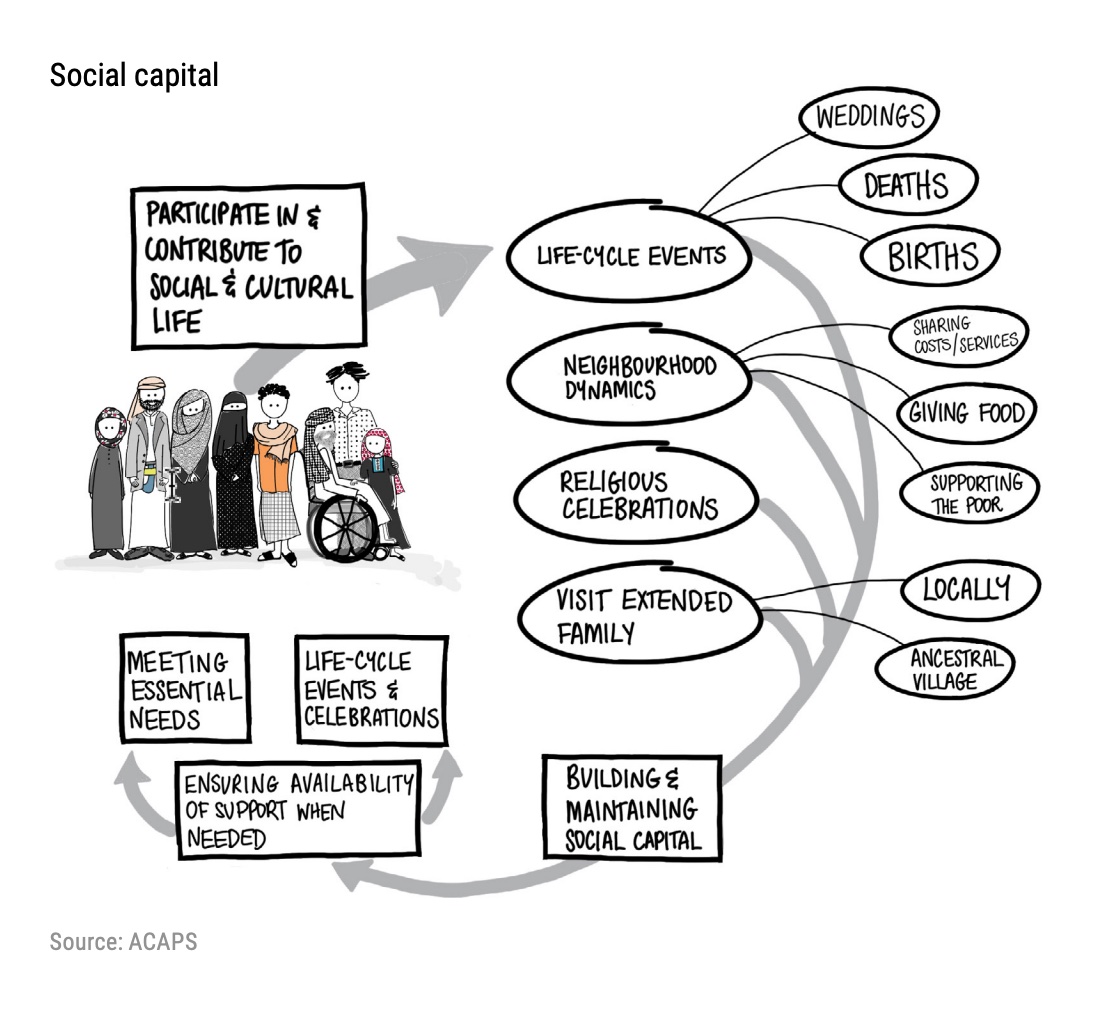
ACAPS published a report in May 2022, Life goes on in Yemen: Conversations with Yemeni families as the war nears its eighth year, that illustrates why humanitarian response cannot be just about providing water, food and shelter, and why it’s a mistake for charities to limit their communications with donors to only these needs. Water food and shelter are often called “basic needs”, but the reality is that social interactions, cultural practices and trust in the strength and work of institutions are all a part of basic human needs as well. The report is about Yemen, but it applies to every country.

This image is, to me, oh-so-powerful – and applies to every community, not just Yemen:

An image of a family as a part of a cycle that includes life-cycle events like weddings, deaths, births, etc., and the essential nature of having a social and cultural life.

This excerpt from the report is a good summary of what the image and the entire report is trying to say:

This research serves as a reminder that Yemenis are interested in more than just the satisfaction of their essential needs (such as water, food, and shelter). It highlights the diversity of households and the creative ways people adapt to economic challenges and accommodate long term strategic needs. Yemenis continue to participate in life-cycle events, celebrations, and social obligations. Having a social life maintains and creates networks and connections that build social capital, enhance the quality of life, and form the support network people can rely on when they most need it. Understanding the key role social capital plays in Yemeni life highlights that social capital is something built, maintained, stored, and used in a continuous cycle. Connections are important, but social capital is the glue that keeps these connections alive. When Yemenis keep celebrations modest by inviting fewer guests or keeping events shorter, they build less social capital. Similarly, they lose social capital when they hold fewer gatherings or visit extended family in their ancestral villages less.

So many people want to volunteer and/or donate financially to help people experiencing extreme poverty caused by social injustice, historic oppression and inequities and armed conflict. That should continue to be encouraged and cultivated – but people also need to understand that community development is every bit as important as charity and the provision of water, food and shelter.

Shout out to the Aidnography blog for bringing this to my attention.

Also see:

Decolonizing International Aid (including international volunteering).

humanitarian stories & photos – use with caution.

Extreme poverty is not beautiful.

Advice for teaching children compassion & understanding instead of pity with regard to poverty.

Nope, volunteering is not always inherently “good”.

the growing youth & loneliness crisis (& lack of empathy crisis) – could volunteer engagement help?

The results of a nationwide survey by the health insurer Cigna released last year said that nearly 50 percent of respondents in the USA felt alone or left out always or sometimes. Two in Five felt like “they lack companionship,” that their “relationships aren’t meaningful” and that they “are isolated from others.” And the loneliest demographic among respondents was young people: members of Generation Z, born between the mid-1990s and the early 2000s, had the highest loneliness score, followed by Millennials. Yesterday, CBS Sunday Morning did segment that mentions this Cigna study and on the growing loneliness epidemic in the USA.

And then there is this report: significantly large numbers regarding unemployment among young people worldwide: in 2017, it was reported by CNN Money that youth unemployment in the eurozone has been stuck between 19% to 25% for the past eight years. In Spain and Greece, it’s north of 40%. The number of people in Italy aged between 15-29 years that are not in education, employment or training rose by 21 percent from 2008 to 2012, to 23.9 percent, and that number hasn’t improved seven years later. In Arab states, youth unemployment is around 30%. The incidence of unemployment among youth in Northern Africa was at 29.3% in 2016, representing the second highest rate across all regions.

Economists and government officials focus on the cost of unemployment to the economy as a whole, but for the unemployed, it’s a personal issue. Young people need jobs for the obvious reason: they need income to give them employment to pay for what they need to survive, day-to-day. But studies have shown that prolonged unemployment harms the mental health of workers and can actually worsen physical health and shorten lifespans as well. Prolonged unemployment can lead to an erosion of skills and, more worryingly, lead to pessimism, resentment and anger. Those negative feelings can be targeted at anyone that an unemployed person blames for their situation – people not from the area, people who are perceived as not at risk for unemployment, people perceived as taking the jobs the unemployed want, government officials, institutions, and anyone who is perceived as different.

While promoting volunteer engagement does nothing to address the immediate financial needs of the unemployed, volunteering can help a person with skills development for a career change and eventual employment. Could volunteer engagement also address other issues, like disconnection from society, resentment and anger for certain groups of people, like immigrants or ethnic minorities, and growing distrust in institutions? Can volunteering can give a person a connection to other people and to society as a whole, help increase their awareness about people and cultures different from their own and help build or restore trust in people and institutions? I think so, though there’s little data that directly supports my position.

When an organization involves volunteers, it gives non-staff a first hand, in-person experience with programs that are trying to improve the community or the environment – anything from promoting the arts to helping children’s education to accommodating dogs and cats that have been found or surrendered. This volunteer engagement can help build trust in organizations, in institutions, in the community and among people. It can give a volunteer a sense of value and influence. Volunteer engagement can play a vital role in building social cohesion and intercultural understanding, bringing together different segments of a population in a setting that can help build relationships and community. Volunteer management is community engagement and, as such, I believe volunteer engagement can help to address youth unemployment, cultural conflicts, intergenerational misunderstandings, integration, community cohesion, social integration, and on and on.

However, I’m not at all calling for business and government to start yet another Get-Out-And-Volunteer campaign. Please, don’t do that. Rather, this is a call for business and government to realize that, if they expect nonprofits, NGOs, charities and other organizations to involve more young people as volunteers, they need to provide the funding for that to happen.

Volunteers are not free. I just don’t know how many times I’m going to have to say that for it to finally be understood. For organizations to involve volunteers effectively, to involve more volunteers and to create opportunities for volunteers that go beyond just getting work done but also to build civic engagement and greater trust in the community, these volunteer-involving organizations must have the expertise to do it – which may come from training (which isn’t free) or hiring staff (also not cost-free) – and they may need additional resources to support additional volunteers, such as software or physical spaces.

Are corporations, governments, foundations and individual donors ready to step up and fund what’s needed to increase volunteer engagement, especially among young people?

April 16, 2019 update: Since the late 1960s, researchers have surveyed young people on their levels of empathy, testing their agreement with statements such as: “It’s not really my problem if others are in trouble and need help” or “Before criticizing somebody I try to imagine how I would feel if I were in their place.” According to this NPR article, Sara Konrath, an associate professor and researcher at Indiana University, collected decades of studies and noticed that, starting around 2000, the line starts to slide and young people are becoming less empathetic: more students were saying it’s not their problem to help people in trouble, not their job to see the world from someone else’s perspective. By 2009, on all the standard measures, Konrath found, young people on average measure 40 percent less empathetic than the previous generation. Again: could volunteer engagement help? Could exposing young people to those different from themselves help? And are corporations, governments, foundations and individual donors ready to step up and fund what’s needed to increase volunteer engagement, especially among young people?

July 16, 2019 update: US Teen and the number of suicide deaths among young people began climbing around 2008 and reached a new high in 2017, according to the Centers for Disease Control and Prevention. Suicide rates lately have been increasing in all age groups in America, in almost every state. The number of teens diagnosed with clinical depression grew 37 percent between 2005 and 2014. And suicide attempts are on the rise as well.

July 27, 2025 update: The headline proclaims Americans under 30 are so miserable that the U.S. just fell to a historic low ranking in the annual World Happiness Report. “If you were only to assess those below 30, the U.S. wouldn’t even rank in the top 60 happiest countries, the report finds.” It’s not at all a surprising finding: people are increasingly on their own, isolated from interactions with others. People are wearing headphones when and if they walk, listening to music or talking to someone, and not greeting anyone they pass, or talking to anyone when they stop. There are far less of us in face-to-face situations with other community members having any sort of shared experience, like watching a movie, attending a local sports event, participating in a pick-up basketball game, and on and on. Many students are taking classes from home rather than going into an actual classroom. And many young people aren’t volunteering, though they would like to do so, if posts to r/volunteer on Reddit are any indication; rather, they are being turned away, or are so sensitive to guidance that they feel like it’s criticism.

Also see:

Welcoming immigrants as volunteers at your organization

Internet-mediated volunteering – the impact for Europe“, part of the ICT4EMPL Future Work project. This 2013 study on virtual volunteering in European countries includes information on volunteering as a path to employability and social inclusion, especially for young people.

Volunteering to Address Your Own Mental Health (Depression, Loneliness, Anxiety, etc.)

Deriding the monetary value of volunteer hours: my mission in life?

can volunteer engagement cultivate innovation?

Volunteer management is community engagement

hey, corporations: time to put your money where your mouth is re: nonprofits & innovation

Corporations: here’s what nonprofits really need