
by Jayne Cravens
via coyotecommunications.com & coyoteboard.com (same web site)
From February 2001 to February 2005, I had the honor of
directing the United Nations
Online Volunteering service. It was originally hosted at NetAid
and was co-managed by Netaid staff in New York City and staff at
the UN Volunteers program in Germany. After joining UNV in
Germany, I worked to move the service entirely to the ownership
and management of UNV, which happened at last in early 2004.
When I took over directing UNV's support of the Online
Volunteering service, there were a LOT of people signing up to
volunteer, but not many organizations were using the service.
Therefore, online volunteering wasn't really happening.
I knew, per my experience directing the Virtual
Volunteering Project, that recruiting people that want to
volunteer online is oh-so-easy, but that getting organizations
to create assignments for online volunteers, and then for those
organizations to provide appropriate guidance and support for
those online volunteers, was a substantial and ongoing
challenge.
A selection of stories profiling both volunteers and the organizations they helped all over the world that are no longer available on the OV service. These are not all that were published on the site - all can be found via earlier versions of the OV site at archive.org. This was done as much to show organizations what effective engagement of online volunteers looked like as to honor these volunteers:
On Saturday, 27
October and Sunday, October 28, 2001, UN Volunteers joined
CERN in Geneva and online to celebrate UN Day and the increasing
role of online technologies in humanitarian work, including
virtual volunteering. I was the remote host from Bonn, Germany.
My event was on Saturday, and I interviewed Nicolas Fleuri, Sean
Osner and others involved in UNITeS
initiative in Jordan. On Sunday, the event featured a
broadcast of live events in Geneva, including the head of UNV,
Sharon Capling-Alakija in Geneva interviewing World Wide Web
inventor Tim Berners-Lee in Boston. The host was Paola Catapano
and featured a rollicking performance of the song "Surfing on
the Web" by Les Horribles Cernettes.
During the event, Berners-Lee talked about the key role online volunteers played in the development of the web. During the two-day event, three online volunteers recruited via the UN's Online Volunteering service facilitated an online discussion about the Global Digital Divide, "Tech for Humanity", and ICT4D. Note that most of the links in these PDF files, which I downloaded from archive.org, will NOT work. The videos are, unfortunately, long-gone; according to CERN, they outsourced the video web hosting in 2001, and the company, the Orbigate.net streaming portal/Orbital & Cie, went under.
I spent about 60 to 75% of my time directing the UN's Online
Volunteering service. The rest of my time was spent creating
content for and managing the web site of the United Nations Technology Service
(UNITeS). Most of my time on the OV service was spent
writing guidance for NGOs on engaging with and supporting online
volunteers and promoting the service both internally and
externally (for reasons I will never understand, when UNV got a
new head of marketing, she told me flat out that it was not her
job to promote the OV service). As I noted earlier, I did
nothing to promote the service to potential online volunteers:
all of my focus was on recruiting organizations to post
opportunities to the site.
Various UN agencies promoted the site within their own web
sites; this collaboration was essential in getting the word out
about the site.
I also secured the URL onlinevolunteering.org, and
having that URL I believe played an essential role in almost
instantly getting a huge number of visitors to the site right
after launch.
There was also an unpaid intern who would be in charge of
reading and responding to every email from people using, or
trying to use the service, using responses I had written. This
role changed every six months, but it was easy to get the intern
up-to-speed regarding what most emails would be asking and how
to respond. Could an AI-powered chat bot do this job now? Much
of it, yes, but we humans regularly learned so much by reading
the questions people trying to use the service had and their
quesitons and suggestions were essential for continually
refining the service.
Our department had a web developer who split his time between managing the OV service and UNITeS. He spent a great deal of time developing the site when it came over from NetAid, and we had the intern, various online volunteers and staff from our unit test the site regularly before launch.
I offer this information to show just how little staffing it
took to host and manage this wildly successful global program -
however, being a part of a global network like the United
Nations eliminated a lot of marketing needs that another
platform would need.
In 2016, UNV removed support materials for users of the OV
service, or at least made them unavailable for unregistered
users. It was a stunning development, one that no doubt
adversely affected the quality of online volunteering
opportunities, the support for online volunteers and the
experience of both volunteers an host organizations. Word from
colleagues inside UNV said leadership was ready to let the
online volunteering service fade away.
Then, in October 2019, UNV stopped accepting any new hosting
organizations, limiting the service only to organizations that
already registered. Then, UNV posted this message on its OV web
site: "Effective 1 January 2020, the Online Volunteering service
is free of charge to all eligible partners. Eligible partners
are: UN entities, Governmental or other public institutions, and
Civil Society Organizations." But if you clicked on the link for
more information, you discovered that UNV has a VERY narrow
version of civil society organizations (CSOs): it had to be a
CSO already registered with the OV service, or the organization
has to provide evidence of accreditation with the Economic and
Social Council (ECOSOC), or the organization has to be working
with a UN Country Team as an implementing partner or through an
agreement and submit a form signed by the UN Entity they are
partnering with.
It was a really sad time for online volunteering. Support for
it within UNV had crumbled. It's days were numbered.
Then, in October 2021, UNV did something I never expected: it
launched a Unified Volunteering Platform and Unified
Conditions of Service. This new volunteer recruitment platform
brought together UNV’s onsite UNV assignment recruitment and its
recruitment of online volunteers into one place. Via this new
unified platform, organizations can request services of both
onsite and online volunteers, and candidates can apply for both
onsite UN Volunteer assignments and online assignments. It is
the single-entry point for all UNV partners – from candidates
for onsite and online volunteering to donors, funding partners
and UNV personnel and partner organizations.
In my time at UNV, I had fought the then-head of volunteer
services to incorporate online volunteering into her work, and
she refused outright. And as I noted earlier, the marketing
manager refused to do any promotion of the online volunteering
service as well. And here we were, 20 years later, and UNV was
at last embracing online volunteering at every level! As
I blogged at the time:
I love that UNV now, at last, sees its online volunteering engagement as part of its overall volunteer engagement. I would love to know how it happened! But this change, this unified platform, comes at a big cost: UNV no longer allows any nonprofit or NGO that’s working on behalf of the developing world to recruit online volunteers via its platform. The only organizations allowed to use the platform to recruit online volunteers are “eligible partners”: UN entities (UNICEF, UNDP, UNESCO, etc.), those with accreditation with the Economic and Social Council (ECOSOC), or an organization working with a UN Country Team as an implementing partner. That means small NGOs who don’t have a formal partnership with UNV or aren’t working with a UNV in the field are now locked out of the platform for recruiting online volunteers... (but) ultimately, it’s the right decision, because it means UNV now makes it clear that ALL of the volunteering it facilitates, including online volunteering, must be in support of the goals of communities in developing countries, and must have real impact – it must put the needs of the communities first.
I will never know what change in leadership and other staffing led UNV away from dismantling the Online Volunteering service and, instead, fully embracing and promoting online volunteering again. But I'll always be grateful and happy about it.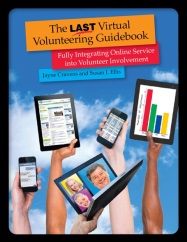
The Last Virtual
Volunteering Guidebook
available
for purchase as a paperback & an ebook
 my web site home page my consulting services
& my workshops &
presentations my credentials & expertise my research projects my book: The Last Virtual Volunteering
Guidebook How to Support
This Web Site & My Work (or to say thank you
for such) contact me or see my schedule My Resources for Community Outreach, With & Without
Tech
my web site home page my consulting services
& my workshops &
presentations my credentials & expertise my research projects my book: The Last Virtual Volunteering
Guidebook How to Support
This Web Site & My Work (or to say thank you
for such) contact me or see my schedule My Resources for Community Outreach, With & Without
Tech My Resources for Nonprofit, NGO & other
mission-based management My Technology Tips for Non-Techies My Advice for Web Development, Maintenance,
Marketing for non-Web designers My Resources For people & groups that want
to volunteer linking to or from my web site &
view this web site's privacy
policy. Coyote Helps Foundation
My Resources for Nonprofit, NGO & other
mission-based management My Technology Tips for Non-Techies My Advice for Web Development, Maintenance,
Marketing for non-Web designers My Resources For people & groups that want
to volunteer linking to or from my web site &
view this web site's privacy
policy. Coyote Helps Foundation how to support my work & this
web site
how to support my work & this
web site 





Disclaimer: No guarantee of accuracy or suitability is made by the poster/distributor. This material is provided as is, with no expressed or implied warranty.
Permission is granted to copy, present and/or distribute a limited amount of material from my web site without charge if the information is kept intact and without alteration, and is credited to:

Otherwise, please contact me for permission to reprint, present or distribute these materials (for instance, in a class or book or online event for which you intend to charge).
The art work and material on this site was created and is copyrighted 1996-2026
